
Home / Hayati Pro Max Plus Pods / Blue Razz Lemonade Hayati Pro Max Plus Pods
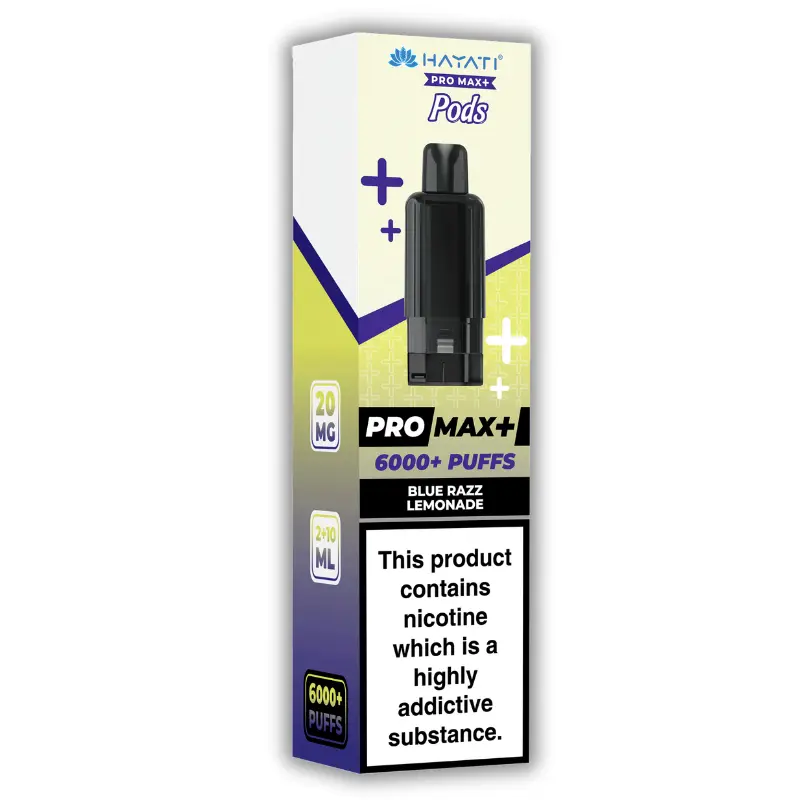
Hayati · Pro Max Plus
Blue Razz Lemonade Hayati Pro Max Plus Pods
£5.49
✔ In stock — ready to ship
Genuine Hayati
Free over £20
Same-day dispatch
Secure checkout
Blue Razz Lemonade Hayati Pro Max Plus Pods is the refill on its own: one prefilled pod, twelve millilitres of liquid at 20mg nicotine salt, £5.49, and nothing else in the packet. You are here because the device question is already settled and the only thing left to decide is what goes in it. Hayati describe the liquid as candied blue raspberry underneath a tangy citrus lift, and they put the ratio at roughly half sweet and half sour.
There is one more line in that listing, and it is the reason this page exists in the form it does. Hayati finish their flavour paragraph by saying the blend stays bright across the whole pod. That is a claim about duration rather than about taste, and it is unusual. I read the flavour copy on all eighty-nine listings on the Hayati Pro Max Plus Pods shelf and only seven of them assert that the flavour holds up over the run of a pod at all. This is the only one of the eighty-nine that measures the claim in pods rather than in puffs or in sessions.
A duration claim is the one kind of flavour copy that has a decision attached to it. If the blend really does hold its shape until the liquid is gone, you empty every pod, your effective cost is the sticker price divided by twelve, and you can order in quantity without thinking about it. If it does not, there is a point somewhere before empty at which you are no longer vaping what you bought, and everything after that point is money spent on something else. Where that point sits decides how many of these to have in a drawer.
So this page is about replacement cadence rather than about whether you will like the flavour, though it does the flavour work too, because no other page on this site has. It takes Hayati's duration claim seriously, asks what it would look like if it failed, works out what the failure would leave you holding, and prices the decision. Along the way it corrects two things it was set up to assert, because both turned out to be wrong when counted.
Four arguments already on this site that I am not going to rebuild
This liquid is new to the site. There is no bottle page for it and, unusually for a bare pod, no kit page either, so the flavour analysis below is the first one and it is done properly rather than skipped. The surrounding reasoning is a different matter. Four pages already own pieces of what a cadence argument needs, and rewriting any of them in my own words would be worse than pointing at them.
The Berry Lemonade pods page works out why an acid-led blend declines the way it does. Its finding is that a citrus edge rides on the lightest material in a liquid and is the first thing a residue-loaded coil stops lifting, so a lemonade does not get weaker on its way down, it turns into a different and blander liquid, and it does so while there is still plenty left. That is the mechanism this page depends on and I did not discover it.
The Blackcurrant Lemonade Hayati Pro Max Plus Pods page settles what the word Lemonade is doing in a Hayati title. Its answer, reached by reading all nineteen listings that carry the word, is that Lemonade is a coordinate rather than a recipe: it says the named fruit is held below the ceiling it would reach alone, and that a citrus sharpness the fruit cannot generate by itself has been added on top. It also establishes that none of the nineteen ever introduces a third fruit. Take both findings as given here.
The T-Misu pods page separates the two things that make a pod seem to be dying. One is happening in you and reverses if you stop; the other is happening on the coil and does not. Both push the draw the same way, which is why they feel like one steep decline, and its three-day rest test tells them apart. Anybody acting on the retirement signal described below needs that test first, because the signal and the false alarm look identical from inside.
The Blue Razz Fruit Twist Hayati Pro Max Plus Pods page builds the record you would keep to find your own answer: four short readings per pod, anchored to how far down the pod is rather than to the date, with the reason for retirement written down alongside the moment of it. It also, and this matters below, names this liquid by name and predicts the opposite of what I was sent here to argue.
The claim I was handed, and the three counts it did not survive
The brief for this page arrived with a specific argument in it, and honesty about what happened to it is more useful than quietly writing something else. The argument was that the lemonade half is the volatile half and therefore goes first, that a tiring Blue Razz Lemonade pod does not taste burnt but quietly reverts to plain blue razz, and that this matters more here than anywhere else on the shelf because a reverted pod becomes a duplicate of something the buyer could have bought instead. Three parts, and they did not all hold.
The first count: the shelf arithmetic is right
Seven listings on the eighty-nine-pod shelf are built on blue razz. They are this one, Blue Razz Fruit Twist, Blue Razz GB, Blue Razz Pineapple, Blue Razz Cherry, Blue Razz Mojito and Blue Razz Blackcurrant. That is one in every twelve or so listings on the shelf sharing a base, which is the heaviest concentration on any single flavour there. The figure in the brief was correct and I checked it because the house rule here is that a rarity claim gets counted before it gets repeated.
The second count: there is no plain blue razz to be a duplicate of
The claim that a reverted pod becomes a duplicate of something you could have bought instead is the part that fails, and it fails cleanly. Forty-eight listings in this catalogue of four hundred and ninety-two carry blue razz in the title, and they resolve to eighteen distinct flavour-name strings. Not one of the eighteen is blue razz on its own. Every single one pairs it with a second thing, whether a fruit, a gummy-bear treatment, a mint or a partner flavour behind a collar. Hayati have never put a bare blue razz on sale in any format, at any volume, on any platform.
So the residue is not a duplicate. It is something stranger and, for a cadence argument, more interesting: it is the common property of a seventh of the shelf, sold nowhere by itself. You cannot buy it deliberately and you cannot avoid it either, because every blue razz listing has it underneath.
The nearest thing you could actually put in a basket is Blue Razz GB, whose own copy calls it the sweet-toothed option among the blue raspberry refills, blue raspberry pushed further towards confectionery with a rounded, sugared finish and less sharpness than the sour blue listings. That is an approximation rather than a match, because GB has been deliberately sweetened past plain, but it is close enough to make the point with. It sits on the same shelf and it costs the same £5.49. I have narrowed the claim to that and the narrowed version is the one the rest of the page uses.
The third count: I cannot assert that the lemonade goes first
This is the part that needed the most correction. Blue Razz Lemonade is sold three times over in this catalogue, as this pod, as the Blue Razz Lemonade Hayati Pro Max Plus Pod Kit at £7.99, and as a 10ml bottle in the Pro Max nic salt line at 10mg. Hayati wrote fresh copy for each. Line the three up and they agree on the structure, candied berry underneath, sharp citrus over the top, sweet and sour in something close to equal measure. They also agree on the thing my brief wanted me to contradict.
This listing says the blend stays bright across the whole pod. The kit listing says the sharpness keeps it from turning sickly even across a long session. The bottle listing goes furthest of the three and says the lemonade tang helps the berry taste fresher towards the end of a pod, when sweeter liquids can start to feel heavy. Three independently written descriptions, three assertions that the citrus is what survives, and one of them specifically about the late stage.
Hayati are selling the thing, so their copy is not evidence in the way a specification would be. But a page on this site is not evidence either, and there is a second voice pointing the same way. The Blue Razz Fruit Twist pods page, working out which liquids show their age soonest, names Blue Razz Lemonade explicitly as an example of a light citrus structure that should hold its character further into the pod than a heavier blend does. It marks that as inference and it is arguing from the opposite direction to my brief, which makes it worth something.
Against all that I have no measurement, no coil resistance, no wick material, no flavouring load and no formulation, because Hayati publish none of those for any prefilled pod they sell. Asserting that the lemonade goes first would be putting a guess in the same voice I use for the price, which is the exact failure this site keeps recording. I am not going to do it.
What survives is narrower and, I think, better. The shape of the failure is predictable even though its timing is not, and the shape is what the money turns on.
Seven durability claims on eighty-nine listings, sorted by what they rest on
Here is the census that replaces the volatility guess, and it is the piece of this page I would defend hardest.
Read the flavour paragraph of every listing on the Pro Max Plus pods shelf and sort by whether it claims the flavour lasts. Most say nothing at all about duration. Seven do. Smooth Strawberry Ice says the strawberry stays centre stage from the first puff to the last. Banana Ice says its chill keeps things interesting across the same span, and the shelf's own 20mg variant listing says the ice keeps the pod pleasant throughout. Juicy Peach says that with no other fruits competing the peach is clean and consistent from first puff to last. Hubba Bubba says it rarely loses its character as the pod runs down. Cherry Berry says the berry tang keeps it enjoyable right through the pod rather than wearing thin. And this one says it stays bright across the whole pod.
Now sort those seven by the mechanism each one credits, because they are not all making the same kind of claim.
- Three rest on a coolant. Smooth Strawberry Ice, Banana Ice and the variant listing all attribute the durability to the ice rather than to the fruit.
- Two rest on simplicity. Juicy Peach says it outright, that nothing else is competing. Hubba Bubba's version is that it is sweet with no sour or sharp elements anywhere in it.
- Two rest on a balance between components. Cherry Berry credits a berry tang holding the sweetness in check. This one credits a sour half holding a sweet half in check.
The three groups have different failure modes and that is the whole point. A coolant cannot revert, because cooling is a sensation rather than a flavour, and the T-Misu page has already worked through why a sensation is the channel that holds up longest under repetition. A single-fruit blend cannot revert either, because there is nothing underneath it to revert to; if it fades it just gets quieter, and quieter is easy to notice and easy to forgive.
A balance is the only one of the three with a reversion failure mode, because a balance has a part that can go missing while the rest carries on. Lose one side of a two-part accord and you are not left with less of the blend. You are left with the other side, at full strength, presenting as though it were the whole recipe.
That is how the retirement signal on this pod gets established without guessing about volatility. It does not depend on the citrus being the fragile half. It only depends on the blend being a balance, which Hayati say it is, in the same sentence where they make the durability claim. If this pod ever stops being what it was, the way it will stop is by becoming one of its two halves rather than by becoming faint or harsh. Which half is not something I can tell you. What the arithmetic below shows is that you do not need to know in advance, you only need to notice.
The flavour, in order, and where the two halves sit
No other page on this site has described this liquid, so here it is in detail rather than in summary.
The opening
The front of the draw is citrus and it arrives before anything else does. It is the soft-drink reading of lemon rather than the fruit itself, sweetened, slightly rounded, closer to cloudy lemonade from a bottle than to a squeezed wedge. There is no pith in it and no bitterness, which is what separates a lemonade accord from a lemon one. The Blackcurrant Lemonade page's reading holds here: the word is a position rather than an ingredient, and the position it marks is sharpened and lightened.
What you notice on a fresh pod is that the citrus is genuinely at the front. It is not a finish and it is not an aftertaste. Take a short draw and stop, and you will get mostly lemonade with the berry only beginning to arrive. That is worth knowing because it makes the diagnostic later on very easy.
The middle and the exhale
The blue raspberry comes in underneath about halfway through the inhale and it is unmistakably the confectionery version of the fruit, not the botanical one. Blue razz is a sweet-shop flavour everywhere it appears and it tastes broadly the same wherever you meet it, which is a point the Blue Razz Fruit Twist kit page works through and which is not worth re-deriving. What it brings here is body and sugar. It is rounder than the lemonade, it sits lower, and it lingers noticeably longer after you exhale.
The exhale is where the ratio Hayati quote becomes checkable. On the inhale the citrus is ahead. On the exhale the berry catches up and the two sit roughly level, with a faint tang at the very end that is the lemonade still present rather than the berry's own tartness. Whether that adds up to half and half is a matter of taste, but the description is not misleading. Neither half is a garnish.
How sweet it actually is
Sweeter than a straight lemon listing, less sweet than the confectionery blues. Put it beside Blue Razz GB and the difference is obvious immediately, because GB has been pushed towards sugared confectionery and this has not. Put it beside Blue Sour Raspberry and this is the sweeter of the two by a clear margin, because a sour listing leads with acid and this leads with a sweetened citrus that is a very different thing.
The useful comparison is against the other lemonades, because they share a construction. This is the only blue one of the four on the shelf. It is sharper than Blackcurrant Lemonade, which has a darker and heavier fruit under it, and it has a more defined base than Berry Lemonade, whose whole design is a blur that no single fruit dominates.
There is no coolant in it
Nothing in the title signals cooling and nothing in the product data records any, which is the reliable test across this range. There is no ice, no menthol and no chill of any kind. What can read as coolness on a first draw is the acidity, because sharpness and cold produce a similar impression of freshness, and people routinely report one as the other. If you want the same berry with actual cooling you are looking at Strawberry Raspberry Ice or at the mint-and-blue-razz pairing on the larger platform rather than at anything on this listing.
The absence matters for cadence, as the census above sets out. A cooled pod has a second anchor that survives after the flavour has gone quiet. This has one channel and everything it does is in the taste.
What it is not
It is not tart in the way a genuinely sour listing is tart; the acid here is a soft-drink acid rather than an assault. It is not a lemon flavour, and a buyer arriving from the Lemon Vapes shelf looking for citrus on its own will find the berry too loud. It is not complex; two components is two components, and the page has no interest in pretending that is three. It is not a dessert and it is not creamy. And it is not, whatever the blue suggests, a berry-forward liquid in the way Blueberry Raspberry is, because in that one the fruit is the subject and here it is the floor.
What the residue is, and why it is worse here than it sounds
The Berry Lemonade pods page, having worked out that a lemonade declines into a different liquid rather than a weaker one, draws a distinction that is the hinge of this page. Its own blend has no named fruit underneath, just an unassertive red sweetness built so that nothing dominates, so losing the citrus leaves nothing with an identity. And it says, explicitly, that a lemonade built around one named fruit is the better case, because losing the citrus there leaves you with that fruit, a recognisable thing with its own identity that remains worth vaping for a while.
Blue Razz Lemonade is exactly that better case. It has a named fruit underneath and the fruit is recognisable. On the face of it this should be the reassuring version of the argument.
It is not, and the reason is the count. The named fruit underneath this one is the most repeated base on the shelf. Seven of eighty-nine listings share it, and read their copy side by side and they share the same vocabulary for it too: candied, tangy, sugary, sweet. What varies between the seven is not the blue razz, it is the second thing. Blue Razz Cherry adds a darker fruit underneath. Blue Razz Pineapple adds a tropical acidity. Blue Razz Mojito adds mint and lime. Blue Razz Blackcurrant adds purple-fruit depth. Blue Razz GB adds more sugar. This one adds lemonade.
So the identity you are left with, if the citrus is the half that goes, is not a distinctive fruit you happen to also like. It is the generic term of a seven-listing family, the property that makes all seven recognisably blue razz and none of them distinguishable from each other. Berry Lemonade's consolation prize does not pay out here. Being left with the named fruit is only reassuring when the named fruit is worth being left with, and on this shelf blue razz is the least differentiating thing you could be left with, because six other listings have it too and all six cost the same £5.49.
Stated as a purchase rather than as a tasting note: the only thing your £5.49 bought that a Blue Razz Cherry buyer's £5.49 did not is the lemonade. Everything else in the pod is what the other six also have. If the lemonade goes, the differential goes with it, and what is left is the part that was never the reason you chose this one.
That is the whole cadence case and it holds whichever half turns out to be fragile. If the citrus goes, you are holding the shelf's common denominator. If the berry goes, you are holding a sweetened lemon, which is closer to the thin end of the Lemonade Vapes shelf than to what you ordered. Neither is the product. Both arrive before empty.
The pod itself, which is the short part
One prefilled pod arrives and nothing else does. No device, no cable, no spare anything. The device is the Blue Razz Lemonade Hayati Pro Max Plus Pod Kit, which bundles the same liquid with a rechargeable body for £7.99, so a first-time buyer pays £2.50 over the refill price for hardware and everyone else does not.
Before ordering, check the range name printed on your device against the range name in this title, because Hayati run several pod families that are not interchangeable.
The specification that does any work on this page is the twelve millilitre fill, and it works because it is a constant rather than a variable. Every pod on the Pro Max Plus shelf holds twelve millilitres and every one of the eighty-nine costs £5.49. There is no cheaper pod to switch to within the format and no larger one, which means the per-millilitre price is not something you can shop against here. The only economic lever the format leaves you is how much of each pod you leave behind, and that is why a page about this liquid ends up being a page about when to stop using it.
The coil is fixed in the pod, is not published in any respect, and is discarded with it. Everything else about the hardware is covered on the Hayati Prefilled Pods & Refills shelf and there is no point in a ninth account of the same body.
The figures, ordered by how much each one moves the decision
| Liquid volume | 12ml, the figure every cost calculation on this page divides by |
| Price | £5.49, identical across all 89 pods on this shelf |
| Nominal rate | 45.75p per millilitre if the pod is emptied |
| Nicotine | 20mg, the UK ceiling for a consumer e-liquid |
| Manufacturer rating | Up to 6,000 puffs, a laboratory estimate rather than a forecast |
| Flavour name | Blue Razz Lemonade, one of four lemonades on this shelf and the only blue one |
| Contents | One pod, no device |
| SKU | hpm-plus-6k-pods-blue-razz-lemonade |
| Not published | Coil resistance, wick, VG and PG split, flavouring load, and any statement about when the blend stops presenting |
Two rows deserve a note. The 20mg figure is the maximum strength a nicotine-containing e-liquid may be sold at in the United Kingdom, so it is a legal ceiling rather than a choice Hayati made for this flavour, and every prefilled pod in the range carries it. Nicotine is addictive and that is true at any strength.
The puff rating is a machine figure taken under fixed conditions. It is genuinely useful for one purpose only, which is converting between millilitres and draws: six thousand rated puffs across twelve millilitres works out at about two microlitres a puff, so a millilitre is roughly five hundred of them. That conversion is what makes the arithmetic below feel like something rather than like a rounding error.
The last row is the important one. Nothing in the specification tells you when this pod stops being itself, and nothing could, because it depends on how hot the device runs and how long your draws are as much as on the liquid.
Pricing the decision, and what it means for how many you order
The general theory of retiring a pod early has been done, and done better than a summary would be, on the Lemon Lime Rubik prefilled pod kit page. It works out the effective cost per millilitre actually drawn rather than per millilitre bought, runs that across every platform Hayati sell, and shows that for most of the questions a buyer asks the answer does not require knowing the retirement point at all. Its Pro Max Plus column applies to this pod unchanged. Read it before adopting any policy. The Triple Mango pods page prices the same decision from the other end, as an invoice for the liquid you throw away. Both are cited rather than restated.
What I need here is the short version and one figure neither of them marks.
Five pounds forty-nine over twelve millilitres is 45.75p a millilitre, and that is the only rate at which anybody actually pays for this liquid if the pod goes to empty. Stop at ten millilitres drawn and the rate you really paid is 54.9p. Stop at nine and it is 61.0p, with £1.37 of liquid going in the bin, which is a quarter of the purchase and about fifteen hundred rated puffs.
Nine millilitres is the figure worth adding, because it is where the curve starts to bite. Between twelve and ten the penalty is mild, a fifth on top of the nominal rate. Below nine it climbs quickly and keeps climbing. So the practical question is not whether to retire early in the abstract. It is whether your reversion point lands above or below roughly the three-quarter mark, and those two cases call for different behaviour.
Why this changes the order size rather than the retirement rule
Here is the conclusion, and it is not the one the arithmetic on the other two pages reaches, because they are answering a different question.
Those pages ask which format is cheapest given an early-retirement policy. That question has a stable answer you can work out once. The question in front of a repeat buyer of this pod is different: it is how many to have in the drawer, and the answer to that is set by where the reversion point lands, not by how long the liquid lasts.
Consider the two cases. If this blend does what Hayati say and holds its shape to the bottom, then a pod is twelve usable millilitres, the rate is 45.75p throughout, and there is no reason not to stack. You know you like it, the liquid does not change on you, and buying six removes a recurring errand at no cost. If instead the balance breaks at nine or ten, a pod is nine or ten usable millilitres, the real rate is somewhere between 55p and 61p, and stacking becomes actively expensive in a way that has nothing to do with the sticker price: you have pre-committed to a liquid whose last quarter you will either waste or dislike, six times over.
The gap between those two policies is wide, the evidence does not settle which one applies, and the cost of guessing wrong is asymmetric. Guess that it lasts and stack, and if you are wrong you have bought six pods you will each abandon early. Guess that it reverts and buy one at a time, and if you are wrong you have lost nothing but a few reorders.
So the cadence rule for this listing is: buy one, find your own reversion point on it, and let that number set the size of every order after it. The first pod is not a purchase, it is the measurement that prices all the others. That is a genuinely different instruction from the standard advice about holding one in use and one behind it, which assumes the liquid is a known quantity. Here the unknown is not whether you like it. It is how much of each pod you will get to keep.
The test, and the one thing this shelf gives you that others do not
The signal to watch for follows from the census rather than from a chemistry guess: you are not listening for the pod getting quieter or rougher, you are listening for it arriving as one thing instead of two. On a fresh pod the front of the inhale is citrus and the berry comes in underneath partway through. When that separation closes, whichever way it closes, the pod has finished being Blue Razz Lemonade whatever is left in it.
Rule out the false alarm before acting. The T-Misu page's three-day rest is the test for that and it costs nothing: put the pod down, run something unrelated and preferably not another sweet blend, then come back and take several draws before judging. If the separation is back, the coil was fine and you were saturated.
Now the part that is specific to this pod. A Triple Mango owner watching for the same kind of collapse has to do it from memory, because nothing else on the shelf is built the same way. You do not, because six other listings share your base. Buy or borrow any one of them, Blue Razz Cherry and Blue Razz Pineapple being the clearest because their second components are nothing like lemonade, and you have a fresh reference for the shared half. Draw on the fresh one, then on yours. The blue razz should read the same in both. If it does, and your lemonade is thinner than the other pod's second component is, the citrus is what has gone and the pod is done. If the blue razz reads weaker in yours than in the fresh one, the coil is tired generally and the whole draw is going, which is a different and later state.
That is a real control rather than a recollection, and it works because the variable and the constant are separable on this shelf in a way they are not on most. Keep the reading itself short and write down the reason alongside the moment, in the format the Blue Razz Fruit Twist pods page sets out; four pods of that gives you a number you can order against for as long as you keep buying this.
Where it sits against the neighbours
The other three lemonades on this shelf
Four of the eighty-nine carry Lemonade, and since they share a construction the choice between them is really a choice of what sits under the citrus. Blackcurrant Lemonade is the darkest and the heaviest, and it is the one to take if you want the fruit to have weight; its page is also the best account of what the shared word is claiming. Berry Lemonade is the deliberately unassertive one, built as a rotation base rather than as a feature, and its own page is candid that its last third is unreliable for exactly the reason discussed above. Pink Lemonade is the softest. This one is the sweetest of the four in the confectionery sense and the only one whose base is a sweet-shop flavour rather than a fruit.
On cadence specifically, this one and Berry Lemonade are the two with the most to lose, because both are balances. The difference is what the failure leaves behind, and that is worth reading both pages on if you are choosing between them.
If you want the blue razz without the citrus
Blue Razz GB is the direct answer and it is the one to buy if, having run a pod of this, you conclude that the half you actually enjoy is the berry. It costs the same, it is sweeter, and it has no acid structure to lose, which by the census logic above means it does not have a reversion failure mode at all. That is a real argument in its favour for anyone who found the late stage of this pod annoying. Blueberry B'Gum is the neighbouring idea with a different fruit.
If you want more structure rather than less
Blue Sour Raspberry keeps the acid and drops the sweetened-citrus framing, so the sharpness is the fruit's own rather than a lemonade's. Blue Razz Pineapple pairs the base with a fruit that brings its own acidity, which is the closest thing on this shelf to what this pod does without using a drink word to do it. Blue Razz Cherry goes the other way and adds body rather than edge.
Berry blends, if the blue is the point
Blueberry Raspberry is the botanical version of the same colour and it is a genuinely different flavour, fruit rather than confectionery; it also carries one of the seven durability claims on the shelf. Blueberry Raspberry Cherry adds a third fruit. Mixed Berries and Strawberry Raspberry Blueberry spread it wider, and Blueberry Pomegranate and Mr Blue and Blue Fusion are the other blue entries, the last two named for an impression rather than an ingredient. The Blueberry Raspberry Vapes shelf holds forty-six listings if you want to browse the family.
The same ideas at other volumes
Blue Razz Lemonade itself is not sold on the larger platform, so if you want this pairing you are on Pro Max Plus. The nearest relatives at twenty-two millilitres are Blue Razz GB / Lemon & Lime, which puts the sweet blue and a citrus in one divided pod with a collar to choose between them rather than blending them, and Blueberry Raspberry Lemon, which blends berry and citrus properly. Blackcurrant Lemonade is on that platform too. Fresh Mint / Blue Razz Mint is where the blue base meets an actual coolant. Going smaller, Blueberry Raspberry Mini Ultra Pods at £3.49 hold four millilitres, which is a format worth knowing about precisely because a pod that small cannot really be retired early.
Running this one well
A new pod wants a minute standing upright in the device before the first draw so the wick is properly wetted. That matters more on a sweetened liquid than on a thin one and this is a sweetened liquid.
Draw length is the one variable you control and on this recipe it changes the balance rather than the strength. A short clipped pull ends while the citrus is still ahead and before the berry has arrived, so it tastes sharper and thinner than the pod really is. A longer, slower pull lets both halves land and is the only way to judge the ratio Hayati quote. Anyone about to conclude the blue razz has gone missing should lengthen the draw by a second before concluding anything, because a fair proportion of those reports are a short pull rather than a tired coil.
Chain-drawing is worth avoiding here for a specific reason rather than a general one. Running draws back to back outpaces the wick, and on a two-part accord the part that suffers is the lighter one, so a chained session will make this pod read as though it has already reverted when it has not. Leave a few seconds between pulls and you will get a truer reading of where the pod actually is, which matters when the whole cadence question is a question about reading it correctly.
On storage, keep it upright, out of direct sun and away from a hot car, and let it come back to room temperature before drawing if it has been somewhere cold. Acidic flavours are the ones most worth protecting from heat, because warmth is hardest on the light material that carries the citrus, and on this pod the citrus is the half doing the differentiating. A pod stored badly can arrive at its reversion point before you have drawn much of it at all, which produces a misleading first reading and, if you are keeping a record, poisons the number you are trying to establish. Anything nicotine-containing also stays out of reach of children and pets, which is the ordinary precaution rather than a product-specific one.
Rotating with something unrelated genuinely helps on this one, because a sweet-and-sour blend saturates the two channels it uses and a palate that has spent all day on it will under-report the sharpness first. Something with no fruit in it is the useful partner, since a second fruit pod rests neither channel.
When the pod is spent, it goes to a shop take-back bin or a household recycling centre that handles electricals rather than into a bin at home, because there is a cell and a coil inside it that should not go to landfill. Hayati publish no parts breakdown, so do not attempt to open it to separate anything.
Questions a repeat buyer asks about this one
Does the flavour really last the whole pod?
Hayati say it does, in all three listings for this liquid, and this is the only one of the eighty-nine pods on the shelf that frames the claim in terms of the pod rather than the session. Nobody has measured it and Hayati publish nothing that would let them. The honest position is that it is their claim, it is unusually specific, and the page above tells you how to check it on your own pod rather than taking either side.
What does it taste like when it goes?
Not burnt and not harsh. The predicted failure is that the two halves stop arriving separately and the draw turns into one thing, most likely the candied blue razz on its own. That is a subtler signal than a scorched taste, which is why it is worth knowing in advance, and it arrives while there is still liquid in the pod.
So should I throw a pod away before it is empty?
Only once you have established your own reversion point, and only if it lands early. Stopping at ten millilitres drawn moves your real cost from 45.75p a millilitre to 54.9p; stopping at nine makes it 61.0p and discards £1.37. Whether that is worth paying depends on how much you dislike the reverted version, which is a judgement nobody can make for you.
How many should I order at once?
One, until you know where your reversion point sits. That is the whole conclusion of this page. If it turns out the pod holds to the bottom, stack freely thereafter; if it breaks at three quarters, buying six commits you to abandoning the last quarter six times. The first pod is the measurement.
Does it have any ice or menthol?
No. Nothing in the title signals cooling and the product data records none. Any impression of freshness is the acidity, which is easy to mistake for cold. For an actual coolant with the same berry, look at the ice listings or the mint pairing on the larger platform.
How is this different from Blue Razz GB?
GB is the same base pushed towards sugared confectionery with no acid structure over it; this puts a sharp, sweetened citrus on top instead. They cost the same and sit on the same shelf. By the reasoning above, GB also has no reversion failure mode, because it has no second component to lose, which is a point in its favour if the late stage of this one irritates you.
Is this the same liquid as the kit?
Yes. The kit adds a rechargeable device for £2.50 over the refill price and the liquid, fill and strength are identical. The kit's own copy describes the flavour in slightly different words and makes the same durability claim in its own way, which is one of the three agreements the page above relies on.
Why does the blue razz taste like every other blue razz?
Because it broadly is. Blue raspberry is a confectionery flavour rather than a fruit and the range's treatments of it are close to each other, which is the point the Blue Razz Fruit Twist kit page works through at length. Seven listings on this shelf share it, and what distinguishes them is the second component rather than the base.
Can I tell how much liquid is left?
Not to the millilitre, and the arithmetic on this page is about the shape of the cost rather than about hitting an exact figure. Estimating in quarters is enough to act on, and pairing the estimate with the reason you retired the pod is more useful than a precise volume would be.
Is 20mg the only strength?
For this pod, yes. Twenty milligrams per millilitre is the legal maximum for a nicotine-containing e-liquid in the UK and every prefilled pod in the range is filled to it. The 10ml bottle of the same flavour in the Pro Max nic salt line is sold at 10mg, which is the only other strength this liquid exists at.
What if I only like one half of it?
Then the shelf has both exits and they cost the same. For the berry alone, Blue Razz GB. For citrus with a lighter fruit under it, the other lemonades, or the lemon-forward listings on the larger platform. Working out which half you are actually buying it for is also the thing that tells you how much the reversion point matters to you.
The position, plainly
Blue Razz Lemonade is a two-part liquid, candied blue raspberry under a sweetened citrus, in roughly the balance Hayati claim, with no coolant and no third component. It is the sweetest of the four lemonades on its shelf and the only one built on a confectionery base rather than a fruit. Twelve millilitres at £5.49 is the same deal every pod on that shelf offers.
What is particular about it is a duration claim in its own listing that only six other listings on the shelf make, and that no other listing in the catalogue frames in terms of the pod. Taking that claim seriously is what this page has done. Of the seven durability claims, this is one of only two resting on a balance between components rather than on a coolant or on simplicity, and a balance is the only structure of the three that can fail by reversion rather than by fading. If this pod stops being itself it will do so by becoming one of its halves, most plausibly the shared base that six other listings on the same shelf also have and that Hayati sell nowhere on its own.
Two things in the brief for this page did not survive being counted and have been narrowed on it: there is no plain blue razz listing anywhere in four hundred and ninety-two to be a duplicate of, and I cannot assert that the citrus is the half that goes, because all three of this liquid's listings say the opposite and so does a sibling page here. What survives is enough to buy on. Order one, find out where your own reversion point sits, and let that number decide every order after it.
Strictly for adults aged 18 and over. Nicotine is an addictive substance.
You might also like


