
Home / Hayati Pro Max Nic Salts / Strawberry Raspberry Blueberry Hayati Pro Max Nic Salt
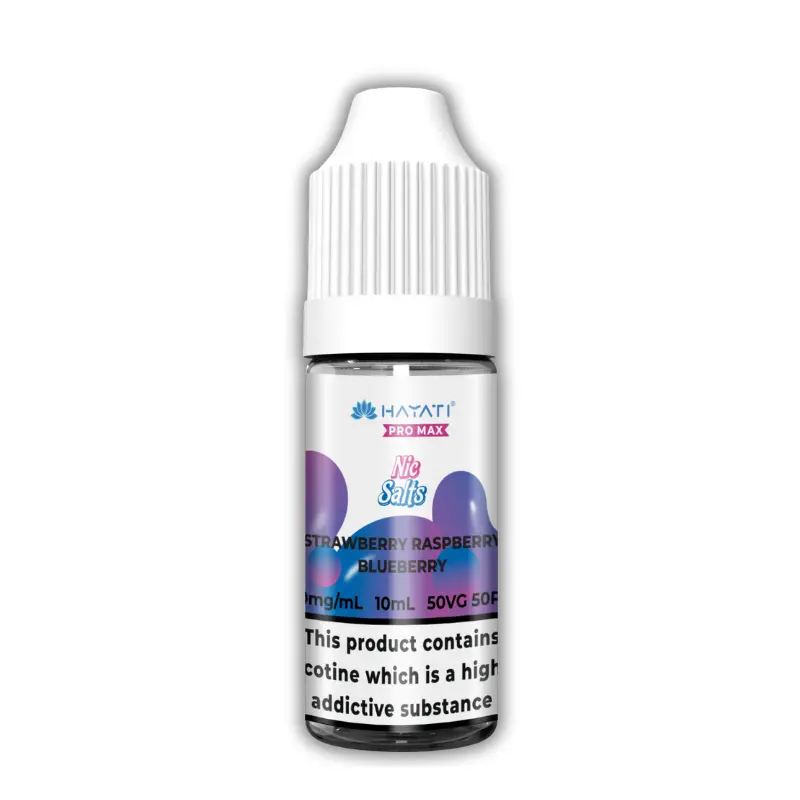
Hayati · Pro Max
Strawberry Raspberry Blueberry Hayati Pro Max Nic Salt
£2.49
✔ In stock — ready to ship
Genuine Hayati
Free over £20
Same-day dispatch
Secure checkout
Strawberry Raspberry Blueberry is a 10ml bottle of Hayati Pro Max nicotine salt at 10mg per millilitre, mixed at an even fifty percent vegetable glycerine to fifty percent propylene glycol, listed at £2.49 under the code HPM-NS-STRAWBERRY-RASPBERRY-BLUEBERRY. It is liquid and nothing else. No device, no pod, no coil, no battery. The blend has no cooling in it, which is worth saying plainly at the top because two of the three listings Hayati publish for this recipe state the absence and one leaves you to infer it.
There is one structural fact about this recipe that no other page can claim, and it is the reason this page exists. Strip the hardware words off all 492 titles in this catalogue and you are left with 192 distinct recipe names. Exactly one of them runs to three or more words with every single word naming a berry, and this is it. Not one other three-word name in the range manages it. Every other three-fruit blend either reaches outside the berry set for one of its components or is not a fruit blend at all.
That claim came to me as an assertion and I have counted it, because the standing instruction on this site is to distrust a rarity claim until somebody has added it up. It survives, but only inside two boundaries that I have to state rather than bury, and the second of them is load-bearing. Both are set out in the next section along with the method, so you can disagree with the boundary and recalculate.
What this page does not do is describe how the liquid tastes across a draw. That work is finished. The Strawberry Raspberry Blueberry Pro Max Plus refill pod page took this recipe apart properly: the three-listing comparison, the component roles, the assembly of a single draw, the sweetness placement, and a long argument about which part of the accord fades once you have lived with it for a fortnight. Repeating any of that here would produce a thinner copy of something already on the site. So this page takes the other half of the subject. What kind of recipe is this, how was it built, what does its construction cost, and what changes when you buy that construction in a bottle rather than sealed inside a pod.
Counting the claim, and the two boundaries it needs
Here is the method, because a census is worth nothing if you cannot repeat it. Take all 492 listings. Cut each title at the word Hayati, which is where the brand and the hardware designation begin on every one of them. What remains is the recipe name. Deduplicate, and 492 listings collapse to 192 names. Thirty-nine of those contain an oblique, meaning the listing carries two recipes in one pod, and I have tested both sides of every one of those separately rather than treating the pair as a single name.
Then ask of each name whether every word in it is the name of a berry. Four names pass at any length. Blueberry Raspberry, which Hayati sell eleven times over. Blackberry Raspberry, which they sell three times, including as a bottle on this same shelf. A one-word entry, Blueberry, which turns out to be a nicotine pouch rather than a liquid. And this recipe, three times.
Boundary one: the claim is only true at three words or more
Two-word all-berry names exist and they are not obscure. Blueberry Raspberry sits four positions away on this very shelf and is the most heavily stocked recipe in the range. Blackberry Raspberry is also a bottle at £2.49. So anyone saying "the only all-berry blend Hayati make" is simply wrong, and I am not saying it. The claim has to be pitched at three or more words, where it holds without qualification against the other 191 names.
The one-word case resolves neatly and in a direction that corroborates rather than undermines. Blueberry appears as a standalone recipe name once, on a nicotine pouch. The Blueberry Raspberry Cherry Pro Max Plus 6000 kit page established, by going through the blueberry listings one at a time, that there is no Hayati e-liquid anywhere in the catalogue sold as blueberry and nothing else, and its figure was zero. Finding the lone Blueberry name attached to a pouch is the same finding arrived at from a different direction. That census belongs to that page and I am citing it rather than running it again.
Boundary two: cherry has to be outside the berry set, and that is not my decision
This is the boundary that actually decides the claim, so it gets more than a clause. Count cherry as a berry and the picture changes completely. Six three-word names qualify instead of one: this recipe, Blueberry Raspberry Cherry, Strawberry Raspberry Cherry, Strawberry Cherry Cranberry, Blueberry Cherry Cranberry and Straw' Cranberry Cherry. At six out of 192 the recipe stops being singular and becomes one of a small group, and the whole angle deflates.
Botany will not settle it for you, and anyone who reaches for botany here has not looked. A cherry is a drupe, a single stone in flesh. A blueberry and a blackcurrant are true berries. A strawberry is an accessory fruit and not a berry at all in the technical sense, and a raspberry is an aggregate of small drupelets, which makes it closer to a cluster of tiny cherries than to a blueberry. Apply the botanical definition strictly and this recipe contains one berry, one aggregate and one accessory fruit, and the name Strawberry Raspberry Blueberry is not an all-berry name under any reading. Botany is the wrong instrument.
What does settle it is Hayati's own filing, and it settles it cleanly. This site carries a Berry Vapes shelf running to 225 listings. Eighteen listings in the catalogue are named for cherry without any other berry word attached to them, covering Cherry Ice, Fizzy Cherry, Cherry Cola and Cherry Peach Lemon across several hardware families. Not one of those eighteen is filed under Berry Vapes. Zero out of eighteen. Hayati do not regard a cherry as a berry for the purpose of sorting their own range, and since the question here is what their naming convention treats as a berry rather than what a botanist would, their filing is the evidence that matters.
So the claim stands in this form, and this is the form I am willing to defend. Of the 192 distinct recipe names Hayati use across 492 listings, Strawberry Raspberry Blueberry is the only one of three or more words in which every word names something the retailer files as a berry. It is not the only all-berry recipe, because two-word ones exist. It would be one of six rather than one of one if you counted cherry in, and the reason not to count cherry in is that Hayati do not.
A narrowed claim with its workings shown is worth more than a bold one, and the narrowing is the interesting part rather than a concession. It tells you the range does have a berry category with a boundary, that the boundary sits between raspberry and cherry, and that Hayati police it consistently enough for eighteen listings in a row to fall on the far side of it.
What an all-berry name does and does not prove
One more caution before building anything on this. A name is a naming decision, not a recipe. Nothing in the census tells you what concentrates went into the bottle, in what proportion, or whether some fourth thing is in there that the label does not mention. Hayati publish an ingredient list for none of their liquids, and a title is a marketing artefact before it is a specification.
What the census does prove is something about intent. Somebody chose three words for this bottle and all three landed inside one category. On a shelf where a third component is usually a citrus, a coolant, a confectionery note or a stone fruit, choosing another berry is a decision to stay put. That decision is visible in the data whether or not the liquid behaves the way the decision implies, and the rest of this page is about what that decision commits the recipe to.
The reordering in the title, and what it actually records
The second piece of evidence is in the word order, and it is more specific than the census. Twenty-eight of the 492 listings name both blueberry and raspberry somewhere in the title. Twenty-five of those put blueberry before raspberry. Three put raspberry first, and those three are the three listings of this recipe: the bottle you are reading about, the Pro Max Plus pod kit at £7.99 and the refill pod at £5.49.
Twenty-five to three is a strong enough split to be worth a second look, and the second look is better than the first. Of the 28, twenty-two carry "Blueberry Raspberry" as an adjacent pair of words, unbroken. Six do not. Three of those six are the Blueberry Cotton K / Raspberry Cotton K listings, where the two words are separated because the pod carries two recipes and each half takes its own qualifier, but blueberry still comes first. The other three are this recipe, which is the only case in 492 listings where the pair is both reversed and split apart, with strawberry inserted at the front and blueberry pushed to the back.
The figure of twenty-two matches independent work. The Blueberry Raspberry Rubik kit page counted the listings carrying that exact flavour name and reached twenty-two in total, eleven plain and eleven with something added, and used that split to argue that Hayati treat Blueberry Raspberry as a base recipe they extend rather than as one flavour among many. Its twenty-two and my twenty-eight are the same catalogue counted two ways, and the six-listing gap between them is exactly the set of titles that break the unit. That the two counts reconcile to the listing is a reasonable check that neither is wrong.
What the reordering does not tell you
The tempting move here is to say that strawberry leads the name because strawberry leads the draw. Do not make it. The White Peach Raspberry Pro Max Plus pods page examined precisely this question and concluded that word order in a flavour title is weak evidence of what reaches you first, on the grounds that listings in this range routinely lead with whichever fruit sits most comfortably at the front of a name rather than with the one you taste. That finding is theirs, it is sound, and this page adopts it rather than relitigating it.
The refill pod page for this recipe arrives at the same place by a different route. It works through what all three published descriptions of this liquid claim, notes that they simultaneously describe a sequence and deny that a sequence occurs, and resolves the contradiction by treating the name as a statement about roles rather than about timing. Two pages, two methods, one conclusion. The order of the words in Strawberry Raspberry Blueberry is not a prediction about your mouth.
What it does tell you
Once the order stops being about taste, the only thing left for it to record is provenance, and that reading is supported by something firmer than inference. Hayati file all three listings of this recipe under Blueberry Raspberry Vapes, a shelf of 46 products. They did that even though the title reverses the pair and puts a third word between the reader and it. A shopper browsing that shelf finds this bottle sitting alongside the plain base, its lemon version, its cherry version and the whole blue razz wing, because the filing system knows what the title obscures.
The contrast with the Cotton K listings sharpens it. Those three also name both fruits, and they are not on the Blueberry Raspberry shelf at all. So the filing is not keyword matching on two words in a title. It tracks recipe families, and it has decided that this bottle belongs to the blueberry and raspberry family while the Cotton K pods do not, despite the Cotton K titles keeping the conventional word order and this one breaking it.
Put the census, the reordering and the filing together and a consistent picture emerges, which I will label as inference because that is what it is. This recipe reads as the house's existing two-berry pairing with a third berry placed in front of it, rather than as a fresh three-fruit blend designed from nothing. The word order records the construction. Strawberry is the addition, and it went to the front of the name because additions usually do, not because it arrives first in the vapour.
There is a competing explanation and it deserves a hearing. Perhaps somebody simply wrote the three fruits in whatever order came to hand, and no decision was made at all. Against that, twenty-five listings out of twenty-eight keep blueberry in front, which is a convention strong enough that departing from it once looks like an accident and departing from it three times, across three separate listings of the same recipe, looks like the name was fixed before the listings were written. The fact that the three reversals are all one recipe is the part that makes the accidental reading hard to sustain.
Five ways to build on the same pairing, and only one of them stays inside
Narrow the 192 names to those that put blueberry and raspberry together as a single recipe, with no oblique and no second pod involved, and you get five. They are worth listing because the comparison between them is the clearest statement of what this bottle is.
- Blueberry Raspberry. The pairing on its own, eleven listings, more than any other recipe in the catalogue. Nothing added.
- Blueberry Raspberry Cherry. Adds a stone fruit. Two listings.
- Blueberry Raspberry Lemon. Adds a citrus. Three listings, one of them a bottle on this shelf.
- Blueberry Raspberry Menthol. Adds something that is not a fruit at all. One listing.
- Strawberry Raspberry Blueberry. Adds another berry. Three listings, of which this bottle is one.
Four of the five extensions import a foreign element. Blueberry Raspberry Lemon, which you can buy as a bottle at the same £2.49, brings in a citrus acid that no berry supplies and that cuts on a different frequency from raspberry's tang. Blueberry Raspberry Cherry brings in weight and a darker sugar. Blueberry Raspberry Menthol at £3.49 brings in something that is not a flavour in the ordinary sense at all, since a coolant works on a sensory channel the fruit never touches.
This recipe reaches back inside the set it started in. Strawberry is the one addition on the list that shares a register with what it is being added to. It is red to purple, it is sweet, it has the same jammy top note the other two have, and it brings no acid of its own worth the name. Whatever it contributes, it does not contribute contrast.
That is the entire finding, and the rest of this page is about its consequences. Four out of five extensions to the house's most-sold pairing go outside for their third element. The fifth stays home. If you want to know what this bottle is for, that is a better starting point than any adjective.
What a blend with no outsider in it is like to own
The Strawberry Guava Pro Max Plus 6000 kit page worked out the general shape of this problem and named it well. Its argument is that acid functions as punctuation in a fruit liquid: it marks the end of one draw so the next one lands fresh, and a blend with no acid anywhere in it runs continuously, one unbroken sweet note, until the palate stops distinguishing anything inside it. That page's liquid pairs strawberry with guava, two soft fruits in one register with nothing sharp between them, and it concluded that the blend does not punctuate. The reasoning is theirs and I am not rebuilding it.
What is different here, and what makes this recipe a harder case rather than the same case again, is that this blend does have acid. Raspberry supplies it. The refill pod page treats that acid as the structural element of the whole accord and is right to. So the Strawberry Guava conclusion does not simply transfer, and pretending it does would be lazy.
The question this recipe actually raises is a step along from that one. What happens when a blend has its contrast, but the contrast is supplied from inside the same family as everything it is contrasting with?
Internal punctuation is punctuation, but on a shorter scale
My answer, marked as reasoning rather than as a published fact, is that a contrast drawn from within the berry set punctuates a phrase rather than a sentence. Raspberry's acid is real and it separates one component from another inside a single draw. What it does not do is reset the palate between draws, because to reset a palate you need something that occupies a band the liquid does not otherwise fill, and a raspberry's acid arrives wrapped in a raspberry's aromatics, which sit next door to the strawberry's and overlap the blueberry's.
A lemon in that slot would behave differently, and Blueberry Raspberry Lemon is the controlled experiment for it sitting on the same shelf at the same price. Citrus acid is sharper, it lingers on a different part of the tongue, and its aromatic signature has nothing in common with a berry's. It clears rather than cuts. A menthol in the slot, as on the Mini Ultra version, does not even engage the flavour system, which is why the refill pod page observes that a coolant keeps working long after a flavour note has gone quiet.
Take both of those away and you have a liquid with one dial and three settings, all of which are within a semitone of each other. Nothing in it arrives from outside. That is a real property with real consequences and it is neither a fault nor a selling point on its own.
The three overlapping registers, stated as a limitation
Set out the components as bands rather than as flavours and the compression is obvious. Strawberry is broad, warm, sweet and low on acid. Raspberry is narrower, brighter, and carries the acid, but it is still a red soft fruit with a jam-adjacent top. Blueberry is lower, duskier and slightly skin-bitter, and it is the quietest of the three. Three bands, all of them in the same half of the spectrum, none of them separated from the others by more than a step.
Against that, consider what a third element from outside would have done to the spacing. Cherry would have pushed the bottom band down and added weight at the finish. Lemon would have opened a gap at the top. A coolant would have added a channel that is not aromatic at all. Each of those buys separation cheaply. This recipe declines all three and buys its separation the expensive way, by relying on the listener to distinguish three similar things.
Hayati's own copy is alert to this, which is the best evidence that the risk is real rather than something I have invented. The bottle text goes out of its way to insist the result is layered instead of indistinct, and the refill pod page counted that defensive vocabulary across the catalogue and found the key word used exactly once in 492 descriptions. Copy that pre-empts a specific criticism is telling you where the recipe is exposed. It is not telling you the criticism lands.
Who the construction suits
Two kinds of buyer do well out of a blend with no outsider in it, and it is worth being specific rather than saying it suits everyone.
The first wants a berry liquid that stays a berry liquid. Every one of the extensions above changes the category of the thing you are drinking. Add lemon and you own a berry and citrus blend. Add menthol and you own a cooled liquid. Add cherry and the darkness of the cherry becomes the first thing anyone notices. If what you actually want is fruit of one kind, more of it, and nothing arriving from elsewhere, this is the only three-word recipe in the range built to that specification.
The second wants a liquid with no sharp edge to tire of. A strong contrast element is the thing people either love or stop being able to ignore, and citrus in particular has a habit of becoming the only thing you can taste by the end of a bottle. Nothing here is capable of doing that, because nothing here is far enough from anything else.
Two kinds of buyer should walk past. If you want a liquid that reintroduces itself on every pull, there is not enough distance between these three components to keep doing that, and Strawberry Raspberry Ice on this same shelf is the obvious correction. If you want sharpness as the headline rather than as an internal detail, Blue Sour Raspberry is built around an acid spike instead of balanced by one, and this bottle will read as flat next to it.
The bottle, and why the format suits this particular recipe
The general case for a bottle over a sealed pod is made at length on the Hayati Pro Max Nic Salts range listing, which counts the costs honestly: you have to own and maintain hardware, there is a filling step and a priming step that a prefilled pod never asks of you, and the bottled menu is a different and smaller menu than the pod shelves. That argument is complete and there is no point in a second version of it here.
What is specific to this recipe is narrower and it follows directly from everything above. In a blend built with no outsider, your hardware becomes the outsider.
On a liquid carrying citrus or a coolant, equipment is a second-order variable. The recipe supplies its own contrast, and changing coil, airflow or power shifts the presentation a little without changing what kind of thing you are drinking. On this recipe nothing internal is doing that job, so the only variables that can separate the three bands are the ones you control. A tighter draw and a cooler, lower-powered setup keeps the three distinguishable for longer, because less material arrives at once and the strawberry has less opportunity to swamp the other two. A warmer, looser, higher-volume setup pushes all three into the same place and gives you a general sweet red impression, which is the outcome the copy is anxious about.
A sealed pod removes every one of those controls. That is the honest argument for buying this particular recipe as liquid rather than prefilled, and it is a better argument than price. You are buying the one blend on the shelf where the equipment is doing the work that the third fruit would normally do.
The even fifty-fifty base matters for the same reason. A thin mix wicks quickly through the narrow channels a low-power mouth-to-lung coil uses, which keeps the delivery consistent at exactly the settings that keep the three berries apart. Hayati describe the liquid as intended for refillable pod kits and for low-wattage restricted-draw hardware, and as unsuitable for wide-open high-power tanks. Match the range on your own equipment rather than taking a compatibility judgement from a retail page, ours included.
The figures, and the one thing the whole shelf refuses to vary
Everything Hayati publish for this listing is in the table. Rows that are absent are absent because nothing is published, not because they were trimmed. There is no coil resistance here, no wattage recommendation, no ingredient list and no batch information, and none of those should be taken from a sibling page either.
| Recipe name | Strawberry Raspberry Blueberry |
| Format | 10ml bottle of e-liquid. No hardware included. |
| Nicotine | 10mg per millilitre, nicotine salt |
| Base | 50 percent vegetable glycerine, 50 percent propylene glycol |
| Cooling | None |
| Intended hardware | Refillable pod kits and low-power restricted-draw devices |
| Not intended for | Sub-ohm tanks |
| Price | £2.49 |
| Product code | HPM-NS-STRAWBERRY-RASPBERRY-BLUEBERRY |
| Maker | Hayati |
| Other listings of this recipe | Two, both prefilled Pro Max Plus: a kit at £7.99 and a refill pod at £5.49 |
| Shelves it appears on | Eight, including Blueberry Raspberry Vapes |
One row explains most of the others. The Hayati Pro Max Nic Salts shelf runs to 65 listings and every single one of them is 10ml, every one is 50/50, every one is 10mg and every one bar a single range-level entry is £2.49. There is no strength to select and no ratio to choose. Nicotine is an addictive substance and the figure here is published as a plain specification rather than as a recommendation, and this page has nothing to say about what anyone should pick.
The consequence of that uniformity is worth drawing out, because it is what makes a census like the one at the top of this page meaningful at all. When volume, ratio, strength and price are constant across 65 products, the recipe is the only thing that varies. The shelf is a pure flavour menu. That is also why the construction question matters more here than it would on a hardware shelf, where a buyer is weighing several things at once. On this shelf you are weighing exactly one.
The wider Hayati E-Liquids section takes in 105 bottles, adding the larger 50/50 and 70/30 lines to these 65. Those are a different proposition in a different size at different ratios, and the reason to know they exist is mainly so you do not buy one expecting this.
The neighbours, sorted by what they bring in from outside
Most comparison sections on this site sort by fruit. Sorting this one by fruit would be useless, because the fruits are the thing this recipe deliberately does not vary. Sort instead by what each neighbour imports that this one does not, and the shelf organises itself.
Nothing imported at all
Blueberry Raspberry at £2.49 is this recipe with the strawberry taken away and the balance recalculated. It is the base rather than a lesser version of this, and the Rubik kit page makes the case that a base is built to a specification of its own: broad enough for an addition to land somewhere, quiet enough not to argue with it, and complete enough to sell eleven times over on its own. If you find three similar berries harder work than two, that is the bottle, and it is not a compromise.
Blackberry Raspberry is the other all-berry bottle on the shelf and the more instructive comparison of the two. It is also two berries with no outsider, but blackberry sits lower and drier than blueberry does, so the two bands are further apart than any two bands in this recipe. Same construction principle, wider spacing.
A coolant imported
Strawberry Raspberry Ice is the single most useful comparison available for this bottle and it is on the same shelf at the same price. It keeps two of these three berries and replaces the third with a sensation. If you buy both and run them alternately you have isolated the variable this whole page is about: same front, same middle, and a third element that is either another berry or a coolant. Nothing else in the range sets that experiment up so cleanly.
Blue Frozen takes the cooling considerably further and is a different order of thing. It is worth naming because that page ran the definitive count of Hayati's cooling vocabulary across the catalogue and established that the terms are not graded, which is the answer to a question people reasonably ask when they see Ice on one label and Frozen on another.
A citrus or a sour note imported
Blueberry Raspberry Lemon, already linked above, is the closest thing to a direct test of the central claim on this page, since it is the same family pairing with a genuine outsider in the third slot. Blue Sour Raspberry, also linked above, goes further and makes the acid the point rather than the structure. Between them they cover both ways of adding sharpness: from a different fruit, or by dialling the existing one past balance.
A stone fruit imported
Blueberry Raspberry Cherry as a £5.49 refill pod is the extension that adds depth rather than brightness, and the Blueberry Raspberry / Blueberry Raspberry Cherry Pro Ultra Plus 25000 kit at £11.99 puts the base and its cherry version behind one collar so you can move between them in a session. That is the narrowest gap between two halves anywhere on that format and it is the cheapest way to hear what a single added component does to a recipe.
Confectionery instead of fruit
A large part of this shelf reaches the same colour through sweets rather than through berries. Blue Razz Mojito, Blue Fusion and Mad Blue are all £2.49 bottles here, and all three are sweeter and less literal than this recipe. The last two are named for a mood rather than for an ingredient, which is its own problem and one their pages deal with directly. On the prefilled side Blue Razz Fruit Twist is the reference point for how a blue razz accord is built. Anyone expecting sherbet from a title containing the word blueberry will find this bottle drier and more like actual fruit.
No roles assigned at all
Mixed Berries at £5.49, or the Mixed Berries kit at £7.99, is the version of an all-berry idea that names no fruits and therefore promises no separation. It is the honest recommendation rather than a lesser one for anybody who has read this far and concluded that telling three similar berries apart is more effort than they want from a bottle. Note that it is not an all-berry name by the census above, since "Mixed" is not a fruit, which is a reminder that the census is about names and not about contents.
The same recipe elsewhere, and the formats it never reached
This recipe exists three times and that is the whole of it. The bottle you are reading about, the Pro Max Plus kit and the refill pod, both linked above. There is no Mini Ultra version, no Rubik version, no Pro Ultra Plus version, no shortfill and no iced counterpart anywhere. Its family pairing, by contrast, is everywhere: Blueberry Raspberry Rubik Pods at £3.99, the Blueberry Raspberry Pro Max Plus kit at £7.99, a 50/50 shortfill and a 70/30 bottle, both at £6.99. If you want this liquid on other hardware, you cannot have it. If you want the base, you can have it on almost anything.
Two listings worth knowing about for a different reason
The Blueberry Straw' Menthol / Blueberry Raspberry Menthol Mini Ultra kit at £3.99 is the listing that taught this site to read titles rather than web addresses, because its address drops the second menthol and a page was once planned on the assumption that half the pod was uncooled. The Blue Razz Pineapple / Strawberry Ice Mini Ultra kit has the same defect in the other direction, with an address that begins blueberry and a title that says Blue Razz. Both are worth a glance if you ever plan to search this catalogue by typing rather than by clicking, since the address bar and the product name do not always agree.
Browsing rather than choosing
If none of the above lands, the Blueberry Raspberry Vapes shelf collects all 46 listings in this recipe family including this one, which is the fastest way to see the five extensions side by side. Berry Vapes is the wider view at 225 products, Raspberry Vapes narrows to 119 by single fruit, and the full Hayati catalogue runs to 492.
Running this bottle so the three berries stay three
General advice about nicotine salts is worth little, so this is narrowed to the thing that is specific about this liquid, which is that its components sit close together and the equipment is what keeps them apart.
Fill before the chamber runs low, not after. A pod that is close to dry heats the last of the liquid harder than a full one does, and extra heat pushes volatile top material into the vapour faster. On a blend with wide spacing that produces a stronger draw. On this one it collapses the raspberry into the strawberry, because the two are only a step apart to begin with. Topping up early is the cheapest single thing you can do for this recipe.
Give a new coil six or seven draws before you judge it. An even 50/50 base soaks a wick quickly, so the wait is short, but the first few pulls on fresh cotton read sweet and flat while the wick settles. On a liquid whose whole identity is the separation between three similar fruits, those first pulls will tell you the bottle is one-dimensional when it is not.
Read the coil signal, and remember a bottle lets you act on it. The refill pod page works out what a tiring coil takes first from this recipe and why a worn coil and a tired palate produce the same symptom. That analysis applies here unchanged. What changes is your options. A sealed pod owner who reaches that conclusion has to throw away the liquid with the coil. You do not. Change the coil, keep the bottle, and you have separated the two causes for the price of a coil rather than the price of a pod.
Keep it away from warmth and light. A bottle on a windowsill or in a parked car ages from the top down, and the brightest, most volatile material is the first to go. On this recipe that is the raspberry, and the raspberry is the only thing standing between the blend and an undifferentiated sweet red. A cupboard is enough. Keep it out of reach of children and pets, and keep the cap on between fills.
Expect an opened bottle to drift. The range listing covers this in general terms and there is no point restating the chemistry. The version specific to this liquid is that the drift will not read as the bottle getting weaker. It will read as the blend getting simpler, because the component that goes is the one carrying the distinction rather than the one carrying the volume.
Think twice before adding to it. A bottle allows mixing in a way a pod does not, and this recipe is the one on the shelf most obviously short of an outsider, so the idea suggests itself. Two cautions. Anything sharp or cold you add will dominate quickly, because there is nothing here loud enough to hold its own against it. And a result you mix yourself is a result nobody has formulated, whereas Blueberry Raspberry Lemon is the same idea done deliberately for the same £2.49.
Questions this listing raises
Is this really the only all-berry blend Hayati sell?
No, and the page says so. At two words there are others, including Blueberry Raspberry and Blackberry Raspberry. The claim is specifically about names of three or more words, where this is the only one of 192 distinct recipe names in which every word is something Hayati file as a berry.
Why does cherry not count as a berry here?
Because Hayati do not count it as one. Eighteen listings in the catalogue are named for cherry with no other berry word attached, and not a single one of them is filed on the Berry Vapes shelf. If you did count cherry in, six three-word names would qualify instead of one and the claim would not be worth making.
Does the strawberry come first because you taste it first?
Not necessarily, and the order should not be read that way. Word order in a flavour title is weak evidence of what arrives first, a finding established on the White Peach Raspberry pods page. What the order does record is that this recipe puts a third berry in front of the house's existing two-berry pairing, which is a fact about how the name was built.
Is there any ice or menthol in it?
None. The bottle text states the absence directly and so does the pod kit listing. If you want the nearest cooled thing, Strawberry Raspberry Ice keeps two of these three berries and puts a coolant where the blueberry sits.
Where does the full flavour description live?
On the Strawberry Raspberry Blueberry Pro Max Plus refill pod page, linked at the top. It covers the roles of the three fruits, how a draw assembles, where the blend sits for sweetness and what it is not. It describes the same recipe, so the account holds for this bottle, allowing for the fact that a bottle runs at 10mg rather than 20mg and that your own hardware affects the presentation.
Can I get this in a strength other than 10mg?
Not as a bottle. All 65 listings on this shelf are recorded at 10mg per millilitre in salt form, so there is nothing to select. The two prefilled versions of this recipe are listed at 20mg, which is the maximum permitted for a nicotine-containing e-liquid sold in the UK.
Is the bottle the same liquid as the prefilled pod?
Treat it as the same flavour idea rather than as confirmed identical liquid. The recipe name matches and the published descriptions run along the same lines, but the bottle is 10mg in a stated 50/50 base and the pods are 20mg with no carrier ratio published at all. Those differences are enough to change the presentation even if the concentrate is the same.
Will it work in my device?
It is formulated for refillable pod kits and low-power restricted-draw hardware, and Hayati say it is not intended for sub-ohm tanks. Beyond that the coil your device takes is the coil the device specifies, and this page will not pick one for you.
I can only taste two berries. Is the bottle faulty?
Probably not, and there are three ordinary explanations before that one. A worn coil, a bottle that has been kept somewhere warm or bright, or a setup running hotter and looser than this blend wants. All three take the raspberry first, because it is the brightest and most volatile of the three. Work through them in that order.
Which of the five blueberry and raspberry recipes should I start with?
Decide what you want the third slot to do. Nothing at all gives you the plain pairing. Another berry, which is this one, keeps everything inside one family. Lemon opens a gap at the top, cherry adds weight at the bottom, and menthol adds a sensation rather than a flavour. Four of the five are available on this shelf or nearby at low cost, so the comparison is cheap to run yourself.
Why is this bottle only sold in one size?
Every bottle on the nic salt shelf is 10ml. The larger Hayati bottles are on a separate shelf in different ratios, and this recipe is not among them. Its family pairing is, in both a 50/50 shortfill and a 70/30 version, but those are the two-berry base rather than this three-berry recipe.
Where do I see the rest of the family?
Blueberry Raspberry Vapes collects all 46 listings that Hayati file under this recipe family, which is where all five variants sit together. Berry Vapes is the wider shelf at 225 products, and the nic salt shelf itself runs to 65 bottles.
Where that leaves it
Strawberry Raspberry Blueberry is a 10ml bottle at 10mg in an even 50/50 base, £2.49, uncooled, and built out of three fruits that all sit inside the same category. Counted against all 192 recipe names Hayati use, it is the only one of three or more words where every word names a berry by the retailer's own reckoning, and the two boundaries that claim needs are stated in full at the top of this page rather than glossed over.
The construction is the thing to decide on. Four of the five recipes Hayati build on their most-sold pairing import something from outside the berry set, whether that is a citrus, a stone fruit or a coolant, and each of those imports buys separation cheaply. This one declines the import and relies instead on three similar things staying legible next to each other. That is what you are buying, and the reordered title is the trace the decision left behind.
Buy it if you want fruit of one kind with nothing arriving from elsewhere, and if you are prepared to let your own equipment do the work a third component would normally do, which is a job a bottle lets you do and a sealed pod does not. Look elsewhere if you want something that reintroduces itself on every draw, if you want cooling, or if you want a recipe that exists on more than one piece of hardware. The bottled shelf has 64 other flavours on it at the same price, which makes disagreeing with any of this inexpensive.
Strictly for adults aged 18 and over. Nicotine is an addictive substance.
You might also like


