
Home / Hayati Pro Max Plus Pods / Blue Sour Raspberry Hayati Pro Max Plus Pods
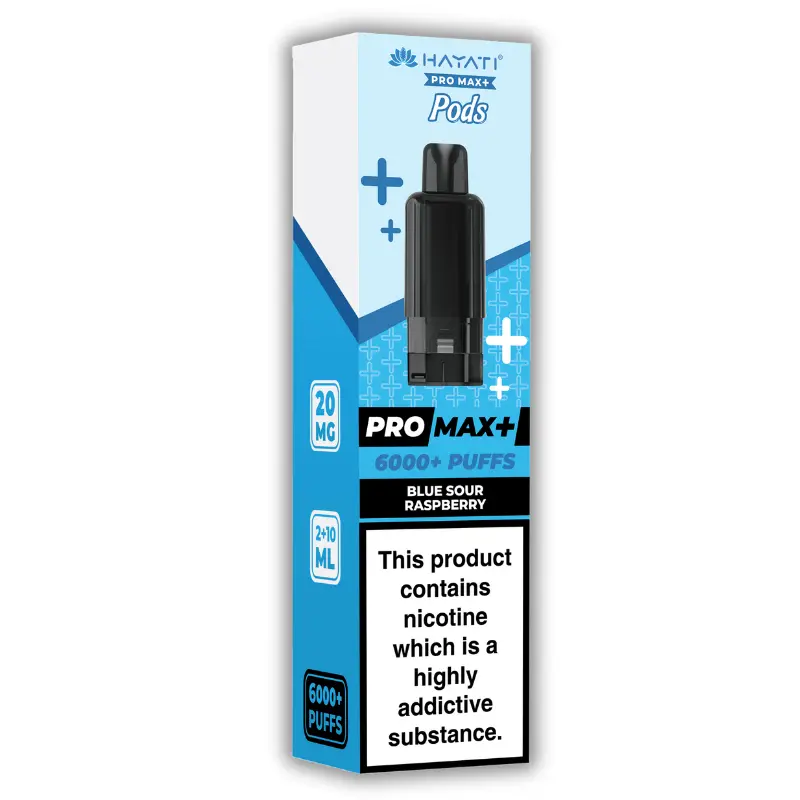
Hayati · Pro Max Plus
Blue Sour Raspberry Hayati Pro Max Plus Pods
£5.49
✔ In stock — ready to ship
Genuine Hayati
Free over £20
Same-day dispatch
Secure checkout
This listing is the refill and nothing else: one prefilled twelve millilitre pod of Blue Sour Raspberry at 20mg nicotine salt, £5.49, with no device in the packet. Hayati rate it at up to 6,000 puffs, a laboratory estimate produced under a test protocol rather than a description of anybody's month. Everything else on the sheet is the same as every other pod on the Hayati Pro Max Plus Pods shelf, because all eighty-nine of them are £5.49 and all eighty-nine hold twelve millilitres.
A refill is bought by somebody who has already settled the two questions a product page usually argues about. The flavour is chosen. The hardware is owned. What is left is a scheduling problem wearing the clothes of a purchase decision: when do you take this pod out of the device, and what do you need to have already done in order to be able to.
For most liquids on this shelf that question answers itself, because the pod stops when the liquid stops and there is no decision in it at all. This one is different, and the difference has been established properly on other pages rather than here. Blue Sour Raspberry is built on a dosed acid over a confectionery base, the acid is the thing you bought, and at some point before the pod is empty it stops arriving the way it did on day one. That is the finding. The consequence of it, which is that you end up retiring a pod with liquid still in it, is what this page is about.
Two things in the instructions I was given did not survive checking, and I have said what I narrowed them to rather than printing the confident version. The first was a claim about how unusual this pod's behaviour is on its shelf. The second, and the more important one, was that the buyer's remaining lever is retirement timing. It is not. Timing is precisely the thing that is unavailable here, because there is no window in the pod, no gauge on the device and no published figure for where in the twelve millilitres the change happens. What is actually available is provisioning: whether the next pod is in your possession on the morning the current one goes. That is a smaller lever than timing and it is the only one that exists, and working out what it costs turns out to be worth the page.
What four earlier pages already settled, so that none of it gets rebuilt here
Blue Sour Raspberry is one of the most heavily worked liquids on this site. Hayati sell it eleven separate times across a 492 line catalogue, in four pieces of hardware and three bottles, and several of those listings already carry long pages. Rather than derive any of it again, here is what each one owns, so the argument below can stand on it.
The Mini Ultra kit page for this flavour did the listing diff. It lined all eleven descriptions up against each other and found that every one of them agrees on three things: a sweet blue raspberry base, an acid element that was specified rather than inherited from a fruit, and the interaction between those two being the point of the liquid rather than either one alone. It also found that the eleven contradict each other on which of the two arrives first, which tells you about copywriters and not about the recipe. Most usefully for this page, it established why the acid matters more here than it would on a raspberry blend: blue raspberry is a confectionery accord rather than a reconstruction of a fruit, so when the sharp front goes there is no botanical identity underneath for the liquid to settle back onto. It does not become a quieter version of itself. It becomes a generically sweet blue.
The Cherry Sour Raspberry refill page, which sits on this same shelf at this same price, owns the case for stopping a pod early and took the arithmetic to the four fifths mark. It also owns the memory mechanism: an experience gets summarised by its strongest moment and by how it finished, so a pod whose last stretch is its worst gets filed as the worst pod regardless of what the rest of it was like.
The Rubik refill page for this flavour owns the consequence of that for the rebuy, which is that the moment you naturally decide whether to order another one is the single least representative reading the pod produces. Its correction is to make the decision on the first morning of the next pod rather than the last night of this one. It also holds the running cost table across formats and the finding that this liquid is the only declared sour on the nineteen name Rubik pod shelf.
The two Red Sour Raspberry pages own the red side of the comparison, including the question of what the colour word is doing in these names. This listing's own text points at that page unprompted, describing Red Sour Raspberry as the tarter and less candied version of the same idea, so the direction of the difference is on the record and does not need inferring. Take it as read.
What none of those four asked is what a retirement policy does to a supply schedule. They each treat the end of a pod as a judgement problem: how do I know, should I bin it, when do I decide. The question left over is a logistics one, and it is the one that decides whether any of their advice is executable.
The counts, including the one I was handed and narrowed
The claim I was given was that this pod reaches a retirement decision with liquid still in it in a way that most of the eighty-nine pods on this shelf never do. The second half of that is not something the catalogue can be made to say, because nothing in the data records how anybody finishes a pod. What the catalogue can settle is how unusual it is for a Pro Max Plus pod to declare sourness as its subject, and that is the part worth putting a number on.
Eighty-nine listings sit on the Pro Max Plus pod shelf. Four of them are strength listings that name no flavour at all, covering zero, five, ten and twenty milligrams, which leaves eighty-five named flavours. Of those eighty-five, exactly four put Sour in the title: this one, Red Sour Raspberry, Cherry Sour Raspberry and Tropical Sour Juice. So the property is not unique to this pod. It belongs to a set of four, all four of which already have pages, and I would rather say that than let a set of four read as a set of one.
The more interesting number is the one underneath it. Fifty-five of the eighty-five named flavours use the word sour, tart or tang somewhere in their description. Thirty use none of the three. So roughly two thirds of this shelf has some acidity described in its copy, which means a bit of bite is thoroughly ordinary here and being built on it is not. That gap between fifty-five and four is the whole of the argument. A pod with a tart edge somewhere in the blend is a pod where the edge is one contributor among several. A pod with Sour in the title is a pod where the edge is the reason you bought it.
The narrowed claim, then, is this. Four listings on this shelf sell acidity as the headline, and on those four a change in acid delivery is a change in the product rather than a change in one of its components. That is what makes the end of the pod legible. It is not a claim about how this pod behaves compared with eighty-five others. It is a claim about what you are in a position to notice, and it holds for four listings and not for the rest.
Why the ending is audible here and inaudible on a pod with a tang in it
A background property that softens does not announce itself. Take Blueberry Raspberry Hayati Pro Max Plus Pods, which is the nearest fruit-true berry on the shelf and whose listing describes raspberry sharpening a soft blueberry base. When the sharpening weakens on that pod, what you get is a slightly rounder, slightly jammier blueberry blend. It is still recognisably the thing on the label. Nothing has failed; the balance has shifted, and shifted towards the fruit that was always the base. The same is true of Mixed Berries Hayati Pro Max Plus Pods, which is deliberately low definition to begin with, and of Strawberry Raspberry Blueberry Hayati Pro Max Plus Pods, where three fruits sharing the work means no single one of them leaving is decisive.
On a declared sour the same amount of change reads completely differently, and not because your tongue is doing anything special. It is because you are auditing rather than noticing. Somebody who bought a pod with Sour printed on it has an expectation with a name attached to it, and a named expectation is one you can check against. Every draw is, whether you intend it or not, a test with a pass and a fail. That is why the ending is legible here: not because the liquid changes more, but because the change is measured against something specific rather than against a general impression of fruit.
There is a useful corollary, which is that this works in both directions and the corpus has not settled which direction applies. One reading holds that residue accumulating on a coil takes the acid first, so the sharp front weakens while the sugar carries on arriving and you end up with a sweet blue that has lost its edge. The other reading holds that the aromatic material goes first, so the bite survives and the fruit behind it stops turning up, leaving something narrow and hollow. Those are opposite descriptions and I am not going to pretend the data picks one, because it does not.
What is worth pointing out is that the cadence argument on this page does not need them resolved. Under the first reading the pod stops delivering the thing you paid for. Under the second it delivers it without anything to balance it. Both are a failure of the product rather than a fading of it, both are audible on a pod whose subject is the acid, and both arrive before the twelve millilitres are gone. Whichever mechanism is operating, you are going to reach a decision with liquid left in the pod, which is the only premise the rest of this needs.
Two rates, and why the reorder heuristic is built on the wrong one
Here is the consequence that follows from all of the above and that none of the earlier pages went after. If you retire a pod on a signal rather than on an empty tank, you are consuming pods at a different rate from the rate at which you are consuming liquid. Those two rates are the same number for almost every product Hayati sell, and people build their restocking habits on the assumption that they always will be.
Think about how a reorder actually gets triggered in practice. It is almost never volumetric, because you cannot see into the pod. It is temporal. You know roughly how long a pod lasts you, you have a rough sense of where you are in that period, and at some point in the last stretch you order the next one. That habit is calibrated on the pods you have already been through, and unless you have been running declared sours exclusively, it was calibrated on pods that ran to empty.
Apply an early retirement policy to this pod and the interval shortens, but the habit does not. If the change arrives around the two thirds mark, a pod that used to occupy three weeks now occupies two, and the reorder that used to be comfortably early is now a week late. This is the first thing that goes wrong, and it goes wrong in a way that is invisible until it has already happened, because the thing that changed was not your consumption, it was the definition of when the pod is finished.
What retirement at two thirds actually costs
Twelve millilitres for £5.49 is a shade under 46p a millilitre on the ticket, and that is the figure everybody compares formats on. It stops being the right figure the moment you decide some of the liquid is not going to be used.
Retire at the two thirds mark and eight millilitres have done work and four have not. The £5.49 has bought you eight usable millilitres, which puts the real cost at just under 69p each. That is a fifty per cent increase on the headline figure, and it is the honest number for anybody who intends to act on the advice the sibling pages give.
Scaled up, it is a pod count problem rather than a pennies problem. Getting through eight usable millilitres per pod instead of twelve means buying three pods for every two you would otherwise buy. Somebody who works through twelve millilitres a fortnight is buying twenty six pods a year on a run to empty basis, which is £142.74. On a two thirds policy the same consumption needs thirty nine pods, which is £214.11. The difference is £71.37 a year, and the point of stating it is not to argue against the policy. It is that this figure never appears on the listing, never appears in the per millilitre comparison, and is invisible to anybody comparing £5.49 against £3.99 or £3.49 on the basis of what is printed on the box.
The break-even that changes how the formats line up
Now put that next to the small format, because this is where the arithmetic goes somewhere the earlier pages could not. Blue Sour Raspberry Hayati Mini Ultra Pods hold four millilitres for £3.49, which is 87.25p a millilitre, and the Mini Ultra kit page makes a careful proportional case for that premium: a small pod spends a much larger fraction of its life in the condition you bought it in, and on a liquid whose whole character is a dosed acid that fraction is what you are paying for. Against the 46p headline here, the small pod looks ninety one per cent more expensive and the case has to work very hard.
Against 69p it does not have to work nearly as hard. The gap collapses from ninety one per cent to about twenty seven. And the break-even is worth having as a single number: at 87.25p a millilitre, £5.49 buys 6.29 millilitres. So if the point at which you would put this pod down is anywhere before about fifty two per cent of the fill, you are paying more per used millilitre than the four millilitre refill costs, while also getting a third as many fresh pods across the same liquid.
I want to be careful about what that does and does not establish. It does not tell you where the change actually happens, because nobody publishes that and no page on this site should pretend to. What it does is convert a proportional argument into a threshold you can hold against your own experience. If you find yourself giving up on these pods around the halfway mark, the format is telling you something, and the thing it is telling you is that you are buying the wrong size of this particular liquid. If you get to four fifths before it bothers you, the twelve millilitre pod is comfortably the cheaper route and the small format's case does not apply to you at all.
One adjacent fact, stated and then left alone. This flavour is one of eighteen that Hayati sell both as a Pro Max Plus pod at £5.49 and as a twelve millilitre Rubik pod at £3.99, which is the same volume of the same liquid for £1.50 less. What that gap is and what the Pro Max Plus premium buys is a price floor argument, it belongs to the Blueberry Cherry Cranberry refill page in this cluster, and re-running it here would just be the same reasoning with a different fruit on it. For the purposes of this page it is enough to note that the early retirement multiplier applies identically on either platform, so it does not change which one is cheaper. It changes both by the same proportion. Blueberry Raspberry Hayati Rubik Pods is the nearest thing to a control there, being the same volume on the same cheaper hardware with no declared acid in it and therefore nothing to retire early for.
Why the policy only exists if a pod is already in the drawer
This is the part that makes the whole thing a provisioning question rather than a timing one, and it is the reason I narrowed the instruction I was handed.
A pod that runs dry gives you notice. Not precise notice, but real notice: the draw changes, the device behaves differently, you have a rough sense of the week you are in, and there is a day or two of grace at the end where you know perfectly well what is coming. That grace period is what a temporal reorder habit is quietly relying on.
The signal on a declared sour supplies no grace period whatsoever. It is not a gradient you can watch approaching. It is a morning on which you take a draw and the thing you bought the pod for is not there in the form it was, and the honest reading of that morning is available immediately and not before. There is no version of it where you get advance warning, because the warning and the event are the same event.
So the decision to retire early is only a decision if you are holding the replacement. If you are not, then what you actually have is a wait, and the wait gets filled by the pod you have just decided is finished. Three or four days of that is not a neutral interval. It is exactly the stretch the Cherry Sour Raspberry refill page identifies as the one that rewrites your memory of a liquid, since it is the worst material the pod produces and it is also the most recent. The reorder that follows is then made against that impression. A buyer without a spare does not merely lose the benefit of retiring early; they get a worse reading of the flavour than a buyer who never intended to retire early at all, because they have identified the bad phase, named it, and then sat in it.
That is the whole practical output of this page. The lever is not when you stop. It is whether stopping is available to you at the moment it becomes worth doing, and that is decided a week or two earlier, by an order you place while the current pod is still perfectly good.
What this does not license
Holding one in reserve is not an argument for holding six, and the reason is specific to this liquid rather than general good sense. The Mini Ultra kit page records that acidity in storage tends to drift downwards over a long stay rather than upwards, and that no Hayati listing publishes a fill date, so a pod that has been sitting in a warehouse for a year is indistinguishable on paper from one filled last month. A deep stack of a liquid whose entire value is a dosed acid is the one purchase the argument on this page specifically does not support. One pod ahead of yourself is the position that makes early retirement executable. Two is a buffer against a delayed delivery. Beyond that you are storing the thing you are trying to protect.
It is also not an argument for buying the kit again. Blue Sour Raspberry Hayati Pro Max Plus Pod Kit is £7.99 and contains this same twelve millilitres with a device attached, so the body costs £2.50 on top of the liquid. That is the right purchase once, when you have no device, and it is on the same twelve millilitres as this listing so it inherits the identical cadence problem. If you want a second body so that a retired pod can be swapped out without the current one going back in, Blue Razz GB Hayati Pro Max Plus Pod Kit gets you one with a different flavour attached, which is more useful than a duplicate of this one.
The liquid, described for somebody who has had it before
A full draw by draw account of this flavour exists already and is good, so what follows is deliberately not that. The parts a repeat buyer needs are the shape of the thing, where it sits against the pods it is competing with on this shelf, and which of its properties are the ones that move.
The base is a confectionery blue raspberry. Blue raspberry is not a fruit and has never been one; it is a flavour accord that refers to a sweet rather than reconstructing a berry, and Hayati's own text for this pod calls it candied without hedging. Over the top of it sits an acid that was put there on purpose. Those two elements are the entire recipe as far as the published copy goes, and this listing commits to an order for them, saying the flavour starts with a pucker and finishes sweet. The eleven listings of this liquid do not agree on that order, which the Mini Ultra kit page documents in detail, so treat the sequence as this copywriter's reading rather than as a specification.
Sweetness, placed honestly. This is a high sugar liquid and the listing says so in as many words, describing it as a pick for somebody who wants plenty of sugar in the mix alongside the sour. It is not an austere or drying flavour. The acid does not reduce the sweetness, it makes the sweetness legible, which is a different job and one it does well while it is being delivered. Against the shelf, it is sharper than Blue Razz GB Hayati Pro Max Plus Pods, which takes the same accord and pushes it further into confectionery with the tang deliberately rounded off, and it is sweeter than the fruit-true berries. Blue Razz Fruit Twist Hayati Pro Max Plus Pods sits between the two, with a bright edge at the front of the draw and a mixed fruit body softening it, and no declared sour treatment anywhere.
Red against blue is the comparison this listing itself raises, and because it raises it there is no need to infer anything. The copy names the sweeter blue options on one side and points at Red Sour Raspberry on the other as the tarter and less candied version of the same idea. That is the direction, stated by the seller, and both Red Sour Raspberry pages take it from there. What matters for a cadence decision is the structural difference behind it. Red Sour Raspberry is a dosed acid over an actual raspberry, so it has fruit character underneath that persists when the acid weakens. This one has a confectionery impression underneath, which is a thinner thing to fall back on. Two pods with similar amounts of acid in them therefore have very different failure states, and the blue one has further to fall.
What it is not, stated as a list of negatives because the listing does not rule any of them out and the absences matter. There is no cooling of any kind, not ice, not menthol, not mint, and none of the eleven listings of this liquid mentions any. If a cold edge is what you actually want from a sharp pod, that is a different mechanism and the shelf has it: Strawberry Raspberry Ice Hayati Pro Max Plus Pods puts a chill behind sweet and tart red berries, and Blackberry Ice Hayati Pro Max Plus Pods does the same behind a darker, earthier fruit. It is not a drink treatment, so the acid is bolted on rather than arriving as part of a lemonade or a citrus squeeze, which is how Blue Razz Lemonade Hayati Pro Max Plus Pods handles the same problem. It is not herbal, which is the route Blue Razz Mojito Hayati Pro Max Plus Pods takes to get lift out of a blue base using mint and lime instead of acidity. And it is not a multi fruit blend, so there is no second fruit to carry the pod when the first element weakens, which is exactly what Blue Razz Cherry Hayati Pro Max Plus Pods has and this does not.
The property that moves across a pod is the acid, and the property that does not is the sugar. That asymmetry is the whole reason this liquid has a retirement decision at all. A pod that lost its sweetness would simply taste weaker and you would notice at the same moment you noticed on any other pod. A pod that loses the element that was organising the sweetness does not taste weaker. It tastes like a different product, one that is closer to what a sugar-forward blue already is, and which several pods on this shelf sell openly at the same price.
The pod itself, which is the short part
The packet contains one prefilled pod and no device. Hayati publish no parts breakdown for it and sell no separate coil for it, so whatever is inside is replaced along with the pod and there is nothing in it to service. It is not refillable and it is not designed to be opened.
The one specification that matters for this particular liquid is the fill, and it matters for the reason the whole page has been about: twelve millilitres is three times what the smallest prefilled format in the range holds, so whatever fraction of a pod arrives in first condition, there is three times as much of this one to get through. Everything else on the sheet is shared with the other eighty-eight pods on the shelf and is better read there.
On fitting, one sentence and then it is done: match the range name printed on your device against the range name in this title before ordering, since Hayati run several prefilled platforms and the pods are not interchangeable between them. The rest of the platform, what comes in the kit and how the device behaves, belongs on the shelf page rather than on a refill listing.
When a pod is finished, it holds a residue of liquid and an electronic component, so it does not belong in ordinary household rubbish. Vape retailers and local authority sites in the UK take them back under the electrical waste rules. If you are running an early retirement policy you will be doing this more often than a full-run buyer, which is one more small consequence of the same decision.
The sheet, with the derived figures first
The published facts on this listing are thin and identical to eighty-eight neighbours, so the rows that are actually specific to a purchase decision have been put at the top and the shared ones underneath.
| Cost per millilitre, ticket | 45.75p (£5.49 over 12ml) |
| Cost per used millilitre, retiring at two thirds | 68.6p |
| Fill below which the 4ml refill is cheaper per used millilitre | about 6.3ml, roughly 52 per cent |
| Same volume of the same liquid, Rubik platform | £3.99 |
| Same liquid with a device attached | £7.99, a £2.50 difference |
| Prefilled volume | 12ml |
| Nicotine | 20mg, the UK ceiling for a consumer nicotine product |
| Preparation | Nicotine salt, the standard for a prefilled pod at this strength |
| Manufacturer rating | Up to 6,000 puffs, a laboratory estimate |
| Declared cooling | None |
| Device included | No |
| Coil specification | Not published |
| VG/PG ratio | Not published for the prefilled pods |
| Fill date | Not published |
The 20mg is the legal maximum strength for nicotine sold this way in the UK, which is why every prefilled pod in this range carries the same figure and why there is no choice to make on it here. Nicotine is addictive, and that is true at this strength as at any other.
The puff rating is the number people compare formats on and it is the number least worth comparing. It is produced under a test protocol, and across Hayati's four prefilled platforms the published ratings imply wildly different quantities of liquid per puff for what is often the same recipe, so a figure from one platform cannot be set against a figure from another and treated as a measurement. Read it as a rough class marker and nothing more.
The three blank rows at the bottom are the ones that cost you something. The absent coil specification means there is no way to reason about how quickly residue will build. The absent ratio means the wicking behaviour is not something you can predict from the sheet. The absent fill date is the one that bites hardest on this liquid specifically, because a dosed acid is not a permanent fixture and there is no way to tell from the packet how long the pod has already been sitting.
What else to buy, sorted by what it does to your replacement cycle
Comparisons on a refill page are not really about which flavour is nicer. You have already decided that. They are about what a given alternative does to the problem described above, so they are grouped that way here.
If you want this liquid but a shorter cycle
Blue Sour Raspberry Hayati Mini Ultra Pods is the same recipe at four millilitres for £3.49, on different hardware. Three of them cost £10.47 and deliver the twelve millilitres this pod delivers for £5.49, which is close to double, and that is the correct comparison if you run pods to empty. It stops being the correct comparison if you do not, for the reasons worked through above. The other thing a short cycle buys you is a fresh pod three times as often, which on a liquid where the failure is in the hardware rather than the liquid is not a small consideration.
Going the other way, Blueberry Raspberry Hayati Pro Ultra Plus Pods shows what twenty two millilitres of an undeclared, fruit-borne tartness looks like: a very long cycle on a liquid that has no particular reason to be retired early, which is the combination the big format suits. This flavour also exists at twenty two millilitres, and everything on this page scales against it in the wrong direction. A longer pod is the wrong answer to a problem caused by pod length.
If you want a blue without a retirement decision in it
Blue Fusion Hayati Pro Max Plus Pods puts blue raspberry tang against a deeper blueberry sweetness, which means there is a second fruit doing structural work and the pod does not hollow out when one element weakens. Blueberry Raspberry Cherry Hayati Pro Max Plus Pods goes further in the same direction with three fruits and no declared sour treatment, and it is the one I would put next to a retired pod of this if the aromatic material is what you find yourself missing. Strawberry Raspberry Cherry Hayati Pro Max Plus Pods is the red equivalent of that idea, built so each fruit has a defined job, and it is a full-run pod in a way this one is not.
If it is the sharpness you want and the dosed acid is the problem
Fruit that brings its own acidity behaves differently across a pod, because the sharpness is carried in the same material as the flavour rather than added on top of it. Blue Razz Pineapple Hayati Pro Max Plus Pods is the cleanest example on this shelf, with the pineapple's natural acidity amplifying the blue rather than sitting over it. Blueberry Pomegranate Hayati Pro Max Plus Pods gets a tannic, slightly drying edge out of the pomegranate, which is a different sensation from a sour coating and does not fade on the same schedule. Blueberry Raspberry Lemon Hayati Pro Ultra Plus 25K Pods takes the citrus route on bigger hardware if you have moved platform.
If you want an escape hatch inside one pod
A single flavour pod has no way out of itself, which is part of why a change in it is so conspicuous. The divided pods on the Pro Ultra Plus give you a second liquid behind a rotating collar, selectable during a session. Blackcurrant Cotton K / Blue Raspberry Hayati Pro Ultra Plus Pods puts a confectionery blackcurrant opposite a sharp blue, and Blueberry Raspberry / Blueberry Raspberry Cherry Hayati Pro Ultra Plus 25K Pods runs a two-fruit blend against a three-fruit version of itself. Fresh Mint / Blue Razz Mint Hayati Pro Ultra Plus 25000 Prefilled Pod Kit is the cooled version of the same arrangement. Note that the two halves share one budget and one coil, so the ageing is shared too and the escape hatch does not reset anything.
The wider shelves
If none of the above is close enough, Raspberry Vapes runs to 119 listings across every platform Hayati make, Blueberry Raspberry Vapes narrows that to the 46 that pair the two, and Berry Vapes is the widest version at 225. For the refill question specifically rather than the flavour question, Hayati Prefilled Pods & Refills holds all 201 listings that are a pod without a device.
Running a pod you intend to put down early
Most handling advice is the same on every product and there is no point repeating it. These are the parts that change because of the argument above.
Take the reading first thing, before anything else has touched your palate. The judgement you are making is whether the sharp front is still arriving as it did, and that is a comparison, so it needs the most repeatable conditions you can arrange. A first draw of the morning, before coffee, before anything fizzy and well clear of toothpaste, is the version of this pod least contaminated by the rest of your day. A verdict reached mid afternoon on a pod you have been using for two hours is not a verdict about the pod.
Do not make the decision at the end of a session. The last part of a run is when acid perception is at its lowest, so everything tastes flatter than it is. The Rubik refill page for this flavour puts the general version of this well and the specific version is worth stating here too: the two moments when you are most likely to conclude the pod is finished, the end of a long session and the last day of a pod, are the two moments its reading is least trustworthy.
Buy the next one before you need it. Everything on this page comes down to this. The order goes in while the current pod is still good, not when it stops being good, because the gap between those two events is measured in delivery days and gets filled by the pod you are trying to stop using.
Do not follow it with another declared sour. There are only four on this shelf and moving from one to another keeps you acid adapted while supplying no new aromatic material, which is the worst of both. Something with real fruit in it and no dosed acid does more for a tired palate. Blueberry Raspberry Hayati Mini Ultra Pods at £3.49 is a cheap way to keep that option in a drawer if you have a second body.
Storage, and the specific reason it matters here. Keep reserve pods upright, out of direct light and away from heat, and never leave one in a car through a warm afternoon. Acidity drifts downwards over a long stay rather than upwards, and with no fill date on the packet you have no way of knowing how much of that has already happened before it reached you. Keep anything in reserve where children and pets cannot get at it.
Draw style is a setting, not a variable. A long, slow, warm draw moves more liquid and brings the sugar forward; a short one favours the edge. Whichever you habitually do is effectively a fixed configuration on this flavour, so a verdict you reach is a verdict about your setting. That is worth knowing before you conclude the pod has changed, because a change in how you are drawing produces the same symptom as a change in what the pod is delivering.
Questions this listing gets on the second purchase
How do I know when to take it out, if I cannot see the liquid?
You cannot do it by volume, and nobody should tell you that you can. The signal is a change in what arrives at the front of the draw: either the sharp edge stops turning up ahead of the sweetness, or the fruit behind the edge stops turning up. Judge it on a rested palate first thing, not at the end of a session.
Is retiring a pod early actually worth £1.83 of thrown-away liquid?
That is the right way to frame it, and the honest answer is that it depends on how much of this product's value you think is in the sharp front. Four millilitres discarded from a £5.49 pod is about £1.83, and over a year of fortnightly pods the policy adds roughly £71 to what you spend. If you bought a listing with Sour in the title rather than one of the fifty-five pods on this shelf that merely mention tartness, you have already indicated which part you were paying for.
Is this sourer than Red Sour Raspberry?
Nothing published lets you rank them, because Hayati put no intensity figure on any sour listing. What this listing does say is that Red Sour Raspberry is the tarter and less candied version, so the difference is in how much sugar sits under the acid rather than in the acid itself. The practical consequence is that the red one has fruit character to fall back on and this one has a confectionery accord, so they do not age into the same thing.
Is there any ice or menthol in this pod?
No, and none of the eleven catalogue listings of this flavour mentions cooling of any kind. If you want a cold edge rather than an acid one, that is a different mechanism and the shelf sells it separately, on Strawberry Raspberry Ice and Blackberry Ice among others.
Why is the same twelve millilitres £3.99 on the Rubik and £5.49 here?
That gap is real and this flavour is one of eighteen where you can see it directly, since both platforms sell the same twelve millilitre fill. What the £1.50 buys is a question about the two platforms rather than about this liquid, and the Blueberry Cherry Cranberry refill page in this cluster takes it up properly. It does not affect the argument here, because an early retirement policy multiplies the per millilitre cost on both platforms by the same factor.
Should I keep two of these on the go at once?
Running two pods of the same flavour in parallel gains you nothing, since they age at the same rate and give you two copies of one reading. Running one of these alongside something structurally different is more useful, because it gives you a reference point to notice this one moving away from. That partner should not be another sour.
Can I refill the pod when it runs low?
No. It arrives sealed and prefilled and is not built to be opened or topped up, and Hayati publish no parts breakdown for it. When it is finished the whole unit is replaced.
Does the flavour get weaker or just different?
Different, and that distinction is the reason this pod has a decision in it at all. A liquid that simply weakened would still be the thing you bought, at lower volume. This one is built on a contrast between a sugar and an acid, so a change in either element rearranges the flavour rather than turning it down.
Is the kit worth buying again for the device?
Only if you want a second body. The kit is £7.99 for the same twelve millilitres, so the device costs £2.50 on top, which is reasonable value for a first purchase and pointless for a fourth. A second body is genuinely useful if you want a rotation partner running at the same time, but it need not be another one of these.
What is the 6,000 figure actually telling me?
It is a manufacturer rating arrived at under laboratory test conditions, not a forecast. It is also not comparable across Hayati's platforms, since their published ratings imply very different quantities of liquid per puff for the same recipes. Treat it as a rough class marker for how long a pod is meant to run, and nothing finer than that.
How many pods should I keep in reserve?
One, or two if your deliveries are unreliable. Beyond that you are storing a liquid whose value is in a dosed acid, and acidity tends to drift downwards in storage rather than holding. There is no fill date on the packet, so you cannot tell how long a pod has already been waiting before it reached you.
Where does this sit for sweetness against the rest of the shelf?
High. The listing itself describes it as suiting somebody who wants plenty of sugar alongside the sour, and the acid is there to make that sugar legible rather than to reduce it. It is sharper than Blue Razz GB and sweeter than the fruit-true berry pods, so anyone who finds sweet blends tiring will get on with it better in short sessions than long ones.
The short version
This is a twelve millilitre refill of a high sugar confectionery blue raspberry with an acid dosed over the top, at 20mg, £5.49, no device included, rated by the manufacturer at up to 6,000 puffs under laboratory conditions. The flavour has been analysed at length on four other pages and this one deliberately does not do it again.
What is specific to buying it as a refill is that it is one of four listings on an eighty-nine line shelf that sells acidity as its subject rather than as one component among several, which means the point at which it stops being the product you chose is something you can hear rather than something you infer. That point arrives with liquid still in the pod. Retiring it there takes the real cost from about 46p a millilitre to about 69p, adds roughly £71 to a year of fortnightly buying, and only beats the four millilitre format on price if you would have run past about fifty two per cent of the fill anyway.
The instruction I was given said the remaining lever was retirement timing. It is not, because there is no gauge and no published threshold, and the signal arrives on the same morning you would need to have acted on it. The lever is provisioning. Order the next pod while this one is still good, keep one in reserve and not six, and the decision to put a pod down early becomes available to you. Without that, it is not a decision at all, just a few days of using something you have already worked out is finished.
Strictly for adults aged 18 and over. Nicotine is an addictive substance.
You might also like


