
Home / Hayati Pro Max Nic Salts / Mad Blue Hayati Pro Max Nic Salt
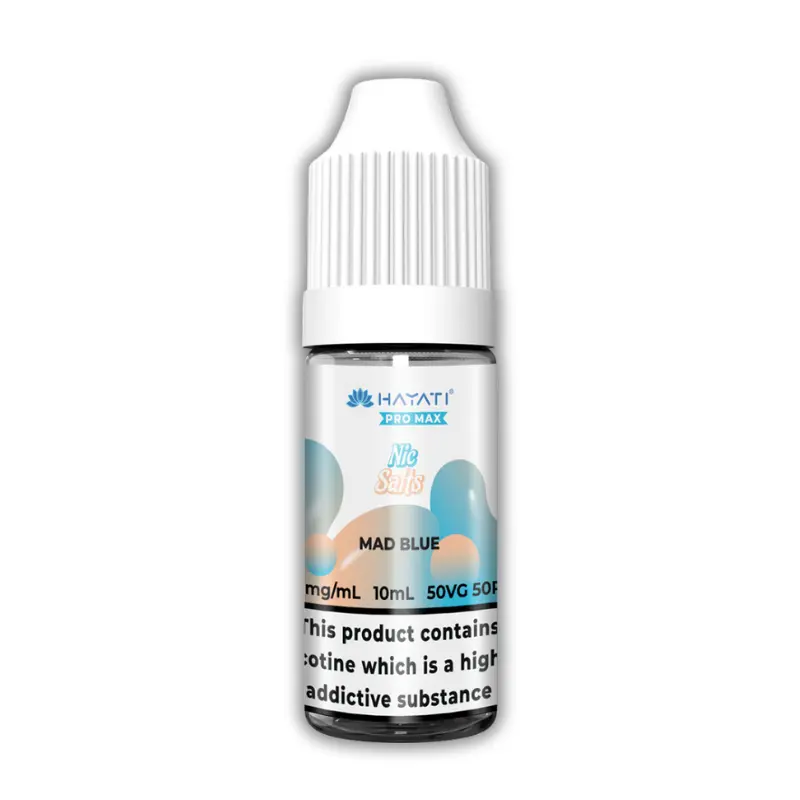
Hayati · Pro Max
Mad Blue Hayati Pro Max Nic Salt
£2.49
✔ In stock — ready to ship
Genuine Hayati
Free over £20
Same-day dispatch
Secure checkout
Mad Blue in a bottle costs £2.49. Ten millilitres of nicotine salt at 10mg, mixed evenly between vegetable glycerine and propylene glycol, with no device, no pod, no coil and no cell anywhere in the purchase. It belongs on the Hayati Pro Max Nic Salts shelf alongside sixty-four other bottles that are the same size, the same strength and the same base, and it is the only one of the three Mad Blue listings Hayati sell that is not a sealed pod. If you own something refillable, this is the cheapest way the name is available anywhere in the range.
That is the transaction and it is unremarkable. What is not unremarkable is a single sentence Hayati printed on this listing and nowhere else. The copy suggests that if Mr Blue sounds too tame, this bottle is the more intense-sounding choice within the same colour. Read that twice, because the two load-bearing words in it are both about hearing. Not tasting. Not how the liquid behaves in the mouth, not where the sweetness sits, not whether there is any coolant. Hayati have compared two of their own products and the property they have compared them on is the impression made by their names.
The people who wrote that sentence are the people who wrote both names. So what a buyer is handed is not a comparison of two liquids by someone who has tasted them. It is a comparison of two labels by their author, offered as a reason to pick one over the other. That is a peculiar piece of evidence, and it is also, as far as I can establish from the catalogue, the only direct comparative statement Hayati make between these two flavours anywhere in four hundred and ninety-two listings.
This page is about that sentence. What it actually claims, how unusual its construction is once you count the catalogue for similar sentences, why this particular shelf is where such sentences cluster, and what happened to the two names afterwards, which is the part the sentence cannot tell you and the sales record can. Everything below is about labels, filing and distribution. None of it is a claim about what is inside the bottle, and where I move from a count to a guess I have said so in the sentence where it happens.
The two words in the sentence that are about hearing
Take the construction apart before counting anything, because the grammar is doing more work than it looks.
The first clause sets a condition on the reader: a rival product is said to sound a certain way. Not to taste mild, not to be mild, not to have struck previous buyers as mild. To sound it. The verb locates the whole judgement in the act of reading a label rather than in the act of using a liquid, and it does so about a product that thirteen separate listings in this catalogue describe without any of them calling it weak.
The second clause resolves the condition, and it resolves it in the same register. The bottle is offered as the more intense-sounding choice. A copywriter with an intensity claim to make about a liquid has an obvious word available and it is shorter: intense. Adding four letters to it converts a claim about the product into a claim about the product's name, and the conversion was deliberate enough to happen twice in one sentence.
Now the counting, because a single sentence read closely can be made to mean almost anything and a count cannot. I searched all four hundred and ninety-two Hayati descriptions for the suffix used that way, meaning an adjective attached to how a flavour name registers rather than how a flavour tastes. It appears exactly twice. Once here. Once on the Black Mamba Pro Max Plus kit, which calls that liquid one of the bolder-sounding blends in the line-up, and which is a name with the same problem: a snake is not an ingredient and there is nothing to describe, so the copy describes the label instead. Black Mamba exists on this shelf as a bottle too, at the same £2.49, and it is the natural companion piece to this one for anybody interested in what a copy desk does when the title hands it nothing.
Two listings out of four hundred and ninety-two. In both cases the flavour name refuses to specify an ingredient, and in both cases the writer, given nothing to describe, has described the name. That is a small sample and I am not going to claim it establishes a policy. What it does establish is that the construction is rare, that it is not the house default, and that the two places it occurs have the same underlying problem.
Here is the sharper version of the same test. The sentence on this bottle sits inside a template Hayati use repeatedly: if a named flavour is too something for you, here is the alternative. Counting every instance of that shape across the catalogue gives thirteen, of which twelve are genuine flavour comparisons and one is about liquid thickness and a device. Of the twelve, ten use a verb of experience. Blackberry Raspberry feels too busy. Black Mamba is too dark. Triple Mango feels too one-note. Spearmint is too soft and Menthol too icy. Straight lemon flavours are too sharp. Two use the verb of hearing, and one of those two, on the Strawberry Watermelon bottle, aims it at an unnamed variant rather than at a specific product.
Which leaves this listing as the only place in four hundred and ninety-two where Hayati name a specific sibling product, set the reader's own product against it, and make the whole comparison turn on how the rival's name sounds. The angle I was handed said the ranking was of names rather than liquids. Counting does not merely support that, it puts the claim on firmer ground than the version handed over, because the copy states it outright in both halves of the sentence and nothing else in the catalogue does.
Twenty-seven sentences that rank, and where they live
A single unusual sentence is a curiosity. It becomes useful once you know how common the underlying behaviour is, so here is the wider count, with the rule stated first so anybody can repeat it or disagree with it.
The rule. A description counts if one sentence of it names two or more Hayati flavours, at least one of which is not the product being sold, and places them on a shared axis using a comparative. Sweeter, sharper, darker, lighter, more defined, less specific, sits between, too much of something. A sentence that merely mentions a sibling does not count. Neither does a sentence that steers you to a different flavour on grounds of preference without ordering the two, which is a different and much commoner move.
Applying that rule to all four hundred and ninety-two descriptions returns twenty-seven listings. Roughly one in eighteen. The figure I was handed was about twenty, which turns out to be a little low, and the correction goes in the same direction as the argument rather than against it.
Twelve of the twenty-seven sit on this bottle shelf.
That is the number worth pausing on. The bottled nic salt shelf holds sixty-five of the four hundred and ninety-two listings, which is thirteen per cent of the catalogue. It carries forty-four per cent of every sentence in which Hayati rank one of their own flavours against another. Ranking copy is more than three times as concentrated here as it is anywhere else, and if you exclude the dual-flavour pods, where two names appear in one title and comparison is close to unavoidable, the concentration goes up rather than down.
The twelve, so the count can be checked rather than taken on trust. Blackberry Ice against Blackberry Raspberry. Red Berry Ice against Black Mamba. Blueberry Cherry Cranberry against Strawberry Cherry Cranberry. Berry Lemonade against both the blackcurrant and the blue razz lemonades, on the axis of how specific each name is. Menthol against Spearmint and Fresh Mint. Fresh Mint against Spearmint and Menthol, in the other direction. Black Mint against both of them again. Mango Peach Pineapple against Triple Mango. Fizzy Cherry against Cherry Ice. Cherry Cola placed between Cola Ice and Cola Lime. Fresh Menthol Mojito against Strawberry Mojito. And this one.
Two features of that list are worth drawing out.
The first is that the mints account for three of the twelve on their own, and all three rank the same small group against each other in different orders. That is a family with a genuine ordering problem, because Menthol, Spearmint, Fresh Mint and Black Mint differ from one another in ways that a fruit name cannot express, and the copy has responded by building a rough scale. It is the closest thing to a deliberate index anywhere in the range, and it is confined to four listings.
The second is that five of the twelve use the if-too template, and all five are on this shelf. Blackberry Ice, Red Berry Ice, Mango Peach Pineapple, Fresh Mint and this one. So the sentence on your bottle is not a one-off flourish. It is a house construction, reached for five times on sixty-five listings and almost never elsewhere, which matters for how much weight you put on it. A template sentence is filled in rather than composed, and the thing filled into the slot here was a judgement about a name.
If you loosen the rule to admit sentences that pair two named flavours without ordering them, the total rises by roughly half again. Most of the additions are simple cross-references: Cola Lime naming Cola Ice as a partner, Bru Ice suggesting the same, Mr Pink describing itself as the counterpart to Mr Blue, Blue Razz Lemonade pointing at the other two lemonades. The shelf keeps its lead under the looser rule as well, which is the check worth running on any count of this kind, because a finding that survives only one definition is usually a finding about the definition.
Why a shelf of bottles is where the copy turns navigational
The concentration is not a coincidence and it is not a criticism. It follows from the structure of the shelf, and once you see the structure the behaviour is close to forced.
Every bottle here is ten millilitres. Every bottle is 10mg, and that is the only concentration the shelf offers. Every bottle is an even split of glycerine and glycol. Sixty-four of the sixty-five are £2.49, a figure the Summer Dream bottle page established and which I am citing rather than recounting, the exception being the range-level listing that sits at £2.79 and sells the line rather than a flavour. Nothing arrives in the box except liquid. There is no device to choose, no fill volume to weigh up, no puff rating to compare and no hardware decision of any kind.
Which means that when a copywriter sits down in front of one of these listings, the only thing that distinguishes it from sixty-four neighbours is the name on the front, and the only service the copy can perform is to help someone choose between names. On a pod shelf there is other work available. Volume, device inclusion, whether a body comes in the box, what the price buys that the cheaper listing does not. Those are real differences and copy can spend itself on them. Here there is nothing to spend on but the name, so the copy becomes navigational, and navigation between similar things means ranking them.
Look at what falls out of that. The mints rank each other because a buyer genuinely cannot tell Fresh Mint from Black Mint from Menthol by reading, and the copy has no other lever to pull. Blueberry Cherry Cranberry reaches for Strawberry Cherry Cranberry because two of its three fruits are shared and the difference is one substitution. Berry Lemonade ranks itself as the vaguer of three lemonades, which is a statement about labels rather than liquids and is honest about being one. And this bottle ranks itself against Mr Blue, because Mr Blue is the other bare colour on the shelf and there is nothing else to hold it against.
So the sentence on your listing is the shelf working as designed. A flat shelf forces the copy into comparison, and a pair of names that describe no ingredient forces the comparison onto the names. What that does to the sentence's value as evidence is the uncomfortable part: it was produced by a structural pressure rather than by anybody's knowledge of the two liquids, and a sentence written because the slot needed filling tells you about the slot.
Worth saying plainly, since a page can drift into complaint without noticing. Flat pricing across a shelf is a decision in the buyer's favour. It makes a basket predictable, it removes the suspicion that a longer name costs more, and on the Hayati E-Liquids shelf, which runs to a hundred and five listings across the bottled formats, it means moving between flavours costs nothing but the flavour. The cost is confined to one place. When every other variable is held constant, the description has to carry the whole discrimination, and descriptions written under that pressure start ranking labels.
The ranking runs one way, and it starts from the cheapest listing
Here is a check on the sentence that does not depend on reading it at all. If Hayati genuinely hold a view that one of these two liquids is more intense than the other, that view should show up in more than one place, because both flavours are described repeatedly and independently.
It does not. Mad Blue is sold three times and therefore described three times. The Pro Max Plus pod listing places it among the boldly named blue flavours and points at blue razz as the family it belongs to, which is a category rather than a product. The Pro Max Plus kit listing calls it loud and sweet and treats the blend as one cohesive thing. Neither of them names another Hayati flavour at all. The comparison with Mr Blue appears once, on this bottle, which is the cheapest of the three by more than half.
Run it from the other side and the asymmetry is starker. Mr Blue carries thirteen listings, which means thirteen separate attempts to describe that liquid. Not one of them mentions Mad Blue. Not once, in thirteen descriptions written across every format Hayati operate. The louder name knows about the quieter one. The quieter one has never heard of it.
There is one place in the catalogue where both names appear in a sentence written by somebody with no stake in either, and it is instructive. The Blue Fusion bottle, three listings along on this same shelf, names Mr Blue and Mad Blue together as two ways into the same colour family, and pointedly does not put one above the other. Same shelf, same price, same copy desk, both names in one sentence, and no ranking. Which tells you the ranking was not an established house position waiting to be stated. It was a move made once, on one listing, by whoever was filling in that template.
A related claim needs handling carefully rather than repeated or contradicted. The Blueberry Raspberry / Mr Blue Pro Ultra Plus kit page states that that pairing and its bare-pod twin are the only places in the catalogue where Hayati put both of those names in one sentence and say which is which. That claim is about that specific pair of names, Blueberry Raspberry and Mr Blue, and nothing on this page touches it. Twenty-seven listings ranking various flavours against each other is not a counter-example to a claim about one pair, and I am citing the finding rather than correcting it.
One footnote on it, offered as a definitional edge rather than an error. The solo Mr Blue Pro Ultra Plus kit points the reader at the dual listing and calls the other half a more defined berry mix, which does put both names in one sentence and does order them, although the second name reaches the sentence only inside a product title. Whether that counts depends on whether a name inside a title counts as a mention, which is a judgement rather than a fact. The reason I lean towards it being a house construction rather than an oversight is that the solo Summer Dream kit does exactly the same thing in the same words, pointing at its own dual listing and calling the other half sharper. Two instances of one sentence shape is a template, and templates are not positions.
What the two names did afterwards
The sentence ranks the names. The catalogue records what happened to them, and that is a different kind of evidence entirely, because it was produced by commercial decisions rather than by a copywriter with a slot to fill.
Mr Blue travelled. The Mr Blue Rubik kit page counted this properly and I am citing it rather than doing it again: thirteen listings spread across all seven of the product lines Hayati operate, which puts it in a top distribution tier that only eight flavour names in the catalogue reach, and makes it one of only two names in that tier that describe no ingredient. That page also sets out the honest limits, which are worth carrying over. Distribution measures how few people refuse a flavour rather than how many love it, there is a feedback loop in the number, and nothing about being on seven lines tells you what a liquid tastes of. I have nothing to add to any of that and will not pretend otherwise.
Mad Blue did not travel. Three listings on two product lines, and both lines carry Pro Max in the name. This bottle, the Pro Max Plus pod at £5.49 and the Pro Max Plus kit at £7.99. It has never appeared on the Pro Ultra Plus, never on the Mini Ultra, never on the Rubik, and never in either of the two larger bottled formats, where plenty of blue flavours do appear: Blueberry Raspberry as a 50/50 shortfill, the same blend at 70/30, a Blue Razz Gummy Bear shortfill and others besides. So the name that was offered as the more intense-sounding of the pair is on three listings, and the one it was ranked above is on thirteen.
Two cautions before anybody reads a verdict into that. Distribution says nothing about which liquid anyone prefers, for exactly the reasons the Rubik page sets out. And a flavour's spread is partly a function of how long it has been in the range, which the catalogue does not publish, so a name on three lines might be a name that failed or a name that arrived late. Neither is knowable from here and I am not going to pick one.
What can be said without guessing is narrower and still useful. Whatever the sentence on this bottle asserts about how the two names sound, the quieter-sounding one is the one Hayati have tooled onto seven separate product lines, seven sets of packaging and seven inventory commitments. Intensity of name and reach of name run in opposite directions here, and the listing that claims the first has none of the second.
The filing tells the same story, from a different department
There is a second layer of evidence nobody has looked at, and it comes from the shop rather than from the manufacturer, which makes it independent of everything above.
The catalogue carries thirty flavour shelves. Most gather something generic: a fruit, a treatment, a style. Berry Vapes runs to two hundred and twenty-five products, Blueberry Vapes to ninety, and there are shelves for cherry, lemon, mango, cola, mint and the rest. Exactly four of the thirty are named after a single Hayati flavour and contain nothing else: Mr Blue with thirteen listings, Summer Dream with thirteen, Juicy Peach with thirteen and Fresh Mint with eleven. Four flavour names out of roughly a hundred and sixty in the catalogue have been given a shelf of their own.
Mr Blue has one. Mad Blue does not.
The comparison gets sharper if you hold the format constant and look at the two bottles side by side on this shelf. Mr Blue's bottle carries exactly one flavour shelf tag, and it is the shelf named after Mr Blue. No berry tag, no blueberry tag, nothing generic at all. The shop files that bottle under itself. This bottle carries two flavour tags and neither is its own: Berry Vapes and Blueberry Vapes. It is filed under a fruit that its own description offers only as a reading of the colour, on a shelf of ninety products where it will sit beside listings that name blueberry in the title and mean it.
Read charitably, that is a retailer doing a sensible thing with an ambiguous name, putting it where somebody hunting blue fruit will trip over it. Read less charitably, one of these two names has become a category and the other has been absorbed into a fruit it does not claim. Both readings are available and the filing supports both. What neither reading permits is treating the shelf structure as evidence about the liquid, and I want to be explicit that it is not: these are merchandising decisions made by the shop, not statements by Hayati, and a shelf tag is a routing instruction rather than a description.
One more thing the filing does say, and this one is practical. Because this bottle sits on Blueberry Vapes and Mr Blue's does not, the two are harder to find together than you would expect from two products that Hayati's own copy explicitly links. A shopper browsing by fruit meets one of them. A shopper browsing the Mr Blue shelf meets the other and thirteen of its formats. The bottled shelf and the shop's full new-listing feed are the two places both appear at once.
The one Mad Blue that is not sealed
A consequence of the three-listing spread is worth stating on its own, because it is the only genuinely practical difference between this listing and its two siblings.
The Pro Max Plus pod and the Pro Max Plus kit are both sealed prefilled pods. Nothing about either can be measured, decanted, split or sampled, and the liquid inside them comes as a fixed quantity at a fixed strength in a fixed piece of hardware. This bottle is ten millilitres of liquid in a bottle. You decide the device, you decide how much goes in, and you can stop after two millilitres if you have formed a view.
That makes this the only Mad Blue anybody can approach in small quantities, and it is the reason the price gap matters more than the numbers suggest. The gap between £2.49 and £5.49 is three pounds on paper. In practice it is the gap between a commitment you can abandon and one you cannot, and the Summer Dream bottle page has already worked through in detail what a bottle can and cannot settle about a sealed pod, including the two confounds that stand in the way. Anyone planning to use this bottle that way should read that argument rather than a compressed version of it here, and should know before starting that the strengths are different numbers on the two sides.
The bottle itself, which is the short part
Ten millilitres of liquid arrives and nothing else does. No device, no pod, no replacement parts, no accessories. The nicotine is present as a salt at 10mg per millilitre, and nicotine is addictive whatever form it takes and whatever the concentration.
An even split of glycerine and glycol makes a thin liquid. Thin matters for one practical reason: it moves through cotton quickly, which suits a small chamber with a narrow airway and a restricted draw, and does not suit a wide low-resistance tank, where a thin liquid tends to arrive faster than the element can turn it into vapour. The listing itself says to keep it away from sub-ohm tanks and that is sound.
Beyond that, the hardware side of this purchase is yours rather than the listing's. Element resistance, power, airflow and how much liquid sits above the wick at any moment are all properties of a device in your drawer, and no bottle listing can tell you any of them. On which devices accept what, do not take a cross-range fitment judgement from any retail page including this one, because Hayati publish very little about it.
Two millilitres is the maximum a refillable chamber holds under UK rules for that format, so ten millilitres is five fills of a full chamber, give or take whatever your particular pod actually takes. That arithmetic is the only reason the bottle size is worth a sentence: it sets how many separate occasions you get to form an opinion before the bottle is gone.
The figures, ordered by how much each one helps you choose
The rows below run from the ones that separate this bottle from its neighbours down to the ones that are identical across the whole shelf and therefore cannot discriminate at all. On a shelf this uniform that ordering is the useful one, because nearly everything on a nic salt specification sheet is shared.
| Row | Entry |
|---|---|
| What the name specifies | A colour family and a magnitude. No fruit, no coolant, no sweetness level |
| Comparative claim on the listing | One, against Mr Blue, and it is a claim about how the two names sound |
| Flavour shelves this bottle is filed under | Berry and Blueberry. Neither names Mad Blue |
| Other listings carrying this name | Two, both sealed Pro Max Plus pods, at £5.49 and £7.99 |
| Product lines the name reaches | Two of the seven Hayati operate, both inside Pro Max |
| Price | £2.49, matching sixty-four of the sixty-five bottles on the shelf |
| Cost per millilitre | 24.9p, which is the arithmetic and not a claim |
| Volume | 10ml, as every bottle here is |
| Nicotine | 10mg per millilitre, in salt form. The only concentration the shelf offers |
| Carrier base | Half glycerine, half glycol |
| Supplied hardware | None |
| SKU | HPM-NS-MAD-BLUE |
| Brand and range | Hayati, Pro Max |
Three rows carry the page and the rest are shelf furniture.
The comparative-claim row is the one this listing has that its neighbours mostly do not, and the table is the right place to record what kind of claim it is rather than leaving the reader to discover that the intensity is attributed to a label. Twelve bottles on this shelf carry a ranking sentence. This is the only one in the catalogue whose ranking sentence is about how a rival's name sounds.
The filing row exists because it is genuinely decision-relevant and nobody would think to look for it. If you are working through the blue end of this shelf by browsing a fruit category, the category you are browsing contains this bottle and does not contain Mr Blue, which is the opposite of what the copy's own comparison would lead you to expect.
The two rows about distribution are there because they are the only hard numbers available on the question the listing raises. A name on two product lines and a name on seven are different commercial objects, and the listing that makes the comparison mentions neither figure.
Two absences are worth naming rather than leaving blank. Hayati do not publish which fruits, if any, this blend is built from, and they do not publish whether there is any coolant in it. The naming convention is weak evidence against a heavy chill, since the range declares cold in a title when cold is a feature, but weak evidence is not an answer. If a definite answer on cooling is what decides your purchase, Blue Frozen states it on the front and costs the same money.
Which bottle instead, and on what grounds
Sorted by the reason you would switch. Everything named here is £2.49, ten millilitres and 10mg unless the link says otherwise, so the only thing you are trading is the liquid.
If what you wanted was the intensity, stated on an axis instead of attributed to a name. Blue Sour Raspberry is the straight answer. Sour names a property and a direction in one syllable, it is checkable on the first draw, and it applies that property to precisely this colour on precisely this shelf at precisely this price. If the appeal of Mad Blue was the promise of something turned up, and you would rather the turning-up were declared than implied, that bottle declares it. Nothing on this page says it is the same liquid pushed further, because nothing published says that.
If the colour was the point and the vagueness was not. Blueberry Raspberry is the reference bottle for the whole blue end of the shelf, two fruits, both real, nothing withheld, and it is the most heavily described flavour in the catalogue by a distance. Blueberry Raspberry Lemon adds a citrus cut at the end of the same pairing. Strawberry Raspberry Blueberry keeps three named berries and leads with red rather than blue, which changes the character more than an ingredient list suggests it would.
If you want the blue accord with a second declared thing in it. Blue Razz Cherry puts a darker, rounder fruit underneath the blue. Blue Razz Mojito takes the same accord through a drink construction with citrus and mint in it. Blue Razz Lemonade lightens the impression rather than deepening it. Each of those three has a second word doing real work, which is the difference between a name that filters and a name that sorts.
If depth rather than brightness is the complaint. Blueberry Cherry Cranberry puts an astringent berry at the back of a three-fruit blend, and its own copy is one of the twelve ranking sentences counted above, which makes it a useful listing to read for the construction as well as the liquid. Blackberry Raspberry keeps two berries from the same genus with one plainly in front. Blackcurrant Juice goes somewhere darker again and names a fruit that holds its shape under sugar.
If cold is the missing variable. Blue Frozen and Blackberry Ice both declare it in the title, and Banana Ice does the same well outside the berry family if the fruit is what has stopped working rather than the temperature. Buying a titled product is the only way to be certain, on a shelf where the absence of a cold word is suggestive and not conclusive.
If the coined name is what interests you rather than the flavour. Black Mamba is the closest relative this bottle has, for the reason set out near the top: it is the other listing in the catalogue whose copy describes how the name sounds. Blue Fusion is the third bare colour on this shelf and the one that names both Mr Blue and Mad Blue without ranking them. Hayati Pro Max Shisha Nic Salts takes the problem somewhere else again by borrowing a term from a different tradition entirely. Reading those four bottles together is the quickest tour of what this range does when a title has no ingredient in it.
If you would rather meet the name on hardware than in a bottle. The two sealed Mad Blue listings are the Pro Max Plus pod and the Pro Max Plus kit, and neither is linked here because neither is a bottle. For the surrounding pod shelf, Blueberry Cherry Cranberry pods and Blue Razz Pineapple pods are the named blue-adjacent options at £5.49, Blueberry B'Gum pods take the berry towards confectionery, and the same two flavours also exist as complete kits with a device at £7.99. Those are different transactions from this one and the reasoning on this page does not transfer to them.
If you want the same idea in a larger bottle. Mad Blue is not sold that way, which is part of the distribution finding above. The blue flavours that are include Blueberry Raspberry as a 50/50 shortfill and the 70/30 version at £6.99, with Blueberry Cherry Cranberry and its own 70/30 counterpart doing the same for the darker three-fruit blend. Those are a different format with a different base and a different device requirement, so treat them as a separate decision rather than a bigger version of this one.
If none of the blues are landing any more. The Blueberry Vapes shelf runs to ninety listings and Berry Vapes to two hundred and twenty-five, and the full Hayati range to four hundred and ninety-two, which is a great deal of room if the accord itself has stopped being interesting rather than one bottle of it.
Using a bottle whose only comparative claim is about a label
The general handling of a ten millilitre nic salt is the same here as anywhere. What follows is only the part that changes because of what this particular listing is.
Do not let the sentence set your expectations before the first fill. This is the specific risk on this bottle and it is worth naming. You have been told, by the only comparative statement available, that this is the more intense of a pair. That statement is about a name. If you go in expecting a liquid that announces itself, you will find one, because an expectation of loudness is very good at manufacturing an impression of loudness on a first draw. Fill the chamber, let it stand, and take the first two or three draws before you think about the comparison at all.
Give a new fill two or three minutes before drawing. A thin base wets cotton quickly, so this is not a long wait, but a dry first pull on a sweet liquid tastes flat and faintly papery rather than obviously wrong, and that is very easy to file as a property of the flavour when it is a property of the first thirty seconds.
Keep a record, because the bottle is five fills and the memory of the first will be gone by the fourth. Three lines is enough and they should be the three things the name withholds. Where the sharpness lands, at the front of the draw or on the exhale. Whether the sweetness coats or runs dry. Whether there is any cooling at all, on a scale of none, a trace, or obvious. Those three readings are the only description of this liquid that will exist anywhere you can reach, and they cost nothing to take.
Do not run the comparison the listing invites on a tired element. If you intend to set this against Mr Blue, or against any of the named bottles above, do it on fresh cotton in both directions. A sweet liquid leaves residue faster than a dry one, and the first thing a fouled element stops reproducing is the fine aromatic detail that any comparison between two similar blues would turn on. Comparing a new fill of one against the last fill of another measures the element rather than the liquids.
Cap it properly and keep it in a drawer. Light and warmth work on sweet fruit liquids over weeks, darkening them and dulling the top notes, and on a flavour with no published description that matters more than usual, because you have no reference to tell you whether what you are tasting is the recipe or six weeks on a windowsill. Somewhere out of reach of children and pets is the right drawer.
Know when to stop rather than pushing on. When a fill has gone quiet and what remains is sweetness with a warm edge behind it, that is the element and not the bottle, and continuing gains nothing but a worse impression of a liquid you may well still like. An empty bottle is ordinary plastic once it is rinsed, and any residue should go the way liquid waste does rather than down a drain.
Questions this listing raises
Is Mad Blue actually stronger than Mr Blue?
Nothing published says so about the liquids. What Hayati say is that Mr Blue sounds tamer and that Mad Blue is the more intense-sounding of the two, and both of those adjectives are attached to how the names register rather than to how either liquid behaves. Nicotine is identical at 10mg across every bottle on this shelf, so strength in that sense is not a variable here at all.
Why does it matter that the comparison is about names?
Because the people making the comparison wrote both names, which makes it circular as evidence. A ranking of two labels by their author tells you what the author thought the labels imply. It does not tell you that anybody tasted the two liquids side by side, and no other listing in the catalogue repeats the ranking.
How unusual is a sentence like that?
Ranking sentences themselves are not rare: twenty-seven of the four hundred and ninety-two descriptions place two Hayati flavours on a shared axis in one sentence, and twelve of those twenty-seven are on this sixty-five bottle shelf. What is rare is the register. Only two descriptions in the whole catalogue describe how a flavour name sounds, and only this one does it about a specific named rival.
Why are so many of the ranking sentences on this shelf?
Because there is nothing else for the copy to distinguish. Every bottle here is ten millilitres, 10mg, the same even base, and sixty-four of the sixty-five are the same price. When every variable except the name is held constant, the description has only names left to work with, and helping somebody choose between names means ordering them.
Does Mad Blue contain blueberry?
Unpublished. The description offers blue raspberry and blueberry as the territory the colour points at, which is a reading of the name rather than a statement of contents, and it says so itself by calling them clues. The shop files the bottle on its Blueberry shelf, but a shelf tag is a routing decision made by the retailer and not a recipe.
Is there any ice or menthol in it?
Not stated either way. The range does tend to declare cooling in a title when cooling is a feature, so the absence of a cold word is weak evidence against a heavy chill, and weak evidence is all it is. A bottle that names the cold on the front settles the question and costs the same.
What is the difference between this and the Mad Blue pod?
Format, strength, price and reversibility. This is ten millilitres of 10mg liquid you pour into your own device for £2.49. The pod is a sealed prefilled unit at a higher strength for a Pro Max Plus, and a kit version adds the device. This bottle is the only Mad Blue that is not a sealed pod, which is the whole of its practical distinction.
Can I use this bottle to find out whether I would like the pod?
Partly, and less than the arithmetic suggests. The strength is a different number on each side and the device is yours rather than the factory's, so two of the variables that shape what you taste are not held constant. The Summer Dream bottle page works through both confounds at length and is the right place to read about it before spending the money on that basis.
Why is Mad Blue on so few listings?
Three listings on two product lines, both of them Pro Max, against thirteen listings on seven lines for the name it is ranked against. What that means is not settleable from public catalogue data, since spread reflects how long a flavour has been in the range and how few people refuse it as much as anything else. It is a fact about the range rather than a verdict on the liquid.
Is the liquid in the bottle the same recipe as the liquid in the pod?
Hayati do not say. The two share a name and a brand, which is suggestive, and they are built at different strengths for different hardware, which is a reason recipes sometimes diverge. Nobody outside the factory can settle it and no page on this site should pretend to.
Is £2.49 a fair price?
It is what sixty-four of the sixty-five bottles on this shelf cost, so the shop is charging nothing extra for the intensity claim and giving nothing back for the missing fruit description. Price on this shelf carries no information about the liquid, which is one of the reasons the copy has to do the sorting.
Which device should I put it in?
Something refillable with a small chamber and a restricted draw. An even glycerine and glycol split is thin enough to wick quickly into a narrow airway and too thin for a wide low-resistance tank, where it tends to arrive faster than the element can cope with. Beyond that the hardware is yours and the listing cannot help.
The position, plainly
£2.49 buys ten millilitres of Mad Blue at 10mg in an even base, with no device and no hardware of any kind, on a shelf where sixty-four of the sixty-five bottles carry the same price and every one of them carries the same strength, volume and base. It is the only one of the three Mad Blue listings that is not a sealed pod, and therefore the only one anybody can meet a little at a time.
The listing carries one comparative claim and it is a claim about labels. Hayati suggest that if a rival name sounds too tame, this one is the more intense-sounding choice, and both halves of that sentence rank the sound of a name rather than the behaviour of a liquid. Counting the catalogue supports the reading rather than softening it: the suffix used that way appears twice in four hundred and ninety-two listings, the template the sentence sits in is used thirteen times and usually with a verb of experience, and this is the only place where a specific named rival is judged on how it sounds. Ranking sentences themselves are commoner than they look, twenty-seven in all, and twelve of those sit on this one shelf, which is what a flat shelf does to copy that has nothing else to differentiate.
Set against the ranking is the record of what the two names did. The one called tamer runs to thirteen listings across seven product lines and has a shelf in this shop named after it. This one runs to three listings on two lines, both inside Pro Max, and is filed under a fruit it does not claim. That is not a verdict on either liquid and it should not be read as one. It does mean that the only comparative evidence a buyer has between these two bottles was written by the people who named them, about the names they chose, and that everything else in the catalogue points the other way.
Strictly for adults aged 18 and over. Nicotine is an addictive substance.
You might also like


