Home / Hayati Pro Max Plus Pods / Blueberry Raspberry Cherry Hayati Pro Max Plus Pods
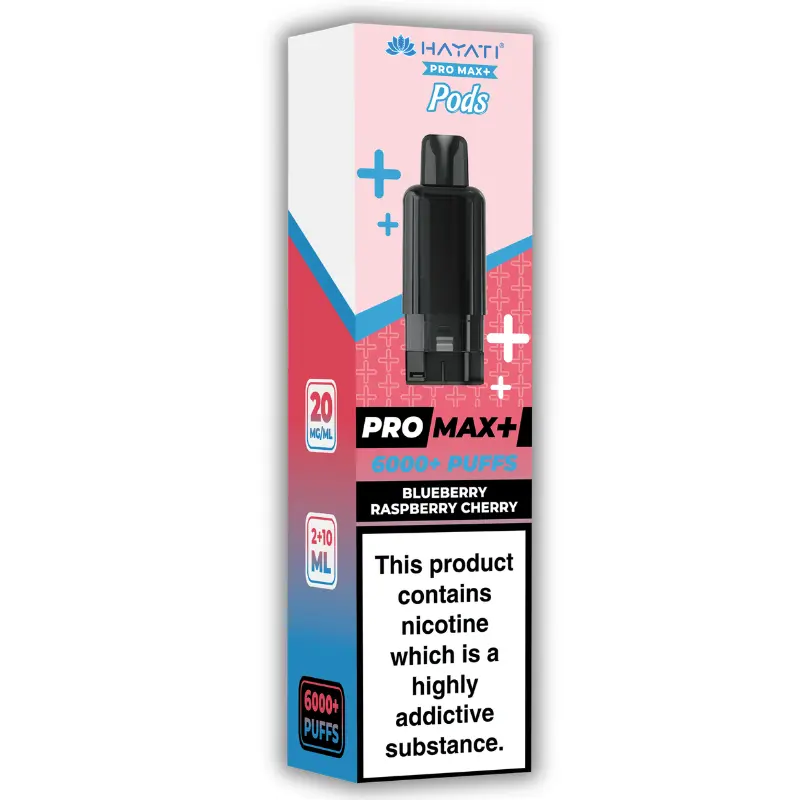
Hayati · Pro Max Plus
Blueberry Raspberry Cherry Hayati Pro Max Plus Pods
£5.49
✔ In stock — ready to ship
Genuine Hayati
Free over £20
Same-day dispatch
Secure checkout
Three fruit names on one label, and all three of them grow in the same part of the palate. Blueberry, raspberry and cherry sit within a narrow band of colour, a narrow band of sugar and a narrow band of acid, and if you handed somebody a draw of this liquid with the packet hidden they would almost certainly say dark berry and then stop. That is the interesting thing about this pod and the reason this page exists. It is not whether the blend is pleasant, because it is, and it is not whether the fruits are real, because a flavour house builds all of them from aroma compounds regardless. It is whether the third name on the label is buying you a third flavour or simply a third word.
This is the replacement pod on its own at £5.49, factory filled, for a Hayati Pro Max Plus body you already have in a pocket or a drawer. No device comes with it. Anyone who needs the hardware as well wants the Blueberry Raspberry Cherry Pro Max Plus 6000 Pod Kit instead, which is the identical liquid with a body attached. Hayati's own figure for a full pod is up to 6,000 puffs, produced by test equipment drawing on a timer in laboratory conditions, and it tells you how much work one sealed coil has been given rather than how long the pod will last you.
What this page spends its length on is a single argument, worked through properly, because the specification is the same specification carried by the eighty-eight other listings on the Hayati Pro Max Plus Pods shelf and there is nothing new to say about it. The argument is this. Two of these three fruits are near neighbours that merge into one another in the mouth. One of them is genuinely different, and its difference comes with a condition attached that most buyers never hear about. Work out which is which and you can decide, before spending anything, whether you are buying a three-fruit blend or a two-fruit blend with a longer tail on it. Both are legitimate purchases. They are not the same purchase, and the label does not distinguish them.
Three names from one neighbourhood
What two other three-fruit pages have already settled
Two listings in this catalogue have had the same question put to them and the answers are worth carrying over rather than rebuilding, because both are sound and neither is about these fruits.
The first is Orange Lemon & Lime on the Pro Ultra Plus, which asked whether three citrus fruits deliver three flavours and concluded firmly that they cannot. All three share citric acid as their dominant acid, so the sour dimension of the liquid is one channel arriving from three directions rather than three sournesses in sequence. All three share limonene as the majority component of their peel oil, so the aromatic base is common as well. What separates orange from lemon from lime is a handful of minor terpenes present at a few percent, and those compounds are the most volatile and the most fragile in the whole recipe. That page's verdict was that three citrus names buy a better proportioned single citrus, with a floor, a top and a finish, rather than three things you can point at. Take it as established.
The second is Guava Kiwi Passion Fruit on this same platform, which asked a different question and answered it just as firmly. Its subject was not whether the fruits separate in the mouth but whether they separate in the shop. They do not. A three-part blend arrives pre-mixed in proportions decided by somebody you will never meet, the pod is the smallest unit anyone sells, and a buyer who forms an opinion about one component has nowhere to spend it. There is no version of any of these recipes with the third fruit turned down. That argument applies here in full and this page does not repeat it.
Why this trio is the harder case
Those two pages cover the extremes. Orange, lemon and lime are one botanical family and one sensory family, so they merge. Guava, kiwi and passion fruit are three separate families occupying three separate registers, green acid against scented body against a late aromatic lift, so they hold apart in the mouth and only fail to separate at the till.
Blueberry, raspberry and cherry are neither of those situations, and that is what makes this the awkward one. Take the botany first, because it runs the opposite way to intuition. Raspberry and cherry are close relatives, both members of the rose family, one a cluster of tiny drupelets and the other a single large drupe built on the same plan. Blueberry is not related to either. It belongs to the heath family, a different order of plant entirely, and its nearest relations in the catalogue are cranberry and bilberry rather than anything red. On paper, then, the outsider of this trio is the blueberry.
On the palate the ranking inverts completely. Blueberry and raspberry are the pair that blur together, and cherry is the one you can hear on its own. Botanical distance and sensory distance are pointing in opposite directions, which they rarely do, and the reason is worth setting out because it decides everything else on this page.
Before that, one count, because a claim about how unusual a construction is should be checked rather than asserted. Strip the hardware words off every title on the Pro Max Plus pod shelf and seven of them name three distinct fruits: Mango Peach Pineapple, Cherry Peach Lemon, Strawberry Cherry Cranberry, Strawberry Raspberry Cherry, Strawberry Raspberry Blueberry, Blueberry Cherry Cranberry and this one. Five of those seven are built entirely from red and blue fruit. So a same-neighbourhood three is not a rarity on this shelf at all. It is the majority construction, which makes the question more worth answering rather than less, because a buyer working through the berry listings will meet it repeatedly and the label gives them no way to tell one three from another.
Raspberry, the loud one
Raspberry is the fruit in this blend that announces itself first and most confidently, and it does so on two channels at once rather than one.
The first channel is acid. Raspberry carries a real acid load, mostly citric with malic behind it, and acid registers on the tongue faster than aroma reaches the nose because it does not have to travel. You get the tang inside the first moment of an inhale, along the sides of the tongue, before any of the aromatic material has had time to arrive. That is why raspberry reads as the opening of this liquid even though it is printed second on the label.
The second channel is a distinctive aromatic top that has no counterpart in blueberry. Raspberry's recognisable character leans heavily on a ketone, the compound commonly sold under the name raspberry ketone, supported by ionones that read as violet and slightly powdery. Whether a given liquid uses that exact isolate is not something Hayati publish and not something this page can tell you, but the profile is being referenced whatever the route to it, and the result is a note sitting high and bright above the sweetness. It is the single most identifiable thing in the pod for most people.
The important qualification is that raspberry is loud and short. Both of its channels are front-loaded. The acid thins out well before the draw finishes and the bright top goes with it, which is why raspberry on its own tends to read as sharp and slightly unsupported. A liquid built on raspberry with nothing beneath it stops rather than finishes, and if you want to hear that effect directly then Blue Sour Raspberry on this same shelf is the demonstration: a sharpened raspberry with no weight underneath, which ends abruptly.
Blueberry, the one that is easiest to bury
Blueberry is the quietest fruit in the trio by a considerable distance and the one whose contribution is hardest to name while it is happening.
Its acid content is low. Its aromatic material is spread across a large number of compounds none of which dominates in the way the raspberry ketone dominates raspberry, and much of what people recognise as blueberry is a soft, slightly floral, slightly resinous impression rather than a single recognisable marker. It also sits low and slow in the draw, building through the middle and staying into the exhale, because heavier aromatic material moves later than light aromatic material does.
Add those three properties together and you get a fruit that supplies weight, sweetness and duration without supplying an identifiable voice. The palate reports edges and novelty. A soft low-acid sweetness occupying the middle of a profile is neither of those things, so it registers as texture and the drinker attributes it to whatever else is in the glass.
That is not a criticism of blueberry and it is certainly not an argument that it could be left out. The catalogue itself makes the point without meaning to: across the whole range there is almost nothing built on blueberry alone. The Blueberry Vapes shelf runs to ninety listings and essentially every one of them pairs blueberry with something sharper, brighter or sweeter. A fruit with no acid cannot hold the front of a draw and ends up supplying the body instead, which is a useful job and an invisible one. The only place blueberry gets to be the loud element is when the recipe pushes it into confectionery territory, which is a different proposition entirely and is what the bubblegum treatment on the blueberry listing of that kind is for.
So the honest description of blueberry here is that it adds a property rather than a flavour. Sweetness, length, a rounded middle. Remove it and you would notice immediately, but you would not be able to say what had gone.
Cherry, the only voice made of different material
Cherry is the exception in this trio, and the reason is chemical rather than impressionistic.
The flesh of a cherry contributes very little aroma. What people recognise as cherry comes substantially from benzaldehyde, which occurs in the kernel, and benzaldehyde is unlike anything blueberry or raspberry brings to this recipe. It is not a fruit ester, it is not a terpene of the kind that carries berry character, and it does not sit anywhere near the compounds the other two are made of. That is precisely why cherry is the one component of this blend capable of being heard as itself: it is the only voice in the group that is not constructed out of the same materials as the others.
The chemistry of that dial, how much kernel character a cherry liquid allows through and what happens at each setting, is worked out at length on the Blueberry Raspberry / Blueberry Raspberry Cherry Pro Ultra Plus kit page, which is analysing this exact liquid as one half of a divided pod. That page establishes where the setting sits on this recipe and what the cherry is doing as a result. It is not restated here.
What this page does with it is different, and it is the point I was commissioned to make. Grant that cherry is the only separable voice in the group. Then notice the condition attached to that separability, which is the awkward part of the whole argument.
The separable voice cancels itself
Benzaldehyde has an unfortunate property for anyone who wants cherry to be a distinct third fruit in a berry blend. Below a certain concentration it does not read as cherry at all. It reads as a vague dark red sweetness that could be several other fruits, and at that level it is contributing depth and length rather than identity. Above that concentration it reads as almond and marzipan, because that is the other thing benzaldehyde smells like, and it always has been. There is very little space between the two.
Follow the consequence through. For cherry to be audible as cherry on top of a blueberry and raspberry base, it has to be pushed up to the point where its kernel character shows. But a marzipan note laid over dark berries does not read as a third fruit. It reads as a confectionery treatment, a glacé or liqueur character, which changes what the whole liquid is rather than adding a component to it. A buyer who came to a berry pod looking for three berries would not describe that outcome as three berries. They would describe it as a cherry sweet.
Which means the third name on this label cannot pay out in full at any setting. Turn cherry down and it stops being identifiable. Turn it up and it stops being a fruit in a berry blend. This is not a failure of formulation and it is not Hayati cutting a corner. It is a property of the fruit, and it is why cherry is so often found on a label next to something sharp or fizzy that gives the kernel note a job to do. Cherry Sour Raspberry on this shelf does exactly that, leading with the cherry and dosing the acid hard enough to hold it up, and the result is a liquid where you can point at the cherry without ambiguity. That is a different design from this one and worth understanding as such.
Mark that last stretch as reasoning rather than reporting. Hayati publish no proportions, no concentrations and no compound list for any pod in this catalogue, and nothing in this product's data says how much of anything is in it. What I have set out is what the fruits can and cannot do, which is a general claim about the materials, applied to a recipe whose actual settings are not published by anybody. Treat a page that quotes you percentages for this liquid as having invented them.
The catalogue ran this experiment already
One base, extended three ways
Here is the part of the argument that does not depend on my palate, because it comes out of the product data.
Strip the hardware wording off all 492 titles Hayati list and look for flavour names that are another flavour name with exactly one word added on the end. There are four. Three of those four extend the same base, and the base is Blueberry Raspberry. The extensions are Cherry, Lemon and Menthol. The fourth pair is unrelated, a watermelon build with bubblegum added.
That is a genuinely unusual position in the catalogue. Blueberry Raspberry is the only flavour Hayati have taken and modified in three separate directions, and the three directions happen to be perfectly graded by distance from the original. Menthol is not a fruit at all and is not even an aroma in the ordinary sense, since a coolant works on a receptor rather than on the nose. Lemon is a fruit from a different family occupying a register the base does not use, all acid and lift with no weight. Cherry is a fruit from the same colour, the same sugar band and very nearly the same sensory position as the two already in the bottle.
Line those three up and you have a measure of what adding a word to a two-fruit name is worth, graded by how far the added thing sits from what was already there. Nobody could fail to identify the difference between the base and its menthol version, because cold is not a flavour and has nothing to hide behind. That listing exists as Blueberry Raspberry Menthol Mini Ultra Pods at £3.49, and set against the plain Blueberry Raspberry Mini Ultra Pods at the same price, the pair costs seven pounds to run as an experiment and settles itself in one draw.
The lemon extension is nearly as easy. Lemon brings acid, and acid arrives early and in a position the base leaves partly empty, since raspberry's tang fades quickly and nothing replaces it. Add lemon and there is a second sharp event in the draw where previously there was one. That listing is on the Pro Ultra Plus rather than this platform, so it is not a like-for-like swap, but the principle holds.
The cherry extension is the hard one, and now you can see exactly why. It is the only one of the three that lands in territory already occupied. Raspberry has the acid. Blueberry has the weight and the length. Cherry, at any setting that keeps it reading as fruit, brings weight and length. It is the only extension of this base that has to share a job rather than take an empty one.
Eleven listings of the base, two of the extension
One more number from the same data, because it says something the marketing does not.
Plain Blueberry Raspberry, with no third word, appears eleven times across the Hayati range. It is on this platform as Blueberry Raspberry Pro Max Plus Pods at the same £5.49 as this pod, on the small format, on the Rubik system, on the Pro Ultra Plus at 22ml, in nic salt, and in two bottled formats. Eleven listings across seven kinds of hardware is as close to a house flavour as this catalogue has.
Blueberry Raspberry Cherry appears twice: this pod and its kit. It also turns up as one half of a divided pod on the Pro Ultra Plus, paired with the base it extends, which is the only place in the range where Hayati have put a flavour next to its own parent. That listing, Blueberry Raspberry / Blueberry Raspberry Cherry Pro Ultra Plus 25K Pods at £7.99, is a curiosity for exactly that reason, and its own page works through what a pairing built by addition rather than contrast does to a repeat buyer's memory of it.
Read the eleven against the two and the shape of the thing is plain. The base is the product. The cherry version is a variant of the base that two listings carry, and nothing in Hayati's own distribution of it suggests they regard it as a separate flavour deserving the same spread.
What the third word actually buys
Set the palate aside for a moment and ask a duller question. In Hayati's own product data, what changes when cherry is added to the name?
The answer is short enough to state exactly. This pod and its two-fruit parent are the same price, £5.49. They are the same volume, the same strength, the same format and the same hardware. They sit on the same shelves as each other with precisely one exception: this listing also appears on Cherry Vapes, a shelf of sixty-nine products, and its parent does not. That is the whole of the recorded difference between them. One extra shelf placement.
I am not suggesting that is why the flavour was made. A liquid with cherry in it belongs on the cherry shelf and it would be odd if it were not there. But it is worth knowing that the third word's only measurable effect in the catalogue is to put this pod in front of people browsing for cherry, because that is a fair description of what a third name does commercially: it widens the net. The same pod also sits on Blueberry Raspberry Vapes, a thirty-nine product shelf built around the base flavour, on Raspberry Vapes with a hundred and sixteen others, and on Berry Vapes with two hundred and nine more.
The second thing the third word buys is reassurance, and this is more valuable than it sounds. A shelf of ninety listings contains several named for a mood rather than an ingredient, and Blue Fusion is the example nearest to this one in colour. A buyer looking at that name knows nothing about what is in the pod and cannot form an expectation at all. Three printed fruit names tell you the recipe is fruit, that it is dark, that it is not cooled, that it is not a drink profile and not a confectionery build. That is real information and it is worth paying attention to even if the three names do not resolve into three tastes.
And the third thing it buys is a small amount of genuine liquid, which is the honest answer to the question this page opened with. The cherry is in there. It contributes depth and a longer finish. It just does not contribute an event you can point at.
So is this a cherry blend with a berry base?
That reading is tempting and I think it is wrong, but it is worth taking seriously before dismissing, because the logic behind it is sound as far as it goes.
The logic runs like this. Of the three fruits, only one is capable of being heard as itself. Blueberry and raspberry merge into a single dark berry accord in which raspberry supplies the edge and blueberry supplies everything else, and a drinker cannot reliably separate them without being told they are both present. Cherry is chemically distinct from both. Therefore the blend has one voice and one background, and the sensible way to name a thing with one voice and one background is by the voice. Cherry blend, berry base.
The reason that fails is the condition set out earlier. Cherry is only the separable voice in potential. To become the actual voice of this liquid it would have to be pushed to the setting where its kernel character shows, and at that setting it is no longer functioning as one fruit among three. It has become the identity of the whole pod. A liquid built that way exists and is easy to recognise, and the blue razz listings that add a cherry to a confectionery base are much closer to it than this pod is.
Where the cherry actually sits here, it is doing the same kind of work blueberry is doing: sweetness, weight, length. So the accurate description is not one voice over a base. It is one voice and two supports, where the voice is raspberry and the supports are blueberry and cherry. Which is close to the reverse of the tempting reading, and it means the naming order Hayati chose, blueberry first, raspberry second, cherry last, describes neither the volume nor the structure. It is alphabetically arbitrary and it happens to put the quietest fruit at the front.
The verdict, stated plainly
Three names. Two contributions. One experience.
The two contributions are an acid-and-brightness event at the start of the draw, supplied entirely by the raspberry, and a sweet weight underneath and behind it that runs to the end, supplied jointly by the blueberry and the cherry with no way for a drinker to apportion it between them. That is the whole architecture. A buyer who paid attention to a list of three is, on the evidence, attending to a list that behaves as two, and one of those two is a committee.
Does that make the third name dishonest? No, and the distinction matters. The cherry is present, it is doing something, and the something it is doing is a thing many people specifically want. What the name does is imply a kind of contribution, a separable third fruit taking its turn, that the chemistry of these three particular fruits cannot deliver in this particular arrangement. The implication is in the reader's head rather than in Hayati's words, but a label that reliably produces the same wrong expectation in most readers is worth flagging.
The case for roundness, which is a real thing to want
Having spent several thousand words arguing the third fruit is not separately audible, it would be dishonest to leave the impression that it is therefore pointless. It is not, and the argument in its favour is stronger than the sceptical reading allows.
A broad accord assembled from three sources behaves differently from one assembled from a single source, and the difference is not subtle. Each contributor brings a spread of compounds with its own weights and its own volatilities, and stacking three such spreads produces something with more material at more points across the draw than any one of them provides alone. The practical result is a profile with fewer gaps in it. Nothing drops out between the raspberry's exit and the exhale, because there are two things holding that stretch rather than one.
Over twelve millilitres that matters more than novelty does. A liquid with a gap in it becomes noticeable around the third day, because the palate stops being distracted by the first impression and starts registering the shape. A pod you are going to spend a week or two with is better served by being well filled out than by being striking, and this one is well filled out. That is the honest case for the recipe, and it is the same shape of case the citrus page reached on entirely different fruit: three names do not buy three flavours, but they do buy better proportions than one name could.
There is a second, more speculative advantage and I mark it as inference because nothing published supports it directly. A profile carried by three overlapping contributors should degrade more gracefully as a coil ages than one carried by a single contributor, because the volatile material that goes first is not all coming from the same place. The corresponding weakness is that what survives longest here is the durable part, the sweetness and the weight, and that part is common to a very large number of listings. So a late pod on this liquid drifts towards a generic dark berry sweetness rather than towards nothing. Whether you read that as graceful or as anonymous depends on what you wanted from it.
Who should buy the base instead
Anyone whose interest in this pod is the cherry specifically should buy something else, and the something else is not the two-fruit parent. It is a listing where cherry is the headline and has been given a partner that holds it up.
Anyone who likes dark berry liquids and is choosing between this and the two-fruit version at identical money is choosing between a slightly shorter, slightly more defined draw and a slightly longer, slightly heavier one. That is the real decision and it is a small one. Two ingredients separate more cleanly than three do when two of the three are occupying the same position, so the parent is marginally the more legible liquid and this one is marginally the rounder. Neither is better. They are two settings of the same idea, sold as two products at the same price, and the fact that you can buy both and run them back to back for eleven pounds is the most useful thing about the pair.
That test, incidentally, works better on this platform than on the divided pod where Hayati put the two halves together. A divided pod shares one chamber and one coil, so the first draws after switching sides are a mixture rather than a clean read of the new one, which is a problem its own page identifies. Two separate pods on the same body do not have that problem. Each pod brings its own coil and its own wick, so a swap gives you an uncontaminated second sample and the only carryover left is on your own palate, which a glass of water and ten minutes handles.
The pod itself, kept short
There is very little about this hardware that has not already been written eighty times over, so this section states what arrives and then gets out of the way. One sealed pod, prefilled, in a wrapper. Nothing else. No body, no cable, no spare, no adaptor of any kind. If the device you own has stopped working, this listing will not get you vaping again and the kit version is the one you want.
The specification that bears on the argument above is the fixed coil. It is built into the pod, it cannot be reached, changed or rewicked, and it processes the entire twelve millilitres before being discarded with the shell. For a liquid whose identity sits in a bright, early, volatile note, that arrangement has a specific consequence: coil ageing and flavour ageing are the same event, because you cannot pair a tired coil with fresh liquid to work out which one has changed. The raspberry top is the part that goes first. The sweet weight underneath it is the part that stays, which is why a late pod on this flavour reads rounder and duller than a new one rather than simply weaker.
Hayati publish the volume, the strength, the flavour name and a laboratory puff rating for this product, and nothing else. No coil resistance, no wattage, no carrier ratio, no airflow figure, no wick material and no dimensions appear against it, and none has been supplied from any other source for this page. On fitment, the sensible rule is to match the range name printed on your device to the range name in the listing title rather than reasoning from the brand, because Hayati publish no cross-range fitment chart and a hardware compatibility claim taken off a retail page is worth nothing. The rest of the format lives on the prefilled pods and refills shelf, and the full range across every system Hayati make is on the Hayati Pods shelf.
The sheet, sorted by how much it is worth knowing
The table below is not in the usual order. It runs from the things that are published and decide the purchase, through the things that are published and decide nothing, to the things nobody publishes at all, because on a pod like this the third group is larger than buyers expect and it is the group most often filled in by guesswork.
| Flavour, as printed | Blueberry Raspberry Cherry. One liquid, three named fruits. |
| How many of those you can expect to hear | Two contributions. Raspberry at the front, a shared sweet weight behind it. |
| Cooling | None. No cold word appears in the title and Hayati mark cooled listings plainly. |
| Sweetness | Medium to sweet. Clearly a sweetened fruit liquid, short of a confectionery build. |
| Sharpness | Moderate, front-loaded, and gone before the exhale. Tang rather than a dosed sour treatment. |
| Liquid | 12ml, filled at the factory, no way in. |
| Nicotine | 20mg in salt form. One option on this listing. |
| Price | £5.49 for the pod alone |
| Device | Not included. A Hayati Pro Max Plus you already own. |
| Manufacturer puff rating | Up to 6,000, measured on test equipment rather than by a person |
| Coil | Mesh, sealed inside the pod, discarded with it |
| Proportions of the three fruits | Not published, anywhere, for any pod in this catalogue |
| Flavour concentrations | Not published |
| Carrier ratio | Not published against this listing |
| Coil resistance | Not published against this listing |
| Fill date or batch marking | Not on the listing and not on the wrapper |
| Stock code | hpm-plus-6k-pods-blueberry-raspberry-cherry |
| Maker | Hayati |
Two rows repay a closer look, and both of them for reasons particular to a blend built inside one fruit family.
The second row is doing work the others are not, and it is there because the first row is misleading on its own. Every listing on this shelf prints a flavour name, and on a pod that names two fruits from different registers the name is a fair summary of the experience. On a pod that names three fruits from the same register it is not, and a sheet that reports only the label is telling you less than it appears to. That row is my reading rather than a published figure, so weigh it as such, but the reasoning behind it occupies the first half of this page and you can check it on your own pod inside a day.
The proportions row matters more here than it would almost anywhere else in the range. On a blend of fruits from different families, ignorance of the ratio is survivable, because you can hear which component is doing what and estimate from that. On a blend of near neighbours you cannot, and the ratio is the only thing that would tell you whether the cherry is a tenth of the recipe or a third. Hayati publish nothing, so nobody selling this pod knows, and anyone who tells you otherwise is guessing in a confident voice.
The nicotine row is fixed at 20mg in salt form, which is the highest strength permitted for sale in the United Kingdom, and the pod offers no alternative. Salt-form nicotine at that level is what makes a low-power sealed pod work at all, since a freebase liquid at the same figure would be unpleasant through a narrow draw. Nicotine is addictive, and the strength on a listing is a fact to read rather than a recommendation to act on. Hayati do publish a separate range-level entry at Hayati Pro Max Plus Prefilled Pods 10mg, and nothing in this product's data indicates whether this particular blend is among the flavours available there, so do not assume it is.
On the cooling row, the absence is reliable rather than an oversight in the data. The question of whether Hayati's cooling words are graded has already been counted properly on the Blue Frozen pods page, which went through the whole catalogue and found that they are not: Ice appears in ninety titles, Frozen in three, Cooler in two, Chill and Freeze in none, and no listing ever mixes an ice word with a mint word. The practical point for this pod is that no word from either family appears in its title, so there is no coolant in it, and everything keeping the liquid lively is fruit acid and volatile aroma. Neither of those survives a tired coil the way a coolant does.
Where it sits against its neighbours
The berry end of this shelf is crowded and most of the listings on it are describable in the same six words, so the useful comparisons are the ones that change a specific variable rather than the ones that sound similar.
The same blend with the third fruit removed
Blueberry Raspberry Pro Max Plus Pods is the control, at the same £5.49, in the same format, on the same body. It is the only place in this catalogue where you can buy a blend and its own parent as two separate products at identical money, which is why so much of this page is built around the pair. Expect a shorter finish, marginally better definition between the two remaining fruits, and a draw that stops more decisively. Buy this one if you want the extra beat at the end; buy that one if you want to hear the raspberry more clearly against less behind it.
The same third fruit on a different base
Strawberry Raspberry Cherry swaps the blueberry for a strawberry and keeps everything else. This is the more instructive comparison of the two, because strawberry is not the near neighbour blueberry is. Strawberry carries its own recognisable marker, a cooked, slightly caramelised sweetness that reads as jam rather than as fresh fruit, and it holds its identity in a blend far better than blueberry does. So that listing is genuinely closer to three audible things than this one is, and if the complaint you have with this pod is that the parts do not separate, that is where to go next rather than to another blueberry build.
Strawberry Raspberry Blueberry is the same thought run the other way: three berries with the cherry replaced by the strawberry. It is the closest thing on the shelf to a fair test of whether a third berry is more audible when it has a marker of its own, and on the reasoning set out above it should be, noticeably.
The same fruits with acid instead of sugar as the third element
Blueberry Cherry Cranberry keeps the blueberry and the cherry and replaces the raspberry with cranberry, which is the single most interesting substitution available here. Cranberry brings acid without much sweetness and without a soft aromatic top, so the resulting blend is drier, sharper at the back rather than the front, and considerably less rounded. Anyone who finds this pod too sweet by the second day should try that one before concluding berry blends are not for them. The same combination exists at £3.99 on a smaller system as Blueberry Cherry Cranberry Rubik Pods, which is a cheaper way to find out whether the drier construction suits you, with the usual caveat that it is listed against different hardware.
The unitemised version of the same idea
Mixed Berries deserves a mention precisely because it declines to name anything. It is the same neighbourhood, assembled from an unspecified set, and the interesting thing is how little you lose by not being told. If the argument on this page is right, and three same-family berry names produce one accord with an edge on it, then a pod that says mixed berries and leaves it there is being more accurate about the experience than one that lists three fruits. It is also, for exactly that reason, harder to shop for, since you cannot form an expectation from the name at all.
The confectionery route to the same colour
Blue Razz Cherry is the listing to reach for if what you actually want is an unmistakable cherry, because it does the thing this pod deliberately does not. Blue razz is a confectionery flavour rather than a fruit, sweet and broad and slightly synthetic by design, and a cherry laid over it has somewhere to sit without having to compete for the fruit position. The kernel note is allowed through. You will know it is cherry. What you give up is any pretence that the liquid is a berry blend. For the base of that construction on its own, Blue Razz GB is the plain version, and it is a useful reference point for anyone who has not tasted how far a confectionery berry sits from a fruit one.
Raspberry against something that is not a berry
White Peach Raspberry is worth naming because it demonstrates the general principle from the opposite direction. Peach is nowhere near raspberry in register: soft, floral, low in acid, and aromatically quite unlike anything in a dark berry. Two fruits from different neighbourhoods separate effortlessly, and most people can hold both in mind through a single draw. That is what a two-fruit name buys when the two fruits are far apart, and it is a fair measure of what a three-fruit name fails to buy when the three are close together.
Elsewhere in the range
If you own a Pro Ultra Plus as well, the base flavour runs to 22ml as Blueberry Raspberry Pro Ultra Plus Pods at £7.99, undivided, and there is a paired listing at Blueberry Raspberry / Mr Blue for anyone who wants the base with somewhere different to go rather than a variation on itself. Neither is a substitute for this pod on a Pro Max Plus body, and the whole catalogue across every system is browsable from the full Hayati range.
Handling a pod whose character lives in its top end
Most advice about prefilled pods is generic and most of it is worth about as much as generic advice usually is. What follows is narrowed to this liquid, because a blend that depends on a bright front note has different failure modes from one that depends on a coolant or a heavy sweetener.
The first ten minutes. A pod that has been sitting cold takes a short while for the wick to come fully up to temperature and saturation. On a liquid with a raspberry opening, that period is audible: early draws from a cold pod read flatter at the front and sweeter overall, because the sweet weight is being delivered while the bright note has not fully arrived. Leave a new pod seated for a few minutes before judging it. Several people conclude a pod is a disappointment inside three draws and they are usually judging a cold wick rather than a recipe.
Draw length is the only setting you have. There is no button, no wattage and no airflow collar on this system, which leaves the length and speed of your inhale as the sole variable under your control. On this blend it changes the balance more than people expect. A short sharp pull brings the raspberry forward and cuts the tail off, which makes the liquid read younger and sharper. A longer slower pull lets the heavier material through and pushes it towards the sweet, round end. If the pod feels too sweet, shorten the draw before writing it off.
What chain-vaping costs on this particular liquid. Drawing repeatedly with no gap leaves the wick struggling to keep pace, and the first thing to suffer is the volatile front rather than the sweetness. So the specific symptom here is a pod that tastes progressively more like syrup and less like fruit across a run of draws, then recovers after a rest. That is a handling artefact and not the pod dying. The way to tell them apart is that the recovery happens.
Storage, with this blend's weak point in mind. Heat is the enemy of exactly the material that makes this pod distinguishable from a generic berry sweetness. The bright aromatic top is the most fragile thing in the recipe and the sugar load is the most durable, so a spare left in a warm car for a fortnight will not taste empty when you open it. It will taste rounder, flatter and sweeter, which is a harder fault to notice and therefore a worse one. Keep spares somewhere cool and dark, upright, and buy one at a time rather than a drawer full, because a stockpile of this flavour ages towards blandness rather than towards obvious spoilage.
Reading a part-used pod. Twelve millilitres is a long commitment on a fixed coil, and the decline is gradual enough to creep up on you. The reliable tell on this liquid is not loss of volume or loss of sweetness, both of which hold up well. It is the collapse of the opening. When the first moment of the inhale has no edge on it, the coil has enough residue on the mesh to be muting the light aromatic material, and everything from that point is the durable half of the recipe playing on its own. You can carry on and plenty of people do. Just know that what you are drinking then is no longer the thing you chose.
When it is finished. The pod ends as a sealed plastic shell containing a mesh coil, a wick and whatever few tenths of a millilitre the wick is still holding, which is why it should not go in with household waste. Take it to a retailer collection point or a local recycling facility that accepts small electrical and electronic items. This is the one respect in which a bare pod is easier than a kit: there is no cell in it and no electronics, just the coil assembly, so the handling requirement is simpler than for the device.
Questions buyers actually ask about this one
Can I really taste three separate fruits in this?
Most people will taste two things: a bright tang at the start and a sweet weight behind it. The bright tang is the raspberry. The sweet weight is the blueberry and the cherry together, and separating those two by attention alone is very difficult because they occupy the same position in the draw and carry the same kind of material. The listing text suggests all three are individually identifiable, and that is a more optimistic reading than I think the fruits allow.
Does the cherry come through as almond or marzipan?
No. That character comes from benzaldehyde at higher concentrations, and nothing on this pod reads that way. It is the reason the cherry is hard to identify as cherry: the setting that would make it obvious is also the setting that would stop it reading as fruit. If you want an unmistakable kernel-forward cherry, a listing where cherry is the headline will serve you better than a three-berry blend.
How different is this from the two-fruit Blueberry Raspberry pod?
Less different than the names suggest, and both cost £5.49. The cherry version has a longer, heavier finish and a slightly stickier mouthfeel. The two-fruit version stops more cleanly and is marginally easier to read. Buying both and running them consecutively on the same device is the only way to settle it for your own palate, and it costs under eleven pounds.
Is there any ice or menthol in it?
None, and the title is the reliable guide. Hayati put a cooling word in the name when a liquid contains a coolant, and there is no such word here. The freshness you meet on the inhale is fruit acid from the raspberry, which fades within the draw, rather than a cooling sensation, which would not.
What proportions of each fruit are in it?
Unknown, and unknowable from anything Hayati publish. No pod in this catalogue states a flavour concentration or a ratio between named fruits. Any page that quotes you figures for this recipe has made them up. It is a more consequential gap on a same-family blend than elsewhere, because you cannot infer the ratio from what you can hear.
Does the device come with this?
No. This is the refill pod on its own at £5.49 and it assumes you already own a Pro Max Plus body. The kit listing pairs the identical liquid with the hardware if you need both, and the price difference between the two listings is the tell if you are ever unsure which you are looking at.
Can I refill the pod when the liquid runs out?
No. It is sealed at the factory with the coil built in and there is no port to open. When the liquid is gone the whole assembly is finished, including a coil that has processed twelve millilitres and a wick that will still be holding a little liquid. Attempting to force one open damages the seal and generally makes a mess of the coil.
Will it fit a different Hayati device?
Match the range name in the title to the range name on your device and do not reason from the brand. Hayati make several pod systems and publish no compatibility chart between them, so a pod listed for one range should not be assumed to seat in another.
How long does a pod last?
Hayati rate it at up to 6,000 puffs, a laboratory estimate produced by machine under fixed conditions, and it is close to useless as a forecast for any individual. What it does tell you is how much liquid one sealed coil is expected to process, which is why the figure is worth comparing between formats rather than converting into days.
Why does it taste different towards the end?
Residue builds on the mesh over twelve millilitres and mutes the lightest aromatic material first. On this blend that means the bright raspberry opening goes before the sweetness does, so a late pod reads rounder, flatter and sweeter rather than weaker. It is the most reliable sign the pod is near the end of its useful life.
Is this the same liquid as the side of the divided Pro Ultra Plus pod?
It carries the same flavour name and appears as one half of that listing, alongside the two-fruit base it extends. The two products are on different hardware at different volumes, so treat them as the same recipe rather than as an identical experience, and note that a divided pod shares one coil between both sides, which affects how the two halves read against each other.
Is 20mg the only strength?
It is the only one on this listing, and it is the maximum permitted for sale in the United Kingdom. Nicotine is addictive. A separate range-level entry for 10mg pods exists in the catalogue, but nothing in this product's data confirms whether this flavour is offered there, so check that listing rather than assuming.
In short
A twelve millilitre prefilled pod at £5.49, 20mg nicotine salt, no cooling, no device in the box, for a Pro Max Plus body you already own. The liquid is a dark berry blend with a tart opening and a long sweet finish, and it is a good example of its kind.
The three names on the front resolve into two contributions rather than three. Raspberry supplies the edge at the start, and blueberry and cherry supply a shared weight behind it that no drinker will be able to divide between them, because the one fruit in the group with a genuinely separate voice can only use that voice by becoming something other than a berry. What the third name buys is a slightly longer tail, a place on a sixty-nine product cherry shelf, and the reassurance of knowing what family the pod belongs to. What it does not buy is a third thing to taste.
That is not a reason to avoid it. A rounder accord built from three sources has fewer gaps in it than one built from two, and over twelve millilitres a profile without gaps is worth more than a profile with a novelty in it. Buy it for the roundness, at the same price as its two-fruit parent, and do not go looking for the cherry.
Strictly for adults aged 18 and over. Nicotine is an addictive substance.
You might also like