
Home / Hayati Pods / Blue Razz GB Hayati Rubik Pods
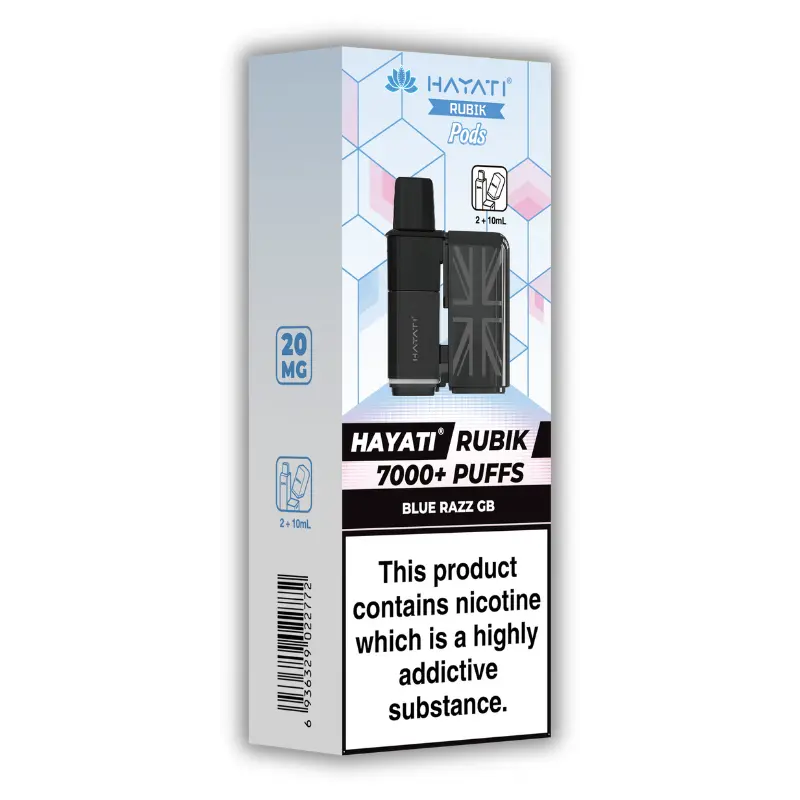
Hayati · Rubik
Blue Razz GB Hayati Rubik Pods
£3.99
✔ In stock — ready to ship
Genuine Hayati
Free over £20
Same-day dispatch
Secure checkout
Three pounds ninety-nine buys one sealed replacement pod for the Hayati Rubik, filled with twelve millilitres of Blue Razz GB at 20mg nicotine salt, with a manufacturer's rating of up to 7,000 puffs produced on laboratory apparatus rather than by anybody drawing on one. There is no device in the packet. Someone who does not already own a Rubik body has bought an object with nothing to seat it in, and the Blue Razz GB Hayati Rubik Prefilled Pod Kit at £5.99 is the listing that arrives ready to use.
Divide the ticket by the fill and the pod costs 33.25p a millilitre. That figure is not new and it is not a secret. The Hayati Rubik Pods shelf page is built on it, sets it against every other prefilled platform in a table, and then does something most shelf pages do not: it attaches a correction to its own headline. Bottled liquid undercuts every sealed pod Hayati make, a 10ml salt at 24.9p a millilitre and a 120ml shortfill at under 6p, so the Rubik pod is the cheapest prefilled rather than the cheapest anything. That correction is right, it is properly argued, and there is no sense in restating it here.
What is worth saying here is that for this one liquid the correction has nothing to bite on. Sixteen listings in a catalogue of 492 carry the name Blue Razz GB. Every one of them is a prefilled pod. Not one is a 10ml salt, a 120ml shortfill or a 120ml 70/30 bottle. So the caveat that qualifies the shelf page's claim about the platform does not qualify the claim about this flavour: 33.25p is not the cheapest-with-an-asterisk price for Blue Razz GB, it is the floor, and nothing on the site goes under it.
That sentence is the whole argument of this page, and it took two corrections to get it into a form worth printing. The first is that the raw rarity figure is much softer than it sounds, and this page counts it rather than quoting it. The second is larger: Hayati do bottle something extremely close to this, under a different name, and any honest page about a price floor has to put that on the table early rather than bury it. Both are below, along with the question that follows from them, which is what the money above 33.25p was ever buying on the platforms that charge it, and a test of the claim that this is the sweetest thing on its shelf.
Sixteen listings, four platforms, no bottle
Start with the plain count, because it is checkable and it is the foundation for everything after it. Searching the whole catalogue for the string Blue Razz GB returns sixteen listings. They sit across four prefilled platforms and split evenly by whether the flavour has the pod to itself.
Eight listings give it the whole pod. Those are the Rubik pod you are reading about and its kit, a Pro Max Plus pod at £5.49 and a Pro Max Plus kit at £7.99, a Mini Ultra pod at £3.49 and a Mini Ultra kit at £3.99, and a Pro Ultra Plus pod at £7.99 with its kit at £11.99. The other eight are divided 22ml Pro Ultra Plus pods where Blue Razz GB occupies one side and something else occupies the other: paired with Grape GB, with Lemon and Lime, with Blue Razz Cherry and with Red Razz GB, each of those four pairings sold once as a bare pod and once as a complete kit. You can see the pattern on Grape GB / Blue Razz GB Hayati Pro Ultra Plus 25K Pods, Blue Razz Cherry / Blue Razz GB Hayati Pro Ultra Plus 25K Pods and Blue Razz GB / Lemon & Lime Hayati Pro Ultra Plus 25K Pods.
Sixteen is a lot. It makes Blue Razz GB the third most widely listed flavour name in the catalogue on my count, behind Banana Ice on eighteen and Lemon Lime on seventeen. Both of those are bottled. So are the next several down the list. Across the twelve most listed names, Blue Razz GB is the only one with no bottled version at all, and that is a more useful way to state the point than any adjective.
The soft version of the claim, and why it needed narrowing
The tempting version runs: most flavours here can be had in a bottle, and this one cannot. Counted, that is not what the catalogue says. Splitting every divided pod into its two halves and normalising the punctuation, I get 146 distinct flavour names across the 492 listings, and 79 of them have no bottled form. Fifty-four per cent of the menu is not bottled. Stated at that level the observation is nearly meaningless.
The reason it is meaningless is structural rather than random, and it is worth setting out because it is what makes the narrowed version strong. Of those 79 unbottled names, sixteen appear exactly once in the catalogue and forty-six appear exactly twice. A name appearing twice is almost always one flavour on one platform sold as a pod and again as the kit of the same pod. It is one product with two tickets, not a flavour Hayati have declined to bottle. Only nine of the 79 never appear as a whole-pod flavour at all, which is to say only nine are the one-off halves of divided pods that a quick reading might assume account for most of the list. The bulk of the unbottled menu is simply the long tail of single-platform flavours, and a long tail is not evidence of anything.
Filter for names Hayati have committed to, meaning names carried on four or more listings, and the picture inverts. Twelve unbottled names clear that bar. Blue Razz GB has sixteen listings. The next two, Dragon Berries and Blue Razz Pineapple, have six each. Nothing else gets past five. A flavour that Hayati have put on sixteen separate tickets across four different pieces of hardware, and have never once put in a bottle, is not part of a long tail. That is the version of the claim that survives counting, and the gap between sixteen and six is what makes it worth a paragraph.
The same count on the shelf you are actually shopping
Narrow it once more, to the nineteen pods on this one shelf, and the finding holds at a smaller scale. Sixteen of the nineteen Rubik flavours exist somewhere in Hayati's bottled range. Three do not: Vim Ice, Lemon Cola Ice and this one. Of those three, Lemon Cola Ice appears on only two listings in the entire catalogue and Vim Ice on four, so both are thinly stocked flavours whose absence from the bottle shelf carries no particular weight. Blue Razz GB is the only one of the three that Hayati sell sixteen times over.
Put the two counts together and the shape of the thing is clear. This is not an obscure flavour that nobody got round to bottling. It is one of the most heavily listed names Hayati own, present on every prefilled platform they run, and it has never been supplied in a format you pour.
The correction: Hayati do bottle a blue raspberry gummy liquid
Everything above is true of the name. It is not true of the flavour idea, and a page that stopped there would be selling the reader a technicality.
The GB suffix appears on four names in this catalogue: Strawberry GB, Grape GB, Red Razz GB and this one. Our page for the Strawberry GB Pro Max Plus 6000 kit did the decoding work on what the suffix denotes and on how consistently Hayati's own copy attaches confectionery vocabulary to it, so that is settled elsewhere and taken as read here. What matters for a pricing argument is the thing that turns up when you search for the unabbreviated words instead.
Blue Razz Gummy Bear exists in the Hayati Pro Max bottled range three times over: a 10ml nicotine salt at £2.49, a 120ml 50/50 shortfill at £6.99 and a 120ml 70/30 bottle at £6.99. It has no prefilled version anywhere. Blue Razz GB has sixteen prefilled listings and no bottle. The two sets do not overlap by a single listing, and between them they cover both tiers of the catalogue.
Hayati publish nothing that says those are the same recipe, and this page will not say it either. What can be said is what the copy says. Their bottled listing describes blue raspberry wrapped in a chewy sugary sweetness and calls it candy-led rather than fruit-led, which is the same register their prefilled listings use for Blue Razz GB. It also, in its own closing line, points the reader who likes Strawberry GB towards it, which is Hayati themselves treating the abbreviation and the full words as neighbours.
So the honest position on the price floor has a clause attached. Among the sixteen listings labelled Blue Razz GB, £3.99 for 12ml is the outright floor and there is no cheaper route to that label at any price. Among liquids that Hayati describe in the same terms, there is a cheaper route, and it runs through a differently named bottle at 24.9p a millilitre in salt form or under 6p as a shortfill. Whether those are the same liquid is not published, and a buyer who cares about the answer is choosing between an unverifiable guess and a sealed pod.
Two things stop that clause collapsing the argument. The strengths differ: the bottled salt is listed at 10mg against 20mg here, and the shortfills carry no nicotine as supplied. And the bottled route needs a device you fill and a coil you replace on a schedule, which is the workflow a prefilled pod exists to remove. The Rubik pod shelf makes both of those points about the platform in general and they apply here without modification. The difference on this flavour is only that the comparison is between two names rather than one, which makes it a genuinely harder call to make and a much easier one to overlook.
It is also worth noticing what the GB family does elsewhere, because it shows the naming is not a rule. Strawberry GB is bottled, as a 10ml salt, under the GB label. Grape GB is bottled, as a 10ml salt, under the GB label. Both of those flavours use one name across both tiers. Blue Razz GB is the exception, and Red Razz GB is not really a counterexample because it exists on only two listings and both are halves of the same divided pod. So out of three GB names with any real presence, two are bottled under their own name and one is not. Whatever produced that is not a format convention, and Hayati do not explain it.
What 33.25p is the floor of, priced across all four platforms
The Rubik pod shelf compares platforms using whichever flavour happens to sit on each one. This flavour allows a tighter comparison, because it is on all four, so the liquid is held constant and only the format moves. Here is every listing that carries the name, sorted by what a millilitre of it costs.
| Listing | Ticket | Fill | Cost per millilitre |
|---|---|---|---|
| Blue Razz GB Hayati Rubik Pods (this one) | £3.99 | 12ml | 33.25p |
| Blue Razz GB Pro Ultra Plus pod | £7.99 | 22ml | 36.32p |
| Blue Razz GB Pro Max Plus pod | £5.49 | 12ml | 45.75p |
| Blue Razz GB Rubik kit | £5.99 | 12ml | 49.92p |
| Blue Razz GB Pro Ultra Plus kit | £11.99 | 22ml | 54.50p |
| Blue Razz GB Pro Max Plus kit | £7.99 | 12ml | 66.58p |
| Blue Razz GB Mini Ultra pod | £3.49 | 4ml | 87.25p |
| Blue Razz GB Mini Ultra kit | £3.99 | 4ml | 99.75p |
The eight divided pods are deliberately absent from that table. A 22ml pairing at £7.99 works out at 36.32p a millilitre for the pod, but only some fraction of those millilitres is Blue Razz GB and Hayati do not publish how the 22ml is apportioned between the two sides. Putting a divided pod in a table of what this flavour costs would mean inventing a split, so the eight are left out and the comparison runs on the eight listings where the whole fill is one liquid.
Read the top two rows first, because they are the ones that decide anything. The lead over the Pro Ultra Plus pod is 3.07p a millilitre. Across a whole 12ml Rubik pod that is 37p, which is the price of nothing at all. Anyone treating the floor as a reason to prefer this pod over the 22ml one is reading the table wrong: on money those two are level, and the choice between them is a choice between twelve millilitres and twenty-two, which is a question about commitment rather than cost. The Rubik pod shelf reaches the same conclusion from the platform side and it is worth reading there in full.
The gap that does mean something is the third row. The Pro Max Plus pod holds the identical twelve millilitres at the identical declared strength and costs £1.50 more, which is 12.5p a millilitre or a little over a quarter. Our Vim Ice Rubik kit page has already worked that arithmetic all the way through, including the part most buyers miss, which is that the £2.00 difference between the two kits resolves into fifty pence of body and £1.50 of pod, and that only the pod half repeats. It puts twenty-six pods a year at £103.74 on the Rubik against £142.74 on the Pro Max Plus. Those figures apply here unchanged and there is no reason to compute them twice.
What that page could not do, because Vim Ice is only on two platforms, is run the same volume across all four. Take 312 millilitres, which is twenty-six Rubik pods, and buy it in each format this flavour is sold in. On the Rubik it is £103.74. On the Pro Ultra Plus pod it is roughly £113, since 312ml is a little over fourteen pods. On the Pro Max Plus pod it is £142.74. On the Mini Ultra pod it is seventy-eight pods and £272.22. The spread between the cheapest and dearest way to buy one year of one flavour is £168.48, and every listing in it is the same name at the same declared strength from the same manufacturer.
Two footnotes on that spread, because a number that large invites a misreading. The Mini Ultra figure is not a criticism of the Mini Ultra, which is bought for being small and is priced for being small; anyone who wants a 4ml pod is not shopping on cost per millilitre and the Blue Razz Cherry Hayati Mini Ultra Pods listing sits on the same terms. And the Pro Ultra Plus figure assumes you finish every pod, which is exactly the assumption that the Grape GB / Blue Razz GB pod page took apart. It published a ladder of what a 22ml pod really costs once you account for what is left in it when the coil stops being worth drawing on, and the effective rate climbs past 54p a millilitre by the time eight millilitres are stranded. That correction applies to any large pod, this 12ml one included, and it is the single strongest reason not to treat a headline per-millilitre figure as money in your pocket.
The cheapest ticket and the cheapest millilitre are different listings
One more thing falls out of the table and it matters more to a first purchase than the floor does. The lowest price on any listing carrying this name is not £3.99. It is £3.49, the Mini Ultra pod, and at 87.25p a millilitre it is the most expensive liquid in the whole set. The cheapest way to find out whether you like Blue Razz GB is therefore not the cheapest way to drink it, and the two answers are separated by a factor of two and a half.
That distinction is usually invisible, because for a bottled flavour the cheapest trial and the cheapest supply are the same object: a 10ml bottle at £2.49 is both. Remove the bottle, as Hayati have done for this name, and the two questions come apart. If you own a Mini Ultra, four millilitres for £3.49 is a real sample. If you own a Rubik and nothing else, there is no sample. The smallest quantity of this liquid you can buy for a Rubik is twelve millilitres, and the smallest quantity you can buy at all if you own no Hayati hardware is the 4ml Mini Ultra kit at £3.99.
What the body premium bought, with nothing to decant
Every argument about a sealed pod being expensive has the same escape route behind it. Buy the liquid in a bottle, put it in a device you refill, and the premium disappears. That route is the reason the Rubik pod shelf had to correct itself, and it is a fair thing to hold against any prefilled platform.
For this flavour, under this name, the route does not exist. There is no bottle of Blue Razz GB to decant, no shortfill to top up with, no way of obtaining this label in any container you open. The only variable available to a buyer is which sealed pod to put it in, and that reduces a complicated purchase to a very simple one.
So the question changes from what am I paying for convenience to what am I paying for a body. On this platform the answer is published by subtraction and it is two pounds: £5.99 for the kit against £3.99 for the pod, with the same twelve millilitres at the same strength on both sides. Two pounds is the entire hardware charge, paid once, and after it every subsequent millilitre of this flavour costs the least it can cost anywhere in the catalogue.
Work out when that two pounds is recovered and the case for the platform stands or falls on one fact about you. Against the Pro Max Plus pod, the saving is £1.50 a pod, so the body is paid off partway through the second refill. Against the Pro Ultra Plus pod, where the per-millilitre gap is 3.07p, twelve millilitres saves you 37p and the body needs five and a half pods to pay for itself, by which time you have drawn sixty-six millilitres. Against the Mini Ultra the recovery is immediate, on the first pod, and it is not close.
Those three answers are different enough that the right one depends entirely on what is already in your drawer, which is why a single payback figure is misleading. If you own a Pro Max Plus and drink this flavour, buying the Rubik body is straightforwardly good arithmetic. If you own a Pro Ultra Plus and drink this flavour, buying a Rubik body to save money is close to pointless, and the reason to do it would be wanting a 12ml commitment instead of a 22ml one.
There is a third case that the arithmetic does not reach. If you own nothing, the £5.99 kit is not competing against the other pods at all. It is competing against the possibility that you will dislike the liquid, and twelve millilitres is a long way to carry a flavour you have decided against. The complete Rubik kit is the correct purchase in that case and it is still a gamble, which is the honest thing to say about any first pod of a sweet liquid on a platform with no small format.
Testing the claim that this is the sweetest thing on the shelf
The Rubik pod shelf page calls this the most sugar-forward listing on the grid, and the feed copy for the pod itself is unusually blunt about it. A claim like that is repeatable or it is not, and the way to find out is to read all nineteen descriptions side by side and count rather than to take the adjective on trust.
Hayati write a fresh flavour paragraph for every listing, and the nineteen on this shelf are close enough in length to compare directly, at roughly 130 words each. Counting sweetness vocabulary across them, meaning sweet, sweetness, sugar, sugary, confectionery, candy, syrup, rich, creamy, jammy and cloying, this listing carries the densest concentration of it on the shelf. It is also the only one of the nineteen where Hayati use the word sugary, and the only one where they use the word confectionery. Two words, each appearing exactly once in nineteen descriptions, both on this pod.
That is a fact about vocabulary rather than about sugar, and it should be read that way. Nobody has measured anything. What it establishes is that when Hayati sat down to write nineteen paragraphs, this is the one they reached for the sweet-counter register to describe, and they did it on a shelf where the neighbouring paragraphs reach for fruit words instead.
The more revealing count: which listings name a brake
Vocabulary density is a blunt instrument, so here is a sharper one. Read each of the nineteen for whether it names something that checks the sweetness, and the shelf sorts itself almost cleanly.
Thirteen of the nineteen name a counterweight and say what it does. Banana Ice Hayati Rubik Pods has the chill stopping the fruit turning cloying. Blueberry Cherry Cranberry Hayati Rubik Pods gives cranberry the job of stopping the blend going too sweet. Blue Razz Cherry Hayati Rubik Pods has the blue side keeping the cherry from feeling heavy. Strawberry Kiwi Hayati Rubik Pods has the kiwi cutting through. Blue Sour Raspberry Hayati Rubik Pods is built entirely out of the brake. Even Blueberry Raspberry Hayati Rubik Pods, which names no cooling at all, gets a tart opening from the raspberry before the blueberry settles.
Three of the remaining six are not really in the running. Fresh Mint and Lemon Lime have no sweetness to check in the first place, so a brake would have nothing to work on, and Summer Dream names nothing because it names no ingredients at all.
The last three say outright that nothing checks it. Juicy Peach Hayati Rubik Pods states there is no sharpness and nothing icy or sour in the way. Triple Mango states there is no ice and no citrus. And this one names the tang and then says it recedes.
That last construction is the one that separates it. Juicy Peach and Triple Mango have no counterweight because their sweetness is fruit sweetness and nothing was put in to balance. This listing has a counterweight, says so, and then tells you it sits behind the sugar. Of the three unbraked pods on the shelf, it is the only one whose sweetness Hayati describe in confectionery terms rather than as ripeness, and it is the only one where the balancing element is present and outranked.
So the handed claim survives, narrowed to what the evidence actually supports. On this shelf, judged by the nineteen paragraphs Hayati wrote for it, Blue Razz GB is the sweetest listing and the only one whose sweetness is candy-shaped rather than fruit-shaped. That is a defensible sentence. Stretch it to the catalogue and it breaks, which is the next part.
Where the claim fails, and the disagreement that causes it
Our page for the Grape GB / Blue Razz GB Pro Ultra Plus kit placed this liquid at about seven on a ten-point sweetness scale running from an unsweetened mint to a heavy bakery profile, and said plainly that it is not the sweetest thing Hayati make. That page is describing the same name, and it is not wrong.
The reason two pages on one site can put the same liquid in two places is that Hayati's own sixteen descriptions of it do not agree, and the disagreement is systematic enough to be worth reporting. Lined up, they split by platform.
All six listings outside the Pro Ultra Plus, meaning both Rubik listings, both Pro Max Plus listings and both Mini Ultra listings, put the acid behind the sugar. One says the tang takes a back seat. One says the GB character smooths the sharp edges. One says the tang acts as seasoning rather than the main event. One says it has less bite and more body. Six for six, in the same direction.
On the Pro Ultra Plus the copy pulls the other way. Six of the ten listings there name the sharpness as noticeable and give it a job. The single-flavour pod says the sharpness stops it feeling one-note. The single-flavour kit says it stops it feeling flat. The pairing with Lemon and Lime says the tang runs right through it. The pairing with Red Razz GB calls it the tangier of the two. And the Grape GB kit goes furthest, putting the sweetness between medium and sweet and saying it stays bright rather than sugary, which is very nearly the opposite of what the Rubik listing says about the same name.
What that is evidence of is how the copy was produced, not that there are two recipes. Hayati write each listing separately, and a description written for a 22ml pod that has to be distinguished from a partner will emphasise different properties from one written for a 12ml pod sold on its own. Nothing in the specifications differs: 20mg on every listing, the same name on every listing, and no published recipe anywhere. The sensible reading is one liquid described by several writers with several briefs.
It does leave one observation that is uncomfortable and worth stating anyway. The platform where you buy this liquid in the largest quantity, twenty-two millilitres at a time, is the platform whose copy insists the acid is still doing work. The platform where you buy it cheapest is the one whose copy says the acid has stepped back. A buyer reading only the listing in front of them would come away with two different pods. There is no evidence that the liquid changes and no reason to think it does, but the buyer arriving at the cheapest millilitre is being shown the sweetest reading of it, and knowing that is worth more than either description on its own.
Twelve millilitres of one thing, and what the earlier pages left undone
The draw-by-draw for this liquid is already written, more than once, and printing a third version would be padding. The Grape GB pairing page sets out the sequence properly: the sweetness and the tang arriving together rather than in order, the gummy body thickening through the middle of the draw, the exhale finishing sweeter than the inhale, and a long finish with the berry identity still intact at the end of it. The Red Razz GB pairing page does the same work from a different side, comparing two gummy raspberries against each other. Both are better places to read about the taste than anything a fourth page could add, and both are describing this exact name.
What neither of them could describe, because neither product allows it, is this liquid on its own for twelve millilitres. Every prior page on Blue Razz GB analyses it as one half of a divided 22ml pod, where a turn of the collar puts something else in your mouth within a second. The Juicy Peach Pro Ultra Plus pods page owns the general argument about what a single-flavour pod costs you by removing that option, and that argument is not going to be rebuilt here. The specific question is narrower and it belongs to this listing: what does the absence of an alternative do to a liquid whose defining property is that its brake has stepped back?
Three consequences, in the order they arrive.
The first is that adaptation has nowhere to reset. A sweet liquid stops registering as sweet after enough consecutive draws, which is a property of perception rather than of the pod. On a divided pod that is self-correcting: turning to the other side gives the palate a different stimulus and the sugar reads properly again when you turn back. Here there is nothing to turn to inside the pod, so the reset has to come from putting the device down or from a second device with something sharp in it. That is the practical case for keeping a contrasting pod in the rotation rather than a second Blue Razz GB, and Lemon Lime Hayati Rubik Pods is the shelf's obvious candidate for the job because it is the only listing on it with no sweetness to speak of.
The second concerns the coil, and the Strawberry GB Pro Max Plus 6000 kit page has already explained the chemistry of why a confectionery accord fouls a wick faster than a light fruit one: the perception of body and syrup comes from heavier material and intense sweeteners, and heavy material is exactly what does not leave a wick cleanly. That reasoning transfers to this liquid unchanged and there is no point restating it. What differs is the signal you get. Strawberry GB is a confectionery accord with very little acid in it, so when the wick tires the page's advice is to listen for a toffee note where the fruit used to be. Blue Razz GB has an acid seam running through it that Strawberry GB does not, and a seam is a thinner, more volatile thing than a sugar body. It will thin out first. So the early warning on this pod is not a toffee note, it is the disappearance of the tang: a draw that reads as broad sugar with no edge on it at all, when the same pod gave you an edge in week one, is the pod telling you where it is in its life. That is a more useful signal than the general one because it arrives earlier.
The third is about the twelve millilitres as a quantity rather than as a price. Our Fresh Mint Rubik kit page made the case that a plain flavour can be judged correctly on the first draw, because there is nothing arriving late and nothing held back. This liquid is the opposite kind of object. Its verdict moves, and it moves in the direction people like least, because the thing that fatigues is sweetness and sweetness is what it is made of. Twelve millilitres is a long run for a liquid whose day-one impression is its most flattering one. That is not an argument against buying it, and plenty of people drink sweet liquids happily for months. It is an argument for buying one pod rather than three, and for treating the floor price as a reason to restock often rather than a reason to stockpile.
The published figures, and the ones that are not
Four numbers are on this listing and a fifth is derived from two of them. Everything else a buyer might want is absent, so the table below separates what Hayati state from what they do not, rather than running the two together as a single specification block.
| Stated by Hayati | Value | What it decides |
|---|---|---|
| Ticket price | £3.99 | Identical across all nineteen pods on the shelf, so flavour choice here costs nothing either way |
| Fill | 12ml | The only measured quantity you can divide the price by |
| Derived from those two | 33.25p per ml | The floor for this flavour anywhere in 492 listings |
| Nicotine | 20mg salt | The UK maximum for a consumer e-liquid, so no listing on this shelf goes higher |
| Puff rating | up to 7,000 | A Hayati laboratory estimate for a pod this size, not a measurement of anyone's use |
| Contents | One sealed pod | No device, no spare, no multipack |
| Device named | Hayati Rubik | The listing names the range it is made for and nothing beyond it |
| Not published | Consequence for this pod |
|---|---|
| Coil resistance | No ohm figure exists in the data for any Hayati prefilled pod, so any resistance quoted for one came from somewhere other than Hayati |
| VG and PG ratio | Not stated on this listing, so nothing about wicking speed can be inferred from it |
| Recipe or sweetener load | The confectionery reading comes from Hayati's own descriptive copy, not from a disclosed formulation |
| Relationship to the bottled Blue Razz Gummy Bear | Unstated, which is why the price floor above is stated about the label rather than about the liquid |
Two of those rows deserve a sentence rather than a cell. The 20mg is the legal ceiling in the United Kingdom rather than a choice Hayati made for this flavour, which is why every prefilled pod in the catalogue carries the same figure and why strength is never a reason to prefer one of these pods over another. And the puff rating should be read as a ranking device at best. The Rubik pod and the Pro Max Plus pod both hold twelve millilitres and are rated at 7,000 and 6,000, which is a seventeen per cent difference on an identical volume. The Rubik pod shelf page works through why that makes the millilitre the only figure worth dividing a price by, and this page is built on the same conclusion.
On fitment, the position is one sentence long. Hayati publish no cross-range fitment information, so match the range name on your device to the range name on this listing and do not take a hardware compatibility decision from a retail page, this one included.
What else £3.99 opens, and who should spend it elsewhere
Because every pod on this shelf carries the same ticket, choosing between them is a decision with no money in it. That is unusual and it is worth exploiting: there is no penalty for picking the harder flavour, and no saving in picking the plain one. The only question is which twelve millilitres you want to be committed to.
Stay on blue and the nearest neighbour is Blue Sour Raspberry Hayati Rubik Pods, which Hayati's own copy positions directly against this one by opening on the idea that ordinary blue raspberry is too sweet for some people. It is the same fruit with the order reversed, tart first and the familiar sweetness arriving a beat later, and that sequence repeating is what keeps it readable over a long pod. If the thing you are unsure about is whether twelve millilitres of unbraked sugar will hold up, that listing is the answer to the question and it costs the same.
Blue Razz Cherry Hayati Rubik Pods is the middle position between the two. It keeps a sweet blue opening and then hands over to cherry, so the draw moves from bright to dark and there are two things to attend to rather than one. Anyone who likes the blue register but has tired of a single note will get further with it, and the same pairing exists at 22ml on Blue Razz Cherry Hayati Pro Ultra Plus Pods and at 12ml on Blue Razz Cherry Hayati Pro Max Plus Pods if you are on another platform.
Mr Blue Hayati Rubik Pods is the shelf's other blue entry and it names no fruit whatsoever. Hayati describe it as bold and sweet with a tangy side, and that is genuinely all anybody can tell you. On a four millilitre pod an unnamed flavour is a small gamble; on twelve it is not, and the Rubik pod shelf page makes that point about the whole platform. If you want a sweet blue liquid and you want to know in advance what is in it, this listing is the one that answers the question and Mr Blue is the one that does not.
Move off blue and the useful comparisons are structural rather than flavour-led. Strawberry Raspberry Ice Hayati Rubik Pods is the shelf's most-chosen berry and it solves the twelve-millilitre problem with cold rather than with acid, which is a different mechanism and a more reliable one for most people. Red Apple Ice Hayati Rubik Pods does the same thing to a sweeter, rounder fruit. Blueberry Cherry Cranberry Hayati Rubik Pods is the most layered listing on the grid and the cranberry gives it a dry edge that nothing here has. Any of the three will survive twelve millilitres more comfortably than this pod will, and saying so is more useful than pretending otherwise.
On other platforms, the comparison worth making is with the blue raspberry variants Hayati never brought to the Rubik. Blue Razz Mojito Hayati Pro Max Plus Pods takes the same berry and adds citrus and a thread of mint, which is the most aggressive brake in the blue family. Blue Razz Pineapple Hayati Pro Max Plus Pods uses tropical acidity for the same purpose. Blue Sour Raspberry Hayati Pro Max Plus Pods is the sour version at 12ml on that platform. None of the three is stocked here, which is the flavour-library cost of the cheaper millilitre that the shelf page counts in detail.
For browsing rather than comparing, Hayati Rubik puts the nineteen pods and the twenty kits in one grid, which is the quickest way to see whether a body purchase makes sense alongside a pod purchase. Raspberry Vapes gathers every raspberry-derived listing in the catalogue and is the right shelf if the blue variant is not fixed in your mind. Berry Vapes is the wider version of the same thing. Hayati Pods and Hayati Prefilled Pods & Refills are where every refill across every platform sits together, which is the view that makes the per-millilitre differences visible. And the full Hayati catalogue is there if you would rather look than filter.
Running a pod of this properly
Most handling advice is generic and most of it is already on this site. Four things are specific to a large, unbraked, confectionery-led pod bought at the cheapest millilitre on the platform, and they are the only four worth your time.
Draw short and leave gaps. A sweetener-heavy liquid coats a wick, and a wick that is already coated and then run hot moves the sugar material towards caramel. Shorter draws with a pause between them keep the wick cooler and will often bring some of the fruit stage back when it has started to thin. Chasing a fading tang with a longer, harder pull does the reverse. This matters more here than on the iced pods on the shelf, because cold masks the early stages of a tiring wick and there is no cold in this one.
Learn the tang as your gauge. Everything above about the acid seam thinning first has a practical use: pay attention to the edge on the inhale in the first week, because that is your reference reading. When the edge is gone and the draw is broad sweetness with nothing on top of it, the pod has finished doing what it can do, whatever quantity of liquid is still visible. Acting on that reading rather than on the window is the difference between a pod that tasted right for its whole life and one that you pushed too far.
Keep something sharp in the rotation, not a second one of these. The floor price makes buying two of the same pod look sensible and it is the least sensible thing to do with a liquid like this. Sweetness fatigue is cumulative and a second identical pod extends the run rather than breaking it. A contrasting pod costs exactly the same £3.99 and it is the purchase that makes the first one last.
Store it flat, cool and dark, and buy the next one early. A sealed pod is stable but heat and daylight are not kind to a sweet liquid over months, and a drawer is better than a windowsill or a car. The other half of that is timing: twelve millilitres lasts long enough that running out arrives as a surprise, so the moment to order the replacement is when you open the current one rather than when you notice it is low. Keep both the pod and the device away from anyone they are not intended for, and from pets.
Two things not to do. Do not try to open a sealed pod: it is not built to be opened, there is no documented way of doing it, and the low millilitre price is exactly what you pay instead of the flexibility a bottle gives you. And do not read a slow or weak draw as a flat battery without checking the pod first, because on a liquid this heavy the wick is the far more likely explanation.
When the pod is done it contains a coil and a residue of liquid, so it is electrical waste rather than household rubbish. A vape retailer or a local recycling point will take it.
Questions this listing raises
Is 33.25p a millilitre really the cheapest this flavour gets?
Under this name, yes. Sixteen listings in the catalogue carry the name Blue Razz GB and this is the lowest cost per millilitre of any of them, ahead of the 22ml Pro Ultra Plus pod at 36.32p and the 12ml Pro Max Plus pod at 45.75p. None of the sixteen is a bottle, so the usual caveat that bottled liquid undercuts every sealed pod has nothing to attach itself to here.
So there is no bottled version at all?
Not under this name. Hayati do sell a Blue Razz Gummy Bear in the Pro Max bottled range, as a 10ml salt and as two 120ml bottles, and it has no prefilled version anywhere. Whether that is the same liquid as Blue Razz GB is not something Hayati publish, so the floor claim on this page is stated about the label rather than about the recipe.
Why does the Rubik pod beat the Pro Ultra Plus pod by so little?
Because 3.07p a millilitre is 37p across a whole 12ml pod, which is not enough to decide anything. The real difference between those two listings is 12ml against 22ml and the size of the flavour menu on each platform, not the price. Treat them as level on money.
How long does the £2.00 body premium take to pay back?
It depends entirely on what you own now. Against a Pro Max Plus you save £1.50 a pod, so the Rubik body is recovered partway through the second refill. Against a Pro Ultra Plus you save 37p a pod and it takes five and a half pods. Against a Mini Ultra it is recovered on the first one.
Is this genuinely the sweetest pod on the Rubik shelf?
On the evidence available, which is the nineteen descriptions Hayati wrote, yes. It has the densest sweetness vocabulary of the nineteen and it is the only one where the words sugary and confectionery appear. It is also the only unbraked pod on the shelf whose sweetness is described as candy-shaped rather than as ripeness. Across the whole catalogue the claim does not hold, and our Grape GB pairing page puts this liquid around seven on a ten-point scale rather than at the top of it.
Is there any ice, mint or menthol in it?
No. Nothing in the listing names a cooling element, and Hayati name cooling in a title when it is present, as seven of the nineteen pods on this shelf do. The finish here is warm and sweet rather than cold, which is part of why sweetness fatigue is the thing to plan around.
Should I buy two or three at once at this price?
One, and a different flavour alongside it. Twelve millilitres of a heavily sweetened liquid with nothing cutting through it is already a long run, and a second identical pod extends that run rather than resetting it. The saving on this shelf is only banked if the pod gets finished, and buying a contrasting pod at the same £3.99 is what makes finishing likely.
What is the difference between this and the Rubik kit?
Two pounds and a device. Both carry the same twelve millilitres at the same strength, so the entire gap is hardware. If you already have a working Rubik body, buying the kit is paying twice for something you have.
How will I know when the pod is spent?
Listen for the tang rather than watching the window. The acid seam in this liquid is thinner and more volatile than the sugar body, so it fades first, and a draw that arrives as broad sweetness with no edge on it is the pod telling you it has finished. That signal usually comes before the liquid runs out.
Does the 7,000 puff figure mean it lasts longer than a Pro Max Plus pod?
It is not safe to read it that way. Both pods hold twelve millilitres and Hayati rate them at 7,000 and 6,000, which is a seventeen per cent difference on an identical volume produced by laboratory test apparatus rather than by use. The millilitre is the figure you can divide a price by and the puff rating is not.
Can I refill the pod from a bottle once it is empty?
No. It arrives sealed, Hayati document no way of opening it, and there is no bottle of this flavour to refill it from in any case. What you can do is keep buying it at the lowest millilitre price on the site, which is the whole point of the listing.
Which flavours on this shelf hold up best over twelve millilitres?
The ones with something checking the sweetness. Blue Sour Raspberry uses acid, Strawberry Raspberry Ice and Red Apple Ice use cold, and Blueberry Cherry Cranberry uses a dry cranberry edge. All three mechanisms outlast an unchecked sugar body, and all of them cost exactly the same as this pod.
The short version
This is twelve millilitres of a sweet, confectionery-led blue raspberry at 20mg, sold as a bare pod for a Hayati Rubik at £3.99, which is 33.25p a millilitre. Sixteen listings in the catalogue carry the name Blue Razz GB, across four prefilled platforms, and none of them is a bottle. That makes this the floor price for the flavour outright rather than the floor with a footnote, which is not true of any other pod on the shelf and, among heavily listed names, is not true of anything else in the catalogue either.
The clause on that is Blue Razz Gummy Bear, which Hayati do bottle and do not sell as a pod, and which their own copy describes in the same terms. Nothing published says the two are the same liquid, and a buyer who wants certainty rather than a reasonable guess is buying the sealed pod.
Against the money, weigh the liquid honestly. Of the nineteen descriptions on this shelf, this is the only one where Hayati name a counterweight and then tell you it has stepped back, and unchecked sweetness is the property people tire of soonest. The floor price is real and it is only realised on a pod you finish. Buy one, keep something sharp beside it, and judge it again at nine millilitres rather than on the first afternoon.
Strictly for adults aged 18 and over. Nicotine is an addictive substance.
You might also like


