
Home / Hayati Pro Max Plus Pods / Cherry Sour Raspberry Hayati Pro Max Plus Pods
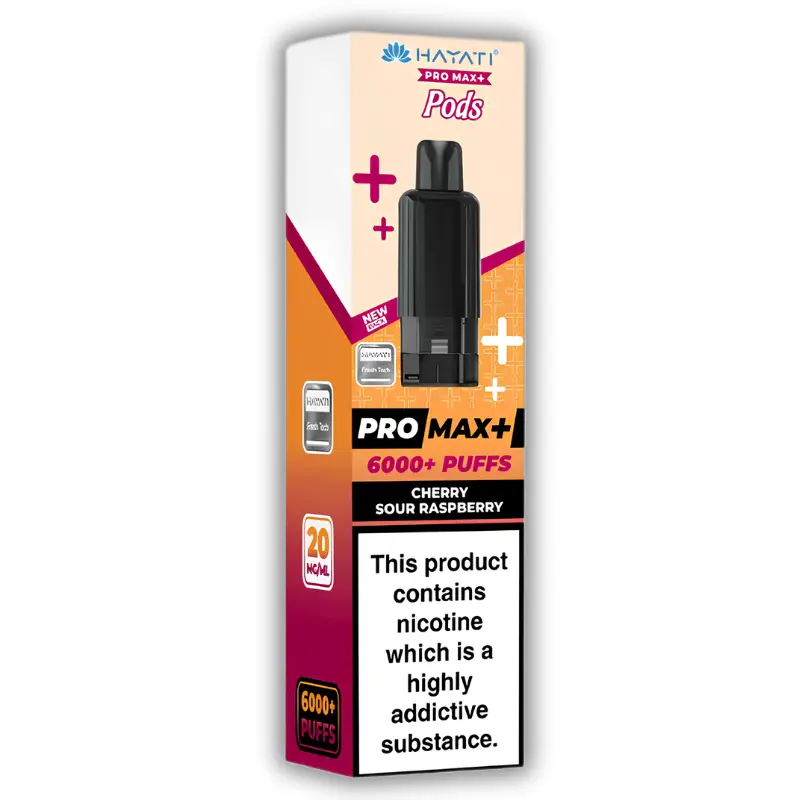
Hayati · Pro Max Plus
Cherry Sour Raspberry Hayati Pro Max Plus Pods
£5.49
✔ In stock — ready to ship
Genuine Hayati
Free over £20
Same-day dispatch
Secure checkout
This is the refill on its own: one prefilled Pro Max Plus pod holding 12ml of liquid at 20mg, £5.49, no body in the packet. Nobody arrives at a bare pod by accident. You are here because you had one of these, you reached the end of it, and you are weighing up whether to do that again.
So this page is not going to sell you the flavour. What Cherry Sour Raspberry tastes like, why three separate sources of acidity present as one sharpness rather than three, and what happens to cherry's kernel character under an acid dose, all of that is worked out on the Cherry Sour Raspberry Hayati Pro Max Plus 6000 Pod Kit page. It is the better page for a first purchase and none of it gets derived again here.
What that page also established, almost in passing, is the thing this listing has to deal with. Cherry Sour Raspberry wears out backwards. Most pods die quietly: the flavour thins, the sweetness flattens, you finish it mildly bored. This one gets louder in the one dimension you were not asking for. Aroma falls away as the coil picks up a caramelised coating, acid does not fall away with it, and a tired pod of this liquid therefore does not go flat and sweet. It goes sharp and hollow. The bite still lands and the fruit that used to arrive behind it does not turn up.
That is a specific defect, no better batch will fix it, and it is the whole subject of this page. You liked the liquid enough to be looking at the refill, and you also know exactly where it lets you down. There are four things you can do about that, they cost different amounts, and only some of them work.
Naming the fault properly before trying to manage it
The short version above is accurate, but it collapses two separate processes into one symptom, and the two respond to completely different interventions.
The pod is running two clocks, not one
The first clock is throughput. Coil residue accumulates with the amount of sweetened liquid vaporised across it, not with how long you have owned the pod. Every millilitre leaves a little more caramelised material behind, the surface gets steadily worse at volatilising the delicate aromatic fractions, and what you taste is increasingly a blunted version of the recipe. Every prefilled pod in the range does this.
The second clock is the calendar, and it acts on the liquid still sitting in the pod rather than on the coil. Aroma compounds are volatile by definition, and the lightest of them do not sit in a part-used pod indefinitely without loss. Cherry recipes are especially exposed here, because benzaldehyde, the compound doing the actual cherry work, is not among the more stable things in a flavourist's cupboard. A pod opened six weeks ago and dipped into occasionally has been shedding aroma the whole time, independently of how many millilitres have crossed the coil.
Both clocks subtract aroma. Neither subtracts acid. Citric and malic acids are not aromatic compounds at all; they are non-volatile, they ride into the aerosol in the liquid fraction rather than being lifted off the wick as vapour, and they land on your tongue whether the coil is immaculate or filthy. A degraded coil makes a coarser, less efficiently heated aerosol, and a coarse aerosol still carries acid perfectly well while it stops carrying the delicate material. Nobody has published measurements on this liquid, so treat that as a well-supported reading rather than a datasheet.
Splitting the problem in two matters because the halves have different remedies. Throughput fouling can only be escaped by not vaping the last portion of the pod. Calendar loss can only be escaped by getting through the pod sooner. Much of the confused advice about ageing pods comes from people trying to solve one with the other.
Where in the pod it starts, and why I cannot give you a number
Hayati publish a single volume figure, 12ml, and nothing about how the liquid sits inside the pod or what the coil is made of. No window, no gauge, no fill line. Anyone naming a specific millilitre is guessing, and the guess would not travel between two people anyway, since draw length is the only variable on offer and two people drawing differently put very different amounts of liquid across the coil for the same number of puffs.
My own reading, offered as an inference with its reasoning attached rather than as a fact: the transition tends to land somewhere in the final fifth. Aroma declines on a gentle slope while acid stays flat, so what you notice is not the slope but a threshold being crossed, the moment the ratio tips far enough that your brain stops hearing a fruit with a sharp edge and starts hearing an edge with some fruit behind it. Threshold crossings feel sudden even when the decline underneath is gradual, which is why people describe this pod as falling off a cliff.
Replace my estimate with your own, which on a repeat purchase is worth doing once. Note when the pod went in, then note the day the opening bite first arrives with nothing following it. That interval is your number, it holds reasonably well from pod to pod given similar use, and it turns every later rebuy from a gamble into a scheduled event.
What the hollow phase actually tastes like
A fresh pod, once it has had a minute upright and a few draws to settle, gives the full shape: acid first along the sides of the tongue, a mouth-watering response, suppressed sweetness, bright raspberry through the middle, dark cherry arriving last and staying longest. The middle of the pod's life is that same shape slightly turned down, and that is where most of the pod is spent. Nobody writes about it because nothing is happening.
The end is different in kind. Acid lands exactly as hard as it did on day one, because nothing has happened to the acid, and your mouth waters on cue. Then the exhale returns almost nothing. Cherry goes first, which is counterintuitive until you remember that body and weight in a fruit liquid are carried by heavier aromatic fractions, and those are precisely what a fouled coil stops volatilising. Raspberry lasts a little longer, since brightness rides on lighter compounds, so for a while there is acid and a thin red brightness with no floor underneath. Then that goes too, leaving acid, sweetener and a dry edge on the finish that reads as scorched paper rather than fruit. It is not unpleasant in the way a genuine dry hit is unpleasant, and that is the problem: it is perfectly drawable, so you can keep at it for days without the pod ever forcing you to stop.
Three things that look identical and are not
Rule out the two impostors before writing a pod off, because both are recoverable and the real thing is not.
The first is your own palate. Sourness fades faster from perception during continuous use than anything else in a liquid, so an hour into a session the pod genuinely does read blander. That is adaptation, the opposite of the hollow phase, and ten minutes elsewhere resolves it.
The second is a partly dry wick. Draw faster than the wick refills and you heat material that is not fully wetted, giving a thin, scratchy pull with the fruit missing. Put the device down for half a minute and it returns.
The third is the genuine end of the pod, and the test is simple. Rest ten minutes, drink water, take one deliberate draw on a settled mouth. If the bite lands clean and nothing follows on the exhale, that is neither you nor the wick. The pod has crossed over and it does not come back.
Why this flaw distorts your memory of the flavour
People do not summarise an experience by averaging it. They summarise it by its most intense moment and by how it ended, and on this pod both anchors land in the bad phase. The most intense acid you will meet is acid with nothing balancing it, which is the hollow phase by definition, and the ending is the hollow phase too. A pod that was balanced for four fifths of its life and unbalanced for the last fifth therefore gets filed in memory as the sharp hollow one, and the recollection you are using to decide about a second one is harsher than the pod was.
Two consequences. If you are hesitating over this listing and cannot articulate why when you remember enjoying it, some of that hesitation is an artefact of where the worst moments sat rather than of how much of the pod was good. And on the next one, form your verdict at the halfway mark and write it down, because the version you will remember at the end is not the version you were buying.
Four moves, and what each one is worth
Every one of these is a real option that real people use. They are not equally good, and two of them do not do what people think they do.
Move one: get through it faster
The intuition is that a pod finished in a week spends less time in the bad part than a pod spun out over two months. That is half right, and the wrong half is worth understanding before acting on it.
Speed does nothing whatever to the throughput clock. Wherever the coil fouls past the threshold, it fouls there whether you took five days or five weeks to arrive: the same quantity of liquid crossed the same coil and left the same residue. You have not shrunk the bad phase as a proportion of the pod, only compressed it into fewer calendar days, which changes how much of your week is spoiled rather than how much of your pod is.
Where speed genuinely helps is the second clock, and there it helps a lot. A pod opened, half used, dropped in a drawer and returned to across six weeks has been shedding its lightest aroma fractions the entire time, so the aroma side of the balance has been cut twice, once by the coil and once by the calendar, while the acid has not moved at all. That pod goes hollow earlier and harder than a briskly used one. It is the strongest argument there is against treating Cherry Sour Raspberry as an occasional flavour.
The move has a limit, and going past it is counterproductive. Chain-vaping a low-power prefilled coil outruns the wick, and repeatedly heating material that is not properly wetted caramelises residue faster than steady use does, bringing the throughput clock forward. This is not an argument for vaping harder. It is an argument for commitment: put the pod in for a continuous stretch and finish it.
Verdict. Adopt it, because it costs nothing, but understand it as removing one of two contributions rather than solving anything.
Move two: stop early and take the loss
This is the only one of the four that eliminates the bad phase rather than shrinking it, and the arithmetic is worth doing once so the decision gets made against a number rather than a feeling about waste.
The pod is £5.49 for 12ml, which is 45.75p per millilitre. Abandon it at the four fifths mark and you have discarded 2.4ml, about £1.10. Hold on to the nine tenths mark and you have discarded 1.2ml, about 55p. That is the entire cost of this option, and it is smaller than most people's instinctive estimate, because the instinct attaches to the idea of binning something that still works rather than to the sum.
A volumetric rule cannot be executed anyway, since there is no window and no gauge, so the rule has to be behavioural. Mine is this: when a rested palate, on a deliberate draw with water taken first, gets the bite and nothing behind it, the pod is finished. Not nearly finished. Finished. The temptation is to allow it another two or three days in case it settles, and it will not, because nothing about a caramelised coil reverses. Those days are the ones that go into memory and rewrite your opinion of a liquid you otherwise like.
The honest counterweight is that this is a recurring cost. Run a pod a fortnight and it is roughly £1.10 each time, which over a year is a real sum rather than a rounding error. Whether that is worth paying depends on how much the hollow stretch bothers you. What I would push back on is the assumption that discarding liquid is automatically wrong. You are not buying millilitres. You are buying a particular experience, and the last 2.4ml do not contain it.
Verdict. This is the move that works. It is the only one that removes the problem, the price is known and modest, and the trigger is unusually easy to spot on this liquid.
Move three: cover it with something else
The obvious version of this move is to keep a second flavour on the go and alternate, so the failing pod is diluted across your week. Examined properly, the obvious version does not work, and the reason is instructive.
Sweetness and sourness suppress each other, and the suppression runs across a gap in time as well as within a draw. Come to an acid-forward liquid straight off a sweet one and the acid reads sharper, not softer, because your palate has recalibrated in the sweet direction. Alternating a hollow, acid-dominant pod with a sweet berry pod therefore does not soften it. It makes each return more jarring than staying put would have been.
A narrower version does work, falling straight out of the adaptation effect described earlier. The hollow phase is worst on a cold, rested palate, when acid sensitivity is fully reset and no aroma occupies the other half of the draw. Mid-session, with adaptation in your favour, the identical pod reads less brutal. So the partner's job is not to alternate all day. It is to take the first ten minutes of each session, so the hollow pod is never what your palate meets cold.
Which partner, then. You want real aroma, no dosed acid, and ideally not a sugar bomb, since the contrast problem scales with how sweet the other pod is. Blueberry Raspberry Cherry is the natural choice, holding both of this pod's fruits with no declared sour treatment, so it supplies exactly the aromatic material your tired pod has stopped producing. Mixed Berries is the lower-definition version of the same idea and adequate for ten minutes of palate work. Blackberry Raspberry is jammier and sweeter, so take water in between. What fails is another declared-sour listing: Blue Sour Raspberry keeps you acid-adapted but supplies no more aroma than the pod you are escaping. A cooled listing such as Banana Ice works on a different axis, cold in the airway rather than acid on the tongue, so it does not compete and does not restore the missing fruit either.
The cost is the part people skip. The coil lives inside the pod here, so running two flavours means swapping pods in and out of one body, which is a faff and puts wear on the contacts, or keeping a second body. And you are buying a second £5.49 pod earlier than you needed to, which is more than four times the cost of simply stopping the first one. If a second body is already in the drawer, the cover pod need not be a Pro Max Plus refill at all: Blue Razz Cherry Hayati Mini Ultra Pods are £3.49 and Blue Razz Cherry Hayati Rubik Pods £3.99, and either does the ten-minute job.
Verdict. Worth doing only if you already run more than one flavour, in which case it is free and you should reorder your day so the failing pod never gets a cold start. Buying a second pod purely as cover for this one is spending £5.49 to avoid a £1.10 problem.
Move four: accept it and change when you use it
The last option is to decide the hollow stretch is tolerable and arrange your use around it, which is what most people do without ever framing it as a decision. It is more defensible than it sounds, provided you are honest about where it stops being defensible.
Two things make the late pod easier to live with. Draw length is the only variable this device hands you, and a long, slow pull moves more liquid across the coil, brings forward whatever heavier aromatic material is still being lifted, and buries the acid under a larger dose of sweetener. A short brisk pull does the opposite, which is unfortunate, because a thinning flavour is exactly what makes people draw harder and shorter. Fight the instinct. The second is timing: keep the late pod for mid-session use and let something else take the cold starts.
Where this stops working is at the far end. A long draw amplifies a quiet signal and cannot amplify an absent one, and once the cherry weight has gone entirely you are vaping acid and sweetener with a dry edge on the finish. At that point accept-and-adapt has become do-nothing, and you are three days into rewriting your memory of the flavour.
Verdict. Fine for the first part of the hollow phase, indefensible for the last. Treat it as a way of extending the pod by a few days, not as an alternative to ever stopping.
What I would actually do
A combination, in a specific order, and the order matters because two of the steps are free.
First, commit to the pod: run it as the main flavour for a continuous stretch rather than dipping into it over six weeks, which removes the calendar contribution and costs nothing. Second, once the first hollow draw appears, stop giving it cold starts, handing the opening of each session to whatever else is already in rotation. Third, and this is the step doing the real work, stop the pod at the second or third unmistakable hollow draw on a rested palate and accept the loss of roughly a pound.
I would not buy a second pod purely as cover, I would not try to outrun the problem with speed beyond the free version above, and I would not let the last stretch run to the bitter end. The asymmetry in how memory works means those final three days carry far more weight in the rebuy decision than three days deserve. A pound is cheap for keeping your opinion of a flavour aligned with what it is actually like across the four fifths of its life when it is working.
The flaw does hand one thing back, and it makes all of the above easier than it would be on a subtler product. Most pods die by getting quieter across the board, which is hard to notice, because your palate tracks a slow symmetric decline and quietly resets its expectations. This one dies by changing the ratio between two things that behave differently, and perception is very good at ratios. The end of life announces itself, so no guessing and no tally are required. A fault that tells you when it has arrived is a fault you can manage.
What arrives in the packet
Very little, deliberately. One factory-filled pod for a Pro Max Plus body, holding 12ml at 20mg as a nicotine salt, and nothing else. No device, nothing to charge. If there is no Pro Max Plus in the house this listing is the wrong one, and the boxed version at £7.99 carries identical liquid alongside a rechargeable body.
The specification that matters for everything above is where the coil lives. The heating element is inside the pod rather than the device, which has one excellent consequence and one irritating one. The excellent one is that the wrong-way fade is a per-pod cycle rather than a slow decline you are stuck with: every refill is a new coil, the clock resets to zero, and you are never left wondering whether a disappointing flavour is the recipe or a coil you should have changed weeks ago. No separate coil-buying decision exists, because it is bundled into the £5.49. The irritating consequence is that a fouled coil cannot be rescued. Nothing to clean, nothing to unscrew. Once the caramelised coating has built up the only remedy is a new pod, which is exactly why the stop-early arithmetic is the arithmetic that counts.
Hayati publish no coil resistance for this pod and no VG and PG ratio, the airflow is not adjustable, and there is no setting anywhere on the device to get wrong. Everything else about the platform, charging behaviour, condensate, how the pod seats against the contacts and what to do with a spent one, has been covered properly across the Hayati Pro Max Plus Pods shelf and the pages beneath it, and there is no version of that material that improves for being restated.
The listing in numbers, including the blanks
The interesting thing here is not what the specification contains but which rows are missing, and that the missing rows are the ones a repeat buyer would actually use. Nobody misses the coil resistance on a first purchase, having no frame of reference to apply it to. On a rebuy you do. Resistance and a carrier ratio together would let you reason about how much power crosses the coil and how much of the liquid is propylene glycol, which between them govern how fast residue accumulates and how much acid is carried forward. Those are the two numbers you would need to predict where your hollow phase starts, and they are the two Hayati do not print.
| Listing | Cherry Sour Raspberry Hayati Pro Max Plus Pods |
| Format | Prefilled replacement pod, supplied without a device |
| Price | £5.49 |
| Liquid held | 12ml |
| Nicotine | 20mg, salt form, no other strength on this listing |
| Device needed | A Hayati Pro Max Plus, bought separately |
| Coolant | None declared and none in the product data |
| Hayati's puff figure | Up to 6,000 for a full pod, a laboratory estimate |
| Stock code | hpm-plus-pods-cherry-sour-raspberry |
| Made by | Hayati |
| Carrier ratio | Not published |
| Coil resistance | Not published |
| How the liquid is arranged inside the pod | Not published |
| Listed under | Hayati Pro Max Plus Pods, Cherry Vapes, Raspberry Vapes, Hayati Pods, Hayati Prefilled Pods and Refills, New Products |
On the puff figure, treat 6,000 as a bench number produced under laboratory conditions and useful only for ranking one listing against another. It is close to meaningless as a planning figure here, because the portion of the pod you will want to use is shorter than the portion it will physically deliver, and a number that counts draws cannot tell a good draw from a hollow one.
The 20mg strength is fixed, with no alternative on this listing. Nicotine is addictive, and the figure is a plain specification rather than a suggestion about what anyone ought to use. Two listings in the range are named by strength alone, Hayati Pro Max Plus Prefilled Pods 5mg and Hayati Pro Max Plus Prefilled Pods 10mg, and neither states a flavour, so they are not a route to this liquid at a different strength.
If the flaw is a dealbreaker, where to go instead
Deciding not to rebuy is a legitimate outcome of this page. What you replace it with depends entirely on which part of the problem you object to.
If you like the flavour and hate the ending
Then you want a pod whose ending is boring, and boring endings come from recipes where the sharp element and the aromatic element decay together. Blackberry Raspberry is the nearest straight version of this pod's fruit, two dark berries with jammy weight and only the fruit's own tartness underneath, and it fades the ordinary way: quieter, flatter, entirely finishable. Strawberry Raspberry Cherry sits at the sweet extreme of the same family with no corrective at all, Strawberry Raspberry Blueberry swaps the blue fruit in, and Mixed Berries is the broad accord for anyone who would rather not think about it. None of them gives you the bite. All of them run to the last millilitre without a bad week at the end.
If you want the sharpness but not this failure mode
This is the more interesting request, and there is a real principle behind the answer. Sharpness carried by a dosed, non-volatile acid degrades ungracefully, because the acid outlives the aroma. Sharpness carried by an aromatic compound degrades gracefully, because it fades at the same rate as everything around it and the pod stays in balance right down to the point where it simply goes quiet.
Citrus is aromatic, so the lemonade builds take their lift by a route that ages properly. Blue Razz Lemonade and Blackcurrant Lemonade both give brightness and cut without the tongue-side bite, and neither should develop a hollow phase, because nothing non-volatile is left standing when the rest goes. Blue Razz Mojito does the same with a herbal lift. Fizzy Cherry puts an effervescent prickle over red fruit instead of an acid dose, a sensation rather than a taste, and should likewise fade with the fruit rather than outlive it.
Two cautions on that principle. Blue Sour Raspberry puts the same declared sour treatment on a thinner, more confected base, so it is not an escape from this failure mode and is arguably a worse case of it: less aromatic material means the balance tips earlier. Blueberry Cherry Cranberry gets its dryness from tannin rather than acid, which is also non-volatile, so I would expect a comparable late-pod imbalance, drying rather than sharp. That is a prediction from how the components behave and not something with a specification behind it, so weigh it accordingly. Blue Razz Blackcurrant sits in similar territory.
If you want the same fruits with the acid removed
Blueberry Raspberry Cherry is the cleanest control experiment available. It holds both of this pod's fruits plus blueberry and carries no declared sour treatment, so running it afterwards tells you how much of what you liked was the acid and how much was the fruit. If the fruit was doing the work, you have solved the problem for £5.49 and inherited an ordinary fade into the bargain. Blue Razz Cherry goes the other way, cherry used as structural weight beneath a louder partner. For the wider field, Cherry Vapes collects seventy-two cherry listings and Raspberry Vapes runs to well over a hundred.
Why a bigger pod is the wrong answer here
The instinct when a pod's last stretch disappoints is sometimes to buy a larger one, on the theory that a longer-lived pod spends proportionally less of its life at the end. The theory fails on the throughput clock. A large-format pod puts far more liquid across one coil before it is done, so the residue burden on that coil is higher and the fade is deeper rather than shallower. The kit page notes in passing that big pods suit sweet liquids better than sharp ones; the mechanism is that a bigger reservoir deepens the aromatic loss while leaving the acid untouched. Blue Razz Cherry Hayati Pro Ultra Plus Pods at £7.99 are the large-format take on the nearest cherry pairing, and worth that caveat before you buy one.
Two listings deserve extra caution on a page about predicting failure. Blue Fusion and Blue Razz Fruit Twist are named for a mood rather than an ingredient, and a name that will not say whether the sharpness is aromatic or acid cannot tell you how the pod will age. Everything on the platform is gathered on the Hayati Prefilled Pods & Refills shelf, the full catalogue across every device sits under Hayati Pods, and recent additions appear in New Products.
Handling a pod you already understand
Generic advice is available everywhere. These are the points that change because of what this liquid does at the end.
Note when you started it. The highest-value habit on this pod, and it takes two seconds. The calendar clock is invisible, so a pod you dip into is a pod whose age you have lost track of, and that is how people end up blaming a batch for something the drawer did.
Do not park a part-used one somewhere warm. A sealed spare tolerates a bit of heat. A part-used pod has a wet coil and a headspace, and warmth accelerates both the loss of light aromatics and the drift in the cherry character towards almond and stale. Dark, dry and ordinary room temperature is all that is asked.
Let a new one stand upright for a minute. A dry first pull on an acid-forward liquid gives a thin scratchy sharpness with no fruit behind it, which is an unnervingly good impression of the hollow phase and a poor thing to meet on day one.
Record the opening. A rebuy lets you do something a first purchase cannot: take a deliberate, rested draw from a new pod and note its shape, so you have a reference for what the transition is a transition away from. It also settles whether the flaw is the recipe or a duff pod, since a fault that reproduces identically is a design property.
When it thins, draw longer rather than harder. The reflex is to pull sharper and shorter to chase a fading flavour, and here that is the worst available response, since a short brisk pull brings the acid forward and leaves the aroma behind.
Water before you judge it. Every diagnostic above depends on a settled mouth, and most arguments about whether a pod has gone are really arguments about whether anybody rinsed.
Do not go hunting for a hardware fault. When the flavour hollows out, the body is not the problem and nothing needs adjusting. A new pod restores it completely, which is the clearest evidence available about where the fault lives.
Questions people ask on the second purchase
I liked it. Is that enough of a reason to buy it again?
More than you think, because your memory of it is skewed by where the worst part sat. The ending is both the harshest stretch and the most recent one, so the two anchors people summarise an experience by land in the same bad fifth. If the middle was good, the middle is what you are buying.
Does the sharp hollow ending mean I got a bad pod?
No. It is the recipe meeting a worn coil, and it happens on every pod of this flavour in roughly the same place. Reproducing on your next one is confirmation rather than bad luck, and it is the point at which you can plan around it instead of being surprised.
How far into the pod does the hollow phase start?
Hayati publish nothing that would answer this precisely and there is no window or gauge. My estimate is the last fifth, reasoning from a gentle aroma decline crossing a threshold against a flat acid level, but it shifts with how long you draw. Time your own and the number holds for later pods.
Will using it up faster stop it happening?
It delays and softens it rather than stopping it. Coil residue builds with liquid vaporised rather than with elapsed time, so speed does not shrink the bad stretch as a share of the pod. What speed removes is the separate loss of aroma from liquid sitting in a part-used pod for weeks.
Is it actually worth binning the last bit?
At 45.75p per millilitre, stopping at four fifths costs about £1.10 and stopping at nine tenths about 55p. That is the whole price of never meeting the hollow phase again, and it is smaller than most people assume before working it out.
Does keeping a second flavour on the go help?
Only in one specific way. Alternating generally makes things worse, because coming to an acid liquid straight off a sweet one exaggerates the acid by contrast. What helps is giving the first ten minutes of a session to the other pod, since a rested palate is where the imbalance shows most.
Does every pod in the range do this?
Every pod fades. Most fade symmetrically, going quieter and flatter, which is dull rather than unpleasant. This one is unusual because its defining feature rides on a non-volatile acid that survives a worn coil while the aromatic fruit around it does not, so the balance tips instead of the volume dropping.
Is the sourness getting stronger towards the end?
It is not, and that is the confusing part. The acid output is roughly constant across the pod's life. What changes is everything that was competing with it, so the same amount of acid occupies a larger share of the draw and reads as an increase.
I already own the device. Do I need the boxed version at all?
No. The boxed listing at £7.99 holds identical liquid and exists to supply a body alongside it, so buying it again means paying for hardware you have. The refill is the correct purchase for every pod after the first.
What strength is it, and can I get it in something lower?
20mg as a nicotine salt, and that is the only strength on this listing. Nicotine is addictive and the number is a specification rather than a recommendation. The two strength-named listings in the range do not state which flavour they contain, so they are not a way of getting this liquid weaker.
Would a larger-capacity pod be less affected?
More affected, not less. A bigger reservoir means more liquid crossing one coil before the pod is finished, so the residue burden on that single coil is greater and the aromatic loss goes deeper, while the acid is unchanged. High-capacity formats suit sweet liquids far better than sharp ones.
Has it got any cooling in it?
Nothing suggests so. Hayati put Ice, Frozen or Cooler into a product title when a coolant is present and none of those words appear here. The sharpness is acid on the surfaces of the tongue rather than cold in the airway, which are two different sensations once you have had them side by side.
Where that leaves the rebuy
Cherry Sour Raspberry is a good pod with one honest defect, and the defect sits at the end rather than spread through it. The sharpness comes from a non-volatile acid, the fruit comes from aromatic compounds a fouling coil stops lifting, so the last portion of every pod goes sharp and hollow rather than flat and sweet, and a part-used pod left for weeks in a drawer reaches that point sooner because the calendar takes its own bite out of the aroma.
Of the four responses, running it faster fixes half the problem and costs nothing, a cover pod earns its place only if you were going to run two flavours anyway, and tolerating the last stretch works right up until it does not. The one that works is stopping early. Commit to the pod rather than dipping into it, stop letting it open your sessions once the first hollow draw appears, then bin it at the second or third unmistakable one and absorb the pound or so of waste. The fault makes that easy, because a pod that fails by changing a ratio announces the failure, which is more than a pod that merely fades will ever do.
Rebuy it if the middle four fifths are what you remember enjoying, and treat the £1.10 as the cost of keeping that memory accurate. Choose a berry blend with an ordinary fade if the ending spoiled the whole experience, or a lemonade build if what you wanted was lift rather than bite. A liquid with a known, predictable, manageable weak point is a better thing to buy than one whose weak point nobody has bothered to write down.
Strictly for adults aged 18 and over. Nicotine is an addictive substance.
You might also like


