
Home / Hayati Pro Max Nic Salts / Red Berry Ice Hayati Pro Max Nic Salt
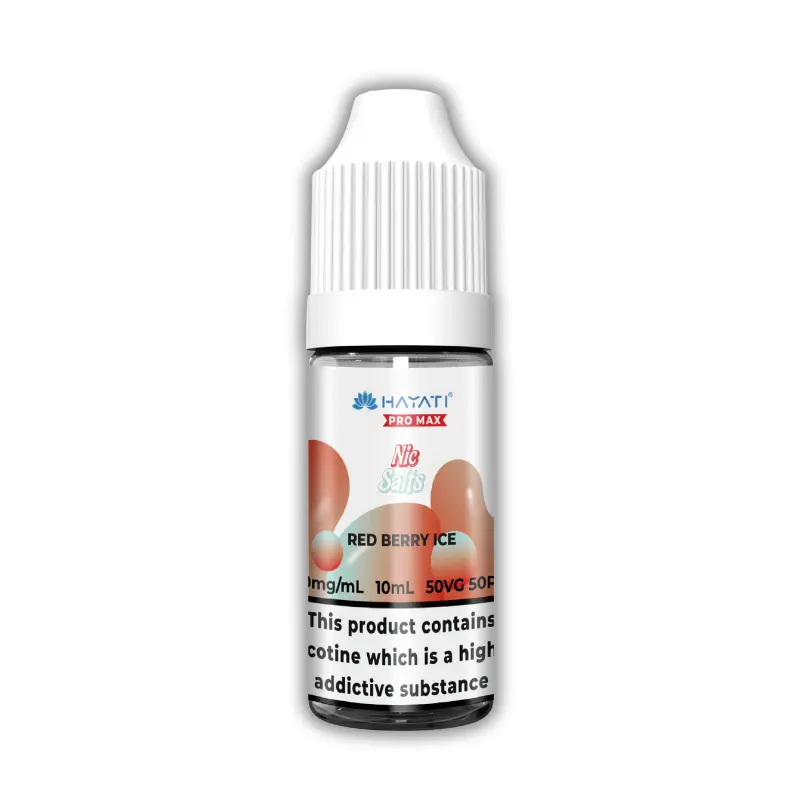
Hayati · Pro Max
Red Berry Ice Hayati Pro Max Nic Salt
£2.49
✔ In stock — ready to ship
Genuine Hayati
Free over £20
Same-day dispatch
Secure checkout
Red Berry Ice is a 10ml bottle of 10mg nicotine salt from the Hayati Pro Max line, mixed at 50/50 VG/PG, priced at £2.49, and filed on five shelves including Berry Vapes and Ice Vapes. Those are the easy facts and they are the last easy thing about it. The harder problem is that the listing describes a flavour without ever naming one. It offers you "a mix of red berries" and stops there. No strawberry, no raspberry, no cherry, no cranberry. The only fruits Hayati commit to paper anywhere in the description are blackcurrant and blackberry, and both of them appear solely to be ruled out.
That is an unusual piece of copy, and it is worth saying plainly at the top that this page is not going to invent the missing fruit. Other pages in this corpus have made a habit of admitting where a listing runs out, and that habit is worth keeping. What this page will do instead is treat the absence as something you can work with rather than something to apologise for. A description made of exclusions still carries information, provided the things being excluded are themselves described somewhere. Two of the three are. Blackcurrant and blackberry are real, well understood profiles with sixteen and six listings behind them respectively across the 492 products in this catalogue. Black Mamba, the named product the listing measures this bottle against, has three listings of its own and a bottle page that characterises it in some detail.
So the blend can be bounded from outside. You can establish what it is not, what it sits beside, what the range's red fruits actually consist of, and therefore how large the remaining space is. That is a smaller answer than a tasting note, and it is an honest one. Where this page infers, it says so and shows the working. Where the evidence runs out, it says that too, and it says which of the unknowns is the one likely to decide whether you keep the bottle.
Three named fruits, and all three of them are refusals
Start with what is on the page rather than what a reader might hope is on it. Hayati's description of this bottle runs to three short paragraphs. Strip out the hardware advice and the format numbers and you are left with a handful of sentences about the liquid itself.
What the listing actually names
Here is the complete inventory of flavour nouns in the description, in the order they appear.
- Red berries. A class, not a member. It appears twice, once as "a mix of red berries" and once as "the red end of the berry spectrum". Both are positive statements and neither identifies anything.
- Blackcurrant. Named once, inside a clause distancing the blend from "the deeper tones of blackcurrant or blackberry". Negative.
- Blackberry. Named once, in the same clause. Negative.
- Black Mamba. Named once, as a product this bottle is offered as an alternative to if that one is "too dark for your taste". Negative in form, though as this page will argue, the most useful sentence in the listing.
- Ice. Positive, and the only positively asserted component in the whole description. It is also in the product title, so it is not new information.
Every named fruit is a fruit the blend does not contain. Every named product is a product the blend is not. The only things stated positively are a category and a coolant. That is the shape of the listing, and it is genuinely unusual enough to be the subject of a page.
The count I ran, and what it changed
This page was commissioned on a stronger version of that observation than the catalogue supports, and correcting it made the argument better rather than worse, so the correction belongs on the page rather than in a private note.
The claim handed over was that only four listings in 492 use the construction "if X is too Y", and that Red Berry Ice, Fresh Mint, a Summer Dream bottle and a Blue Sour Raspberry pod were the four. I counted. The strict construction, a proper name followed directly by "is too", appears three times, not four: here, on Blue Sour Raspberry's Rubik pod sibling, and on the Fresh Mint bottle. The Summer Dream bottle is not a member at all. Its only use of the word is a note that a 70/30 mix is too thick for most mouth-to-lung pods, which is a viscosity caveat about hardware and has nothing to do with flavour comparison.
Loosen the pattern to the whole family, any clause of the form "if such and such feels too something, this is the other one", and the count rises to twenty-eight listings. That is nearly six per cent of the catalogue. It is a house habit, not a rarity, and any page built on the rarity of the construction itself would have been built on sand.
What does survive counting is narrower and more interesting. Of those twenty-eight, only six name a specific Hayati product as the thing that is too something, rather than a generic category like "sweeter blends" or "straight lemon flavours". Those six are Blackberry Ice against Blackberry Raspberry, Mango Peach Pineapple against Triple Mango, Mad Blue against Mr Blue, Bubblegum Ice against H'Bubba, Fresh Mint against Spearmint and Menthol, and this bottle against Black Mamba. Six in 492 is a real pattern and a small one.
Then narrow once more, and the claim lands. Of those six, five name a member of their own flavour family somewhere in their own description. Blackberry Ice names blackberry. Mango Peach Pineapple names three fruits in its title alone. Bubblegum Ice names bubblegum. Fresh Mint names mint. Mad Blue, which is the closest call of the five, places itself in blue raspberry and blueberry territory in its second sentence, so it names candidates even though its title does not. Red Berry Ice names nothing. It is the only one of the six where the comparison is the sole piece of identity information in the listing, because it is the only one that has not already told you what it is made of.
So the angle as handed over was overstated twice, on the count and on the reach, and it has been narrowed to this: the comparison against Black Mamba is the only sentence in the description that positions this liquid at all, and Red Berry Ice is the only listing of the six comparable ones that depends on its comparison this completely. That is the claim the rest of the page builds on, and it is a counted claim rather than a striking one.
One further fact is worth establishing because it explains why there is no second opinion to consult. Most Hayati flavours are sold several times over, across bottles, pods and kits, and Hayati write fresh copy for each listing, which means a writer can usually line up four or five descriptions of one liquid and see which properties all of them assert. That technique is not available here. Red Berry Ice exists exactly once in 492 products. Grouping every listing by its flavour field and counting, fourteen bottles on the Hayati Pro Max Nic Salts shelf carry a flavour that appears nowhere else in the catalogue, and this is one of the fourteen. The others include Tobacco, Menthol, Mr Pink, Gummy Bear, Bru Ice and Black Mint. Fourteen of sixty-five, so a little over a fifth of that shelf. For those fourteen there is one description and no way to check it against a second.
Bounding the blend from the outside
Given one description that names nothing, the workable approach is to draw the boundary rather than the object. Four boundaries are available, and three of them are firm.
The upper bound: what the two exclusions actually remove
Hayati rule out the deeper tones of blackcurrant and blackberry. Take that at face value and it removes a specific, well populated corner of the range. Blackcurrant appears in sixteen product titles across the catalogue and blackberry in six, and the two profiles behave in a recognisably similar way: low, jammy, slightly resinous, with a tannic dryness at the back that is closer to a dark cordial than to fresh fruit. Blackcurrant in particular tends to dominate whatever it is mixed with, which is why the range mostly pairs it with something sharp like a lemonade rather than with another berry.
The exclusion therefore does real work. It tells you the blend has no floor of that kind. Whatever the mix is, it is not built on a dark base with brighter fruit painted over the top, which is the standard architecture for a mixed berry liquid and the architecture that Blackberry Raspberry uses. Confidence here is high, because the sentence is unambiguous and because a manufacturer has no incentive to talk a customer out of a flavour family they also sell.
There is a second implication that is worth stating because it is easy to miss. "Deeper tones" is a statement about weight, not only about identity. A blend without them will read as lighter in the mouth regardless of how sweet it is. Sweetness and weight are separate properties, and a liquid can be quite sweet and still feel thin, which is the usual outcome when the sugar is carried by red fruit rather than dark. Expect this bottle to sit forward on the palate rather than settling at the back of it.
The lateral bound: Black Mamba is a coordinate, not a void
This is the part the commissioning note got backwards, and it is the most useful correction on the page. The brief for this article suggested there was no second description available to check the first against. That is true of Red Berry Ice itself. It is not true of the sentence that matters, because that sentence points at another product, and that product is documented.
Black Mamba has three listings in the catalogue and a bottle page on this site that goes through it in detail. Rather than re-derive any of it, here is what that page establishes, cited: the bottle opens on fruit with no cooling present at all, sits on a rich mixed berry leaning to the dark end with moderate to generous sweetness and only a faint tang, and then turns on the exhale as a cooling note arrives late and sharpens the finish. The Black Mamba bottle page also makes the point, correctly, that Hayati itemise nothing in that blend either, and that the shelf tags are a better guide to it than the title is.
Now read this listing's comparison against that. Red Berry Ice is offered as the lighter, redder option with a similar cool finish. Two claims are packed into that, and they behave differently.
The cooling claim is the stronger of the two. "Similar" is a direct equivalence and it is the only place in the description where this bottle's chill is calibrated against anything measurable. If the cooling on Black Mamba is a late arrival that sharpens rather than dominates, and that is what its page reports, then this bottle's cooling should be read the same way: present, noticeable on the exhale, not a menthol liquid. That is a genuine transfer of information and it is more precise than the listing's own positive sentence about the chill, which says only that it sharpens and freshens.
The fruit claim is weaker but not empty. "Lighter and redder" is a displacement vector rather than a position. It tells you the direction and not the distance. What it does rule out is the specific thing Black Mamba's page describes as its defining characteristic, which is the shift from rich to chilly across a single draw. A lighter, redder blend with a comparable finish has less distance to travel between the inhale and the exhale, because the fruit is not starting from as far down. So the contrast across the draw should be shallower here even though the cold itself is similar. That is an inference, drawn from combining the two listings, and it is flagged as one.
The honest summary of this section is that the negative comparison is the most informative sentence in the listing precisely because it is negative. A positive adjective like "juicy" is unfalsifiable and appears on dozens of listings. A comparison against a named product that has its own documented description is checkable, and it is the only checkable thing here.
The lower bound: which red berries this range actually stocks
If the blend is red berries and the dark ones are excluded, the next question is what the candidate pool contains. This is answerable by counting the catalogue, and the answer is smaller than "berries" sounds.
Counting fruit words across all 492 product titles, raspberry appears in seventy-four, cherry in sixty-two, strawberry in sixty, blueberry in forty-six, cranberry in sixteen, blackcurrant in sixteen and blackberry in six. Blueberry is out on colour. Blackcurrant and blackberry are out by the listing's own exclusion. That leaves four realistic candidates, and one of them, cranberry, is a specialist note that Hayati almost always name explicitly when they use it, as in Blueberry Cherry Cranberry and Strawberry Cherry Cranberry. A dry cranberry bite is distinctive enough that a manufacturer describing a blend as sweet and juicy with only a touch of tartness would be unlikely to have put much of it in.
So the working pool is strawberry, raspberry and cherry, in some proportion, with cranberry possible in a supporting role and unlikely to be prominent. That is not a tasting note and it should not be read as one. It is a statement about what the range has in stock and what the description's own adjectives are consistent with. Confidence: probable rather than confirmed, and the reasoning is entirely visible above so you can disagree with it.
Something else follows from the counts that is worth a sentence. Fourteen product titles in the catalogue use a bare, unqualified berry word, and eight use "berries". The Cherry Berry bottle page has already worked through why a generic berry word signals a blend that has deliberately not been itemised, and that argument is not going to be repeated here. What is worth adding is that this listing goes a step further than the ones that page discusses. Cherry Berry at least names its lead fruit in the title and leaves the bed unnamed. Red Berry Ice names no lead at all, only a colour band and a temperature.
What the positive sentences do supply, which is behaviour rather than identity
It would be unfair to the listing to say it tells you nothing. It tells you a fair amount, but all of it is about how the liquid behaves rather than what it is. The distinction matters for a buying decision, so it is worth separating.
On behaviour, Hayati assert sweetness described as moreish, a touch of tartness rather than a sour edge, juiciness, a crisp chill sitting over the fruit, a sharpening effect on the berries, a fresher exhale, and an overall impression they describe as bright and summery. Every one of those is a property you could verify or contradict on a first fill. None of them narrows the fruit.
On identity, Hayati assert a colour band and nothing else. The gap between the two lists is the whole of this page's subject. You are being told, with reasonable specificity, what the experience of vaping it is like, and nothing at all about what is producing that experience.
Whether that gap matters depends entirely on how you shop. If you buy by profile, meaning you want something sweet, red, cool and easy at £2.49, the listing has actually answered your question and the missing fruit names are an irrelevance. If you buy by ingredient, meaning you avoid cherry because of its almond edge or you specifically want raspberry's sharpness, the listing has not answered your question and cannot, and a bottle that names its fruits is a better use of your money. There is no shortage of those. Blueberry Raspberry, White Peach Raspberry and Strawberry Raspberry Ice all tell you exactly what is in them, and the last of those is close enough in concept that it functions as the named version of this bottle's idea.
The confidence ledger
Pulling the above together into one place, with each item tagged by how much weight it will bear.
- Reasonably confident. There is no blackcurrant or blackberry character, and no dark, jammy floor under the blend. There is real cooling, present on the exhale, calibrated by the listing itself as comparable to Black Mamba's. The sweetness is substantial and the acidity is low. The mix is 50/50 and the strength is 10mg, both stated.
- Probable. The fruit sits somewhere among strawberry, raspberry and cherry. The blend is assembled so that no single component is identifiable, which is the normal reason a manufacturer writes a colour band instead of a fruit list. The change across a single draw is less dramatic than Black Mamba's, because the starting point is higher.
- Unknown. Which berries, in what ratio. Whether the cooling is a menthol or a synthetic coolant, which Hayati do not publish for any bottle in this range. Whether the tartness comes from the fruit itself or from an added acid, which changes how the flavour survives a tired coil. And the one most likely to decide the purchase: whether the blend reads as a confectionery red, in the manner of a boiled sweet, or as a fresh red. The description is compatible with both and the word "summery" leans slightly towards fresh without settling it.
That last unknown deserves its own note, because it is the axis that separates liking this bottle from not liking it. Hayati's range contains plenty of both kinds. Strawberry GB is openly a confectionery strawberry, and the "GB" in that title does the work of telling you so. Nothing in this listing does that work in either direction. If a candied red is a deal breaker for you, a named bottle removes the risk for the same £2.49, and that is a reasonable way to spend the money.
Settling it yourself on the first bottle
A page that says the fruit is unknowable owes the reader a way of finding out. The following is a method rather than a ritual, and it takes about a day of ordinary use. It is written for this bottle specifically, because the cooling and the low acidity are what make the usual approaches unreliable here.
The obstacle is that menthol and coolants suppress your ability to resolve individual fruits. Cold flattens the top of a flavour, which is exactly where the difference between a strawberry and a raspberry lives. Anyone who has tried to identify the components of an iced blend on a full draw knows the result: it tastes of cold red sweetness and refuses to separate. So the method has to work around the chill rather than through it.
Fill a fresh pod and leave it ten minutes before the first draw. A 50/50 mix wicks quickly, but the first pull on a dry wick scorches the top notes and you lose the one part of the flavour you are trying to read. This matters more here than on a bottle whose fruit is already named, because on those you are only checking the balance.
Take the first three draws deliberately short. A one second pull brings across less coolant relative to flavour than a three second pull does, because the coolant sensation builds over the length of the draw while the fruit hits immediately. Short draws are the closest you will get to tasting this liquid without its ice. If a specific fruit is going to identify itself, it will do so in the first second of the first few pulls of a fresh fill.
Then exhale through your nose on one of them. Retronasal exhaling is how you actually smell a flavour rather than taste it, and fruit identity is mostly smell. The cooling registers on the trigeminal nerve rather than the olfactory one, so it interferes less with the nose route than it does with the tongue.
Now do the comparison the listing set up for you. If you have a bottle of Blackberry Ice or Black Mamba in the drawer, run a pod of each on consecutive days rather than the same afternoon. Palate fatigue on iced liquids is real and a same-day comparison will mostly tell you which one you vaped second. Across two days you are comparing memories, which is less precise but less contaminated.
Finally, note what the flavour does at the end of the bottle rather than the start. As a coil tires, the delicate notes go first and the base survives longest. Whatever is still recognisable on a well used coil is the component carrying the blend. On a red berry mix that is usually the sweetest and roundest of the fruits, which in practice means a strawberry-adjacent note tends to be the last one standing while a raspberry sharpness disappears early. If nothing distinct survives and the liquid simply dulls, that is evidence the accord is tightly blended rather than layered, which is a genuine finding about the product and worth knowing before you rebuy.
If you want a control for that exercise, a bottle that names its fruit and carries comparable cooling is the useful one to hold beside it. Strawberry Raspberry Ice is the obvious candidate, because it is two named red berries with ice over the top at the same price on the same shelf. If Red Berry Ice tastes materially like that bottle, you have your answer and the mystery was never deep. If it does not, the difference tells you which direction the unnamed blend actually sits in.
The bottle, briefly
There is not much hardware to discuss on a 10ml bottle, and the parts that matter for this liquid are the mix ratio and what the coolant does to a coil over time.
The ratio is even, half vegetable glycerine and half propylene glycol. On a bottle whose selling point is a chill, that balance matters more than it does on a plain fruit. Propylene glycol is the thinner of the two and it carries flavour compounds and coolants efficiently, which is why a 50/50 mix delivers a cooling sensation more sharply than a thicker mix of the same liquid would. The same ratio wicks fast enough to keep up with a narrow mouth-to-lung draw, which is the draw style this strength is built around. Put the same flavour into a 70/30 base and the chill softens and the vapour thickens, which is a different product rather than a better or worse one. The Strawberry Raspberry Ice 70/30 bottle is the nearest illustration of that trade in the range if you want to hear what an iced red berry sounds like at higher glycerine.
Nicotine is 10mg as a salt preparation, and 10mg is half the maximum strength permitted in a bottle of this size in the UK. A salt preparation at this strength gives a softer throat sensation on a narrow draw than the same figure as freebase would, which is the reason the format exists. Nicotine is addictive, and that is a plain fact about the substance rather than a comment on this bottle.
The practical constraint is the one the range repeats: keep it in low power mouth-to-lung pods and compact kits. A high power sub-ohm tank moves far more liquid per second than this ratio and this strength were designed for, and the result is unpleasant rather than interesting. Higher glycerine liquids at low or zero nicotine are the ones built for that hardware.
One thing specific to a cooled liquid is worth knowing before the first fill. Coolants leave a residual sensation in a pod that outlasts the liquid itself. If you run this and then refill the same pod with something uncooled, the first few draws of the new liquid will carry a ghost of the chill. That is not contamination and it does not last, but it is the reason experienced buyers keep a dedicated pod for their cooled bottles. It applies equally to every bottle on the Ice Vapes shelf and it is the single most common reason somebody thinks a new flavour tastes wrong.
The numbers, and what each one changes
| Reference | HPM-NS-RED-BERRY-ICE |
| Price | £2.49 |
| Cost per millilitre | Just under 25p |
| Volume | 10ml |
| Nicotine | 10mg, as a salt |
| Base | 50% vegetable glycerine, 50% propylene glycol |
| Stated profile | Red Berry Ice |
| Brand and line | Hayati, Pro Max Nic Salts |
| Filed under | Pro Max Nic Salts, Berry Vapes, Ice Vapes, Hayati E-Liquids, New Products |
| Coolant type | Not published |
| Fruits itemised | None |
Two rows in that table are doing work the others are not, and one of them is a row most spec tables would leave out.
The cost per millilitre is the row that makes the shelf legible. At £2.49 for 10ml this sits just under twenty-five pence a millilitre, which is the standard rate across the whole nic salt line, since every bottle on it carries the same price. That uniformity has a consequence worth naming: on this shelf you are never trading money against flavour, only against risk. An unnamed blend costs precisely what a named one costs, so the only thing you gamble by picking this over a bottle that lists its fruit is the chance of not liking it, and ten millilitres is a small amount of liquid to be wrong about.
The last two rows are there because a spec table that only lists what is known gives a misleading impression of completeness. Hayati publish no coolant type for any bottle in this line, so the distinction between a menthol and a synthetic cooling agent, which changes both the character of the chill and how long it lingers, is unavailable for every product on the shelf rather than just this one. And the fruits row records the central fact about this listing in the place a buyer scanning a table would actually look.
Also worth noting for anyone comparing formats: the shelf figures quoted on this page come from the catalogue as it currently stands, with 492 products in total, 65 bottles on the nic salt shelf, 225 across Berry Vapes and 98 across the ice shelf. Berry is the largest flavour category Hayati operate, which is worth holding in mind when a listing describes itself as a berry mix and expects that to be informative.
Where it sits against the rest of the shelf
Because the flavour is bounded rather than described, the comparisons below are organised by what the bounding establishes rather than by taste impressions this page has no standing to offer. Each group answers a different version of the question "what should I buy instead, and why".
The dark berries this bottle is defined against
These are the products the listing excludes, and they are the right place to start because if you read the exclusion and thought "but I like that", the exclusion has done its job and pointed you somewhere better.
Black Mamba is the named reference and the one to take seriously. Its own page describes a rich, dark berry opening with a cooling note arriving late on the exhale, which makes it the same structural idea as this bottle with the fruit moved down the spectrum. If you want the bigger contrast across a draw, that is the one that delivers it. Red Berry Ice is offered as the lighter option with a comparable finish, so the choice between them is a choice about weight rather than about temperature.
Blackberry Ice is the other direction the exclusion points. It names its fruit, which is the thing this bottle does not do, and it delivers a single dark berry with cooling rather than a blend. For a buyer who is uncomfortable with an unnamed mix, it is the closest thing on the shelf to a known quantity in the same temperature bracket, with the caveat that the fruit is the opposite of what this bottle offers.
Blackberry Raspberry deserves a mention as the bridge between the two families. It puts a dark berry and a red one in the same bottle and names both, so if you cannot decide whether the exclusion is doing you a favour, that is the bottle that lets you hear both sides at once. It has no ice, which makes it a poor substitute if the chill is what you came for.
The red bottles that do name their fruit
This group exists for the buyer who wants what this liquid appears to be but is not willing to buy blind. Every one of them tells you exactly what is inside.
Strawberry Raspberry Ice is the single most useful alternative on the page and the one this bottle most likely resembles. Two red berries, cooling on top, same price, same shelf. If you want the concept with the uncertainty removed, buy that one. The only argument for taking the unnamed bottle instead is that a blend built to be unitemised can be smoother than a two fruit mix, because there is no second fruit competing for the top of the draw.
Cherry Berry is the nearest relative in structure rather than in temperature. It names a lead fruit and leaves the supporting berries as an unnamed bed, and its page works through what that kind of construction is for. It has no cooling, so it is the version of this idea with the chill taken off and one fruit identified.
Strawberry Cherry Cranberry is what a fully itemised red blend looks like in this range: three fruits, all named, with the cranberry supplying a dry edge the others do not have. Holding it beside Red Berry Ice is the cheapest way to find out whether you actually want the fruits spelled out or whether you were only anxious about it.
Strawberry GB and Blueberry Raspberry sit either side of the confectionery question. The first is openly a sweet shop strawberry, the second a straight pairing of two fruits with no candy layer. Since this listing does not say which side of that line it falls on, those two bottles between them describe the range of possibilities.
White Peach Raspberry is worth a look if the appeal of a red blend for you is the tartness rather than the sweetness. Raspberry carries the sharp end there and the peach rounds it, which is a different balance from the sweet-forward one this listing describes.
Blueberry Raspberry Lemon and Berry Lemonade both add a citrus element to a berry base. Neither is cooled, and citrus does a partly overlapping job to ice in that it lifts and freshens a sweet fruit. If what you want from the chill is brightness rather than cold, those two get there a different way.
The cold ones, sorted by how much cold
Cooling is the one property this bottle's listing calibrates, so this group is organised by it. The useful background here is already written: the Blue Frozen pods page ran a census of Hayati's cooling vocabulary across the whole catalogue and established that the terms are not graded. Ice appears in ninety titles, Frozen in three, Cooler in two, and Chill and Freeze in none at all, and no listing anywhere combines an ice word with a mint word. The conclusion that matters for a buyer is that "Ice" in a title tells you cooling is present and tells you nothing whatsoever about how much. That page owns the count and it is cited rather than repeated.
What follows from it here is that the word "Ice" in this product's name is not the useful signal. The comparison to Black Mamba is, because it is the only statement in the listing that measures the cooling against something rather than just asserting it.
Blue Frozen is the heavier cooling on this shelf and its page describes a chill that arrives before the fruit has finished. If the chill on this bottle turns out to be too mild for you, that is the direction to move in, with the understanding that you are also moving from red fruit to a blue confectionery profile.
Bubblegum Ice, Banana Ice and Ice Pop are the cooled bottles that are not fruit-forward in the same way. They are useful mainly as rotation partners, because a cooled sweet flavour and a cooled fruit flavour tire the palate differently and alternating between them keeps both legible for longer.
Bru Ice and Cola Ice are the cooled drink flavours, and they are the furthest thing from this bottle that still shares its temperature. Worth naming because a buyer who likes cold liquids in general, rather than cold fruit specifically, has more options on this shelf than the berry filter suggests.
Blue Razz Mojito and Blue Fusion round out the cold and blue corner. Neither is a red fruit and neither is trying to be, but both demonstrate the same trick this bottle uses, which is putting a cooling layer over a sweet blend and letting the contrast do the work.
Other formats and where to browse instead
Red Berry Ice exists only as this bottle, so there is no pod or kit version of the exact flavour to move up to. The nearest equivalents in other formats are approximations rather than the same liquid. Blueberry Raspberry 50/50 shortfill is the way to buy a berry blend in volume at the same base ratio, though it arrives without nicotine and with a blue fruit rather than a red one. Strawberry Raspberry Ice 70/30 is the cloud-focused take on iced red berries for different hardware entirely.
For browsing rather than comparing, the Pro Max Nic Salts shelf holds all 65 bottles at a single price, which makes it the easiest shelf in the range to shop by flavour alone. Hayati E-Liquids widens that to 105 products across every bottle format, and Berry Vapes collects 225 products from every platform if you want to see how many ways this one fruit family has been cut.
Living with an unnamed blend
Ordinary handling advice applies to this bottle as it does to any other, so rather than restate it, here is what is specific to a cooled red berry liquid whose composition you cannot look up.
Judge it on a fresh coil and again on a tired one, and treat those as two different products. This is generic advice everywhere, but it carries extra weight on an unnamed blend, because you have no ingredient list telling you what should still be there. On a bottle labelled raspberry you know what has gone missing. Here, the only baseline you have is your own memory of the first fill, so it is worth paying attention to that first fill more than you normally would.
Sweet liquids build residue faster, and this one is described as sweet. Sucralose and similar sweeteners caramelise on a hot coil and the deposit dulls flavour long before the coil fails outright. On a cooled liquid the first casualty is usually the cooling itself, which stops feeling crisp and starts feeling merely wet. If the chill fades and the sweetness stays, that is the coil rather than the bottle.
Store it upright, closed, away from sunlight and warmth, and out of reach of children and pets. Heat is the enemy of a red fruit liquid in particular, because the brighter top notes are the volatile ones and they are the first to degrade. A bottle left on a sunny windowsill for a fortnight will taste noticeably flatter than one kept in a drawer, and on a blend where the top notes are already the only thing that might identify the fruit, losing them costs you more than usual.
Do not steep it and do not expect it to improve. Commercial nic salts arrive mixed and ready. The idea that a liquid needs time in the bottle comes from home mixing and does not transfer. If it tastes muted on day one it will taste muted on day thirty.
Rotate it against something uncooled rather than something else cold. Coolant fatigue is real and it works faster than flavour fatigue. Two cooled liquids in rotation will both start to seem weaker within a week, because the sensation is the thing your palate is adapting to rather than the fruit. Pairing this with an uncooled bottle such as Berry Lemonade keeps the chill effective for longer than pairing it with another bottle from the ice shelf would.
Finish the bottle before opening the next one. An opened 10ml bottle admits air every time it is used and oxidation gradually darkens both the colour and the flavour. Ten millilitres is a small enough quantity that this rarely becomes a problem, but keeping two or three bottles part-used at once is how it does.
Dispose of it properly. An empty liquid bottle is ordinary plastic recycling once rinsed, but a spent pod or coil contains electronics and belongs at an electrical waste point rather than in household refuse. Retailers selling this category are generally required to take small electricals back.
Questions this listing leaves open
Which berries are actually in it?
Hayati do not say, and this page will not pretend otherwise. The description commits only to a mix of red berries and rules out blackcurrant and blackberry. Counting the fruits this range actually uses, the realistic candidates are strawberry, raspberry and cherry, with cranberry unlikely in any quantity because its dryness would contradict the listing's own description of the blend as juicy with only a touch of tartness.
Why does the description name two fruits it does not contain?
Because a negative comparison is useful when the positive one would be vague. Telling you it is not blackcurrant or blackberry narrows the field more efficiently than another adjective would, and it steers a buyer who dislikes dark berries away before they spend the money. It is a reasonable piece of copywriting, and the oddity is only that nothing positive is named alongside it.
How does it compare with Black Mamba, really?
The listing positions it as lighter and redder with a comparable cool finish, and that is the whole of what Hayati say. Black Mamba's own page describes a dark berry opening with the cooling arriving late on the exhale. Taking both together, the reasonable expectation is similar cooling and a higher, brighter fruit, with less of a shift between the inhale and the exhale because there is less distance to travel.
Is it a menthol?
Hayati do not publish the coolant type for any bottle in this range, so the honest answer is that it is unknown. What the listing does say is that the chill sharpens the fruit and freshens the exhale, which describes a cooling layer over a flavour rather than a mint flavour in its own right. Nothing in the title or the description suggests mint as a taste.
How cold is it?
Not determinable from the title, because the word "Ice" is not a graded term in this range. The one usable calibration is the listing's own comparison, which puts the cooling at a similar level to Black Mamba's. That suggests noticeable cooling concentrated on the exhale rather than the heavy, front-loaded chill of the coldest bottles on the shelf.
How sweet is it?
The listing describes it as sweet enough to be moreish with a touch of tartness, which places it in the upper half of the shelf for sweetness and the lower half for acidity. That combination is common on cooled fruit liquids because cold reads as sharpness and lets a manufacturer use less actual acid. If you want real sourness, this is not the bottle.
Is there a version of this flavour in a pod or a kit?
No. Red Berry Ice appears exactly once in the 492 products in this catalogue and this bottle is it. That is not unusual for the nic salt shelf, where fourteen of the 65 bottles carry a flavour found nowhere else, but it does mean that if you settle on this liquid you are committing to refilling rather than to a prefilled format.
What hardware does it need?
A refillable pod system or a compact mouth-to-lung kit. The even base ratio and the 10mg salt strength are both matched to low power devices with a narrow draw. High power sub-ohm tanks move too much liquid for this strength to be pleasant and are built around thicker, lower nicotine mixes instead.
Is 10mg the only strength?
10mg is the strength this listing carries. For reference, 20mg is the legal ceiling for a bottle of this size in the UK, so this sits at half of it. Nicotine is an addictive substance and the figure is stated here as a fact about the product rather than as a recommendation.
Will the flavour gunk up a coil quickly?
Sweet liquids leave residue faster than dry ones and this is described as sweet, so expect a shorter coil life than you would get from a citrus or a plain menthol. The specific signal to watch for on a cooled bottle is the chill going soft while the sweetness remains, which usually means the coil rather than the liquid has reached the end of its useful life.
Should I buy this or something that names its fruit?
Every bottle on this shelf costs £2.49, so the decision is not financial. If you shop by profile and want something sweet, red and cooled, the listing has told you enough. If you have a specific fruit you avoid or a specific fruit you want, buy one that lists its contents. Strawberry Raspberry Ice is the named bottle closest to what this one appears to be.
Is there anything in the listing that might be a copywriting artefact rather than a fact about the liquid?
Possibly the exclusion itself. A description that defines a flavour by what it is not can be describing the liquid or it can be a writer filling space around a blend they had no ingredient list for. Both readings fit. What tips it slightly towards the first is that the exclusion is specific and the comparison names a real product, which is more effort than a purely decorative sentence usually takes.
The short version
Red Berry Ice is a £2.49 bottle of 10ml, 10mg nicotine salt at an even 50/50 base, offering a sweet, lightly tart red berry blend with cooling over the top. The distinguishing thing about the listing is that it identifies no fruit at all. The only flavour nouns Hayati put in writing are blackcurrant, blackberry and Black Mamba, and all three appear in order to be excluded or moved away from.
The angle this page was commissioned on claimed that construction was near unique in the catalogue. Counting it, that turned out to be overstated: twenty-eight listings use a comparison of that kind and three use the exact form. What survives the count is narrower and holds up, which is that six listings name a specific rival product as the thing that is too something, and this is the only one of the six whose own description never names a member of its own flavour family. The comparison is therefore carrying the entire identity of the liquid, which is why this page spent its length on what that comparison can and cannot tell you rather than on a tasting note nobody is in a position to write.
Buy it if you shop by profile and a sweet, cool, red fruit at a quarter of a pound per millilitre is what you are after. Choose a bottle that names its fruit if the identity of the berry is the thing that decides it for you, because this one will not tell you and no amount of reading will change that.
Strictly for adults aged 18 and over. Nicotine is an addictive substance.
You might also like


