
Home / Hayati Pro Max Nic Salts / Bru Ice Hayati Pro Max Nic Salt
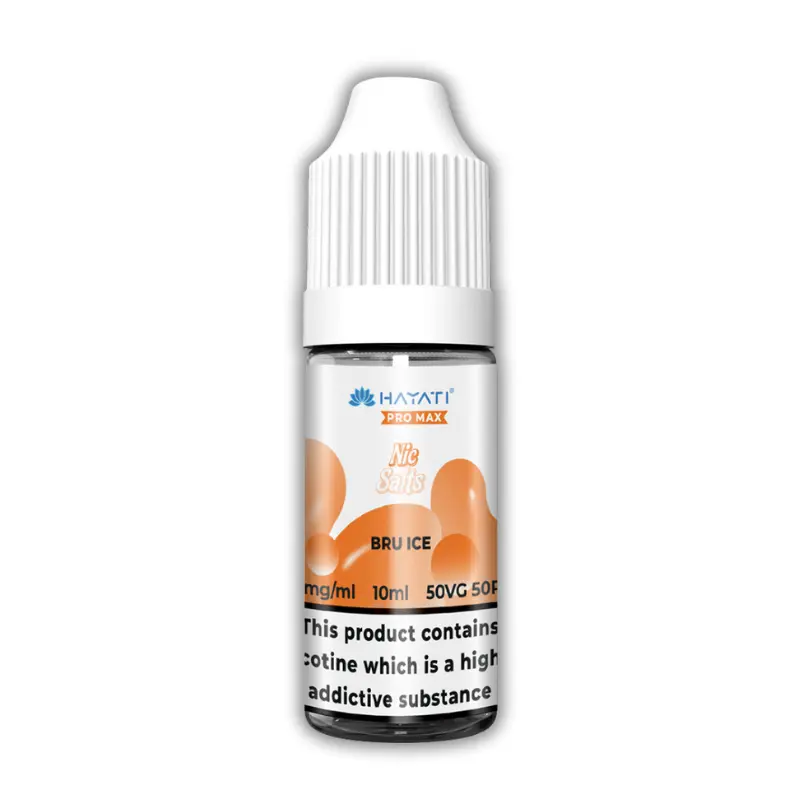
Hayati · Pro Max
Bru Ice Hayati Pro Max Nic Salt
£2.49
✔ In stock — ready to ship
Genuine Hayati
Free over £20
Same-day dispatch
Secure checkout
Bru Ice is a 10ml nicotine salt bottle in Hayati's Pro Max line, sold at £2.49, mixed at 10mg in a 50/50 base, and named after a bright orange Scottish soft drink whose full name belongs to somebody else. That last fact is the whole of the product and the whole of the problem. The name is a clipped reference, the reference is a real object a reader either has in their memory or does not, and Hayati's description is built on the assumption that the reader has it.
What makes this listing unusual is not the name. This shop has already established that Hayati clip brand names constantly, and that a fragment in a Hayati title is usually a truncation of something the brand cannot print. What makes it unusual is that Bru Ice is the only flavour in the range that was given one listing and then left there. No pod. No kit. No shortfill. No second bottle at a second ratio. One product, one description, one price, and no other document anywhere in the catalogue that describes the same liquid.
That matters more than it sounds, because the most productive method this site has found for reading a sealed Hayati liquid is to line up every listing of that flavour and compare the descriptions. Hayati commission fresh copy for each SKU, so a property that every listing asserts is close to a fact, and a property only one asserts is either the most interesting thing on the page or a copywriter's flourish. The technique needs a set. Bru Ice provides a set of one.
So this page does something else. It substitutes a cohort for the missing siblings. Hayati name five flavours after specific branded soft drinks rather than after fruits, sweets or generic drink categories, and four of those five are diffable even though this one is not. Reading those four properly tells you how much a Hayati soda name is worth in general, which is the only honest way to price what this one is worth. Then the flavour section works from what Hayati actually commit to, which is less than it looks, and says plainly where the reasoning stops. The short answer, delivered up front: the listing gives you one testable proposition and a great deal of house vocabulary, and the testable proposition costs £2.49 to settle.
Work five other pages have already done
Several of the arguments that touch this bottle are already settled on this site, and re-running any of them would waste the space the new material needs. They are cited here and not rebuilt.
The Ice Pop Hayati Pro Max Nic Salt page ran the census that put this bottle on the map. It counted the fruit-named shelves in the catalogue, found twenty of them, and then tested the Ice Vapes shelf against them: of 98 listings on that shelf, 80 carry at least one fruit shelf and 18 do not, and once the eight with an identifying non-fruit shelf are struck out, ten remain with no shelf anywhere that names what they taste of. Bru Ice is one of the ten, by name. That page also established that of the 65 bottles on the Pro Max nic salt shelf, 14 are filed as cold, and this is one of them. All of that is taken as given below.
The Cola Ice Hayati Pro Max Nic Salt page mapped which listings on this shelf point at which others, and it examined this bottle's outbound pointer, the line in the description suggesting the two be run together. It also observed, of this product specifically, that Hayati's shelf structure and Hayati's editorial view of the range are not the same map. That pointer graph belongs to that page and nothing here reopens it. What this page does with the two-channel observation is different in kind, and the difference is set out below rather than assumed.
The Vim Ice kit page owns the analysis of what a clipped Hayati brand name is and how to read one. It works through why a three-letter flavour name is a truncation rather than a mood, follows the trail through Hayati's own catalogue, weighs the filing against the naming, and separates the reasoning from the one part of the label that is not reasoning at all. None of that is re-derived here. Vim Ice is used below as evidence about the cohort, which is a different job from decoding it.
The Vim Ice pods page owns the argument about a reference that survives in speech and dies in print, and about how a buyer asks for something similar when they cannot say what it is similar to. That is the closest page in this shop to a regional-reference argument and this one stays off it deliberately.
The Caribb Crush pods page owns scarcity of sources: what it means to run a liquid that has one supplier listing, and where a replacement would have to come from. The temptation on a single-listing product is to rebuild that argument around a count of one. It is not rebuilt. And the Blue Frozen Hayati Pro Max Nic Salts page counted Hayati's cooling vocabulary across the whole catalogue and found it is not graded: Ice appears in ninety titles, Frozen in three, Cooler in two, Chill and Freeze in none, and no listing ever combines an ice word with a mint word. That finding does the work of the second half of this product's name and is cited rather than recounted.
A flavour with nothing to line up against itself
Start with the count, because the claim this page is built on is a rarity claim and house practice here is to test one before using it.
Bru Ice appears in exactly one of Hayati's 492 listings. That much is trivially checkable and it is true. The interesting question is whether it is unusual, and the honest answer is that it is unusual but not unique. Grouping all 65 bottles on the Hayati Pro Max Nic Salts shelf by the liquid inside them, and asking for each whether that liquid appears anywhere else in the catalogue in any format, 14 of the 65 come back as singletons. The full list is worth having, because it makes the shape of the group visible: the Shisha bottle, Tobacco, Strawberry Mojito, Strawberry Jelly Beans, Red Berry Ice, Mr Pink, Menthol, Lemon Peach Passionfruit, Kiwi Grape Raspberry, Gummy Bear, Fresh Menthol Mojito, Bubblegum Ice, Black Mint, and this one.
Roughly one bottle in five, then, exists only as a bottle. Anyone telling you that a single-listing Hayati flavour is a curiosity has not counted. What follows from it for a reader is narrower and more useful: on those 14 bottles, and only on those 14, the listing-comparison method is unavailable. There is no second description to check the first against, no platform split to expose which writer had the brief, and no disagreement between two documents to read as evidence about how the copy was produced rather than about the recipe.
Most of the other thirteen do not need the method. Menthol names a material. Tobacco names a material. Gummy Bear and Bubblegum Ice name confections with flavours almost anyone in Britain can call to mind without help. Strawberry Mojito, Kiwi Grape Raspberry and Lemon Peach Passionfruit list their fruit in the title. Red Berry Ice is genuinely underdetermined and its own page bounds the blend from the outside rather than guessing at it. The group that is both singleton and undecodable from the title is small, and this bottle sits in it.
There is a second, sharper count that belongs to this page rather than to a sibling. Of the 65 bottles, exactly two carry no flavour-named shelf at all except the cold one. Their only entry in the shop's twenty fruit categories and its family categories is Ice Vapes, which records a temperature and nothing else. Those two are Ice Pop and Bru Ice. The Ice Pop bottle has been written. This is the other one, and the whole of what the shop's filing system has recorded about what is in it is that it is cold.
Five names in this catalogue that point at a branded drink
If the flavour cannot be read against its own siblings, it can be read against its relatives. Hayati's naming falls into recognisable families, and one of them is small enough to enumerate completely: flavours named after a specific, identifiable branded soft drink rather than after a fruit, a confection or a generic drink category like cola or lemonade.
There are five, and between them they account for eleven of the 492 listings.
| Flavour | Listings | Formats it reached | Flavour shelves it is filed on |
| Bru Ice | 1 | 10ml bottle only | Ice Vapes |
| Vim Ice | 4 | Pro Max Plus kit and pods, Rubik kit and pods | Berry and Grape on the two Pro Max Plus listings, Ice Vapes on all four |
| Vimbull Ice | 2 | 120ml shortfill only, in two ratios | Ice Vapes on both |
| Caribb Crush | 2 | Pro Max Plus kit and pods | Exotic Vapes on both |
| Pipeline Punch | 2 | Pro Max Plus kit and pods | None at all |
Two notes on the boundary of that set, because a cohort is only as good as its definition. Cola, lemonade and fizzy cherry are excluded, because those are categories of drink rather than products, and a category can be printed without anybody's permission. Mr Blue, Mr Pink, Black Mamba and the aura names are excluded, because they point at a mood or a colour rather than at an object in a fridge. What is left is the set of names where Hayati are gesturing at one specific manufactured drink, and where the gesture had to be clipped because the full name is somebody's property. Four of the five are transparently truncations. The fifth, Pipeline Punch, is a whole phrase that names a particular tropical drink rather than a clipped one, and it is included because the referent is equally specific.
The half of the claim that did not survive counting
This page was commissioned with two rarity claims attached, and only one of them holds.
The claim that holds is that Bru Ice is the only one of the five confined to a single listing. It is: one against four, two, two and two. Every other branded-soda name in the catalogue was given at least a pair of documents, and a pair is enough to run the comparison on. That is the fact the rest of this page rests on and it is correct.
The claim that fails is the stronger version, that Bru Ice is the only one of the five sold exclusively as a bottle and that every other clipped soda reached a sealed-pod platform. Vimbull Ice did not. Both of its listings are 120ml shortfills in the Pro Max bottled line, one at 70/30 and one at 50/50, and neither is a pod of any kind. So the correct statement is narrower: two of the five never reached a pod platform, and Bru Ice is the one of those two that was not even given a second ratio. A Vimbull buyer has a format decision to make and two descriptions to make it from. A Bru Ice buyer has neither.
That correction is worth making rather than quietly dropping, because the narrowed version is the one that actually bears on the purchase. The interesting property is not the absence of pods. It is the absence of a second document.
Two channels, and how often they agree
Every listing in this shop carries two independent records of what is in the liquid. One is the prose, written by somebody employed to sell it, who may never have tasted it. The other is the filing, the set of shelves and tags the listing sits on, which somebody had to choose from a fixed list and which ends up in a machine-readable field. The Cola Ice page noted, for this bottle, that those two maps can disagree about where a product belongs. The question this page asks is a different one, and it is a question about a population rather than a product: across the whole branded-soda cohort, how reliably does either channel decode the name into an ingredient, and do the two channels track each other?
Take the prose first. Four of the five decode themselves to some degree.
Vim Ice decodes hard. All four of its listings describe a dark, cordial-style fruit, and between them they name berries, grape and blackcurrant outright. Whatever the liquid is, Hayati's writers were confident enough to put fruit names in the copy four times out of four.
Vimbull Ice decodes hardest of the lot. Its two descriptions name a blackcurrant and grape cordial character crossed with an energy-drink tang, which is the most specific decoding anywhere in the cohort. It is the only pair in the set that identifies two separate drinks and says what each contributes.
Caribb Crush decodes to a family and then stops, and does so consistently: both listings say tropical, and both state in terms that the name does not specify which fruits. Pipeline Punch decodes to a style of drink and declines to go further, with both listings stating that nothing in the mix leads.
Bru Ice does the least of the five. It names the referent drink by description rather than by brand, then offers one adjective about the taste, and hedges that adjective in the same breath. No fruit. No family. No second component. The one flavour word that is not stock house vocabulary is an admission that the character is difficult to place.
Now the filing, which is where the cohort becomes informative, because it does not follow the prose at all.
Of the eleven listings, two are filed on a fruit shelf. Both are Vim Ice, and both are the Pro Max Plus listings: the kit and the bare pods, filed on Berry Vapes and Grape Vapes. The other two Vim Ice listings, which are the Rubik kit and the Rubik pods, carry the same liquid, describe it in the same terms and are filed on Ice Vapes alone, with no fruit shelf and no fruit tag between them.
That is the finding this page most wants a reader to have. One flavour, one recipe, four listings, two descriptions naming grape and berries on each platform, and a filing decision that records those fruits on one platform and not on the other. The filing is not an independent reading of the liquid. It is a record of whether whoever catalogued that particular listing happened to make a decode, and on one of Hayati's two platforms for this flavour, nobody did.
Vimbull Ice makes the same point from the opposite direction and makes it more starkly. Its copy names blackcurrant and grape explicitly, in both listings, in the clearest terms in the cohort. The shop maintains a Blackcurrant shelf holding 16 listings and a Grape shelf holding 19. Neither Vimbull bottle is on either. Both are filed on Ice Vapes and nothing else. So the most thoroughly decoded flavour in the cohort has a filing record identical to the least decoded one, which is this bottle.
Caribb Crush lands on Exotic Vapes twice, which fixes a family without fixing a member, and is at least consistent with what its copy says. Pipeline Punch carries no flavour shelf at all on either listing, and its own page has already established that the filing and the copy agree in that case, both of them declining to name anything. That agreement is real and it is worth knowing that it is not the rule. Across the cohort as a whole the two channels come apart more often than they line up: eleven listings, and the prose and the filing give the same answer about which fruit is present on four of them.
The control group: what happens when the drink can be printed
A finding about eleven listings needs something to be a finding against, or it is just a description. So run the same test on the drink-named flavours where the drink is a generic category rather than a brand.
Cola Ice exists six times across the catalogue. All six carry a cola tag and all six sit on the Cola Vapes shelf, which holds eighteen listings in total. Fizzy Cherry exists six times. All six are filed on Cherry Vapes. Cola Lime is filed on Cola Vapes. Blackcurrant Lemonade, Pink Lemonade and Berry Lemonade all carry the lemonade shelf and their fruit shelves besides.
Twelve listings across two generic-drink flavours, and the filing records the base on twelve of twelve. Eleven listings across five branded-drink flavours, and the filing records a fruit on two of eleven. That is the calibration, and it is not subtle.
The obvious reading is the right one and it is not a criticism of anybody. A shelf label has to be a word the shop can print. Cola is a word. Lemonade is a word. Cherry is a word. The referent behind a clipped brand name is a registered trade mark, so it cannot become a shelf, which means the person doing the filing has to translate the brand into a fruit before they can record anything, and translating is work. Sometimes somebody does it, as on the two Pro Max Plus Vim Ice listings. More often nobody does, and the listing falls through to the temperature shelf, which is the one word on the label that needs no translation at all.
So the absence of a fruit shelf on this bottle is weak evidence about the liquid and strong evidence about the cataloguing process. It does not mean nobody could identify a fruit in Bru Ice. It means nobody tried, and the cohort shows that nobody trying is the normal outcome for a name of this shape.
What the cohort discounts, and by how much
Put the two halves together and the cohort yields a working rate for how much a Hayati branded-soda name promises.
The prose will usually give you a direction. Four of the five cohort flavours state at minimum a family: dark fruit, tropical, mixed fruit punch. That is real information and it rules things out. Bru Ice states a register, soda, rather than a family, and one hedged adjective, which is less than any of the other four gives.
The filing will usually give you nothing, and when it does give you something it is unreliable enough that it should not be treated as corroboration. This is the part that qualifies an argument already on this site. The Vim Ice kit page treated that flavour's Berry and Grape shelving as a second, independent piece of evidence arriving from a different direction, which strengthened its cordial reading considerably. The reasoning was sound on the evidence available at the time and the conclusion is probably still right. But the same flavour is filed on no fruit shelf at all on the Rubik platform, and the same brand family is filed on no fruit shelf at all on the bottles despite naming blackcurrant in the copy, so the filing is not independent of who did the work. It corroborates when somebody bothered and stays silent when they did not, which is a pattern of effort rather than a pattern of evidence.
Applied here, that means two things. First, the absence of a fruit shelf on Bru Ice tells you very little, and any page that reads it as Hayati declaring the liquid unclassifiable is over-reading. Second, and less comfortably, the presence of the description's single flavour adjective does not get a boost from anywhere. There is no second listing to confirm it, no fruit shelf to cross-check it, and no tag beyond the product's own name and the word ice. This is the thinnest evidence base of the five, and the cohort is the reason we can say so with a number rather than an impression.
The only listing in 492 that hands the description to the reader
There is one more property of this listing that no sibling shares, and it is the sentence that opens the flavour paragraph. Hayati begin it with a condition. If you know the drink, they say, you will recognise the idea.
That construction appears once in the catalogue. Searching all 492 descriptions for the phrase produces exactly one hit, and it is this bottle. Widening the search to the verb alone produces three listings that tell a reader they will recognise something: Double Apple, a Blackcurrant Lemonade kit, and this one. The first two are doing something entirely different. Double Apple says the name will be familiar from shisha menus, which is a remark about where a reader may have met the phrase, not a condition on the description. The Blackcurrant Lemonade listing says the combination of blackcurrant squash and fizzy lemonade is one most people in Britain will recognise, which is a claim about how common the reference is, made after both components have already been named in plain words. Neither description depends on the recognition. Strike the sentence out of either and you still know what is in the liquid.
Strike it out of this one and almost nothing survives. The recognition clause is not decoration here, it is the load-bearing element, and everything after the colon is written as an elaboration of an idea the reader is assumed to already hold. That makes Bru Ice the only listing in Hayati's range whose flavour description is conditional on the buyer supplying the referent themselves.
Two consequences follow, and they point in opposite directions depending on the reader.
If you have had the drink, this is one of the more informative listings in the catalogue rather than one of the vaguer ones. A branded soft drink is a precise target. You know its sweetness, its carbonation, its colour, the specific oddness of its flavour that nobody has ever successfully described, and the fact that it does not taste like any fruit in particular. Hayati are telling you the liquid is aimed at that object. They are not telling you how close the shot landed, but they have given you a target, which is more than a mood name ever does and more than the Caribb Crush pair manage between them.
If you have not had the drink, the sentence is an instruction you cannot follow, and the rest of the paragraph degrades into the catalogue's default register. What you are left with is: sweet, tangy, refreshing, with an iced finish and a slightly citrusy character that Hayati themselves describe as hard to pin down. Every one of those words except the last two is applied to a third or more of the range. The description does not fail for such a reader so much as evaporate.
And there is no cheaper route to the answer, because there is no second format. On any of the other four cohort flavours a curious buyer could sample the cheap version first. Here the bottle is the whole product line. What the bottle does not tell you, nothing in the catalogue tells you.
What Hayati actually commit to, and what they leave out
Flat lists, so that everything below can be checked against them.
On the record. The product is called Bru Ice and is sold as a 10ml bottle. The nicotine strength is 10mg and the preparation is a nicotine salt. The carrier base is 50/50 vegetable glycerine and propylene glycol. The price is £2.49 and the stock code is HPM-NS-BRU-ICE. The intended use is mouth-to-lung, in a refillable pod kit or a compact device running a higher-resistance coil, and not in a sub-ohm setup. The shop files it under four headings: the Pro Max nic salt shelf, Hayati E-Liquids, Ice Vapes and New Products. On flavour, Hayati commit to this much: the target is a named orange Scottish soda, the profile is sweet, it is tangy, it is refreshing, it carries a slightly citrusy character, that character is hard to pin down, and there is an iced finish. They add that it sits apart from the usual fruit-and-ice construction, and they suggest running it alongside Cola Ice.
Off the record. No fruit, anywhere, in any field. The flavour entry in the product data repeats the product name back and stops. No second flavour component. No indication of which element arrives first or what the exhale does. No sweetness figure and no acidity figure on any scale. No cooling intensity, absolute or relative, which is true of every cooled product Hayati sell rather than a gap peculiar to this one. No statement of what the citrus is, whether it is orange, lemon, grapefruit or a general brightness that reads as citrus without being any of them. No bottle-to-bottle consistency note. And no second description of the liquid from any other source inside the catalogue.
Two words in the description that are not stock
Two pages on this site have already established the method for weighing a description's adjectives, which is to count how often each one appears across the whole catalogue before deciding it means anything. The Caribb Crush pods page did it for that flavour's copy and the Pipeline Punch pods page did it for that one. The method is theirs. The numbers for this bottle are as follows, and they are stark.
Sweet appears in 346 of the 492 descriptions. Tangy appears in 145. Refreshing appears in 76, and the wider family of refresh words in 85. Citrus, in one form or another, appears in 86. A word applied to seven listings in ten cannot distinguish this bottle from anything, and a word applied to nearly one in five barely can.
Two constructions survive the count. The qualified form of the citrus claim, with the hedging adverb attached, appears once in 492 and it is here. The admission that the character is hard to place appears once in 492 and it is here. Nothing else in the description is unusual, unless you count the geographical detail, which is also unique in the catalogue but describes the referent rather than the liquid.
Read that carefully, because it is a stranger result than it first looks. Of the two distinctive things Hayati say about this flavour, one is a hedge and the other is a confession. The hedge weakens the only positive flavour claim in the paragraph. The confession states in the middle of promotional copy that the character resists description. A listing whose two non-stock phrases are both forms of retreat is not a listing that is holding information back. It reads like one written by somebody who had the drink in mind, could not translate it into the trade's vocabulary, and said so.
That is a more sympathetic reading than the alternative, and I think it is the right one, but it should be tagged as a reading rather than a fact. The evidence for it is the frequency counts above plus the shape of the sentence. The evidence against it is that an unusual phrase can be a single writer's tic rather than a signal, and with one listing there is no way to tell a tic from a considered choice. On a flavour with four listings you could check whether the same writer's habits recur. Here you cannot, which is the whole difficulty of this product restated one more time.
The claims, graded
Everything above sorted by how much weight it will bear.
Reasonably confident. The liquid is cooled. Cooling is declared in the title, declared again in the description, recorded in the tag field, and recorded a fourth time in the shelf placement, and this range does not hide coolant because unannounced cold is the single attribute most likely to make a buyer return something. The liquid is sweet, in the sense that it is not a dry or savoury profile. The construction is a soft-drink register rather than a fruit-and-ice construction, which Hayati state directly and which is consistent with the name. The format facts are all published and are not in doubt.
Probable. There is some acidity, since tangy is stated and the referent drink is acidic. The profile has a sugary, carbonated-drink quality rather than a fresh-fruit quality, which follows from the soda framing and from how flavours of this type are usually built, and which I am inferring rather than reporting. The citrus element, if present, is a brightness within the soda accord rather than a separate fruit sitting on top, because the description attaches it to the soda character as an attribute rather than listing it as a component.
Unknown. How cold. No coolant dose is published for any Hayati product, so the distance between a light chill and a hard menthol front is invisible on paper for this bottle exactly as it is for the other thirteen cold ones. Which citrus, or whether the citrus reading survives contact with the liquid at all. How sweet, on any comparative scale. Whether the referent is recognisable in the aerosol, which is the axis most buyers actually care about and the one nobody outside the factory can answer. And batch consistency, which on a single-listing product has no external check whatsoever.
If the cooling intensity is the axis that decides your purchase, this is a poor bottle to gamble on and a named cold bottle is a better bet, because at least you can predict what the cold is sitting on top of. Watermelon Ice and Cherry Ice are the obvious substitutes at the same price. If the citrus question is the one that decides it, read the next section, because that one is settleable.
Deciding the citrus question on your own bottle
The Ice Pop bottle page sets out a full comparator protocol for this shelf, built on buying a named bottle alongside, running both on identical coils and writing eliminations rather than descriptions. That protocol works here and there is no point restating it. What follows is narrower and specific to this liquid, because this listing gives you exactly one falsifiable proposition and it is worth isolating rather than burying in a general method.
The proposition is the citrus. Everything else Hayati say is either unfalsifiable (refreshing), universal (sweet), or a statement about a referent rather than about the liquid. The citrus claim is different: it asserts a specific sensory component, it is hedged, and it is checkable in two draws by anybody with a second bottle on the shelf.
Here is why it is worth checking rather than accepting. Citrus in this trade is not one thing. A lemon brightness, an orange sweetness and a grapefruit bitterness behave completely differently on a coil and pair with cold completely differently. The description does not say which, and the hedging adverb suggests the writer was not sure it was citrus at all so much as that it read as citrus. It is entirely possible that what the liquid actually has is an acidic lift that the palate files as citrus because there is nowhere else to file it, which is a common enough effect in sweetened drink flavours. Deciding which of those two it is takes one session and it changes what else on this shelf you will enjoy.
The test: run this bottle and a known citrus bottle from the same shelf alternately, in the same device, on the same coil, taking one draw of each in sequence rather than comparing across an afternoon. Cooling and acidity both fade from perception fast, so sequence is the only reliable way to read them. What you are asking is a single yes or no. Does the bright element in this bottle sit in the same place on the palate as the one in the comparator, or does it sit further back and feel more like fizz than like fruit? If the former, the citrus is real and you can shop for it. If the latter, the description's hedge was doing honest work and you should treat this bottle as a sweet cold soda profile with no fruit in it at all, which is a legitimate and quite rare thing for a liquid to be on this shelf.
Write down whichever answer you get before you form an opinion of the flavour overall, because the two will contaminate each other if you do not. A liquid you have decided you like acquires flavour notes it does not have.
If you do not hold the reference
The awkward case is a buyer who has never had the drink, and it deserves a straight answer rather than reassurance.
The first thing worth saying is that this referent is unusual among Hayati's borrowed names in being a physical object that can still be bought. Most of the catalogue's untranslatable names point at something you cannot acquire: a mood, a colour, a fictional character, a confection that has changed recipe, a cocktail. The soda behind this one is a real product sitting in real chillers. If the recognition clause is the barrier, the barrier is removable, and removing it costs less than the bottle does.
That is a slightly odd thing for a product page to recommend and it is the honest recommendation. Hayati have written a description that only works if you hold the reference. You can go and get the reference. Having done so you will be reading the best-targeted flavour claim in the cohort instead of the vaguest one.
The second thing worth saying is what to do if you would rather not bother. In that case this bottle is a £2.49 unknown and should be treated as one, and the sensible move is to decide whether you want the category rather than the product. The category is drink-register cooled liquid without fruit, and there is a named member of it on the same shelf: Cola Ice, which states its base plainly, contains nothing else, and is priced identically. Buy that first if the question is whether you like a cooled soda profile at all. Come back to this one if the answer is yes and the specific oddness is what you are after.
The third thing is a caution about substitutes. Do not treat this as interchangeable with a fruit bottle that happens to be cold. The soda register is genuinely different from the fruit-and-ice construction that dominates this shelf, Hayati say so, and it is the one part of their flavour copy that no house-vocabulary count undermines. A buyer who wants a change from berries is being pointed somewhere real. A buyer who wants a good berry liquid should buy a berry liquid: Blackberry Raspberry and Blueberry Cherry Cranberry are both on the same shelf at the same price and both name what is in them.
The bottle, briefly
There is not much to say about a 10ml bottle that the other 64 on the shelf do not also demonstrate, so this section is short and spends its words on the one property that matters for this particular liquid.
You supply the hardware. That is the whole difference between a bottle and a prefilled pod, and on an unknown flavour it is worth more than it is on a known one. A sealed pod hands you a liquid welded to a coil somebody else chose, so a first impression of the flavour is really a first impression of the pair, and if the result disappoints there is no way to tell which half disappointed you. Here the coil is a separate consumable and the liquid is not tied to it. If the first fill tastes muted, fit a fresh coil, refill from the same bottle and find out within two draws whether the problem was the wick or the recipe. On a flavour with no second listing to cross-check, that single test is the only diagnostic available anywhere, and it is the strongest practical reason to meet this liquid in bottle form rather than wishing it came as a pod.
The 50/50 base is the other half of that. An even split of vegetable glycerine and propylene glycol is thin enough to wick through a narrow, high-resistance coil without starving it, which is why it is specified for mouth-to-lung use and not for a sub-ohm tank. The practical consequence for a cooled soda profile is worth noting on its own terms: propylene glycol carries flavour compounds more readily than glycerine does and produces less vapour while doing it, so a 50/50 liquid tends to present its flavour in sharper outline and smaller volume than a high-glycerine one would. On a profile whose distinguishing feature is a character its own manufacturer calls difficult to place, outline is exactly what you want. A thicker base would round the edges off the very thing you are trying to identify. The Banana Ice 50/50 shortfill and the Red Apple Ice 70/30 show the two ratios side by side for anyone who wants to see what the choice costs, though neither is this flavour and this flavour is not offered in either.
On strength: 10mg is the figure Hayati mixed, and 10ml is the volume, and neither is variable on this listing. Nicotine is addictive, which is a plain fact about the substance and not a property of this bottle in particular.
The figures, ordered by what this page argues
| Listings of this liquid in the catalogue | One |
| Flavour components named by Hayati | None |
| Flavour shelves it is filed on | Ice Vapes only |
| Cooling intensity | Not published, for this or any Hayati product |
| Price | £2.49 |
| Volume | 10ml |
| Nicotine | 10mg, as a salt |
| Base | 50/50 vegetable glycerine to propylene glycol |
| Intended draw | Mouth-to-lung, higher-resistance coil |
| Not suitable for | Sub-ohm tanks and high-wattage setups |
| Stock code | HPM-NS-BRU-ICE |
The top four rows are the ones that distinguish this product and the bottom seven are the ones that do not. That is not a criticism of the specification, it is the defining property of the shelf. Every one of the 65 bottles is 10ml, every one is 10mg, every one is 50/50, and 64 of the 65 cost £2.49, a point the Ice Pop bottle page establishes in detail and which is taken as read here. What this page takes from it is a single consequence about price rather than about method.
Because the specification is constant, the only variable on the shelf is the flavour, and the price of resolving any flavour question on it is therefore fixed at £2.49. That figure is also the floor for the whole catalogue: no listing anywhere in Hayati's 492 products is cheaper. Now set it against the cohort. To find out what the other four branded-soda flavours taste like costs £3.99 at the lowest, for a Rubik pod, and £5.49, £5.49 and £6.99 for the others. This bottle is the least documented of the five by a distance and the cheapest to settle by a factor of at least one and a half. Those two facts sit oddly together and, on balance, they sit in the buyer's favour. An unknown that costs £2.49 to resolve is a different proposition from an unknown that costs £7.99, and most of the discomfort this page has been describing is priced accordingly.
Where it sits on a shelf of sixty-five
The drink-register bottles
Four bottles on this shelf are built on a soft drink rather than on fruit, and this is the only one of them that does not state its base in plain words. Cola Ice is cola and cooling with nothing else in it, which makes it the reference point for the group and the one to own first if you have none of them. Cola Lime adds citrus to the same base and drops the cooling, so it answers a different question. Cherry Cola sits between the two. This bottle leaves the cola accord entirely while keeping the soda register and the chill, and because the shop files it away from the cola shelf, a buyer browsing that shelf will never meet it. How those four describe each other has been mapped in detail on the Cola Ice page and is not repeated here.
The cooled bottles that name their fruit
Thirteen of the fourteen cold bottles on this shelf tell you what the cold is sitting on. Watermelon Ice and Cherry Ice are the cleanest single fruits of the group and the easiest to predict. Banana Ice is the softest and the least sharp. Red Apple Ice brings an orchard sweetness that behaves quite differently under coolant from a berry. Blackberry Ice and Strawberry Raspberry Ice are the dark and red berry positions respectively. Any of those is the better purchase if you want to know what you are getting before you open it. None of them is in the soda register, which is the trade this bottle asks you to make.
The other bottles whose name withholds
Bubblegum Ice is the closest structural relative on the shelf: a confection reference, cooled, singleton, no fruit shelf. It is an easier case only because a reader who has never had the specific brand can still call bubblegum to mind. Black Mamba gives a direction rather than a family, dark and intense, and its own page works through what a direction is worth. Red Berry Ice names a colour and a category and its page bounds the blend from the outside rather than guessing. Ice Pop is the other bottle on the shelf whose only flavour shelf is the cold one, and its page is the nearest thing to a companion piece to this one. Where those four differ from this bottle is that none of them depends on the reader holding a specific object in memory. They are vague; this one is precise and conditional, which is a different failure mode and, for the right reader, not a failure at all.
If the cold is the part you want more or less of
Nobody can tell you how cold this liquid is, so the sensible alternatives are the ones where cold is the entire point and there is nothing else to be surprised by. Menthol is the unambiguous version. Spearmint is the herbal one. Fresh Menthol Mojito puts lime and mint together for anyone who wants a cold drink profile with a stated citrus rather than a hedged one, which makes it a fair comparator for the test described above. If you want the opposite and would rather the cold were absent, the shelf holds plenty of uncooled bottles, and Blackcurrant Lemonade is the drink-style one among them.
Other formats, and browsing
This flavour exists in no other format, which is the subject of half this page, so there is no kit to link and no pod to compare. For the shelf itself, the Pro Max nic salt shelf holds all 65 bottles at one price, Hayati E-Liquids widens that to 105 including the shortfills, Ice Vapes collects the 98 cooled listings across every format, and the full range is the place to go if none of the above settles it.
Living with ten millilitres of a drink you may not have had
General handling advice is identical across this shelf and repeating it in a ninth voice helps nobody, so here are the three things that are specific to this liquid.
The first concerns what a tiring coil takes away, and it is worse here than on a named bottle. Sweetened liquids leave residue on wire, residue insulates and throttles, and the lightest aromatic compounds are always the first casualties. On a bottle with a fruit in the title you notice immediately, because the word is in your head and the draw stops matching it. Here there is no word to fall short of. What will go first is precisely the hedged, hard-to-place element that is the only distinctive thing in the description, and what will survive is the sweetness and the cold, which are the two parts that were never distinctive in the first place. The failure mode is therefore a liquid that quietly becomes a generic sweet cold vape while still tasting fine, and you will not catch it by tasting for an absence you cannot name. Catch it by date instead. Note when you fit a coil, and swap it on schedule rather than on impression.
The second concerns priming, for the same reason. A dry wick scorches the delicate compounds first and the robust ones last, so a badly primed first fill on this bottle will remove the interesting part of the flavour and leave you with an impression of the product that is wrong in a way you have no means of detecting. Wet the wick, let it stand, and start at the low end of the coil's range. The point is not gentleness for its own sake. It is that you only get one first impression of a liquid you have no second listing to check against.
The third is storage, which Hayati specify and which matters slightly more than average here. Light and heat degrade flavourings, and the more volatile the compound the faster it goes, which again means the distinctive part goes first. A cupboard rather than a windowsill, a drawer rather than a car door, cap on tight between refills. Keep it out of reach of children and animals, and when the bottle is empty it goes to a recycling point rather than into the household bin. None of that is unusual advice. It is worth following literally on this one because the degradation is invisible to you.
Questions this listing raises
What does Bru Ice actually taste of?
A sweet, tangy, cooled soft-drink profile with a slightly citrusy element that Hayati describe as hard to place. That is the whole of what is on the record. No fruit is named anywhere in the listing, the flavour field repeats the product name, and there is no second description of this liquid in the catalogue to check the first against. Anybody giving you a confident tasting note for it has either tasted it and is reporting a personal impression, which is a fair thing to do and a different thing from a specification, or is guessing from the name.
Is it a cola flavour?
No. It is a soda-register flavour aimed at a different drink, which is why the shop does not file it on the cola shelf. Its own copy suggests running it alongside Cola Ice, which tells you the two are considered compatible rather than similar. If you want cola specifically, buy Cola Ice.
Why does the description say "if you know the drink"?
Because the referent is a specific branded soft drink whose name Hayati cannot print, so the description points at it by description and then leans on the reader's memory to do the rest. It is the only listing in the 492 that makes its flavour paragraph conditional in that way. For a reader who holds the reference it is one of the better-targeted descriptions in the range. For a reader who does not, the rest of the paragraph is mostly house vocabulary.
Is there any ice in it, and how much?
Yes, cooling is present, declared in the title, the description, the tag field and the shelf placement. How much is not published, and no coolant dose is published for any product Hayati sell. The Blue Frozen page established that the cooling words in this range are not a graded scale, so nothing can be read from the choice of the word Ice over any other.
Why is it not on a fruit shelf?
Because a shelf label has to be a printable word and the referent behind this name is not one. Across the five branded-soda flavours in the catalogue, spanning eleven listings, only two are filed on a fruit shelf, and both of those are one flavour on one platform. Two other listings of that same flavour, on a different platform, carry no fruit shelf at all. So the absence tells you about the cataloguing rather than about the liquid.
Is a single-listing flavour a risk?
It is a limitation rather than a risk. Fourteen of the 65 bottles on this shelf exist only as bottles, so the pattern is common. What you lose is the ability to compare Hayati's own descriptions of the same liquid against each other, which on a well-travelled flavour is the most reliable evidence available. What you lose in practice is a cross-check, not a guarantee.
Can I try it in a cheaper or smaller format first?
No. This is the only listing of the liquid, and at £2.49 it is already at the catalogue's lowest price point. There is no pod, no kit and no shortfill. The bottle is both the cheapest and the only way to find out.
What device does it need?
A refillable pod kit or a compact device running a higher-resistance coil, used with a narrow mouth-to-lung draw. The 50/50 base is too thin for a sub-ohm tank and the 10mg strength is mixed for a restricted draw rather than a wide one.
How does it compare with Ice Pop, the other bottle with no fruit shelf?
Both are cooled, sweet and filed only on the cold shelf, and both leave the fruit question open. They differ in what kind of gap that is. Ice Pop names a generic frozen confection, so the gap is genuine vagueness that nobody can close. This one names a specific drink, so the gap is closable by anybody who has had it. If you want the unknown to be resolvable, this is the more resolvable of the two.
Will it clash with other liquids in a rotation?
Hayati's own suggestion is to run it alongside Cola Ice as a pair of drink-style flavours, which is a compatibility claim rather than a similarity claim. On general grounds a cooled soda profile sits apart from the berry bottles that make up most of this shelf, which is what makes it a change of direction rather than a variation. That is the one flavour statement in the listing that no frequency count undermines.
How will I know when to change the coil?
By the calendar rather than by taste. The element most likely to fade first is the distinctive one, and because it has no name you will not register its absence as an event. Note the date you fit a coil and replace it on your usual schedule instead of waiting for the flavour to tell you.
The short version
Bru Ice is a 10ml, 10mg, 50/50 nicotine salt at £2.49, cooled, aimed at a specific Scottish soft drink, and sold exactly once. It is the only flavour of the five that Hayati name after a branded soda that never received a second listing, and one of only two bottles in 65 whose sole flavour shelf records a temperature and nothing else.
The usual method for reading a Hayati liquid, comparing its listings against one another, cannot be run here, so this page ran it on the cohort instead. The result is a discount to apply rather than a description to trust. Across the eleven listings of the five branded-soda flavours, the prose usually gives a direction and the filing usually gives nothing, and the two agree about which fruit is present on four of the eleven. One flavour is filed on fruit shelves on one platform and on none on another. Another names blackcurrant and grape in its copy and is filed on neither of those shelves. By comparison, the generic drink names get their base recorded every time, twelve for twelve. The filing records whether somebody did the translation, not whether the liquid has one.
What is left for this bottle is an honest short list. It is cooled, sweet and built in a soft-drink register rather than a fruit one. It carries a citrus element that Hayati hedge and describe as hard to place, and that hedge is one of only two phrases in the description that are not applied to a large fraction of the catalogue. How cold, how sweet and which citrus are all unknown, and there is no second document to consult.
Who should buy it: anyone who knows the drink and wants to see how close the liquid lands, and anyone who wants a cooled soda profile with no fruit in it and is content to spend the catalogue's lowest price finding out what the specific character is. Who should not: anyone for whom cooling intensity is the deciding axis, and anyone who wants to know what a liquid tastes like before they open it, both of whom are better served by one of the thirteen cold bottles that name their fruit.
Strictly for adults aged 18 and over. Nicotine is an addictive substance.
You might also like


