
Home / Hayati Pro Max Nic Salts / Blackcurrant Juice Hayati Pro Max Nic Salts
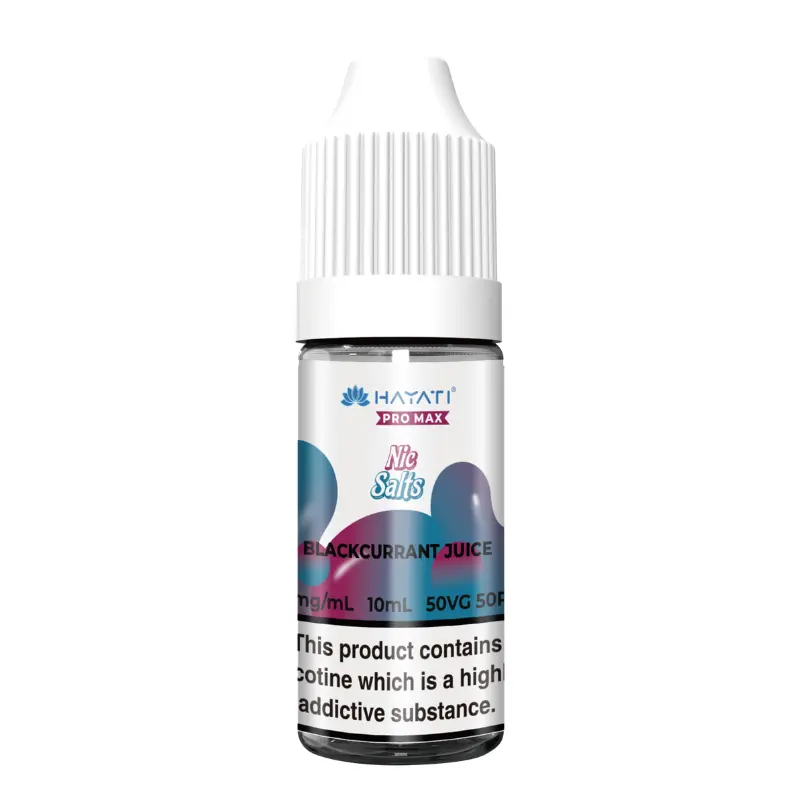
Hayati · Pro Max
Blackcurrant Juice Hayati Pro Max Nic Salts
£2.49
✔ In stock — ready to ship
Genuine Hayati
Free over £20
Same-day dispatch
Secure checkout
Blackcurrant Juice is the least complicated bottle on the Hayati Pro Max nic salt shelf, and that is the whole proposition. One fruit. No second flavour, no citrus lift, no coolant, nothing layered over the top. Ten millilitres of 50/50 liquid carrying a 10mg nicotine salt, £2.49, and a single note to spend all of it on. Most of the range hedges, pairing a dark fruit with a brighter one or dropping a coolant in to keep things moving. This bottle does not hedge, which makes it either the most straightforward thing in the line or the most exposed, depending entirely on how the fruit lands with you.
Single-note liquids are unusual, and the reason is structural rather than fashionable. A blend gives the mixer somewhere to hide. If the base fruit reads thin, a sharper partner picks up the slack; if the whole thing turns heavy, a cold finish resets it between draws. Remove both of those safety nets and the flavour has to carry a full pod on its own merits. Blackcurrant is one of the few fruits with enough body to attempt that, which is presumably why Hayati picked it for the undiluted treatment rather than, say, a strawberry or a pear. It has mass. Most of this page is about what that mass feels like across an hour rather than across a single draw, because the two are not the same experience, and the second one is where people form their actual opinion of a bottle.
Here is the short version before the long one. It tastes like the fruit rendered as a still drink: dark, full through the middle, sweeter than the raw berry would ever be, with the acidity present as a trace at the edges rather than as a structural element holding anything up. Nothing in it is cold. It is excellent for the first three-quarters of an hour and begins asking something of you after that.
One fruit, and nothing standing in front of it
Descriptions of blended liquids can lean on the handover between notes to fill a page. There is no handover here, so the flavour has to be described the way you would describe a single ingredient: by its shape, its weight and what it does to your mouth over time.
What the word juice is actually promising
Two quite different drinks answer to the name blackcurrant juice, and the bottle is only one of them. The first is neat pressed fruit, which almost nobody in Britain drinks, because unsweetened blackcurrant is punishingly dry and needs cutting before it becomes pleasant. The second is the thing most people actually picture: a dark purple soft drink, sweetened, already diluted, poured cold out of a carton or made up from concentrate. That second drink is the reference point Hayati have built to, and knowing which of the two you are being offered saves a certain amount of disappointment.
The consequence shows up immediately in the sugar impression. Anyone expecting the dry, concentrated, faintly medicinal character of the fruit at full strength will find this rounder and more generous than that. Anyone expecting the purple soft drink will find it close. The bottle is not attempting a fruit-off-the-bush interpretation and does not pretend to be, so it should be judged against the drink it names rather than against the plant it comes from. Read that way, it is an accurate piece of work. Read the other way, it will seem to have sanded off the interesting part.
The inhale: mass arrives before detail
Pull on a fresh pod and the first thing that registers is not a flavour note at all, it is density. The liquid feels thick on the tongue before your nose has worked out what fruit it is, in the way a dark grape juice announces itself as heavy a fraction of a second before it announces itself as grape. That front-loaded weight is the single most distinctive thing about the bottle and the main thing separating it from the lighter berry mixes elsewhere in the line.
Identification follows about half a second later. The fruit reads low rather than bright: no top note to speak of, no sparkle, nothing floral sitting above it. What you get is the middle and the bottom of the fruit together, skin and flesh at once, delivered as one block rather than as a sequence. If you are used to liquids that open with a sharp flash and then settle, the opening here will feel oddly quiet for an instant and then arrive all at once. It is not a slow flavour, it is just a flavour with no introduction.
Draw length changes this more than airflow does. A short sharp pull gives you mostly sugar and a vague dark-fruit impression, because the weightier aromatics need a moment of contact to register. A longer, slower draw on a narrow mouth-to-lung pod gives the fruit time to develop across the tongue, and that is plainly the way the bottle wants to be used. Two seconds is thin. Three and a half to four is where it becomes the flavour it is meant to be.
The middle, and the second act that never comes
In a blended liquid the middle of the draw is where the handover happens and where most of the interest lives. Here the middle is simply more of the same fruit, held at full volume. That sounds like a criticism and it is not, at least not yet. Sustained single notes are restful in a way that layered ones are not, and there is a real pleasure in a flavour that does not keep asking you to notice it doing something clever.
What fills the space a partner note would normally occupy is body and sweetener. The sweetness rises through the middle of the draw rather than sitting flat, which is a common design choice and a sensible one: without it, a single dark fruit would sag noticeably halfway through. You can feel that rise if you pay attention to it. The fruit arrives at one level and the sugar impression climbs behind it, so that by the time you stop inhaling, the balance has tipped a little further towards sweet than it started.
The other thing occupying the middle is a soft, jam-adjacent roundness that is not quite the fresh fruit and not quite a preserve. Cooked blackcurrant loses its edge and gains a syrupy depth; this sits perhaps a third of the way along that road. Not a jam bottle, which would be thicker and more obviously stewed, but not a fresh-pressed one either.
The exhale, which is where most of the value is
Uncooled fruit liquids give you a longer and more detailed exhale than iced ones do, and this bottle takes full advantage. With nothing numbing the palate and nothing brighter pulling focus, the retro-nasal part of the experience, the flavour you perceive through the back of the nose as you breathe out, is the biggest single portion of the whole draw. The fruit widens on the way out. It goes from a concentrated spot on the tongue to something filling the whole of the mouth and the back of the throat, and it stays there for a good while.
The finish is long by the standards of the range. Twenty-five to thirty seconds of recognisable fruit after the exhale is normal, considerably longer than a mint or a citrus would manage and longer than most of the blends. It fades by dropping in volume rather than by changing character, so the last thing you taste is the same thing as the first thing, quieter. Whether that long tail is an asset depends on how often you intend to draw. Used every few minutes, it is generous. Used continuously, it is the root of the problem described further down.
The sharpness, and how little of it there is
There is acidity in the mix and it is modest. It appears at the sides of the tongue near the end of the exhale, reads as a faint tightening rather than as a sour hit, and is gone quickly. Its job appears to be preventing the fruit from turning completely syrupy, and at that job it succeeds, but only just. It is not doing the structural work that acid does in a drink-styled liquid, where the whole balance depends on it.
If you like a fruit liquid to bite, this will not bite. The genuinely sharp bottles in the range are a different proposition altogether, and Blue Sour Raspberry is the one built around that effect, with a deliberate citric spike at the front of the draw that makes your jaw react. Nothing of that kind happens here. The edge in this bottle is a texture, not an event.
Sweetness, measured against the shelf
On a ten-point scale where a bare unsweetened fruit base sits at two and a confectionery bottle such as Blue Razz Gummy Bear sits at nine, this lands around seven. That is above the middle of the range and well short of the top of it. It is sweeter than a lot of buyers expect from a fruit described as dark, because dark reads as serious and this fruit has been treated generously.
The sweetener is detectable as itself, not only as an impression of ripeness. After twenty minutes you will notice a slight film on the teeth, the same sensation a sugary soft drink leaves. That is entirely normal for a fruit salt pitched at this level and it is worth knowing in advance rather than discovering on the second pod. If you habitually rinse your mouth after a sweet bottle, keep doing it with this one.
Nothing cold happens, and that is the defining choice
There is no menthol, no koolada and no other cooling agent anywhere in the recipe. Hayati state this plainly and the bottle behaves accordingly. Vapour temperature stays at whatever your device produces, and there is no chill on the exhale at any point.
That absence buys two things. Cooling agents flatten a flavour slightly by desensitising the palate, so removing them means more of the fruit reaches you, particularly in the lower and heavier parts of the profile where a coolant does the most damage. The finish also runs longer, since nothing is cutting it short. Compare the same fruit family with a chill applied, such as Blackberry Ice, and the iced version will read as crisper and shorter while this one reads as fuller and slower.
What the absence costs is any sense of refreshment. Cold is one of the two ways a liquid can reset your palate between draws, and acidity is the other, and this bottle has meaningful amounts of neither. That is not a flaw so much as a design decision with a consequence attached, and the consequence deserves its own section rather than a footnote.
What it is not
It is not a mixed berry liquid. There is one fruit in it and the fruit is identifiable, which sounds obvious until you have worked through a few dark bottles whose contents turn out to be a generic purple accord. Black Mamba is the range's dark blend and it works differently, building its depth out of several fruits so that no single one is responsible for the whole thing.
It is not tart, not sour and not dry. Anyone chasing the austere version of this fruit, the sort of thing a cordial made with very little sugar gives you, will find this considerably more generous than that.
It is not a confectionery flavour either. There is no gelatine texture, no bubblegum roundness, no candied edge of the kind that defines the sweet shop corner of the range. It reads as a drink throughout.
And it is not subtle. Subtlety is a property of blends, where one component sits beneath another and rewards attention. A single fruit at full volume is the opposite of subtle by construction. If you want a liquid that keeps revealing things, Blueberry Cherry Cranberry stacks three notes precisely so that the balance shifts as you go, and this bottle deliberately does not.
Where the weight stops being a virtue
Every honest description of a liquid should include the point at which it stops working, and for this one that point is unusually easy to locate. Somewhere between forty and sixty minutes of steady use, Blackcurrant Juice turns from full to heavy. Not burnt, not stale, not faded. Heavy. The fruit is still there and still correct, and you simply stop wanting it.
Three things stack up to produce that. The first is ordinary olfactory adaptation, which affects every flavour: a sustained aroma gets filed as background by the brain within a surprisingly short span, and the perceived intensity drops even though nothing about the liquid has changed. The second is specific to sweet liquids, which leave a physical residue on the tongue and teeth that alters how the next draw is received. The third is the one this particular bottle brings on itself, which is that it has nothing to break the cycle with. A liquid with a citrus component gets a small acid reset with every draw. A liquid with a coolant gets a sensory one. This has neither, so each draw lands on the palate exactly as the previous draw left it, and the effect accumulates instead of clearing.
The signs are recognisable once you know to look for them. The fruit reads flatter and more syrupy than it did at the start. The sweetness, which was pleasant at minute five, begins to register as thickness rather than as flavour. The long finish that seemed generous earlier now feels like something lingering. Most people at this point assume the coil has gone, turn the power up if their device allows it, and make the problem worse, because more vapour means more of exactly the thing that has become tiring.
The fix is not complicated and it is not a coil. Put the device down for twenty minutes, drink some water, and the bottle comes back almost completely. That is worth stating plainly because the alternative diagnosis, that the liquid has degraded, leads people to bin a perfectly good pod. Nothing has degraded. Your palate has simply saturated on a dense, sweet, unbroken flavour, which is precisely what a dense, sweet, unbroken flavour does to a palate.
Who this affects depends almost entirely on usage pattern rather than on taste. If you reach for a pod a handful of times an hour, spread across a working day, you will very likely never encounter the ceiling at all, and the bottle will read as generous and easy from the first fill to the last. If you tend to sit with a device for long stretches, an hour or more at a time, you will meet it regularly, and the bottle will need managing. Neither of those is the wrong way to use a pod. They are just two different relationships with the same liquid, and this one is more sensitive to which of them you have than most bottles in the range.
There is a straightforward workaround that costs nothing: keep something structurally unrelated in rotation and alternate. A mint does the job better than another fruit, because the reset works by contrast rather than by novelty. That argument is developed further down among the comparisons, but it belongs here too, since it is the practical answer to the single real weakness of this liquid.
The bottle, the ratio and the rhythm of refilling
Ten millilitres, one flavour, no variants to choose between, £2.49 from the Hayati e-liquid range. There is no device in the box and nothing to charge or dispose of. What you are buying is liquid for hardware you already own, which is the entire point of the format and the reason a bottle undercuts every prefilled version of any flavour by a wide margin.
The half and half split between vegetable glycerine and propylene glycol is the number that decides where this belongs, and the most useful way to think about it here is in terms of how often you will be refilling. A 50/50 mix is thin and moves quickly through a narrow wicking channel, which is what small pods need. It is also consumed faster than a thick high-VG liquid at the same wattage, because thin liquid wicks freely and the coil keeps pulling it through. Ten millilitres works out at roughly five fills of a 2ml pod, and in a tight mouth-to-lung setup used moderately, that tends to be somewhere around a week. Heavier use halves it.
That refill rhythm matters more with this liquid than with most, and here is why. A fresh fill on a fresh wick gives you the flavour at full strength, and a dense single-note fruit is at its most impressive exactly then. As the pod works through its life, the drop-off is gradual and, crucially, uniform. This is the practical difference between a one-fruit bottle and a two-part one. With two components you get a warning, because one of them fades before the other and the imbalance is obvious. With one component there is nothing to fall out of balance, so the flavour just quietly loses a few per cent of itself per day and you adapt to the decline as it happens. Plenty of people run a single-note pod a week past the point where it stopped being good, purely because there was no moment where anything changed.
The counter-measure is a calendar rather than a taste test. Note when you fitted the coil, decide in advance how long you are giving it, and change it on schedule rather than on impression. If you want a taste-based check instead, the reliable one is comparison rather than memory: keep a second pod with a fresh coil, fill both from the same bottle, and draw on each in turn. The gap will be obvious in a way that it never is when you only have the tired one to judge by.
The 10mg salt also has something to say about hardware. Salt nicotine at this strength is formulated for low-power, narrow-airflow use, and a 50/50 base is built for the same thing. Put this into a wide sub-ohm tank and you get two separate problems at once: the thin liquid floods a coil designed for something thicker, and the amount of nicotine per draw climbs well past what that style of device is intended to deliver. The mix and the strength are both telling you the same thing about where the bottle belongs, and they are worth listening to.
The numbers on the label
Everything in the table comes from the product's own published details. Where Hayati do not publish a figure, this page leaves it out rather than estimating it.
| Product | Blackcurrant Juice Hayati Pro Max Nic Salts |
| Brand | Hayati |
| Profile | Single blackcurrant, drink-styled |
| Volume | 10ml |
| Strength | 10mg |
| Nicotine form | Salt |
| Base ratio | 50/50 VG/PG |
| Cooling agent | None |
| Suited to | Narrow-draw mouth-to-lung pods and low-power refillables |
| Price | £2.49 |
| Listed under | Hayati Pro Max Nic Salts, Blackcurrant Vapes, Hayati E-Liquids, New Products |
The strength line deserves more than a glance, because 10mg behaves differently in this bottle than it does in a chilled one, and that is a genuinely useful thing to know before buying. Coolants suppress throat sensation. A menthol or koolada liquid at the same strength feels smoother at the back of the throat than it otherwise would, which is one reason iced bottles are so common at higher strengths. Take the coolant away and nothing is masking the nicotine, so the 10mg here is more perceptible than the identical figure on an iced sibling. Nicotine is an addictive substance, and the number on the bottle describes the liquid rather than recommending anything to anybody, but the practical point stands: an uncooled 10mg reads as more present than a cooled 10mg.
That interacts with draw style. A tight draw on a high-resistance coil concentrates everything, including the throat character, and this liquid already concentrates readily. Opening the airflow a little, on a pod that allows it, softens the throat side and thins the body at the same time, which for this particular bottle is often an improvement rather than a compromise. The heaviness that builds over a long session is partly a function of how much liquid per draw you are pulling, and a slightly looser draw reduces it.
The base ratio line, meanwhile, is doing quieter work. Half propylene glycol keeps the liquid thin enough for narrow channels, and it also carries flavour more efficiently per unit of vapour than glycerine does. With a single dense note that efficiency is why a small, low-power pod can deliver something this full. You do not need volume of vapour to get volume of flavour here, and a device producing modest clouds will still give you the fruit at full weight.
Choosing between this and the bottles either side of it
Very few people buy one 10ml bottle in isolation. They buy it instead of two or three others from the same shelf, so the useful part of any product page is the part that says who should pick what.
The other blackcurrant, and how to decide
The decision that matters most is between this and Blackcurrant Lemonade, which takes the same fruit and puts a citrus drink over it. Both sit on the blackcurrant shelf at the same price, and buyers routinely toss a coin between them. They should not, because the two answer different questions.
Pick this one if what you want is the fruit at full weight. It is deeper, rounder, longer on the finish and more continuous, and the blackcurrant is the only thing in the glass. It suits short bursts through a day, it suits anyone who finds citrus intrusive in a fruit liquid, and it suits the specific preference for a flavour that stays the same from the first second to the last rather than moving around.
Pick the lemonade if you sit with a pod for long stretches. The citrus does a job that has nothing to do with taste preference: it breaks up the run of sweetness and keeps the palate from saturating, which directly addresses the ceiling described earlier on this page. The trade is that you lose some of the fruit's depth, because anything placed over a flavour takes up room the flavour used to have. The lemonade version is the lighter, more sessionable bottle. This is the more satisfying single draw.
The dark fruits that are not this fruit
Around the blackcurrant sit several bottles that occupy similar territory without tasting the same. Blackberry Raspberry is the jammier neighbour, with the seedy brightness of raspberry lifting a softer dark base, and it is sweeter and less dense than this. Blackberry Ice takes a similar dark direction and applies cold to it, which shortens the finish and answers the heaviness problem with chill rather than with acid. Black Mint is the same idea taken further, with a mint layer over dark fruit that leaves the cooling much more prominent than the berries.
Black Mamba is the one most often bought by mistake instead of this, on the basis that both are dark. It is a mixed dark fruit rather than a single one, so it reads busier and less defined, with no individual berry taking responsibility. If you want depth without caring exactly which fruit is producing it, that bottle will do. If you specifically want blackcurrant and would notice its absence, it will not.
If the sweetness is what puts you off
There is no unsweetened dark fruit in this part of the range, so the honest answer is that stepping away from sugar means stepping away from the fruit family. Spearmint is the driest thing on the shelf by a distance and reads almost savoury next to this. Lemon Lime is the citrus option, sharp and thin where this is round and thick, and about as far from a dark fruit as the range goes while staying in fruit at all.
Inside the berry family, the less sugary options are the ones where acidity is doing more of the structural work. Blueberry Raspberry keeps a tarter finish than this does, and Strawberry Raspberry Blueberry spreads its sweetness across three lighter fruits so that no single one hits as hard.
If the missing cold is the objection
Plenty of people read the no-cooling line, buy it anyway, and then find they miss the chill. Nothing about airflow, wattage or coil choice will produce a cooling sensation that is not in the liquid, so the answer is a different bottle rather than a different setting.
Blue Frozen is the coldest thing in this corner of the range and puts the ice well in front of the fruit. Red Apple Ice is the more balanced iced option, with the fruit still clearly readable under a moderate chill. For something with cold that comes from mint rather than from a bare coolant, Black Mint again, which keeps a dark fruit underneath it.
The blue shelf, named so you do not buy one by accident
A large slice of the range is built on candied blue raspberry, and it is a completely different eating experience from a dark fruit. Mr Blue and Blue Fusion are the two straightforward versions, sweet and bright with a confectionery edge. Blue Razz Cherry adds a dark cherry to the blue base and is the nearest the blue shelf comes to the territory this bottle occupies, though it is still notably sweeter and sharper. Blue Razz Gummy Bear is the sugariest of the set and the furthest from here of anything named on this page.
None of those have the body this has. Blue raspberry is a bright, thin, high-pitched flavour by nature, and its appeal is the opposite of the appeal of a heavy fruit. Buyers who love one frequently dislike the other, which is worth knowing before you order three bottles at once.
The drink-styled alternatives
If what attracted you was the idea of a liquid modelled on a soft drink rather than on a piece of fruit, the range has several other attempts at the same idea. Berry Lemonade is the gentlest, with red fruit under a soft citrus drink. Fizzy Cherry takes a single fruit and gives it the sharp, prickly treatment that this bottle deliberately avoids, which makes it a useful direct contrast: one fruit in both cases, one played straight and one played bright. Lemon Peach Passionfruit is the tropical end of the same idea and the busiest of the three.
Further out, the Pro Max Shisha bottle is the aromatic outlier of the whole line, built on a sweet, molasses-leaning base rather than on any recognisable fruit, and it is the sort of thing worth having in a drawer for when every fruit on the shelf has started to taste the same. Rainbow occupies the sweet shop end and is the confectionery choice rather than the drink one.
Who should leave this bottle alone
Anyone running a high-wattage direct-lung setup, for the reasons set out in the format section: the ratio and the strength are both wrong for that hardware. Anyone whose favourite bottles are the bright candied ones, since the density here will read as cloying rather than as generous. Anyone who needs a cold finish, because there is not one and there is no way to create one. And anyone who vapes more or less continuously for hours at a time without rotating, because that is precisely the pattern this liquid is worst at supporting, and the saturation will spoil what is otherwise a well-made bottle.
Anyone else, and particularly anyone who has been let down by dark fruit liquids that turned out to be vague purple accords, is buying the right thing. The full recent arrivals list and the wider Hayati catalogue are worth a look if you want to compare the neighbours side by side before committing.
Living with a bottle that has only one thing to say
The handling advice that matters here is specific to a dense, sweet, uncooled single fruit, and a fair amount of the generic guidance attached to e-liquid does not apply.
Rotate, and treat it as a requirement. This is the single most useful thing on the page. One liquid used exclusively will fade into background within a fortnight, and it fades faster when the liquid is a single sustained note with no internal variety. Keep a second bottle that is structurally unlike this one, ideally a mint or a citrus rather than another berry, and alternate by session or by day. You will get noticeably more enjoyment out of the same ten millilitres.
Fill partly rather than fully. Counter-intuitive, but useful with a heavy flavour. Two-thirds of a pod means you refill more often, and every refill is a small reset where the liquid at the wick is freshest and the flavour at its clearest. It also reduces the amount sitting in a warm pod for hours, which is where a sweet liquid slowly thickens and dulls.
Prime for longer than you think. A new coil with a dense sweetened liquid wants four or five minutes standing upright after filling, plus a few draws with no power if the device permits it. Thick sweet liquids saturate cotton more slowly than thin plain ones despite the 50/50 base, because the sugar content adds viscosity the ratio alone does not account for. A first puff on a half-dry wick with this in it will scorch sweetener onto the coil immediately, and that damage does not come off.
Expect shorter coil life than a mint would give you. Sweetened dark fruit caramelises on hot metal and builds residue faster than a plain citrus does. That is what sugar does at temperature, across the whole category.
Do not chase a fading flavour with more power. The instinct when a bottle goes quiet is to turn the wattage up, and with this liquid that instinct is actively wrong twice over. If the quietness is palate saturation, more vapour makes it worse. If the quietness is a tired coil, more heat cooks the residue harder and shortens what life is left. Put it down, or change the pod.
Store it upright, capped and away from light. Nicotine oxidises slowly on contact with air and light, and a bottle left open on a windowsill will age faster than one in a drawer. The colour change that follows is normal and not a sign of spoilage, though with a liquid this dark you will struggle to see it happening at all. Keep it out of reach of children and animals.
Questions buyers ask before ordering
Is this just Blackcurrant Lemonade with the lemonade removed?
Functionally that is a reasonable way to think about it, though it is not literally the same base with one component deleted. The fruit character is comparable and the experience is not: without the citrus, this reads heavier, longer and sweeter, and it does not refresh between draws. Which of the two you want depends on how long your sessions run.
Does it taste like the neat fruit or like a bottled drink?
Like the bottled drink. Neat pressed blackcurrant is dry and astringent in a way this is not, and the bottle is clearly modelled on the sweetened purple soft drink rather than on the raw fruit. If you were hoping for the dry version, this will read as generous rather than accurate.
Is there any menthol or ice in it at all?
None. Hayati state that no cooling has been included and the liquid behaves that way in use, with no chill at any point in the draw. Nothing you can adjust on a device will introduce a cooling sensation, so if you want cold, buy an iced bottle instead.
Why does it seem weaker after an hour?
Almost always palate saturation rather than a problem with the liquid or the coil. A sweet, dense flavour with no acid or coolant to break it up accumulates on the tongue and your sense of smell stops registering it as new. Twenty minutes away from the device and a glass of water restores it nearly completely.
How does it compare with the candy bottles for sweetness?
Clearly below them. Put it at around seven out of ten where the gummy and bubblegum profiles sit at nine and an unsweetened base sits at two. It is sweet for a fruit liquid and not sweet for the range as a whole.
Can I blend it with another bottle?
People do, and it mixes readily with anything else at the same 50/50 ratio and the same strength, since there is nothing exotic in the base. A small amount of a mint or a citrus bottle stirred into this will lighten it noticeably. Mix in a clean empty bottle rather than in the pod, and note the proportions so you can repeat a combination you like.
Does the 10mg feel harsher because there is no cooling?
More noticeable rather than harsher. Coolants suppress throat sensation, so the same strength in an iced liquid tends to register less at the back of the throat than it does here. A salt formulation is smoother at the throat than freebase nicotine at the same figure, which offsets a good deal of it.
What hardware is it meant for?
Low-power devices with a narrow draw: small refillable pods and compact mouth-to-lung kits. The thin base will flood a wide sub-ohm coil, and a 10mg salt in that kind of device delivers far more nicotine per draw than the format intends. Check what your pod is rated for before filling it.
How many pod fills will 10ml give me?
Roughly five fills of a 2ml pod, which is arithmetic rather than a promise. How long those five fills last depends entirely on your device, your draw length and how often you reach for it, so anyone quoting you a number of days is guessing.
How do I know when the coil has had enough?
Harder with a single-note liquid than with a blend, because there is no component to fade first and give you a warning. Keep a second pod with a fresh coil, fill both from the same bottle and compare directly. The difference is obvious side by side and nearly invisible from memory.
What should I keep alongside it?
Something with no fruit in it, so the contrast actually resets your palate. Spearmint is the obvious partner and works better than another berry would. If you want a second fruit anyway, pick one from the opposite end, such as Lemon Lime.
Where this leaves you
Blackcurrant Juice is a 10ml, 10mg, 50/50 nicotine salt at £2.49 that does one thing thoroughly. The fruit is dark, heavy and unmistakably blackcurrant rather than a vague purple stand-in, the sweetness is generous without tipping into confectionery, the small amount of acidity sits at the edges rather than holding the structure up, and there is no cooling anywhere in it. The exhale is the best part, wide and long, and the finish runs well past what most of the range manages.
Its strength and its weakness are the same property. Nothing stands in front of the fruit, so you get all of it, and nothing breaks up the run of it either, so a long unbroken session will eventually tire you out. Used in bursts, or rotated against something unrelated, that ceiling never arrives. Used continuously, it arrives at around the hour mark and is mistaken for a dying coil more often than not.
Against its nearest rival the choice is clean. Take this one for depth and take Blackcurrant Lemonade for pace. For £2.49 a bottle, owning both and deciding by session is a perfectly rational answer to the question, and probably the one most people should give.
Strictly for adults aged 18 and over. Nicotine is an addictive substance.
You might also like


