
Home / Hayati Rubik Prefilled Pod Kit / Lemon Lime Hayati Rubik Prefilled Pod Kit
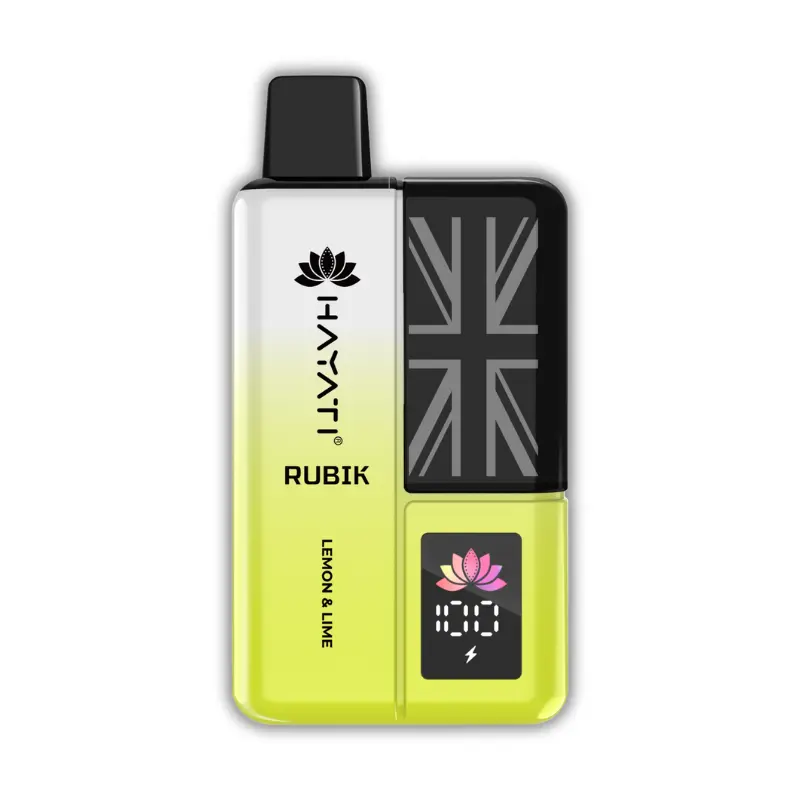
Hayati · Rubik
Lemon Lime Hayati Rubik Prefilled Pod Kit
£5.99
✔ In stock — ready to ship
Genuine Hayati
Free over £20
Same-day dispatch
Secure checkout
£5.99 puts a Hayati Rubik body in your hand with a 12ml pod already seated and filled, and what is inside it is two citrus fruits and nothing else. Twenty milligrams of nicotine salt, an 850mAh cell, and a manufacturer's laboratory rating of up to 7,000 puffs printed against the kit, which describes a bench workload and not a fortnight. Nicotine is an addictive substance. On the specification alone this is one of twenty near-identical entries on the Hayati Rubik Prefilled Pod Kit shelf, separated from the other nineteen by nothing except what has been sealed into the pod.
The reason it earns a page of its own is an accident of two facts that were each settled elsewhere on this site and have never been set beside one another. The first is about the liquid. Lime, in this catalogue, lives at the finish of a draw and is the first component a residue-loaded coil stops carrying. The second is about the hardware. A Rubik refill is the cheapest millilitre of sealed prefilled liquid Hayati sell. Put those together and you get a practical argument rather than a coincidence: this is the flavour in the range that gains most from a cheap refill, because the half of it that goes first is the half that distinguishes it, and the only way to keep a fresh element under a liquid in a closed pod is to replace the pod sooner than you otherwise would.
That argument has a cost attached and the cost is liquid you have paid for and will bin. Most of what follows is working out how much, on this platform against the three others that sell the identical flavour, and arriving at a rule you can actually follow without a measuring cylinder. There is a second thread running under it, and it is the reason the first one matters at all. A lemon-lime that has lost its lime is not a quieter lemon-lime. It is a lemon, which is a change of kind rather than of degree, and it is the only such change on this shelf that leaves you holding a profile the catalogue refuses to sell in any of its 492 listings.
The two findings this page is built on, and neither of them is mine
Both are cited rather than rebuilt, because rebuilding them would waste the space and because they were done properly the first time.
The Lemon Lime Vapes shelf holds the first. Counting across the whole catalogue, 24 titles name lime and not one of the 492 begins with the word. Lime never leads a name anywhere; something is always printed in front of it, lemon in 21 cases and cola in three. That shelf also sets out why, and the reasoning is structural rather than a matter of taste: Hayati name blends in tasting order, lime arrives at the finish of the draw, and a component that turns up last cannot head a name without the name misdescribing what happens in your mouth. Lime Lemon does not exist because Lime Lemon would be a false label. The same page records the consequence that this one runs on, which is that lime's distinguishing compounds are the lightest material in the liquid and therefore the first thing a tiring coil gives up. A pod here drifts towards a plain lemon as it ages.
The second finding belongs to the Hayati Rubik range pages. A Rubik refill is £3.99 for 12ml, which works out at 33.25p a millilitre, and nothing else Hayati sell as a sealed pod comes in under that. The nearest rival is three pence behind and the furthest is two and a half times dearer. Those pages also state the honest correction, which is that a bottle of liquid is cheaper still, that this has always been true of bottles, and that the claim only holds inside the category of things you clip on and use. All of that is taken as read here.
Before building on either, it is worth saying what part of this ground is already occupied, because a page on this shelf has come close. Juicy Peach Hayati Rubik Prefilled Pod Kit works through what happens when a flavour declines smoothly, with no moment at which it stops being a recognisable version of itself, and it names this product in passing as the opposite case: a liquid with a bitter citrus edge that is either arriving or it is not. That observation is theirs and it is correct. What it leaves entirely undone is the thing a buyer would do about it, which is arithmetic rather than diagnosis. Knowing that a flavour reports its own decline is only useful if acting on the report is affordable. Whether it is affordable here, and how affordable, is what nobody has worked out.
A lemon-lime that loses its lime is not a weaker lemon-lime
Start with what makes this profile unusual among the twenty on the shelf, because the buying argument depends on it entirely.
Most liquids fade. A mango gets less mango. A blue raspberry gets less loud. At every point along that decline the thing in your mouth is still a plausible, if duller, version of what you bought, and the Juicy Peach page sets out at length why a decline of that shape is close to impossible to catch from the inside. Your reference updates itself, the daily increment sits below what a palate can register, and a tired version of a flavour is indistinguishable from a good version met by a tired person.
This liquid does not decline that way, and the reason is that it has only two components and they are not interchangeable. Lemon opens the draw and carries the acidity. Lime lands at the close and carries a green, faintly bitter edge that stops the draw rather than letting it trail off. Remove the second and you have not removed a proportion of the flavour. You have removed one of the two things the flavour is made of, and what is left has a different name.
That is the distinction worth being precise about. A fade is a change of degree and it is continuous, so there is no point at which you can say the pod has crossed a line. A component dropping out is a change of kind and it is categorical, so there is a line and you can be standing on either side of it. Categorical changes are enormously easier to notice than continuous ones, and the reason is not that they are larger. It is that they can be answered with a yes or a no, and a yes or a no does not require you to remember a magnitude from three weeks ago.
There is a second property that sharpens the signal further, and it is specific to this recipe rather than to citrus generally. Nine of the eleven listings Hayati write for this liquid state in one form or another that there is no sugar underneath it. The Rubik pod copy calls it uncluttered, the Mini Ultra pod copy says citrus with no distractions, the large bottle copy says there is no sugary weight in the pairing. On a sweetened blend, a component dropping out leaves the sweetener standing where it used to be, and the gap fills. Here nothing fills it. When the lime stops arriving, the end of the draw does not become sweet or soft, it becomes absent, and an absence at the point where you were expecting a full stop is about as loud a signal as a flavour can send you without breaking.
Follow it one step further and the change turns out to be stranger than a simple loss. What you are left holding is a plain lemon, and a plain lemon does not exist in this range. Thirty-eight titles name lemon, fifty-seven if you count the lemonades, and every single one of them pairs it with something: a berry, a tropical fruit, mint, cola, or a sugar base. The Lemon Vapes shelf establishes that across all 54 of its listings and there is no exception anywhere. So the degraded state of this pod is not a worse version of a product Hayati sell. It is a product Hayati have declined to sell, arrived at by attrition. You cannot mistake it for a tired version of itself in the way you can mistake a thin peach for a peach, because there is nothing in the catalogue for it to be a tired version of.
What the signal is, and how early in the pod it arrives
A signal is only useful if you know where to point your attention, and on this liquid the place to point it is not where most people look.
The inhale will mislead you for the whole life of the pod. Lemon acidity is the loudest thing in the recipe, it is the component that survives, and it will be reporting normally long after the part you are trying to monitor has gone. Someone checking the front of the draw is checking the one element that is not at risk.
Three things change at the finish, and they change in an order worth knowing.
- The bitterness goes first. Three of the eleven listings for this liquid attach a bitterness word to it, and in all three the word is fixed to the lime and never to the lemon. Two of those three are the Rubik pair, which makes this the platform whose own copy is most explicit about the note that disappears. Bitterness is a low-intensity sensation carried by a small quantity of light aromatic material, which is precisely the profile of a component a fouled element stops lifting out of the wick. When the exhale stops having a faint bitter edge and is only sour, the process has started.
- Then the draw stops closing. With the lime intact, a pull ends. There is a green, slightly resinous moment that arrives after the acid and puts a stop on the whole thing. Without it the pull tapers: the acid simply runs out of energy and there is nothing after it. People describe this as the flavour getting weaker, which is the wrong description and sends them looking at the wrong end of the draw.
- Last, the two fruits stop overlapping. Whatever aromatic lift was sitting over the lemon and making it read as something other than a plain lemon has gone, and what is left is one note from start to finish. At that point the pod is doing one thing, and the thing it is doing is available nowhere else in the range, which is not a recommendation.
How early does the first of those arrive? Earlier than any of the signs people normally treat as end-of-pod. It arrives before the flavour dulls generally, well before anything tastes scorched, and with no relationship at all to how much liquid is left, which on a sealed unit you cannot see anyway. That is the awkward part and it is also the point. The pod is behaving perfectly. The battery is fine, the draw is fine, the vapour is fine, and the one thing that has changed is the component you cannot see the level of and would not think to check.
Two confounds have to be ruled out before you act, and both are cheap to rule out.
The first is draw length, and it is almost certainly the commonest cause of somebody deciding a Lemon Lime pod has lost its lime when it has not. The shelf page establishes that on a blend whose components arrive in sequence, the length of a pull decides how much of the product you get, and a short clipped draw on this liquid ends before the finish has happened. If the lime has gone missing, extend the pull by a second and attend to the exhale rather than the inhale before condemning anything. It costs nothing and it resolves a fair proportion of cases.
The second is you. A palate that has had coffee, or a heavy sweet pod, or a cold, will under-report a quiet aromatic note. The Juicy Peach page works through how to separate that from a genuine change in the hardware, using a second pod with an unmistakable edge as a check on yourself rather than on the liquid, and the method transfers here without modification. It is set out properly there and there is no value in my restating it. Fresh Mint Hayati Rubik Prefilled Pod Kit is the obvious partner for the job on this shelf, being the only entry with no fruit in it anywhere.
Rule both out and you have a reading you can act on, which brings the page to the part nobody has done.
The arithmetic of retiring a pod before it is empty
Here is the structural fact that makes the whole calculation work, and it is worth stating on its own because getting it the wrong way round produces the wrong answer.
A coil fouls as a function of how much liquid has passed over it. It does not foul as a function of what proportion of the pod has been used. Those two things are the same only when every pod holds the same volume, and on this site they hold four, seven, twelve and twenty-two millilitres. So if the lime on this recipe stops arriving after some quantity of liquid has crossed the element, that quantity is a property of the liquid and the element, and it is the same number whether it sits inside a small pod or a large one. What changes between platforms is how much of the pod is still full when you reach it.
Call that quantity T. Nobody publishes it. Hayati publish no coil resistance, no wick material and no flavour formulation for any prefilled pod they make, so T is not a number anyone can look up, and it will vary with how hot you run the device and how long your draws are. What can be done, and what has not been done, is to work out the cost of a replacement policy as a function of T, and then to find out whether the answer depends on knowing T at all.
Cost per millilitre actually drawn, rather than per millilitre bought
The published per-millilitre figures assume you empty the pod. If you retire it early, the millilitres you did not draw still cost you money, so the honest measure is the ticket price divided by the volume you actually consumed. On a 12ml Rubik refill retired at T, that is £3.99 divided by T. The table below runs the same division across every platform that sells this exact flavour, using refill prices on the assumption that the body is already yours.
| Millilitres drawn before the pod is retired | Rubik, £3.99 for 12ml | Pro Max Plus, £5.49 for 12ml | Pro Ultra Plus, £7.99 for 22ml | Mini Ultra, £3.49 for 4ml |
|---|---|---|---|---|
| 4ml | 99.8p | 137.3p | 199.8p | 87.3p |
| 6ml | 66.5p | 91.5p | 133.2p | 87.3p |
| 8ml | 49.9p | 68.6p | 99.9p | 87.3p |
| 10ml | 39.9p | 54.9p | 79.9p | 87.3p |
| 12ml, the pod emptied | 33.3p | 45.8p | 66.6p | 87.3p |
| 22ml, the largest pod emptied | 33.3p | 45.8p | 36.3p | 87.3p |
The Mini Ultra column is flat because a 4ml pod cannot be retired early for this purpose. Its element never gets old enough to matter, so every millilitre in it qualifies and the rate stays at its published 87.3p. That is the format the shelf page recommends to anyone chasing the lime, on exactly these grounds, and the recommendation is sound as far as it goes. What the table shows is that it stops being the cheapest way of achieving the result almost immediately.
The result does not depend on knowing T
Read down the columns and one thing falls out that makes the whole exercise usable. The Rubik is the cheapest option in every row except the first. The crossover against the always-fresh Mini Ultra sits at £3.99 divided by 87.25p, which is 4.6ml. Above that the Rubik wins; below it the Mini Ultra wins. Against the two larger platforms the Rubik wins at every value of T without exception, because it is cheaper per millilitre to begin with and because a policy that discards the tail of a pod discards more of a bigger one.
So the answer to the question does not require the number. It requires only knowing which side of 4.6ml the number sits on, which is a much weaker thing to have to establish. A Mini Ultra pod holds four millilitres in total and carries a laboratory rating of up to 1,500 puffs. If this recipe genuinely lost its lime inside 4.6ml, a Mini Ultra pod would lose it too, somewhere around its last mouthful, and the format's own copy is the one that leans hardest on the lime being present and fragrant throughout. The balance of what is on the record points to T comfortably above the crossover, which puts the Rubik ahead.
Two further lines are worth marking on the same scale, because they answer the question a buyer will actually ask, which is not whether the Rubik beats other pods run the same way but whether an early-retirement policy is worth having at all.
- 8.7 millilitres. Below that, a Rubik pod retired early costs more per drawn millilitre than a Lemon Lime Hayati Pro Max Plus Pod Kit refill emptied to the last drop. Above it, the policy is cheaper than simply buying the dearer pod and drinking all of it. Expressed as a fraction of the pod, 8.7 of 12 is roughly the three-quarter mark.
- 11 millilitres. Above that, the policy also beats a 22ml Lemon Lime Hayati Pro Ultra Plus 25000 Prefilled Pod Kit pod emptied completely. That is a narrow margin and it should be read as a caution rather than a boast: the Rubik's lead over the largest platform is three pence a millilitre when both are drained, and a policy that throws liquid away eats that lead quickly.
The rule, in a form you can follow without measuring anything
Millilitres are not visible inside a sealed pod, so convert the thresholds into fractions and estimate the fraction from days. Run one pod normally, to the bottom, and note how long it took. That gives you a denominator. Then, on the next one, note how far in the signal arrives.
- Signal before the pod is about 40 per cent down. The 12ml format is wrong for you on this flavour and the arithmetic says so. Move to Lemon Lime Hayati Mini Ultra Pod Kit at £3.99, where the element never gets old enough for the question to arise. You will pay 87.3p a millilitre and you will get the lime in every one of them.
- Signal between 40 per cent and roughly three-quarters. Stay here and retire on the signal. You are cheaper than the same policy run on any other platform, by a wide margin against the large ones. You are dearer per drawn millilitre than a Pro Max Plus pod emptied completely, and what you are buying with the difference is that every millilitre you draw is a lemon-lime rather than three-quarters of them being a lemon.
- Signal after three-quarters. Retire on the signal and you are ahead of everything, including the dearer platforms run to exhaustion. Nothing to think about.
- In every case, buy the replacement when you open the current pod, not when you retire it. A policy that depends on having a spare fails the first time you do not have one, and what you do instead is keep running the old pod, which is the only way to lose the entire argument.
The last bullet is the one that actually decides whether any of this works. Lemon Lime Hayati Rubik Pods at £3.99 is the purchase the whole page turns on, and one spare in a drawer is the difference between a rule and an intention.
The waste, quantified, and why it is only tolerable at this price
None of the above is free, and the part that is not free is liquid you paid for and will throw away. A pod on this platform carries its own element sealed inside it, which means the element cannot be replaced without replacing the liquid sitting on top of it. There is no way to refresh one and keep the other. That is the cost of the closed format and it is the reason this argument works on some platforms and not others.
Take eight millilitres as an illustration rather than as a claim, since it sits in the middle of the plausible range and makes the sums easy to follow. Retiring a Rubik pod at that point leaves four millilitres in the bin, and at 33.25p each that is £1.33 of liquid discarded per pod. The same policy costs £1.83 a pod on the Pro Max Plus, where the four surviving millilitres are dearer. On the Pro Ultra Plus it costs £5.08, because eight millilitres arrives barely a third of the way into a 22ml pod and fourteen millilitres go out with it.
Scaled up, the figures are stark enough to be worth writing down. Per 100ml of liquid actually drawn through an element no older than eight millilitres:
| Platform and refill | Pods needed | Total spend | Liquid binned | Value binned |
|---|---|---|---|---|
| Rubik, £3.99 for 12ml | 12.5 | £49.88 | 50ml | £16.63 |
| Pro Max Plus, £5.49 for 12ml | 12.5 | £68.63 | 50ml | £22.88 |
| Pro Ultra Plus, £7.99 for 22ml | 12.5 | £99.88 | 175ml | £63.56 |
| Mini Ultra, £3.49 for 4ml | 25 | £87.25 | none | none |
One millilitre binned for every two drawn is not a small waste and it should not be dressed up as one. A third of the money goes in the bin on either 12ml platform, and on the 22ml platform it is nearly two thirds, which is the number that ends the argument for running this policy on a large pod. What makes the Rubik column survivable is not that the proportion is better, because it is identical to the Pro Max Plus. It is that a third of £49.88 is £16.63 and a third of £68.63 is £22.88. The policy costs £6.25 less per 100ml here than on the next platform up, and £46.93 less than on the largest, and the whole of that difference is the price of the millilitre.
Which is the honest statement of what the cheap refill buys. It does not make the waste disappear, it makes the waste affordable. A range page on this shelf has already noted in passing that abandoning a pod halfway costs around two pounds here against nearer three on the Pro Max Plus, which is the same fact met from a different direction; what changes when you turn an abandonment into a policy is that the two pounds stops being an occasional annoyance and becomes a line item you incur every pod.
Three limits belong with the figures rather than buried after them.
- The recipe being the same across platforms is an inference, not a published fact. What is published is that four listings share a flavour name, a declared strength and, on three of them, a declared volume. Hayati write fresh copy for each and never state that the liquids match. The arithmetic above compares prices for things that carry the same label, which is the information a buyer has, and it is not a statement that the contents are identical.
- T being constant across platforms is also an assumption. No resistance figure exists anywhere in the data for any Hayati prefilled pod, so whether a Rubik element fouls at the same rate per millilitre as a Mini Ultra one is unknown. If Rubik elements happen to foul faster, the crossover moves against this platform.
- The policy only pays if you keep it. A retired pod that stays in the drawer because it still has liquid in it, and then gets used again the following week, has cost you the waste and bought you nothing.
One flavour on this shelf cannot run the policy at all, and it is worth naming because the exception shows what the rule depends on. Fizzy Cherry Hayati Rubik Prefilled Pod Kit is the single Rubik kit with no matching standalone refill, so every replacement is another £5.99 kit rather than a £3.99 pod. Run the eight-millilitre policy on that and the cost per drawn millilitre is 74.9p rather than 49.9p, half as much again, with a spare body accumulating each time. The whole argument on this page rests on the refill existing, and on this one flavour it does not.
Is the lemon doing anything the lime is not, besides going first?
The shelf page establishes that lime is never sold without lemon in this range, and that there is no plain lemon either, so the pairing is effectively compulsory in both directions. That looks symmetrical and it is not, and working out where the asymmetry sits turns out to matter for anyone who wanted one fruit and not the other.
Order is the obvious difference and it is the least interesting one. Beyond arriving first, the lemon does three things the lime does not.
It carries recognition. The opening of a draw is where you identify what you are holding, and a flavour that declares itself in the first moment is a flavour you can tell apart from the other nineteen on the shelf without concentrating. Lime, arriving at the close, never gets to do that job. Anyone taking a short draw on this pod is identifying it entirely by the lemon.
It persists. This is the one that actually matters, and it is the mirror image of the finding the whole page is built on. If lime is the first component an ageing element drops, then lemon is by definition the component that survives, which makes it the load-bearing half of the recipe rather than merely the loud one. Over the life of a pod you get all of the lemon you paid for and some fraction of the lime. The two halves of the label are not sold to you on equal terms.
It is sellable on its own terms. Lemon heads six distinct flavour names in this catalogue and anchors a 54-product shelf. Lime heads none and anchors nothing, and five further times it turns up in a description without reaching the title at all, always inside a drink reference. A component that can carry a name can be searched for, browsed to and reordered. One that cannot is only ever found by looking for something else.
Set against that, the lime does exactly one thing, and the lemon cannot do it. It terminates. A draw that ends on a green, faintly bitter edge is punctuated; a draw that ends on citric acid simply runs out. On a liquid you are going to breathe for a fortnight, that punctuation is most of the reason to choose this over a lemonade or a berry, and the Lemon Lime Vapes shelf is right that the people who get the most out of this profile are the ones who wanted a full stop rather than the ones who wanted a lime.
Now take the buyer who wanted one and not the other, which is the practical question, and notice that the two cases are nothing like each other.
Someone who wants lemon without lime has a route, and it is faintly comic. The catalogue does not sell a plain lemon, but this pod becomes one if you wait. Run it to the bottom and the last stretch is exactly the product that does not exist on the shelf, delivered by attrition rather than by purchase. That is not an endorsement, but it is a true statement about what you will be holding, and it means the fade that this entire page is organised around avoiding is, for one kind of buyer, the thing they were after. If you have read the section above and thought that a pod drifting towards a plain lemon sounds perfectly acceptable, then the early-retirement argument is not for you, you should run every pod to the last millilitre, and your cost per drawn millilitre is the published 33.25p with no waste at all. Say so to yourself explicitly rather than drifting into it, because it is a genuinely different purchase.
Someone who wants lime without lemon has no route whatsoever. Not on this shelf, not on another platform, not at a higher price, not in a bottle. Twenty-four lime titles exist and twenty-one of them put lemon in front; the other three put cola in front. The closest approximation available anywhere is a brand new pod of this recipe, drawn long, on the theory that the lime share is at its highest when the element is at its youngest. Which is to say that for the lime-seeking buyer, the replacement cadence described above is not a way of preserving value. It is the entire product.
Eleven listings of one liquid, lined up against each other
This flavour is sold eleven times over: two sealed pods and two complete kits on four platforms, one 10ml bottle of salt at 10mg, and two 120ml bottles supplied at 0mg. Hayati write fresh copy for every one, which means eleven more or less independent attempts to describe the same thing. Lining them up is the cheapest evidence available about which properties are real and which are a copywriter's choice.
Four patterns hold across the set.
- Green is the house word for the lime, and the Rubik pair are the ones that avoid it. Eight of the eleven attach a green or grassy word to the lime and nothing else. The three that do not are the Pro Ultra Plus refill, which calls it tangy, and both Rubik listings, which reach for a perfume word instead. That is a platform-paired variant of exactly the kind this site has documented before: two listings written for one piece of hardware diverging together from the other nine.
- Bitterness is fixed to the lime and never to the lemon. Three of the eleven name it, and two of the three are the Rubik kit and the Rubik refill. This listing describes a perfumed, slightly bitter zest; the refill describes a faintly bitter twist. Whatever the reason, the Rubik copy is the most explicit in the set about the note that goes first.
- Sweetness attaches to the lemon three times and to the lime never. Not once in eleven independently written descriptions does anyone call the lime sweet. The shelf page found the same ratio across all 24 lime listings in the catalogue, and it turns out all three of those lemon-sweetness mentions sit inside this eleven.
- The two Pro Max Plus listings are the only pair that put sugar in the blend. One says there is enough sweetness to take the edge off, the other says there is enough sugar to round the fruits off. The other nine say the opposite, in nine different ways. Read that as a copywriting variant rather than as evidence of two recipes, which is the reading this site applies elsewhere and which the absence of any specification difference supports. It is worth noting all the same, because if you have come here from the Pro Max Plus version and found this drier than you remember, the copy at least predicts it.
The interesting disagreement is smaller and closer to home. Both Rubik listings describe the same 12ml of liquid on the same body, and they describe its structure differently. This one says the two fruits sit close enough together to read as one note rather than as two separate fruits. The refill listing says the lemon acidity hits first and the lime follows behind it. Fused, or sequential. Same liquid, same hardware, same house, two answers.
Both are reachable on one pod, which is the honest resolution. The shelf page's finding about draw length does most of the work: a short pull ends before the finish has happened, so you get the acid and very little else, while a long one lets the sequence unfold and the two fruits separate audibly. Add element age to that and you get the rest, because a fresh pod delivers the lime at full volume and close behind the lemon, where it reads as part of one event, while a part-worn one delivers it quieter and later, where it reads as a second thing arriving. So the two descriptions are not really in conflict; they are the same pod at two draw lengths, or on two days. What neither listing tells you, and what no listing anywhere in the eleven admits, is that only one of those readings survives to the end of the pod.
The kit itself, which is the short part
The ticket price covers the Rubik body with a filled 12ml pod already seated in it, an 850mAh cell, and 20mg of nicotine salt, which is the maximum strength permitted for sale in the UK. Hayati publish a laboratory rating of up to 7,000 puffs for the kit. That figure was produced on a bench, it moves with draw length, draw frequency and how warm the device runs, and it is not a quantity you can divide a price by. The Rubik range pages make the point with a comparison worth borrowing: a Rubik pod and a Pro Max Plus pod hold the same twelve millilitres and are rated at 7,000 and 6,000 respectively, which is a seventeen per cent difference in a claim about two identical volumes. Buy on millilitres.
Pairing twelve millilitres with an 850mAh cell means the battery runs out well ahead of the liquid, repeatedly, across the life of one pod. That is the bargain every large-fill prefilled device strikes and it is not a fault. The practical consequence for this flavour in particular is that charging tells you nothing about pod condition, so the cable is not a prompt to check anything. The prompt is the exhale.
The rest of what is worth knowing about the hardware, including what a shaped body does in a pocket and how the thirty-nine listings on the platform divide, is set out on the Hayati Rubik shelf and there is no point repeating it. One thing only: match the range name printed on your device to the range name on the pod, and never take a compatibility decision from a retail page, this one included.
The figures, ordered by what each one changes
The table below is arranged by how much each number affects the decision this page is about, rather than in the order a specification sheet would print them.
| What it is | Figure | Why it matters for a replacement policy |
|---|---|---|
| Refill price, once you own the body | £3.99 | The number the whole argument rests on. Divided by the volume you actually draw, it is the cost of the policy. |
| Pod volume | 12ml | The denominator. Everything above the point where the lime goes is liquid at risk of being binned. |
| Cost per millilitre if the pod is emptied | 33.25p | The floor for sealed prefilled liquid on this site. It is also the price of each millilitre you discard. |
| Price of this kit | £5.99 | A one-off. Two pounds of it is the body, recovered on the first refill. |
| Nicotine | 20mg salt | The UK maximum, and the only strength the platform offers. Nicotine is an addictive substance. |
| Cell | 850mAh | Will be recharged many times inside one pod. Tells you nothing about the state of the liquid. |
| Manufacturer's puff rating | up to 7,000, laboratory | Not a unit you can divide a price by, and not comparable across platforms. |
| Cooling agent | none named | No ice, mint or menthol in any of the eleven listings. There is nothing cold to mask a fading finish. |
| Coil resistance | not published | The reason the point at which the lime goes cannot be stated as a number. |
| Refillability | sealed unit | The element cannot be changed without changing the liquid, which is the entire cost of the policy. |
Two of those rows are blanks and they are the honest ones. Nothing in Hayati's data gives a resistance for any prefilled pod they sell, and nothing describes the wick or the flavour formulation. Anyone quoting an ohm figure for this device has taken it from somewhere other than the manufacturer.
Where it sits against the alternatives
The comparison that matters most is against the same liquid on other hardware, so take those first.
Lemon Lime Hayati Rubik Pods at £3.99 is the same twelve millilitres without the body, and it is the correct second purchase and every purchase after it. Buying this kit twice would be two pounds thrown away for a duplicate body, unless you want a second body deliberately, which on a flavour run to a replacement cadence is a more reasonable want than usual. A charged spare with a fresh pod in it means the moment the signal arrives you swap devices rather than hunting for a pod, and the argument for that is stronger here than on a flavour where the changeover can wait a week.
Lemon Lime Hayati Mini Ultra Pod Kit at £3.99 is the shelf page's recommendation for anyone chasing the lime, and the reasoning behind it is correct: four millilitres never gets far enough into an element's life for the finish to fade. The arithmetic on this page narrows that recommendation rather than overturning it. The Mini Ultra is the right answer only if the lime on your device goes before the 4.6ml mark. Above that figure the Rubik delivers the same young-element liquid for less, and by ten millilitres it is delivering it for well under half. If you have no idea where your own threshold sits, the Mini Ultra is the cheaper experiment at £3.99 for a body plus liquid, and finding out is worth the trip.
Lemon Lime Hayati Pro Max Plus Pod Kit at £7.99 holds the same twelve millilitres on an 850mAh body and refills at £5.49. There is no version of the argument on this page where that is the better buy for this flavour: the volume is identical, so the policy discards the same number of millilitres, and each one costs 12.5p more. Its only advantage is the platform's flavour library, which runs to eighty-five names against nineteen here, and if the rest of your rotation lives there then carrying one body rather than two is worth something. Weigh that against £1.50 a pod, every pod.
Lemon Lime Hayati Pro Ultra Plus 25000 Prefilled Pod Kit at £11.99 is the largest single-flavour version of this liquid and the worst fit for the argument. Twenty-two millilitres on one element means the back end of every pod is a plain lemon, and retiring early discards fourteen millilitres at 36.32p. It is the right buy for someone who is content with the drift, who wants the fewest changeovers, and who would rather have the lowest price for liquid drunk to the bottom. It is the wrong buy for anyone who came for the lime.
Among the dual pods, Blue Razz GB / Lemon Lime Hayati Pro Ultra Plus 25000 Prefilled Pod Kit puts this citrus opposite a confectionery blue raspberry behind a collar, and the shelf page is right that carryover between two sides sharing one element is most obvious in that pairing. A sweet residue sitting over a finish whose whole job is to be dry costs more here than it would on most flavours. Cola Ice / Orange Lemon Lime Hayati Mini Ultra Pod Kit at £3.99 is the cheapest complete device carrying any version of this citrus, though the version is the three-citrus one with orange filling the middle, and it sits opposite something cold.
Within the twenty flavours on this platform, this is the least sweet thing on the grid and it has one natural companion and several natural opposites. Fresh Mint Hayati Rubik Prefilled Pod Kit is the other entry with nothing sugared in it, and the two work as a pair for the reason set out above: one of them is a usable check on your own palate when the other reads flat. Lemon Cola Ice Hayati Rubik Prefilled Pod Kit is the only other citrus here, and it is the single flavour on the platform available nowhere else in the catalogue at any price.
At the other end, Blue Razz GB Hayati Rubik Prefilled Pod Kit is the most sugar-forward entry on the shelf and about as far from this as the range goes, with Blue Razz Cherry Hayati Rubik Prefilled Pod Kit the more balanced version of the same idea. Blue Sour Raspberry Hayati Rubik Prefilled Pod Kit is the one flavour here that competes with this pod on sharpness, though it does it with a sour layer over sugar rather than with acid and nothing else.
If what you actually want is a fruit with some weight to it, the uncooled group is where to look. Triple Mango Hayati Rubik Prefilled Pod Kit goes thick rather than bright, Blueberry Cherry Cranberry Hayati Rubik Prefilled Pod Kit is the most layered thing on the shelf with a dry cranberry edge doing structural work, and Blueberry Raspberry Hayati Rubik Prefilled Pod Kit is the dependable all-day entry. Among the cooled seven, Watermelon Ice Hayati Rubik Prefilled Pod Kit is the least demanding over a long pod, Strawberry Raspberry Ice Hayati Rubik Prefilled Pod Kit the one most people settle on, Red Apple Ice Hayati Rubik Prefilled Pod Kit the mellowest, and Banana Ice Hayati Rubik Prefilled Pod Kit the outlier.
Looking outside this platform for more citrus: Lemon Pineapple Hayati Pro Max Plus 6000 Pod Kit puts the lemon against a tropical fruit with real body, and Cherry Peach Lemon Hayati Pro Max Plus 6000 Pod Kit demotes it to a cutting agent over stone fruit. Both are on Lemon Vapes with 52 others. For the full view of the format, Hayati Prefilled Pod Kits collects every kit we stock, and all Hayati products is the unfiltered catalogue.
Running a pod you intend to replace early
Practical handling, anchored to a liquid whose distinguishing note is the fragile one.
Give a new pod a few minutes seated before the first draw, and then discount the first day of readings entirely. A fresh pod runs wet, with excess liquid sitting over the element, and on this recipe the thing that gets muffled is the light aromatic material at the finish, which is precisely the thing you are trying to monitor. Judging the lime on the first evening will give you a low reading for a reason that has nothing to do with the element.
Draw long rather than often. The finish is the last thing to arrive and a short pull ends before it, so a habit of quick snatches will hide the lime from you from the day the pod is opened and then hide the moment it goes. If the pod is reading as all acid and no green edge, lengthening the draw usually fixes it and drawing more frequently reliably does not.
Keep the device off heat. A hot element loses the light aromatic fraction first, which is the same casualty as a fouled one, so chasing a fading lime with harder and longer pulls in quick succession is the most efficient way of finishing off what is left of it. If the finish has gone quiet mid-session, the useful response is to put the device down for twenty minutes rather than to work harder at it.
Store a spare cool, dry and dark. The light material that carries the lime is also the material that goes first in a warm drawer, so a pod that has spent a fortnight on a sunny window ledge will read as a part-worn one from its first draw, and you will blame the element for something the storage did. Because twelve millilitres at 20mg is a meaningful quantity of nicotine in one sealed object, a spare belongs somewhere children and pets cannot get at it.
Buy one spare, not five. The cheap refill makes stocking up tempting and a stocked flavour is a committed flavour; a drawer of six is a bet that your taste holds steady across seventy-two millilitres of one thing. One spare is what the replacement rule needs and anything beyond that is a different decision.
A retired pod with liquid still in it is an open component, and the honest advice about it is to treat it as finished rather than as something to come back to. Standing it upright out of the sun will keep it usable for a while, but the reason you retired it has not gone away and it does not recover on a shelf. If you find yourself returning to retired pods, the policy is not for you and you should run each one to the bottom, which is a perfectly reasonable way to buy this flavour and costs 33.25p a millilitre with nothing wasted.
On disposal, a spent pod is not household waste. It contains an element, a residue of nicotine-bearing liquid and, in the case of the body itself when it eventually fails, a cell. Both belong at a retail take-back point or a local recycling facility that accepts electricals. A replacement cadence means more pods through your hands than most flavours generate, so this is worth a habit rather than an afterthought.
Questions this listing raises
Is there any ice or menthol in this?
No. None of the eleven listings Hayati write for this liquid names ice, mint, menthol or any cooling agent, and the Rubik refill copy states plainly that no cooling is named. That is relevant beyond taste: there is no cold sensation sitting over the flavour, so nothing masks the finish as it fades. On a cooled pod people routinely misjudge the end of a pod because the chill carries on working after the fruit has flattened. That failure mode is not available here.
How will I know the lime has gone?
Attend to the exhale, not the inhale. The first thing to go is the faint bitter edge at the very end of the draw, and the second is the sense that the pull has been closed off rather than having simply run out. The lemon will still be reporting normally throughout, which is why monitoring the front of the draw tells you nothing. Before acting, lengthen the draw by a second and check again, because a short pull ends before the lime has arrived and that accounts for a good proportion of cases.
Should I really throw away a pod that still has liquid in it?
Only if the part you are paying attention to has stopped arriving, and only if you are prepared to keep doing it. At an eight-millilitre retirement point the discarded liquid costs £1.33 a pod here, against £1.83 on the Pro Max Plus and £5.08 on the Pro Ultra Plus. The proportion wasted is the same on the two 12ml platforms; the difference is entirely the price of a millilitre. If throwing liquid away sits badly with you, run the pod to the bottom instead and accept that the closing stretch is a lemon.
Why not just buy the 4ml Mini Ultra version instead?
That is the right answer if the lime on your device goes before about 4.6ml, because a 4ml pod never has an old element in it and nothing is wasted. Above that figure the Rubik costs less for the same young-element liquid, and by ten millilitres it costs well under half. The Mini Ultra kit is £3.99 including the body, so finding out where your own threshold sits is a cheap experiment either way.
Is this the same liquid as the Pro Max Plus version?
The name matches, the declared volume matches at 12ml and the declared strength matches at 20mg. Nothing in Hayati's specifications says the recipes are identical, and they write fresh copy for each listing rather than repeating one description. What is worth noting is that the two Pro Max Plus descriptions are the only pair of the eleven that mention sugar in the blend, while the other nine, including both Rubik listings, describe it as having none.
What does the 7,000 puff figure actually mean?
It is the manufacturer's own rating, produced under laboratory conditions rather than in a pocket, and draw length, draw frequency and how warm the device runs all move the real number. It is also not comparable between platforms: a Pro Max Plus pod holds the same twelve millilitres and is rated at 6,000, which is a seventeen per cent gap in a claim about two identical volumes. Millilitres are a measured quantity you can divide a price by. Rated puffs are not.
Can I replace just the coil and keep the liquid?
No. The pod is a closed unit with its element sealed inside it and Hayati document no way of opening one, so the element and the liquid arrive and leave together. That is the single fact that makes this page's argument cost anything at all. If controlling the two separately is what you want, the refillable side of the catalogue is where to look, with bottled liquid bought separately.
How sweet is it compared with the rest of the Rubik shelf?
It is the least sweet thing on the grid, alongside the mint. There is no sugar base, no confectionery layer and no cooling, so the sweetness you get is whatever the two fruits carry themselves, which is not much. At the other end of the same twenty, Blue Razz GB is the most sugar-forward entry by a distance. If your drawer is full of sweet pods, this is the counterweight, and that is most of what it is bought for.
Which gives more lime, this or the 22ml version?
This one, and not because the recipes differ. Twenty-two millilitres on a single element means a longer stretch of the pod is drawn through a part-worn one, and the lime is the first thing a part-worn element stops carrying. The largest pod gives you the lowest price per millilitre drunk to the bottom and the highest proportion of millilitres that no longer taste the way the label says.
Is £5.99 a reasonable price for a complete kit?
It is the cheapest route to a 12ml sealed pod with a body attached, and the two pounds over the bare refill is recovered on your first reorder. Whether the kit is the right purchase depends on whether you already own a Rubik body: the £3.99 refill does nothing at all without one. Buying a second kit rather than a refill is only sensible if you actually want a second charged body, which on a flavour run to a replacement cadence is a more defensible want than usual.
What happens if I just ignore all of this and use it normally?
You get a pod that opens as a sharp two-fruit citrus and closes as a plain lemon, at 33.25p a millilitre with nothing wasted, which is the lowest rate for sealed prefilled liquid on this site. That is a perfectly respectable purchase and a good number of people will prefer it. The argument on this page is only worth anything to someone for whom the green edge at the finish is the reason they chose the flavour.
Is there a lime flavour without the lemon anywhere?
No. Twenty-four titles in the catalogue name lime, twenty-one of them put lemon in front and the other three put cola in front, and no title in 492 begins with the word. The Lemon Lime Vapes shelf works through why, and the short version is that lime arrives at the finish of a draw and the range names blends in the order they arrive. The nearest thing to a lime on its own is a new pod of this recipe, drawn long.
The position, plainly
At £5.99 this is a complete 12ml kit holding the sharpest and driest liquid on a twenty-flavour shelf, and refilling at £3.99 it is the cheapest sealed millilitre Hayati sell. Taken as an ordinary purchase, run to the bottom, that is the whole story and it is a good one.
Taken as the flavour it actually is, there is a second story, which is that the half of the recipe doing the distinguishing is also the half a tiring element gives up first, and that when it goes you are left holding a profile the catalogue does not otherwise sell. That change announces itself, which most fades do not, and the announcement arrives at the finish of a draw while every other sign says the pod is fine. Acting on it means binning liquid you paid for, roughly a millilitre for every two you draw at a plausible threshold, and the only reason that is a sensible thing to do is that a millilitre here costs 33.25p rather than 45.75p or 87.25p. Retire on the signal, buy the spare when you open the pod rather than when you finish it, and if the signal keeps arriving before the pod is 40 per cent down, take the 4ml format instead and stop paying for liquid you never taste properly.
Prices are current at the time of writing. Hayati Flavours is an independent UK retailer of the Hayati range, and nothing on this page is a health claim of any kind.
Strictly for adults aged 18 and over. Nicotine is an addictive substance.
You might also like


