
Home / Hayati Pro Max Plus Pods / Blue Fusion Hayati Pro Max Plus Pods
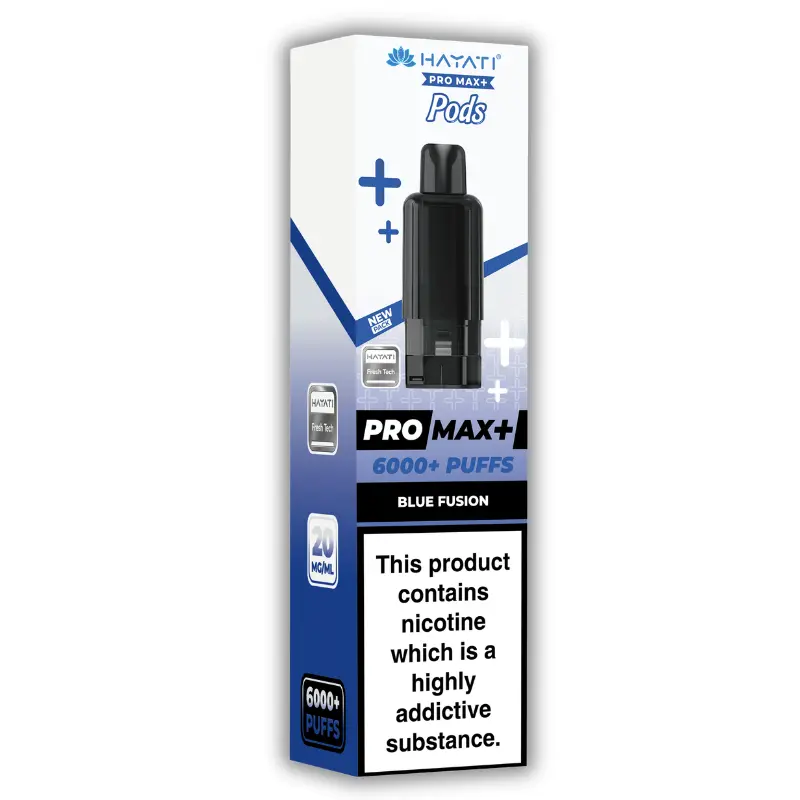
Hayati · Pro Max Plus
Blue Fusion Hayati Pro Max Plus Pods
£5.49
✔ In stock — ready to ship
Genuine Hayati
Free over £20
Same-day dispatch
Secure checkout
Blue Fusion as a bare pod is £5.49 for twelve millilitres of 20mg liquid, already sealed in, with no device in the box. It seats in a Hayati Pro Max Plus body you own already. That last clause decides what this page is for, because nobody arrives at a replacement pod listing as an introduction to anything. Something ran out, the profile was good enough to repeat, and the only live question is whether to order the same thing once more or spend the same £5.49 on one of the eighty-eight other listings sitting on the Hayati Pro Max Plus Pods shelf.
The draw-by-draw account of how this liquid behaves, what the name rules out, and what the device does belongs on the Blue Fusion Hayati Pro Max Plus 6000 Pod Kit listing, which was written for somebody meeting the flavour for the first time. Everything settled there is taken as read here. Repeating it would waste the space, and the space is worth something, because there is one structural fact about this flavour that a first purchase does not expose and a second one does.
Here it is, plainly. Blue is not a fruit. There is no blue raspberry growing anywhere, no blue slush bush, no blue bubblegum tree. The accord that every manufacturer means by blue was assembled in confectionery and soft drinks, and it has been stable across brands and decades because each producer is copying the same body of existing products rather than sampling the same plant. Blue is one of a very small set of flavours whose reference standard is other manufactured goods. Cola is another. Bubblegum, sherbet and tutti frutti are the rest of the short list.
That reads like trivia and it is not. It changes what you are doing when you restock. A disagreement about a mango pod can be settled by buying a mango. Here there is nothing to appeal to outside the category, so the standard you measure the arriving pod against is made of other products and belongs to the trade rather than to nature. What follows works out what that costs you and what it hands you, because it does both.
A flavour with no original
Every flavour category has an arbiter somewhere. For most of them the arbiter is a physical thing you could put on a table. Peach, lemon, blackcurrant, pomegranate: if a liquid claiming one of those is wrong, the wrongness is demonstrable, and demonstrable to somebody who has never vaped in their life. The fruit exists, it is purchasable, and it settles the argument without anyone's opinion being involved.
Blue has no such object. The accord was built for products that needed a flavour to go with a colour, it was refined by competition between confectioners, and it acquired its stability from the fact that customers learned it from those products and then expected the next one to match. What makes a blue liquid correct is agreement with the existing population of blue things, and nothing else. The category is self-referential all the way down, and it works perfectly well that way. Almost everyone who buys a blue vape knows precisely what they are expecting and is right to expect it.
Notice what that does to the vocabulary. Words like authentic, true-to-fruit and accurate are doing real work on a mango listing and are close to meaningless on this one. There is no fruit for the liquid to be true to. A blue liquid can be typical, atypical, a strong example, a thin example, a conservative reading, an unusual one. It cannot be accurate, because accuracy needs a target that exists independently of the things being measured, and this target is constituted by those things.
Hayati have sharpened the situation by naming this listing after the convention rather than after any of its members. Most blue products at least say which member they are aiming at: blue raspberry names the slush and boiled-sweet reading, blue bubblegum names the chew. This one names the colour and then says only that several things went in together, which places it inside the convention without locating it.
One more feature of a conventional standard is worth flagging before the practical consequences, because it is the one people find counter-intuitive. The convention is not fixed by anything. A natural referent is stubborn: peaches will be peaches next year, and a liquid that missed the fruit in 2024 misses it in the same direction in 2026. A commercial referent has no such anchor. It is the running average of whatever blue products are currently being made and sold, so when the leading examples get sweeter, or shorter, or start carrying more coolant, the centre of the category moves with them and the definition of a correct blue moves too. This is not about your palate or your memory changing. It is about the yardstick being a set of goods that companies are free to reformulate.
Which means a repeat buyer of a blue liquid is buying against a standard that is genuinely mobile in a way that a repeat buyer of a peach liquid is not. Nothing dramatic follows from that over a few months. Over a few years it is the reason a profile can feel subtly out of step without anybody having changed the recipe in front of you.
What the second pod is actually being judged on
Open a replacement pod, take four or five draws, and some verdict forms within about thirty seconds. Most people never examine what that verdict is a verdict about. On a flavour with a natural referent it is a compound of two separate questions that happen to give the same answer most of the time: does this match the fruit, and does this match what I bought before. On Blue Fusion only the second question has any content, and a third one quietly replaces the first: does this match what blue is supposed to be.
That third question is a conformity test, not an accuracy test, and it behaves differently. Conformity admits of degrees along several independent lines rather than a single distance from a target. It can be assessed by anyone who has eaten enough blue confectionery, and cannot be assessed at all by someone who has not, regardless of how good their palate is. And it has no external adjudicator, so a disagreement between you and the manufacturer about whether a pod tastes right has nowhere to go. You say this does not taste like blue. They say theirs is also a blue. Both statements are about the same convention, neither can be checked against an object, and the argument simply stops.
What is useful to carry into a restock, then, is not a memory of a taste but a short set of attributes that vary between members of the convention. These are the dimensions along which a pod can move while still being recognisably the same product, and they read most clearly while a new order is fresh.
- Where the sour lands in time. Some blues put their acid in the first instant and are done with it; others hold a tartness back for the exhale. This one is front-loaded, with moderate rather than aggressive acid, and position is more stable across batches than intensity is.
- Whether the sugar is syrup or sherbet. The convention supports both. A syrup reading coats, a sherbet reading prickles and runs drier. This one is the syrup kind.
- How much happens in the nose. Blue accords differ enormously in how much of their character is aroma rather than taste. A pod that reads flat while still tasting sweet has usually lost the aromatic half, which is the half that goes first.
- The length of the tail. Blue Fusion runs long, so a shortened finish is the deviation you are most likely to meet, and it is worth telling apart from the liquid simply being less sweet.
- Whether the middle is filled. This is what makes the listing a fusion rather than a plain blue, and it is the part of the construction doing the most work, so it is the likeliest thing to move.
Five named attributes are worth more than a general impression because an impression arrives as a yes or a no and cannot be interrogated afterwards. Named attributes turn a mood into four agreements and one disagreement, and a single disagreement is actionable. If the tail has shortened and nothing else has moved, your rhythm has probably changed rather than the pod. If the middle has emptied out and taken the tail with it, the blend has moved and a different listing is the sensible next order.
Good blue, bad fruit, no contradiction
A consequence that catches people out, and it is worth naming because it dissolves an argument that otherwise goes in circles. Two verdicts on this liquid can both be true at once. It can be a competent, well-centred example of the blue convention, and simultaneously a poor representation of any actual berry. Those are not in tension, because they are answers to questions about different standards.
Most of the complaints written about blue liquids anywhere are that confusion in a single sentence. Somebody wanted fruit, was given a confectionery accord, and called the result artificial. It was neither artificial nor wrong; it was a faithful member of a category the writer was not buying. The reverse turns up too, less often, when a blue is praised for tasting like real berries, which if it were literally true would make it a poor blue.
For a restock this tells you which complaint to act on. If the trouble is that the pod is not fruit, no other blue will fix it and the whole cluster comes off the list; Blueberry Raspberry Hayati Pro Max Plus Pods is the standard landing place, because both of its named components are plants and it reads accordingly. If the trouble is that the pod is a weak or off-centre blue, staying in the cluster is right and the fix is a different member of it.
It also tells you which complaints are worth making. Comparative ones stand up, because they concern two objects you have both experienced: this pod is sweeter than the last, has less aroma, finishes shorter. The claim that the liquid is wrong in some absolute sense has nowhere to go, since no component list is published and no natural referent exists to appeal to. That is the ordinary condition of every house blue in the trade rather than anything peculiar to Hayati.
Why tasting somebody else's blue tells you more here
The argument for cross-brand comparison is usually a weak one. On a peach liquid, tasting four other manufacturers' peaches tells you which of them is closest to a peach, and you could have found that out faster and cheaper by eating a peach. Other products are intermediaries between you and a target that is directly available, so sampling them is a slow route to something you can check in a greengrocer's.
Invert the referent and that argument inverts with it. When the target is the population of products, sampling the population is not a detour towards the standard. It is the only way to observe the standard at all. Every additional blue you have tasted genuinely improves your ability to say where any particular blue sits, because you are building up the distribution rather than approximating a fixed point. This is one of the rare cases where the advice to try a few others before deciding is not filler.
It also changes who counts as a useful comparison. On a fruit liquid the relevant comparisons are other products naming the same fruit. On a conventional accord, the comparisons that teach you most are the ones furthest from the centre, because outliers define the edges of what the category will tolerate before it stops reading as blue at all. Tasting three near-identical mid-range blues tells you almost nothing. Tasting a very sour one, a very sweet one and a cooled one tells you roughly the whole shape.
Conveniently for anyone doing this at £5.49 a time, Hayati's own range is a serviceable sample of the convention on its own, and every member of it shares a price, a volume and a fitting, which removes the variables that make cross-brand tasting messy. The blue cluster on this shelf is a set of deliberate variations on one accord.
Sampling the category without buying twelve pods
Three purchases will do it, chosen for spread rather than similarity. Take an edge, take the opposite edge, and take the version of the accord that has been modified in a way you have not tried.
Blue Sour Raspberry Hayati Pro Max Plus Pods is the acid edge. It keeps the confectionery framing and pushes the sourness hard, stripping out most of the weight Blue Fusion carries in the middle. Coming to it straight from this pod, what you notice first is not the sourness but the missing floor underneath it, which is the most direct way to understand what the word fusion is buying you.
Blue Razz GB Hayati Pro Max Plus Pods is the sugar edge, a chewy-sweet reading with the acid pulled right back and any pretence of fruit resemblance abandoned. It makes the self-referential character of the accord obvious, because nobody would mistake it for anything grown. If this pod already reads sweet to you, that is a step further in the same direction rather than an alternative.
Blue Razz Lemonade Hayati Pro Max Plus Pods is the structural modification. A soft-drink frame lightens the body, shortens the tail and changes how the acid presents without touching the underlying reference, which demonstrates that treatment and accord are separate layers. That separation is what lets you predict any of these listings before ordering.
Those three plus this one cover the span from sour to confected and one worked example of a treatment, for under £22. It is a better map of the convention than a dozen mid-range purchases would give you.
The other members, and what each one varies
The rest of the blue corner, described by what each one changes rather than by a tasting note. Mad Blue Hayati Pro Max Plus Pods is the other undeclared house blue at this size, with no component list and no modifier in its name, which puts it in the same position as this listing. Order the two in separate weeks, because two unnamed blue blends tasted close together become impossible to attribute afterwards.
Blue Razz Pineapple Hayati Pro Max Plus Pods is the hybrid case, bolting a real fruit onto a conventional accord with the join audible. Pineapple brings its own acid and a tropical aroma, so rather than one blended impression you get two things you can name in sequence. Whether that is an improvement depends on whether you value coherence or legibility.
Blueberry B’Gum Hayati Pro Max Plus Pods swaps the reference product entirely, since bubblegum is a second manufactured accord with the same self-referential character as blue. That makes it a confection built on a confection, and the sweetest thing in the neighbourhood. Blue Razz Fruit Twist Hayati Pro Max Plus Pods is the closest structural relative to this pod, filling the same mid-palate gap with a vague mixed-fruit sweetness instead of a dark berry, and it is the one to try if you want the middle lighter.
What "fusion" can honestly mean when neither word names a plant
Take the name apart with the referent problem in mind and it reads differently from the way it reads on a first purchase. The first word names a convention. The second names an intention held by whoever mixed the liquid. Neither half points at anything you could grow, buy loose, or hold up as evidence. The whole title describes a manufacturing decision, and it is worth being explicit about the three things it could reasonably mean, because they are genuinely different products and the listing does not tell you which one you have.
Reading one: two members of the convention combined. Blue is a family of accords rather than one. The slush reading, the boiled-sweet reading and the chew reading are all blue, all self-referential, and all distinguishable. Fusing two of those stays entirely inside confectionery and simply has more of it, and the result would be sweet throughout with nothing at any point behaving like fruit.
Reading two: the convention with a real fruit used underneath it. A plant is present but is not the subject. It has been brought in to supply something the accord is short of, usually weight in the middle of the draw, chosen for what it does structurally rather than for its own character. A liquid built this way tastes like one thing rather than two, and the fruit registers only as body.
Reading three: nothing at all. Fusion is a word that differentiates a listing from the one above it in a grid of ninety. On a range this size the null reading stays on the table, and any page that rules it out is guessing.
Hayati's own short listing text points at the second reading. Their description pairs a bright, tangy blue raspberry character at the top with a darker, jammier blueberry depth underneath it, worked into one rounded sweetness. That is a manufacturer's summary of their own product, which is worth more than an outsider's inference and considerably less than a specification: no proportions, no component list, no flavour-house detail, and no statement anywhere of whether the blueberry is a real fruit extract or a second confectionery reading of the same colour. What it does establish is a shape, and the shape is consistent with what the liquid does.
Follow that reading through and it produces the most interesting thing on this page. If the description is right, the only plant anywhere near this product has been recruited to make a non-plant standard read correctly. The blueberry is not there to taste like blueberry. It is there because the blue accord is all top and no floor, and something with weight and no acid of its own is the obvious material to put under it. A real fruit, employed as a structural component in service of a manufactured convention, and deliberately mixed so that you cannot pick it out.
That is why people who buy this expecting the fruit are so reliably disappointed even though the fruit is very probably present. It is present in the way a foundation is present in a building. You are standing on it and you are not looking at it. Anyone who wants the berry as the subject rather than as the substructure wants Blueberry Pomegranate Hayati Pro Max Plus Pods, where an astringent partner dries the finish without covering what is underneath, or Blueberry Raspberry Cherry Hayati Pro Max Plus Pods, where every component is named and all three are audible.
The shelving says the same thing in a different way
Hayati file this pod under Blueberry Vapes and Blueberry Raspberry Vapes, which is consistent with the description, and also under Orange Vapes, which is not consistent with anything. Nothing in the flavour text mentions citrus of any kind. The sensible conclusion is not that there is a hidden orange in the blend but that shelf tags on a catalogue this size are a retail filing system rather than a disclosure of contents, and that a tag is a much weaker signal than a named component.
Which is the same lesson the name teaches, arriving from a different direction. Classification here is commercial throughout. The category the liquid belongs to was decided by people selling things, the standard it is measured against was set by other things that were sold, and the shelf it sits on was chosen to make it findable. None of that is a criticism, and none of it stops the pod being good. It does mean that a buyer looking for botanical information in any of those places will not find it, and that the Berry Vapes shelf is best used as a way of locating neighbours rather than as a statement about what is in them.
The pod on its own
Little needs saying about the hardware, because it is shared with the rest of the Hayati Prefilled Pods & Refills range and nothing about it is specific to this flavour. You receive a single prefilled pod carrying 12ml at 20mg. There is no body, no charging equipment and nothing to assemble, and the listing records no accessories, so this page will not promise any. The pod arrives closed and is not designed to be opened, topped up or decanted; when the liquid is finished you fit a new one.
Hayati's rating for a filled pod is up to 6,000 puffs. That figure comes off test equipment taking regular draws at a set length, so it is a reasonable way to compare the liquid capacity of one Hayati pod against another and a poor way to forecast how long yours will take. Your own second pod is the better estimate, since the first one already told you.
The one specification that earns attention on this particular liquid is the 12ml, because of how the two-part construction ages. A blend whose top note is the whole of its conventional character and whose middle is structural does not fade evenly. The bright top goes first, since fine volatile material always does, and what is left is the floor with less sitting on it. On a twelve-millilitre pod that decline is long enough to be noticeable, which gives you a clear end signal: when the sweetness is still fully there but the blue has gone dull on top of it, the pod has finished being what you bought even if it has liquid left. That is ordinary behaviour rather than a fault, and it is more visible here than on a single-note listing.
Everything else about the device belongs on the kit page and on the shelf listing for the range. If you need the body as well as the liquid, the kit is the same flavour with a rechargeable unit added and £2.50 on the price.
Specifications
| Listing reference | blue-fusion-hayati-pro-max-plus-pods |
| Sold as | Replacement pod only, no device included |
| Device required | Hayati Pro Max Plus, purchased separately |
| Price per pod | £5.49 |
| Liquid carried | 12ml, filled at the factory |
| Nicotine | 20mg |
| Manufacturer puff rating | Up to 6,000, obtained by laboratory testing |
| Flavour family | Blue Fusion, a house blue blend with no published components |
| Brand | Hayati |
Seven of those nine rows are identical on every named flavour at this size, which is the reason the table sits two thirds of the way down this page rather than at the top. A specification that cannot tell two listings apart is not a decision aid. It is a compatibility note, and it should be read as one: this fits a Pro Max Plus, it costs £5.49, it holds 12ml.
The listing reference is the row worth copying somewhere. On a shelf holding several undeclared blue blends, a string that identifies one listing exactly beats a name you will half remember, and Hayati's naming is inconsistent enough across ranges that searching for a remembered phrase often returns the wrong product.
Two rows need a sentence of interpretation rather than a number. The strength is fixed at 20mg on this listing, so it separates nothing on this shelf and should not be read as any kind of recommendation; nicotine is addictive and what strength to buy is the buyer's own decision. If a lower figure is what you are after, the range's generic option is Hayati Pro Max Plus Prefilled Pods 5mg, which is a different product rather than a variant of this one. The puff rating, meanwhile, tells you about relative scale between pods and nothing about days, because draw length alone moves the real figure by a wide margin in either direction.
Nothing in the title flags a coolant, and this range declares cooling in the product name without exception when it is present. Read the absence as reliable: there is no ice, frost or menthol element here, so the sweetness arrives with nothing sitting over it and the finish runs its full length. Anyone coming to this from a cooled listing such as Vim Ice Hayati Pro Max Plus Pods should expect the change to feel larger than a change of flavour alone would explain.
Which blue to restock instead, and when to stop
Reordering the same thing is the default and it is usually right. The cases where it is not divide into three, and each has a different answer.
If the convention itself is the problem
Some people work out, several pods in, that what they dislike is not any particular blue but the manufactured edge the whole category carries. That edge is a defining property rather than a flaw to be engineered out, and no member of the family is without it, so the move is to leave the cluster entirely. Helpfully, every good exit from it names its components.
Blueberry Raspberry is the obvious first stop and the profile most people settle on afterwards, with raspberry supplying acid and blueberry supplying body, both behaving as fruit. Mixed Berries Hayati Pro Max Plus Pods spreads the same idea across more components and reads softer for it. Strawberry Raspberry Blueberry Hayati Pro Max Plus Pods puts recognisable red fruit over the top of the same blueberry underlayer, which is the gentlest available step away from where you are. For real dryness rather than a softer sweetness, Blueberry Cherry Cranberry Hayati Pro Max Plus Pods uses cranberry to cut the sugar properly, and it is the most effective single correction on the shelf if sweetness is the thing you are escaping.
If the blend is right and the sweetness is not
This is the commonest reason for moving, and it does not require leaving the neighbourhood. Sweetness in a blue accord can be reduced three ways: by adding acid, by adding a structural frame, or by cooling. All three are represented, and they produce noticeably different results, so the choice is worth making deliberately rather than picking whichever is nearest.
Acid is the most direct and the most disruptive, which is the Blue Sour Raspberry route. A soft-drink frame is the gentlest, which is Blue Razz Lemonade, and it lightens the liquid while keeping it recognisable. Cooling suppresses perceived sugar most effectively and also does most damage to the mid-palate depth that makes this listing what it is, so it fixes one problem by removing the feature you presumably bought the pod for.
If you have simply had enough of it
Twelve millilitres is several consecutive days of one profile, and a sweet uncooled liquid wears faster than a dry one. Running two pods in alternation is the standard answer, and the partner is better chosen for contrast than for similarity, because something dry and unrelated resets the palate between sessions in a way a second berry will not.
Candidates that sit far enough away to do the job: White Peach Raspberry Hayati Pro Max Plus Pods keeps a raspberry link while replacing the confectionery framing with something lighter and floral, Cherry Berry stays in berries while changing the lead entirely, and Strawberry Kiwi goes further still, with kiwi supplying a green, slightly sharp edge that has nothing in common with a blue accord. One listing worth knowing about for structural reasons rather than flavour ones is Galaxy Aura Hayati Pro Max Plus Pods, another undeclared blend named for a mood, whose title rules out even less than this one does.
The same convention on other hardware
The blue accord appears across Hayati's other ranges at different volumes and prices, which matters if you run more than one device. Blueberry Raspberry Hayati Mini Ultra Pods at £3.49 is the cheapest way to put a related profile on smaller hardware, though it is a fruit-led blend rather than a blue one. Going the other way, Blueberry Raspberry/Mr Blue Hayati Pro Ultra Plus 25K Pods at £7.99 pairs a named fruit blend with another undeclared house blue in one listing, which is the only answer available to the fact that a sealed single flavour cannot be changed mid-pod, and Grape GB / Blue Razz GB Hayati Pro Ultra Plus 25K Pods does the same with two confectionery readings. None of those pods interchange with a Pro Max Plus body, so treat them as reasons to consider other hardware rather than as alternatives for the device you own.
Handling a pod you have bought before
Most of what can be said about looking after a prefilled pod applies to all of them equally, so what follows is limited to the parts that bear on this liquid and on the fact that you are repeating a purchase rather than making one.
Let a new pod stand for a couple of minutes after fitting and keep the first few draws short. The general reason is wick saturation. The specific reason on a restock is that the opening draws of a fresh pod are your only clean comparison against the last one, and a wick that has been pulled hard before it was wet contaminates that comparison for good. On a sugar-forward liquid a lightly scorched coil does not announce itself. It shows up as a flat, faintly bitter line behind the sweetness, which is exactly the sort of thing that gets attributed to the blend rather than to the first thirty seconds of handling, and it is the most common cause of a pod being wrongly written off as a bad batch.
Make the comparison early or not at all. The five attributes listed further up are all easiest to read in the first day, while the top notes are intact, and by the middle of a pod the liquid has moved enough that a comparison against a remembered pod is comparing two different stages. If you want to know whether this order matches the last one, the time to find out is the first evening.
Pace affects this liquid more than most because the tail runs long. Draws taken in quick succession land on the residue of the one before rather than on a reset palate, so the same pod reads considerably sweeter over a fast stretch than a slow one. A sudden impression that a restock is sweeter than the previous pod is more often rhythm than formulation, and slowing down for a few minutes distinguishes the two cheaply.
Storage is ordinary and worth doing properly on sweet liquids specifically. Keep spare pods upright, out of direct sun and out of a warm car, since heat thins liquid and thin liquid migrates where you would rather it did not. Sweet blends leave more residue in a pod bay than dry ones, so wipe the bay with a dry cotton bud between pods; a faint film is the usual explanation for a fresh pod that seems not to fire on the first draw. Keep pods where children and pets cannot get at them.
One spare is the sensible quantity. The bright top of a blue accord is the part most exposed to time in storage, and the whole value of a restock is that it opens close to the way the last one did, so two in rotation replaced as they empty keeps the comparison honest.
Questions repeat buyers ask
Is there actually any blueberry in it?
Hayati's own description points at a darker blueberry character underneath the blue raspberry, and the liquid behaves in a way that is consistent with that. No component list is published, so nobody outside the manufacturer can confirm it, and there is no statement anywhere of whether that darker element is a fruit extract or a second confectionery reading. Treat it as the manufacturer's account of their own product rather than as a specification.
Why does it not taste like blueberry then?
Because on the most likely reading of the blend, the blueberry is there to do a structural job rather than to be the subject. It supplies weight and a rounded sweetness underneath a confectionery accord that is all top and no floor. You are tasting what it does, not what it is, which is why it is not identifiable while you vape it.
How do I tell whether a new pod is off, or whether I have just got used to the flavour?
Compare on named attributes rather than on overall impression: where the acid lands, whether the sweetness is heavy or dry, how much of the character is in the nose, how long the finish runs, and whether the middle of the draw is filled. If one of those has moved and the rest have not, the pod has changed. If all of them read the same and you simply like it less, that is you rather than the liquid.
Is it worth trying another brand's blue before reordering?
More than it would be on a fruit flavour. Blue has no natural reference point, so the standard is the set of blue products that exist, which means every other example you taste genuinely improves your sense of where any given one sits. Outliers teach you more than near-identical examples, so pick a very sour one and a very sweet one rather than two mid-range ones.
Is Blue Fusion sweet?
Above the middle of the range and below the top of it. The chewy and bubblegum readings such as Blue Razz GB and Blueberry B’Gum are meaningfully sweeter, and the cranberry-led and blackcurrant-led profiles are far drier. Most of what makes this one read as sweet is the reduced acid and the long finish rather than an unusual amount of sugar.
Is there any cooling in it?
None is declared, and cooling is always signalled in the product title across this range, so the absence of any such word is dependable. Expect the sweetness to arrive unmasked and the tail to run longer than a cooled listing of the same fruit family would.
What is the difference between this and the kit?
This is the pod on its own at £5.49. The kit is the same flavour supplied with a rechargeable Pro Max Plus body for £7.99, and the gap between the prices is the device. If you already have a working body, buying the kit leaves you with a spare unit you did not need.
Will this pod fit anything other than a Pro Max Plus?
No. Pro Max Plus pods seat in Pro Max Plus bodies. Mini Ultra, Rubik and Pro Ultra Plus each use their own pods and none of them interchange, so a pod bought for the wrong device is simply a pod you cannot use.
Can I refill it when the liquid runs out?
No. It arrives filled and closed, with nothing on it intended to be opened or topped up. When it is finished you fit a fresh pod and dispose of the old one responsibly.
Why is it listed under Orange Vapes?
There is nothing in the flavour description that would explain it, and no citrus is mentioned anywhere in the product data. The reasonable reading is that shelf tags on a catalogue of this size are a filing convenience rather than a statement of contents, and that a tag carries much less information than a named component does.
The short version
Blue Fusion as a replacement pod is £5.49 for 12ml at 20mg, prefilled, for a Pro Max Plus body you already own. It is a sweet, uncooled house blue with a darker berry weight filling the middle of the draw and a finish that runs long. The kit listing describes all of that in detail and this page assumes you have read it or tasted it.
What is different about restocking this one is that the standard you are judging it against is not a plant. Blue is a convention built out of other manufactured products, so the arriving pod can only be checked against other members of the category rather than against anything grown, and the questions that follow from that are questions about conformity rather than accuracy. Two useful things come out of it. Cross-brand and cross-listing comparison is not idle here, it is the only way to observe the standard at all. And a blend can be a good blue and a poor berry at the same moment without anybody being mistaken, which tells you whether to stay in the cluster or leave it.
Reorder this if the blue corner is where you want to be and you like the filled middle that the word fusion is pointing at. Move to Blue Sour Raspberry if you want the acid back, Blue Razz Lemonade if you want it lighter, and out to Blueberry Raspberry entirely if what you actually wanted all along was fruit.
Strictly for adults aged 18 and over. Nicotine is an addictive substance.
You might also like


