
Home / Hayati Pro Ultra Plus Pods / Lemon Lime Hayati Pro Ultra Plus Pods
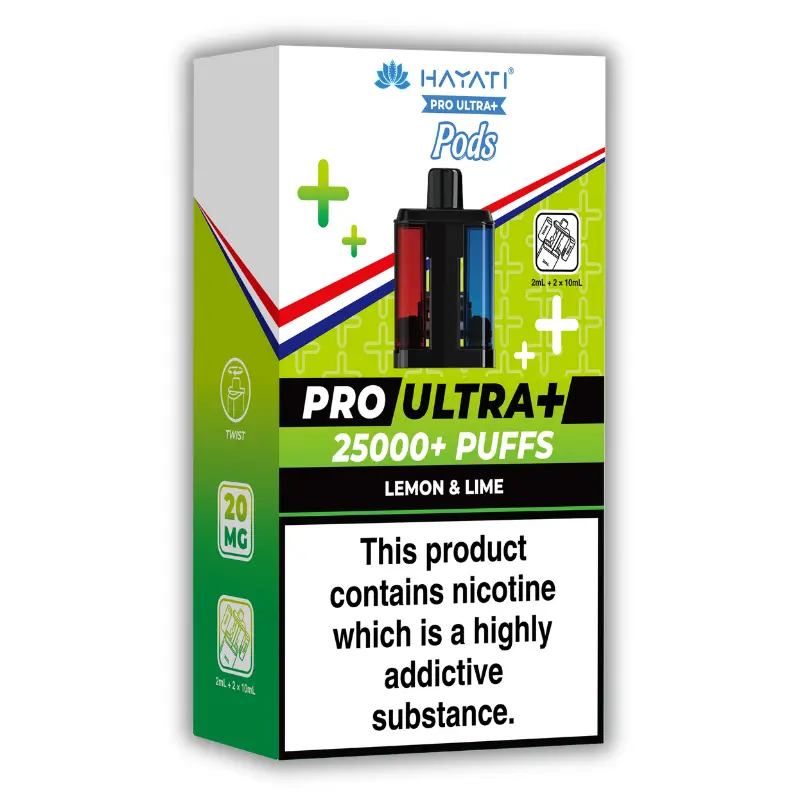
Hayati · Pro Ultra Plus
Lemon Lime Hayati Pro Ultra Plus Pods
£7.99
✔ In stock — ready to ship
Genuine Hayati
Free over £20
Same-day dispatch
Secure checkout
A single sealed pod for the Hayati Pro Ultra Plus at £7.99, holding 22ml of liquid at 20mg nicotine salt, with one flavour in it and one position to draw from. Hayati put a laboratory rating of up to 25,000 puffs on a full pod, which is a bench figure and not a promise about your fortnight. No device is in the pack. A pod on its own produces nothing without a Pro Ultra Plus body to sit in, and anyone reading this without one wants the Lemon Lime Hayati Pro Ultra Plus 25000 Prefilled Pod Kit at £11.99 instead, which is this liquid with the hardware supplied.
The liquid is two citrus fruits and nothing else. No berry, no confectionery treatment, no coolant. Hayati say so in the negative on their own sheet, which is unusual for them and worth noticing, because most listings in this range describe what a flavour contains rather than what has been kept out of it.
What makes this particular listing worth a paragraph of argument rather than a description is the company it keeps. There are four Lemon Lime pods on the Hayati Pro Ultra Plus Pods shelf. They all cost £7.99, they all hold 22ml, and three of the four have a second flavour name in the title. This is the fourth. It is the only one of the four that gives the whole pod to the citrus, and that is the entire difference between them, because the money and the volume are identical. So the question this page is for is not what lemon and lime taste like, which four other pages on this site have already answered at length. It is what Hayati's own decision to build three alternatives tells you about which of the four you should be holding.
The count behind this page, who ran it, and the figure in it that was wrong
This page was commissioned on the back of a claim about how often Hayati reuse a flavour as one half of a divided pod, and the claim arrived with numbers attached. Numbers in a brief have a poor record on this site, so the first job was to check them against data/catalog.json as it stands rather than as somebody remembered it. Two things came out of that: most of the census already belongs to another page, and one of the figures handed over does not match the file.
What is already published, and stays published
The Blue Razz GB Mini Ultra kit page ran the full census and it is thorough. Its working is not reproduced here and its figures are cited rather than recounted. Filtering 492 titles for an oblique returns 101 hits, of which forty are the carrier ratio printed into bottle names and not flavour divisions at all. Sixty-one listings genuinely divide a pod between two names. Those sixty-one resolve to twenty-eight distinct pairings once you normalise the spellings, which matters here because Hayati write this citrus as Lemon Lime on some listings and Lemon & Lime on others, and an automated count that misses that splits this flavour's tally in half.
The distribution that page found is the one that matters for this listing. Blue Razz GB appears in four pairings. Lemon Lime appears in three. Six flavour names appear in two. The remaining thirty-seven appear in one each. I re-ran all of it against the catalogue as it stands today and it holds exactly, so there is nothing to correct in the census and no reason to print the arithmetic twice.
The Pro Ultra Plus portion of it belongs to the Lemon Lime / Lemon Blueberry kit's sibling, the Lemon Lime / Summer Dream kit page, which established that this platform carries fifty divided listings resolving to twenty-five pairings, every one of them sold twice, once as a bare pod at £7.99 and once as a boxed kit at £11.99. No exceptions, no pairing sold only one way. That page also counted this liquid's distribution across every Hayati product line and published the result in full, so any figure on this page about how far Lemon Lime travels is theirs and is cited, not rebuilt.
The figure that was wrong
The brief I was given attributed the sixty-one divided listings to the Pro Ultra Plus alone and put the pairing count at twenty-six. Neither is right. Sixty-one is the whole-catalogue total and it splits fifty on the Pro Ultra Plus and eleven on the Mini Ultra, with nothing else in the range dividing a pod at all. And the pairings come to twenty-eight, not twenty-six, because three of the eleven Mini Ultra combinations exist nowhere else. The correction is small and it points the same way, so nothing in the argument below rests on the difference, but a page that repeats a denominator it has not checked is exactly how the wrong number ends up on four listings instead of one.
What survives, stated narrowly
The shape of the claim holds. Only two flavour names in the entire Hayati range are used as a collar partner more than twice, and this liquid is one of them. Everything else in the catalogue tops out at two pairings, and thirty-seven of the forty-five paired names are used once and never again. Being reached for three separate times is genuinely unusual and it is a fact about a product decision rather than about copy, which is what makes it worth a buyer's attention.
What does not survive is the interpretation that came attached to it, and the section after next explains why. First, the finding that does hold up, which is more useful than the one I was handed.
Three pairings, one job: what Hayati's own sheets say this liquid is for
The three listings that divide a pod with this citrus in it are the Lemon Lime / Lemon Blueberry pod, the Lemon & Lime / Summer Dream pod and the Blue Razz GB / Lemon & Lime pod. All three sit on the same shelf as this one, all three are £7.99, all three hold 22ml. Each was written up separately by Hayati, which makes the three descriptions three independent readings of the same liquid rather than one statement repeated.
Line them up and they agree on something the individual sheets do not draw attention to.
- Against Lemon Blueberry. Hayati describe this half as the one that keeps the citrus sharp, and the blueberry half as the one that softens the picture and trades bite for a rounder fruit.
- Against Summer Dream. Hayati call the citrus the tangy half outright and the unnamed blend the softer counterpart, framing the switch as a move from sharp to mellow.
- Against Blue Razz GB. Hayati put the citrus at the opposite end of the scale from a gummy berry and say plainly that the contrast is the point of the pod.
Three descriptions, three different partners, one consistent assignment. In every case the citrus is cast as the acid and the other side is cast as the relief. Hayati never once build a pairing in which this liquid is the sweet half, the soft half or the background. That is not a taste claim and it is not my reading of the flavour. It is what their own product sheets say, three times, about three different products.
Why the consistency is worth something
Hayati's descriptions of one liquid routinely disagree with each other, which the Lemon Lime Rubik kit page demonstrated by lining up all eleven listings of this recipe and finding real divergence in how the two fruits are weighted. Against that background, three sheets agreeing on a role is not the default outcome. It is the kind of agreement you get when the property in question was settled before the copy was commissioned, because the pairing itself was built around it.
Set it against the other most-reused flavour for contrast. The Blue Razz GB census found that three of that flavour's four partners share a component with it, which makes each of those pods a one-variable comparison: change the fruit and hold the confectionery treatment, or hold the fruit and change the treatment. Its partners are relatives. This liquid's are not. Of its three, only Lemon Blueberry shares anything at all, and what it shares is the lemon rather than the character. Summer Dream shares nothing nameable. Blue Razz GB shares nothing whatsoever. Against a range that splits roughly evenly between pairing relatives and pairing strangers, which is the Blue Razz GB page's count and not mine, this flavour is two-thirds strangers.
So the two most-reused names in the catalogue are reused for opposite reasons. One is a fixed point that you measure small changes against. This one is the far end of a scale, reached for when Hayati want two halves that could not be mistaken for each other. That is a genuinely different role and, as far as I can find, nobody has said it on this site.
The graded distance, which is the useful part
The three partners are not interchangeable and they are not at the same distance from the citrus. Read them as a ladder.
Lemon Blueberry is the near neighbour. It opens on the same fruit, so the two halves of that pod are variations on one theme and the change you hear is the lime being replaced by a body. Summer Dream is the middle rung and the uncertain one, because the name resolves to nothing specific and the Summer Dream pod page has already established how little the record settles about it. Blue Razz GB is the far rung, a confectionery blue raspberry with the sugar forward, and it is the only one of the three that changes the register rather than the fruit.
That ladder is the actual product range here, and this listing is the rung below all of it: zero distance, because there is no second flavour to be a distance from. Four purchases, one price, four different amounts of citrus in the pod.
The inference that fails, and the count that kills it
There is a tempting conclusion sitting right next to those facts and it is worth stating before taking it apart, because most readers will arrive at it on their own. If Hayati have built three separate escape routes out of this liquid and only one pod without one, surely that is the manufacturer telling you they do not expect many people to want 22ml of it neat.
It reads well. It does not survive counting, and the count is straightforward enough to run in a couple of minutes.
The test
If exits get built because a liquid is hard to live with, then the flavours Hayati pair most often should be the ones they are least willing to sell on their own. Availability should run opposite to pairing frequency. That is a prediction and the catalogue can settle it.
Thirty-nine distinct flavour names are used as a collar partner across the twenty-five Pro Ultra Plus pairings. Eight of the thirty-nine are used in two or more pairings. Of those eight, five are also sold as an undivided 22ml pod on the same platform: this citrus, Blue Razz GB, Blueberry Raspberry, Cherry Ice and Strawberry Raspberry Ice. The three that are not are Grape GB, Strawberry Ice and Straw' Cranberry Cherry.
Now the other thirty-one, the names used in exactly one pairing. Five of those thirty-one have an undivided pod: Fresh Mint, Summer Dream, Mr Blue, Blue Razz Cherry and Juicy Peach. The remaining twenty-six exist at 22ml only behind a collar and cannot be bought whole at any price.
So five in eight of the repeatedly paired flavours are available undivided, against five in thirty-one of the once-paired ones. The rate is roughly four times higher among the flavours Hayati reuse. The prediction is not merely unsupported, it is inverted.
What that means, and what I narrowed the claim to
Pairing frequency does not track doubt. It tracks how much of a liquid Hayati already make. A flavour that is in production across the range is a cheap thing to put in a new pod, and the same logic that gets it a solo listing gets it reached for when a partner is needed. The Blue Razz GB Mini Ultra page noticed the two-case version of this on a different shelf, where both of the most-paired flavours are sold solo at 4ml and neither is divided. This is the same pattern with a population behind it rather than two data points, and at 22ml rather than four.
So the claim I was handed, that the three pairings are Hayati's own evidence that most buyers are not expected to want the whole pod, does not hold and I am not making it. What replaces it is narrower and, I think, more useful:
The three pairings are evidence about the role Hayati assign this liquid, not about their confidence in it. They reach for it when they want a pod to have a sharp end, and they have never once reached for it to be anything else. The undivided pod is the same liquid with the other end removed. Whether that is what you want is a real question, and it is a question about your own use rather than about Hayati's opinion of the recipe.
Four pods, one price, and what you are actually choosing between
The Pro Ultra Plus pods shelf runs to 52 listings and every one of them is £7.99 for 22ml, a flatness the Blue Razz GB pod page documented across the whole catalogue. Twenty-seven of the 52 are single-flavour and twenty-five are divided, which is close enough to even that the divided pod is a standard format here rather than a curiosity. Four of the 52 carry this citrus. Choosing between those four costs nothing and changes everything about what arrives.
The volume question, briefly, because it is not settled
Hayati publish the total capacity of a divided pod and never publish how it is apportioned. Eleven millilitres a side is a working assumption that several pages here use and every one of them flags it as an assumption. I am not going to treat it as a specification either. What is certain is only this: a divided pod holds 22ml in total and some of that total is the other flavour, while this pod holds 22ml and all of it is the citrus. The exact split does not need settling for the decision to be clear.
Who each of the four is for
Take them in order of how much they change.
This pod, if the citrus is the point. You have run the flavour before, you know you do not tire of it inside a pod, and you would rather have all of the thing you came for than most of it plus an insurance policy. This is also the right listing if what you want is a palate reset in your rotation rather than an all-day liquid, because a reset works best when it is a separate pod you pick up, not a position on a collar you have to remember to turn back.
The Lemon Lime / Lemon Blueberry pod, if you want variation without leaving the fruit. Both halves open on lemon, so the pod is one idea with two endings rather than two ideas. Its page is the one to read if you are a returning buyer, because it works through what happens when a running order becomes a permanent habit and it sets out four behavioural tests you can apply to your last pod to find out whether you are using both halves or paying for one.
The Lemon & Lime / Summer Dream pod, if you are willing to buy a question. Half of it is described and half of it is a mood word. Its page treats that asymmetry as the subject and reaches a fair position on it.
The Blue Razz GB / Lemon & Lime pod, if you want the two ends of the range in one housing. This is the widest gap Hayati have built with this citrus in it, and its page argues that the pod asks you to buy by class rather than by fruit, which is a fair description of what a sugar-forward confection next to a two-acid citrus amounts to.
And the fifth option, which is a kit
If you do not own the body, none of the four is any use to you on its own. The Lemon Lime kit is this liquid at £11.99 with the device supplied, and the Lemon Lime / Lemon Blueberry kit is the boxed version of the nearest pairing. What Hayati charge for the body, and whether that charge is recovered, is worked out properly on the Blue Razz GB / Lemon Lime kit page and is not repeated here.
One sentence of housekeeping and then no more of it. Check the range name printed on your device against the range name in this title before ordering, and do not settle a compatibility decision from a retail page, this one included.
The liquid, in the space four other pages have left
This recipe has more pages on this site than almost anything else in the catalogue, and the flavour writing is finished. The draw-by-draw, the sweetness placement, the listing diff and the verdict all belong to earlier pages. What follows orients a buyer and points at the owners rather than restating them, and then adds the one observation about this listing's own sheet that nobody has made.
What is established
The Lemon Lime Vapes shelf page did the structural work. Lemon opens the draw and lime arrives at the finish carrying a green, faintly resinous edge, and the middle of the draw is close to empty because neither fruit brings body. That shelf also established, by counting every lime title in the range, that lime never leads a name here and is always positioned last, and that the ordering follows the draw rather than being arbitrary. It is worth reading if the balance between the two fruits is what you are deciding on, because that balance varies more across the 21 listings on that shelf than the shared name suggests.
The Rubik kit page owns what happens to the balance as a pod wears. Its finding is that the lime goes before the lemon rather than the whole profile fading together, and it identifies the point in a pod's life where that becomes audible. The Pro Max Plus pods page owns the repeat-purchase reading, including what a third pod of one liquid tells you that a first cannot. Nothing in any of that is re-derived below.
The short orientation, for anyone who has not read those. Sharp at the front, dry through the middle, a green stop at the end. Sweetness sits low for this range and exists mostly to keep the acid civil rather than to be tasted on its own account. No coolant of any kind, which matters more on a pod this size than it would on a small one, because a coolant holds its apparent freshness as a coil tires and fruit acid does not. Nothing here is a lemonade: no fizz, no sugar-water base, no dilution. It is two acids and a little sweetener.
The observation this listing's own sheet supports
Hayati say on this sheet that the lime sharpens the blend beyond anything the lemon would manage by itself. That is a comparison against a product they do not sell. Fifty-seven titles in the catalogue name lemon, a figure the shelf page counted, and not one of them is lemon by itself. Every single one brackets it with a second fruit, a drink construction or a mint. The shelf page made the matching observation about lime and found the same thing from the other direction.
So both halves of this pairing are sold exclusively in company, and the sheet for this pod invites you to measure it against a reference the range has never produced. That is a small thing and it is not a criticism of the copy, which is describing a real effect. It is worth knowing because it means the comparison cannot be run. If you want to know what the lime is contributing, the available test is not lemon on its own. It is the three-citrus Orange Lemon & Lime pod, where a sweeter, juicier orange is added to the same two fruits, or the Lemon & Mint pod, where the lime is removed and a cooling agent takes its place in the structure. Both are £7.99 and both are on this shelf.
The pod as an object
One sealed prefilled pod in the pack and nothing else. No body, no cable, no spare. It is not designed to be opened or refilled and there is no sensible way to treat it as though it were.
Hayati publish very little about the internals and this page states nothing they have not. There is no coil resistance on the sheet, no carrier ratio, no description of the airflow path, and no window or gauge to tell you how much liquid is left. The first indication that a pod is running low is that it starts to taste thin, and on this liquid that arrives as the finish going quiet rather than the whole draw dropping away.
The undivided construction removes the one moving part a divided pod has. There is no collar to turn, no position to be in and no chance of leaving it halfway. The Blackcurrant Cotton K / Blue Raspberry pod and the other twenty-four divided listings on this shelf all have one; this one does not. What that absence costs in use is the subject of the Juicy Peach pod page, which prices the three ways out of a single-flavour pod and is the right page for that question. What it is worth in diagnosis is a different matter and is covered further down.
The sheet, ordered by what each row decides
The rows below are arranged by how much each one bears on the choice between this pod and the three pairings beside it, rather than in the order a spec sheet usually prints them.
| Flavour positions in the pod | One. No switching, no collar. |
| Liquid volume | 22ml, undivided |
| Price | £7.99, which is about 36p per millilitre |
| What arrives | The prefilled pod only. No device. |
| Nicotine | 20mg/ml, as a salt |
| Manufacturer puff rating | Rated by the manufacturer at up to 25,000 puffs, a laboratory estimate |
| Cooling | None. No ice, menthol or mint on the sheet or in the name. |
| Platform | Hayati Pro Ultra Plus |
| Boxed equivalent | Lemon Lime Pro Ultra Plus kit, £11.99, device included |
Two of those rows do real work and the rest are shelf furniture. The first row is the whole argument of this page compressed into three words, because it is the only row that differs from the three pairings sitting beside it at the same price.
The cooling row matters more than it looks on a pod of this size. A coolant is durable as a coil ages in a way that a citrus top note is not, so a cooled pod tends to hold its apparent freshness late in its life while this one relies entirely on fruit acid to stay lively. Soften the acid and there is nothing underneath holding the line. That is the honest reason an uncooled citrus reads as tired in its last quarter more noticeably than something like the Watermelon Ice pod does, and it is a property of the construction rather than a fault.
The strength row is the UK maximum for a nicotine-containing liquid of this kind, so it is not a choice being offered. Every pod on this shelf carries the same figure and there is no lower option in the format. The preparation is not stated on this particular listing; a salt is the standard preparation at this strength in a prefilled pod and the rest of this site states it plainly, so this page does too.
Where the £7.99 goes if this is not the right pod
Everything below is the same price and the same volume on the same shelf, so these are routes rather than upgrades. They are grouped by which part of this pod you were unhappy with.
If the problem is that two acids get tiring
That is the most common reason people move off a two-citrus pod and it is not a criticism of the liquid. A profile with a sharp front, a hollow middle and a dry stop is a strong signal and a short one, and strong short signals are the ones that wear out first. Three sensible directions.
Add a third fruit and the acid softens: the Orange Lemon & Lime pod keeps the same two fruits and puts a sweeter orange over them, which fills the middle without making the pod sugary. Put the citrus in a drink construction and it changes shape entirely: the Blackcurrant Lemonade pod and the Straw' Lemonade pod both use a lemonade base where the sharpness is diluted into sweetness rather than standing alone. Or keep the lemon and swap the lime for cold, which is what the Lemon & Mint pod does, and it is the closest thing on this shelf to a structural substitute for this listing.
If the problem is that you want the citrus inside a fruit blend rather than on its own
The Blueberry Raspberry Lemon pod is the direct version of that idea, with lemon mixed into a berry recipe rather than sitting beside one. It is worth distinguishing from the Blue Razz GB / Lemon & Lime pod, where the two remain separate and you choose between them, because those are different products solving different problems. Mixed is not the same as adjacent.
If you have decided you want a collar after all
Twenty-five divided pods sit on this shelf. The three carrying this citrus are covered above. Beyond them, the useful ones to know about are the pairings built on a wide gap rather than a narrow one, since that is the style this liquid belongs to. The Blue Razz Pineapple / Strawberry Ice pod and the Straw' Cranberry Cherry / Strawberry Raspberry Ice pod both separate their halves on temperature instead of on acid. The Blueberry Raspberry / Mr Blue pod is the other pairing in the range that puts two widely produced liquids together, and the Blue Razz Cherry / Blue Razz GB pod is at the opposite extreme, two halves sharing their principal component. The Fruit Bomb / Straw' Watermelon B'Gum pod is the one to avoid if specificity is what you value, since neither half resolves to a single fruit.
If you want a single flavour but a different one
Twenty-seven undivided pods share this shelf. At the opposite end of the sweetness range from this listing sits Blue Razz GB, which is the confectionery pole and the only name in the catalogue reached for as a partner more often than this one. Blue Sour Raspberry is the nearest thing to this pod's attitude in a berry, sour rather than sugared, and it is one of the few declared sours available whole at 22ml. Cherry Ice and Strawberry Raspberry Ice cover the cooled red fruit corner. Cola Ice and Raspberry Cola leave fruit behind for a soft-drink profile with a long finish, which is about as far from a short acid spike as this shelf travels. Mango Peach Pineapple and Fruit Twist are the rounded tropical options for anyone who wants body in the middle of the draw, which is precisely what this pod does not have.
Wider than that, the Lemon Vapes shelf collects 54 listings across every format and hardware line Hayati run, the Pro Ultra Plus kits and pods shelf holds all 104 listings on this platform in one place, and the Hayati Prefilled Pods & Refills shelf widens it to 201 across every prefilled format. The full Hayati range runs to 492.
Living with a pod that gives you no second opinion
Most of the practical material for this format is written up elsewhere and pointing at it is more useful than saying it again. The Rubik kit page covers when to retire a citrus pod and what the discarded liquid costs. The Juicy Peach pod page covers what a single flavour removes in use. What follows is the part specific to this combination of an undivided pod and a fragile profile, which I do not think anyone has set out.
A divided pod is a control condition; this one has none
Here is the thing a collar quietly does that nobody buys it for. Three weeks into a pod, something has changed. The question is what. It could be the coil, it could be the liquid settling, it could be your palate having acclimatised, and those three call for three different responses.
On a divided pod you can find out in ten seconds. Turn the collar and taste the other side. If both halves have gone flat, the coil has aged and the pod is telling you it is near the end. If one has and the other has not, the coil is fine and what changed is either that liquid or you. It is a genuine diagnostic and it is free, and it is the reason the Lemon Lime / Lemon Blueberry pod page could work out how coil wear distributes across a pairing at all: it had two references in one housing.
This pod has one. Everything you notice arrives undifferentiated, and there is no way to separate coil age from acclimatisation without a second pod to compare against. That matters more here than it would on almost anything else on the shelf, because citrus is the profile that shows coil condition earliest, which is the Lemon Blueberry page's finding and not mine. You are running the most sensitive instrument in the range with the reference channel removed.
Two practical answers, neither expensive. Keep a different pod in rotation and taste it occasionally, which gives you the second reference the collar would have given you, and one reason a rotation partner from a different family earns its place beside this one. Or accept the ambiguity and treat the citrus-going-quiet signal as sufficient on its own, which is reasonable, because on this liquid the coil and the flavour fail in the same direction and the right response to both is a new pod.
Storage, anchored to a liquid with nothing to hide behind
A 22ml pod is in your possession for weeks rather than days, so where it sits between uses is a live question rather than a theoretical one. Keep spares somewhere cool, dark and stable, and away from a windowsill, a car dashboard or anything that cycles warm and cold. A pod that has been through a few heat cycles reads duller at the top of the draw than one that has not, and a two-acid citrus has no sweetness and no coolant underneath to disguise a dull top. On a jammy berry you might not notice. Here it is the first thing you meet.
Store it upright if the packaging makes that easy, leave the seal on until the pod goes into the device, and keep it out of reach of children and pets like anything else containing nicotine. A part-used pod left standing for a fortnight is not ruined, but it will want a few unhurried draws before it reads properly again, because the wick has had time to sit in liquid and the first pulls after a rest come through thick.
Pacing, and why the first day is the atypical one
An acid-forward liquid rewards a slower, longer draw and punishes a hurried one, and on a pod this large the difference compounds over weeks rather than minutes. Chain-drawing a citrus flattens it faster than it flattens a sweet blend, because the top note is the part that needs the wick to have caught up and the top note is most of what you came for. Leave a few seconds between pulls and the finish stays green rather than turning soapy.
The first hours of a new pod are also not representative and it is worth knowing that before you form a view. A fresh wick on a fully saturated pod delivers the brightest version of this liquid it will ever produce, which is flattering and slightly misleading. Give it a day before deciding whether this is a pod you want to rebuy, and take the reading from the second day rather than the first.
When it is done, and what to do with it
A spent pod on this liquid announces itself by the finish going first. The green stop at the end shortens, then the lime stops registering as a separate thing, and what is left is a rounder, sweeter and less interesting lemon. That is the point at which more draws will not recover anything. It contains a coil, a residue of liquid and electronics, so it does not belong in household waste; a shop take-back point or a local recycling facility will accept it.
Questions that come up on this listing
Is this the same liquid as the half in the dual pods?
Hayati describe it in the same terms across all four listings and there is nothing published to suggest two recipes. The difference is the quantity and the presence or absence of a second flavour, not the formulation. What does differ slightly is the emphasis in the copy, since a writer describing one half of a pairing reaches for whatever separates it from the other half.
Does the pod include the device?
No. This is the pod only, at £7.99. The complete version is the Lemon Lime Pro Ultra Plus kit at £11.99, which is the same liquid with the body supplied. If you already own the hardware, buying the kit means paying for a second device you do not need.
Why would anyone buy this rather than one of the three pairings, when they all cost the same?
Because you get the whole 22ml of the flavour you actually wanted. A pairing spends some of that budget on a second liquid, and if you never turn to it, that portion is thrown away with the pod. The pairings are worth their share to somebody who genuinely uses both sides. They are a straight loss to somebody who does not.
Is there any ice, menthol or mint in it?
None. There is no cooling agent of any kind on the sheet and no cooling word in the name. The freshness people describe in it comes from fruit acid rather than from a coolant, which is a different sensation and behaves differently as a pod ages.
Is Lemon Lime really one of the two most-paired flavours Hayati make?
Yes, counted against the catalogue as it stands. It appears in three of the twenty-eight distinct divided pairings in the range. Only Blue Razz GB appears in more, with four. Six names appear in two pairings and thirty-seven appear in one. That census belongs to the Blue Razz GB Mini Ultra kit page; I verified it rather than recounting it, and it holds.
Does being paired three times mean Hayati think the flavour is hard to live with on its own?
No, and I checked because the brief for this page implied it. If exits were built out of doubt, the most-paired flavours would be the least available whole. The opposite is true on this platform: five of the eight repeatedly paired flavours have an undivided pod, against five of the thirty-one paired only once. Hayati reuse the liquids they already produce in volume.
How sweet is it compared with the rest of the shelf?
Low. It sits near the bottom of the range for sweetness, with what sugar there is present to keep the acid civil rather than to be tasted. Anything in the confectionery register, including Blue Razz GB and the gummy and candy-floss pods, is a long way above it. The three-citrus Orange Lemon & Lime pod is the nearest thing to a slightly sweeter version of this idea.
Which fruit leads, and does the lime ever come first?
Lemon opens the draw and lime arrives at the finish. That ordering holds across the whole range, and the Lemon Lime Vapes shelf page established by counting every lime title that lime is never placed first in a Hayati name. If you are buying for the lime specifically, read that shelf page before choosing, because the amount of lime that actually reaches you varies across its 21 listings.
How do I know when the pod is finished rather than just tired?
On this liquid the two are hard to separate, because it fails in the same direction either way: the finish shortens, the lime recedes and what remains reads rounder and duller. Without a second flavour to compare against inside the same pod, the practical test is another pod from your rotation. If that one still reads correctly, the citrus pod is done.
Can I refill it?
No. It is a sealed prefilled pod with no fill port and it is not built to be opened. When the liquid is gone the pod is finished, and it goes to a take-back point or a recycling facility rather than in the bin, because it contains a coil and electronics.
What is the puff rating actually telling me?
Hayati rate a full pod at up to 25,000 puffs. That is a laboratory estimate produced under test conditions and it is not a forecast of your own use, which depends on how long you draw and how often. Treat it as a way of comparing formats within the range rather than as a number of puffs you are being sold.
The position, plainly
This is 22ml of a two-acid citrus in a sealed pod for the Pro Ultra Plus, at £7.99, with one flavour in it and nothing to switch to. Its only real competition is three pods at the identical price that give part of the same budget to something sweeter, and the choice between the four is a choice about quantity rather than about taste.
The catalogue says something useful about which way to go, though not what it first appears to say. Hayati have used this liquid as a collar partner three times, more often than anything in the range except one confectionery blue raspberry, and in all three cases they cast it as the sharp end and the partner as the relief. That consistency is real and it is worth knowing. What it is not is a verdict on whether the liquid holds up alone, because the flavours Hayati pair most are also the ones they are most willing to sell whole, at roughly four times the rate of the flavours they pair once. The pairing tells you about the role, not about the confidence.
So the honest recommendation is narrow. Buy this pod if you have run the citrus before and know you do not reach for an escape from it, or if your use for it is as a distinct reset alongside other pods rather than as the only thing in the device. Buy one of the three pairings if you want the sharp end available without committing the whole pod to it. And if you are meeting the flavour for the first time, the pairings are the less demanding introduction, which is exactly what Hayati built them to be.
Strictly for adults aged 18 and over. Nicotine is an addictive substance.
You might also like


