
Home / Hayati Pro Ultra Plus Pods / Straw’ Grapefruit / Straw’ Dragonfruit Hayati Pro Ultra Plus Pods
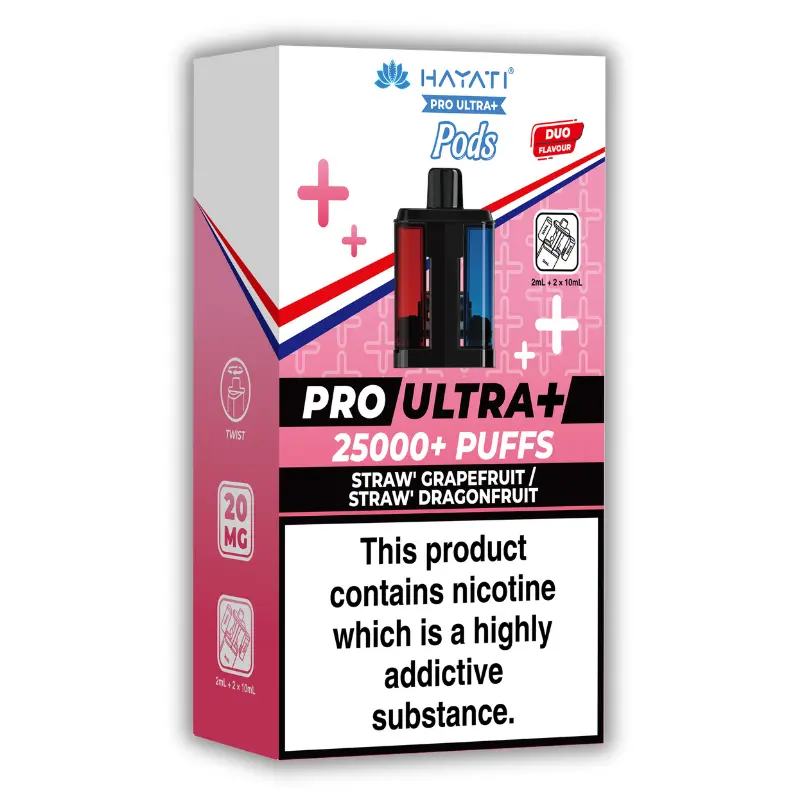
Hayati · Pro Ultra Plus
Straw’ Grapefruit / Straw’ Dragonfruit Hayati Pro Ultra Plus Pods
£7.99
✔ In stock — ready to ship
Genuine Hayati
Free over £20
Same-day dispatch
Secure checkout
One pod, £7.99, 22ml of 20mg nicotine salt held as two separate liquids inside a single housing, with a collar on the mouthpiece that decides which of the two reaches the coil. No device in the packet. Both halves are built on strawberry: turn the collar one way and the partner is grapefruit, turn it the other and the partner is dragon fruit. Hayati quote a ceiling of 25,000 puffs against the pod, a bench number produced on test apparatus and worth using for ranking listings against one another rather than for planning a week. If you do not already own a body for it, the complete Straw' Grapefruit / Straw' Dragonfruit Hayati Pro Ultra Plus 25000 Prefilled Pod Kit at £11.99 is the listing that arrives ready to use. Check the range name printed on your device against the range name in this title before ordering either, because that is the only fitment guidance anyone should take from a retail page.
That is the listing. What makes it unusual is one word in the description, and the word is not strawberry.
Hayati describe the grapefruit side as bittersweet. Across 492 listings in this catalogue, that word appears twice, and both times it is this liquid: once here and once on the kit. Some form of the word bitter appears in eleven descriptions in total, which is a little over two per cent of the range. Some form of the word sweet appears in 464 of them. This is a catalogue that sells sweetness, sells acidity readily alongside it, and almost never sells bitterness, and the pod you are looking at is one of the very few places where it does.
So this page is going to spend most of its length on that, because it is the only genuinely interesting question the listing raises. What is grapefruit's bitterness, chemically, and why is it a different thing from grapefruit's acidity even though almost everybody files the two under the same word. Why a range this size would take the bet at all, given that bitterness is the taste most people spend their lives avoiding. What a strawberry is doing sitting next to it, which is almost certainly a buffering job rather than a partnership. And then the other half of the pod, which by the account of the sibling pages contains the quietest fruit anybody names a product after, making this one of the more lopsided pairings on the shelf.
Two of four hundred and ninety-two
Rarity claims on product pages are usually decoration, so this one was counted before it was written, and the count is more striking than the claim would have been.
Grapefruit appears in exactly two titles in this catalogue. They are this pod and its kit, which is to say one flavour pairing sold in two formats. It appears nowhere else at all: not as a secondary note in another blend's description, not as a supporting fruit, not in a tropical mix, not in a citrus trio. Search the descriptive copy of all 492 listings and the only sentences containing the word are the two that describe this liquid. Grapefruit is not an under-represented fruit in the Hayati range. It is a fruit that exists in the range once.
Now the wider question, which is what else is bitter. Eleven listings carry some form of the word in their descriptions. Two of those eleven need removing before the number means anything. One is a nicotine pouch rather than an e-liquid, where a coffee flavour is called slightly bitter, and pouches are a different product on a different shelf. The other is a denial rather than a claim: a listing whose copy says it has no sour or bitter edges, which is evidence of the opposite habit. That leaves nine e-liquid listings out of 492 whose own copy admits to any bitterness whatsoever.
Those nine are not nine recipes. They are four.
- Straw' Grapefruit, this liquid, on two listings. Bittersweet, both times.
- Lemon Lime, on two listings across different hardware, where the copy puts the bitterness in the peel and calls it a hint of peel bitterness on one and a faintly bitter twist on the other.
- Orange Lemon Lime, on three listings, where the lime is described as slightly bitter and the copy is explicit that the source is the peel.
- Peach Green Tea, on two listings, where a faint bitterness is credited to the tea and described as a check on the sweetness.
Read that list again and notice where the bitterness is located in each case. In the lime builds it is in the rind. Hayati say so themselves, twice, in the word peel. Lime juice is not bitter, it is aggressively sour, and the bitter component is in the oil of the skin and the pith, which is a completely different part of the fruit from the part you would eat. In the green tea build it is not a fruit at all, it is the polyphenol content of an infused leaf. That leaves grapefruit as the only case in this catalogue where the bitterness is in the flesh and the juice of the named fruit, which is to say the only bitterness you would encounter by eating the thing rather than by chewing its skin or brewing a leaf.
That is the narrowed version of the claim and it is the one worth making. Grapefruit is the only genuinely bitter fruit in the Hayati range, in the sense that matters: the bitterness is in the edible part, it is the fruit's defining characteristic rather than an incidental note from a rind, and there is no way to include grapefruit in a blend and leave it behind.
The contrast with acidity is the part that turns a curiosity into an argument. Some form of the word tart appears in 198 descriptions. Sharp appears in 268. Sour appears in 73 descriptions and in 21 titles, so the range is happy enough to print sourness on the front of a box. Zest turns up in 68. Set against nine mentions of bitterness across four recipes, the pattern is not that this range avoids anything that is not sweet. It embraces acidity enthusiastically and at scale. It avoids bitterness specifically, and near-completely, and the one exception is in your hand.
One more piece of evidence, and it is the one that shows the hedging most clearly. Hayati do not write that the grapefruit is bitter. They write that it is bittersweet, a compound word that takes the edge off before the reader reaches it, and then in the same sentence they attach the words sharper and more refreshing, and on the kit listing they follow it with crisp and refreshing again. Refreshing appears in 76 descriptions across the range and crisp in 97, so those are ordinary house words doing ordinary reassurance work. Bittersweet appears twice and belongs to one recipe. The one unusual property of this liquid is stated once, softened by a prefix, and immediately wrapped in the vocabulary of refreshment.
The catalogue's own machinery cannot hold it
Here is the oddest thing the data turns up, and it took nothing more than reading the record fields rather than the sales copy.
This listing's flavour field, the structured one, reads Strawberry Dragonfruit. Not Strawberry Grapefruit Dragonfruit. Not two entries. The field that is supposed to say what the liquid tastes of names one of the two sides and drops the other, and the side it drops is the grapefruit. The kit listing does exactly the same. The tag list attached to the pod runs berry, grape, strawberry and strawberry dragonfruit, and again there is no grapefruit in it.
The shelf filing is stranger still. Both grapefruit listings sit on the Grape Vapes shelf, alongside Grape GB, Grape Berry, Sakura Grape and Grape GB / Strawberry GB Hayati Pro Ultra Plus Pods. There is no grape in this pod. Grapefruit is not a grape, has no botanical relationship to one, and tastes nothing like one. What has happened is almost certainly a substring match: the first five letters of grapefruit spell grape, and something in the filing process took them at face value. Of the eighteen listings on that shelf, sixteen are genuinely grape builds and two are this pairing, sitting there because of a coincidence of spelling.
Add it up and the position is this. The bitter half of this pod exists in exactly two places in the entire dataset: the product title, and one clause of one sentence of descriptive prose. It is absent from the flavour field, absent from the tags, and misfiled at the shelf level under a fruit it has nothing to do with. Every automated surface of this catalogue, every filter, every category page, every structured lookup, treats this product as a strawberry dragonfruit pod. Only the human-written sentence knows about the grapefruit.
That is not an accusation of carelessness so much as a demonstration of the point. A taxonomy built for a sweet fruit range has berry, grape, strawberry, tropical and ice in it. It has no cell for bitter, because until this pairing arrived there was nothing to put in one. When a genuinely anomalous product turns up, a classification system with no category for the anomaly does the only thing it can, which is to file it under the nearest string it recognises and lose the interesting part.
Why almost nobody sells a bitter vape
Nine listings in 492 is not an oversight. It is a decision, repeated four hundred and eighty-three times, and the reasons behind it are worth setting out because they explain what this pod is trying to get away with.
Start with what bitterness is for. Sweetness is a signal that something contains usable energy. Sourness signals acid, which can mean unripe or fermented and which people learn to enjoy in controlled doses. Bitterness is the one that evolved as a rejection signal, and it is the only one of the basic tastes where the default human response is to spit rather than swallow. Almost everything that tastes strongly bitter in nature is an alkaloid or a glycoside the plant produced to stop being eaten. The response to it is present from birth and does not require learning, unlike the appreciation of bitterness, which absolutely does.
That learning happens for coffee, for beer, for dark chocolate, for tonic and for bitter greens, and in every one of those cases the appreciation is acquired through repeated exposure paired with something the drinker wanted anyway, usually caffeine, alcohol, or the social context. It is acquired slowly and it is acquired specifically. Learning to enjoy coffee does not transfer to enjoying grapefruit. Each bitter thing has to be learned on its own terms, which makes bitterness the hardest flavour dimension to sell to somebody who has not already decided they want it.
Second problem: bitterness does not read as refreshing. Refreshment is a package of sensations that includes coolness, acidity, carbonation and a fast clean finish, and bitterness is the opposite of the last of those. It lingers. A refreshing thing gets out of the way; a bitter thing stays. This is why the vape trade reaches for ice, mint and citrus when it wants to signal freshness, and why Hayati's own copy attaches the refreshment vocabulary to this liquid rather than letting the bitterness stand alone. They need the word bittersweet to be read as bracing, and bracing is a stretch that the reader has to be willing to make.
Third problem, and the decisive one for a sweetened product. In a liquid that is manifestly built to be sweet, a bitter note does not read as a flavour choice unless the drinker was expecting it. It reads as a fault. Bitterness in sweet food is overwhelmingly a signal of something having gone wrong: burnt sugar, oxidised fat, a sweetener taken past its useful concentration, or in vaping specifically, a coil that has started to scorch. That last one matters here more than anywhere. A vaper who tastes bitterness they did not order will not conclude that the recipe is sophisticated, they will conclude the coil is going, and they will think about replacing the pod. A manufacturer putting deliberate bitterness into a sweetened e-liquid is therefore taking on a real risk of being blamed for a hardware failure that has not happened, and the only defence against it is to print the word on the listing so the buyer arrives expecting it. Which is exactly what Hayati have done, twice, in a catalogue where they have otherwise never used the word for a fruit.
Put those three together and a 492-listing range containing one bitter fruit build starts to look like what it is: a narrow, deliberate, slightly awkward bet on a small group of buyers who already know they like grapefruit and have been unable to find it anywhere. That is a defensible commercial position and it is not a mass-market one, and it is the reason this page is worth writing at length rather than treating the pod as another strawberry listing.
Bitter and sour are two different machines
The most useful thing anyone can do before committing to 22ml of this is to separate two sensations that the English language habitually merges. Ask somebody what grapefruit tastes like and the answers come back as sharp, tangy, sour, tart, bitter, in no particular order and often several at once. Those words are not synonyms. They describe two mechanisms that arrive together in a real grapefruit and can be separated completely in a formulated liquid, which is precisely why the question of what this pod actually delivers is an open one.
A related confusion, between acidity and astringency, is worked through in detail on Straw' Cranberry Cherry / Strawberry Raspberry Ice Hayati Pro Ultra Plus 25K Pods, which establishes that cranberry's drying quality is a tactile event rather than a taste and that it accumulates across a session in a way acid does not. That page also notes in passing that grapefruit's bitterness is a third thing again, and declines to open it. This is the page that opens it. Astringency is touch, acidity is one taste, bitterness is another, and all three get called tart by people describing them casually.
What acidity does, briefly
Acid is detected through ion channels responding to hydrogen ions. It arrives fast, it is unmistakable, it registers near the front of the mouth early in a draw, and critically it is self-limiting, because saliva buffers and clears it within seconds. The practical consequence is that sourness does not build. The fortieth sour draw of an evening lands with roughly the force of the first, because the reset between them is automatic and complete. That is why a range can sell 21 titles with sour in the name without wearing anybody out.
What bitterness does, at greater length
Bitterness runs on entirely different hardware. It is detected by a family of G protein-coupled receptors, the TAS2R family, of which humans carry roughly twenty-five functional variants. That number alone tells you something. There is one broad mechanism for sour and one for salt. Bitterness gets two dozen receptors, because there are thousands of structurally unrelated bitter compounds in the plant world and the body needed broad coverage rather than precision.
Four consequences follow, and every one of them changes how this pod behaves.
It is slow to arrive and slow to leave. A receptor cascade takes longer than an ion channel. Bitterness peaks noticeably later in the course of a mouthful than sourness does, and it decays over a much longer tail. The old diagram putting bitterness at the back of the tongue is wrong as anatomy, since all the receptor types are distributed across the whole surface, but it captures something real by accident: bitterness tends to be noticed late, after swallowing or exhaling, which is how it got associated with the back of the mouth. On a vape this is the single most important practical fact on the page. If you draw on the grapefruit side and judge it on the inhale, you will very likely conclude there is no bitterness in it. The bitterness, if it is there, shows up after the exhale, in the finish, several seconds later.
It adapts rather than resetting. Where acid is cleared by saliva, repeated bitter exposure produces adaptation in the receptors themselves, and the response diminishes with each closely spaced hit. Draw five times on the grapefruit side in quick succession and the fifth will read less bitter than the first, not because the liquid changed but because you did. This is the opposite of the astringency case, where the sensation accumulates, and the opposite of the acid case, where it holds steady. It means that chain-drawing this side is the single most reliable way to make the thing you bought it for disappear.
It varies enormously between people. The TAS2R family is among the most polymorphic receptor families in the human genome, with common deletions and variants that leave different people with measurably different sensitivity to the same compound. Nobody disagrees very much about whether lemon juice is sour. People disagree violently about whether a given bitter thing is pleasant, faint or overwhelming, and a good part of that disagreement is receptor-level rather than a matter of taste in the cultural sense. This is worth knowing before you read anybody's opinion of this pod, mine included. On the bitter side specifically, another person's experience is a weaker guide than it would be on any other flavour in the range.
It is suppressed by sweetness far more effectively than acid is. That one gets its own section below, because it is the entire reason the strawberry is there.
What is actually bitter in a grapefruit
Two families of compound, working on different timescales, and neither of them is the thing that makes grapefruit smell like grapefruit.
The immediate bitterness comes chiefly from naringin, a flavanone glycoside concentrated in the albedo, the white pith, and in the membranes dividing the segments, with a smaller amount in the juice itself. It is present at its highest levels in unripe fruit and declines as the fruit matures, which is why grapefruit varieties and harvest timing make such a difference to how punishing the result is.
The delayed bitterness is a separate story and a stranger one. It comes from limonoids, principally limonin, which are not especially bitter in the intact fruit. They are present as a tasteless precursor, and acid conditions convert that precursor into the bitter form over a period of minutes to hours after the fruit is pressed. Freshly squeezed grapefruit juice therefore becomes measurably more bitter as it sits, which is a real and well-documented headache for the juice industry and a phenomenon anybody can verify at a breakfast table.
There is one detail in the naringin story that makes the whole subject click into place, and it is worth a paragraph. Naringin is bitter because of the specific way a sugar is attached to it. The molecule is a flavanone, naringenin, carrying a disaccharide called neohesperidose, and the bond in that disaccharide is a one-to-two linkage. Change that single bond to a one-to-six linkage and the disaccharide becomes rutinose, the compound becomes narirutin, and it is essentially tasteless. Same flavanone. Same two sugars. One bond in a different place, and the bitterness vanishes entirely. Bitterness is not a measure of how much of something is present or how concentrated it is. It is a question of whether a molecule fits a receptor, and the fit can be destroyed by a rearrangement too small to see.
The smell is not the bitterness, and that is the problem
Grapefruit's aroma comes from a different set of molecules again. The characteristic notes are carried largely by nootkatone, a sesquiterpene ketone, and by a sulphur compound, 1-p-menthene-8-thiol, which has one of the lowest detection thresholds of any known aroma compound and is recognisable at concentrations measured in parts per trillion. Those two, with a supporting cast of terpenes shared across the citrus family, are what your nose identifies as grapefruit.
Neither is bitter. Bitterness is a taste, mediated by receptors in the mouth; nootkatone and the thiol are volatiles, mediated by receptors in the nose. They are separate systems reporting on separate molecules, and the reason you experience them as one thing is that they normally arrive together.
Which sets up the honest uncertainty at the centre of this page. A grapefruit accord for a sweetened e-liquid can be constructed entirely from the aroma side. Put in the nootkatone and the thiol and the supporting terpenes, leave out the naringin and the limonin, and you have something that smells precisely like grapefruit and contains no bitter principle at all. That is not a hypothetical shortcut, it is the direction the entire grapefruit trade pushes in. Commercial juice is routinely debittered, using adsorbent resins that strip the offending compounds out, or enzymes that cleave the very sugar linkage described above and turn naringin into something that is not bitter. Every industrial process applied to grapefruit at scale is aimed at removing the property this listing is advertising.
So what is in this pod? The listing says bittersweet, and that is the only evidence available, and it is a marketing description rather than a specification. It may mean genuine bitter tastants were formulated in, which would be the interesting and unusual choice. It may mean the aroma is convincing enough that the copywriter reached for the word everybody associates with grapefruit. It may mean something in between, a token quantity sufficient to register in the finish without ever becoming the point. Hayati publish nothing that would separate those readings, and I am not going to pretend otherwise by describing a bitterness level I cannot know. What I can do is tell you exactly how to find out, which is further down, and the test takes about thirty seconds.
What the strawberry is doing there
Hayati's own framing is that strawberry is the anchor and the two partners sit either side of it. Read the grapefruit side in isolation and a different reading is available: the strawberry is not a partner at all, it is a buffer, and it is there because without it the bitter side would be unsellable.
The mechanism is mixture suppression, and the important part is that it is asymmetric. Sweetness suppresses bitterness strongly. Bitterness suppresses sweetness too, but less. Add sugar to something bitter and the bitterness drops away sharply; add a bitter compound to something sweet and the sweetness diminishes rather less. This asymmetry is why sugar is the universal answer to a bitter drink and why nobody has ever fixed an over-sweet drink by adding quinine.
Some of that suppression happens at the receptor and some of it happens centrally, in the processing rather than the detection. The evidence for the central part is that suppression still occurs when the sweet and the bitter stimulus are delivered to different regions of the mouth, where they cannot be competing for the same receptors. Whatever the balance, the outcome for a formulator is a reliable dial: more sweetness makes a bitter component recede, in a predictable and controllable way.
Acid does not respond nearly as well to the same treatment. Sweetness and sourness interact more evenly and more mutually, each reducing the other somewhat, and the result of balancing them is not the disappearance of the acid but a recognisable and much-loved combination. Lemonade is the everyday proof. So is every sour confectionery product ever made, and so is Straw' Lemonade Hayati Pro Ultra Plus 25K Pods, which puts sugar and citrus acid together and gets a flavour people actively want rather than a compromise. Sweet-sour is a destination. Sweet-bitter is a rescue operation.
Once you see the strawberry as a suppressant, several details of the build stop looking arbitrary. Strawberry is one of the sweetest-reading fruits in the range and one of the lowest in perceived acidity, which is why it turns up in 80 of the 492 titles here and why it functions as the default base of this shelf. It is also aroma-heavy and structurally soft, so it fills the early part of a draw without asserting a shape of its own. If the task is to put a cushion under a bitter component without adding a second personality to argue with it, strawberry is close to the ideal choice, and the range has a great deal of it to hand.
But the suppression is incomplete, and the incompleteness is where the pod becomes interesting rather than merely safe. The two sensations run on different timetables. Sweetness arrives early in a mouthful and decays quickly. Bitterness arrives late and decays slowly. Overlay one on the other and the suppression is at its strongest exactly when the bitterness has not yet appeared, and has largely worn off by the time the bitterness reaches its peak. The strawberry protects the front of the draw and cannot protect the finish.
Which produces a specific, testable prediction about how this liquid should behave, and it is the prediction I would judge the pod on. The inhale should read as an ordinary sweet strawberry, close enough to the rest of this shelf that you would struggle to pick it out. The exhale should bring a citrus lift. And then, several seconds after the exhale, with nothing left in your mouth, a dry bitter edge should appear and hang around. If that late arrival happens, the formulator has put real bitter material in and the strawberry is doing exactly the job described above. If the finish is clean and the only citrus character sits in the aroma, then what you have bought is a grapefruit-scented strawberry pod, which is a perfectly pleasant thing and not what the word bittersweet implies.
The other half, and an unusually lopsided pairing
Turn the collar and the grapefruit is replaced by dragon fruit. This is where the pod stops being unusual and becomes something closer to a puzzle.
The dragon fruit question has already been settled elsewhere in this catalogue and there is no sense in re-running it. Straw' Guava / Dragon Berries Hayati Pro Ultra Plus Pods shares a shelf with this pod, and the Dragon Berries pages on the Pro Max Plus platform did the work in full. Their findings, which I am citing rather than rediscovering, are these. Dragon fruit has no character compound: no single molecule that means dragon fruit and nothing else, unlike banana, peach or raspberry, which is why nobody who has eaten one can describe it without borrowing pear, melon, kiwi or lychee to do it. Its volatile profile is mostly green and grassy with small floral terpene alcohols behind it. What people enjoy about eating one is largely colour, texture, chill and water content, and vapour carries none of those across. The conclusion those pages reach, carefully hedged as an inference, is that a dragon fruit accord anywhere is an impression assembled to order rather than an extract of anything, and that it contributes very little to the blend it sits in.
There is a second finding on those pages that concerns this listing directly, and it is slightly odd to be on the receiving end of it. The Dragon Berries kit page argued that Hayati clip the fruit's name to Dragon on their listings, and used this pod as the evidence that the clipping is shorthand rather than mood-naming, on the grounds that when Hayati mean the fruit and are confident about it they write Dragonfruit out in full, as they do here. This page is the exhibit in somebody else's argument. It also does the reverse trick in the same breath: strawberry, the fruit everybody recognises, is clipped to Straw' on both sides of the oblique, while the unfamiliar one is spelled out. Twenty-two titles in the catalogue use that clipped form and sixty write Strawberry in full, so the abbreviation is ordinary house practice rather than anything meaningful, but the combination on a single title is still a small pleasure: the familiar fruit truncated twice, the obscure one given all four syllables.
Now the lopsidedness, which is the part that belongs to this page.
On one side of the collar is the rarest taste dimension in a 492-listing catalogue, present in the flesh of a named fruit exactly once across the whole range. On the other side is, by the account of the sibling pages, the quietest fruit anybody builds a product around. Both sides sit on the same strawberry base. So the collar is not switching between two flavours in any full sense, it is switching a modifier, and the two modifiers are at opposite ends of the loudness scale by about as wide a margin as the catalogue permits.
Before calling that unusual, it was worth checking whether shared-base pairings are themselves odd, and they are not. Of the 25 dual listings on the Hayati Pro Ultra Plus Pods shelf, 15 share a word between the two halves, including Strawberry Ice / Strawberry Raspberry Ice, Blue Razz Cherry / Blue Razz GB, Kiwi Banana / Straw' Banana, Watermelon B'Gum / Strawberry B'Gum and Blueberry H'Bubba / Watermelon H'Bubba. Keeping a common element and varying one term is the majority pattern on this shelf, not an exception. So the shared strawberry is unremarkable. What is remarkable is the distance between the two things that vary.
Two readings of that are available and they lead to different purchases.
The charitable reading, which I think is correct. A bitter flavour is not something most people want to sit in for three weeks without relief. Bitterness is the dimension least suited to continuous exposure, both because the receptor adaptation described above dulls it and because the cognitive load of a challenging taste does not stay enjoyable indefinitely. If you are going to sell a bitter pod at 22ml, the correct partner is not a second assertive flavour competing for attention. It is a rest. Something soft, sweet, low in acid, with no edges and no demands, which is exactly what a strawberry carrying a pale floral modifier is. On this reading the dragon fruit side is not weak by accident, it is quiet by design, and its quietness is the feature. The two sides are not two flavours, they are a flavour and a place to recover from it.
The uncharitable reading. The dragonfruit side is a plain strawberry pod with a fashionable word attached, indistinguishable in practice from a good deal of the rest of this shelf, and it is occupying half of a 22ml budget you paid £7.99 for. On that view you are buying one genuinely distinctive liquid and one filler, at a single price, with no way to spend the whole pod on the half you came for.
Both readings are defensible and the evidence does not fully separate them, but the charitable one has the stronger case and it rests on the collar itself. A switch is only worth having if there is somewhere worth switching to, and the value of the destination depends entirely on what you are switching away from. A rest is worth very little beside a mild sweet flavour and worth a great deal beside a demanding one. This is the one pairing in the range where a deliberately unassertive half has a clear job, because it is the one pairing where the other half is hard work. Buy a grapefruit pod with no escape from the grapefruit and by the tenth millilitre you would be looking for a different pod entirely.
The condition on that verdict is straightforward. It holds only if the grapefruit side is genuinely bitter. If the bitterness turns out to be an aroma impression with no real tastant behind it, then you have two sweet strawberry pods sharing a housing, the collar has nothing meaningful to switch between, and the uncharitable reading wins by default. Which is why the thirty-second test below is worth running on your first evening rather than your third week.
The pod as an object
What arrives is one prefilled pod and nothing else. No body, no case, nothing to plug in. It holds 22ml in total at 20mg nicotine salt, divided between the two liquids, and it goes onto a Pro Ultra Plus body you already own. Hayati state that the two are kept apart inside the housing and that rotating the mouthpiece collar selects which one feeds the coil. What they publish about how that selection works internally is nothing at all, so this page describes what the collar does and stops there rather than inventing valves or seals to explain it.
Three consequences of the shared-coil arrangement matter more on this pairing than they would on most, and all three come from the bitterness.
Carryover is the first. One coil, one wick and one airflow path serve both sides, so the draws immediately after a switch are contaminated by whatever was in the wick before. On a pairing of two sweet fruits that is a minor blurring. Here it is a real measurement problem, because bitterness has the longest decay of anything in the pod and because residual bitter material will follow you into the dragonfruit side and make the soft half read wrong. Give it a handful of draws after turning the collar before you form any view of the side you have just switched to.
Shared wear is the second. Both liquids pass through the same coil, so the two sides age together and neither can be replaced independently. Shared budget is the third: the 22ml is one pot of liquid, and if you use the grapefruit side heavily and barely touch the other, the pod reaches the end of its life with liquid still in the half you avoided, and that liquid goes in the bin with the housing. The two halves are not separable purchases at any point.
Everything else about the platform, how the pod seats and how the range is laid out, sits on the Hayati Pro Ultra Plus Prefilled Pod Kits & Pods listing, which carries 104 products across both formats.
The record, sorted by whether the grapefruit appears in it
The table below is arranged around the finding in the second section, because on this product the gaps in the record are more informative than the entries. Rows marked as absent are absent from Hayati's published data for this listing, not omitted here.
| Field | What it contains |
|---|---|
| Title | Straw' Grapefruit / Straw' Dragonfruit, both sides clipped on strawberry |
| Flavour field | Strawberry Dragonfruit. The grapefruit is not recorded |
| Tags applied | berry, grape, strawberry, strawberry dragonfruit |
| Shelves it is filed on | Eight, one of which is Grape Vapes, which contains no grapefruit apart from this pairing |
| Bitterness stated in copy | Once, as bittersweet, of the grapefruit side |
| Coolant named anywhere | None, in the title or the copy |
| How the sides are separated | Stated as kept apart, with the rotating mouthpiece selecting one. No internal detail published |
| Total liquid in the housing | 22ml, shared between both sides |
| Split between the two sides | Not published |
| Nicotine | 20mg, the UK ceiling for a consumer e-liquid, as a nicotine salt |
| Puff figure quoted | 25,000, obtained on test apparatus |
| Device supplied | None. A Pro Ultra Plus body is required and sold separately |
| Carrier ratio | Absent from this listing's data |
| Coil resistance | Absent from this listing's data |
| Stock code | straw-grapefruit-straw-dragonfruit-hayati-pro-ultra-plus-pods |
| Maker | Hayati |
| This listing | £7.99 |
| Same pairing with a body included | £11.99 |
Four rows deserve a note. The 20mg is a statement of concentration and nothing else; nicotine is addictive, and 20mg is the maximum a consumer e-liquid may contain in this country, which is a legal ceiling rather than a recommendation of any kind. The unpublished split between the two sides is the row that would matter most to somebody buying this for the grapefruit, because if the housing is divided evenly then half of what you paid for is a flavour you may barely use, and Hayati give no figure. The two absent technical rows are the ones most often filled in by copying a neighbouring page, after which a guess circulates as though somebody had measured it, so neither is given a value here. And the puff figure describes an apparatus rather than a person, since draw length and frequency both move the real total and move it downwards.
Where it sits, and what to buy instead
Everything below is on the same platform and, unless noted, at the same £7.99 as a pod on its own. The grouping is by what you actually want rather than by fruit colour, because on this product the deciding question is which taste dimension you are after.
If it is the bitterness you want, there is no alternative. That is the blunt answer and the counting above is why. No other listing in the range puts a bitter fruit at the centre of a build. The nearest available thing is the citrus peel bitterness in the lime family, and it is not the same sensation: peel bitterness is thin, aromatic and tied to a zest character, where grapefruit's is broader and sits lower. Blue Razz GB / Lemon & Lime Hayati Pro Ultra Plus 25K Pods is the way to sample that register on this hardware. If what you are really after is any dimension other than sweetness, Fresh Mint / Blue Razz Mint Hayati Pro Ultra Plus 25K Pods is the only other non-sweet axis the range sells at scale, and menthol cooling is a trigeminal sensation rather than a taste at all, so it scratches a different itch entirely.
If what you actually like is acidity and you have been calling it bitterness. This is the most likely misdiagnosis and it is worth taking seriously, because the range serves acidity extremely well and bitterness hardly at all. Straw' Lemonade keeps the strawberry base and swaps the bitter partner for a clean citrus one, which is the closest thing to a controlled comparison available: same base, same platform, same price, one variable changed. Blackcurrant Lemonade Hayati Pro Ultra Plus 25K Pods runs the same idea over a darker fruit. If the answer to the thirty-second test below is that you preferred the sharpness to the finish, one of those two is your pod and this one is not.
If it is drying you want rather than bitterness. Those are separate sensations and the difference is set out properly on Straw' Cranberry Cherry / Strawberry Raspberry Ice. Cranberry works by stripping the lubrication out of your mouth, which is touch rather than taste, and it accumulates across a session where bitterness adapts away. Straw' Cranberry Cherry / Cherry Ice Hayati Pro Ultra Plus Pods puts the same drying half against a cooled cherry instead.
If you want the strawberry without the awkward half. Plenty of options, and no shame in it. Strawberry Watermelon Hayati Pro Ultra Plus Pods is a single-flavour pod with no collar, pairing the same base with a watery, low-intensity partner, and it is the most restful thing on this shelf. Strawberry Raspberry Ice Hayati Pro Ultra Plus 25K Pods adds a second red fruit and a coolant. Strawberry Ice / Strawberry Raspberry Ice is the dual version of that idea, with both sides cooled and the difference between them small by design.
If cooling is the contrast you want across the collar. A coolant does the job of a palate reset more reliably than a soft fruit does, at the cost of dominating whichever side carries it. Cherry Ice / Peach Mango Hayati Pro Ultra Plus 25K Pods sets a cooled half against an uncooled one, which is structurally the same bet this pod makes with a different mechanism. Blue Razz Pineapple / Strawberry Ice does it the other way round.
If the exotic half is what drew you. Then buy it from a listing where the exotic fruit is one that can actually be tasted. Straw' Guava / Dragon Berries keeps a strawberry lead and puts guava beside it, and guava is fragrant, assertive and completely identifiable, which is the property dragon fruit lacks. That pairing also carries a dragon fruit element on the other side, so it is the direct comparison if you want to test the sibling pages' finding for yourself.
If your usual territory is the confected end. Crossing from a sweet-shop profile to a bitter citrus one is the biggest jump available in this catalogue and it is worth making deliberately rather than by accident. Blue Razz GB Hayati Pro Ultra Plus Pods and Blue Razz Cherry Hayati Pro Ultra Plus Pods are the reference points for that register. Blackcurrant Cotton K / Blue Raspberry goes further into it, and Mr Blue Hayati Pro Ultra Plus Pods asks to be taken as one cohesive blue flavour rather than a blend you pick apart. Coming off any of those, the grapefruit side of this pod will read as severe for the first day or two while expectation recalibrates, and that adjustment is not a fault in either product.
If you want something softer on both sides. Cherry Berry Hayati Pro Ultra Plus Pods is a single flavour with no switching at all, and Kiwi Banana / Straw' Banana is the gentlest dual pairing on the shelf, with banana doing the same cushioning job strawberry does here.
If you would rather test the idea cheaply first. Straw' Lemonade Hayati Mini Ultra Pods is £3.49 on smaller hardware, and while it is a citrus rather than a bitter build, it will tell you inexpensively whether a sharp partner beside strawberry is a direction you enjoy at all before you commit 22ml to a harder version of the question.
The Strawberry Vapes shelf runs to 82 listings if the base is what you are shopping for, and the full Hayati catalogue is there if none of the above is close.
Running a pod with a bitter side in it
Generic handling advice applies to this pod as it does to any other and is not worth restating. What follows is specific to having bitterness in the housing, and most of it would be wrong advice on a sweet pod.
The thirty-second test, on the first evening. Turn the collar to the grapefruit side, take one unhurried draw, exhale, and then do nothing at all for ten seconds. Do not draw again, do not drink anything, do not talk. You are waiting for the late arrival. A dry, slightly gripping bitterness appearing after the sweetness has gone is the answer you are looking for, and it settles what you have actually bought. A finish that stays clean and fruity means the grapefruit is aroma-only, and you should read the rest of this pod as a strawberry listing and judge it accordingly. Run the test once, properly, before forming any other opinion.
Do not chain-draw the grapefruit side. Bitter receptors adapt to repeated closely spaced exposure, so a run of quick draws will flatten the exact property you paid for and leave you with plain sweet strawberry, convinced the pod is a disappointment. Space the draws on that side and it stays legible. This is the reverse of the advice that suits a cooled pod, where repetition builds the effect rather than erasing it.
Give the soft side a clear run after switching. Because bitterness decays slowly and because one wick serves both liquids, the first several draws after turning the collar towards the dragonfruit side carry the previous side with them. Judged in that window the soft half will read as muddled and faintly harsh, which is a carryover artefact rather than a property of the liquid. Four or five draws is usually enough to clear it.
Keep it cool, because temperature moves the balance. Warmth reduces perceived sweetness and leaves bitterness comparatively more prominent, so the same pod after an afternoon on a sunny windowsill will read as more severe than it did in the morning without a drop of the liquid having changed. Room temperature, upright, out of direct sunlight, never left in a parked car, and out of reach of children and pets.
Water between sides helps less than you expect. Rinsing clears acid quickly because acid is water-soluble and the mouth buffers it actively. Bitter compounds partition into oral tissue and linger there, so a mouthful of water shifts them far less than it shifts sourness. A short gap does more than a large drink, which is another reason the two halves of this pod are better used in stretches than alternated every few minutes.
Know which direction this one ages in. As a coil accumulates residue it strips the lightest aromatic material first, and on the grapefruit side the lightest material is precisely the nootkatone and thiol carrying the smell. The naringin-type bitterness, if it is in there, is not volatile in the same way and does not leave at the same rate. So this pod should age in a specific and unappealing direction: losing the grapefruit aroma while keeping the grapefruit bitterness, ending up drier and blanker rather than simply fainter. If the last few millilitres read as bitter without smelling of anything much, that is the coil rather than the recipe, and there is nothing left worth chasing.
Do not judge it against the pod you finished yesterday. Coming off weeks of confected sweetness, the first day on a bitter build reads as a shock, and the second day does not. Expectation is a large part of bitter perception, larger than it is for sweetness or acidity, and it moves quickly. Give it two days before deciding.
When it is spent, it is spent. Thinning vapour and a faint toasted edge behind the fruit mean the coil is finished, and on this pod those signs are easy to confuse with the flavour itself, which is the one real inconvenience of buying something bitter. Judge it on the vapour volume rather than the taste. The housing holds a coil and residual liquid, so it does not belong in household waste; a retailer take-back point or a local recycling facility will take it.
Questions this listing raises
Is this two pods or one?
One. A single 22ml pod with the two liquids kept apart inside it and a rotating collar on the mouthpiece that selects which reaches the coil. Switching is instant and can be done mid-session as often as you like, so there is no question of opening one first and saving the other.
How bitter is the grapefruit side, really?
Unknown, and this page will not pretend otherwise. Hayati state that it is bittersweet and publish nothing further, and a grapefruit accord can be built from aroma compounds alone without any bitter tastant in it. The thirty-second test above settles it in your own mouth on the first evening, and the answer determines whether the pod is the unusual thing it advertises or a strawberry pod with a citrus scent.
Why does the catalogue file this under Grape Vapes?
Almost certainly because the word grapefruit begins with the word grape. There is no grape in the liquid and grapefruit has no relationship to a grape. Sixteen of the eighteen listings on that shelf are genuine grape builds and this pairing makes up the other two.
Is bitterness the same as sourness?
No, and they run on different biological machinery. Sourness is detected through ion channels responding to acid, arrives fast and is cleared by saliva within seconds. Bitterness is detected by a family of around twenty-five receptor proteins, arrives late in a mouthful, decays slowly and dulls with repeated exposure rather than resetting. The two happen to arrive together in a real grapefruit, which is why the words get used interchangeably.
Is there any ice or menthol in it?
No coolant is named in the title or anywhere in the description, and this range flags cooling in the product name when it is present. An unmarked title is therefore reasonable grounds for expecting none. Cooling strength is not published for anything in the range, so that is a reading of a naming convention rather than a measurement.
Which side will run out first?
Whichever you use more, and the pod cannot be topped up on either side. Hayati publish the total capacity of 22ml but not how it is divided, so if you expect to live mostly on the grapefruit side you should know you may be discarding the housing with liquid still in the other half. That is a genuine cost and it is not disclosed anywhere on the listing.
Can I taste the dragon fruit at all?
Probably not as an identifiable fruit. The sibling pages on Dragon Berries set out the reason at length: dragon fruit has no character compound, so even the real fruit is hard to name blind, and an accord built to represent it is a pale floral impression rather than an extract. Expect the soft side to read as a slightly lighter strawberry rather than as anything exotic, and do not treat that as a fault in the pod.
Is it a sweet pod overall?
Yes, comfortably. Both halves are strawberry-led, strawberry is one of the sweeter-reading fruits in the range, and the sweetness on the grapefruit side is doing structural work in suppressing the bitterness rather than being incidental. Anybody expecting an austere grapefruit liquid will find it considerably sweeter than that.
Why is bitterness so rare in this catalogue?
Because it is the taste people are built to reject and have to learn to like, because it lingers rather than refreshing, and because in a sweetened liquid an unexpected bitter note reads as a fault rather than a feature. In vaping specifically it can be mistaken for a failing coil, which is a commercial risk no manufacturer takes casually. Nine e-liquid listings out of 492 mention it at all, across four recipes.
What is the VG to PG ratio, and the coil resistance?
Neither is published for this product, so no figure appears anywhere on this page. Numbers quoted for either of them on other listings did not come from Hayati's data for this pod, and copying one across would only make a guess look corroborated.
Should I buy the kit or the pod?
The pod if you already own a Pro Ultra Plus body, the kit if you do not. The £4.00 difference between £7.99 and £11.99 is the device, and buying this listing without a body to put it on leaves you with a sealed pod and nothing to do with it.
Does the 25,000 figure tell me how long it will last?
Not usefully. It is an upper bound Hayati obtained on test equipment under controlled conditions, and it describes the apparatus rather than anybody's week. The 22ml figure is the more honest planning number, and even that depends on how long your draws are and how the two sides get used.
What it comes down to
£7.99 buys one pod, 22ml at 20mg, two strawberry-based liquids kept apart in a single housing with a collar deciding which one reaches the shared coil, and no device. Hayati put a ceiling of 25,000 puffs against it, measured on a bench.
What makes it worth a second look is one word in the description. Grapefruit appears in two titles out of 492 and both are this pairing, so this is the only bitter fruit the Hayati range sells. Nine listings out of 492 admit to bitterness at all, across four recipes, and in every case but this one the bitterness comes from a rind or a leaf rather than from the flesh of the fruit. A catalogue where 464 descriptions use the word sweet and 198 use the word tart has made a very narrow bet here, and made it once.
Whether the bet pays depends on something the listing does not tell you, which is whether the bitterness is a real tastant or an aroma impression. The chemistry allows both: the compounds that make grapefruit smell like grapefruit are entirely separate from the ones that make it bitter, and the whole grapefruit trade spends its time removing the second group. Run the late-finish test on your first evening and you will know which one you have.
The other half of the pod is soft, strawberry-led, and carries a fruit that by the sibling pages' account contributes almost nothing. That is a lopsided pairing and I think it is the right one, because a bitter liquid at this volume needs somewhere to retreat to more than it needs a second personality to argue with. Buy it for the grapefruit, use the other side as the rest it was built to be, and if the grapefruit turns out to be scent rather than substance, one of the citrus listings a click away will give you the sharpness you were actually after.
Strictly for adults aged 18 and over. Nicotine is an addictive substance.
You might also like


