
Home / Hayati Pro Max Nic Salts / Watermelon Ice Hayati Pro Max Nic Salt
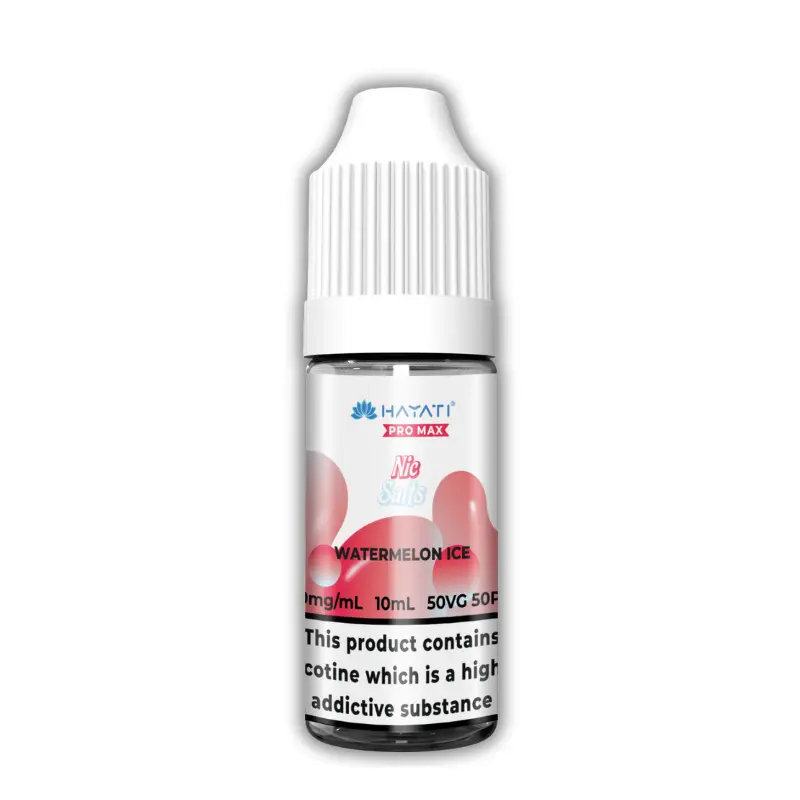
Hayati · Pro Max
Watermelon Ice Hayati Pro Max Nic Salt
£2.49
✔ In stock — ready to ship
Genuine Hayati
Free over £20
Same-day dispatch
Secure checkout
Watermelon Ice Hayati Pro Max Nic Salt is a 10ml bottle of 10mg nicotine salt in a 50:50 base, priced at £2.49, and it sits on a shelf of sixty-five bottles that are the same liquid specification as each other in every published respect. Same strength. Same ratio. Same volume. Almost the same price. What is not the same, and what this page is about, is the instruction sheet attached to each one. Hayati wrote a fresh "What to know" block for every listing in the catalogue, all four hundred and ninety-two of them, and on this shelf that produced sixty-five separately composed sets of guidance for one formulation. Some tell you to let a new wick soak. Some tell you to store the bottle upright. Some tell you the liquid will fit in a pocket. Some tell you to start low on the power and work up. Most tell you none of those things.
This bottle is worth using as the anchor for that comparison because its block does something no other block on the shelf does, and, as far as I can establish, something no other listing in the entire catalogue does. Every one of the sixty-five tells you what hardware to put the liquid in. This one also tells you something about how the nicotine feels. Hayati write that a nicotine salt will tend to feel smoother on the throat, set against freebase at a matched strength, and that this is the reason salts are paired with small pod hardware. That is a statement about the buyer's sensation rather than about the coil's requirements, and it is the only one of its kind here.
So the question this page answers is not what watermelon tastes like, which three earlier pages have already settled at length. It is narrower and more useful at the point of purchase: the guidance you receive with a Hayati bottle is largely a function of which flavour you happened to click on, not of what is in the bottle. Below is the complete set, every item attributed to the listing it came from, with a plain statement at the end of which parts genuinely depend on the flavour and which are interchangeable. Four of the claims I was given to work from did not survive the counting, and I have said so at each point rather than at the end.
The sentence on this bottle that appears nowhere else
Start with what is genuinely identical, because the shelf is usually described as uniform and that description is very nearly right.
What all sixty-five agree on, and the two places "identical" breaks
All sixty-five listings state 10mg. All sixty-five state a half-and-half base, sixty of them writing it as 50/50 and five writing it as 50VG/50PG, which is the same thing typed differently. Sixty of the sixty-five state the bottle size inside the "What to know" block itself; four more state it in the opening paragraph instead, this bottle among them; one, Lemon Lime, omits both the size and the strength from the block and leaves them to the body copy. Every single one of the sixty-five names the same hardware category. Not one of them contradicts another on any published specification. The Hayati Pro Max Nic Salts shelf really is one recipe skin sold sixty-five ways, and the Fresh Mint page has already established the strength half of that, having found that 10mg is the only figure offered anywhere on the bottled line.
Two things I was told were uniform are not, and both matter slightly.
The price is not sixty-five times £2.49. Sixty-four listings carry that figure and one, the range-level Hayati Pro Max Nic Salts E-Liquid listing, carries £2.79. Whether that is a real thirty-pence difference or a filing artefact I cannot tell you, because nothing in the data explains it. Several pages on this site state that every bottle on the shelf costs the same. On today's catalogue that is true of sixty-four of them.
The sixty-five are also not sixty-five named flavours. Two of them are range-level listings whose titles name no fruit at all, and in both cases the flavour is disclosed only in the first line of the description: the £2.79 listing is Banana Ice, and the Shisha listing is Apple Mint Grape. A buyer scanning titles sees sixty-three flavours and two product ranges. That is a small thing, but it is the kind of small thing that makes a count come out wrong, and the corpus has a standing instruction to count before repeating a figure.
Sixty-five instruction sets for one liquid
Now the part that is not uniform at all. Laid end to end, the sixty-five "What to know" blocks run to two thousand one hundred and ninety-two words. The shortest is sixteen words, on Blackberry Raspberry. The longest is fifty-one, a tie between Blue Frozen and Strawberry Raspberry Ice. The mean is just under thirty-four. This bottle's block is forty-five words, in the upper quarter.
The first structural split is the format. Thirty-two blocks are bulleted lists and thirty-three are running prose, which is as close to an even division as sixty-five allows and looks unplanned rather than designed. Inside those two groups there is a further regularity that I did not expect and that held without exception. Every prose block is either two sentences or three, eighteen of the former and fifteen of the latter, and none is one sentence or four. Every bulleted block is three, four or five items, two of the former, sixteen of the middle and fourteen of the latter, and none is two or six. Whatever process produced these had a length it was aiming at and hit it every time, while the choice between bullets and prose was apparently free.
Four of the thirty-two bulleted blocks go further and drop into a specification-sheet layout, with a label and a colon in front of each value. Blackberry Raspberry Hayati Pro Max Nic Salts is one, with its four lines reading Nicotine, Blend, Bottle and Use with. Mad Blue Hayati Pro Max Nic Salt is another, reading Strength, Ratio and Size. Cherry Berry and Strawberry Kiwi complete the four. Sixty-one listings for the same liquid write the specification as sentences or plain bullets, and four write it as a form. There is no pattern to which four.
The sentence, and what makes it rare
All sixty-five blocks instruct you on hardware. That is the one instruction the shelf never omits: put this in a pod kit or a mouth-to-lung device. Thirty-three of the sixty-five add the negative form and rule out sub-ohm tanks explicitly. Thirty-two leave the exclusion unstated.
Beyond the bare instruction, some blocks give a reason and some do not. I read all sixty-five and counted twenty-five that offer one. Another reader could land on twenty-three or twenty-seven, because "use a higher-resistance coil" is an instruction on one reading and a justification on another, and I am not going to pretend that boundary is crisp. What is not arguable is the composition of the twenty-five, and the composition is the finding.
- Thirteen give viscosity as the reason. The liquid is thin, so it moves into a small wick without stalling. Red Apple Ice Hayati Pro Max Nic Salts says the ratio is thin enough for small pod coils to manage, Banana Ice Hayati Pro Max Nic Salts says it wicks readily, Mr Blue Hayati Pro Max Nic Salt adds that this keeps the flavour consistent from fill to fill.
- Three give coil resistance, framed as the condition for getting the flavour out rather than as a compatibility rule.
- Three give a mismatch between the liquid and the hardware. Fresh Menthol Mojito Hayati Pro Max Nic Salt puts it most bluntly of the sixty-five, calling the liquid too strong in nicotine and too thin in texture for a sub-ohm tank.
- Two give harshness at power. Blackberry Ice Hayati Pro Max Nic Salts says salts in a high-wattage setup can feel harsh.
- Three name a different liquid as the right one for the other device instead. Red Berry Ice Hayati Pro Max Nic Salt sends you to a 70:30 freebase for a sub-ohm tank.
- One is vague enough that I counted it out of fairness rather than conviction.
- One describes how the nicotine feels. That is this bottle.
So the claim I was handed, that this is the only listing of the sixty-five whose copy explains a property of the format instead of instructing about hardware fit, is too generous by a factor of twenty-five. Plenty of them explain. I have narrowed it, and the narrowed version is sharper than the original. This is the only one whose explanation is about the person rather than about the equipment. Every other reason on the shelf is a property of the coil, the wick, the wattage or the tank. Twenty-four listings tell you why the hardware wants this liquid. One tells you why you might want it.
Three causes of throat character, and which one this bottle names
That distinction can be pinned down harder, because the vocabulary is countable. The word "throat" appears in six of the four hundred and ninety-two product descriptions on this site. Six, out of every listing Hayati publish here. I expected more and I was wrong.
Of those six, four are 120ml 70:30 bottles, and all four attribute the sensation to the carrier ratio: more vegetable glycerine, softer feel. Banana Ice Hayati Pro Max 70/30 E-Liquid is in that group, and the 70:30 Watermelon Ice bottle is another, which makes this flavour one of the very few to appear on both sides of the split. The fifth is Menthol Hayati Pro Max Nic Salt, and there the throat is mentioned as somewhere the coolant reaches rather than as a property of the liquid's construction.
The sixth is this bottle, and it is the only one of the six that attributes throat character to the nicotine preparation. Three different causes are named across four hundred and ninety-two listings: the carrier ratio on four bottles, the coolant on one, and the nicotine on one. That is a cleaner version of the rarity claim than the one I started with, and it survived counting where the broader version did not.
There is a second, tighter way to see the same thing. The word "freebase" appears in exactly four descriptions out of four hundred and ninety-two, and all four are nic salt bottles: Red Apple Ice, Red Berry Ice, the £2.79 range listing, and this one. In three of the four, freebase is the label for what belongs in the other device, a liquid you should buy instead if you are running a sub-ohm tank. In this one alone it is a comparison term, set against salts at the same strength, measuring the same thing on both sides. Three listings use the word to sort products into bins. One uses it to compare a sensation.
Two caveats, both important. First, whether salts actually do feel smoother than freebase at a matched strength is not a question this page is answering, and the claim is Hayati's rather than mine. The Spearmint bottle's page has already worked through why the preparation suits low-power hardware and what 10mg in a 50:50 base feels like, and that argument belongs there. My subject is the distribution of the sentence, not its truth. Second, a sentence appearing once in four hundred and ninety-two is evidence about a copywriting process, not about a recipe. Nobody reformulated this bottle. A writer working through a list reached for a different explanation on listing number eighteen, and that is the whole of it.
The complete set, attributed
Here is every category of guidance the shelf carries, with the count, the listings, and a judgement on whether the item has anything to do with the liquid it is attached to. I am treating all of it as evidence about the copy. None of it is advice from me, and where an item genuinely is worth acting on I have said which page on this site owns the reasoning.
The specification floor, on all sixty-five
Strength, ratio, volume and hardware category. Sixty of the sixty-five carry all four inside the block. The remaining five push one figure into the opening paragraph. This is the only material that appears on every listing, and the only material that is genuinely a property of the product rather than a choice by the writer. Kiwi Grape Raspberry Hayati Pro Max Nic Salt is close to the minimal case: four bullets, three of them numbers, one of them the hardware line, and nothing else at all. Read that block and you know everything the shelf is contractually obliged to tell you.
Two listings decorate the volume figure by explaining it. Banana Ice calls 10ml the standard UK size for a nicotine-containing liquid, and Blackcurrant Lemonade says the same thing in prose. Sixty-three do not. The bottle is the same bottle in all sixty-five cases.
Priming, on seven
Seven blocks tell you to let a new wick take up liquid before the first draw. Six use the words soak or saturate; the seventh, Fizzy Cherry, says to give the pod a moment for the liquid to settle into the cotton after refilling, which is the same instruction in different clothes. The seven are Double Apple, Tobacco, Rainbow, Fizzy Cherry, Blueberry Raspberry, Cherry Ice Hayati Pro Max Nic Salt and Strawberry Raspberry Ice Hayati Pro Max Nic Salt. Only the last of the seven says what happens if you skip it, naming a dry hit.
Across the whole catalogue the strict wording appears on nine listings, so this shelf holds most of the site's priming advice. Within the shelf, the seven have nothing in common. Two are apple or tobacco, two are cherry, one is a multi-fruit, two are berries. There is no cooled or uncooled pattern, no sweet or dry pattern, no bulleted or prose pattern. A fresh coil in a 50:50 liquid behaves the same way regardless of which fruit is dissolved in it, and the seven bottles that mention it are not the seven where it matters more. They are just seven bottles.
Storage, on five
Five blocks say something about where to keep the bottle. White Peach Raspberry says upright, capped, out of direct sunlight. Summer Dream says capped and away from heat and sunlight. Lemon Peach Passionfruit says upright with the cap tight. Blueberry Raspberry Lemon says upright with the cap on. Ice Pop Hayati Pro Max Nic Salt says away from heat and direct sunlight, and is the only one of the five to give a reason, which is to keep the flavour at its best.
Across the catalogue, ten listings carry a storage line. Sixty of the sixty-five bottles on this shelf do not, and they are the same bottle with the same cap and the same contents. If light and heat degrade a 10ml bottle of Summer Dream, they degrade a 10ml bottle of Watermelon Ice on the same schedule. The distribution carries no information about the liquid. It carries information about which listing a writer was on when they decided the block looked short.
The pocket, on three
Three blocks mention carrying the bottle. Mango Peach Pineapple says the 10ml size makes it easy to keep a spare in a pocket or bag. Blueberry Raspberry says it fits in a pocket so you can top up while out. Blue Sour Raspberry says it fits easily in a pocket. Five listings in the whole catalogue say anything of the kind.
This is the purest case of the pattern, because the property being described is the bottle's dimensions, and the bottle's dimensions are set by regulation rather than by flavour. Sixty-five bottles of exactly the same size, three of which are described as pocketable. There is no reading on which Mango Peach Pineapple is more portable than Cola Lime.
Power, on four, and the one place the liquid does get named
Four blocks tell you to start at the low end of your device's range and work up. Blue Frozen Hayati Pro Max Nic Salts, Menthol, Lemon Lime and Blue Razz Lemonade. Those four are the only listings in all four hundred and ninety-two that carry an active wattage instruction, which makes this the most concentrated category on the shelf and the only one that exists nowhere else on the site.
This is where the claim I was working from fails, and it fails in an interesting direction. I was told the power notes, like the priming and storage notes, were distributed without reference to the liquid. Three of the four reference it directly. Menthol says to adjust until the chill suits you. Blue Frozen says to adjust until the balance of fruit and chill suits you. Lemon Lime says that running a salt too hot mutes the fruit and hardens the draw, which is both a reason and a flavour-specific consequence. Only Blue Razz Lemonade gives the bare version, adjust to taste.
So the correct statement is narrower than the one I was handed and more flattering to the copy. Priming, storage and pocketability are distributed at random across the shelf, fifteen listings between them and not one of the fifteen anchored to what is in the bottle. Power is not. Three of the four power notes are attached to strongly cooled liquids and talk about the cooling, which is exactly where a wattage instruction earns its keep, because a coolant is one of the few components whose perceived intensity moves with temperature in a way a buyer will notice within a session. That is a real editorial decision, and it is the only one on this shelf I can find evidence for.
It has an obvious consequence for this bottle. Watermelon Ice is a cooled liquid. It carries no wattage note. Blue Frozen and Menthol do. If the instruction is right for those two it is right for this one, and the reason it is missing is that a writer wrote a different second sentence here.
The sweetener warning, on six, and the eight it misses
Six blocks warn that a sweet liquid shortens coil life. Bubblegum Ice Hayati Pro Max Nic Salt says sweet liquids wear coils faster and to keep a spare. Blue Razz Gummy Bear Hayati Pro Max Nic Salt says the residue builds over time and to change the coil when the flavour fades rather than pushing on. H’Bubba Hayati Pro Max Nic Salt calls candy flavours sweetener-heavy by nature and says to expect more frequent replacement than with a mint or a citrus, which is the only one of the six to give a comparison. Strawberry Watermelon Bubblegum Hayati Pro Max Nic Salt says sweeter liquids can shorten coil life. Strawberry Jelly Beans says heavily sweetened liquids gunk up coils faster than plainer ones. Strawberry GB says sugary profiles darken coils sooner and to swap them when the taste dulls.
Across all four hundred and ninety-two listings the warning appears eight times, the other two being the 70:30 and 50:50 Blue Razz Gummy Bear bottles. Every single one of the eight is a confectionery flavour. Not one lands on a plain fruit, a mint or a tobacco. As a precision test that is a perfect score, and the claim I was given, that the warning is correctly targeted, is true as far as it goes.
It does not go very far, because precision is only half of targeting. Count the confectionery bottles on this shelf rather than the warnings and you get at least thirteen. Six carry the warning. Eight do not, and the eight include Cola Ice Hayati Pro Max Nic Salt, Cola Lime, Cherry Cola, Rocky Candy Orange, Rainbow, Ice Pop, Grape GB, and Gummy Bear.
Read that last name again. Gummy Bear Hayati Pro Max Nic Salt, whose own description calls it a confectionery-led option and a sugary mix of fruit notes, carries no coil warning. Blue Razz Gummy Bear, four bottles away on the same shelf, carries one. The pairing repeats: Strawberry GB, whose copy explains that GB stands for gummy bear, is warned; Grape GB is not. Two matched pairs, four bottles, one recipe class, opposite guidance.
That is the strongest version of the finding and it took the correction to reach it. The warning has no false positives and eight false negatives. A buyer who picks Blue Razz Gummy Bear is told to keep a spare pod. A buyer who picks Gummy Bear is told nothing, and the property is identical.
What actually depends on the flavour
Eleven of the sixty-five blocks say something that could only be said about that bottle. The six sweetener warnings, the three liquid-anchored power notes, Blackcurrant Juice stating flatly that there is no cooling in the recipe, and Blue Sour Raspberry saying that a muted sour note means the coil needs changing, which is the only coil-exhaustion signal on the shelf tied to a specific tasting note. Fifty-four blocks say nothing that a different flavour could not have said.
Two of the eleven are worth more than the other nine, and they are the two that name a signal. Blue Sour Raspberry tells you what to listen for. H’Bubba tells you what to compare against. Everything else on the shelf, including this bottle's own second sentence, is context rather than instruction.
The practical upshot for anyone buying a bottle here is short. Read the "What to know" block for the numbers, which are reliable and complete. Do not read the presence or absence of a handling note as information about the liquid, because on fifty-four of the sixty-five it is not. And if you want to know what a specific flavour does to a coil, the flavour family tells you far more than the listing does: Hayati’s bottled liquids are not labelled for it, so sweetness has to be read off the description rather than off the guidance.
The melon, with three pages already on it
Watermelon Ice is sold nine times across this site and four of those listings now have a page. That is enough that the tasting work is finished, and going looking for a fifth description of a cold melon would produce either a repetition or an invention. So this section is short by design, it cites rather than re-derives, and it adds exactly one observation that the earlier pages did not make because they were not looking at this bottle's copy.
What the earlier pages settled
The Rubik kit page lined up all nine Watermelon Ice descriptions and read them as a set. Its findings are that every one of the nine places the cooling after the fruit rather than across it, that not one of the nine reaches for an intensity word, and that seven of the nine use verbs describing the coolant acting on the melon rather than arriving beside it. It also owns the argument that a coolant layered onto a fruit which already reads as cold is a redundancy, and the self-test built on that. None of that is repeated here.
The Pro Ultra Plus pods page owns the description of the melon as a fruit that already carried a cold impression before anything was added to it, the account of two kinds of cold stacked on each other, and the drift finding: that a tiring coil loses the light aromatic material first while the coolant keeps firing at full volume, so the balance moves one way across a pod's life. The Pro Ultra Plus kit page owns the arithmetic of what a flavour can and cannot change about an £11.99 purchase. All three are better places to go for the taste than this one.
The one claim this bottle's flavour copy makes alone
Here is the piece that was left. Five of the nine Watermelon Ice descriptions reach for a slice as the reference object. The Pro Ultra Plus kit says a chilled slice on a hot day. The Pro Max Plus kit says a cold slice out of the fridge. The 50:50 shortfill says a ripe slice. The Rubik kit talks about pink-fleshed juiciness without locating it. This bottle is the only one of the nine that names a part of the slice, putting the sweetness in the pink flesh and placing it near the centre.
That is not a flourish, because a watermelon is not uniformly sweet and everybody who has eaten one knows it. Sugar concentrates towards the middle and falls away towards the rind, and the band nearest the white is watery and faintly vegetal. A description that says centre is describing the sweeter, rounder, less green end of the fruit. A description that said rind, if one existed, would be describing something noticeably drier with a cucumber edge to it. Nothing else in the nine makes that choice explicit, and it is the only piece of information in this bottle's flavour paragraph that is not present somewhere else in the set.
It fits what the rest of the copy says. The block calls the liquid light rather than dense, refreshing rather than rich, and says it does not become heavy over a long session. Those are all consistent with the centre-of-the-slice reading: sweet but watery, with the sweetness thin rather than syrupy. If you have tried the Watermelon Ice Hayati Pro Max 50/50 Shortfill E-Liquid, that bottle is the same flavour idea in the same base ratio at 120ml, and its listing is the only one of the nine that cross-references another format inside its own flavour paragraph, pointing readers at this 10ml version by name. The cross-reference runs one way. Nothing in this bottle's copy points back.
What the copy does not claim, and what I therefore will not: it does not say how much coolant is in it, it does not rate the sweetness against anything, and it does not say what the melon is doing by the end of a pod. The Rubik page's finding that no listing in the set uses an intensity word means the dose is undescribed across all nine, not just here. If cooling intensity is the axis you care about, the shelf gives you a name and nothing more, and the cooling-vocabulary census on the Blue Frozen pods page has already established that Hayati's cooling words are not graded against each other.
The bottle, and what the base is doing under a light fruit
A 10ml bottle of 10mg salt at half and half. That specification is shared by all sixty-five bottles on the shelf, so there is a limit to how much of it is worth explaining again. Two things about it are worth attaching to this particular liquid rather than to the shelf in general.
The first is the carrier ratio and what it does to a thin fruit. Propylene glycol is the lighter of the two carriers and it carries flavour more efficiently than vegetable glycerine, which is why a half-and-half base tastes more defined at low power than a high-glycerine mix of the same profile. On a heavy dessert that efficiency is barely the point, because there is plenty of material to carry. On a watermelon it is the whole point, because the fruit is built from light, volatile aromatic compounds and very little body. A melon in a thick base tends to read as generic sweetness with a faint green edge. The same melon in a thin base keeps more of its specific character. This is the argument for buying the fruit in this format rather than as the 70:30, and it is a flavour argument rather than a hardware one.
The second is refill frequency, which is a consequence of the bottle rather than the liquid. Ten millilitres into a small pod is a lot of fills, and a bottle that lasts weeks is a bottle that spends weeks partly empty with air above the liquid. That is true of every bottle on the shelf and it is the reason five of the sixty-five carry a storage line, although as established above the five are not the five where it matters more.
On hardware, the shelf's single universal instruction applies here as it does on all sixty-five: a refillable pod kit or a low-power mouth-to-lung device with a higher-resistance coil, not a sub-ohm tank. This listing is one of the thirty-two that does not state the sub-ohm exclusion explicitly, which is a gap in the copy rather than a difference in the liquid. Check the range name printed on your device against the range name in this title before ordering, since Hayati publish different pods for different hardware and a compatibility decision should not be taken from a retail page.
The figures, and the fields the listing leaves empty
The table below is everything the listing publishes, arranged by how much of it is a decision Hayati made about this flavour rather than about the shelf. The answer, as the whole of this page has been arguing, is almost none of it.
| Decided per flavour | The name, the description, and the second sentence of the "What to know" block. Nothing else. |
| Nicotine | 10mg salt. Identical on all sixty-five bottles; no other strength is offered on the bottled line. |
| Carrier base | Half vegetable glycerine, half propylene glycol. Identical across the shelf. |
| Volume | 10ml. Identical across the shelf. |
| Price here | £2.49. Shared with sixty-three others; one listing on the shelf is £2.79. |
| Stock code | HPM-NS-WATERMELON |
| Filed on | Five shelves: the nic salt range, the bottled liquids, the cooled listings, the melon listings and the new arrivals. |
| Cooling level | Not published. The title says Ice and the description says chilled; no listing in the range quantifies a coolant. |
| Sweetness level | Not published. The copy says it does not become heavy, which is a direction rather than a measurement. |
| Coil life | Not published on this listing. Six bottles on the shelf address it; this is not one of them. |
Three of those rows are empty on purpose and it is worth being clear about which. Cooling level is unpublished across the whole range, so no page on this site can give you a number and any page that offers one has invented it. Sweetness is unpublished here but is at least gestured at, since the copy says the liquid stays light over a long session and that is a claim about sweetness even if it is not a scale. Coil life is unpublished on this listing and published on six others for the same reason a storage note appears on five: somebody wrote it there and not here.
The £2.49 row is the one that does most work at the point of purchase. At that price the bottle is the cheapest way to try this flavour by a considerable margin, and it is the only format in which trying it costs less than a sandwich. If you dislike it you have lost £2.49 and the rest of the bottle. Every other format carrying this liquid asks for more up front, and two of them ask you to buy hardware at the same time.
Where it sits, sorted by what the neighbour's copy actually tells you
Comparison sections on this site normally sort by taste. This one sorts by evidence, because that is what the page has been about, and because on a shelf of sixty-five bottles at one price the taste comparisons have mostly been made already. The question here is which neighbour you can find out most about before spending anything.
The other melons, which are the closest substitutes
Three bottles on the nic salt shelf carry melon in the name and this is one of them. Strawberry Watermelon Hayati Pro Max Nic Salt puts a red berry in front of the melon and leaves the cooling out, so the fruit has to stand on its own sweetness rather than being sharpened by a chill. Strawberry Watermelon Bubblegum adds a confectionery layer on top of both and is one of the six bottles carrying a coil warning, which tells you something real about how sweet it is. That warning is worth reading as a sweetness signal even though it was written as a handling note, and it is the clearest example on the shelf of guidance doing a job its author did not intend.
Between the three, this bottle is the only one where the melon is the headline rather than a partner, and the only one that is cooled. If the melon is the thing you want, this is the one that gives it the most room. The wider Watermelon Vapes shelf runs to twenty-nine listings across every format Hayati make, so if the profile suits you there is plenty of it.
The cooled fruits, where the choice is the fruit and not the cold
Fourteen of the sixty-five nic salt bottles are filed on the Ice Vapes shelf, which runs to ninety-eight listings across all formats. Within the nic salts, the cooled fruits are close enough in construction that the fruit is the whole decision. Cherry Ice puts a darker, rounder stone fruit under the chill. Red Berry Ice spreads across several berries rather than committing to one. Blackberry Ice is the deepest of the cooled berries. Red Apple Ice is the driest and the most orchard-like. Bru Ice Hayati Pro Max Nic Salt is not a fruit at all and reads as a soft-drink profile with a chill on it.
Watermelon is the lightest of that group by some distance, and that is the axis worth deciding on. A cherry or a blackberry gives you something to chew on; a melon does not, and if you find light fruits thin you will find this thin. The counterpart is that it is the least tiring of them over a long day, which is what its own copy claims and what four of the nine Watermelon Ice descriptions independently say in different words.
If you want the cold without the fruit
Menthol is the shelf's uncompromised cooling bottle and its listing is unusually honest about it, saying there is one job here. It is also, as established above, one of only two nic salts in four hundred and ninety-two to mention the throat, and one of only four listings anywhere on the site to carry a wattage instruction. Between those two facts it is probably the best-documented bottle on the shelf, which is a strange thing to be able to say about a product whose flavour is a single note. Black Mint Hayati Pro Max Nic Salt softens that with a dark fruit underneath. Fresh Menthol Mojito adds citrus and herb and has the shelf's bluntest hardware sentence.
If the sweetness is the thing you want more of
The confectionery corner is where the shelf's guidance is least consistent and most worth knowing about before you buy. Bubblegum Ice, Blue Razz Gummy Bear, H’Bubba and Strawberry Watermelon Bubblegum all carry the coil warning. Cola Ice, Cola Lime, Cherry Cola, Rainbow, Ice Pop, Rocky Candy Orange, Grape GB and Gummy Bear do not, and there is no reason to think they behave differently. If you are coming from a light fruit like this one and moving to any of them, expect the coil to need attention sooner, whether or not that particular listing says so. The Strawberry GB page has already worked through what a sugary bottle does to a pod, what the failure actually tastes like, and why the first casualty is the fruit opening rather than the sweetness. That reasoning is not repeated here and it applies to all thirteen.
If you want this liquid in another format
The 50:50 shortfill is the same flavour idea at 120ml and 0mg, and its listing says so directly. The Pineapple Ice shortfill sits beside it if you want a different cooled fruit in the same large format. The 70:30 version of Watermelon Ice is a different proposition entirely, built for thicker vapour in a sub-ohm tank, and it is one of the four listings in the catalogue that attributes throat feel to the carrier ratio rather than to the nicotine. Reading it alongside this bottle is the cheapest way to see the point this whole page rests on: the same fruit, the same brand, two listings, two completely different accounts of where throat character comes from, neither of which is wrong and neither of which mentions the other.
Beyond the bottles, the melon appears on pods and kits across several ranges, and the full Hayati catalogue carries four hundred and ninety-two listings in total. The three Watermelon Ice pages already on this site cover those formats properly.
What the shelf tells you to do, and where it stops
Everything in this section is quoted or attributed rather than recommended. The point is not to hand you a handling routine, which the shelf has already done sixty-five different ways, but to show what you would end up believing if you took each listing at its word.
On priming. Seven of the sixty-five tell you to let a new wick take up liquid first. Only Strawberry Raspberry Ice tells you what you are avoiding, naming a dry hit. Rainbow gives a duration, a few minutes. Double Apple and Tobacco give the same duration. Fizzy Cherry frames it as something to do after any refill rather than only with a new coil, which is the broadest version on the shelf and the only one that would apply to your fifth fill as well as your first. If you read only this listing, you would not know any of that, because this listing says nothing about it. If you read only Fizzy Cherry's, you would think it applied to every refill of every bottle. Both readings come from the same liquid.
On storage. Five listings specify it and they do not agree on what matters. Two say upright and capped. One says capped and away from heat. One says upright, capped and out of sunlight. Only Ice Pop says why, and its reason is flavour preservation rather than anything else. A buyer assembling advice from the shelf would conclude that Summer Dream needs storing carefully and Watermelon Ice does not, which is not a conclusion the shelf intends and not one the liquid supports.
On power. Four listings say to start low. Three of the four attach it to a coolant, and this bottle has a coolant. Lemon Lime gives the fullest version, saying a salt run too hot mutes the fruit and hardens the draw. That is the one item in this whole census I would say transfers cleanly to this bottle on the evidence of the copy itself, because the property it depends on, a cooled fruit whose balance shifts with heat, is present here and is the reason the instruction was written on Blue Frozen and Menthol.
On coil life. Six listings warn about sweeteners and none of the six is this one, which is consistent, because a light melon is not a confectionery liquid. Blue Sour Raspberry gives the only flavour-specific exhaustion signal on the shelf, saying that a muted sour note means the coil is the problem. This bottle has no sour note to lose, so that particular tell does not transfer, and nothing on the shelf offers a replacement for it. The Spearmint page has already covered what a low-sweetness liquid does to a coil compared with a sugared one, and the melon sits nearer the mint end of that scale than the confectionery end.
On what none of the sixty-five say. Not one of them tells you how much liquid to put in a pod, how long a bottle keeps once opened, what the coolant is, or what to do with the bottle when it is empty. Keep it out of reach of children and pets, as with anything containing nicotine, and take packaging to a household recycling collection rather than putting a nicotine container in general waste. Those two lines are mine rather than the shelf's, and the shelf's silence on both is total across all sixty-five listings.
Questions this listing raises
Is the liquid in this bottle different from the other sixty-four on the shelf?
In flavour, yes. In everything else the listings publish, no. All sixty-five state 10mg, all sixty-five state a half-and-half base, and all but one carry the same price. The differences between the listings are differences in how they were written, which is what most of this page has been about.
Why does this listing mention the throat when almost none of the others do?
The honest answer is that a writer chose to. The word appears in six of the four hundred and ninety-two descriptions on this site, and this is the only one that attaches it to the nicotine preparation rather than to the carrier ratio or to a coolant. Nothing about this liquid makes the point more relevant here than on Cherry Ice or Bru Ice.
Should I prime a new pod with this, given the listing does not say so?
Seven listings on this shelf say to let a new wick take up liquid before the first draw and fifty-eight do not, and the seven are not distinguished by anything in the liquid. The instruction is about a dry coil rather than about a particular flavour, so its absence here is a fact about the copy and not a statement that the step is unnecessary.
How much cooling is in it?
Unpublished, and unpublished across the whole range. The title says Ice and the description says chilled, and the Rubik kit page found that not one of the nine Watermelon Ice listings uses an intensity word anywhere. Any specific figure you see for a Hayati coolant, on this site or another, has been invented.
Is this sweet enough to shorten coil life?
The listing does not address it, and six bottles on the shelf do. All six of those are confectionery flavours and this is a light fruit, so the absence is consistent here even though it is arbitrary elsewhere. Eight confectionery bottles on the same shelf carry no warning either, so absence alone is not evidence.
What is the difference between this and the 120ml shortfill of the same flavour?
Volume and nicotine. The shortfill is 120ml at 0mg in the same half-and-half base, so it is the same flavour idea in a format that expects you to add nicotine yourself. Its listing is the only one of the nine Watermelon Ice descriptions that points at another format by name, and the format it points at is this one.
Why do two listings on this shelf have no flavour in their titles?
Two of the sixty-five are range-level listings rather than named bottles. Their flavours are stated only in the first line of the description, and they turn out to be Banana Ice and Apple Mint Grape. If you are counting flavours on this shelf rather than listings, the figure is sixty-three.
Is £2.49 the price of every bottle here?
Of sixty-four of them. One listing, the range-level Hayati Pro Max Nic Salts E-Liquid, shows £2.79. Nothing in the data explains the difference, and several pages on this site describe the shelf as uniformly priced, which is very nearly but not quite right.
Does the wattage advice on Menthol and Blue Frozen apply to this bottle?
On the evidence of the copy, it transfers better than anything else in the census. Three of the four wattage notes in the entire catalogue are attached to strongly cooled liquids and talk about the cooling, and this is a cooled liquid. That is a reading of why the instruction was written where it was, not a claim that Hayati intended it here.
Which bottle on this shelf is the best documented?
Menthol, by some distance, which is an odd result for a single-note flavour. It carries one of the four wattage instructions in the catalogue and one of the two nic salt mentions of the throat, and its description is unusually direct about what the liquid is for. The most thinly documented is Blackberry Raspberry, whose block runs to sixteen words.
Is the shelf's guidance worth reading at all, then?
The numbers are, and they are complete and consistent on all sixty-five. The handling notes are worth reading as a set rather than one at a time, because any individual bottle shows you a random four or five items out of a much longer list. Reading the absence of a note as information about the liquid is the mistake the distribution invites.
What can I not find out from this listing?
How cold it is, how sweet it is, how long a coil lasts on it, how it behaves at the end of a pod, and what the coolant is. Four of those five are unpublished across the entire range rather than only here, so no amount of clicking through neighbouring bottles will settle them.
Where this leaves it
As a purchase, this is £2.49 for 10ml of a light, cooled melon at 10mg in a half-and-half base, aimed at a refillable pod or another low-power mouth-to-lung device. The flavour has been described properly on three other pages on this site and there was no honest way to describe it a fourth time, so this page went somewhere else.
What it found is that the sixty-five bottles on this shelf are one liquid specification carrying sixty-five separately written instruction sheets, and that the sheet you get is a function of the flavour you picked rather than of anything in the bottle. Seven bottles tell you to prime. Five tell you where to store it. Three tell you it fits in a pocket. Four tell you to start low on the power, and three of those four are the only items on the shelf where the instruction and the liquid genuinely line up. Six warn about sweeteners, all six correctly, while eight equally sugary bottles beside them say nothing, including the one actually called Gummy Bear. And one bottle, this one, explains how the nicotine feels rather than what the coil needs, which makes it the only listing in four hundred and ninety-two to attribute throat character to the nicotine itself.
None of that changes what is in the bottle. It changes what you should do with the guidance, which is to read it across the shelf rather than one listing at a time, and to treat a missing note as a gap in the copy rather than as a property of the liquid.
Strictly for adults aged 18 and over. Nicotine is an addictive substance.
You might also like


