
Home / Hayati Pro Max Nic Salts / Double Apple Hayati Pro Max Nic Salts
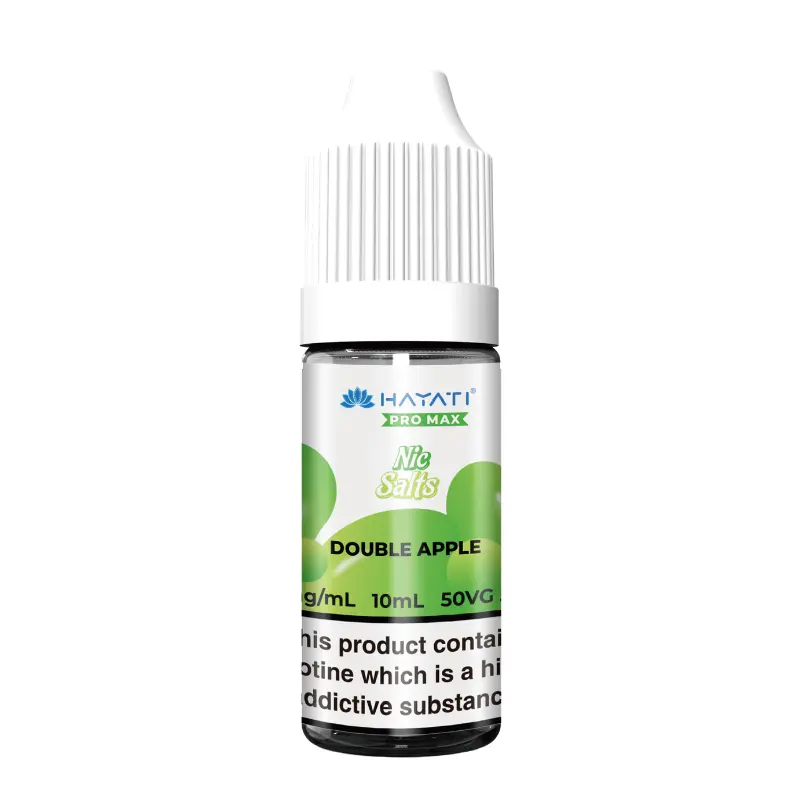
Hayati · Pro Max
Double Apple Hayati Pro Max Nic Salts
£2.49
✔ In stock — ready to ship
Genuine Hayati
Free over £20
Same-day dispatch
Secure checkout
Double Apple Hayati Pro Max Nic Salts is a 10ml bottle at £2.49, blended 50/50 VG/PG, and offered in a single nicotine strength of 10mg/ml salt. Those are the plain numbers, and they place it squarely in the middle of the Hayati Pro Max Nic Salts range, where roughly sixty-five bottles all carry the same price and the same format. What sets this one apart is the name on the label, and the name is carrying more history than most buyers expect.
Double apple is not a description of quantity. It does not mean twice the apple, or apple concentrate turned up. It is the English rendering of a flavour that arrived in the West through shisha culture, where the apple blends served in cafés across Egypt, Lebanon and the Gulf became a recognisable category in their own right. In that tradition the phrase points at a specific construction: a soft, ripe, red-fleshed apple sitting under a sharper green one, with a third element woven through the middle that is neither of them. That third element is aniseed. It is the reason double apple tastes like double apple and not like apple juice, and it is the reason a vaper who orders this expecting a straightforward apple liquid can be genuinely thrown by the first draw.
Which brings us to the single most useful thing this page can tell you, and it is a piece of honesty rather than a selling point. Hayati do not mention aniseed anywhere in their description of this bottle. Their own text talks about two apple characters and nothing else. So the question every buyer of a double apple liquid wants answered, namely whether the anise is present and how loud it is, is a question the manufacturer has not answered. This page will not answer it for them by guessing. What follows sets out exactly what is specified, exactly what is not, and how to read the gap between the two before you spend £2.49 finding out.
Everything else about the bottle is unambiguous. It is a 10ml unit, thin enough for low-power mouth-to-lung hardware, listed at a nicotine salt strength of 10mg/ml, and it appears on the Apple Vapes shelf next to a much smaller group of bottles than you might imagine, given how common apple is as a flavour idea.
The name, the tradition, and what Hayati actually commit to
Where double apple comes from
The shisha blend the name derives from is usually credited to Egyptian producers in the twentieth century, and it spread because it was distinctive rather than because it was subtle. Two apple characters were laid over each other, one full and jammy and one green and astringent, and then anethole, the aromatic compound that defines aniseed, fennel and star anise, was run through the middle of both. Anethole has a useful property for a blender: it registers as sweet on the tongue by itself, considerably sweeter per unit than table sugar, while also delivering a cool, faintly liquorice-like aroma that lingers long after the fruit has faded. It gives a fruit blend a tail.
That tail is why double apple became a category rather than a variation. An apple flavour on its own tends to be a short flavour. The compounds responsible for ripe apple, principally esters such as ethyl 2-methylbutyrate and hexyl acetate, are light and volatile. They arrive quickly, they are pleasant, and they are gone. The green side comes from a different chemical family, the six-carbon aldehydes, which is why an unripe apple reads as grassy and stalky rather than as a lesser version of a ripe one. Put those two together and you have a fuller apple, but still a brief one. Add anethole and the whole thing acquires a long finish it could not otherwise have. That is the architecture the name points to.
Vape liquids carrying the name have never agreed on how much of that architecture to keep. Some are close to the café original, with the anise sitting right at the front and the fruit acting almost as a dressing. Others use the phrase purely to signal two apples and leave the anise out entirely, which produces a perfectly nice apple liquid that has nothing in common with the thing the name refers to. Both exist on UK shelves. Both are sold under the same two words. That is the practical reason this matters: the name alone does not tell you which one you are buying.
What Hayati specify, and what they leave open
Here is the whole of what the manufacturer commits to for this bottle. Two apple characters are layered, one described as ripe and sweet with a fuller body, the other as crisper and slightly sharp. Neither dominates. The result is described as rounded rather than flat, sweet but positioned below the level of a sweet-shop flavour, and finishing on a fresh apple note. The blend is 50/50 VG/PG, the strength is 10mg/ml nicotine salt, the bottle is 10ml, and it is meant for pod hardware rather than sub-ohm gear.
Aniseed does not appear in that description. Neither does liquorice, fennel, anise or any synonym. Neither, for that matter, does menthol, koolada or ice of any kind.
There are two honest readings of that silence and it is worth holding both. The first is that the anise is simply not in the blend, and Hayati have named it Double Apple because that is the established consumer name for a two-apple flavour, with the shisha association coming along for free. The second is that the anise is present at a low level and Hayati's copywriting has described the fruit and skipped the rest, which manufacturers do routinely because fruit sells and aniseed divides opinion. Nothing published by Hayati settles it.
What that means in practice is straightforward. If you are buying specifically for the anise, and for many people who order double apple that is the entire point, treat this bottle as unconfirmed rather than as a yes. If you actively dislike aniseed and have avoided the flavour for that reason, you cannot treat it as a no either, because the description accounts for the apples and says nothing about what sits behind them. At £2.49 the cost of resolving the question yourself is low, but you should go in knowing it is an open question rather than discovering it on the second draw.
The ripe side
Taking the description at face value, the fuller of the two apples is the one that carries the body of the liquid. This is the red-fleshed register: soft, juicy, with the slightly perfumed quality that ripe apple gets when it has been sitting in a warm kitchen. In a 50/50 base at low power, that kind of note tends to present early in the draw and to occupy the middle of the tongue rather than the edges. It is the part of the flavour that reads as sweet, and it is the part that makes the liquid feel like a drink rather than a sweet.
Body is the word Hayati use, and it is the right one. A single crisp apple flavour can come across as thin and slightly hollow, all top note and no middle. The ripe component is what fills that space. It is also, in most apple blends, the component that fades first as a coil ages, because those esters are the most fragile part of the mix. More on that further down, because it changes how the bottle behaves over the life of a pod.
The sharp side
The second apple is the one doing the cutting. Hayati describe it as crisper, with a slight sharpness that keeps the profile lively, and that is the classic function of a green apple note in a blend: it supplies acidity and a stalky, just-snapped freshness that stops the sweet side turning syrupy. It tends to arrive fractionally later than the ripe note and to sit on the sides of the tongue where sourness registers most strongly.
The balance between the two is the thing Hayati are most explicit about. Neither side takes over. That is a meaningful claim on a shelf where most fruit blends have a clear lead flavour and a clear supporting one, and it sets expectations correctly: this should read as one apple flavour with depth, not as two flavours taking turns. A liquid built that way is generally easier to vape for a full day than one with a dominant sharp note, because there is nothing for your palate to fatigue against. A sibling such as Blue Razz Cherry takes the opposite approach, with a loud lead and a clear second act, and the difference in how long you can stay on one or the other is noticeable.
Front to back, in order
Working through a single draw on a fresh wick, the sequence the description implies runs roughly like this. The opening is fruit, immediate and sweet, with the ripe apple arriving first because it is the lighter and faster of the two. Through the middle of the inhale the sharper green character builds underneath it, adding acidity and a drier texture. By the point of the exhale the two have merged and you are tasting a single apple rather than two, with the sharpness preventing the sweetness from coating.
The finish is where any anise would declare itself, if it is there at all. Anethole is a persistent compound. It does not fade with the fruit; it sits on the soft palate and stays measurable for ten or fifteen seconds after the vapour has gone, and it carries a faint cooling sensation that is not menthol and should not be mistaken for it. If you draw on this bottle and something sweet and slightly medicinal lingers after the apple has left, that is your answer. If the finish is purely fruit and drops away cleanly within a few seconds, that is your answer too. It is a test you can run in one draw.
Sweetness, placed on a scale
Hayati put the sweetness below confectionery level and above neutral, which in practice means it should land in the same territory as a bottled apple juice rather than a boiled sweet. That is a genuinely different position from a good part of this range. Gummy Bear Hayati Pro Max Nic Salt and Blue Razz Gummy Bear Hayati Pro Max Nic Salt are both built to taste like sweets and make no secret of it. H'Bubba Hayati Pro Max Nic Salt sits in the same sugared register. Against those, an apple pitched at juice level is a noticeably drier proposition, and if you have been finding the sweeter bottles heavy after an hour, that difference is the reason to look here.
It also has consequences for hardware, which is covered below. Sweetener load is the main thing that shortens coil life in a pod, and a liquid that sits lower on that scale generally treats a wick more gently. Hayati do not publish a sweetener figure, so this is inference from their own positioning rather than a specification, but it is reasonable inference.
Nothing on this bottle says ice
There is no coolant named anywhere in the specification and no ice in the product name, which for this range is a real signal rather than an oversight. Hayati label their cooled liquids clearly and consistently. Red Apple Ice Hayati Pro Max Nic Salts, Banana Ice Hayati Pro Max Nic Salts, Blackberry Ice Hayati Pro Max Nic Salts and Red Berry Ice Hayati Pro Max Nic Salt all announce the cooling in the name. This one does not, and the flavour text describes a fresh finish rather than a cold one.
Fresh and cold are not the same sensation and the distinction is worth holding onto. Freshness here comes from acidity and from the green apple character, both of which brighten a draw without triggering the cold receptors in your mouth. Cooling comes from menthol or a synthetic coolant and produces an actual chill. If you want the second thing from an apple, this is not the bottle, and the iced apple option in the range is the obvious place to go instead.
What it is not
It is not a sour liquid. Sharpness and sourness are different: the description points at acidity balancing sweetness, not at the puckering intensity a dedicated sour flavour aims for.
It is not a toffee apple, a baked apple or an apple pie. There is no bakery element specified, no caramel, no pastry and no spice. Everything named is fresh fruit.
It is not a cordial or a fizzy drink flavour. The blend is fruit rather than beverage, which separates it from Blackcurrant Juice Hayati Pro Max Nic Salts and from the lemonade bottles, where the drink format is part of the profile.
And it is not, on the evidence published, a shisha-styled liquid in the full sense, whatever the name implies. The bottle in this range that points at that register by name is Hayati Pro Max Shisha Nic Salts, and if the café association is what drew you to double apple in the first place, that is the more direct route to it.
A thin base, a volatile fruit, and why the ratio matters here
Most pages in this range explain 50/50 in terms of vapour production or throat feel. For an apple liquid the more useful angle is solubility and speed, because apple is one of the flavour families where the base ratio changes what actually reaches you.
Propylene glycol is the better solvent of the two for small, volatile aroma compounds, and it is also the thinner liquid. Vegetable glycerine is viscous and slightly sweet in its own right, and it holds onto aroma more tightly. Run a light ester-driven fruit through a high-VG base at sub-ohm power and a portion of the top note gets buried under the density of the vapour. Run the same flavour through an even split at low wattage and the top note arrives intact, early, and in the order the blender intended. That is why nearly every fruit designed for pod hardware, this one included, is mixed at or near 50/50, and it matters more for apple than it does for, say, a heavy dark berry, because apple has proportionally more of its character in the fragile top end.
The second consequence of the thin base is wicking speed. A 50/50 liquid moves through cotton quickly, which suits the narrow feed channels of a mouth-to-lung pod. Those channels are deliberately small, sized for a liquid of roughly this viscosity, and feeding them something thicker is how people end up with dry hits. It also means a fresh pod saturates fast. A few minutes standing after filling is usually enough, rather than the longer wait a thicker liquid demands.
The third, and the one people notice at the till, is how quickly you get through it. A thin liquid in a low-power device is consumed steadily rather than dramatically. Ten millilitres is five fills of a standard 2ml pod, so the arithmetic is simple: a shade under 25p per millilitre, roughly 50p of liquid per pod fill. That is the number worth holding in your head when you are deciding how many bottles to pick up from the Hayati E-Liquids shelf in one go.
Hardware this suits, and hardware it does not
The intended home is a refillable pod device running a coil in the higher resistance bracket, with the airflow set narrow, taken as a restricted mouth-to-lung draw. In that context the 10mg salt strength behaves as intended: nicotine salts are formulated to be palatable at higher strengths than freebase nicotine at the same concentration, which is what makes a double-figure strength workable in a device that produces relatively little vapour per draw.
What it is not built for is a sub-ohm tank or a high-wattage direct-lung setup. Two separate problems arise there. A low-resistance coil vaporises far more liquid per second, so a 10mg salt in that context delivers a great deal more nicotine per draw than the blend is designed around. And a thin 50/50 liquid in a high-airflow sub-ohm coil tends to leak past the seals and flood the chamber, because the wicking ports on those coils are cut for something considerably thicker. Neither of those is a matter of preference. The liquid is specified for the low-power end and that is where it works.
Within the low-power bracket there is still room to move. A tighter coil will give you a denser, warmer draw with the ripe apple pushed forward, while a slightly looser one at the same wattage opens the draw up and lets the sharper green edge sit more prominently. If the balance is not landing where you want it, the airflow ring is the first thing to adjust, before you conclude the liquid is wrong.
How it changes as the coil ages
Apple is an unusually good early-warning flavour for a tiring wick, and this is the practical detail worth remembering about this specific bottle. The ripe, ester-driven side is the most volatile part of the blend, so it is the first thing to go. A pod that is halfway through its life will still deliver the sharp green character and the general impression of apple, but the juicy middle will have thinned out. You will notice the flavour has become drier and slightly hollow before you notice anything is wrong at all.
Push further and the second stage sets in: the remaining aldehyde notes start to read as flat and papery rather than green, which is the point at which an apple liquid stops being pleasant. If you get to that, the coil went past its useful life some time ago. The useful habit with this flavour is to treat the loss of the sweet middle, not the arrival of a burnt taste, as your signal to change.
The numbers on the label
Everything below is taken from the product's own specification. Where a figure is not listed, it is not listed, and nothing here fills the gap with an estimate.
| Product | Double Apple Hayati Pro Max Nic Salts |
| Brand | Hayati |
| Flavour | Double Apple |
| Profile | Sweet and crisp apple |
| Nicotine strength | 10mg/ml nicotine salt |
| VG/PG ratio | 50/50 |
| Bottle size | 10ml |
| Price | £2.49 |
| SKU | HPM-NS-DOUBLE-APPLE |
| Range | Hayati Pro Max Nic Salts |
| Coolant | None listed |
Two entries in that table deserve a comment, and the first is the strength, because it is a list of one. There is no 20mg option for this flavour and no 5mg either. Hayati have made a single decision on your behalf, which is unusual across the wider nic salt market where two strengths per flavour is the norm. If 10mg is not where you want to be, no amount of hunting through the Pro Max nic salt shelf will produce a different figure for this particular flavour, and that is worth knowing before you order.
The second is the coolant row, and it is there precisely because it is empty. On a shelf where a good third of the bottles carry a declared ice element, the absence of one is a specification in its own right rather than an omission. Nicotine is an addictive substance and the strength is stated as a plain fact above; it is not a recommendation, and nothing on this page suggests a figure appropriate to any individual.
The price is worth one line of arithmetic rather than a paragraph of enthusiasm. At £2.49 for 10ml this sits at the same figure as every other bottle in the range, which means the choice between them is purely a flavour choice and never a budget one. Nothing about Double Apple costs more because the blend is more involved, and nothing about the simpler single-note bottles costs less.
Placing it against its neighbours
The apple shelf is smaller than you would guess
Apple is one of the most common flavour words in vaping and one of the least common actual shelves. The Apple Vapes category here runs to twenty-four products in total, across every format the site stocks, which is a small fraction of the catalogue. Within the Pro Max nic salt line specifically, the apple options come down to this bottle and the iced one, and they are aimed at different people.
Red Apple Ice Hayati Pro Max Nic Salts is the straightforward alternative: a single apple direction with a declared cooling element. The choice between the two is not really about which apple you prefer, it is about whether you want cold in the draw and whether you want the complication of a second fruit character behind the first. If the answer to both is no, the iced bottle is the simpler purchase. If you want depth without chill, this one is.
The bottle that names the tradition
Given that the whole interest of this flavour is its shisha lineage, the most relevant neighbour in the range is Hayati Pro Max Shisha Nic Salts. That bottle points at the café register directly by name rather than by association. The same caution applies to it that applies here, in that a name is not a specification and you should read its own facts rather than assume, but if you came to double apple for the tradition rather than for the fruit, it is the obvious second look. Buying both at £2.49 each and comparing them across an evening is a reasonable way to work out which register you actually wanted.
If the anise is what you are chasing
There is no aniseed-led bottle in this range and it would be dishonest to point you at one that does not exist. What does exist is a set of liquids with a cool, structural finish that performs a roughly similar job of extending a flavour past the fruit, even though the mechanism is completely different. Black Mint Hayati Pro Max Nic Salt pairs a dark fruit with a mint spine. Spearmint Hayati Pro Max Nic Salts is the herbal end of mint rather than the icy end, and of everything on the shelf it is the closest in sensation to what anethole does, in that it is green and sweet rather than cold. Fresh Mint Hayati Pro Max Nic Salt is the plainer of the three. None of them is a substitute for a genuine anise note, but if the long, sweet, slightly medicinal tail is the part you like, that is where to look.
Sweeter than this
Several bottles in the range sit clearly above this one on sweetness. Gummy Bear Hayati Pro Max Nic Salt is the reference point for the confectionery end. Juicy Peach Hayati Pro Max Nic Salt is fruit rather than sweet but a much rounder, softer fruit with far less acidity to cut it, which makes it read sweeter even at a similar sugar level. H'Bubba Hayati Pro Max Nic Salt belongs firmly in the sugared camp. If Double Apple turns out drier than you wanted, any of those three moves you in the other direction without leaving the shelf.
Sharper or more acidic than this
Going the other way, the citrus and lemonade bottles will out-cut it comfortably. Berry Lemonade Hayati Pro Max Nic Salt and Blackcurrant Lemonade Hayati Pro Max Nic Salts both use a lemonade structure to keep acidity high throughout the draw rather than only in the middle. Lemon Peach Passionfruit Hayati Pro Max Nic Salt stacks three acidic-leaning fruits and is the tartest of the group. Blueberry Raspberry Lemon does something similar with a berry base. A green apple note is sharp by the standards of apple; it is mild by the standards of lemon, and it is worth calibrating expectations accordingly.
The dark fruits
The largest single block in the range is dark berry, and it is a different world from apple: denser, jammier, with the flavour sitting lower and later in the draw. Blackberry Raspberry Hayati Pro Max Nic Salts and Blackcurrant Juice Hayati Pro Max Nic Salts are the two most representative. Black Mamba Hayati Pro Max Nic Salts is the more elaborate mix in that corner. The practical point for an apple vaper is that dark berries ghost a pod far more aggressively than apple does, so if you rotate between the two you will taste the berry through the apple for a fill or more. Apple is the lighter flavour and always loses that fight.
The colas and the mojitos
Two smaller clusters are worth a mention because both do something structurally comparable to what anise does in a traditional double apple, which is to add a non-fruit element that lengthens the finish. The colas, Cherry Cola Hayati Pro Max Nic Salt, Cola Lime Hayati Pro Max Nic Salt and Cola Ice Hayati Pro Max Nic Salt, use a spiced beverage base under the fruit. The mojitos, Strawberry Mojito Hayati Pro Max Nic Salt and Blue Razz Mojito Hayati Pro Max Nic Salts, use mint and lime the same way. If what appeals to you about double apple is the idea of a fruit with something else running through it, rather than apple specifically, those clusters are worth a look before you settle.
Who should pick this bottle
You want an apple liquid with more going on than a single note. You are comfortable with a fruit pitched at juice sweetness rather than sweet-shop sweetness. You do not want cooling. And you are either curious about whether the anise is in there or indifferent to the question. That is the buyer this suits, and at £2.49 the risk of being wrong is a single bottle.
You should probably leave it alone if you need the anise confirmed before you buy, if you want your apple cold, or if you are looking for something loud. This is a mid-volume flavour by design. The whole point of a balanced two-part apple is that nothing shouts, and a vaper who wants to be hit in the face by a flavour will find it polite. The New Products listing and the full Hayati catalogue both carry plenty of louder options.
Handling, filling and knowing when the pod is finished
Most of the standard advice about pod liquids applies here and does not need repeating at length. What follows is the part that is specific to this flavour.
Give a new wick a proper soak, and judge the flavour afterwards. This is worth more on an apple liquid than on most, because the first few draws through a partly dry wick under-deliver the ripe ester side specifically, which is exactly the component you are trying to assess. A blend that would read as balanced will read as thin and green. If you are trying to work out whether the anise is present, and that is the main open question here, do not run the test on the first three draws of a fresh pod. Fill it, leave it standing for five minutes, take a few draws, and then form a view.
Rotate on a spent pod, not a rinsed one. Apple is a light flavour and it sits at the bottom of the pecking order against anything darker. If you have had a blackcurrant or a berry in the pod, the residue in the wick will sit on top of the apple for most of a fill. Rinsing helps a little and does not solve it. If you intend to keep this in rotation with the heavier bottles on the Hayati E-Liquids shelf, a second pod kept for fruit is a better answer than a cleaning routine.
Keep the cap on and keep it out of the light. Ester-driven fruit notes are volatile by definition, which is the same property that makes them arrive fast on the draw. An open or loosely capped bottle loses the top of the apple over days rather than months, and a bottle left on a sunny windowsill or in a car loses it faster still. The failure mode to watch for is a papery, slightly stale note replacing the juicy middle. A cupboard at room temperature is all the storage this needs.
Refill before the pod runs dry rather than after. With a 50/50 liquid in a narrow-channel pod the wick empties from the middle outward, and a few dry draws at the bottom of a fill do measurable damage to the cotton. On an apple flavour the damage announces itself as a loss of the sweet centre rather than as an obvious burnt taste, so you can carry on for a day or two without realising you have cooked the wick.
Do not judge the balance on a hot day. Warm liquid is thinner and wicks faster, which pushes more vapour per draw and tips the perceived balance toward the sweeter side. The same pod in a cold room the following morning will read sharper and greener. That swing is normal for any thin liquid and it is more noticeable on a blend built around two components of similar weight than on a single-note bottle.
Track the fills, not the days. Ten millilitres is five pod fills. Coil life in low-power hardware is usually quoted in fills rather than in time, and with a moderately sweetened fruit like this one a wick should comfortably see out a full bottle and often more. If yours is not managing that, the likely culprit is power rather than the liquid: running a mouth-to-lung coil above its comfortable range cooks the sweetener rather than vaporising it.
Common questions about this bottle
Does Double Apple contain aniseed?
Hayati do not say. Their description covers two apple characters and makes no reference to aniseed, liquorice or fennel, so the honest answer is that it is unconfirmed rather than confirmed or ruled out. Traditional double apple blends from shisha culture do carry an anise note, which is why the question comes up, but a name is not a specification. The finish is where you would detect it, as a sweet, lingering, slightly medicinal tail after the fruit has gone.
Is double apple just apple twice over?
No. The phrase describes a specific blend from the shisha tradition rather than a doubled concentration. In its classic form it means a ripe apple and a sharp apple layered together, historically with an aniseed element through the middle. Hayati's version specifies the two apples and does not mention the third component.
Is there any ice or menthol in it?
No coolant is listed in the specification and there is no ice in the product name. Hayati label their cooled bottles clearly across this range, so the absence here is meaningful. The freshness described in the flavour text comes from the sharper apple character and its acidity, not from a cooling agent.
What nicotine strengths can I get this in?
One only: 10mg/ml as a nicotine salt. There is no 20mg version of this flavour in the range and no lower option either. Nicotine is an addictive substance, and that figure is stated here as a fact about the product rather than as guidance.
Will it work in my sub-ohm tank?
It is not intended for one. A 50/50 blend is thin enough to seep past sub-ohm wicking ports and flood the chamber, and a low-resistance coil vaporises far more liquid per draw than a 10mg salt blend is formulated around. Higher-resistance pod coils and low-wattage mouth-to-lung hardware are what this is built for.
How does it compare with Red Apple Ice?
Red Apple Ice carries a declared cooling element and this one does not, which is the main practical difference. Beyond that, this bottle is built around two apple characters in balance rather than a single apple direction, so it should read as the fuller and more layered of the pair. Both are £2.49.
Is it sweet?
Moderately. Hayati place it below sweet-shop level, which puts it roughly where a bottled apple juice sits rather than where a boiled sweet does. Next to Gummy Bear or H'Bubba it will read as noticeably drier.
How many pod fills should I get from a bottle?
Ten millilitres divides into five fills of a standard 2ml pod, which works out at just under 25p of liquid per millilitre and around 50p per fill. How long each fill lasts depends entirely on your device and how you draw, and no figure for that appears in the product specification.
Will it wreck a coil quickly?
Sweetener load is what shortens coil life in a pod, and this bottle is positioned below the confectionery bottles on that scale, so it should be gentler than the sweet-led options in the range. Hayati publish no sweetener figure, so that is inference from their own description rather than a stated fact. The first sign of a tiring wick on an apple liquid is the loss of the juicy middle, well before anything tastes burnt.
Can I mix it with another bottle in the range?
Nothing stops you, and apple takes mint reasonably well, so Spearmint or Fresh Mint are the sensible partners if you want to experiment. Both are 10mg salts at 50/50, so the base and the strength stay constant whatever ratio you pour. Be aware that apple is the lighter of any pair and will be the one that disappears.
Why does it taste different from the double apple I had before?
Because the name is not standardised. Different producers interpret it differently, with some keeping the anise front and centre and others treating the phrase as simply meaning two apples. Comparing two bottles from different brands under the same name tells you about the two blends, not about the flavour category.
Where does it sit in the wider Hayati range?
It is part of the Hayati Pro Max Nic Salts line, which is the 10ml salt bottle side of the brand, and it also appears under Apple Vapes and in the New Products listing. Everything in the Pro Max salt line shares the same 10ml format and the same £2.49 price.
Summing up
Double Apple Hayati Pro Max Nic Salts is a 10ml, 10mg nicotine salt bottle at 50/50, priced at £2.49 like everything else on its shelf, built around two apple characters held in deliberate balance rather than one apple turned up. The ripe side supplies the body and the sweetness, the sharper side supplies the acidity and the freshness, and Hayati are clear that neither is meant to lead. Sweetness sits at juice level rather than sweet level. There is no cooling agent listed and none implied.
The open question is the one the name raises and the specification does not close. Aniseed belongs to the tradition this flavour is named after, and Hayati describe the apples without describing anything behind them. That is not a criticism of the bottle, but it is the thing a buyer most needs to know, and it is better said plainly than papered over with confident tasting notes nobody can stand behind. If the anise matters to you, buy it knowing you are testing a hypothesis. If it does not, you are buying a balanced two-part apple at the same price as every other flavour in the line, with the whole Pro Max nic salt shelf available if this one turns out not to be your apple.
Strictly for adults aged 18 and over. Nicotine is an addictive substance.
You might also like


