
Home / Hayati Pro Max Nic Salts / Cola Ice Hayati Pro Max Nic Salt
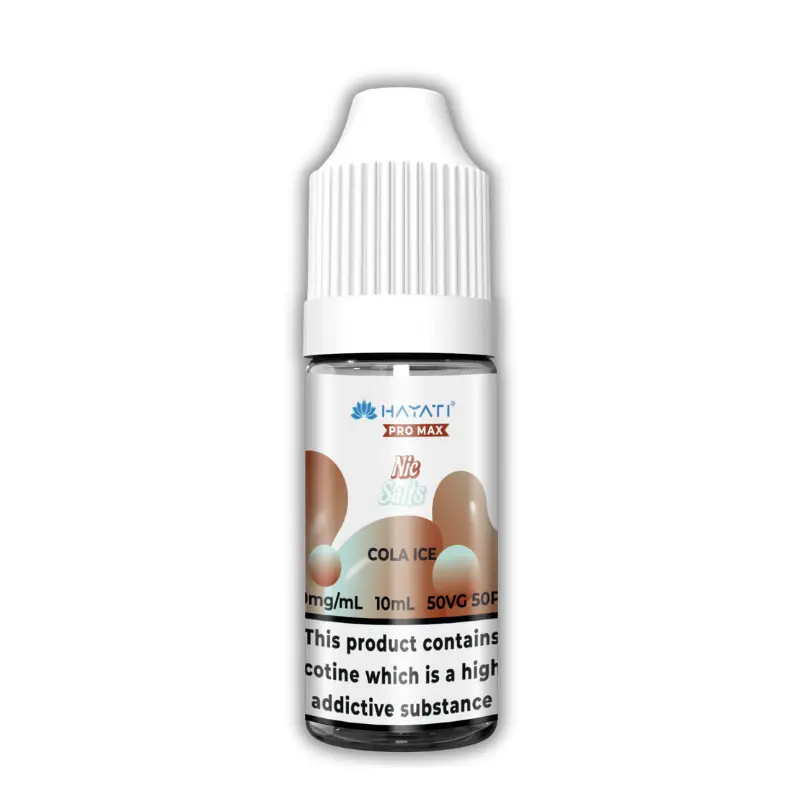
Hayati · Pro Max
Cola Ice Hayati Pro Max Nic Salt
£2.49
✔ In stock — ready to ship
Genuine Hayati
Free over £20
Same-day dispatch
Secure checkout
Cola Ice is a 10ml bottle of 10mg nicotine salt at a 50:50 base, priced at £2.49, filed under the code HPM-NS-COLA-ICE. Nothing in that sentence separates it from the shelf it sits on. Sixty-five listings make up the Hayati Pro Max Nic Salts line and the specification is effectively frozen across all of them, so a buyer reading the numbers is reading a shelf, not a product.
What does separate this bottle is not in the specification at all. It is in where the rest of the catalogue's copy points. Five Hayati listings name Cola Ice inside their own descriptions and use it to explain themselves. Three of those five are bottles on this same shelf. Cola Ice's own description names no Hayati product whatsoever. It measures itself against an unnamed category instead, saying it suits you when fruit liquids start to feel samey, which is a comparison with the idea of fruit rather than with anything you could add to a basket.
That combination, five listings in and one out across the whole range, is what this page is about. It is not a tasting note. Seven pages in this shop have already analysed this liquid and thirteen have analysed the cola family around it, and the flavour work is finished. What has not been done is reading the direction of the pointers rather than counting them, and that turns out to change the buying order inside a four-bottle family.
The short version of the argument, before the counting: three of the four soft-drink bottles on this shelf are written as deltas from Cola Ice. They use the words partner, between and sharper. Each of those words needs a starting point, and all three are measured from the same one. If you have not had Cola Ice, three of the four listings you are choosing between are written in a unit you do not hold. That makes this £2.49 bottle the one to buy first in this family, which is a different claim from saying it is the one to buy.
Counting who gets pointed at
The Cherry Ice pairing page and its twin have already established the outgoing side of this. The Fizzy Cherry bottle page counted how many listings on each shelf name a rival inside their own copy, found 22 of the 65 bottles do it against 18 of 179 on the Pro Max Plus shelves, 8 of 104 on Pro Ultra Plus, 6 of 50 on the Mini Ultra and none at all across the 39 Rubik listings or the 40 shortfills, and worked out why a bottle can afford a comparison when a pod cannot. That census is cited here and not rebuilt. The same page ran the reciprocity test and found nine pairs across the catalogue that point at each other, two of them on this shelf.
Every one of those measurements looks at listings as senders. None of them asks the opposite question, which is the one that decides a purchase order: when a description names a neighbour, who does it name? An arrow has two ends and only one of them has been counted.
What I counted, and what I threw out
The method was to take every flavour name Hayati use as a filed flavour value, search all 492 descriptions for that name written as a proper name, and discard any hit where the listing's own title already carried the name. Matching case matters here and it is not fussiness. Lower-case bubblegum is an ingredient. Capitalised Bubblegum is a product. A search that cannot tell them apart produces a table that is mostly noise, which is what happened on the first pass.
Three categories of false hit had to come out, and they are worth naming because each one inflates a different flavour.
- Family-default listings. The raw count put Banana Ice at the top with ten. Every one of those ten is a listing whose own flavour is Banana Ice but whose title does not say so, because it is a strength-only or format-only entry filed under a default. Those listings are about Banana Ice. They do not point at it. Genuine incoming pointers to Banana Ice: none.
- Longer names containing shorter ones. Menthol looked like six. Read the sentences and five of the six are talking about Double Menthol or about a Blueberry Raspberry Menthol pod, both of which are separate products that happen to contain the shorter word. Exactly one listing points at the Menthol bottle itself, and it is the Fresh Mint bottle placing itself between two neighbours.
- Ingredient words at the start of a sentence. Bubblegum also looked like six, and all six are the material rather than the product: a sentence beginning with the word, or a product whose own longer name contains it. Incoming pointers to the Bubblegum product: none.
Strip those out and the table is short. Two liquids are named by five separate listings: Cola Ice and Strawberry GB. Three are named by three: Mr Blue, Double Menthol and Cola Lime. Below that the counts fall to one and two and stop being informative.
The claim I was handed, and the two corrections it needed
This shop has a standing rule that a rarity claim in a brief is a hypothesis, so the claim was tested rather than repeated, and it moved in both directions.
The version handed to me said plainly that Cola Ice is not the most-referenced liquid in the catalogue, because Menthol and Bubblegum sit above it at six each. On a raw string count that is correct and the caution was the right instinct. On a corrected count it is wrong, because both of those sixes are artefacts of the kind described above and neither survives reading the sentences. The honest result sits between the bold version and the cautious one: Cola Ice is joint first on five, tied with Strawberry GB, and there is nothing above them. It is not the outright most-referenced liquid, because nothing is. Two liquids share the top and the gap to third place is two pointers.
The second correction is larger and it kills a sub-claim outright. I was told Cola Ice is the only one of the top group whose pointers all come from inside a single flavour family. That is false, and checking it produced a better observation than the one it replaced. Strawberry GB is named by Blue Razz Gummy Bear, by the Gummy Bear bottle, by Strawberry Jelly Beans, by a strawberry bubblegum pod and by a Grape GB pod. Every one of those is confectionery. Mr Blue is named by Mr Pink, Mad Blue and Blue Fusion, all of them colour-named and all of them on this shelf. Cola Ice is named by three soft drinks and two colas on another platform. All three hubs are fed entirely from inside their own family.
So the thing that is true is not about Cola Ice specifically. It is about the copy. All thirteen pointers feeding the three hubs come from inside that hub's own family, without a single exception: sweets point at the sweet, colour-names point at the colour-name, drinks point at the drink. Nobody at Hayati has written a sentence sending a cola buyer to a berry or a mint buyer to a sweet.
That is a tendency rather than an iron law, and the exception is worth naming so the claim is not overstated. Cherry Ice reaches across: it names Fizzy Cherry, which is a cherry like itself, and then also names Cherry Cola, which is a cola. That is the clearest case on the shelf of a description pointing out of its own register, and it does it by using a fruit the two families happen to share as the bridge. Nothing points from a fruit to Cola Ice, because there is no shared ingredient to make the crossing on.
Either way the consequence for browsing is the same. The descriptions will keep you inside a family, so if you want to leave one you have to do it through a shelf rather than through a sentence, which is what the full listing is for.
The three hubs are all silent
Here is the property that does hold for all three, and it is the one that carries the rest of this page. None of the three most-named liquids names anybody back. Cola Ice mentions no Hayati product. Strawberry GB mentions none. Mr Blue mentions none, which the Fizzy Cherry page already noticed in passing when it observed that Mr Pink calls itself the pink counterpart to a bottle whose own copy has never heard of it. That page spotted one instance. Counting the whole range shows it is the rule: on the bottled shelf, being named often and naming nobody are the same condition.
That is not a coincidence of editing. A reference point cannot be defined by comparison without becoming circular, so the copywriter who wants to use a liquid as a yardstick has to leave the yardstick undescribed by other yardsticks. Whether it was done deliberately is unknowable and I am not going to claim it was. What is checkable is that it was done consistently three times out of three.
One further split separates the three, and it decides which of them actually works. A reference point has to be specified or it transfers nothing. Strawberry GB is specified: strawberry plus a gummy sweet, sugary throughout, almost no sharpness. Cola Ice is specified: cola plus cooling and, in Hayati's own words, nothing else pulling attention away. Mr Blue is not specified at all. Its description says the name puts it in blue raspberry and blueberry territory and that blue usually signals those, which is a hedge about a naming convention rather than a statement about a liquid. Three listings are measured from Mr Blue and Mr Blue declines to say what it is, so those three arrows carry no information. Two of the three hubs are usable. Cola Ice is the only usable one that is a drink.
The cola set, drawn rather than counted
Narrow the field to the soft drinks on this shelf and the graph is small enough to draw on a receipt. Three bottles are filed on Cola Vapes: this one, Cola Lime and Cherry Cola. A fourth, Bru Ice, is a soda-named bottle that Hayati file outside that shelf entirely, and yet its copy points straight into it. Four bottles, then, if you let the copy draw the boundary rather than the filing.
Four pointers exist inside that set. Cola Lime offers itself as a good partner to Cola Ice. Cherry Cola places itself between this bottle and the sharper Cola Lime, which is two pointers in one sentence. Bru Ice suggests pairing it with Cola Ice. Cola Ice issues nothing.
Tally the ends. Cola Ice receives three of the four arrows and sends none. Cola Lime receives one and sends one. Cherry Cola sends two and receives none. Bru Ice sends one and receives none. Every arrow in the set terminates on one of the two cola bottles, and three quarters of them terminate on this one.
The lemonades, for contrast
The same shelf holds a second drink cluster of four, and it behaves nothing like this. The lemonade bottles also produce four pointers between them, but they distribute them: Berry Lemonade names two neighbours, the blue raspberry version names two, and the other two name nobody, leaving every member of the set with exactly one arrow arriving. The Fizzy Cherry page owns the reciprocity finding inside that group and it is cited rather than restated here. What matters for this page is only the shape. Four bottles, four arrows, and a flat distribution with no centre.
The cola four have the same number of bottles and the same number of arrows and a completely different shape. One node absorbs three of them. That difference is not visible if you count how many listings compare, which is what has been counted before. It only appears when you ask where the arrows land.
The filing and the copy disagree about the boundary
Bru Ice is worth a paragraph on its own, because it shows that the shelf structure and the editorial view of the range are not the same map. Hayati file Bru Ice on Ice Vapes and not on Cola Vapes, which is defensible: it is not a cola, it is a nod to an orange Scottish soda. But its copy volunteers a pairing with Cola Ice, which means the person writing it considered this bottle the nearest thing in the range. A buyer browsing Cola Vapes will never meet Bru Ice. A buyer reading Bru Ice's description is sent here immediately.
Cola Ice is also the only bottle on this shelf that appears on both of those category pages. Fourteen of the sixty-five bottles are filed on Ice Vapes, and worth noting, two of those fourteen carry no cooling word in the title at all, so even the ice shelf is not a straight read of the names. Three bottles sit on Cola Vapes. The overlap between the two lists is one listing, this one, which is a small structural fact with a real consequence: it is the only bottle that a cola shopper and an ice shopper can both arrive at without changing shelf.
What partner, between and sharper actually ask of you
Take the three sentences at face value and read them as instructions rather than as marketing, because that is what they are.
Cola Lime says it makes a good partner to this bottle if you like switching between the two. That is not a description of Cola Lime. It is a description of a relationship, and the useful information in it is the word partner rather than the word alternative. It tells you Hayati expect the two to be owned at once and used in rotation, not chosen between. You cannot act on that unless you know what the other half of the rotation does, because the whole proposition is that the two differ enough to relieve each other.
Cherry Cola says it sits between the chilled one and the sharper one. That is the most informative of the three and the most useless without calibration, because it specifies a position on a line whose ends are two other products. It is a coordinate. If you do not hold either end, a coordinate is just a word. Notice also that the sentence assumes the line runs from cold to sharp, which is a slightly odd axis to construct, since cooling and acidity are different sensations rather than two ends of one scale. That axis only makes sense if you have tasted the two anchors and found that they do in fact feel like opposite directions from where Cherry Cola sits.
Bru Ice says to pair it with Cola Ice for a couple of drink flavours on rotation. Again the content is relational. It is not telling you Bru Ice tastes like anything in particular relative to this bottle, it is telling you the two coexist without clashing, which is a claim about compatibility and is unverifiable without one of them in hand.
Three sentences, three different relationships, one shared zero. Partner assumes you can rotate against it. Between assumes you can place yourself relative to it. Pair assumes you can run alongside it. None of the three can be decoded by someone who has not had it.
Why that makes it the first purchase rather than the best one
The practical consequence is an ordering rule and it is worth stating carefully, because it is easy to overclaim. Nothing here says Cola Ice is the one you will like most. It may well not be. Cherry Cola is sweeter and rounder by its own account and plenty of people will settle there. What the graph says is narrower: of the four bottles, this is the only one whose description is self-contained, and the other three are written as offsets from it.
So if you intend to work through the cola family, starting anywhere else means reading three descriptions in a unit you have not yet defined. Start here and the other three descriptions become readable in the order you meet them. At £2.49 a bottle the cost of getting the order wrong is small in money, but it is not small in information. Buying Cherry Cola first tells you what Cherry Cola tastes like and tells you nothing about what its own listing meant by between.
The reverse is also true and worth saying, because it is the honest limit on the argument. If you have no intention of buying more than one cola, none of this applies to you and you should simply pick the name that appeals. The ordering rule only pays if there is a second purchase.
The same liquid holds two different positions
One more asymmetry, which only shows up because Hayati sell this recipe six times over. As a bottle, Cola Ice is silent. As a Pro Max Plus pod it is not: that listing names Cola Lime directly, pointing at it as the option if you prefer citrus over cooling, and the Cola Lime pod names this one back. The Fizzy Cherry page listed that pair among the nine reciprocal pairs in the catalogue without noting what it implies.
What it implies is that the graph position belongs to the listing rather than to the liquid. The same recipe is a silent hub on the bottled shelf and a conversational peer on the pod shelf. Whoever wrote the pod copy felt the need to offer an exit and whoever wrote the bottle copy did not. The two other formats of this liquid, the Pro Ultra Plus pod and the Mini Ultra pod, both stay silent like the bottle does. Five of the six listings say nothing about a sibling; one does.
That is a small thing but it undercuts any reading of the pointer graph as a map of the range. It is a map of who happened to be writing. Treat an arrow as one person's opinion about the nearest neighbour, which is still worth having, rather than as a structural fact about the liquids.
What a reference point has to be, and what this one actually is
For a liquid to carry three other listings on its back it has to be describable without reference to anything else, and Hayati's copy for this bottle does exactly that, by subtraction. It states two components and then closes the door: cola, cooling, and nothing else pulling attention away. The closing clause is the load-bearing part. Without it you would have a cola with ice and an open question about what else is in there. With it you have a specification.
Compare how the other three define themselves and the difference is stark. Cola Lime states an addition to a cola. Cherry Cola states an addition to a cola. Bru Ice states a resemblance to a named drink plus a chill. All three are built as cola plus something, which is precisely why they need the unmodified version to exist somewhere.
The Pro Ultra Plus kit page in this shop has already established the deeper point that cola is a recipe rather than a single material, and the raspberry version's page established that the recipe in question is an unpublished commercial formula, which is why cola descriptions agree with each other more than fruit descriptions do. Both findings are cited here rather than re-derived. They matter to this page for one reason only: they explain why a cola can function as a reference at all. A fruit varies by batch, by cultivar and by what the formulator chose to emphasise. A cola accord is aiming at a target that everyone in the room has tasted, so two people describing it are more likely to agree.
The zero is not actually zero, and the catalogue admits it
Here is the flaw in using this bottle as a reference, and it is a real one rather than a rhetorical concession. Cola Ice is cooled. The reference point has a treatment on it.
Hayati sell no plain, uncooled cola liquid. Not on this shelf, not on any shelf, not in any format. The Cola nicotine pouch page in this shop established that the only plain cola in the range is a pouch, and a pouch is not a liquid and cannot be run through a coil for comparison. So the nearest thing to a neutral cola available as an e-liquid already carries a coolant, which means every measurement taken from it inherits that coolant.
Work through what that does to the three sibling sentences. Cherry Cola calls this the chilled end of its line, which is accurate and quietly concedes that the axis it is describing is not cola against cola, it is cola-plus-cold against cola-plus-acid. Cola Lime offers itself as the citrus option instead of the cooling one, which again treats the cooling as this bottle's defining variable rather than as a neutral background. Bru Ice is itself cooled, so that pairing holds two coolants side by side.
The Blue Frozen bottle page counted the cooling vocabulary across the whole catalogue and found that Ice, Frozen and Cooler are not a graded scale, that Ice carries ninety titles against three and two for the others, and that Hayati never combine an ice-family word with a mint-family word. That finding is cited, not recounted, and it bears here in a specific way: the word Ice in this title tells you a coolant is present and tells you nothing about how much. So the reference point is a cola with an unquantified amount of cooling on it, and the three listings measured from it are measured from something whose main variable is unpublished.
That is not a reason to distrust the sentences. It is a reason to take your own reading rather than trusting the words. Which brings us to the part that actually costs people money.
What breaks when the reference moves
A yardstick is only useful if it stays the same length, and this one does not, for two reasons that act on different timescales.
The first is the coil. A cola accord is a stack of aromatic materials sitting on a sweetened base, and as a coil ages the top of that stack goes before the bottom does. The Pro Max Plus pods page for this flavour worked through what survives and what does not, and it is cited rather than repeated. The consequence for a reference point is the thing worth adding here: if you take your reading of Cola Ice on a coil that is three days into a sweetened liquid, you have calibrated against a degraded version, and every sibling description you then read will be misplaced by the same amount. Cherry Cola will seem further from centre than it is. Cola Lime's sharpness will read as larger than it is, because you will be comparing it against a cola whose own top notes have already flattened.
The second is you. Repeated exposure to a coolant makes you less responsive to it, a point the Blue Frozen bottle page owns and which I am citing rather than arguing. A fortnight of running nothing but this bottle leaves you reading its cooling as milder than a first-time user would, and since cooling is the published variable that distinguishes it from the other three colas, your whole set of coordinates slides. Nobody notices this happening, because the drift is slow and the liquid in the bottle has not changed.
Put those together and the practical rule falls out. Take your reference reading early and take it twice. The 10ml bottle gives you several pod fills, which is enough to read the liquid on a fresh coil, use it for a fortnight, and then read it again on another fresh coil before you decide what Cherry Cola's between is supposed to mean. If the two readings differ noticeably, trust the first one, because that is the one closest to the state the copywriter was describing.
There is a corollary for rotation. Running this bottle alongside another cooled liquid, whether that is Blue Frozen or Watermelon Ice or anything else off that shelf, accelerates the adaptation and makes the reference drift faster. If you are deliberately calibrating, run it against something uncooled for that fortnight instead. Blackcurrant Juice and Juicy Peach are both on this shelf with no cooling word in the name, and either will leave your cold reading intact.
The bottle as a format, and the one thing it does that no pod can
Most of what can be said about a 10ml bottle of 50:50 salt has been said on the fifty-one other bottle pages in this shop and will not be repeated. There is one property of the format that matters specifically to the argument above, and it is the reason a bottle is the right vehicle for a reference liquid in a way that a prefilled pod is not.
Every prefilled version of this recipe arrives permanently attached to a coil somebody else chose. The Mini Ultra pod, the Pro Max Plus pod, the Pro Ultra Plus pod: each is a liquid and a heating element sold as one object, and a reading taken from one of them is a reading of the pair, not of the liquid. You cannot separate what the recipe does from what that particular coil, wick and airflow path do to it, because you were never offered the recipe on its own.
A bottle separates them. Pour this into your own pod, at your own resistance, on your own draw, and then pour Cola Lime into the same pod tomorrow, and the hardware is a constant across both readings. That is the only way to compare the four cola bottles with one variable moving, and it is available in exactly one format. It is also why the four bottles are the right place to run this comparison even if you intend to buy the flavour as a pod afterwards: the bottled shelf is the only shelf where all four family members exist at the same price on the same hardware.
The rest of the format facts are short. The liquid is thin, which is what a 50:50 blend is for, and a thin blend is what a small high-resistance coil needs if it is to keep up with a tight, restricted draw. The nicotine is a salt. The strength is 10mg, half the ceiling a bottle of this kind is allowed in the UK, and there are no other strengths attached to this listing. Sub-ohm tanks run too hot and pull too loosely for this ratio and this strength together, so that is the one hardware combination to avoid. Beyond that, a bottle has no device to be compatible or incompatible with, which removes the whole fitment question that dominates the pod listings in this catalogue.
Ten millilitres is also the right quantity for the job described above, and that is not a coincidence. It is enough liquid to take two separated readings on two fresh coils with normal use in between, which is what a calibration actually requires. A 2ml prefilled pod is one reading. A 22ml pod is a month's commitment before you know whether the reference suits you.
The figures, ordered by what this page argues
The rows below are arranged so the graph facts come first, because on this shelf they are the only rows that differ between one bottle and the next. Everything from the price downwards is shared with sixty-three or sixty-four other listings and is printed for completeness rather than for comparison.
| Listings that name this liquid | 5 (3 bottles, 2 Pro Max Plus) |
| Listings this one names | 0 |
| Rank by incoming pointers | Joint 1st of 492, tied with Strawberry GB |
| Pointers inside the four-bottle cola set | Receives 3 of 4, sends 0 |
| Shelves | Hayati Pro Max Nic Salts, Cola Vapes, Hayati E-Liquids, Ice Vapes, New Products |
| Only bottle on both Cola Vapes and Ice Vapes | Yes |
| Flavour as filed | Cola Ice |
| Components named | Two: a cola accord and a coolant |
| Coolant strength | Not published |
| Sweetener load | Not published |
| Cola accord composition | Not published, and not published by anyone |
| Price | £2.49 |
| Volume | 10ml |
| Nicotine | 10mg nicotine salt |
| Base | 50:50 VG/PG |
| Strength options | None attached to this listing |
| Product code | HPM-NS-COLA-ICE |
| Brand | Hayati |
Three of those rows are blank on purpose and the blanks are the ones that would settle the argument. If the coolant strength were published, the word chilled in Cherry Cola's description would become a number and the line it describes would become a scale. If the sweetener load were published, you could tell whether the cooling is doing the work or whether it is simply covering sugar. Neither figure exists anywhere in this range, on any listing, so the three sibling descriptions remain qualitative and the only way to put a value on them is to hold the bottle yourself.
The last of the three is different in kind, and the raspberry cola page in this shop has already set it out: a cola accord is a commercial formula that nobody publishes, which is unusual in a catalogue where every other name points at something you could buy in a shop and taste. That is cited here because it explains why the row is blank rather than incomplete. It is not an omission by Hayati.
Where this sits against everything near it
Inside the family of four
Cola Lime is the one the copy treats as the rotation partner rather than the replacement, which is a distinction worth taking seriously: it is the only cola bottle offered as a thing to own alongside this one rather than instead of it. Cherry Cola is the middle position and, on its own account, the sweeter and rounder of the set, with the cherry acting on the cola rather than beside it. Bru Ice is the one that leaves the cola accord altogether while keeping the soda register and the chill, and it is also the one most likely to be missed, because it is filed away from the cola shelf.
If you want the family in a sensible order: this bottle, then whichever of Cola Lime or Cherry Cola matches how you reacted to the cooling here, then Bru Ice if the soda register turned out to be the appealing part rather than the cola specifically.
The same liquid at other prices
Cola Ice exists six times across the catalogue and the complete price ladder for the cola family, every listing worked out per millilitre, is set out on the Lemon Cola Ice Rubik pods page. That table runs from this bottle at the bottom to the Mini Ultra kit at the top and it is cited here rather than rebuilt, because there is nothing left to add to it. The short summary is that the bottle is the cheapest route to this liquid by a wide margin and every other format is paying for hardware.
What the bottle cannot give you is portability or a sealed pod, so the prefilled versions are not simply worse value. Cola Ice Mini Ultra Pods are the smallest commitment in a prefilled form. The Cola Ice / Orange Lemon Lime Mini Ultra Pod Kit puts this liquid behind a collar with a citrus blend, and its page counted how much of this catalogue is a drink at all, arriving at 52 listings of 492 with a drink in the title and 44 aiming at something carbonated. The Lemon Cola Ice Rubik Prefilled Pod Kit is a different recipe rather than this one, a cola with lemon rather than cooling, and is the closest thing the range has to a fifth member of the family.
Against the cooled bottles on this shelf
If what you actually want is the cold rather than the cola, fourteen bottles on this shelf are filed on the ice list and most of them will serve you better, because a cola accord is doing a lot of work that a fruit does not ask for. Red Berry Ice and Strawberry Raspberry Ice are the straightforward red-fruit versions of the same cooled construction. Blackberry Ice is the darker single fruit, and its own listing offers itself as the simpler choice if Blackberry Raspberry reads as too busy, which is another one-way arrow from the same census. Red Apple Ice is the crispest of the set. Blue Frozen sits at the cold extreme.
Two bottles are worth naming for the opposite reason, which is that they are cooled without being fruit. Bubblegum Ice is the confectionery version of the same idea, sweeter than this and with no spice underneath it. Fresh Menthol Mojito pushes the cold much further and adds lime, so it lands in a different part of the mouth entirely.
If the cooling is the part you want to remove
There is no uncooled cola to move to, which is the structural gap this page keeps running into. The nearest available moves are sideways rather than backwards. Lemon Mint keeps a cold sensation with almost no sweetness stacked behind it, which is the opposite balance to this bottle. Black Mamba is the other direction again: a dark berry blend where the cooling arrives late rather than running throughout, so it is the same treatment placed somewhere else in the draw. Neither is a cola, and that is the point. If the cooling is what you want gone, the family has no answer and the catalogue will not give you one.
Shelves, if none of the above settles it
Cola Vapes holds all eighteen cola listings across every format and is the right place to start if you have decided on the accord and not the hardware. Hayati E-Liquids holds 105 listings, forty of them 120ml shortfills at zero nicotine, which is where to look if 10ml is the wrong size for you. No cola is offered in that larger format, so the shortfill route is not open to this flavour at all. Ice Vapes collects 98 cooled listings across the whole range. The full Hayati range runs to 492 listings and is worth browsing only with something specific in mind.
Getting a usable reading out of the bottle
The handling advice that applies to every 50:50 salt applies here too and is not repeated. What follows is only the part that changes because of what this particular bottle is being used for.
Prime it and then wait longer than feels necessary. A cola accord is a layered thing and the spiced middle of it is the slowest part to come through on a partly wet wick. The first draw on a fresh fill will read as sweet and cold with the middle missing, which is not what the liquid does and is a bad first data point. Fill, leave it several minutes, take three or four gentle draws and only then form the view you are going to compare everything else against.
Take the reference reading on a coil under a day old. This matters more here than on most bottles because of what the page above argued: you are not just deciding whether you like it, you are establishing the unit that three other listings are written in. A degraded reading produces three misread descriptions rather than one.
Do not judge the cooling on the last fill. By the end of a bottle you have had two weeks of the same coolant and your response to it has moved. If you want a second reading, take it after a gap rather than at the end of a run.
Watch the spice, not the sweetness, to know when a coil is finished. Sweetness and cold both keep performing long after the aromatic layer has gone, so on this liquid a tired coil does not taste weak, it tastes simplified. When the draw has gone flat and sugary and the gently spiced part has dropped out, the coil is the problem and not the bottle.
Rinse between liquids if you are comparing. A coolant leaves a trace in pod plastics and seals, so a cola read immediately after any iced bottle is not a clean reading. If you are running the four-bottle comparison described above, put the uncooled ones through the pod first or use a second pod.
Storage. Upright, capped, out of direct light and away from heat. A sweetened liquid darkens with light and warmth, and a darkened bottle usually reads duller at the top end rather than spoiled, which on this recipe means the spiced layer goes and the sugar stays. Keep it out of reach of children and pets. The empty bottle is plastic and belongs in household recycling once rinsed, and since there is no cell and no electronics in this purchase there is no other disposal question, which is one genuine advantage of the bottled format over every prefilled pod in this catalogue.
Questions this listing raises
Is Cola Ice really the most-referenced liquid Hayati sell?
Joint first, not outright first. Five separate listings name it inside their own copy, and Strawberry GB is named by five as well. Nothing in the 492 is named by more once you discard the false hits, which are family-default listings, longer product names containing shorter ones, and ingredient words capitalised at the start of a sentence. The brief I was given said it was not the most-referenced because two other flavours sat at six, and both of those sixes turned out to be artefacts.
Why does that matter when I am just buying a bottle of cola?
Because three of the four soft-drink bottles on this shelf describe themselves in terms of this one. Cola Lime calls itself a partner to it, Cherry Cola places itself between it and Cola Lime, and Bru Ice suggests running the two together. If you have not had this bottle, those three sentences are written in a unit you do not hold, so the descriptions you are choosing from are less useful than they look.
Does Cola Ice's own description point at anything?
No. It names no Hayati product at all. It positions itself against fruit liquids in general, which is a comparison with a category rather than with a product. That silence turns out to be the rule for the most-named liquids: Strawberry GB and Mr Blue also name nobody. Being pointed at often and pointing at nothing appear to go together on this shelf.
What does the bottle actually taste of?
Cola and cooling, and by Hayati's own account nothing else. The detailed analysis is not on this page because it is finished elsewhere: the Pro Max Plus kit page took the arc across a pod, the Pro Max Plus pods page took what the cold is doing in place of carbonation, and the Pro Ultra Plus kit page took the construction of the accord itself. Those are the pages to read if the taste is your question.
How cold is it?
Not published, and not knowable from the name. The Blue Frozen bottle page counted every cooling word across the catalogue and established that Ice, Frozen and Cooler are not a graded scale, so the word in this title tells you a coolant is present and nothing about the quantity. That is the main reason to take your own reading rather than relying on the comparative words in the sibling listings.
Is there a plain cola without the ice?
Not as a liquid, anywhere in the range, in any format. The only plain cola Hayati sell is a nicotine pouch, which that product's page establishes, and a pouch cannot be run through a coil for comparison. So the reference point for the whole cola family is itself a treated liquid, and every description measured from it inherits the cooling whether it says so or not.
Should I buy this or Cherry Cola?
If you are only ever buying one, pick on the name, because that is as good as the available information gets. If you expect to buy two or more, take this one first. Cherry Cola's own listing describes its position relative to this bottle and to Cola Lime, so buying it first gives you a taste and no way to interpret the sentence that sold it to you.
Is the cola family comparison better done with bottles or with pods?
Bottles, if you want a clean comparison. All four family members exist at £2.49 on the same shelf and a bottle lets you put each one through the same pod and the same coil, so only the liquid changes. A prefilled pod bundles the liquid with hardware you did not choose, which means a reading taken from one is a reading of the pair.
Why is Bru Ice not on the Cola Vapes shelf?
Because it is not a cola. It is described as a nod to an orange Scottish soda, so Hayati file it on Ice Vapes instead. Its copy still points here, which means the filing and the editorial view of the range disagree about where the boundary sits. A shopper browsing Cola Vapes will not meet it, and a shopper reading its listing is sent straight to this bottle.
Does the pointer graph tell me anything reliable about the liquids?
Less than it appears to. The same recipe is silent as a bottle and talkative as a Pro Max Plus pod, where it names Cola Lime and is named back. Five of the six Cola Ice listings mention no sibling and one does, which suggests an arrow records who was writing rather than a property of the liquid. It is still useful, because a pointer tells you which product its author considered the nearest neighbour, and no specification will tell you that.
What hardware does this need?
A refillable pod or a low-powered mouth-to-lung kit with a higher-resistance coil. The 50:50 base is thin enough to wick into a small coil without starving it, and a 10mg salt is aimed at a tight, restricted draw rather than a loose airy one. High-wattage sub-ohm tanks are the wrong pairing for both the ratio and the strength, and since this is a bottle rather than a system there is no device-specific fitment question at all.
Is 10mg the only strength?
On this listing, yes, with no options attached. That is half the maximum a nicotine-containing bottle of this size may carry in the UK. The prefilled versions of the same recipe are made at a higher strength, which is normal for a sealed pod, and that difference is one more reason a reading taken from a pod is not directly comparable with a reading taken from this bottle.
The short version
Cola Ice is a £2.49 bottle holding 10ml of 10mg nicotine salt at 50:50, and every figure in that sentence is shared with more or less the whole shelf. What is not shared is its position in the catalogue's own web of references. Five Hayati listings name it to explain themselves and it names nobody, which puts it joint first in the range for incoming pointers alongside Strawberry GB, with Mr Blue two behind.
Two parts of the claim I was handed did not survive counting. The version that said Cola Ice is not the most-referenced liquid was built on raw string matches that put Menthol and Bubblegum at six each; reading the sentences shows those are longer product names and ingredient words rather than pointers, and the corrected ranking is a tie at the top rather than a fourth place. The version that said this is the only reference hub fed entirely from within one family is simply wrong, because all three hubs are, which is the more interesting result: in 492 descriptions, no comparison ever crosses a flavour family.
What follows for a buyer is an ordering rule rather than a recommendation. Within the four soft-drink bottles on this shelf, Cola Lime calls itself a partner to this one, Cherry Cola places itself between this one and Cola Lime, and Bru Ice offers itself as a rotation companion. Partner, between and sharper are all measured from the same zero, and the zero is this bottle. Buy it first and the other three listings become readable. Buy one of the others first and you get a flavour you may well prefer, plus a description you still cannot decode.
Strictly for adults aged 18 and over. Nicotine is an addictive substance.
You might also like


