
Home / Hayati Pro Max Nic Salts / Ice Pop Hayati Pro Max Nic Salt
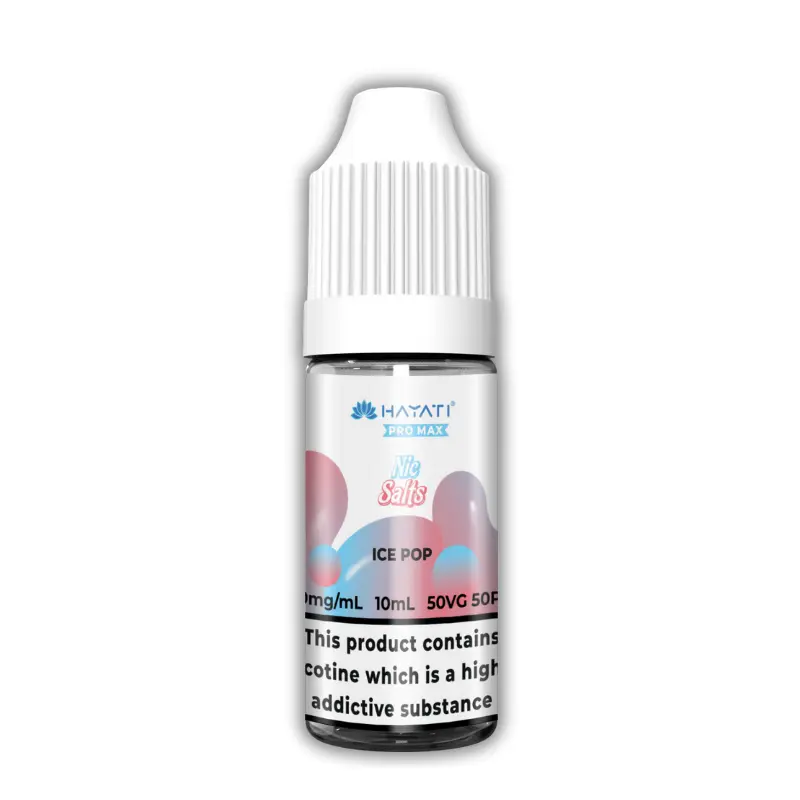
Hayati · Pro Max
Ice Pop Hayati Pro Max Nic Salt
£2.49
✔ In stock — ready to ship
Genuine Hayati
Free over £20
Same-day dispatch
Secure checkout
Ice Pop Hayati Pro Max Nic Salt is a 10ml bottle at £2.49, carrying 10mg of nicotine salt in a 50/50 carrier, sold under the SKU HPM-NS-ICE-POP. It sits on the Hayati Pro Max Nic Salts shelf with sixty-four other bottles, and it is also filed on Ice Vapes, which is where the argument of this page starts. The liquid is intended for a refillable pod or a small mouth-to-lung device with a high-resistance coil, and Hayati say to keep the bottle away from heat and direct sunlight. That is the transaction, and none of it is in dispute.
What is in dispute, or rather what is simply missing, is both of the two things a buyer of a cooled fruit liquid actually needs to know. Which fruit, and how cold. Every neighbour on the cold end of this shelf answers at least the first. Watermelon Ice answers it in the title. Cherry Ice answers it in the title. Blackberry Ice answers it in the title, and then the shop answers it again by filing the bottle on a shelf named after the berry. This listing answers neither, and it is unusually honest about the first of the two: Hayati's own description says the liquid is fruit and then says, in as many words, that it is not a single specific one.
So this page is not a tasting note. Nobody writing it has had the bottle, and inventing a flavour for a liquid whose maker declined to name one would be the least useful thing that could be done with six thousand words. What it is instead is an audit. It counts what the catalogue can tell you about the fruit blank and what it can tell you about the cooling blank, reports the two answers separately because they turn out to be different shapes of problem, says plainly which parts of the reasoning are inference, and finishes with a way of characterising your own first bottle that takes advantage of something this format has and the pod formats do not.
Two of the claims handed to this page did not survive the counting, and both corrections are in the text where they belong rather than buried. One rarity claim turned out to be house vocabulary. One novelty claim turned out to belong to a page that already exists.
Five pages already did work this one is not going to repeat
The corpus on this site has already settled several things that bear directly on this bottle, and re-deriving any of them would waste the space the new material needs.
The Blue Frozen pods page counted Hayati's cooling vocabulary across the whole catalogue. Its findings, taken as given here: the word Ice appears in ninety titles, Frozen in three, Cooler in two, and Chill and Freeze in none at all, which disposes of the idea that the words form a ladder a shopper could climb. Rarity is not intensity. That page also noted, in passing and without drawing conclusions from it, that Ice Pop and Ice Cold are the two names that put the word at the front where it is doing something else entirely, and that Ice Pop names a frozen confection. Everything in this page's second half builds on that observation, and none of it re-establishes it.
The Rocky Candy Orange pods page worked out which sensory channels an aerosol can and cannot carry, and concluded that cooling words are the honest ones on a vape label because chemical coolants act on the nerve endings that report temperature, so a cold liquid genuinely produces the sensation it advertises. That page also ran a census of physical-state words across Hayati's names and included Ice Pop in it. Both findings are cited below and neither is rebuilt.
The Sunset Aura pods page and its kit sibling established the shape of a page about a listing that names nothing: two flat lists of what is on and off the record, claims graded by confidence, the deciding axis put in the unknown column when that is where it belongs, and a named alternative for anyone who cannot tolerate the gap. That shape is used here. The content filling it is this bottle's own.
And the Ice Pop pods page, the listing for the same liquid in 12ml prefilled form, has already lined Hayati's three Ice Pop descriptions up against each other and reported that across three separate pieces of flavour writing the count of named fruits is zero. The brief for this page said the three-way comparison had not been done. It had, on that page, and it was done well. What follows therefore takes the comparison as established and adds one thing to it that the earlier page did not measure, which is that the three listings do not conceal the fruit to the same degree, and that the one which admits the most is the cheapest.
The fruit blank, tested against the shelving rather than the prose
An assertion that a name tells you nothing is worth exactly as much as the count behind it, so here is the count, done against the catalogue file that drives this shop as it stands today rather than against any figure quoted in a brief.
Hayati's 492 listings are filed across a set of shelves, and twenty of those shelves are named after a fruit: apple, banana, berry, blackcurrant, blueberry, blueberry raspberry, cherry, grape, juicy peach, kiwi, lemon, lemon lime, mango, orange, peach, pineapple, raspberry, strawberry, strawberry raspberry ice, and watermelon. A listing on any of them has had somebody at some point decide which fruit it contains and record that decision in a machine-readable field. That is a different kind of evidence from a sentence in a description, because a shelf is a filing decision rather than a piece of writing, and it has to be made even when the copy is vague.
The Ice Vapes shelf holds 98 listings. Eighty of those carry at least one fruit-named shelf as well. Eighteen carry none.
Eighteen is not the interesting number, because eight of the eighteen are accounted for immediately. Six are Cola Ice, in six different formats, and they are filed on a cola shelf, which names their referent precisely even though a cola is not a fruit. Two are Lychee Ice, filed on the exotic shelf, which names the family the fruit belongs to. Those eight have been placed somewhere that identifies what is in them. Strike them out and ten listings remain on the cold shelf with no shelf anywhere in the catalogue that names what they taste of.
Here are the ten, in full, because a list settles an argument that a number only asserts:
- Bubblegum Ice Hayati Pro Max Nic Salt
- Bru Ice Hayati Pro Max Nic Salt
- Vimbull Ice Hayati Pro Max 70/30 E-Liquid
- Vimbull Ice Hayati Pro Max 50/50 Shortfill E-Liquid
- Vim Ice Hayati Rubik Prefilled Pod Kit
- Vim Ice Hayati Rubik Pods
- Ice Cold Hayati Nicotine Pouches
- Ice Pop Hayati Pro Max Nic Salt, this listing
- Ice Pop Hayati Pro Max Plus Pod Kit
- Ice Pop Hayati Pro Max Plus Pods
Seven of the ten are not really in the same position as the three at the bottom, and the way they differ is where the first correction to this page's brief belongs. The brief said all seven name a non-fruit referent outright. Six of them do. Bubblegum Ice names a confection with a flavour everyone can recall. Bru Ice names, by way of its copy, a particular bright orange Scottish soda. The four Vim and Vimbull listings name a well-known British cordial, and go further than that, because their descriptions between them mention blackcurrant, grape and dark berries by name. The seventh, Ice Cold, does something different and slightly sharper: it names no referent at all, and its description states outright that the product is about the chill and not about any fruit, which is the opposite of a blank. It tells you the fruit is absent rather than leaving you to wonder.
That leaves the three Ice Pop listings, and they are alone in a specific position on this shelf. Their copy asserts that the liquid is fruit. Their titles name no fruit. Their filing names no fruit. Nothing anywhere in the catalogue record identifies a fruit, and yet the product is sold as one. Three of ninety-eight, and all three are the same recipe under different SKUs, so functionally it is one liquid.
Two honest qualifications belong with that count, and both of them weaken the filing evidence rather than the conclusion.
The first is that a missing fruit shelf does not prove a missing fruit. The four Vim and Vimbull listings are the proof: their prose names blackcurrant, grape and berries, and not one of them is filed on a berry, blackcurrant or grape shelf. Whoever assigned those shelves either did not read the description or treated the cordial reference as the whole story. So the filing is a weak signal on its own, and the Blue Frozen pods page already found the same thing from another direction when it observed that the shelving drifts between formats of a single flavour and in at least one case contradicts a listing's own text. The filing corroborates here; it does not carry the argument. What carries the argument is Hayati saying it themselves, in the description on this bottle.
The second is a discrepancy in the shelf size that is worth explaining rather than glossing over, because two pages on this site now quote different figures. The Blue Frozen page reports an ice grouping of 92 members. This page reports 98. Both are right, because they are counting different fields. There is an ice tag and there is an Ice Vapes shelf, and the tag is a strict subset of the shelf: every one of the 92 tagged listings is also shelved, and six shelved listings carry no tag. The six are the Black Mamba pod and kit, the Blue Frozen pod and kit, and two long dual-flavour Pro Ultra Plus listings whose titles end in Strawberry Ice. Nothing sinister, just two overlapping indexes maintained to different standards, which is a fair description of the whole catalogue.
Narrow the same test to this bottle's own shelf and the position is even plainer. Of the sixty-five bottles in the Hayati Pro Max Nic Salts line, fourteen are filed as cold: Banana Ice, Blackberry Ice, Red Apple Ice, Red Berry Ice, Watermelon Ice, Cherry Ice, Strawberry Raspberry Ice, Blue Frozen, Black Mamba, Blackberry Raspberry, Cola Ice, Bubblegum Ice, Bru Ice and this one. Read across the three places a name can hide, the title, the shelving and the description, and thirteen of the fourteen name something edible somewhere. Ice Pop is the fourteenth.
Forty-one listings that tell you they are reading the label
The filing count establishes where the fruit is not recorded. A second count, which nobody has run on this site before, establishes something more interesting, which is where Hayati's own copywriters knew they were guessing.
Read enough of these descriptions and a particular sentence construction starts to recur. The name points to. The name hints at. Going by the name, expect. Named for a mood rather than an ingredient. As the name suggests. Takes its cue from. Each of those is a writer telling you, in the middle of a piece of promotional copy, that the source of the following description is the word on the bottle rather than anything they were told about the liquid.
Across all 492 listings, 41 carry a sentence of that kind. Eight and a half per cent, which is a small minority and a large enough one to be a habit rather than an accident.
The 41 split into two groups that are worth keeping apart. In one group the hedge is confirming an informative name. The Tobacco bottle says that, as the name says, this is a tobacco flavour. The Juicy Peach bottle says it delivers what its name says. Double Apple and the Fizzy Cherry kit do the same thing. In those cases the sentence is a flourish, because the name already names an ingredient and the copy is agreeing with it. In the other group the hedge is a concession. Summer Dream, Mr Blue, Rainbow, Blue Fusion, Galaxy Aura, Black Mamba, Vim Ice, Vimbull Ice and Ice Pop all use it, and in every one of those the name is the only thing the writer had.
Now the number that matters. Group the 41 by flavour rather than by listing, and ask which flavours have the hedge on every single listing they appear in. Only three do. Vimbull Ice manages two out of two. The dual Blueberry Raspberry and Mr Blue listing manages two out of two. Ice Pop manages three out of three, and it is the only flavour sold three or more times in Hayati's entire range where every listing announces that the description was derived from the name.
For scale, Summer Dream, which is the range's archetypal mood name and the one most often cited as the product that tells a buyer nothing, is sold eleven times and hedges on five of them. Vim Ice hedges on three of four. Mr Blue, which is a colour and nothing else, hedges on two of eleven. Those flavours have listings where somebody wrote a confident description anyway. Ice Pop has none.
Be careful about what that is evidence of, because it is easy to over-read. It is not evidence about the recipe. It does not mean the liquid is vague, unfinished, or made of whatever was in the tank that week, and Hayati's formulators presumably know exactly what is in it down to the last percentage point. It is evidence about the information that reached the person writing the copy. Three times, on three different formats, across three different shelves, whoever sat down to describe this liquid had the name and no flavour specification, and rather than invent one they said where their description came from. That is a defensible thing for a copywriter to do and it is more than most product copy manages. It simply means the buyer is downstream of the same gap the writer was.
There is a second, more specific construction worth counting, and this is where the brief's rarity claim needs narrowing. Hayati's description of this bottle contains an explicit negative: the fruit is bright and sweet, and then the phrase "rather than a single, specific fruit". Handed on its own, that reads like an unusual admission. It is not unusual at all. Twenty-three of the 492 listings contain some version of the same negative, most of them phrased as rather than a single fruit or rather than one fruit. It is house vocabulary, and a word or phrase that appears twenty-three times says nothing on its own, which is exactly the trap this site's brief warns writers about.
So the claim has to be narrowed, and the narrowed version is sharper than the original. Of those 23 listings, eighteen use the negative to mean not a monofruit but a blend, and then immediately name the fruits in the blend. Kiwi Grape Raspberry says rather than one fruit and then names three. Mango Peach Pineapple does the same. Cherry Peach Lemon does the same. In those the negative is a rhetorical setup, not a withholding.
Five listings in 492 use the negative and then name no fruit at all, anywhere in the title or the description. They are the Sunset Aura pod kit, two Rainbow listings, one Fruit Bomb listing, and this bottle. Five out of 492 is a genuine rarity and it is a counted one. Of those five, this is the only one that is also cooled, the only one on the ice shelf, and the only one where the name's referent is a physical object rather than a mood, a colour spectrum or an intensity.
That is the corrected claim, and it is worth more than the one this page started with. Ice Pop is not the only listing in the range that admits it cannot name its fruit. It is the only cooled one that does, and it is the only flavour sold three or more times where every listing flags the same gap.
Which of the three Ice Pop listings is telling you the truth
The Ice Pop pods page established that Hayati's three descriptions of this liquid name no fruit between them. Taking that as given, there is a further distinction inside the three that the earlier page did not draw, and it goes to which listing a buyer should trust.
The three are not equally candid. The 12ml pod says the flavour takes its lead from frozen fruit, which flags the derivation so gently that most readers will not notice it is a flag at all, and then proceeds to describe sugar, brightness and cold as though all three had been observed. The kit says the profile follows the name, which is a plainer flag, and then describes a fruit side that is sweet rather than tart, which is a real claim about the recipe presented without any hedge attached. This bottle, the cheapest of the three at £2.49, says the name indicates a fruity ice lolly and then does the thing the other two do not, which is to state the absence directly, in the manufacturer’s own words: "rather than a single, specific fruit". It is the only outright negative anywhere in the Ice Pop set.
Take that seriously as a pattern rather than as a coincidence. The listing with the least revenue attached to it is the one that tells the buyer the most about what is not known. There are dull explanations available, and the dullest is probably right: bottle copy on a sixty-five-strong shelf is written quickly and in bulk, and a writer working through a list is more likely to reach for a flat statement than a flattering one. But whatever the cause, the practical consequence stands. If you are deciding between the three formats of this liquid on the strength of their descriptions, the £2.49 bottle has given you the most accurate picture and the £7.99 kit the least, and the difference is not that one liquid is better documented than another. It is the same liquid three times.
What all three agree on is the closest thing to a fact available. Every one of them puts sweetness ahead of cold in the order of arrival, and every one of them treats the cold as the thing that closes the draw rather than the thing that opens it. Two of the three say explicitly that the sweetness is not counterweighted by tartness: the kit calls the fruit sweet rather than tart, and the pod says there is more sweetness than bite. Nothing in any of the three names an acid, a sour note or a citrus lift. A property that three independently written descriptions all assert is the strongest evidence this catalogue offers about any liquid, and the property here is that the liquid is sweet-led, cold-finished and unsoured.
What only one of them says is also informative, by the rule that a property asserted once is either the most interesting thing available or a copywriting variant. Exactly one of the three offers a comparative: the kit says that anyone who likes iced fruits but finds some of them too sharp may prefer the softer approach here. That is the only statement in the entire Ice Pop record that positions this liquid relative to anything else. It is unsupported, it appears on one listing out of three, and it is doing marketing work, so treat it as a weak signal. But it points the same way as the two sweetness statements, so it is at least consistent.
The cooling blank is a different shape from the fruit blank
The second axis is the one a buyer of a cold liquid cares about at least as much, and it is missing in a different and less obvious way.
Start from what the word Ice does on a normal listing. On Watermelon Ice, the structure of the title is a subject followed by a modifier, and the modifier is a declaration. Somebody has taken a melon recipe and added coolant to it, and the word records that decision. The same grammar runs through nineteen single-flavour names in the range, from Banana Ice through Cherry Ice to Cola Ice. In every case the word sits in a slot, and the slot means cooled.
On this bottle the word is not in that slot. Ice Pop is a compound noun naming a thing, and the thing is a frozen confection on a stick. The word Ice in it is not reporting that a coolant has been added to a recipe called Pop, because there is no recipe called Pop. It is reporting that the referent object is frozen solid, which is a property of a lolly and not a property of a liquid. This is the observation the Blue Frozen pods page made when it said the two front-loaded names are doing something else entirely, and it is also why the Rocky Candy Orange pods page filed Ice Pop among the names that report a physical state rather than an ingredient. Both pages are right and neither drew out the consequence for a buyer, which is this: the title of this product does not tell you the liquid is cooled.
Everything that tells you the liquid is cooled comes from somewhere else. The description says an icy chill and a cold finish, which is direct and sufficient. The listing carries an ice tag. The shop files it on the cold shelf. Three independent confirmations, all of them outside the name. Strip them away and a buyer reading titles alone would have no more reason to expect coolant in Ice Pop than in Gummy Bear or Rocky Candy Orange, both of which are also confections and neither of which is cold.
That is a small point in isolation and a real one on a shelf. Somebody scanning sixty-five bottle names for something cooled will pick out thirteen of the fourteen by the word in the title. The fourteenth they will pick out only if they open it, because its cold word is doing a different job.
Now the question of how cold, which is the part nobody can answer. The Blue Frozen pods page settled the vocabulary question: the cold words are not graded, the filing does not grade them either, and no coolant dose is published for any listing in the range. That applies here exactly as it applies everywhere. What is worth adding is that the usual workaround is also unavailable, and then, immediately, that this is not special.
The workaround for an unquantified coolant is to taste the uncooled version of the same recipe and attribute the difference to the coolant. It requires the range to sell both. Nineteen single-flavour names in Hayati's range take Ice as a suffix, and exactly two of them have an exactly matching uncooled listing in the catalogue: Cola Ice has a plain Cola, and Bubblegum Ice has a plain Bubblegum. The other seventeen do not. There is no plain Watermelon, no plain Cherry, no plain Blackberry, no plain Banana. So the absence of a control is the normal condition on this shelf rather than a peculiarity of this bottle, and any page telling you Ice Pop is uniquely impossible to calibrate has not counted.
Ice Pop's position on this axis is worse in one narrow respect and no worse in any other. Everybody on the cold shelf is missing a control. Ice Pop is additionally missing the declaration, because its cold word is part of a noun rather than a modifier attached to one. The dose is unknown for all fourteen bottles equally.
Which makes the cooling question, for this bottle, unanswerable from the record in precisely the same way as the fruit question, but for a different reason. The fruit is unknown because Hayati say they are not naming one. The cooling level is unknown because Hayati never publish one for anything, and this particular title does not even put the word where a reader could take it as a claim.
On the record, and off it
Here is the whole record, without interpretation, so that you can see the size of it.
What Hayati state about this bottle:
- The name, Ice Pop, and the SKU, HPM-NS-ICE-POP.
- Ten millilitres of liquid, at £2.49.
- Ten milligrams per millilitre of nicotine, prepared as a salt.
- A 50/50 ratio of vegetable glycerine to propylene glycol.
- That it is built for refillable pod kits and small mouth-to-lung hardware, the balanced base being thin enough for a narrow wick.
- That the character is frozen-fruit in style, pairing sweet fruit with an icy chill.
- That the sweetness arrives first and the cooling follows.
- That the liquid is not a single specific fruit.
- That the flavour description is derived from the name.
- That the bottle should be kept away from heat and direct sunlight.
- Its shelving: the nic salt line, the Hayati E-Liquids group, the cold shelf, and the new arrivals.
What Hayati do not state anywhere, on this listing or the other two:
- Which fruit or fruits the blend is built from.
- How many components there are.
- Whether the fruit register is red, tropical, orchard or mixed.
- The identity of the coolant, whether menthol, a synthetic coolant, or a combination.
- The coolant dose, in this or in any other Hayati listing.
- The sweetener level, or whether sweetness comes from sweetener, from the flavouring, or from both.
- Whether there is any acid in the recipe at all.
- Whether the 10mg bottle uses the same flavour concentrate as the 20mg prefilled pods, or a separately balanced one. This matters more than it sounds, because a great deal of advice about this liquid is written from the pod formats.
- The colour of the liquid, which would at least hint at the fruit family.
- Whether the liquid benefits from standing before use.
- Any coil resistance range, wattage range or device model by name.
The second list is longer than the first and contains both of the axes that decide the purchase. That is the honest summary of this product's documentation, and nothing on this page should be read as filling either gap.
Three columns, and both deciding axes in the last one
Reasonably confident. These follow directly from stated facts or from three descriptions agreeing. The liquid is sweet-led, with the sweetness arriving before the cooling on a normal draw. The cooling is present on every draw and positioned as a finish rather than an opening. There is no acid or sour component named anywhere in the record, on any of the three listings, which for a range that routinely advertises tartness is close to a negative result. The carrier is 50/50 and will wick in a high-resistance mouth-to-lung coil without fuss. The nicotine is 10mg, which is the figure every bottle on this shelf carries. The liquid will read as a confectionery register rather than a fresh-produce one, because a frozen lolly is a sugar product and all three descriptions point the same way.
Probable. These are inferences and the reasoning is given so you can reject it. The blend is composite rather than a single fruit with a modifier, because Hayati say so on the listing where they had the most room to be specific, and because if a single fruit were in there naming it would have been easier than not naming it. The fruit register leans bright rather than dark, because every description reaches for words like bright and sugary and none reaches for deep, rich, jammy or dark, all of which are freely used elsewhere in this catalogue. The sweetness is carried substantially by sweetener rather than by a fruit-acid balance, because an unsoured sweet liquid usually is. Each of these could be wrong and none of them is a fact.
Unknown. Which fruit. How cold. Those are the two axes on which a cooled-fruit purchase is actually decided, and both of them sit here, and no amount of reading the catalogue moves either one into a higher column. If you need the fruit fixed before you spend £2.49, you should buy a bottle that names one. If you need the cooling level fixed, no Hayati bottle fixes it, but a menthol-named one at least names a substance rather than a sensation.
Why a 10ml bottle is the right instrument for a liquid like this
Everything above is a description of a gap. This section is about closing part of it yourself, and the reason it can be written at all is a property of this format that the prefilled pods do not have.
Look at what the Hayati Pro Max Nic Salts shelf actually is as a dataset. Sixty-five bottles. Every one of them is 10ml. Every one of them is 10mg. Every one of them is 50/50. Sixty-four of the sixty-five cost £2.49, the sixty-fifth being a multi-option listing. There is no other shelf in this catalogue with that property. The prefilled pod shelves mix capacities, strengths and prices, and comparing two pods means comparing two coils as well as two liquids. Here, every variable except the flavour concentrate has been held constant by the manufacturer, and you supply the hardware yourself, so you can hold that constant too.
That turns the shelf into something you can run an experiment on, and it is the only place in the range where the two blanks on this bottle can be narrowed by a buyer rather than merely noted.
The protocol, which takes one extra bottle and about a week:
Buy one named comparator from the same shelf. The best choice is a cooled single fruit you already know, because you need to be able to subtract it. Watermelon Ice and Cherry Ice both work well for this, being single, unambiguous and cold. Same price, same strength, same ratio, same shelf. The only thing that differs between the two bottles in your hand is the flavouring.
Run both on fresh, identical coils. Two pods of the same resistance, filled at the same time, used at the same power. A new coil overstates everything, so this is the fairest condition for a first read and the worst condition for judging how a liquid ages.
On the first fill, write down eliminations rather than descriptions. This is the part most people get wrong. Do not try to name the fruit, because the naming instinct will produce a confident answer built from the packaging and the colour and the word lolly, and you will then believe it. Write instead the list of families it is definitely not. Not citrus. Not apple. Not dark berry. Not tropical. Four or five negatives are worth more than one guess, they are far more likely to be right, and they are the only kind of note that gets more useful as you add to it.
Compare the cooling by alternating, not by remembering. Take one draw of the comparator, then one of this, then one of the comparator again. Coolant sensation fades fast and the difference between two bottles is far easier to read in sequence than across an afternoon. What you are looking for is only whether this one is colder, less cold, or indistinguishable. That is a three-way answer and you can get it in a minute. You cannot get a number, because there is no number to get.
Use the third and fourth fills for the settled read. A 10ml bottle is five fills of a 2ml pod, which means five separate first impressions of the same liquid, and that is the thing no prefilled pod can give you. The first fill tells you what the liquid does on new wire. By the third the coil has settled and you are tasting the recipe rather than the hardware. If the two readings disagree, the later one is the truer description of what you will be living with.
Do not export your conclusion. Whatever you decide about the fruit, it is a guess from one bottle on one device, and if you write it down somewhere public it will be indistinguishable from a fact within a month. The Sunset Aura pods page made the general version of this point about unnamed liquids and it is worth repeating in one sentence: a confident tasting note for a liquid nobody has documented was written by somebody in your exact position who felt the blank needed filling.
One caution about using the pod formats as a reference. The 12ml Pro Max Plus pod is nominally the same flavour, but it is 20mg rather than 10mg, on hardware you do not control, and as noted above Hayati nowhere confirm that the concentrate is identical between the two. Three variables differ and possibly a fourth. Treat the pod as a relative of this bottle rather than a copy of it.
The numbers, relabelled
| Shelf price | £2.49 |
| Nicotine strength | 10mg per ml, as a salt |
| Volume | 10ml |
| Cost per ml | 24.9p |
| Carrier ratio | 50/50 VG to PG |
| Intended hardware | Mouth-to-lung devices and refillable pod kits |
| Flavour family as filed | Ice, and nothing else |
| Fruit named by Hayati | None |
| Coolant dose published | None, here or anywhere in the range |
| Stock code | HPM-NS-ICE-POP |
| Storage | Away from heat and direct sunlight |
Two of those rows are deliberately empty of content and they are the two that matter, which is the point of putting them in the table rather than leaving them out. A specification table that lists only what is known reads as complete. This one does not, and it should not.
The rest is arithmetic worth doing once. At 24.9p per millilitre, this is the cheapest way Hayati sell this liquid by a wide margin, and the comparison is not close: the 12ml prefilled pod works out at roughly 45.8p per millilitre and the complete kit at about 66.6p, though the kit price includes a device so it is not a like-for-like. What you are buying at 24.9p is liquid and nothing else, on the condition that you already own something to put it in and are prepared to replace coils yourself.
The 50/50 ratio is the specification that actually matters for this liquid, and not for the usual reason. A balanced carrier is thin enough to reach a small wick quickly, which is standard. What is specific here is that a thinner carrier produces a less coating vapour, and a less coating vapour lets a coolant read more sharply, because there is less glycerine sitting between the aerosol and the tissue that registers the sensation. On a liquid whose cooling level is unpublished and whose fruit is unnamed, the carrier is the one lever you can reason about, and it is set towards the sharper end.
The 10mg figure is the shelf default rather than a choice anybody made for this flavour: all sixty-five bottles in the line carry it. It is half the strength of the prefilled Ice Pop pods, which is worth knowing only so that you do not read a difference in intensity between the two formats as a difference in recipe.
If either axis has to be fixed before you buy
This is the section the graded claims oblige. If the unknown column is not acceptable to you, do not buy this bottle, and here is what to buy instead depending on which of the two blanks is the problem.
If you need the fruit named and the cold kept. Eight bottles on this shelf give you both. Watermelon Ice is the most literal of them and the easiest to predict. Cherry Ice puts a single stone fruit behind the same treatment. Blackberry Ice and Red Berry Ice take the darker and the composite ends of the berry range respectively, the second of those being composite in a way this bottle is rumoured to be but with the family at least declared. Red Apple Ice is the orchard option. Banana Ice is the outlier and the one most likely to read as a confection rather than a fruit, which makes it the nearest neighbour in register even though it names a species. Strawberry Raspberry Ice is a two-fruit blend with both fruits on the label, which is the shape a lot of people assume Ice Pop is. And Blue Frozen is the blue-fruit cold bottle, worth knowing about because it is the only Hayati flavour that uses Frozen rather than Ice, for reasons the Blue Frozen pods page examined at length and found to be naming rather than temperature.
If you want the cold to be the point. Fresh Menthol Mojito is the one to take, and the reason is structural rather than a matter of taste. Menthol is an ingredient name. It refers to a specific compound with a character people can recall and agree about, which means a listing naming it has told you something checkable. Ice, Frozen and Cooler are effect names, and an effect has no fixed strength attached to the word. That distinction was drawn on the Blue Frozen pods page and it is the single most useful thing in the cooling vocabulary for a buyer who wants predictability.
If a non-fruit referent would suit you better than an unnamed fruit. Three bottles on this shelf name something that is not a fruit and name it clearly. Cola Ice is the most predictable product in the cold group, because a cola flavour is a fixed target that everybody has in memory, and it happens to be one of only two Ice listings in the range with a plain uncooled twin. Bru Ice takes a Scottish soda as its reference, which is a narrower target but still a target. Bubblegum Ice is the closest thing on the shelf to Ice Pop in register, being a cooled confection rather than a cooled fruit, and it has the advantage of naming the confection precisely. If what appeals about Ice Pop is the sweet-shop framing rather than the fruit, that is probably the bottle to try first.
If you are comfortable with a blank and just want a different one. The nic salt shelf has several and they are not all blank in the same way. Black Mamba is cold and filed on berry, menthol and sweet shelves at once, so the filing says more than the name does, which is the inverse of this bottle. Blue Fusion names a colour and then, unlike Ice Pop, names the fruits behind it in the copy. Mr Blue names a colour and a title. H'Bubba names nothing recognisable at all and is filed as sweet, so it is closer to a confection blank than a fruit one.
If you want sweetness without the cold. Several bottles deliver the confectionery register this one is aiming at with no coolant involved. Rocky Candy Orange is a hard-sweet citrus and the closest uncooled analogue to a lolly framing. Cherry Cola and Berry Lemonade both take the soft-drink route to sweetness. Blackcurrant Lemonade and Blue Razz Cherry put an acid against the sugar, which is the thing this bottle's record conspicuously never mentions. Double Apple goes somewhere else entirely and is worth knowing about if fruit-and-sugar is starting to feel repetitive.
If you get through liquid quickly. The 10ml format is a convenience rather than a value proposition at volume, and the shortfill line exists for people who have settled on something. Banana Ice in the 50/50 shortfill and Pineapple Ice in the same format are the cold options there, both at 120ml. Neither is Ice Pop, which is not sold in that format, so this is a route for a liquid you already trust rather than one you are investigating. The full range of formats is on the complete Hayati listing if you want to see what a flavour is and is not sold as.
One short note on hardware, because it is the same on every page and does not need repeating at length: a Hayati liquid is a liquid and will go in whatever mouth-to-lung device you own, but where a listing names a Hayati device range, check that name against the range printed on your own device before ordering, because the pod ranges are not interchangeable and a retail page is not the place to settle a fitment question.
Living with ten millilitres of an unnamed sweet cold
Most handling advice is the same for every bottle on the shelf and there is no value in restating it in nine different ways. Two things about this particular liquid are worth attaching to the general advice, and they both follow from the fruit being unnamed rather than from anything about the recipe.
The first is the coil question. A sweet liquid leaves more residue on wire than a dry one, and residue insulates the coil, throttles the wick and eventually adds a note of its own. That much is true of half this shelf. What is different here is what you lose first and whether you notice. On a named bottle the aromatic top of the flavour goes first and you register it as an event, because the word on the label is sitting in your head as a description and the draw stops matching it. On Cherry Ice the cherry thins and you think, that is not cherry any more. On this one the fruit thins and there is no word waiting to catch it, so what you experience is a vague flattening with nothing to attribute it to. The cooling and the sweetness both survive longer than the aromatics do, so the liquid continues to arrive cold and sugary long past the point where it is still interesting. The Ice Pop pods page worked this out in detail for the 12ml pod and gave a method built on watching whether the cold starts arriving before the sweetness does. That method transfers to this bottle unchanged and there is no point restating it here.
What is different on a bottle, and better, is that you can act on it immediately. A prefilled pod with a tiring coil has to be thrown away with whatever liquid is left in it. Here the coil is a separate consumable and the liquid is not tied to it, so the moment you suspect the fruit has gone quiet you fit a new coil, refill from the same bottle, and find out within two draws whether the problem was the hardware or the liquid. That single test resolves the ambiguity this flavour would otherwise leave you sitting in, and it is the strongest practical argument for buying an unnamed liquid in bottle form rather than as a prefilled pod.
The second is storage, which Hayati specify and which matters slightly more here than average. Heat and light both degrade flavourings, and the lighter and more volatile the compound the faster it goes. A bright confectionery fruit character is exactly the sort of thing that sits at the fragile end, and since you have no name for it you will not be able to tell a degraded bottle from a correctly stored one by tasting for an absence. So follow the instruction literally: a cupboard, not a windowsill, not a car, not a coat pocket in summer. Keep it upright and keep the cap on, keep it out of reach of children and pets, and note that a 10ml bottle used two millilitres at a time takes weeks to finish, which is long enough for storage to matter.
Two small things to finish. Let a freshly filled pod stand for a few minutes before the first draw so the wick is properly wet, which is ordinary practice and costs nothing. And when the bottle is empty, it is a small plastic container and belongs in plastic recycling rather than general waste, with any residue left in it rather than rinsed into a drain.
Questions this listing actually raises
What fruit is in Ice Pop?
Hayati do not say, and they say so explicitly on this bottle: the description states that the liquid is bright sweet fruit rather than a single, specific fruit. No fruit is named on any of the three Ice Pop listings, and the product is filed on no fruit shelf. Anybody who tells you which fruit it is has guessed.
Is it actually cooled, given that Ice is part of the name rather than a suffix?
Yes. The description states an icy chill and a cold finish, the listing carries an ice tag, and the shop files it on the cold shelf. The point about the name is narrower: the word Ice in Ice Pop is naming a frozen confection, so unlike Watermelon Ice the title alone is not a declaration that coolant was added. The confirmation comes from the copy and the filing instead.
How cold is it compared with the other Ice bottles?
Unknown, and unknowable from the record. Hayati publish no coolant dose for any listing in the range, and the cooling words are not a graded scale, which the Blue Frozen pods page established by counting. Nothing in the name, the description or the filing ranks this bottle against Watermelon Ice or any other.
Is this the same liquid as the Ice Pop prefilled pods?
It is the same flavour name from the same manufacturer, and the descriptions point the same way. Hayati do not confirm that the concentrate is identical, and the bottle is 10mg in a stated 50/50 carrier while the pods are 20mg on hardware you do not control. Treat it as the same flavour family rather than a guaranteed match.
Why is 10mg the only strength?
Because it is the shelf default. All sixty-five bottles in the Hayati Pro Max Nic Salts line are 10mg, 10ml and 50/50, with no variation. Nothing about this flavour in particular determined the figure. Nicotine is an addictive substance and the strength is a plain specification, not a recommendation.
What is the closest thing on this shelf if I like the idea but want to know what I am getting?
Bubblegum Ice is the nearest in register, being a cooled confection rather than a cooled fruit, with the advantage of naming its confection. If it is the fruit side that appeals, Red Berry Ice is composite like this one but declares the family.
Will it work in my device?
It is a 50/50 liquid at 10mg, made for mouth-to-lung use in a refillable pod or a small kit with a higher-resistance coil. It is not intended for a low-resistance sub-ohm tank. Beyond that, a bottle goes wherever you can pour it, which is the advantage this format has over a prefilled pod.
How many refills will I get from 10ml?
Five, if your pod holds two millilitres, which most mouth-to-lung pods in this class do. That is the practical reason the bottle is a better instrument than a prefilled pod for a liquid like this, because five separate first fills on fresh wick give you five chances to read the flavour under the same conditions.
Why does the bottle description sound less confident than the pod and kit descriptions?
Because it is the only one of the three that states the absence of a named fruit outright. The pod says the flavour takes its lead from frozen fruit and the kit says the profile follows the name, both of which flag the derivation more gently and then describe the fruit as though it were established. The bottle is the cheapest of the three and the most accurate.
Is an unnamed flavour a sign of a cheap or leftover recipe?
There is no evidence for that and it would be unfair to imply it. What the catalogue shows is that whoever wrote the copy, three separate times, had the name and no flavour specification, and chose to say so rather than invent one. That is a fact about the documentation, not about the liquid in the bottle.
How should I store it?
Away from heat and direct sunlight, as Hayati specify, upright and capped. A 10ml bottle used a couple of millilitres at a time lasts weeks, which is long enough for a warm shelf to matter, and because the fruit here has no name you will not easily detect degradation by tasting for something missing.
Where that leaves it
Ice Pop Hayati Pro Max Nic Salt is £2.49 for ten millilitres of 10mg salt in a 50/50 carrier, sweet-led, cold-finished, with no sour note named anywhere in its record and no fruit named either. On the ninety-eight-listing cold shelf it is one of three SKUs, all of them the same liquid, whose copy asserts fruit while the title, the description and the shelving between them decline to identify one. It is the only flavour in Hayati's 492 listings sold three or more times where every listing tells you the description came from the name. And its cold word is not a modifier attached to a subject, which means that even the cooling, which is real and confirmed elsewhere in the listing, is not something the title itself declares.
Two claims this page was handed did not survive counting and both were narrowed rather than dropped. The explicit "not a single fruit" phrasing is house vocabulary used twenty-three times, so it proves nothing on its own; what is genuinely rare is the five listings that use it and then name no fruit at all, of which this is the only cooled one. And the three-way comparison of Hayati's own Ice Pop descriptions was not new to this page, having already been done on the Ice Pop pods listing; what is added here is that the three descriptions differ in how much they admit, with the cheapest admitting the most.
Buy it if a sweet, cold, unspecified fruit is an acceptable thing to spend £2.49 finding out about, and if you would rather run the experiment yourself on a shelf where the manufacturer has helpfully held every variable except the flavour constant. Buy something named if the fruit matters to you before the money leaves your hand, and buy a menthol-named bottle if what you want fixed is the cold. There is no shame in the first option and no timidity in the second. The listing is unusually honest about what it has not told you, and this page has tried to be the same.
Strictly for adults aged 18 and over. Nicotine is an addictive substance.
You might also like


