
Home / Hayati Pro Max Nic Salts / Fresh Menthol Mojito Hayati Pro Max Nic Salt
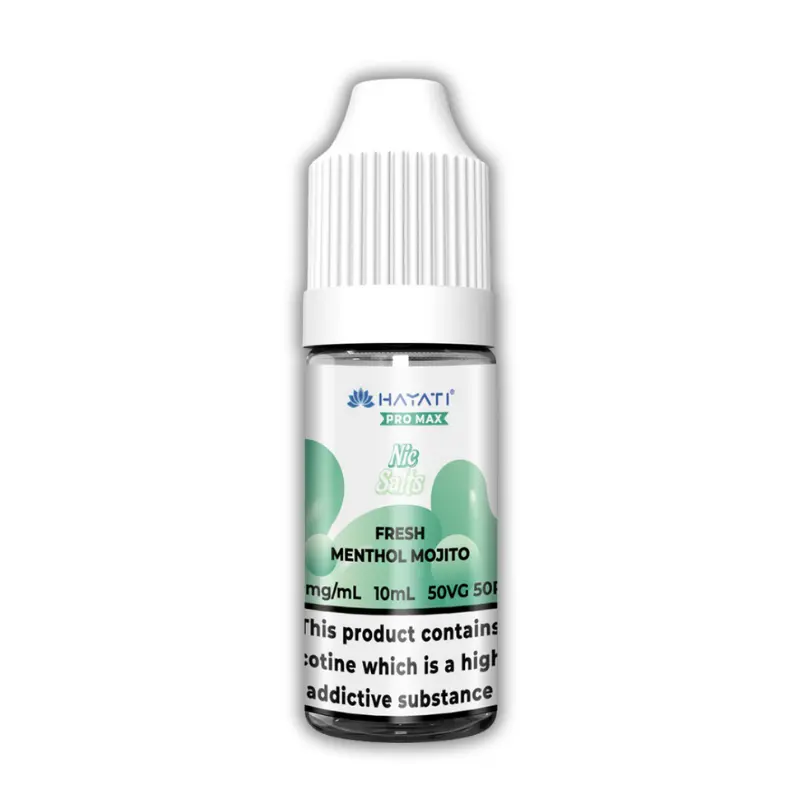
Hayati · Pro Max
Fresh Menthol Mojito Hayati Pro Max Nic Salt
£2.49
✔ In stock — ready to ship
Genuine Hayati
Free over £20
Same-day dispatch
Secure checkout
Fresh Menthol Mojito is a 10ml bottle of 10mg nicotine salt in a 50/50 base, priced at £2.49, sitting on the Hayati Pro Max Nic Salts shelf with sixty-four other bottles at the same money. Lime, mint, menthol. No fruit beyond the citrus, no confectionery layer, and no sweetener named anywhere in Hayati's own copy for it. That is the whole product, and if the volume, the strength and the price are all you came for, you have them.
The reason to read on is a detail in the name. Hayati put a cooling word into the flavour name of 130 of their 492 listings, and in almost every one of them the cold word comes last. Banana Ice. Cherry Ice. Red Apple Ice. Blue Frozen. Kiwi Cooler. Lemon Mint. Black Mint. The flavour is announced, then the temperature is applied to it, in that order, with the grammar of a modifier stuck on the end. This listing does it the other way round. The cold arrives first, twice over, and the thing being cooled is named last.
That inversion is a curiosity on its own and it would not be worth eleven hundred words if it stopped there. It does not stop there. The order of the words in the title turns out to predict the order of the ingredients in the bottle, and more usefully it predicts what the bottle does not contain. Every other mojito Hayati sell is a fruit recipe with a mojito idea laid over it. This one has no fruit in the slot where the others keep theirs, and the cold has moved into that slot instead. A mojito with the fruit taken out is also, as it happens, a mojito with the sugar taken out, because on the other three recipes the fruit was supplying both.
So this page is about two things. What the position of a word in a product name can honestly be made to tell you, counted rather than asserted. And what a mojito is once nothing sweet has been added to it, which is a genuinely unusual thing to find in a range of 492 listings and is the whole character of this bottle.
Where the cold word sits, counted properly
This page was commissioned on the premise that Fresh Menthol Mojito is the only title in 492 where a cooling word sits in front of a non-cooling flavour component, with six listings named as the exceptions that prove it. The premise was checked against the catalogue file that drives this shop before a word of the page was written, because a claim of that shape is exactly the kind that falls over on contact with the data. It fell over. The corrected version is narrower, and it is more interesting than the one handed across.
What was already established, and by whom
The cooling vocabulary has already been counted here. The Blue Frozen family of pages ran a full census of every cold word in the range and published the table: Ice in ninety titles, Frozen in three, Cooler in two, Chill and Freeze in none at all, and no listing anywhere combining an ice-family word with a mint-family word. That census also established, and settled, that the words are not a graded scale. Ice is not colder than Frozen. Cooler is not a step below either. Those figures are not re-derived here and this page takes them as given.
One observation in that census is the direct ancestor of this one. Counting the Ice family, it noted that the ninety listings resolve to twenty-one distinct flavour names, and that nineteen of the twenty-one follow a single grammatical pattern: a fruit or a drink, then the word. What it did not do, because it was asking about which cold word Hayati choose rather than about where they put it, is extend that test beyond the Ice family to the mints, the menthols, the Frozen, the Cooler and the Frosted. That extension is what this page contributes.
The count, across every cooling family at once
Take every listing whose flavour name contains any cooling word at all: Ice, Frozen, Cooler, Mint, Menthol, Frosted, Fresh, Cold. That is 130 of the 492. Several of those are dual listings with two flavour names behind one collar, so counted as individual flavour-name components rather than as products the figure is 136. Reduced to distinct names, ignoring the fact that Banana Ice is sold eighteen times over in different formats, there are thirty-six.
Now apply one mechanical test to each of them. Is the cooling word the last element of the name?
- Of the 136 components, 129 put the cooling word last.
- Seven do not.
- Those seven are three distinct names: Ice Pop, which appears on three listings, Apple Mint Grape, which appears on three, and Fresh Menthol Mojito, which appears on one.
That is a convention holding at better than ninety-four per cent across a range assembled over several years and several platforms, which is tight enough to make the breaks worth examining individually.
The exceptions the brief named, and the one it missed
The premise named six exceptions, two of which were Frosted Mint and Ice Cold, both from the nicotine pouch line. Neither is an exception to the test above. Frosted Mint ends on Mint and Ice Cold ends on Cold, and Mint and Cold are cooling words, so both names end in the cold exactly as the convention requires. What is true of them, and what the premise was probably reaching for, is that they are cooling words all the way through with nothing else in them at all. They never leave the cold, so they cannot break a rule about where the cold stops.
Ice Cold does break a different and narrower test, which is the one the Blue Frozen census applied: it is one of the two Ice names out of twenty-one that is not of the form fruit-plus-Ice. That is a real finding and it belongs to that page. Mixing the two tests together is how a list of six exceptions got assembled out of items that fail different tests for different reasons, and it is worth saying plainly so that nobody reading this page and that one together concludes they contradict each other. They do not. They are counting different things.
The item the premise missed is the one that actually matters. Apple Mint Grape appears on three listings, the two Pro Ultra Plus Shisha 30000 products and the Pro Max Shisha nic salt bottle, and it puts Mint in the middle of the name with a fruit on either side. A cooling word sitting in front of a non-cooling flavour component is precisely what Apple Mint Grape does, three times, and it does it more flagrantly than this bottle does, because Grape is as plain a fruit as the catalogue contains. The handed claim of uniqueness is therefore false, and no amount of squinting rescues it.
There is a second detail in those shisha listings that is worth a sentence, because it demolishes any reading in which the word order is deliberate. Both dual versions of Apple Mint Grape are paired with Peach Grape Mint behind the same collar. Same manufacturer, same product, same 22ml pod, two flavour names, and one puts the mint in the middle while the other puts it at the end. If Hayati had a rule about where a cooling word goes, it is not one they were consulting when they typed those two names.
What survives, and exactly what was narrowed
Two versions of the claim survive the count. One needs no interpretation at all and one needs a single judgement call, which is declared rather than smuggled.
The version that needs no judgement: Fresh Menthol Mojito is the only flavour name in 492 that stacks two cooling words in front of a non-cooling component. Four names in the catalogue carry more than one cooling word. Fresh Mint, Frosted Mint and Ice Cold are the other three, and all three are cold from the first word to the last. This is the only one that spends two words on temperature and then hands the name over to something that is not a temperature. That is checkable by anyone with the product list and a text editor, and nothing about it turns on what you think Ice Pop means.
The version that needs one judgement: it is the only flavour name in 492 in which the cooling vocabulary comes first and a non-cooling flavour component comes last. Apple Mint Grape does not qualify because its name opens on a fruit. Ice Pop opens on a cooling word and closes on a word that is not one, so on a strict reading it qualifies and the claim fails again. The judgement is that Ice Pop is a fixed compound noun for a frozen lolly, in which the Ice names the state of the confection rather than a coolant added to a Pop, and that treating it as an instance of cold-applied-to-flavour misreads ordinary English. That reading is defensible and it is not free, so it is flagged here rather than left implied. If you reject it, the surviving claim is the two-word one above, which stands either way.
So the narrowing, stated once and plainly, is this. The claim handed to this page was that one title in 492 puts a cooling word in front of a non-cooling flavour component. Counting found three names doing that rather than one, on seven listings rather than six, and found the named exception list built from two incompatible tests. What survives is a claim about stacking and a claim about opening position, both of which are true and both of which are smaller than the original. The smaller claims are worth more, because they are the ones that turn out to describe the liquid.
And the same count on this shelf alone
Narrowing to the sixty-five bottles in the Pro Max nic salt range makes the convention easier to see at the point of purchase. Seventeen of the sixty-five carry a cooling word. Fourteen of the seventeen put it last, and they are the ones whose names you can read at a glance: Banana Ice, Blackberry Ice, Cola Ice, Bru Ice, Strawberry Raspberry Ice, Blue Frozen, Black Mint and the rest. One is nothing but the cold word: Menthol. One is cold throughout, Fresh Mint. One is Ice Pop. And one is this bottle. On the shelf where you are most likely to be standing, the break is visible without a spreadsheet.
The grammar tracks the recipe
A naming quirk is only worth the page if it predicts something. This one does, and the way to see it is to line the mojitos up.
Hayati sell seven mojito listings across three platforms, resolving to four distinct recipes, and every one of the seven names mint in its description while not one of the seven names mint in its title. Six of the seven name lime as well. That census, the copywriting-variant finding that explains the seventh, and the argument that mojito is an ingredient word wearing a drink's clothes all belong to the Strawberry Mojito bottle page, which did the work properly and which this page takes as settled rather than repeating. The separate argument about what a cocktail name cannot deliver in a sealed format, and the fact that no listing in the range names a spirit, belongs to the Blue Razz Mojito pages. That is not re-argued here either.
What has not been said is what the four recipes look like as a set of grammatical constructions rather than as a set of flavours.
- Blue Razz Mojito. A confectionery fruit, then the drink word.
- Strawberry Mojito. A soft fruit, then the drink word.
- Strawberry Raspberry Mojito. Two soft fruits, then the drink word.
- Fresh Menthol Mojito. Two cooling words, then the drink word.
Three of the four fill the modifier slot with something you could put in a bowl. The fourth fills it with a sensation. Read as a set, the pattern is not that this listing has an odd word order. It is that this listing has substituted a coolant for a fruit in a fixed frame, and the frame is doing the same job in all four cases: the word before mojito tells you what the lime and the mint are going to be arguing with.
On three of the four the answer is a fruit, and a fruit brings body and sweetness with it. On this one the answer is more cold, which brings neither. The consequence is not subtle and it decides most of what follows. This is the only one of the four mojito recipes with no fruit outside the citrus. There is nothing for the lime to cut through and nothing for the mint to keep in check, because the thing those two components exist to restrain on the other three recipes has been removed. What is left is the restraining apparatus with nothing to restrain, plus a menthol on top of it.
Which is a description of a much starker liquid than the title's third word suggests, and it is worth being blunt about, because a buyer who reads mojito and thinks cocktail will be expecting the sweetness the word implies. The name promises a drink that is famously sweetened. The recipe supplies no sweetener of any kind.
A mojito with the sugar taken out
That last sentence is not a figure of speech and it is not an inference from the cold words. It is what the listing says, or rather what it conspicuously does not say, and the omission is measurable.
The sweetness word, listing by listing
Line up the descriptive copy for all seven mojito listings and look only for words in the sweetness family: sweet, sweetness, sugary, syrup, jammy, ripe, juicy, candied. The technique of diffing a flavour's own listing set is borrowed rather than invented, and it earns its keep again here.
- Blue Razz Mojito, bottle: sweet, sugary.
- Blue Razz Mojito, pods: sweet, sweetness.
- Blue Razz Mojito, kit: sweetness, sugary, sweet.
- Strawberry Raspberry Mojito, pods: sweet, jammy.
- Strawberry Raspberry Mojito, kit: sweetness, sweet.
- Strawberry Mojito, bottle: ripe, sweet, juicy, sweetness.
- Fresh Menthol Mojito, bottle: none.
Six listings out of seven reach for a sweetness word, most of them more than once. This one reaches for none. Not one word in the sweetness family appears anywhere in Hayati's copy for this bottle, in the opening paragraph, the flavour paragraph or the bullet list.
The obvious objection is that copywriters vary and an absence proves nothing, which is a fair objection and the right way to test it is to widen the frame. Across all 492 listings, the number whose description contains no sweetness word at all is fourteen. Three of those fourteen are hardware entries for the Quokka devices, which have no flavour to describe. Two are nicotine pouches. Of the nine remaining liquids, several are the mood-named listings whose copy is vague about everything rather than specific about the absence of sugar, and the information-gap problem those names create is the subject of the Black Mamba page rather than this one.
Nine liquids out of 492 with no sweetness word, and this is one of them. That is rare enough that silence starts to look like description rather than oversight, and it lines up exactly with what the ingredient list implies. Lime is an acid. Mint is a herb. Menthol is a sensation. None of those three carries sugar, and there is nothing else in the bottle.
What the fruit was doing on the other three
Here is the part that makes the name worth all this attention. A mojito in a glass is five things: a spirit, lime, mint, sugar and soda. A 10ml bottle can carry two of those five honestly and the spirit question has been settled elsewhere. What is easy to miss is that sugar is not a garnish in that list. Unsweetened lime and mint in soda water is a completely different drink from a mojito, and the syrup is load-bearing in the way the lime is.
On Blue Razz Mojito the sugar arrives as a confectionery blue raspberry, which is a sweet wearing a fruit's name. On the two strawberry recipes it arrives as ripe red fruit. In all three cases the fruit named in the title is doing double duty: it is the headline flavour and it is the syrup. Remove it and you do not lose one component, you lose two, and nothing in this recipe replaces the second one.
So the honest description of this bottle is not a mojito with extra cold. It is a mojito reduced to its two botanicals and its temperature, with the sweetening element removed and not substituted. Whether that is still a mojito is a reasonable question and the answer is a matter of taste rather than of fact. What is not a matter of taste is that a buyer who expects the shape of the other three will not get it.
The counter-argument, which is real
One thing cuts against the starkness and it should be stated rather than buried, because it is the reason plenty of people will get on with this bottle perfectly well. A heavy coolant is often read as sweet by a palate that has no sweetener to compare it with. The Double Menthol pods page works through why that happens and this page does not repeat the mechanism. The practical upshot is that the absence of sugar in the formulation does not guarantee the absence of a sweet impression in the mouth, and on a liquid with this much menthol in it the impression may well arrive.
What it will not do is behave like sugar. A sweet impression produced by a cold signal has no weight and no length. It does not coat, it does not build, and it vanishes the moment the cold does. So the correct expectation is a liquid that may read as faintly sweet on the first few draws of a session and reads as dry for the rest of it, which is a different thing from a liquid that is sweet.
The direction of correction, inverted
The listing diff turns up a second pattern, and this one is the tidiest piece of evidence on the page that Hayati knew what they were building.
Every mojito description explains what the mojito element is for. Read the six others and the explanation is always the same shape:
- The mint sits underneath so the berry never tips into cloying territory.
- The lime cuts through the fruit so the berries never feel heavy.
- The mint keeps the berries bright so it tastes fresh rather than jammy.
- The mint and lime cut through the sweetness.
- The mint keeps the razz from feeling sugary.
- The citrus stops the sweetness from building up over a long session.
Six statements, one job. The herb and the acid are brakes, and the thing they are braking is the sugar. That is the standard function of a mojito accord on a fruit liquid and it is why the pairing exists at all.
Now the seventh. This listing says the citrus is there in enough quantity to keep the liquid lively rather than purely icy. The brake is still present, but it has been turned round to face the other way. The citrus is no longer restraining the sweetness, because there is no sweetness to restrain. It is restraining the cold.
That inversion is worth more than the title observation on its own, because it is independent confirmation of it. The word order changed, the direction of correction changed with it, and both changed in the same direction: cold moves from the thing being added to the thing being managed. A single odd title could be a typing accident. A title and a description that are odd in the same way, on the same product, in a set of seven where the other six agree with each other, is a recipe difference showing through the copy.
One caution on reading too much into any single phrase. This site has caught house vocabulary masquerading as evidence more than once, and words like fresh and cool appear on dozens of listings without meaning anything in particular. The reason the inversion above survives that caution is that it is not about which words were chosen but about which noun the corrective clause points at, and across seven listings that target changes exactly once.
What an unsweetened lime and mint liquid actually does
The counting is over. From here on this is a description of a liquid, offered as a description and not as a guarantee, since palates differ and the same bottle in two devices is not the same experience.
The short half and the long half
Most flavoured liquids have a single arc: something arrives, develops and fades. This one has two arcs of very different lengths running on top of each other, and separating them is the most useful thing you can do on a first fill.
The short arc is the flavour. Lime lands almost immediately, reading as peel rather than juice, which is to say aromatic and green rather than sour. The mint appears fractionally behind it as a vegetal line with a faint bitterness at its edge, the way a leaf tastes rather than the way a sweet tastes. Both are present and both are finished quickly. By the middle of the exhale the taste component has largely done its work, and there is nothing underneath it to carry on.
The long arc is the sensation. Menthol builds through the draw, spreads backwards across the palate and into the throat, and keeps going well after the vapour has gone. A mouthful of room-temperature water taken half a minute later will read colder than it is. That tail is the dominant impression the bottle leaves and it is the reason the title is honest about its priorities even while it is unusual in its word order.
So the structure is short flavour, long sensation, with a gap in the middle where a sweeter liquid would have body. That gap is not a fault and it is the single most important thing to know before buying. On a fruit mojito the fruit fills it. Here nothing does.
Two cold words, and whether you can taste the difference
The listing credits mint and menthol with separate jobs in the same sentence, one supplying a herbal coolness and the other pushing the chill further. That is unusual in the range and the Strawberry Mojito page has already used it as evidence that Hayati do not treat the two words as synonyms. Taking that as established, the question this bottle raises is whether a buyer can actually perceive the split.
Partly, and the part you can perceive is the herb rather than the coolant. Menthol on its own has very little taste attached to it, which is the whole subject of the Menthol bottle in this same line. Mint has a great deal. So the detectable difference is not two grades of cold, which would be very hard to separate, but the presence of a green, slightly bitter, aromatic taste sitting inside a cold sensation that has no taste of its own. If you can find the greenness, you have found the mint. Everything else you are feeling is the menthol.
Anyone who has run a lot of iced fruit and no herbs should expect that greenness to read as strange for the first few millilitres. Iced fruit trains you to expect cold with nothing attached, and this has something attached. It is worth half a bottle before forming a view.
How cold, in plain terms
Substantially colder than the fruit mojitos and not as cold as a bottle whose only job is cold. Place it above the iced fruits, since an iced fruit spends part of its budget on a fruit and this spends none, and below Menthol, which has no flavour competing for room at all. The chill arrives inside the draw rather than at the end of it, which is not how the iced fruits behave, and it does not let go quickly.
Two things follow for a buyer. If you have found the iced fruit bottles insufficiently cold, this is a step up from them and the step is a real one. If you have found the mints and menthols too much, this will not rescue you, because the lime and the mint do not reduce the menthol. They sit alongside it.
What it is not
Not sweet. Nothing in the recipe supplies sugar and Hayati's copy names none.
Not a fruit liquid. Lime is technically a fruit and functionally an acid, and it behaves here as a sharpener rather than as something you taste for its own sake.
Not a plain menthol with a twist. There is a real herb in it and a real citrus, and both take up room. If what you want is one sensation delivered at a level you choose, the plain bottle does that and this does not.
Not a mild version of anything. It is one of the colder bottles on the shelf.
Not alcoholic. It contains no alcohol, as no liquid in the range does.
Over a session, the title reverses itself
The most interesting behavioural property of this bottle only shows up over an hour rather than over a draw, and it follows directly from having no sugar in it.
Cold is a sensation reported by a receptor, and a receptor under repeated stimulation reports less over time rather than more. The Menthol bottle page works through how that squares with Hayati's copy claiming the chill builds, and resolves it: accumulation is real across the first few draws of a session, adaptation dominates across an hour. That resolution is theirs and is taken as read.
Apply it to this recipe and something specific happens. The menthol is the long element, the lime and the mint are the short ones, and adaptation acts on the long element only. Forty minutes into a session the cold has flattened considerably while the lime and the herb are arriving as sharply as they did at the start, because nothing about them has changed. The proportions invert. A bottle that opens as a cold product with a citrus edge ends the session as a citrus and herb product with a cold background.
Which means the title is accurate about the first ten minutes and misleading about the rest, in precisely the way the word order suggests. Cold first, mojito last, is the order in which you meet them. Mojito first, cold last, is the order you end up in.
This is genuinely useful rather than merely neat, and it cuts two ways. If you buy the bottle for the cold, note that the cold is the part that fades and the flavour is the part that stays, so a long session will drift away from the reason you bought it. If you buy it for the lime and the mint and find the menthol excessive on the first draws, that is the part that recedes, and the bottle you dislike at the start may be the bottle you like an hour later. Either way the advice is the same: judge it late in a session rather than early, which is the opposite of the advice that suits a sweet liquid.
There is a related effect worth knowing about and it works in the other direction. The lime is the most volatile thing in the bottle, so across the weeks that a 10ml takes to empty it quietens with every opening and closing of the cap. The menthol and the mint sit lower and are more stable. The bottle therefore gets colder relative to its own flavour as it ages, while any single session gets warmer relative to its own flavour as it runs. Those are two separate clocks pointing opposite ways, and the practical version is simply that a fresh fill late in a bottle's life is the coldest this liquid ever gets.
The bottle, and the one specification that matters here
Ten millilitres of liquid, 10mg nicotine salt, a 50/50 base of vegetable glycerine and propylene glycol, a cap, and nothing else. No device, no coil, no hardware of any kind. What a 50/50 mix does in a small mouth-to-lung coil, how it wicks, and why it is a poor match for a sub-ohm tank are covered at length across the Hayati E-Liquids pages, and a fifth account of it here would waste your time when sixty-five bottles on this one shelf share every word of it.
One property is specific to this liquid and is worth the space instead: the ratio is doing unusually visible work here, because propylene glycol is the half of the mix that carries aromatic compounds and this liquid is almost entirely aromatic compounds. There is no glycerine-friendly sweetener and no heavy fruit body for the thicker half of the base to carry. A 50/50 split on a dense confectionery liquid is a compromise between throat and vapour. On this one it is closer to being the point, since the lime, the mint and the menthol all ride on the same half of the mix and all three arrive together as a result.
The practical consequence is that this bottle is more sensitive to how hard you run it than a sweet one is. Aromatic herbal compounds turn before sugars do, and when they turn they go bitter and slightly soapy rather than caramelised, which is an abrupt change rather than a gradual one. If this ever tastes acrid instead of green, suspect the coil temperature before you suspect the bottle.
Beyond that, Hayati publish volume, strength and ratio for this product and nothing about the bottle as an object. No cap type, no nozzle, no dropper detail. So none of that is described here. Look at what arrives before you tip it over a pod.
The numbers, and which of them decide anything
| Flavour name | Fresh Menthol Mojito |
| Components Hayati name | Lime, mint, menthol |
| Sweetener named | None |
| Fruit named beyond the citrus | None |
| Nicotine | 10mg nicotine salt |
| Base | 50/50 VG/PG |
| Volume | 10ml bottle |
| Price | £2.49 |
| Stock code | HPM-NS-FRESH-MENTHOL-MOJITO |
| Brand and line | Hayati, Pro Max |
| Suited to | Refillable pods and higher-resistance mouth-to-lung coils |
| Not suited to | Sub-ohm tanks, on both strength and viscosity |
| Device supplied | No |
Two rows in that table are not rows a spec table would usually bother with, and they are the two that decide the purchase. Recording that no sweetener is named and that no fruit is named beyond the citrus is a statement about the label rather than about the formulation, and on a product whose entire character is an absence, the absence deserves a line of its own rather than being left for the reader to notice.
The strength line deserves one flat observation and no advice. Ten milligrams is the lower of the two figures this range uses. Nicotine is addictive, and what strength suits anybody is not a question a retail page has any business answering.
The price line is worth an arithmetic that the prefilled formats cannot match. At £2.49 for 10ml you are paying just under twenty-five pence per millilitre, which is the standard rate across this shelf and the cheapest way the range sells liquid. The relevance to this particular bottle is higher than usual, because a cold, unsweetened liquid is a profile plenty of people use as a palate reset between other flavours rather than as an all-day choice. A 10ml bottle is a sensible unit for something you reach for occasionally. A sealed prefilled pod of the same idea is not, since anything you do not finish goes in the bin with the pod.
The last row matters more here than on most bottles. Because the herb has a narrower heat tolerance than a sugar does, choosing your own hardware is a live decision rather than an inconvenience, and a device whose output you can adjust will let you find the setting at which the mint stays green.
Where it sits among sixty-five neighbours
The useful comparisons divide by what you came for, and the divisions matter more on this bottle than on a fruit blend, because several groups of buyers will find it is not what they were looking for.
If you came from the fruit mojitos
Adjust your expectations rather than your dose. Strawberry Mojito at the same £2.49 is the closest relation on this shelf and it is a substantially different proposition: a soft red fruit holding up the sweet register, with the lime and the mint working against it. Blue Razz Mojito is sweeter still, built on a confectionery blue raspberry that is robust enough to argue back. If the mojito accord is what you enjoy and the fruit is incidental to you, this bottle is the concentrated version of what you like. If the fruit was half the pleasure, this removes half the pleasure.
If the cold is the point
Then the question is how much flavour you want alongside it. Menthol is the version with nothing else in it, and its own page sets out why a single-sensation bottle is a different category rather than a stronger member of this one. Blue Frozen sits the other way about, with a fruit idea under a heavy cold, and the pages on that flavour are where the cooling vocabulary was counted. Between the two, this bottle is the one that puts a green herbal taste inside the cold rather than a fruit underneath it.
If you want the cold applied to a fruit instead
This is the largest group of neighbours by some distance, and the naming convention counted earlier makes them easy to find, since they all wear the cold word at the end. Strawberry Raspberry Ice is the red-fruit answer and the most direct comparison with the strawberry mojitos, since it reaches a similar place with a coolant instead of a herb. Blackberry Ice does the same on a darker berry. Banana Ice is the soft, low-acid option at the opposite end from the lime. Cola Ice and Bru Ice are the two drink-named cold bottles on the shelf, which makes them the nearest structural cousins to a mojito even though neither tastes remotely like one.
If it is the citrus you are after
Lime is the acid here and it is not sweetened, which is unusual. The lemonades are where the range puts a citrus with sugar behind it: Pink Lemonade is the plainest of them, Berry Lemonade adds a fruit floor, Blackcurrant Lemonade puts a dark berry against it and Blue Razz Lemonade takes the confectionery route. All four give you citrus with something under it. This gives you citrus with nothing under it, which is the whole difference. For a citrus treated as a third fruit with body of its own rather than as a corrective, Blueberry Raspberry Lemon and Lemon Peach Passionfruit are the two to look at.
If you want sharpness without the cold
Several bottles get their lift from acid rather than from temperature. Blue Sour Raspberry takes sourness furthest and does it with the fruit rather than with a separate citrus. Strawberry Cherry Cranberry uses a genuinely tart berry for the same purpose. Blackcurrant Juice is the closest thing on the shelf to a single fruit with its own natural tartness and nothing else added. None of the three has a cooling agent anywhere in it.
If you want the herb without the menthol
Black Mint is the shelf's other herb-and-fruit construction, with a dark berry supporting a mint that is the stated core rather than a component. Fresh Mint in the same line is the herb on its own. Both put the plant in front, which is the inverse of what this bottle does, since here the plant is sandwiched between an acid and a coolant.
If you have come from the sweet end
Be warned rather than encouraged. Blue Razz Gummy Bear and Strawberry GB are confectionery all the way through, and Juicy Peach is soft, round fruit sweetness with no corrective at all. Coming to this bottle directly off any of those will make it read as austere to the point of feeling unfinished. That impression is largely an artefact of the comparison and it settles within a pod, but the first half hour is genuinely unpleasant if you do not know to expect it.
Shelves rather than single bottles
Three places are worth browsing from here. The Menthol Vapes shelf holds twelve listings across every format Hayati make and is the fastest way to see how narrow the cold-first end of the range actually is. The Pro Max Nic Salts shelf is the sixty-five bottles this one competes with directly. And the full listing of 492 is where the counting in the first half of this page came from, if you want to check it. Two of the shelf's named-for-a-mood bottles, Blue Fusion and H'Bubba, are worth knowing about mainly as the opposite problem to this one: their names tell you nothing, where this name tells you the recipe if you read the word order.
Living with a bottle that has nothing sweet in it
Most of the standard handling applies here exactly as it does to every 10ml in the range. What follows is the part that is specific to a cold, dry, unsweetened liquid, because that is the part worth your attention.
Soak a new coil properly before you draw on it. Fill, wait a few minutes, then pull two or three times with no power. A scorched wick on this liquid does not announce itself as burnt sugar, because there is no sugar. It announces itself as a bitter, soapy note off the herb, which is easy to mistake for a bad bottle rather than a dry wick.
Run it cooler than you would a fruit. The window between the setting where the mint is a green line and the setting where it is an acrid one is narrower than the equivalent window on a sweet liquid, and the transition is abrupt. Start low and come up in small steps until the greenness is clear, then stop there rather than exploring further.
Give it its own pod. Menthol and mint aromatics are small, volatile and persistent, and they soak into plastic. A pod that has run this will faintly cool whatever goes in after it however carefully you rinse. One pod for the cold liquids and another for everything else costs less than the flavours you would otherwise spoil, and on this bottle the problem is worse than on a plain mint because you are transferring a citrus as well.
Mind what follows it, not what precedes it. Coming to this off almost anything is fine, since the cold overwrites whatever was there. Going from this to something delicate is not, because the menthol tail outlasts the session. Dark berries and sour fruit handle the residue. Soft fruit and confectionery do not, and a peach straight after this will taste of almost nothing.
Expect the coil to keep going longer than a sweet bottle's. Sweetener is what caramelises on a hot coil and dulls a pod inside a few days, and there is none here. The usual signal that a coil is finished on this liquid is a drop in vapour rather than a change in taste, and a second signal specific to this one: when the lime stops arriving and only the cold does, the coil is nearly gone, because the citrus is the most delicate thing in the bottle and the first casualty of a tired wick.
Keep the cap on and the bottle cool and dark. The lime is what you lose first to air and light, and the lime is load-bearing on a recipe with nothing else doing its job. Store it upright, closed between fills rather than left open beside the device, and somewhere children and animals cannot get to it. When it is empty, the bottle and the cap go to a plastics collection rather than into general waste.
Judge it on the second pod. A green herbal aromatic inside a heavy cold is unfamiliar to most rotations, and unfamiliar reads as wrong before it reads as anything else. Three or four millilitres is a fair test. Plenty of people decide this is not for them, and rather fewer decide it after a full pod than after three draws.
Questions this bottle raises
Is there actually mint in it, or is menthol doing all the work?
Both are named in Hayati's own description and they are credited with different jobs in the same sentence, the mint with a herbal coolness and the menthol with pushing the chill further. What you can detect is the difference between a taste and a sensation: the green, faintly bitter line is the mint, and the broad cold with no taste attached to it is the menthol.
How sweet is it?
No sweetener is named, no fruit is named beyond the lime, and no word in the sweetness family appears anywhere in Hayati's copy for this bottle. Six of the seven mojito listings in the range use at least one such word and this is the seventh. A heavy coolant can read as faintly sweet to a palate with nothing to compare it against, but nothing in the recipe supplies sugar.
Is this colder than the Ice bottles?
Very likely, because an iced fruit spends part of its flavour budget on a fruit and this spends none, but nobody can put a figure on it. Hayati's cooling words are not a graded scale and the Blue Frozen pages settled that with a full census rather than an opinion. What can be said is that this is cold-led in a way the iced fruits are not, and that it arrives inside the draw rather than at the end of it.
Why is the cooling word at the front of the name?
Because the cold is occupying the slot that a fruit occupies on every other mojito in the range. Of the 136 flavour-name components in the catalogue that carry a cooling word, 129 put it last. This is the only name in 492 that stacks two cooling words in front of a component that is not itself cooling.
Does it taste like a real mojito?
It carries two of the drink's five components honestly, the lime and the mint, and it carries the temperature. It does not carry the sugar syrup, which the other three Hayati mojito recipes supply through their fruit. Whether a lime, mint and ice drink with no sweetening is still a mojito is a matter of opinion. It is certainly a different drink from the one the other three are describing.
Can I use it in a sub-ohm tank?
No. The 50/50 ratio is too thin for one and the nicotine strength is matched to a restricted mouth-to-lung draw rather than to a high-output coil. This is the same answer every 10ml salt bottle on this shelf gives, and it is worth checking what your device is built for before filling it.
Why does it sometimes taste bitter or slightly soapy?
That is usually the herb running hotter than it wants to. Green aromatic compounds turn before sugars do and the change is abrupt rather than gradual, so a setting that was fine yesterday can be over the line today with a slightly older coil. Drop the power, leave a longer gap between draws, and taste it again before writing the bottle off.
Does it get colder or warmer as a session goes on?
Warmer, in effect, though nothing about the liquid changes. Cold is a sensation and a receptor under repeated stimulation reports less of it over time, while the lime and the mint are tastes and carry on arriving unchanged. Forty minutes in, the proportions have shifted towards the citrus and the herb, which is the reverse of the order the title puts them in.
How does it compare with the plain Menthol bottle at the same price?
That one is a single sensation with almost no taste attached and a level you set with your hardware. This one puts a real citrus and a real herb inside the cold, so there is something to taste as well as something to feel. Its own listing pitches it at people who want more going on than a plain menthol offers, which is a fair description of the difference.
Will it ruin the next flavour in the pod?
It will affect it, yes. Menthol and mint aromatics soak into plastic and persist through a rinse, and this bottle adds a citrus to the problem. If you rotate flavours, keep a pod for the cold liquids and another for everything else. Anything soft or delicate run immediately after this will be measured against a residue it cannot compete with.
Is a 10ml bottle the right size for something this specific?
It is the smallest unit the range sells this liquid in, at just under twenty-five pence per millilitre, and that matters more here than on a bottle you would use all day. A cold unsweetened profile is one plenty of people keep as an occasional reset rather than a daily choice, and 10ml is enough to find out which you are without committing to a sealed prefilled format you cannot decant.
Does the bottle change as it sits open?
The lime goes first. It is the most volatile thing in the recipe and it quietens with every opening of the cap, while the mint and the menthol sit lower and are more stable. The effect is that the bottle gets colder relative to its own flavour over the weeks it takes to empty, so keep the cap on between fills and buy one at a time rather than opening three.
The short version
A 10ml bottle of 10mg nicotine salt in a 50/50 base at £2.49, built from lime, mint and menthol, with no fruit outside the citrus and no sweetener of any kind. The name is the clue and it is worth reading carefully: of the 136 flavour-name components in this catalogue that carry a cooling word, 129 put the word last, and this is the only one of the 492 that stacks two cooling words in front of something that is not cooling. The handed version of that claim said one listing in 492 and named six exceptions. Counting found three names breaking the rule across seven listings, with Apple Mint Grape a clear counterexample the original missed, so the claim was narrowed to stacking and to opening position, and both of the narrowed versions hold.
The word order predicts the recipe. On the three fruit mojitos the drink word modifies a fruit, and that fruit is quietly doing the job of the sugar syrup as well as being the headline. Here the cold occupies the fruit's slot, so both jobs go unfilled, and the listing's own copy confirms it twice over: no sweetness word anywhere in the description, and a corrective clause that points at the cold rather than at the sugar, which is the reverse of what the other six listings do.
Buy it if you want a cold, dry, citrus and herb liquid with nothing underneath it, and if you like the mojito accord well enough to want it without the fruit. Avoid it if you came for a cocktail's sweetness, if lime is a flavour you steer around, or if you wanted a mild introduction to the cold end of the range, because this is not one. It is an honest bottle with an unusual name, and the unusual part of the name turns out to be the most accurate thing on the label.
Strictly for adults aged 18 and over. Nicotine is an addictive substance.
You might also like


