
Home / Hayati Pro Max Nic Salts / Cola Lime Hayati Pro Max Nic Salt
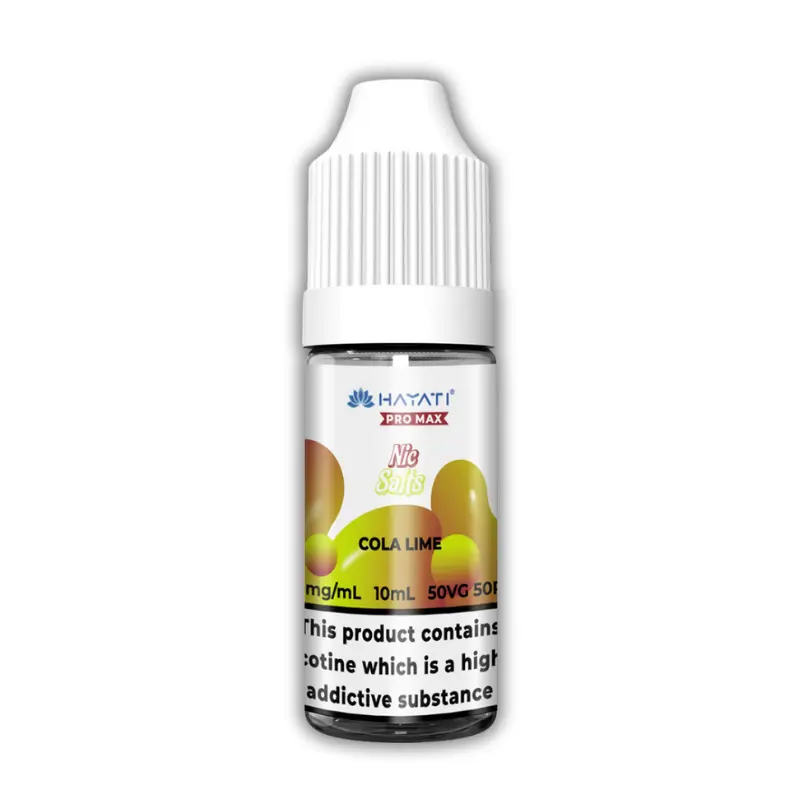
Hayati · Pro Max
Cola Lime Hayati Pro Max Nic Salt
£2.49
✔ In stock — ready to ship
Genuine Hayati
Free over £20
Same-day dispatch
Secure checkout
Two pounds forty-nine buys ten millilitres of Cola Lime as a 10mg nicotine salt on an even glycerine and glycol base, under the stock code HPM-NS-COLA-LIME. There is no device in the purchase, no pod, no heating element and nothing to charge. It is liquid and a cap, and the whole of what you are buying is the contents of the bottle.
That is the third time Hayati sell this flavour. The other two are sealed: a bare 12ml pod at £5.49 and the same pod packaged with a body at £7.99. The three tickets are usually set side by side and divided by their fills, which produces a ranking, and the ranking has already been published on this site by a page that had a better reason to publish it than this one does.
This page does not do that division again and it does not describe the taste. Eighteen listings carry a cola in this catalogue and thirteen pages have already been written across them, two of those on this exact liquid. The chemistry, the naming argument, the draw-by-draw and the ownership arc are all finished, and a fourth account of how lime sits on a cola accord would be a worse version of something already on the site. What is not finished is a question about money, and it only becomes visible once you accept what the earlier pages found.
Here is the question. Our page for the complete kit established that this particular blend loses its brightness before it loses its liquid, and that on a sealed pod there is no way to get the brightness back, because the part responsible is welded into the thing you would have to throw away. That finding is about a coil. It is not about Cola Lime, and it would be true of any liquid whose identity sat in a light aromatic. What is about Cola Lime is that one of its three listings puts that coil in your hands instead of in the packaging, and the useful thing to work out is what each format charges you for a repair the sealed ones cannot perform at all. Not cost per millilitre. Cost per restoration.
What is already settled, and by which page
Six arguments are closed. Setting them out first is not throat-clearing, it is what allows the rest of this page to be narrow, and it is also the honest way to show that the argument below is a remainder rather than an invention.
The decay belongs to the Cola Lime Pro Max Plus 6000 Pod Kit page. That page measured this blend on three timescales and got the same answer from all three, which it summarises as brightness declining while the base becomes steadily more legible, so that Cola Lime keeps turning back into cola. It sets out four phases across a 12ml pod, it identifies the citrus as the lightest material present and therefore the first thing a tiring coil stops carrying, and it puts the turn somewhere in the last third of the fill. It also weighs whether that drift is an improvement or a swindle and reaches a verdict. None of that is re-derived here and anyone wanting it should read it there.
The name belongs to the Cola Lime Pro Max Plus Pods page. Its subject is whether a second word in a product name imports a new ingredient or raises the volume on something the cola accord already contains, and it measures lime against the lemon and orange oils that are conventionally inside that accord. It reaches a verdict, it describes the draw in the order things arrive, and it records that lime never appears on its own anywhere in this range. That page's count of three Cola Lime listings is the count this page starts from.
The cola family's prices belong to the Lemon Cola Ice Rubik Pods page. It reduced every cola liquid in the catalogue to a cost per millilitre and printed the lot in one table, which nobody had done, and the three figures relevant here come from it: 24.9p for this bottle, 45.8p for the sealed 12ml pod, 66.6p for the same pod with a body attached. It also flagged, rather than hid, the reason those numbers do not settle anything on their own.
The unpriced coil belongs to the Blue Razz Gummy Bear Hayati Pro Max Nic Salt. That page searched all 492 listings and found that mentions of a coil occur on bottles and on nothing else, that no listing anywhere publishes a resistance figure, and that the catalogue does not stock the part it tells bottle buyers they will need. Its conclusion is that a true running cost for a bottle is not computable from anything published, and that inventing one would be the pricing version of inventing a hardware specification. That conclusion is correct, it applies to this bottle without amendment, and the arithmetic below is built to respect it rather than to get around it.
The format inversion belongs to the range listing for Hayati Pro Max Nic Salts. Its finding is that a prefilled pod ties the working life of its heater to the working life of its contents, and that decanting the same recipe out of a bottle unpicks that knot, so a fading flavour becomes something you service rather than something that ends a purchase. It then counts what the bottle costs you in things other than money: you become the hardware department, there is a filling step, there is a priming step, and the menu of flavours is a different menu. All of that is general to the shelf. This page is the specific case.
The recipe's opacity belongs to the Raspberry Cola Pro Ultra Plus page, which works through what it means to buy a flavour whose reference is a formula nobody publishes. The relevant consequence here is a caution rather than a finding, and it is set out in its place below.
One smaller thing, noted and left alone. This listing's own copy names Cola Ice as a switching partner, and the practice of a Hayati listing pointing at a named neighbour has been counted properly on the Berry Lemonade Hayati Pro Max Nic Salt page and analysed as a structure by the Cola Ice Hayati Pro Max Nic Salt. The pointer exists. What it means is theirs.
The claim I was given, and what counting did to it
The argument arrived in a strong form: that this is the only Cola Lime where the difference between a serviceable coil and a bonded one has a price attached, and that the bottle is therefore a special case on the shelf. Rarity claims in this range have a poor record, so it was worth counting before building anything on it. Four counts, run against the catalogue as it stands.
The counts
Three listings carry the name Cola Lime and exactly one of them is liquid on its own. True, and thinner than it sounds, because a range that sells a flavour as a bottle and as sealed pods will produce that ratio automatically.
The shelf of bottled Pro Max salts holds 65 listings, of which 63 name a single flavour and two are range-level entries. Of those 63, exactly 43 also exist as a bare Pro Max Plus pod and as a complete Pro Max Plus kit. That is the arrangement Cola Lime is in, and it is not a peculiarity. It is the commonest shape on the shelf, covering two thirds of it.
Twenty-four of the 63 have exactly three listings sitewide, no more and no fewer. Cola Lime is one of twenty-four, alongside names as unrelated as Blue Razz Mojito, Blackberry Ice, Blackcurrant Juice and Blue Frozen.
Widen it again and fifty of the 65 shelf listings share a flavour name with at least one sealed product somewhere in the range. Fifteen exist in bottled form only. So the choice this page is about, between owning the coil and renting it inside a pod, is live for fifty flavours and settled by default for fifteen.
What survives, stated narrowly
The strong version does not survive and it should not be written as though it had. Nothing about Cola Lime's position in the catalogue is unusual. It occupies the most ordinary structural slot the shelf has, at the most ordinary price, in the most ordinary configuration.
Here is the narrowed claim, which is the one the rest of this page rests on. The choice of format is generic. What is not generic is the match between this particular liquid's failure mode and what a serviceable coil actually repairs. A coil that has accumulated residue stops carrying light aromatics first and carries heavy sweetness almost to the end. On most of the shelf that means a flavour loses its lift and keeps its identity. On this one the light aromatic is the identity, which is the kit page's finding and not mine, and that turns a gradual dulling into the removal of the reason you bought the bottle. Replacing a coil is worth more on a liquid whose first casualty is its name.
So the claim is narrowed from a statement about the catalogue to a statement about the liquid, and it is smaller and better for it. The bottle is not an unusual product. It is an unusually well matched one, for a reason another page established and this one is spending.
Restoration, and why it is a better unit than a millilitre
A cost per millilitre answers the question of what the liquid costs. It is a good question and it has an answer. It is not the question a person asks in week three, which is narrower and more urgent: the bright end has gone, what does it cost me to get it back, and what do I lose in the process.
Call that transaction a restoration. It has two prices, not one. There is what you hand over, and there is what you throw away in order to hand it over, and on the two formats those two prices fall in completely different places.
On a sealed pod there is no component-level repair available, because the coil is bonded in and there is no service point on the object. The smallest unit in which a restoration can be bought is a whole new pod. You pay £5.49 and you discard everything still in the old one.
On a bottle the unit is a coil. You pay whatever a coil costs, the liquid is exactly where it was a minute before, and nothing is discarded except a small worn part. The bottle does not become fuller or emptier as a result of the repair, which is the entire structural difference and the only thing this page is really about.
| Listing | Ticket | Fill | Rate for the liquid | Smallest restoration you can buy | Liquid destroyed by it |
| Cola Lime Hayati Pro Max Nic Salt | £2.49 | 10ml | 24.9p | One coil, price not published anywhere on this site | None |
| Cola Lime Hayati Pro Max Plus Pods | £5.49 | 12ml | 45.8p | One entire pod at £5.49 | Whatever is left in the old one |
| Cola Lime Hayati Pro Max Plus 6000 Pod Kit | £7.99 | 12ml | 66.6p | One entire pod, after the first purchase | Whatever is left in the old one |
The three rates in the fourth column are the Rubik page's figures and are quoted rather than recalculated. The fifth and sixth columns are the point of the table and they are what nobody has set out before.
The arithmetic, with the unknown left where it is
The sealed side, which can be worked out exactly
Everything needed for the sealed calculation is published or has been established on this site, so it can be done properly and then checked.
Start with the fraction. The kit page places the turn in the last third of the pod and gives a plain estimate of what that means in volume: roughly eight or nine of the twelve millilitres before the front begins to narrow, followed by three or four millilitres of something the buyer did not choose. Take that as the input, since it is the only figure on the record and it belongs to the page that did the work.
Now divide the ticket by the bright millilitres rather than by the fill. On the bare pod, £5.49 spread across nine millilitres is 61.0p a millilitre. Across eight it is 68.6p. The headline is 45.8p, so a buyer who retires the pod when the lime goes has paid between 1.33 and 1.5 times the advertised rate for the liquid that actually delivered the product they chose.
Run the same sum on the kit and the figures move but the multiplier does not. £7.99 across nine millilitres is 88.8p, across eight it is 99.9p, against a headline of 66.6p. Same 1.33, same 1.5. That is not a coincidence and it is the most useful line in this section: the multiplier is set by the shape of the liquid and not by the price of the package, so it is identical on every sealed listing of this flavour and would be identical on a fourth if one existed.
The brief that commissioned this page suggested a buyer retiring at half full pays roughly twice the headline rate, and the arithmetic confirms the figure while the evidence does not support the trigger. Six of twelve millilitres does give a multiplier of exactly 2.0, and £5.49 across six millilitres is 91.5p. But retiring at half is earlier than anything on the record: the kit page's drift begins in the last third, not the middle. So 2.0 is the impatient case and 1.33 to 1.5 is the documented one, and the documented one is the number to reason with.
The other price is the discarded liquid. Three to four millilitres at the bare pod's own rate is £1.37 to £1.83 thrown away per restoration, and on the kit's rate it is £2.00 to £2.66. Those figures are what the format charges for the privilege of a repair it cannot otherwise offer.
One correction to make before this reads as harsher than it is. A sealed buyer is not obliged to retire anything. They can carry on to the bottom of the pod, waste nothing, and simply accept the drifted liquid for the last quarter, which the kit page argues is a perfectly respectable cola and not a failure. That is a real option and plenty of people will take it. The point is not that the sealed buyer is being robbed. It is that the format forces a choice between paying the multiplier and accepting a different product, and the bottle is the only one of the three listings where that choice does not have to be made.
The bottled side, where one term is missing and stays missing
The bottle's sum has a term this site cannot supply, and the page that established why is the Blue Razz Gummy Bear bottle. No coil price is published in the catalogue, no coil life is published, no resistance is published against any of the 492 listings, and the part is not sold here at all. Pick a plausible coil price, pick a plausible yield, multiply the two together, and out comes a confident-looking running cost whose every input was supplied by whoever wrote the page. That is not a measurement of anything. That page declines to invent them and so does this one.
What can be said without inventing anything is the shape, and the shape is enough to decide something.
The liquid term does not move. A restoration on a bottle leaves the ten millilitres exactly as they were, so the price of the liquid stays at 24.9p across every millilitre of it regardless of how many coils it gets through. Everything the restoration costs sits in a separate, smaller, recurring term.
The bright fraction changes too, and this is the part worth holding onto. On the sealed pod the fraction is roughly three quarters and it is fixed by the hardware. On a bottle it is set by how quickly you act on the signal, and because acting costs a small part rather than three millilitres of liquid, there is no reason to delay. In practice the fraction sits just under one. Not at one, because the draws between the coil sliding and you noticing are already drifted, and not far under it either.
So the honest statement of the whole argument is this. Both formats have an unknown in them. On the sealed pod the unknown is how much drifted liquid you are willing to tolerate, and whatever you decide, the cost falls on the entire remaining purchase. On the bottle the unknown is the price and yield of a small recurring part, and whatever it turns out to be, the liquid is untouched by it. A smaller unknown attached to a smaller object is a better position to be in, and that is a claim about the structure of the two sums rather than a claim that one number beats another. Nobody should read a figure into it, because there is no figure to read.
Two honest deductions against the bottle
The first is strength and it is not a detail. This bottle is listed at 10mg. Both sealed Cola Lime listings sit at 20mg. The Blue Razz Gummy Bear page worked through what that does to a per-millilitre comparison, and its finding is that the ordering inverts entirely when you divide by nicotine content instead of volume, which is proof that the millilitre comparison was never measuring one thing. The same applies here with the same force, so nothing in the table above should be read as a value ranking between formats. What the table ranks is restoration, within each format, which is a quantity strength does not touch.
The second is availability. A restoration you cannot perform today is not a restoration. The sealed buyer's repair is always in stock somewhere because it is the product itself. The bottle buyer's repair is a part that this catalogue does not carry, which means it has to be sourced elsewhere and kept in the house before it is needed. That is a real cost and it is a cadence cost rather than a money one, and it is the single strongest thing to say against the argument this page is making.
A third caution, smaller than either but worth recording because another page earned it. The argument above assumes the liquid in this bottle behaves like the liquid in the sealed pods, and the only evidence for that is a shared flavour name. Hayati publish nothing about the concentrate in any of the three, a point the Raspberry Cola pages make at length about cola generally, and the strengths already differ. If the bottled version is built differently, the transferred finding about which note goes first may transfer imperfectly. It is the most likely reading by some distance and it is still a reading.
Cadence, which is where the money actually goes
The arithmetic above produces one practical instruction, and it is the opposite of the instruction a sealed pod teaches.
On a sealed pod, the rational response to the first sign of the lime going quiet is to wait. Acting immediately costs you three or four millilitres of liquid you have paid for, and the reward is a pod that will do the same thing again in a fortnight. Almost everybody waits, and they are right to.
On a bottle, the rational response to the same signal is to act at once. Waiting saves nothing, because the liquid is not at risk and does not expire when the coil does. Every draw taken past the signal is a draw of the drifted product, bought at full price, in exchange for postponing a small expense you are going to incur anyway. There is no version of that trade that pays.
So one liquid produces two opposite habits depending on which listing it came from, and a person moving from the sealed pods to this bottle will bring the wrong habit with them. That is worth saying plainly, because habits transfer more reliably than reasoning does.
Reading the signal on this liquid, which is harder than on a sweet one
The shelf page's general advice is to change on the flavour signal rather than on the calendar, and the Grape GB Hayati Pro Max Nic Salts page gives the marker to watch for on a sweetened liquid. Both are sound. What is specific here is that this liquid's signal is harder to catch than either of them, for a reason that follows from the kit page's finding.
A heavily sweetened blend announces a tired coil by adding something: a flat, slightly cooked quality that was not there before. An addition is easy to notice. Cola Lime announces it by subtracting, and what it subtracts is a bright edge at the very front of the draw, replaced by nothing. The kit page describes the endpoint as the blend opening round where it used to open sharp. A missing thing is much harder to register than an added one, particularly since your own palate is quietly removing the same component over the course of any long session.
The practical consequence is that this is a liquid worth taking a reference reading on. Fit a fresh coil, let it settle, and on the second half of the first day pay deliberate attention to the first half-second of the draw, because that is where the whole of the difference between this bottle and a plain cola lives. Write down what it does. Two weeks later you are comparing against a note rather than against a memory, and memory on aromatics is poor. The kit page makes the same point for a different purpose, which is judging whether you like the flavour at all. Here it is a maintenance instrument.
How long a bottle lasts, which this listing does not tell you
Ten millilitres is a number of chamber fills rather than a duration, and how many depends entirely on the chamber in your own device, which this listing does not specify and cannot. There is also no puff figure on it, and there could not be one: a puff rating is a property of a sealed pod worked by a machine to exhaustion, and a bottle has no hardware to exhaust. The absence is correct rather than an omission.
What can be said is that the restoration cadence and the refill cadence are unrelated. A coil is retired on the flavour signal, a bottle empties when it empties, and the two clocks have nothing to do with each other. On a sealed pod they are the same clock, which is exactly the property this page has spent its length on.
What the bottle does not fix
An argument this one-sided needs its limits stated, and there are three. None of them is small.
The order inside a single draw is a property of the liquid. Citrus is the lightest component and comes off first, spice follows, and the heavier sweet end arrives on the exhale. That sequence is fixed by volatility, it is described properly on the two Pro Max Plus pages, and no hardware alters it. The consequence, which those pages also set out, is that draw length works as a tone control on this blend in a way it does not on a berry: a short pull is mostly the bright end, a long one gets through to the base. Buying a bottle changes nothing about that. You will still get a lime-forward result from a clipped draw and a cola-forward one from a long draw, on any device, with any coil, at any point in the coil's life.
Session-scale adaptation is between you and the liquid. The kit page's middle clock, on which the bright end recedes from your own perception across a run of consecutive draws while the sharpness does not, is a fact about smell and taste rather than about the pod. A new coil does not reset your nose. Spacing draws does, and it does so on a bottle exactly as it does on a pod.
An opened bottle drifts. The shelf page records that a bottle in use loses its light end slowly to time, and on this liquid that matters more than it would on a heavy one, because the light end is the whole modification. A sealed pod is at least closed. A bottle is opened at every refill. That is a genuine point in the sealed format's favour and it should not be talked past: the bottle makes the coil-driven loss reversible and does nothing at all about the calendar-driven one.
Put together, the bottle does not make Cola Lime durable. It makes one specific failure recoverable. Those are different goods and only one of them is on sale here.
The listing in numbers, arranged around what a repair costs
The rows below are ordered by whether the figure is fixed by the purchase, set by hardware you supply, or not published at all. Where Hayati state nothing the row says so, rather than borrowing a number from a neighbouring listing, which is a habit that has already put wrong figures on pages in this range.
| Fixed by the ticket: product | Cola Lime Hayati Pro Max Nic Salt |
| Fixed by the ticket: code | HPM-NS-COLA-LIME, brand Hayati |
| Fixed by the ticket: price | £2.49 |
| Fixed by the ticket: volume | 10ml |
| Fixed by the ticket: liquid rate | 24.9p a millilitre, and it does not move when a coil is changed |
| Fixed by the ticket: nicotine | 10mg in every millilitre, presented as a salt |
| Fixed by the ticket: nicotine in the bottle | 100mg in total |
| Fixed by the ticket: base | Even split of glycerine and glycol, 50:50 |
| Fixed by the ticket: profile | Cola with lime. Analysed in full on two other pages, not here |
| Fixed by the ticket: cooling | None listed, and the title names none |
| Fixed by the liquid, not the ticket: order of loss | Bright citrus first, heavy sweetness last |
| You supply: the coil | Not included, and no coil is stocked in these 492 listings |
| You supply: resistance, power, airflow, chamber size | Properties of your own device. The listing sets none of them |
| Intended hardware | Refillable pods and low-power restricted-draw kits. Not for sub-ohm tanks |
| Not published: what one restoration costs | No coil price and no coil life appears anywhere on this site |
| Not published: concentrate | Nothing stated about how the lime sits in the accord |
| Not applicable: puff rating | None, and none is possible for a bottle |
| Other listings of this flavour | Two, both sealed, both at 20mg, at £5.49 and £7.99 |
| Filed under | Hayati Pro Max Nic Salts, Cola Vapes, Hayati E-Liquids, New Products |
Three of those rows repay a second look. The liquid rate row is written the way it is because the fact that it does not move is the whole argument: on the sealed listings the equivalent figure rises every time you act on a fading coil, and here it cannot. The row for the coil not being stocked exists because its absence is the one genuine hole in the case, and a spec table that left it out would be making the product look tidier than it is. And the restoration row is deliberately blank of numbers, for the reason the Blue Razz Gummy Bear page gives: a figure assembled from assumptions would acquire authority by being repeated and would be based on nothing.
On the 10mg entry, one plain statement and no advice. That is the concentration listed, it is half what the two sealed versions carry, and nicotine is an addictive substance. Picking a figure for somebody else is not something a shop page should attempt, so this one does not.
Choosing on a shelf where every ticket is the same
Sixty-four of the 65 bottles on this shelf cost £2.49, so price decides nothing and the usual comparison is on taste. This section sorts the neighbours on the axis this page has been using instead: how much of the flavour's identity sits in the fragile end, and therefore how much a coil change gives you back. It is a more useful ranking than it sounds, because it predicts what a bottle is worth to you in its third week rather than in its first hour.
The other colas, where the modifier decides everything
Cola Ice Hayati Pro Max Nic Salt is the same accord with a cooling agent instead of a citrus one, and the kit page's durability ranking puts it well ahead of this flavour for a reason worth restating in one line: a cooling sensation is a receptor effect rather than an aroma, so residue on a coil does much less to it. Translated into this page's terms, a coil change gives a Cola Ice owner less back, because less was taken. That makes it the better bottle for anyone who changes coils reluctantly, and the less interesting one for anyone who enjoys the fact that a repair exists.
Cherry Cola Hayati Pro Max Nic Salt sits between the two. Cherry is heavier than citrus and carries a good deal of itself in the sweet register, so it thins rather than vanishing, and the fruit is still identifiable as fruit well after the lime would have gone. It also adds sugar where this one adds acid, which has a direct bearing on running cost, since sweeter liquids are the ones that leave more behind on a coil.
The wider Cola Vapes shelf runs to eighteen listings and only three of them are bottles: these two and this one. Two cola names in the catalogue, Raspberry Cola and Lemon Cola Ice, have no bottled version at all, which means the argument on this page is simply unavailable to anybody who wants those flavours. They can own the coil or own the liquid, not both.
The other drinks, where the bright end is the whole construction
Lemonades have the same structural problem as this liquid and in a purer form, since a lemonade is citrus and acid with nothing warm behind it. Berry Lemonade and Blackcurrant Lemonade Hayati Pro Max Nic Salts both put a berry under the citrus, which gives the blend something to fall back on as the top narrows. Blue Razz Lemonade does the same with a confectionery berry rather than a real one, which makes it sweeter and therefore harder on coils. All three reward a coil change more than a fruit bottle does, for the same reason this one does.
If lime specifically is the draw rather than cola, the shelf offers it bracketed with mint in Blue Razz Mojito and Strawberry Mojito. The Pro Max Plus pods page's finding that lime never stands alone anywhere in this range holds on the bottled shelf too, and those two are where it goes when it is not inside a cola.
The confectionery end, where coils are the running cost
Blue Razz Gummy Bear is the bottle whose own page prices the coil question properly, and it is the natural next read for anyone persuaded by the argument here. Grape GB gives the marker to watch for on a sweet liquid and makes the case for rotating rather than persisting. Bubblegum Ice and Rainbow sit at the same end. These are the bottles where a coil is consumed fastest, and the exchange is the reverse of this one: they keep their identity to the end and lose their polish, so a coil change buys back pleasantness rather than recognisability.
Blue Razz Cherry is the halfway house, a confectionery top with a stone-fruit weight beneath it, and it degrades in both directions at once.
The fruit bottles, where a coil lasts longer and matters less
Blackcurrant Juice is the clearest contrast on the shelf to what this page describes. Its identity sits in a heavy dark fruit with the acid underneath it rather than in a volatile top note, so a tiring coil takes the lift and leaves the fruit, and the owner is still drinking the product they bought. Blackberry Ice and Blackberry Raspberry behave similarly.
Blueberry Cherry Cranberry and Kiwi Grape Raspberry are three-part builds where the loss of any one component is partially covered by the other two, which is a genuine robustness that a two-part blend like this one does not have. Strawberry Raspberry Ice and Banana Ice Hayati Pro Max Nic Salts put their weight in the sweet register with a chill over the top, which is about as far from this liquid's construction as the shelf goes.
Double Apple is the other bottle here named for a drinking tradition rather than a fruit basket, and the nearest structural relative to a cola on the shelf in that its name describes an arrangement rather than an ingredient.
Rotation partners, which are a maintenance decision as much as a palate one
Black Mint and Blue Frozen are the plain resets, and on this liquid a reset does more than it does elsewhere, because the adaptation that hides the lime is specifically aromatic. Running a second bottle alongside this one is a way of getting an honest reading of the first, and honest readings are what the restoration decision depends on. There is a cost to it, noted on the Blue Razz Gummy Bear page: rotating ruins any attempt to measure how much liquid a coil actually sees, so take that reading first and rotate afterwards.
The Hayati Pro Max Shisha Nic Salts entry is one of the two range-level listings on this shelf rather than a single flavour, and its own page deals with what that means. Beyond the salts, Hayati E-Liquids holds 105 listings across every bottled format, New Products shows what has landed most recently, and the full Hayati range runs to 492 for anyone who would rather scan the lot.
Living with a bottle whose failure you can undo
General bottle handling is set out on the shelf listing and is not repeated. What follows applies because of the economics above, and each item is here for a reason particular to this liquid rather than as good practice in general.
Take the reference reading before you need it. The signal you are waiting for is a subtraction, so you need something to subtract from. On the second half of the first day with a fresh coil, pay attention to the first moment of the draw and record what it does. A tired coil on this liquid does not announce itself the way a tired coil on a sweet one does, and without a reference you will find yourself asking whether the bottle has changed or whether you have.
Act on the signal the day it arrives. This is the instruction that follows directly from the arithmetic and it is the one most likely to be ignored, because anybody arriving from the sealed pods has spent months learning to do the opposite. Nothing is saved by waiting. The liquid does not expire when the coil does and every drifted draw is bought at the same 24.9p as a good one.
The part has to be in the house. The catalogue does not stock it, so a restoration that depends on ordering something is not a same-day repair, and the whole argument on this page quietly assumes it is. Buy the spare with the bottle or the advantage is theoretical.
Expect the first draws after a change to read wrong. A fresh coil needs to be wet before it is worked, and the first handful of draws on one will under-report the bright end, which is precisely the thing you changed the coil to recover. Judging the repair immediately will tell you it failed. Give it a few minutes and half a dozen draws before forming a view.
Do not chase a fading front with harder pulls. The kit page makes this point and it transfers exactly: working a narrow airway harder raises the coil temperature, and heat removes light aromatics before it touches anything heavier, so pulling harder to find the lime is the most reliable way to lose the rest of it. On a sealed pod that instinct costs you the tail of the pod. Here it costs you a coil sooner than necessary, which is cheaper, and still not free.
Keep the bottle dark and cool and use it rather than saving it. Warmth and daylight take the same light citrus fraction that the coil takes, and on a blend whose identity is that fraction the two losses compound. A cupboard is enough. This is also the one loss a coil change cannot reverse, which is why it is worth more attention here than on a heavy fruit.
Cap it properly and do not decant it into something else. Every transfer is another exposure for the top end, and the only thing gained is a slightly more convenient bottle.
What you throw away here is small. A retired coil is a worn metal and cotton part with a trace of liquid on it and it belongs with electrical waste rather than in a household bin, and shops that sell this sort of equipment generally take them back. Compared with a spent pod, which carries away a reservoir as well, it is a modest thing to be disposing of, and that asymmetry is the same one the whole page has been about. Anything holding nicotine belongs somewhere children and pets cannot reach, and a shelf that looks high enough usually is not.
On hardware, one line and no more. This liquid's listing names the class of device it is built for and nothing about specific models, Hayati publish no compatibility chart of any kind, and no compatibility decision from a retail page, this one included, should be trusted over your own device's documentation.
Questions this listing raises
Why does this page not describe the flavour?
Because two pages already do it properly. The Cola Lime Pro Max Plus Pods listing works through what the word lime is doing to a cola accord, and the Pro Max Plus 6000 kit page follows the same blend across a full 12ml pod. Thirteen pages sit on the cola family in total. A fourth tasting note would be a weaker version of something already written, so this page takes a purchasing question instead.
Is the liquid in this bottle the same as the liquid in the sealed pods?
It carries the same flavour name and a different nicotine figure, 10mg here against 20mg in both sealed listings. Hayati publish nothing about the concentrate in any of the three, so whether the flavouring itself is identical is not knowable from the listings. The reasonable assumption is that it is close, and it remains an assumption.
Why compare cost of restoration rather than cost per millilitre?
The per-millilitre comparison has already been published for the whole cola family on the Lemon Cola Ice Rubik pods page, so repeating it would add nothing. It also answers the wrong question for this liquid. What a Cola Lime owner wants to know in week three is what it costs to get the bright end back, and that is a different quantity with a different answer in each format.
So how much does a restoration cost on this bottle?
The price of one coil, and this site cannot tell you what that is. No coil price, coil life or resistance appears in any of the 492 listings and the part is not stocked here, a gap counted and set out on the Blue Razz Gummy Bear bottle page. What is certain is that the liquid is unaffected, so the restoration cost does not include any of the £2.49.
And on the sealed versions?
A whole pod, because the coil is bonded in and there is no service point. That is £5.49 for the bare pod, plus the three or four millilitres left in the old one, which are worth £1.37 to £1.83 at the pod's own rate. Working the sum through, a sealed buyer who retires on the signal pays between 1.33 and 1.5 times the advertised per-millilitre figure for the liquid that delivered the flavour they chose.
Does that mean the sealed versions are bad value?
No, and the page is careful not to say so. A sealed buyer can simply carry on to the bottom of the pod and waste nothing, accepting a drifted cola for the last quarter, which the kit page argues is a perfectly decent thing to be drinking. The format forces a choice rather than imposing a loss. The bottle is the one listing where the choice does not arise.
Is Cola Lime unusual in being sold as both a bottle and sealed pods?
Not at all, and the claim was checked before being used. Forty-three of the 63 named flavours on this shelf exist as a bottle, as a bare Pro Max Plus pod and as a complete kit, which makes it the commonest arrangement here. Fifty of the 65 shelf listings share a name with something sealed. What is particular to this flavour is not its structure but which component a tiring coil takes first.
How will I know when the coil needs changing on this liquid?
By the draw opening round rather than sharp, with nothing bright in front of the sweetness. It is not a burnt taste and not a drop in vapour. That signal is harder to catch than the one a sweet liquid gives, because this one degrades by subtraction and your own palate performs the same subtraction over a long session, which is why a reference reading taken on a fresh coil is worth the trouble.
Does a new coil bring the lime all the way back?
It brings back what the coil took, which on this blend is most of what goes missing. It does nothing about what time and warmth take out of an opened bottle, and nothing about the order things arrive in within a single draw. Those are properties of the liquid and of the container rather than of the element.
Does the bottle change how the flavour arrives across a draw?
No. Citrus is the lightest component and comes off first on any hardware, with the heavier end arriving on the exhale, so short pulls stay lime-forward and long ones still finish on the base. That sequence is set by the liquid. The two Pro Max Plus pages describe it in detail and nothing about owning the coil alters it.
Is it cooled at all?
Nothing in the listing mentions a coolant and no cooling word appears in the name. Hayati name a coolant in the title when one is present, a convention counted across the catalogue on the Blue Frozen pods page, so its absence here is a strong signal rather than a published statement. Sharpness and cold are separate sensations and this blend offers the first.
How long will 10ml last?
That depends on the chamber in your device and how often you pick it up, neither of which this listing sets. There is no puff figure on it either, and there could not be, since a puff rating measures a sealed pod being worked to exhaustion by a machine. The refill clock and the coil clock are separate here, which is the opposite of the sealed arrangement.
What should I put it in?
The listing names refillable pods and low-power restricted-draw kits, and rules out sub-ohm tanks, and that is the whole of what it says. It publishes no resistance, no wattage and no model list. Check your own device's documentation rather than taking a fitment decision from any retail page.
The short version
Cola Lime as a bottle is £2.49 for 10ml at 10mg nicotine salt on a 50:50 base, with no device, no pod and no coil in the purchase. It is the third of three listings of this flavour and the only one where the heating element is a part you own.
The flavour analysis is finished elsewhere and is not repeated. What the kit page established is that this blend loses its brightness before it loses its liquid, and that on a sealed pod there is no repair, because the coil cannot be reached. This page prices that repair. On the sealed pods the smallest restoration you can buy is a whole pod, which means £5.49 and the loss of three or four millilitres, and works out at between 1.33 and 1.5 times the advertised rate for the liquid that actually delivered the product. The multiplier is identical on the kit, because it is set by the liquid rather than by the price. On a bottle the restoration is a coil, the ten millilitres are untouched by it, and the rate for the liquid stays where it started.
The honest limit is that nobody can tell you what the coil costs. No price, life or resistance is published anywhere in these 492 listings and the part is not sold here, so the bottle's sum has a term in it that only you can fill. That is still the better shape, because the unknown is a small recurring part rather than the whole product, but it is a shape rather than a figure and should not be read as one.
Buy the bottle if cola with a lime edge is something you will keep coming back to, you already own refillable hardware, and you would rather change a coil than retire a reservoir of liquid. Buy a sealed version if you want the thing to work without spares, or if you are content to let the blend drift into a plain cola over its last quarter. Neither choice is wrong, and the only mistake available is bringing the sealed format's patience to a bottle, where waiting buys nothing at all.
Strictly for adults aged 18 and over. Nicotine is an addictive substance.
You might also like


