
Home / Hayati Pro Max Nic Salts / Menthol Hayati Pro Max Nic Salt
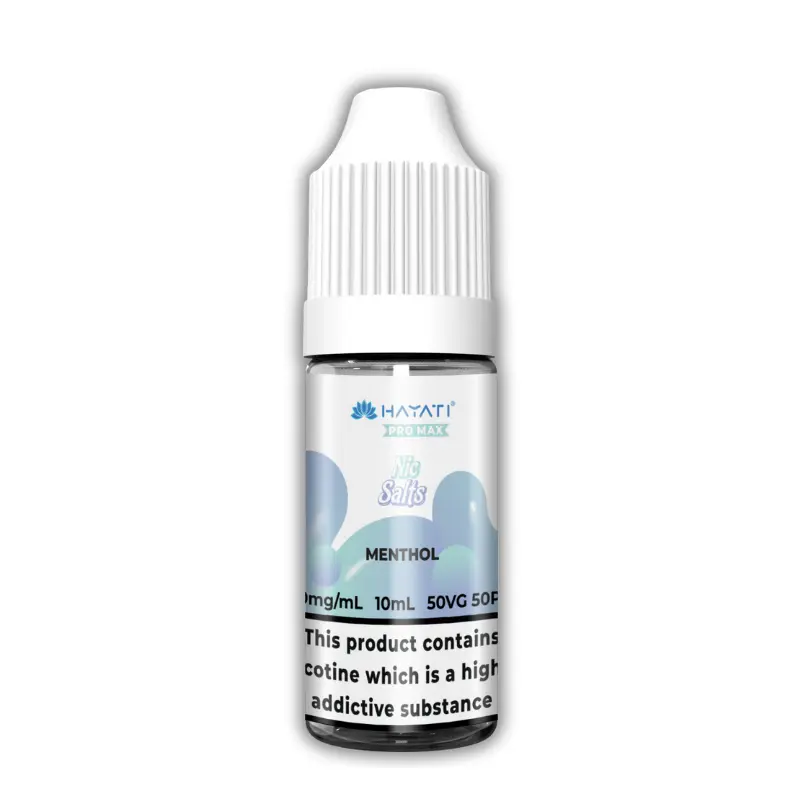
Hayati · Pro Max
Menthol Hayati Pro Max Nic Salt
£2.49
✔ In stock — ready to ship
Genuine Hayati
Free over £20
Same-day dispatch
Secure checkout
Menthol Hayati Pro Max Nic Salt is 10ml of liquid in a small bottle at £2.49, mixed at ten milligrams of nicotine per millilitre in salt form, on a base split evenly between vegetable glycerine and propylene glycol. Hayati file the flavour field as Menthol and leave it there. No fruit, no sugar profile, no second note arriving late. On a shelf of 65 bottles where nearly every other listing is a negotiation between a fruit and a coolant, this one has thrown out the fruit and kept the coolant.
That much is ordinary enough. What is not ordinary is the last line Hayati attached to the listing, which tells you to begin at a low power setting and move it until the cold is where you want it. Read quickly, that is generic advice. Read against the rest of the catalogue, it is close to unique, and it points at the thing that actually distinguishes this bottle from every other pure-cold product Hayati sell.
Everywhere else in the range, cold is a property somebody else decided. A prefilled pod arrives with a coolant load fixed at the factory and a coil sealed in beside it, and the intensity you get is the intensity you were sold. A nicotine pouch arrives the same way. This bottle does not. It arrives as liquid, and the amount of cold that reaches your mouth is settled after the purchase, by the coil you happen to own, the airflow you happen to have set and the power you happen to be running. You are not buying a sensation here. You are buying the ingredient for one, and the last step of the recipe is yours.
The page below spends most of its length on that, because it is the only thing about this listing that is not already covered somewhere else on the site. Along the way it deals with a comparison most buyers of a pure menthol want to make and cannot, and explains why the catalogue's own structure makes it impossible rather than merely inconvenient. Where a number is claimed here, it has been counted against the Hayati Pro Max Nic Salts shelf and the full product list rather than taken on trust.
One listing in 492 says the cold is a setting
The instruction on this bottle is worth isolating before anything else, because it is the anchor for the whole argument and because it is much rarer than it looks.
The count, and what it turned out to be
Plenty of Hayati listings mention power. Twenty-two of the 65 bottles on this shelf say something about wattage somewhere in their text. Almost all of those are the same compatibility note in slightly different clothes: this is a salt, salts belong in restricted-draw pod hardware, do not put it in a wide-open sub-ohm tank. That is a statement about where the liquid goes, not about how to run it once it is there, and it tells the buyer nothing they can act on beyond choosing the right device.
Filter for something narrower, an instruction that assumes you have already chosen the device and now have a dial to turn, and the number collapses. Four listings in the entire 492-product catalogue tell you to start at the bottom of your power range and move up until something is right. All four of them are bottles, and all four sit on this one shelf. They are this Menthol, Blue Frozen, Lemon Lime and Blue Razz Lemonade.
That is a slightly stronger result than the one this page set out to test. The claim as handed over was four of 65 bottles. Four of 492 listings is the same four, but the denominator is the whole range rather than one shelf, and it means no pod, no kit, no pouch and no shortfill anywhere in the catalogue carries an instruction of this kind. Which makes sense once you notice what the four have in common: a bottle is the only format where the buyer owns the hardware and can therefore be told what to do with it.
Three of the four point at taste. One points at the sensation.
Now read what each of the four asks you to adjust towards, because they are not the same target and the difference is the whole point.
Blue Razz Lemonade says to move the power until the result is right "to taste". Lemon Lime says to move it until "the flavour tastes right", and adds that running a salt too hot flattens the fruit. Blue Frozen, which is a cooled fruit rather than a pure coolant, says to move it until "the balance of fruit and chill" suits you. Three listings, three ways of saying the same thing: there is a correct setting somewhere, it is the one where the flavour comes out properly, and your job is to find it.
This bottle says to move it until "the chill suits you". Nothing about flavour, nothing about balance, nothing about a correct point. The target named is the sensation itself.
That reads like a copywriter's variation until you think about what it would mean if it were literal, and on this particular liquid it is literal, because there is nothing else in the bottle for the setting to affect. On Lemon Lime there is a citrus pair that can be muted or harshened, so a wrong setting has an audible cost and the right one can be found by listening for it. On Blue Frozen there are two outputs pulling against each other, and the buyer is looking for a ratio. Here there is one output. Turn the power and the only thing that changes is how much cold arrives. There is no optimum hiding in the liquid waiting to be discovered, because an optimum requires at least two things to be traded off and this bottle has one thing in it.
Why that changes what the instruction is
An instruction to adjust to taste is a search. It assumes the answer is a property of the product and that you will recognise it when you hit it, the way you recognise a radio station coming into tune. An instruction to adjust until the chill suits you is not a search, because there is nothing to find. It is a request that you decide, and the answer is a property of you rather than of the liquid.
The practical consequences are real. A search has a stopping rule and a preference does not, so nobody can tell you that you have gone too far, only that you have gone further than they would. A search converges and stays put, while a preference drifts, because cold receptors adapt to repeated stimulation and a setting that felt severe in the first week will read as ordinary in the third. And a search can be reported, which is why a fruit bottle can be reviewed usefully by a stranger, whereas nobody can tell you what wattage to run a pure menthol at, including Hayati, which may be exactly why the listing declines to name one.
So the single line of usage advice on this listing is doing more work than the three it resembles. It is not tuning guidance. It is an acknowledgement that this product ships incomplete and that the buyer finishes it.
Three names for cold, three platforms, and no overlap anywhere
The second half of the argument comes from where these products sit rather than from what is in them, and it takes a minute to set out because it depends on a count made elsewhere.
What has already been established, and by whom
The Ice Cold nicotine pouches page did the work of establishing how many Hayati listings are named entirely for cold, with no fruit, no confectionery and no plant in the title. The answer is four: this bottle, the two Double Menthol listings on the Pro Max Plus platform, and the Ice Cold pouch itself. That page also checked the result a second way, against Hayati's own product tags rather than their titles, and got the same four. The Double Menthol pod kit page approached it from the other direction and found that seven titles in 492 contain the word menthol, of which four hang it on a fruit and three let it stand alone.
Both of those counts hold up and neither is repeated here. What neither page did was ask where those listings live, and that turns out to be the interesting part.
The distribution
Set the four out by platform and the pattern is immediate.
- Menthol. One listing. This 10ml bottle, on the nic salt shelf, at 10mg. It exists in no other format. There is no Menthol pod, no Menthol kit, no Menthol pouch and no Menthol shortfill.
- Double Menthol. Two listings, both on the Pro Max Plus platform at 20mg: a bare 12ml pod and the matching 6000 pod kit, which are one product with and without a device. It exists in no other format either. There is no Double Menthol bottle.
- Ice Cold. One listing, a can of nicotine pouches at 12mg. Not a liquid at all.
Three distinct names, three platforms, and not one of them appears on a platform another one occupies. This is not a range where a flavour is issued across formats and you pick the one your hardware takes. Fresh Mint is issued that way and turns up eleven times, in bottles, pods, kits and both shortfill bases. Every pure-cold name in the catalogue appears in exactly one place.
The comparison that does not exist
Follow that through and it produces a genuine gap rather than a curiosity.
The obvious question about this bottle is how it relates to Double Menthol. One is called Menthol and the other is called Double Menthol, they are the only two pure-menthol products Hayati make, and the second name is a direct claim about the first. Anyone buying either would like to know whether doubled means twice, means more, or means nothing. It is the single most natural comparison in this corner of the range.
There is no way to make it. Not because nobody has bothered, but because the two products share no platform, and a comparison between liquids needs the delivery held still while the liquid changes. Put the two side by side and count what moves at once. The nicotine goes from 10mg to 20mg. The volume goes from 10ml you pour to 12ml that arrives already loaded. The base is published as an even glycerine and glycol split on the bottle and is not published at all for the pod, so the carrier may or may not be the same. The coil is one you chose on one side and one sealed in at the factory on the other, with no resistance published for either. The airflow is yours on one side and fixed on the other. The power is a dial on one side and a regulated output you cannot reach on the other.
Six variables move together, and the one you actually wanted to isolate, the concentration of coolant, is published on neither listing. A buyer who vapes the bottle in their own pod and then vapes a Double Menthol pod has learned which of those two experiences they preferred, which is worth knowing, and has learned nothing whatsoever about whether the word double corresponds to anything in the mix.
What the missing comparison would have settled
It is worth being concrete about what has been lost, because a vague sense that something is unavailable is less useful than knowing what it would have told you.
Had both liquids existed as 10ml bottles at the same strength on the same base, a buyer could have run them through one pod at one setting on one afternoon, and the difference between them would have been attributable to the recipe and nothing else. That would have answered the question directly. It would also have answered a second question underneath it, which is whether coolant concentration behaves proportionally at all. Cold receptors respond to a dose, but not linearly and not without limit, so twice the coolant does not straightforwardly produce twice the sensation, and the only way to find out what it does produce is to hold everything else still and vary the one thing. The range offers no way to do that.
The Double Menthol pods page sets out three honest readings of what the word double could denote, and tags them by confidence rather than picking one. That page was right to stop there, and this one can add the reason it had to: the evidence that would have settled it does not exist in the catalogue, because Hayati never issued the two names on one platform. The uncertainty is structural. It is not a failure of attention on anybody's part.
Which leaves the honest position, stated plainly rather than papered over. This page does not know whether Double Menthol is meaningfully colder than this bottle, cannot find out from anything Hayati publish, and will not estimate. Anyone who tells you the pod is roughly twice as cold is reasoning from a name to a physical property, which is precisely the move that has produced the contradictions this site has had to correct elsewhere. The only defensible thing to say is that the two are separate purchases on separate hardware at separate strengths, and that the relationship between them is not on the record.
One comparison that is available
The cross-platform comparison is closed, but the within-shelf one is open, and Hayati themselves have made a start on it. The Fresh Mint listing places itself explicitly between two named neighbours, saying that it sits where Spearmint is too soft and Menthol too icy. That is Hayati ranking three of their own bottles on a cold axis, in their own copy, with this bottle at the top of it. The Fresh Menthol Mojito listing does something similar from a different angle, positioning itself as the more eventful option for people who find plain menthol dull.
Two listings is not a census of the shelf, and this page is not attempting one, since that survey belongs on another page in this cluster. But it is a real signal and it is the only ranking Hayati provide anywhere. Within the bottles, Spearmint is the mildest, Fresh Mint is the middle, and this is the cold end. Across platforms, nothing.
Poured rather than sealed, and what that is worth
Of the four pure-cold listings, this is the only one you decant. The two Double Menthol listings and the Ice Cold can all arrive with the dose settled and the container closed. That distinction is usually discussed as a matter of cost, and cost is not the interesting part here.
A bottle is divisible and a pod is not
If the cold in a product is fixed, divisibility hardly matters. Twelve millilitres of a sealed pod is twelve millilitres of one experience, and whether you use it in three days or three weeks changes nothing about what it is. But if the cold is something you set, then the ability to run the same liquid twice at different settings is not a convenience, it is the only way to find out what you want.
Ten millilitres in a bottle is roughly five fills of a small pod, which is five chances to change something and notice the difference. Run the first fill at the bottom of your power range and the second two steps up. Run one fill with the airflow closed and the next with it open. Put the same liquid in two different pods on the same day if you own two. None of that is available on a sealed pod, where the coil, the airflow path and the fill are all one purchase and the only variable left is how hard you draw. The Double Menthol pods are the same substance in a form that has already made every decision for you.
This is the practical content of the word poured. It is not that a bottle is cheaper per millilitre, though at £2.49 it plainly is. It is that a bottle supports iteration and a pod supports a single trial.
The price of entry to pure cold, four ways
Set the four listings out by what they cost and the bottle is also the cheapest way to find out whether you want any of this at all. This one is £2.49 for 10ml with no hardware. The bare Double Menthol pod is £5.49 and needs a device you may not own. The kit is £7.99 and includes one. The Ice Cold pouches are £4.49 for a can and are not a vape at all.
Those are four different products rather than four sizes of one, so the numbers are not strictly comparable, and this page is not going to pretend otherwise. What the arrangement does mean is that the lowest-commitment route into a flavourless cooling product runs through this bottle, and that a buyer who tries it and dislikes it has spent the price of a sandwich finding out. A buyer who starts at the kit has spent rather more, and cannot take the liquid out and try it somewhere else.
Three variables, and which of them you actually control
Given that the listing hands you the setting, it is worth being precise about what there is to set. There are three, they do different things, and they are not equally available to you.
Power, and the ceiling nobody mentions
The Blue Frozen bottle page already establishes that cooling does not scale with power on a cold liquid, and that pushing the wattage up past a point makes the menthol read rough at the back of the throat while the fruit thins out behind it. That finding is not re-derived here. What is worth adding is that the second half of it does not apply to this bottle, because there is no fruit here to thin out.
On a cooled fruit, the wattage ceiling announces itself twice. The cold gets uncomfortable and the fruit disappears, and most people notice the fruit going first because a flavour vanishing is more legible than a sensation getting slightly too much. That gives the buyer an early warning sign that has nothing to do with how the cold feels. Remove the fruit and you remove the warning. The only signal left that you have gone too far is the sensation itself becoming unpleasant, which arrives later and is harder to read, partly because a strong chill and a harsh draw feel similar at the back of the throat and partly because you will have adapted slightly over the course of the session that got you there.
So the practical advice differs from the advice on a fruited cold liquid, and differs in a direction people do not expect. Move the power in smaller increments here, not larger ones, and give each step a day rather than an afternoon. A liquid with one output is not easier to tune than a liquid with two. It is harder, because it has no instrument panel.
Airflow, and the half of it that has nothing to act on
The same Blue Frozen page describes airflow as the cheapest cold dial available on a bottle, with opening it up sharpening the menthol and closing it down concentrating the fruit. On this liquid only the first clause has anything to work on.
Closing the airflow on a cooled fruit does two things at once. It reduces the volume of air crossing the tongue, which softens the chill, and it concentrates the remaining aromatics into a smaller mouthful, which brings the fruit forward. Both are real, and together they produce the familiar result that a tighter draw tastes fruitier and feels warmer. Here the second effect is concentrating nothing, because the only thing in the vapour is the coolant and the faint herbal character menthol brings with it. A tighter draw on this bottle is simply less cold, with no compensating gain.
That makes airflow a cleaner control on this liquid than on any fruited one, and it is the control to reach for first, because it is free, instant and reversible. It also makes it a less rewarding one, since there is no hidden flavour waiting to be revealed by closing it down. You are moving a single number and nothing else moves with it.
Resistance, the variable nobody publishes and few people change
The third variable is the coil, and it is the one this listing is silent about. Hayati name no resistance for it, and this page will not supply one. What can be said without inventing anything is structural rather than numerical.
Resistance and power are not independent. They jointly determine how much energy reaches the wick and therefore how much liquid is turned into vapour per draw, which in turn determines how much coolant arrives in your mouth in a single mouthful. Two pods running the same wattage on different coils do not deliver the same dose, which is why a setting that suited you on one device is not transferable to another and why nobody can recommend a number to a stranger.
The difference that matters in practice is that airflow and power are free and reversible while resistance is neither. Changing the coil means buying one, fitting it, priming it and waiting, and the change is not something you can undo halfway through a session to check. So of the three variables the listing implicitly hands you, two are genuinely yours and the third is a purchase you probably made months ago for reasons that had nothing to do with menthol. Most buyers will therefore tune this bottle on two dials while the third sits fixed in the background setting the range those two dials operate within.
One consequence worth drawing out. If this bottle reads as far too mild or far too severe at both ends of your power range with the airflow fully open and fully closed, the problem is not the liquid and no amount of adjustment will fix it. You have run out of travel, and the remaining variable is the hardware. That is an unusual diagnosis to be able to make with confidence, and you can make it here precisely because there is only one output to be wrong.
The limit is in you, not in the bottle
All three variables terminate at the same place. There is no correct setting for this liquid, there is only the point at which the amount of cold stops being pleasant, and that point is personal, it moves with use and it moves back if you leave the bottle alone for a week. Anyone who has run a heavy coolant daily for a month and then gone back to it after a break knows how far it travels.
Which is the honest reading of the listing's own instruction. It does not tell you where to stop because there is nowhere to stop that is true for two people, and a listing that named a wattage would be making something up.
What is actually in the vapour
The flavour writing on a product with no flavour has to be careful, and most of the chemistry here belongs to other pages. The Double Menthol pods page covers what menthol does to a cold receptor, why a heavy coolant reads as sweet when no sweetener is present, and how the sensation behaves across weeks of use. The Spearmint bottle page covers why a plant mint is not the same thing as a coolant at all. Neither is repeated. What follows is what this particular bottle does across a draw, and one claim on its own listing that deserves examining.
The draw
The inhale starts cold rather than arriving at cold. There is no opening note to get through, so the sensation is present by the time the vapour has crossed the tongue, and on a moderate setting it registers as a broad chill across the roof of the mouth rather than a point of cold anywhere specific. The taste component, such as it is, is the thin medicinal edge menthol carries with it. It is not minty in the way a herb is minty. It is closer to the smell of a menthol crystal than to anything in a garden.
Through the middle of the draw the sensation spreads backwards and reaches the throat, and this is where a setting that is slightly too high announces itself, as a scratch rather than as cold. The exhale is where most of the length is. Cold has a long tail compared with a flavour, and a mouthful of room-temperature water taken twenty seconds after a draw will read noticeably colder than it is. That after-effect is a better measure of how hard you are running the bottle than the draw itself, because it is less affected by how much you have adapted in the last ten minutes.
There is nothing after that. No fruit, no sugar, no body. The mouth returns to neutral rather than to a flavour fading out.
The one claim on the listing worth interrogating
Hayati's copy says the chill builds as you vape. Taken at face value that runs against what the Double Menthol pages establish about adaptation, which is that a sensory channel under repeated stimulation reports less over time rather than more. Both cannot be true over the same interval.
The resolution is that they are describing different intervals, and it is worth saying so rather than choosing a side. Within a draw and across the first few draws of a session, accumulation is real: coolant deposits on tissue faster than it clears, so the third draw of a session does land on a mouth that is already partly cold. Across an hour, and certainly across a fortnight of daily use, adaptation dominates and the sensation flattens. So the listing is accurate about the first two minutes and silent about everything after, which is a fair description of most flavour copy and not a criticism of this one.
The caution attached to that is about vocabulary rather than fact. Building is house language in this catalogue. The Spearmint listing says its chill builds gently, the Fresh Mint listing says its cool edge builds gradually, and the Double Menthol kit says its cooling builds as you go. A word that appears on that many neighbours is not telling you anything specific about any of them, and treating it as evidence about this bottle in particular would be reading a house style as a formulation note.
Sweetness, and what is not here
No sweetener is named and nothing in the profile suggests one. Placed on a sweetness scale against its own shelf, this sits at the bottom with nothing underneath it, well below the confectionery end occupied by Strawberry Jelly Beans and Blue Razz Gummy Bear, and below even the unsweetened fruit bottles, because an unsweetened fruit still has fruit sugar character to it and this has nothing.
What this is not: it is not a mint. It is not a mojito, which needs citrus and a body to work against, as Blue Razz Mojito and Strawberry Mojito both demonstrate by keeping their fruit in front. It is not an iced fruit with the fruit turned down, which is a common way to describe a heavy coolant and is wrong here, because a fruit turned down is still present. And it is not a dessert, a drink or a sweet. It is one sensation, delivered at a level you choose.
The specification, including the rows Hayati leave empty
The table below is the whole of what is on the record for this listing. Two rows are deliberately blank, and they are the two a buyer of a pure coolant would most like filled in.
| What arrives | A 10ml bottle of e-liquid. No device, no coil, no pod. |
| Price | £2.49 |
| Flavour as Hayati file it | Menthol |
| Nicotine | 10mg per millilitre, salt formulation |
| Base | 50% vegetable glycerine, 50% propylene glycol |
| Intended hardware | Mouth-to-lung pod kits and refillable pods |
| Usage note on the listing | Begin low on power and move it until the cold is where you want it |
| Shelves | Hayati Pro Max Nic Salts, Hayati E-Liquids, Menthol Vapes, New Products |
| Product code | HPM-NS-MENTHOL |
| Coolant identity and concentration | Not published |
| Coil resistance | Not published on this listing |
Three of those rows do work that is specific to this bottle rather than generic to the shelf. The even base matters more on a coolant than on a fruit, because menthol travels more readily in the glycol half than in the glycerine half, and an even split therefore delivers the cooling concentrated into a modest mouthful rather than spread thinly across a large cloud. That is set out in full on the Blue Frozen bottle page and is the reason a cold liquid in a small pod can read sharper than a much cloudier version of the same idea.
The 10mg figure is the only strength offered, so it is a fixed property of the purchase rather than a choice, and it sits at half the maximum permitted for sale in the United Kingdom. Nicotine is addictive. Nothing on this page is advice about which strength anyone should be running.
The two empty rows are the interesting ones. Nobody in this trade publishes a coolant concentration, and there is no agreed unit in which they could publish it, so the absence is an industry convention rather than a Hayati omission. The missing coil resistance is different: this is a bottle, the coil is whatever is already in your device, and the number could not be stated even in principle. Between them those two blanks are why the setting has to be yours.
Where it sits among the neighbours
Most of the shelf is a fruit with a decision made about cooling. Sorting the neighbours by that decision is the quickest way to see what this bottle is for.
The iced fruits, where cold is an ingredient
A large part of the shelf pairs one fruit with a cooling note. Blackberry Ice keeps to a single dark berry with the chill running from the first draw, Cherry Ice uses the cold to lift a ripe cherry rather than to bury it, and Red Apple Ice applies it to the sweeter side of apple so the result reads like fruit out of a fridge. Strawberry Raspberry Ice does the same across two red berries, and Banana Ice puts a chill over something soft and rounded to stop it sitting heavily.
In every one of those the cold is in service of the fruit and its level was decided for you. If you have worked through several of them and concluded that the cooling is the part you keep coming back for, this bottle is the version with the rest removed. If you concluded the opposite, that the cooling is the bit you tolerate, then nothing on this page will change your mind and you should stay with the fruits.
The mints, which are a different thing entirely
The shelf carries several plant mints and they are not milder versions of this. Black Mint takes mint in a darker and fuller direction and Fresh Mint leads with the herbal green taste rather than with cold. The Spearmint bottle page sets out why this distinction is real rather than a matter of degree, and why a mint is something you taste while a coolant is something you feel. Read that page before assuming that a strong mint and a pure menthol are two points on one line.
Fresh Menthol Mojito is the closest thing on the shelf to a middle position, since it builds on lime and mint and then pushes menthol over the top of both. Its own listing pitches it at people who want something more eventful than plain menthol, which is a fair description of what it is and a fair description of what this bottle is not trying to be.
The uncooled end, for contrast and for rotation
A palate that has spent a week on a coolant needs something with no chill in it at all to reset against. Blackcurrant Juice states plainly that no cooling has been added, which is unusually explicit for this shelf, and Juicy Peach is a single stone fruit with nothing over it. Double Apple layers a ripe apple against a crisper one and stays warm throughout. Any of the three works as a genuine zero.
Further along, Cola Lime and Blackcurrant Lemonade use acidity rather than cold to do the lifting, and Blue Sour Raspberry uses sourness. Those are worth knowing about because they scratch a related itch by different means, and because alternating a cold bottle with an acidic one rather than with a sweet one keeps both legible for longer.
The ones whose names withhold the answer
Two neighbours sit at the opposite end of this bottle's defining quality, which is that its name tells you exactly what is in it. Blue Fusion names a colour family rather than a fruit, and Summer Dream names a mood. Black Mamba is a dark berry mix with a cool finish arriving late, and its name points at nothing edible either. Those listings have their own pages and their own arguments. The point of raising them here is the contrast: whatever else is true of this bottle, nobody buying it is uncertain what they have ordered.
Shelves worth browsing rather than single bottles
Three routes are useful. The Pro Max Nic Salts shelf holds all 65 bottles at one price point and is the right place to compare like with like. The Menthol Vapes shelf holds twelve listings across several formats, though only three of them are pure cold, and the Blue Frozen pods page has already shown that Hayati's own filing is not a dependable index of what is cooled. The wider Hayati E-Liquids section takes in shortfills and other bases if you want the same idea in a format this shelf does not carry, and the full catalogue is there if you would rather browse by hardware than by flavour. There is also a strength-and-format listing, Hayati Pro Max Nic Salts E-Liquid at £2.79, which carries a flavour of its own in the product data rather than being a generic entry.
Living with a bottle that has one output
Most handling advice for e-liquid is written for something with a flavour to protect. Half of it does not apply here and the other half applies differently.
Change one variable at a time, and give it a day. The temptation with a single-output liquid is to move the power and the airflow together because neither on its own seems to do much. Do that and you will not know which one produced the result, and since the two interact you will not be able to reason back to it. One change, one day, then decide.
Judge the coil by the throat, not by the cold. On a fruit bottle a tired coil announces itself by the flavour going flat. Here there is no flavour to go flat, and cooling is the last thing a degraded wick stops delivering, so a pod well past its useful life will still feel cold. What changes first is the texture of the draw, which turns dry and slightly rough. When the chill is intact but the draw has become unpleasant, the coil has gone.
Expect the bottle to seem weaker after a fortnight. It has not changed. Cold receptors adapt to repeated stimulation and then reset when the stimulation stops, which is why a week on an uncooled fruit will bring this bottle back to where it started. Turning the power up to chase the sensation works for a few days and then stops working, and you will be left running the liquid hot for no gain.
Keep a pod for it. Menthol soaks into plastic and silicone and comes back out into whatever you fill next, which is covered at length on the Spearmint bottle page and holds here with more force, since there is nothing in this liquid except the thing that ghosts. If you own one pod and you use this bottle, accept that the next two or three fills will carry a chill that did not come from them.
Prime properly and then leave it standing. Fill the pod, wet any cotton you can reach, and give it a few minutes before the first draw. A scorched wick on a liquid with no sugar in it is less disastrous than on a sweet one, but it is still a wasted coil.
Storage is easy here. Menthol is stable and does not fade across the life of a 10ml bottle, unlike the volatile top notes that drop out of citrus liquids within weeks. Cap it, keep it out of direct sunlight, and keep it out of reach of children and pets. A bottle opened in January will read the same in April, which is not true of most of the shelf.
Do not take a hardware compatibility decision from a retail page, including this one. What device a liquid suits is a question for the device's own documentation.
Questions this bottle raises
Is this the same liquid as Double Menthol, just weaker?
Nobody can say, and this page will not guess. The two products share no platform, no nicotine strength and no published base, and Hayati state no coolant concentration for either, so there is no way to isolate the recipe difference from the delivery difference. Anyone who tells you the pod is twice as cold is reasoning from the name rather than from evidence.
Why is there no Menthol pod or kit?
Hayati do not say. What the catalogue shows is that each of the three pure-cold names appears on exactly one platform and never on another, which is a deliberate-looking pattern rather than an oversight, but the reasoning behind it is not on the record anywhere.
What wattage should I run it at?
There is no answer that is true for two people, which is why the listing does not name one. Start at the bottom of your device's range, move in small steps, and stop where the sensation is what you want. Your coil resistance sets the range those steps operate in, so a number that suited somebody else's device will not transfer to yours.
Is there any flavour in it at all?
Menthol carries a thin medicinal aroma of its own, so it is not literally flavourless, but there is no fruit, no sweetener and no herbal body. If you want a mint you can taste rather than a cold you can feel, Fresh Mint or Black Mint are the listings to look at.
Will it make my other liquids taste cold?
Yes, for a while, if you use the same pod. Menthol works into plastic and seals and releases slowly afterwards, and with nothing else in this bottle the effect is about as strong as it gets. A dedicated pod solves it.
Does the chill really build as you vape?
Within a session's first few draws, yes, because coolant arrives faster than it clears. Across weeks it does the opposite, because the receptors involved adapt. The listing describes the short interval and says nothing about the long one.
Is it too cold for everyday use?
That depends entirely on how you set it, which is the point of the whole page. Hayati's own copy on a neighbouring bottle puts this at the icy end of the three plain cooling bottles, so if you already found Fresh Mint bracing, start this one low.
Can I mix it into another bottle to cool that one down?
People do, and the arithmetic is not something this page can help with, because the coolant concentration is unpublished and so is the concentration in whatever you would be adding it to. You would be guessing at both numbers.
How long does a 10ml bottle last?
That depends on your hardware and how much you vape, and any figure here would be invented. As a rough structural point, 10ml is roughly five fills of a small pod, which is what makes the bottle useful for trying several settings rather than committing to one.
What is the best thing to alternate it with?
Something with no cooling in it at all, so your reference point resets properly. Blackcurrant Juice states outright that no ice has been added, and Juicy Peach is a single warm fruit. Alternating a coolant with another coolant defeats the purpose.
The short version
This is 10ml of pure cooling at 10mg on an even base, for £2.49, with no fruit and no sweetener in it. What separates it from the other three pure-cold products Hayati sell is not the recipe, which is unpublished, but the format. It is the only one you pour, which means it is the only one whose delivered intensity is set after the purchase rather than before it, and Hayati acknowledge as much in the one line of usage advice on the listing, which is the only instruction of its kind on any of the 492 products in the range that names the sensation rather than the taste as the thing to adjust towards.
The comparison most buyers want, plain menthol against doubled menthol, cannot be made. The two names never share a platform, so six variables move at once between them and the recipe difference cannot be isolated from the hardware difference. That is stated here as a gap rather than filled with an estimate, because an estimate would be a guess dressed as a specification.
Who it suits: anyone who has worked through the iced fruits and decided the cooling was the part worth keeping, and anyone who wants a reset between sweeter bottles. Who should look elsewhere: anyone who wants something to taste rather than something to feel, and anyone unwilling to spend a few days finding their own setting, because this bottle does not arrive with one.
Strictly for adults aged 18 and over. Nicotine is an addictive substance.
You might also like


