
Home / Hayati Nicotine Pouches / Frosted Mint Hayati Nicotine Pouches
Hayati
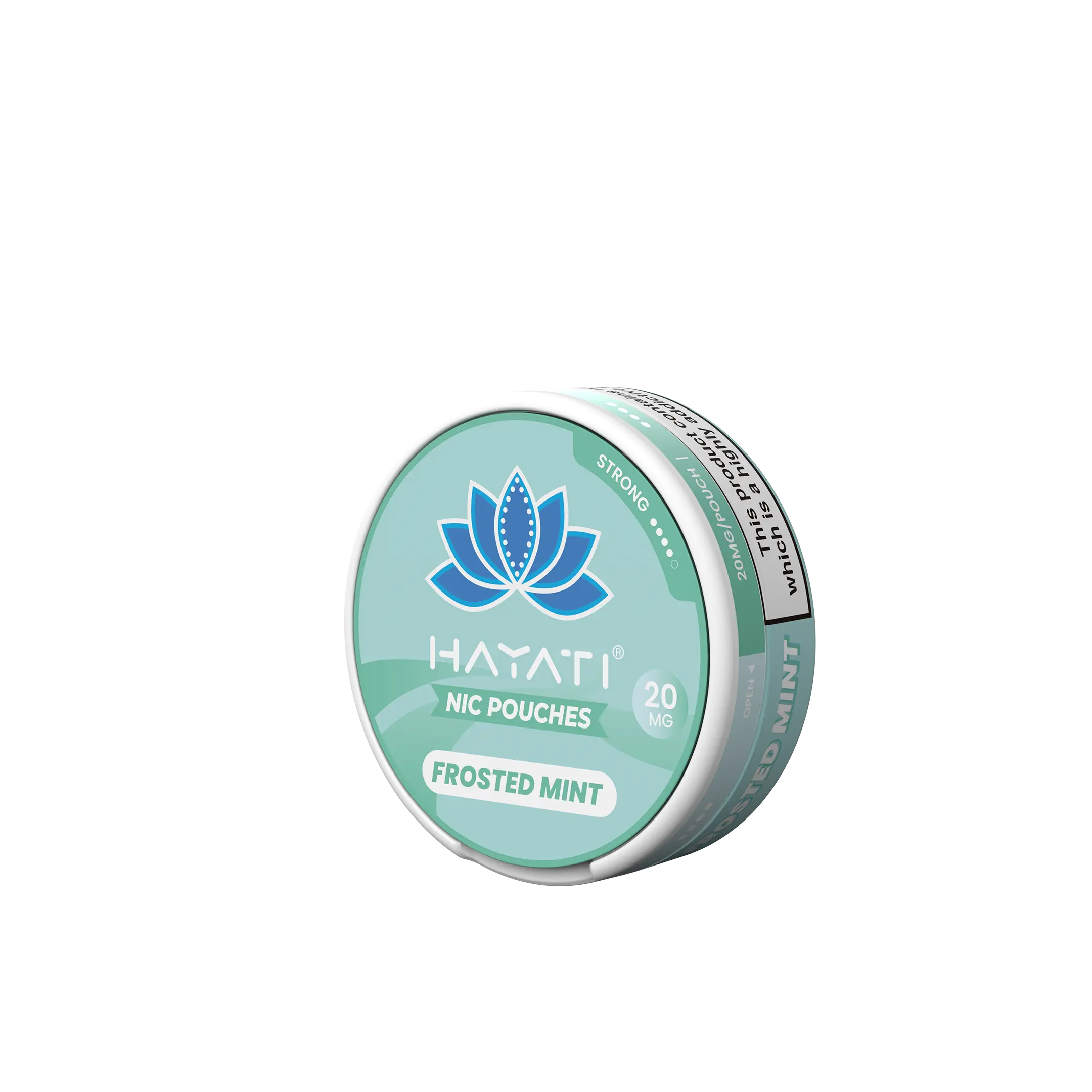
Frosted Mint Hayati Nicotine Pouches
£4.49
✔ In stock — ready to ship
Genuine Hayati
Free over £20
Same-day dispatch
Secure checkout
Frosted Mint is the mint entry in Hayati's oral nicotine pouch line, priced at £4.49 and listed at 12mg. It is a tobacco-free pouch that goes under the upper lip and rests against the gum. Nothing about it is heated, nothing is burned, nothing is inhaled, and there is no device, no liquid, no coil and no battery anywhere in the transaction. You take a pouch out, you put it in position, you leave it there, and when you are finished you take it out and put it in a bin. That is the whole mechanism, and it is worth stating at the front because most of what this site sells works a completely different way, and a buyer arriving here from a pod listing is arriving with the wrong model of what is about to happen.
The interesting thing about this particular listing is not that Hayati have added a mint to a pouch range. It is which flavour got lucky. Eleven flavours are sold in this format and ten of them are fruits, sweets or drinks, and every one of those ten has to do something in a pouch that a pouch is structurally poor at doing. Mint does not. Mint depends on two properties that an oral format handles well, and the fruits depend on a property it handles badly. That is not a preference and it is not a marketing line. It follows from how the two kinds of flavour reach you, and once you have the mechanism straight the conclusion is difficult to avoid: of everything in the Hayati Nicotine Pouches range, this is the pairing of flavour and format that is losing the least in translation.
That is the argument this page makes, and it takes a while to make properly, because it has a second half that is less flattering. The same property that makes mint work in a pouch also changes how the cooling behaves over time, and the change is not free. It gets worse the more pouches you use in a day. Anyone selling you the first half without the second half is selling you half a page. Below: what a pouch actually is, why mint survives the format when a mango does not, what continuous cooling does to your perception of it over twenty minutes and over a day, whether the word "Frosted" is telling you anything at all, and how this compares against the eleven Fresh Mint listings and the other ten pouches.
The format, described once and plainly
A nicotine pouch is a small sealed sachet of white filler material with nicotine and flavouring in it. It has no tobacco leaf in it, which Hayati state directly for this product. You place it between your upper lip and your gum, at the front, and you leave it in position. The pouch stays where you put it. Contents are released gradually into the mouth through the pouch material while it sits there, which is why the format is described as oral rather than inhaled.
Nothing is drawn into the lungs at any point. There is no aerosol, no vapour and no smoke, because there is no heat source to create one. Nothing needs charging, nothing needs priming, nothing needs topping up, and there is no coil to wear out or wick to burn. The entire product is consumed in one sitting and then discarded. Hayati's instruction for disposal is the obvious one: the used pouch goes in a bin.
Two consequences of that follow immediately and both of them matter more than they sound. The first is that almost every category of advice this site normally gives is irrelevant here. There is nothing to prime, no resistance to match, no airflow to adjust, no device to check the range name against, no battery to look after and no electrical waste at the end of it. A vape page spends a third of its length on hardware. This page does not have any hardware to spend it on, which is why the format section you are reading is short and the flavour argument below it is long.
The second consequence is that the specification a pouch listing publishes is thinner than the specification a pod listing publishes, and Hayati's is thin here. What they state for Frosted Mint is the strength, 12mg, the fact that it is tobacco-free, how to use it and how to dispose of it. What they do not state is how many pouches are in a pack, what an individual pouch weighs, how the 12mg figure is arrived at, how long a pouch is intended to stay in, or what the filler material is. Those are real gaps and this page will not fill them by guessing. Where a number would be useful and is not published, the page says so rather than reasoning from what the format usually does elsewhere.
The strength itself is published and is not in doubt: 12mg. Every one of the eleven pouches in the range carries the same figure, so within this format Hayati are not offering a choice of strength at all. There is one strength and there are eleven flavours. That is a simpler proposition than the vape side of the catalogue, where the same flavour turns up at different strengths across bottles and pods, and it removes an entire axis of the decision. The only question this shelf asks you is which flavour.
Why mint survives the format and the fruits do not
The mechanism underneath this is general, it applies to every product on the pouch shelf, and it belongs to another page. The Mango Ice Hayati Nicotine Pouches listing works through the difference between a flavour that reaches you as an aroma travelling up the back of the throat to the nose and a flavour that registers in the mouth itself, and it sets out why the two formats are not equally good at both. That argument is theirs and it is better told in one place at full length than half told in two. What this page takes from it is the single conclusion it establishes: an oral pouch is a poor delivery route for volatile aroma and a perfectly good one for anything that acts in the mouth.
Take that as given and apply it to a mint, because the application is where this product gets interesting.
What a fruit flavour is actually made of
Strip a mango, a banana or a blackcurrant down to what your senses are doing with it and most of the identity is in the volatile fraction. The tongue contributes sweetness, a little acidity and occasionally a trace of bitterness, and those are real, but they are not what distinguishes a mango from a peach. Sweetness and acidity are shared by every fruit in the catalogue. The thing that makes one of them recognisable is a specific set of airborne molecules arriving at the olfactory tissue, and there are dozens of them in any real fruit and a smaller but still substantial set in any flavouring that imitates one.
Which means that when you remove or weaken the route those molecules take, you do not get a slightly quieter mango. You get sweetness, acidity, and a hint of something that could be several fruits. The identity is the first casualty, not the intensity. This is why fruit in an oral format tends to read as generically sweet and faintly fruity rather than as a named fruit, and why the honest way to describe a fruit pouch is in terms of what survives rather than in terms of the fruit on the label. The Blueberry Hayati Nicotine Pouches and the Banana Ice Hayati Nicotine Pouches are both working against that, and so is every fruit pod on the rest of the site when it is asked to do the same job in a different container.
What mint is made of, which is not the same thing
Mint is built differently, and the corpus has already established the chemistry that matters. The Spearmint Hayati Pro Max Nic Salts page sets out the split cleanly: peppermint oil is dominated by menthol, spearmint oil is dominated by carvone, and the two molecules do different jobs. Menthol binds a cold-sensing channel in the tissue of the mouth and produces a chill that has nothing to do with temperature. Carvone produces aroma and taste and very little of that cold signal. A mint flavouring is some mixture of the two families plus a herbal, green, faintly bitter background.
Now put those components through the pouch. The carvone-type aroma fraction is volatile, so it is subject to exactly the same loss the fruits suffer, and this page is not going to pretend otherwise. Some of what you would taste in a mint e-liquid does not make it here. But the other two components are different in kind.
The cooling is a receptor effect happening in tissue. The molecule does not need to travel anywhere or be smelled. It needs to reach the surface of the mouth and bind to what is there, and a pouch parked against the gum is a device for holding a substance in contact with the surface of the mouth. That is not a weakness being worked around. It is the format doing the one thing it is unambiguously good at.
And the herbal green character is largely a taste and a mild trigeminal roughness rather than an aroma. The slightly bitter, slightly astringent, vegetal quality that stops a mint from reading as a sweet is registered in the mouth. It does not need the nose. So of the three things a mint flavour is made of, one is diminished by the format and two are not, and the two that are not are the two a person would point to if you asked them what mint is.
Contact time, and why it matters more on a mint than anywhere else
The general half of this point also belongs to the Mango Ice page, which sets out why a coolant needs nothing but contact with the tissue, and why a continuous source suits a receptor better than a series of two-second pulses does. Its conclusion is that cooling is the one property a pouch arguably delivers better than a pod rather than merely as well, and there is no value in re-deriving it here.
What that page does not have to work out, because its cooling sits on top of a fruit, is what happens when the cooled component and the flavour component are the same component. On this product they are. Menthol is both the cold and a substantial part of what mint tastes like, so the delivery route that favours the sensation is favouring the flavour in the same act. Nothing in Frosted Mint is being carried well while the thing you actually bought it for is being carried badly. That is the whole of the pairing argument, and it is why the asymmetry the pouch format imposes on every other listing on this shelf does not show up on this one.
What that produces, in practice, is cooling that behaves unlike the cooling on any pod on this site. It arrives more slowly. There is no first-draw hit, because there is no first draw. It builds over the opening minutes rather than landing. It is more even once it is established, because nothing is interrupting it. And it lasts very much longer than any individual cold sensation from a vape does, because the source is still there. If you have picked mint products in the past for the cold specifically, that difference is the single biggest thing to understand before buying this, and the next section is about the fact that longer is not the same as better.
The claim, narrowed until it is true
Stated loosely, "mint loses nothing in a pouch" would be wrong, and the brief for this page is not worth much if the page repeats a slogan it can see through. Mint does lose something: the aromatic top of it, the part that in a well-made mint e-liquid gives you a lift on the exhale that is unmistakably a herb. That fraction is volatile and it is attenuated here along with everybody else's.
The defensible version is proportional. Every flavour on this shelf loses its volatile fraction. For a fruit, the volatile fraction is most of the identity, so what remains is a shadow of what the label promises. For a mint, the volatile fraction is the smaller part of the identity, and the two larger parts, the receptor cooling and the green bitter taste, come through intact or better than intact. So the loss is the same in kind and radically different in proportion, and mint ends up the best-matched pairing on the shelf not because the format flatters it but because the format's specific weakness happens to point at the part of mint that matters least.
One qualification on that, stated so the page is not overselling. This is reasoning from what mint and fruit flavours are made of to what should survive a change of delivery route. It is sound reasoning and it predicts something checkable, but it is reasoning, not a measurement of this particular recipe. Hayati publish a short flavour description and a strength and nothing about formulation. If you want the claim tested rather than argued, the test is in the last section of this page and it takes one pouch.
The same argument applied to the rest of the shelf
Run the ten other pouches through the same filter and the results are not uniform, which is itself informative. A fruit with a simple, sweet, low-complexity profile has less to lose than a fruit whose appeal is aromatic detail. A sweet-shop flavour built mostly on sugar character and a single dominant note is in reasonable shape. Something whose whole point is a specific aromatic signature is in the worst position of all.
On that reading the Bubblegum Hayati Nicotine Pouches should translate better than you would expect, because bubblegum as a flavour is already a synthetic composite that leans hard on a couple of loud notes and on sweetness, and loud and simple survives. The Cola Hayati Nicotine Pouches have a spice and citrus profile that is more aromatic and should thin out more. The Coffee Hayati Nicotine Pouches are the most exposed of the lot, because roast coffee is almost entirely an aroma phenomenon with bitterness underneath it, and bitterness without the aroma is not coffee. None of that is a criticism of those products, which may well be good at what they do. It is an observation about which of them are fighting the format and which are not.
Frosted Mint is the only one of the eleven that is not fighting it at all.
What twenty minutes of continuous cooling does to your perception of it
Everything above is the case for the product. This section is the cost, and it is a real one that no amount of good formulation can remove, because it is a property of how perception works rather than of what is in the pouch.
Two different shapes of the same sensation
Picture the cooling from a mint pod as a line on a graph against time. It is a sawtooth. Each draw puts a spike in, the spike decays over the following seconds, the next draw puts another one in. The sensation is repeatedly re-announced, and re-announcement is the thing that keeps it perceptible. Every spike is measured by your senses against the trough before it, so even a modest coolant stays noticeable indefinitely, because it keeps arriving fresh.
The same sensation from a pouch is not a sawtooth. It is a ramp up to a plateau, and then it stays at the plateau, because the source of it is sitting still against the same patch of tissue and is not being interrupted by anything. There are no troughs, so there is nothing to measure each new peak against, because there are no new peaks. That is the whole difference, and every practical consequence in this section comes out of it.
Adaptation, said honestly
Continuous stimulation of a sensory channel reduces the size of the sensation that channel reports. This is not a controversial point and it is not specific to coolants, but coolants run into it hard. The Double Menthol pages on the Pro Max Plus established the long form of it for a vape: sustained exposure to a coolant substantially reduces the reading while the liquid is unchanged, and the recovery answers to absence rather than to variety, with absence measured in days rather than in hours. That finding is theirs and it holds. What this page adds is what happens when the same effect is applied to a format that delivers the stimulus continuously instead of in pulses.
The answer is that a pouch compresses that whole curve into a single sitting. A vaper meets coolant adaptation over weeks, because the pulsed delivery keeps giving the channel gaps to recover in and the decline is slow enough to be mistaken for the liquid changing. A pouch user meets it inside one use, because there are no gaps at all. The intensity you notice two minutes in is not the intensity you notice fifteen minutes in, and the difference is not subtle. The pouch has not weakened. Your reading of it has.
Hayati do not publish an intended wear time for these, so the numbers in the paragraph above are the general shape of the format rather than a specification, and this page is not going to invent one. What is not shape-dependent is the direction: whatever your own duration turns out to be, the cooling will read strongest in the first part of it and weakest in the last part of it, with the liquid content of the pouch behaving perfectly consistently throughout.
The upside, which is also real
It would be easy to write that paragraph as a flaw and stop, and that would be a distortion. The plateau has genuine advantages over the sawtooth and some people will prefer it outright.
There is no spike to brace for. A heavily cooled draw has a peak at the front that some people find sharp, and a pouch has no equivalent of it, because nothing is arriving all at once. The sensation is even, which makes it easier to ignore while doing something else, and it does not require you to keep performing an action to sustain it. You are not managing it. You place it and it is there.
And the duration is not a trick of perception. A cooling sensation that persists for tens of minutes from a single unit is something the vape side of this catalogue cannot produce at all, whatever is in the pod, because the delivery is inherently intermittent. If what you want from a mint is a long, level, unspiky cold rather than a repeated hit of one, this format is not a compromised version of the pod. It is the better instrument for that particular job.
What it means for the second and third pouch of the day
Here is where the adaptation stops being a curiosity and starts costing you money.
The recovery from coolant adaptation is slower than the onset of it. You reach a reduced reading within one pouch, and you do not get back to baseline within the gap before the next one unless that gap is long. So the second pouch of the day does not start where the first one started. It starts on tissue that is partly adapted already, which means it ramps to a lower plateau and reaches it faster. The third starts lower again. By the fourth, on a day of steady use, the cooling is a background condition rather than an event, and it can feel as though the pack has changed.
The pack has not changed. This is the part worth internalising, because the alternative explanation people reach for is that the product is inconsistent, or that the first pouch in a new pack is somehow stronger than the rest of it. Neither is likely. What varies is the state of the receiving tissue, and the first pouch of a day is the only one being read by a rested palate.
Four practical things follow from that, and they are the reason this section exists.
- Judge a new pack on the first pouch of a day, not the fourth. If you try Frosted Mint for the first time at the end of an afternoon in which you have already used two, you will under-rate it, and the thing you will under-rate specifically is the cooling, which is the axis this product is being sold on.
- Do not compare two flavours in sequence. Putting Frosted Mint in after another cooled pouch measures your adaptation state, not the two products. If you want to compare this against a cooled fruit, put them on different mornings.
- A fruit pouch in between does not reset anything. Variety helps with boredom and does nothing for adaptation, because the adaptation is specific to the sensation rather than to the flavour carrying it. An hour of blueberry does not restore your reading of a coolant. An evening of nothing cooled does more.
- Spacing does more than strength ever could. There is only one strength in this range, so the intensity of cooling you experience is not something you can buy your way into. It is determined mostly by how recently you last had a coolant in your mouth. That is an unusual situation for a nicotine product and it is worth knowing before you conclude that a pouch is underpowered.
The general version of the trade, which applies to this pouch more sharply than to anything on the pod shelf: a product whose main attraction is a sensation rather than a taste is exposed to the fastest-adapting thing your senses do. Frosted Mint is not purely a sensation, which is the argument of the previous section and is the reason it holds up better than a pure coolant would. But it is more sensation-led than any fruit pouch on the shelf, and it pays for that in the same coin.
Is the word "Frosted" telling you anything?
Hayati have a habit of putting a cold word in a product name, and buyers read those words as a scale. The question for this listing is whether "Frosted" occupies a position on that scale, and the answer is available because somebody has already counted.
The census, and what it settled
The Blue Frozen pods page ran the cold vocabulary across all 492 listings in this catalogue and published the table. Ice appears in 90 titles covering 21 distinct flavour names. Mint appears in 19 titles, Spearmint and Frosted Mint included, covering 7 flavours. Menthol appears in 7. Frozen appears in 3, all of them one flavour sold three ways. Cooler appears in 2, both of them one flavour. Cold appears once. Frost appears once. Chill and Freeze do not appear at all. Altogether 121 of the 492 listings carry a cold word in the title.
I re-ran that count against the catalogue file before citing it and it reproduces exactly, which is worth saying because this corpus has a record of pages repeating each other's arithmetic without checking. The conclusion the census reached is that the vocabulary is not graded. Ice is a default label applied across a productive naming pattern, Frozen and Cooler are individual product names with one occupant each, and a buyer cannot read intensity off which word was chosen. That conclusion stands and nothing on this page disturbs it.
The single exception to it, which is this product
The census also found that the cold words never combine with one another, and offered that as evidence that they behave like alternatives rather than like dimensions. The Mango Ice page has already flagged the exception and it is this listing: extend the word list to cover Frosted, which was not in the original census, and there is exactly one title in 492 that puts an ice-family word in front of a mint-family word. That amendment is theirs, it is correct, and the point of restating it here is that this page is the exception being talked about.
What can be added to it is the arithmetic, which settles whether the exception is real or an artefact of somebody's choice of search terms. Ninety plus nineteen plus seven plus three plus two plus one plus one is 123, and the total the census reports is 121. The two listings in that difference are the two that got counted under two headings each, and they are Ice Cold and Frosted Mint, the only two titles in the catalogue that stack two cooling words. The original count was right, the number was already carrying the exception inside it, and only the generalisation drawn from it was one product line too broad.
Three tests for whether the word is doing work
Unusual is not the same as meaningful, so here are three ways of checking whether "Frosted" denotes anything, in increasing order of how much they tell you.
Is there a family? No. Frost appears in exactly one title out of 492 and this is it. A grading term needs other members at the same level to be graded against, and there is no Frosted Mango, no Frosted Berry, no Frosted anything else. A word with a single occupant is a name, not a tier. That is the same test the census applied to Frozen and Cooler and it gives the same answer here.
Does Hayati's own filing treat it as a cooling word? This is the more interesting test, because the shelf assignments and tags in the product data are Hayati's own reading of their own name, recorded without any intention of being read by a buyer. Ice Cold carries the tags "ice" and "ice cold", and sits on the Ice Vapes shelf. Mango Ice carries "ice" among its tags and sits on Ice Vapes. Banana Ice and Grape Ice, the same. Four of the eleven pouches are filed as ice products, and in every case the word Ice in the title generated a cooling tag.
Frosted Mint carries the tags "mint" and "frosted mint". There is no cooling tag. It is filed on Mint Vapes and on New Products and it is not on the ice shelf. The word "Mint" in the title generated a family tag. The word "Frosted" generated nothing. Whatever process assigns these, it recognised one half of the name as a flavour family and did not recognise the other half as anything at all.
Does the flavour text treat it as cooling? Yes, and this is the one place the word earns its keep. Hayati's description puts a frosty coolness on top of a mint core, and it makes one explicit comparison: against Ice Cold, Frosted Mint is more about the taste of the mint and less about the chill, with the cooling in a supporting role. That is a relative positioning statement between two products in the same range, from the people who make both, and it is the single most useful sentence in the source material. It tells you that within the pouch range there are two cold-led options and that this is the one where the flavour leads.
The verdict
"Frosted" is not doing anything the other cooling words do not do, and in Hayati's own filing it is doing rather less. It is a synonym standing in for the same undifferentiated cooling label that Ice carries elsewhere, and the likely reason for the substitution is grammatical rather than sensory: the house pattern is a fruit followed by Ice, mint already implies cold, and "Mint Ice" would read as a tautology while "Ice Mint" is not the pattern. A word was needed that meant cold without sounding redundant next to a mint, and Frosted was available.
So a buyer may infer from the name that this product is cooled, which the flavour text confirms anyway. A buyer may not infer that it is colder than something marked Ice, or warmer, or that it sits anywhere on a ladder, because there is no ladder. What actually distinguishes it is on the record in a different place: the seller says the mint taste leads and the cooling supports, and that is a claim about balance rather than about intensity. Balance is the axis to buy on here.
One caveat that this page will not skip. Everything in this section is a reading of a naming convention and a set of database tags. It is evidence about how Hayati name and file things, and it is good evidence for that. It is not a measurement of what is in the pouch, and no amount of counting titles can become one.
The specification, and how much of it is missing
The useful thing about a pouch specification is not any individual row. It is how short it is. A pod listing on this site has a capacity, a strength, a puff rating, a device, a resistance where one is published, and a set of compatibility questions. Almost none of that exists here, and the table below is mostly a record of that absence, which is why the unpublished rows are in it rather than quietly omitted.
| Flavour as listed | Frosted Mint |
| Product family | Hayati nicotine pouches, eleven flavours, one strength |
| Published strength | 12mg |
| Tobacco content | None. Stated by Hayati as tobacco-free |
| How it is used | Placed under the upper lip, against the gum, left in position |
| Anything inhaled or heated | No. No vapour, no device, no charging |
| Disposal | Used pouch goes in a bin |
| Price | £4.49 |
| Shelves it is filed on | Hayati Nicotine Pouches, Mint Vapes, New Products |
| Cooling tag in the product data | None. Tagged "mint" only |
| Pouches per pack | Not published |
| Weight of a pouch | Not published |
| Intended wear time | Not published |
| Basis of the 12mg figure | Quoted as a flat figure with no breakdown |
Take the strength row first, because it is the one that actually decides things. 12mg is the published figure and it is the same across all eleven flavours, so there is no strength decision to make within this range and no way to buy a stronger or a milder version of Frosted Mint. Hayati quote the number without saying what it is measured against, and this page is not going to supply a convention they did not state. What can be said is that the figure is fixed, it is not a per-serving choice you make, and it is the only quantitative thing on the listing.
The three unpublished rows in the middle are the ones that would change a purchase and cannot be answered from the listing. Without a count per pack you cannot calculate a cost per pouch from the £4.49, which means the price is comparable against the other ten pouches, all of which are also £4.49, and is not comparable against anything else on the site. Without an intended wear time you cannot estimate how far a pack goes. Those are genuine holes and the correct response to them is to say so rather than to borrow a figure from how the format usually works elsewhere, which is how this corpus has previously put wrong numbers on a page and then had other pages cite them.
The cooling tag row is in the table because of the naming argument above. It is an odd thing to specify and it is here as evidence: the absence of a cooling tag on a product with a frost word in its name is the strongest single piece of support for the claim that the word is not functioning as a grade.
What to buy instead, and who should
This product has two completely different sets of neighbours. One is the other ten pouches, where the format is fixed and the flavour varies. The other is the mint family across the rest of the catalogue, where the flavour is roughly fixed and the format varies. They answer different questions and they are worth taking separately.
Against the other pouches
Five of the eleven pouches carry a cold word and Frosted Mint is one of them. The other four are Ice Cold, Mango Ice, Banana Ice and Grape Ice, and the split between them is exactly the split this page has been describing. Ice Cold is the pure sensation option with no flavour named at all, and Hayati's own description positions it as chill first and this one as taste first. The three iced fruits are each asking a volatile fruit to come through alongside the cooling, which is the harder ask.
If what you want is the cold and only the cold, Ice Cold is the listing built for that and this is not it. If you want a fruit and accept that the fruit is the part under pressure, Mango Ice and Banana Ice are the two with the loudest, simplest fruits in the cooled group and are the likeliest to hold up. If you want something uncooled and sweet, the Bubblegum and Cola pouches are the ones in that territory, and Blueberry is the plainest fruit in the range with no cooling layered over it.
The Coffee pouch deserves a separate mention as the most interesting gamble on the shelf, for the reason given earlier: its flavour category is the most aroma-dependent of the eleven and therefore the most exposed to the format. It might be very good. It is certainly the one where the outcome is least predictable from first principles, and a reader who finds that sort of thing interesting should try it and a reader who wants a safe result should not start there.
Frosted Mint's position in that field is straightforward. It is the only mint, it is the only one where the flavour and the format are pulling the same direction, and it is the one this page would expect to be the most consistent performer in the range for exactly that reason.
Against Fresh Mint, which Hayati sell nine different ways
The mint family on the vape side is large. Fresh Mint alone appears in eleven listings across every platform Hayati make: the Fresh Mint Hayati Pro Max Nic Salt at £2.49, the 50/50 shortfill and the 70/30 bottle at £6.99 each, the Fresh Mint Hayati Pro Max Plus Pods at £5.49 and the matching Pro Max Plus Pod Kit at £7.99, the Pro Ultra Plus Pods at £7.99 and the Pro Ultra Plus kit at £11.99, the Fresh Mint Hayati Rubik Pods at £3.99 and the Rubik kit at £5.99, plus the dual-flavour Fresh Mint / Blue Razz Mint Pro Ultra Plus kit.
If you already use one of those, the useful question is what changes. Three things do. The aromatic lift on the exhale goes, because there is no exhale and because that fraction is the one the format costs you. The cooling changes shape from a series of spikes into a plateau, which is the whole of the middle section of this page. And the herbal green body, which in a mint liquid is often partly buried under the cold on the front of the draw, becomes proportionally more prominent, because the cold is no longer arriving all at once to sit in front of it. The net effect a mint drinker should expect is a flatter, longer, greener, less punctuated version of a familiar flavour.
That is a description and not a recommendation, because whether flatter and longer is what you want is not something a product page can decide for you. Somebody who likes Fresh Mint in a pod for the snap at the front of each draw is being offered the opposite of the thing they like. Somebody who likes it for the herb and finds the cold gets in the way is being offered an improvement.
Against the other mints, which are not interchangeable
Mint is not one flavour and the catalogue reflects it. Spearmint Hayati Pro Max Nic Salts is the carvone-led one, which its own page works through at length: rounder, sweeter, more herb than chill. That profile would be predicted to translate to a pouch even better than this one does on the taste leg and noticeably worse on the cooling leg, because carvone is the component that does not bind the cold receptor. Hayati do not sell a spearmint pouch, so that is a prediction about a product that does not exist and it is flagged as one. It is offered because it is the clearest demonstration that "mint works in a pouch" is not one claim but two, and the two can come apart.
Black Mint Hayati Pro Max Nic Salt is the range's ambiguous mint, where a colour word is doing unspecified work in front of a flavour that is otherwise clear. Hayati's description guesses at a deeper note alongside the mint without naming it, which is the naming-gap situation several pages on this site have had to handle, and it is a different problem from the one on this page. Here the compound name is a cooling word plus a flavour word and both halves are legible. There, the first half is not.
The Fresh Mint / Blue Razz Mint pod is worth naming for one reason. Half of it is a fruited mint, and a fruited mint is precisely the configuration that would lose the most in a pouch, because the fruit half depends on the delivery route the format is bad at while the mint half does not. A blue raspberry mint in a pouch would arrive as a mint with a vague sweetness attached. That is not a criticism of the pod, which is a pod and works as one. It is the clearest illustration available of why Hayati's pouch mint is a plain mint.
Against the fruit side of the catalogue generally
A reader who has landed here from the fruit listings should know that the comparison mostly does not transfer. Products like the Blackcurrant Juice Pro Max Plus 6000 Pod Kit, the Blackberry Raspberry Pro Max Plus Pod Kit, the Black Mamba Pro Max Plus 6000 Pod Kit and the Blackcurrant Cotton K / Blue Raspberry Pro Ultra Plus kit are all built on layered fruit profiles whose appeal is in the aromatic detail and the interaction between components. There is no pouch equivalent of any of them and on the argument above there probably could not be a good one, because the thing that makes a two-fruit blend worth buying is the part that the format does not carry.
The same goes for the bottled versions of those four, which Hayati also sell as 10ml nic salts, and for a large-format bottle like the Banana Ice 50/50 shortfill, where the whole point of the format is a big aromatic exhale. Those are aroma-led products doing an aroma-led job in a container built for it. If that is what you want, buy one of those and do not expect a pouch to substitute for it, because on the mechanism set out at the top of this page it cannot. Both sides of the catalogue sit together across all Hayati products.
Practical handling
There is very little to do with a pouch and most of the little there is has some bearing on the cooling specifically, which is why this section is not the usual one.
Placement matters more here than it would for a fruit. Hayati say under the upper lip, against the gum, and left in position. That instruction is doing more work on a mint than it would on a blueberry, because the cooling is a contact effect on a receptor in the tissue the pouch is touching, and the area of contact is part of what determines the size of it. A pouch that has drifted, or that is sitting against the lip rather than the gum, is presenting less of itself to the surface that responds. If the cold seems weak and it is early in the day, check the placement before you conclude anything about the product. Hayati publish nothing about repositioning a pouch mid-use, so this page is not going to advise for or against it.
The first two minutes are not the product. The ramp described earlier means a pouch is still building when many people form their opinion of it. Give it longer than you would give a first draw on a new pod before deciding what you think, and then be aware that the reading you take at the fifteen-minute mark will be lower than the one at the peak and that both of them are real.
Storage is simple and the listing is quiet about it. Hayati publish no storage instruction for this product and no shelf life, so there is nothing specific to report. What is general and worth saying is that a flavoured product keeps better closed than open, cool than warm, and dark than bright, and that the volatile part of the mint, which is the fraction already under pressure from the format, is also the fraction most likely to fade in a pack left open in a warm place. Keep it out of reach of children and pets.
Disposal is the shortest instruction on the site. A used pouch goes in a bin. There is no battery in it, no circuit board and no electrical component of any kind, so none of the electrical waste handling that applies to every device on the rest of this catalogue applies here. That is a genuine difference in kind between this format and a disposable pod kit, and it is the one piece of end-of-life advice this page needs.
How to test the argument on this page for yourself. The claim above is that the mint taste survives the format better than a fruit does. It is checkable in one sitting and costs one pouch. Use it as the first nicotine of a day, so your reading is not already adapted. In the first minute, before the cooling has built, pay attention to the taste alone: if the green, slightly bitter herbal character is clearly present and identifiable as mint before the cold arrives, the taste leg of the argument holds. Then do the same with a fruit pouch on a different morning and ask whether you could have named the fruit blind. The gap between those two experiences is the whole of this page, and if it is not there for you then the argument is wrong for your palate and you should buy on some other basis.
Questions buyers ask about this one
Is this a vape?
No. There is no device, no liquid, no coil and no heat, and nothing is inhaled or burned at any stage. It is a small pouch that sits under your upper lip against the gum and releases its contents into the mouth while it is there. It appears on this site alongside vapes because it is a Hayati product with nicotine in it, not because it works the same way.
What strength is it?
12mg, which Hayati publish as a flat figure. Every flavour in the pouch range carries the same number, so there is no stronger or milder version of Frosted Mint and no strength choice to make on this shelf. The listing does not break the figure down further and this page will not guess at what it is measured against.
Does "Frosted" mean colder than the ones marked "Ice"?
No, and there is good evidence for that answer. Frost appears in exactly one title out of 492 in this catalogue, which is this one, so there is no family of frosted products for it to be graded against. Hayati's own product data does not even register it as a cooling word: this listing is tagged "mint" with no cooling tag, while Ice Cold, Mango Ice, Banana Ice and Grape Ice all pick up an ice tag and sit on the ice shelf.
How does it compare with Ice Cold?
Hayati make the comparison themselves and it is the most useful thing on the listing. Ice Cold is built around the chill with no flavour named at all, and Frosted Mint puts the taste of the mint first with the cooling supporting it. So the difference the seller is claiming is one of balance rather than of intensity, and if you want cold without a flavour in the way, the other one is the listing for that.
Will it taste like the Fresh Mint pod I already use?
It will be recognisably the same family and it will not be the same experience. Expect the herbal green part to come through more clearly and the aromatic lift on the exhale to be largely absent, since there is no exhale and that fraction depends on reaching the nose. The cooling will arrive more gradually, sit at a steadier level and last considerably longer than it does from a pod.
Why does the cooling seem to fade while the pouch is still in?
Because continuous stimulation of a sensory channel reduces the size of the sensation it reports, and a pouch delivers its coolant continuously rather than in pulses. The pouch is not weakening; your reading of it is. A vape avoids the same effect largely by accident, because the gaps between draws give the sensation something to be measured against each time it returns.
Why is the second pouch of the day less cold than the first?
Recovery from that adaptation is slower than the onset of it, so the second one starts on tissue that has not returned to baseline and reaches a lower plateau. The third is lower again. Nothing has changed about the product, which is worth knowing before you conclude that a pack is inconsistent, and the only real lever you have over it is the gap between uses.
Does using a fruit pouch in between help?
Not for this. Switching flavours addresses boredom with a taste and does nothing for adaptation to a sensation, because the adaptation attaches to the cooling rather than to whatever is carrying it. A stretch with nothing cooled in it does considerably more than an hour of a different flavour.
How many pouches are in a pack, and how long does one last?
Neither figure is published for this product, so this page does not state them. That also means a cost per pouch cannot be worked out from the £4.49, although the price is directly comparable against the other ten flavours in the range, which are all the same.
Is there any tobacco in it?
No. Hayati state that these are tobacco-free, and that is one of the few things the listing is explicit about. The nicotine is present without tobacco leaf being part of the product.
Is there a spearmint or a menthol pouch?
No. The pouch range runs to eleven flavours and Frosted Mint is the only mint of any kind in it, which is a narrower selection than the vape side, where 19 listings carry a mint word and 7 carry menthol. If you want spearmint specifically, the Spearmint nic salt is where it lives and it is a bottle rather than a pouch.
What do I do with it afterwards?
Take it out and put it in a bin. There is no electronic component, no battery and nothing that needs separating out, which is the one piece of end-of-life handling that is simpler here than anywhere else on this site.
The short version
Frosted Mint is a tobacco-free oral nicotine pouch at 12mg, priced at £4.49, sold in a range of eleven flavours that all carry the same strength. It goes under the upper lip against the gum, it releases while it sits there, nothing is inhaled or heated, and the used pouch goes in a bin.
The case for it over the rest of that shelf is structural rather than a matter of taste. A pouch is poor at delivering the volatile aroma that carries the identity of a fruit and good at delivering anything that acts in the mouth, and mint is mostly the second kind of flavour: a cooling molecule that works on a receptor in tissue the pouch is pressed against, plus a green, faintly bitter taste that does not need the nose. Sustained contact suits a receptor better than a two-second pulse does, so the cold here arrives more slowly, holds more evenly and lasts far longer than it does from any pod on this site.
The cost of that is in the same mechanism. Continuous stimulation adapts, so the cooling reads strongest early in a pouch and weaker later while the pouch itself is unchanged, and the second and third of the day start from a reduced baseline. Judge a new pack on the first one of a day, space them rather than stack them, and do not expect a different flavour in between to reset anything.
As for the name, "Frosted" is not a grade. It appears once in 492 listings, it generates no cooling tag in Hayati's own data, and the product is filed with the mints and not with the iced products. What the listing does tell you, because Hayati say it directly, is that this is the pouch where the mint leads and the cold supports, with Ice Cold sitting at the other end of that balance. Buy it for a long, level, green mint rather than for a cold hit, and if you want the cold hit there is a listing for that instead.
Strictly for adults aged 18 and over. Nicotine is an addictive substance.
You might also like


