
Home / Hayati Pro Max Nic Salts / Black Mint Hayati Pro Max Nic Salt
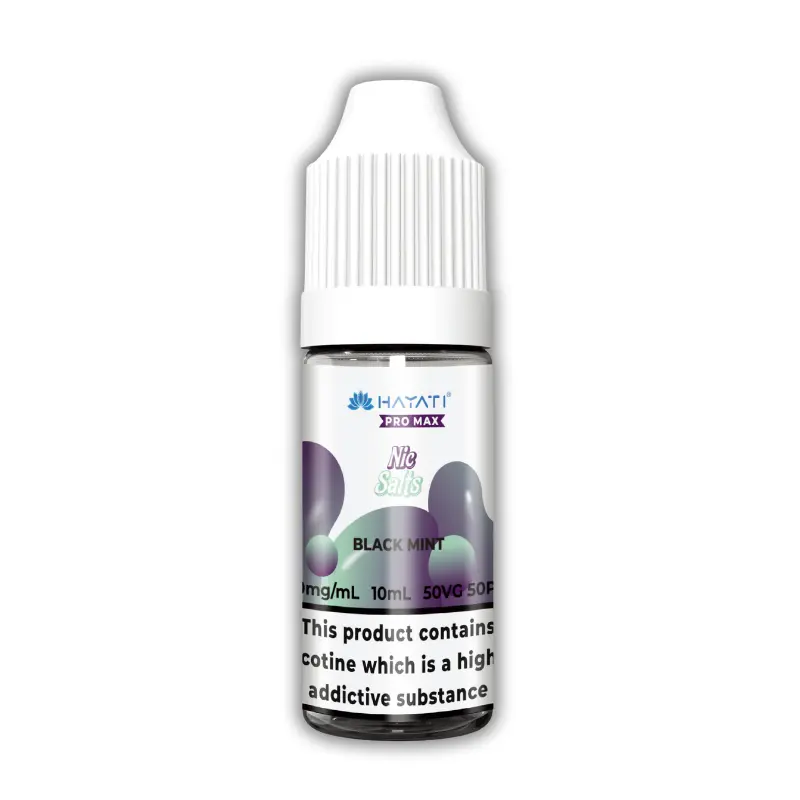
Hayati · Pro Max
Black Mint Hayati Pro Max Nic Salt
£2.49
✔ In stock — ready to ship
Genuine Hayati
Free over £20
Same-day dispatch
Secure checkout
Black Mint Hayati Pro Max Nic Salt is a 10ml bottle at 10mg, mixed 50/50 vegetable glycerine to propylene glycol, priced at £2.49 and sold for refillable pods and small mouth-to-lung hardware rather than sub-ohm tanks. It sits on the Hayati Pro Max Nic Salts shelf with sixty-four other bottles, and on Mint Vapes with eighteen other listings. Every bottle on that first shelf is 10mg and all but one of them is £2.49, so nothing in the price or the strength distinguishes this one from anything beside it. The name does. The name is the entire reason this page exists.
Two words, and only one of them is a flavour. Mint is a flavour. Black is a colour, and mint is not black. Hayati know this, because their own description declines to say what the colour refers to: it offers only "a deeper, richer note" and then stops, without naming a fruit, a berry, a spice, a confection or any second ingredient at all. There is no profile field filled in on this listing. There is no second listing of this recipe anywhere in the 492 products on this site to check the first one against. What Hayati publish about the black half of Black Mint is one hedged sentence, and the hedge is theirs, not mine.
That would be an ordinary gap, of the kind this site documents on a dozen listings, except for one thing. Eight pages already published here have quietly filled it in. They tell you there is a dark fruit in this bottle, or a dark berry, and they say it in the same flat voice they use for the price. They do not agree with each other about what the fruit does, several of them describe an arrangement no listing states, and one of them counts this bottle into a set defined by label wording that this label does not contain. Two other pages say the opposite. This page is about settling that, as far as it can honestly be settled, and being precise about where the settling runs out.
Everything Hayati put on the record, and everything they left off
The useful thing to do with a listing like this is to separate what is stated from what is inferred before any of it gets described, because once the two are mixed together in a paragraph a reader cannot pull them apart again. So, two lists.
Stated by Hayati on this listing: the mint is the core of the flavour; it is fresh and cooling on every draw; the cooling does not fade as the liquid is used; there is a darker character on the exhale; the liquid carries more weight and intensity than a plain mint does; it is positioned above Fresh Mint and above Spearmint for weight; it is 10mg nicotine salt; it is 50/50; it is 10ml; it is made for refillable pods and mouth-to-lung devices; it should be kept out of sub-ohm tanks. That is the whole of it.
Not stated anywhere on this listing: what the black is. Whether the black is an ingredient at all, or a description of the mint, or atmosphere. Whether any fruit is present. Whether any berry is present. Which mint is used, and Hayati do distinguish elsewhere, because the Spearmint copy contrasts its subject against peppermint by name. Whether the cooling comes from the mint itself or from a separate cooling agent. How sweet the liquid is, on a shelf where several neighbours announce their sweetness in the first sentence. Whether there is any sweetener at all. What colour the liquid is. What the exhale's darker character consists of.
The gap is not unusual in its existence. It is unusual in its shape. This site has written at length about names that promise nothing, and the established reading of those is that the blend never resolved into an ingredient anybody could put on a label. Black Mint is not one of those, and treating it as one is a mistake two published pages have already made. This name does name a flavour. Mint is right there, unambiguous, filed by Hayati onto a mint shelf, described as the core. The name resolves halfway and then stops, and a name that resolves halfway is a different problem from a name that does not resolve at all, because the half that resolved makes the unresolved half look more solid than it is.
How rare the hedge is, counted properly
The claim handed to me was that this is one of twelve listings whose own description hedges about its own flavour. That is the sort of claim this site insists on counting, so I counted it. Sixteen of the 492 descriptions contain suggests, suggest, likely or implies. Four of those sixteen are using the word for something else entirely: two say a blend is less likely to become tiring, one says a candy character suggests rock candy rather than juice, which is a taste description rather than a hedge, and one says a flavour is likely to appeal to a particular buyer, which is about the buyer. Strip those and twelve remain, where the word is doing genuine hedging work about what the liquid is. Twelve is right.
Twelve out of 492 is under two and a half per cent, and the membership is more interesting than the number. Two of the twelve are a name confirming itself and are not really hedges at all: Double Apple in its pod form says that as the name suggests there are two apples, and the Blue Frozen kit says the name means what it says. Seven of the remaining ten hedge a mood word: the cosmic theme of one, the night-time theme of another, the summery character of three separate Summer Dream listings, the exotic slant of a berry mix, the soft rounded quality that an aura is meant to convey. Mad Blue hedges the word mad. Blue Fusion hedges the word fusion. And this bottle hedges the word black.
That last group is where the distinction lives, and it is sharper than the version I was given. Mad Blue and Blue Fusion both contain a colour word, and in both of them the copy resolves the colour and hedges something else: their descriptions place blue in the blue raspberry and blueberry family as a matter of fact, then hedge the modifier. Here it is the reverse. The base is resolved and the colour is hedged. Of the twelve, this is the only listing where the hedged element is the colour word itself.
Black in the catalogue, and why this one is different
The colour census belongs to the Mad Blue Pro Max Plus pods page, which counted standalone colour words across the range and found blue eighty-three times, red twelve, orange seven, pink four, black four, white three, green two and purple not at all. Its conclusion, that Hayati name products after one colour rather than after colours in general, is that page's finding and I am not going to re-derive it. The line that matters here is its observation that black standing alone is Black Mamba and Black Mint, which my own count confirms exactly: four titles contain black as a free word, three of them are Black Mamba and its two prefilled siblings, and the fourth is this bottle. Everywhere else the letters appear bound inside a compound fruit noun, sixteen times inside blackcurrant and six inside blackberry.
Now push it one step further than the census did, because the census was counting colours and the question here is grammar. Take every distinct flavour name in the catalogue where a colour word sits free in front of something else, and ask what the colour is modifying. Red Apple Ice: red modifies apple, and apples are red. White Peach Raspberry: white modifies peach, and white peach is a real cultivar. The twenty-two names built on Blue Razz: blue modifies raspberry, and blue raspberry is a confectionery flavour with decades of history behind it. Pink Lemonade: pink modifies lemonade, and pink lemonade is a drink you can buy. Red Sour Raspberry, Red Berry Ice, Red Razz: red modifies a berry, and berries are red.
In every one of those the colour is a colour the flavour can actually be, the pair reads as one ingredient, and nothing is being added. Mint is not black. Mint is green, and Hayati's own Fresh Mint copy says so in as many words. So in this name, and in no other name in 492, the colour cannot be describing the flavour it sits in front of. It has to be doing something else. That is the real finding, and it is why every writer who has touched this listing has reached for a second ingredient: the grammar pushes you there.
The grammar pushing you somewhere is not the same as the label telling you something. It licenses the conclusion that the word is probably doing work beyond decoration. It does not license naming what the work is, and that is precisely the line eight published pages have crossed.
What the corpus has been asserting, and why it is wrong
Here is the payload, stated plainly, because a tactful version of this section would be useless. Eight pages on this site tell a reader that there is a fruit or a berry in this bottle. Not one of them attributes the claim, hedges it, or shows where it came from. I re-read every page that mentions Black Mint, forty-six of them, and sorted the sentences.
The Blackcurrant Juice bottle page says twice that there is dark fruit under the mint, once describing the cooling as more prominent than the berries, which is a claim about proportion between two things when only one of them is known to exist. The Double Apple bottle page says this liquid pairs a dark fruit with a mint spine. The Blackcurrant Lemonade bottle page sends a buyer who wants the dark fruit direction here. The Lemon Lime bottle page says it pairs the cold with dark fruit. The Watermelon Ice bottle page says a dark fruit sits underneath. The Strawberry Mojito bottle page says it twice, first that the mint gets a dark berry alongside it, then that a dark fruit supports a mint which is the stated core. The Hayati Pro Max Shisha bottle page says this one runs the herb under a dark fruit. And the Fresh Menthol Mojito page calls it the shelf's other herb-and-fruit construction, with a dark berry supporting the mint.
Eight pages, eight statements of fact, and no source. The brief I was given named seven of them and listed Spearmint as the eighth. Spearmint does not belong on the list. Its two references to this bottle both say the mint goes somewhere darker as the name suggests and as the name implies, which is the correct attribution and exactly what the listing supports. The two that actually belong and were not named are the Shisha bottle and Fresh Menthol Mojito. So the count of eight is right and the membership was wrong by two, which is worth saying because a correction that repeats an error is not a correction.
They do not agree with each other
If the eight had merely all been guessing in the same direction it would be a smaller problem. They are not. Read them side by side and they describe three different liquids.
On which component leads: Blackcurrant Juice puts a mint layer over dark fruit and reports the cooling as more prominent than the berries. Strawberry Mojito, in its second reference, inverts that, saying the mint is the stated core and the fruit supports it, and explicitly notes the inversion as a difference from its own subject. The Shisha page runs the herb under the fruit, which is the first arrangement again. Double Apple's phrase, a dark fruit paired with a mint spine, reads as a partnership rather than a hierarchy.
On what the fruit is: six say fruit, two say berry. Fresh Menthol Mojito commits furthest and calls it a dark berry supporting a mint. Blackcurrant Lemonade implies a blackcurrant-adjacent character by filing it under the same dark fruit direction as itself and Blackberry Ice, which are the two nearest actual dark fruits on the shelf alongside Blackberry Raspberry.
And on the strongest form of the error, Strawberry Mojito counts this bottle into a set of six listings out of 492 that put a herb next to a fruit and say so on the label. The label does not say so. That page's own test, applied honestly, excludes this listing from the six and from the seven mojitos it contrasts them with, because it belongs to neither group. The rest of that page's arithmetic on herbs, which is careful and which I have no quarrel with, needs one subtracted from the first group.
Where the phrase came from
The interesting question is not that eight writers guessed. It is that eight writers guessed the same two words, and there is a traceable reason. Dark fruit appears in nine of the 492 source descriptions and dark berry in five. I read all fourteen. Every single one of them sits on a listing whose title already names the fruit: Blackberry Ice twice, Blackcurrant Juice, Blue Razz Blackcurrant twice, Vimbull Ice, Blueberry Cherry Cranberry three times, Blackcurrant Lemonade three times, Blackcurrant Mango, Blueberry B'Gum. In all fourteen the phrase is a gloss on something the name has already declared. It is house vocabulary for describing a known fruit, not for identifying an unknown one.
Black Mint's description contains neither phrase. So the words did not come from this listing. They came from the fourteen listings where Hayati use them correctly, and they were carried across to the one listing that names no fruit, by writers who had those fourteen descriptions in their heads and a colour word in front of them. That is a clean mechanism, it is checkable in a minute, and it explains why the error is so consistent.
There is a second, smaller tell. The collocation "deeper, richer" appears in exactly two descriptions out of 492. The other one is the Blue Razz Cherry Mini Ultra kit, where it glosses the cherry, a fruit named in the title. Here the same two words gloss nothing. One usage attaches to a declared ingredient and the other attaches to a blank, and the blank is what the corpus has been filling.
The pages that got it right, and one that filed it wrong
Three pages resisted. The Frosted Mint pouches page disposed of the whole question in a sentence, calling this the range's ambiguous mint, where a colour word is doing unspecified work in front of a flavour that is otherwise clear. That is the correct reading and it was published before this page existed, so nothing here is presented as new: this page is the long version of that sentence, with the counting attached. The Tobacco bottle page says the two are both trying for depth without fruit, which is the opposite claim to the eight and, as it happens, the better supported one. The Lemon Mint page lists the shelf's pure mints and adds arguably before this one, which is exactly the right amount of doubt.
One page files it in the wrong bin. The Ruby Berry pouches page groups seven names that carry a colour word and name no fruit, lists this one among them, and calls them all mood names whose established reading is that they promise nothing. Six of its seven are mood names and the classification is sound for them. This one is not. Black Mamba names a snake, Mad Blue names an intensity, Mr Pink names a person, and none of those four names a flavour. This name names a flavour and withholds a component, which is a different failure and needs a different answer. A mood name promises nothing and the honest page says so. A half-resolved name promises one thing clearly and gestures at a second, and the honest page says which half is which rather than writing the whole name off.
Finally, two pages disagree with each other about the grammar itself, which is worth flagging because a buyer reading both would be told opposite things about how the name is built. The Mad Blue Pro Max Plus pods page says black standing alone is Black Mamba and Black Mint. The Black Mamba Pro Max Plus pods page says black appears in ten distinct names and in nine of them it is bound directly to an ingredient, and lists black mint among the bound nine. Counting distinct flavour names containing the letters, I get nine once the two spellings of one dual listing are collapsed, of which seven bind the word inside blackberry or blackcurrant and two leave it free. Mad Blue's version is right. Black Mamba's is wrong by two, and the specific error is that it treats this name as a compound when it is the one case in the catalogue that is not.
The aggravating factor: there is no second copy
Most Hayati recipes are sold several times over, across bottles, pods and kits, with fresh copy written for each one. Lining those descriptions up against each other is the single most productive technique this site has, and it was established on the Blackcurrant Lemonade kit, which found seven listings of one flavour disagreeing in instructive ways. It cannot be run here.
The Kiwi Grape Raspberry page owns the sold-once set: thirteen recipes appear exactly once across all 492 listings, and it published the list and the normalisation it used to get there. Black Mint is one of the thirteen. The Mr Pink page owns the wider version, thirty-eight of 492 carrying a flavour name that appears exactly once, and the narrowing to thirteen of the sixty-five bottles on this shelf. The Red Berry Ice page owns the consequence, which it put as one description and no way to check it against a second. All three of those are cited rather than recounted, and all three apply here without modification.
What it means in practice is that the hedge has no backstop. On a flavour with four listings, a vague description on one of them is corrected by a specific one on another, and a buyer can triangulate. Here the one description is the entire published record, the one description hedges, and the hedge is about the only part of the name that is not self-explanatory. There is nothing behind it.
Three tests, and what each one returned
Saying the answer is unknown is cheap unless you have tried to find it. Three checks were available against Hayati's own published data, and it is worth reporting all three, including the one that produced nothing, because a negative result is information about the catalogue.
Test one: the profile field
Every listing in the catalogue carries a profile field in its specification data, and on 477 of the 492 it is empty. Fifteen are filled in. All fifteen are on this shelf, which means the profile field is not a catalogue-wide facility that this listing happens to miss, it is a facility that exists only among the sixty-five bottles this bottle belongs to. Fifty of the sixty-five are blank, so blankness is the norm and is not by itself evidence of anything.
What the fifteen are used for is the finding. Six of the fifteen use the field to say something the title does not. Grape GB is unpacked to grape and bubblegum. Strawberry GB likewise. Blue Razz Mojito is unpacked to blue raspberry, citrus and mint, which resolves what a mojito means in a bottle. Double Apple becomes sweet and crisp apple, which resolves what double means. Blue Frozen becomes blue raspberry and menthol, which resolves both halves of a name that states neither. And Black Mamba, the only other free-standing black in the catalogue and the range's most obviously unreadable name, becomes mixed berries and a cool finish.
So Hayati own a mechanism for decomposing an opaque name into its components, they have used it on the six opaquest names on this shelf, and the one they gave it to that is nearest to this bottle in structure is the other black. This listing's field is blank. That is the strongest single piece of evidence available, and it points away from a declared second ingredient rather than towards one, because when Hayati know what is in an oddly named liquid they have somewhere to put it and they put it there. It is suggestive and it is not proof, because fifty blanks include Fresh Mint and Menthol, which need no decomposition, and a blank can mean nobody filled the form in.
Test two: the shelving
This one looked promising and failed, and the failure is worth publishing. Hayati file listings onto flavour shelves as well as format shelves, and there are around thirty flavour shelves including berry, blackcurrant, cherry and blueberry. If a dark fruit were in this bottle and Hayati knew it, a fruit shelf would be the obvious place for the knowledge to leak out. This listing carries exactly one flavour shelf, Mint Vapes, and no fruit shelf of any kind.
That reads as evidence until you test whether the shelving is reliable, and it is not. Eighteen of the sixty-five bottles carry exactly one flavour shelf, and several of them plainly have more than one component. Cola Lime is filed under cola with no citrus shelf. Blue Razz Cherry is filed under cherry with nothing for the raspberry. Fresh Menthol Mojito is filed under menthol with nothing for the lime that its own description leads with. And the Shisha bottle, whose flavour field reads apple, mint and grape, is filed under apple and blueberry, which names a fruit the recipe does not contain and misses two that it does.
A system that misses declared components on at least four bottles on this shelf cannot be used to rule out an undeclared one on a fifth. The absence of a fruit shelf here is consistent with there being no fruit and equally consistent with a fruit nobody filed. The test returns nothing, and anybody tempted to run it again should know that before spending the time.
Test three: the listing diff
Covered above and it fails at the first step. One listing, no second copy, nothing to diff. Worth stating explicitly only because the technique is productive enough elsewhere that its absence here is part of why this particular gap has stayed open.
The half that is knowable
All of the above is about the black. The mint is a different matter, and it is the larger half of the bottle by the listing's own account, so it deserves the analysis rather than a sentence.
Start with what the chemistry pages already established, because redoing it would be waste. The Menthol bottle page owns the distinction between a taste and a sensation, and the point that a pure cooling agent is felt by the cold receptors rather than tasted, which is why nobody can tell you what setting to run it at and why cold preferences drift upward with exposure. The Spearmint Pro Max Plus kit page owns carvone, the compound responsible for the smell of spearmint, and the finding that a garden spearmint left alone is a warm flavour rather than a cold one, with the caraway shadow at its edges and the sweetness that formulators add because steeped spearmint on its own is thin. Between them those two pages cover the mint chemistry this range needs, and the mint and menthol census, twenty-six of the 492 titles, belongs to the Fresh Mint Pro Ultra Plus pods page. Cite, do not recount.
What this listing adds to that is narrow and it is all on the sensation side. Cooling is present on every draw, so there is no build-up pattern of the kind Fresh Mint's copy describes. Cooling does not diminish across the bottle, which is a stability claim rather than an intensity one. And the character on the exhale is darker than the inhale, which is a statement about where in the breath the unexplained component sits, if it exists.
What the listing does not do is name the mint. Hayati distinguish species when they want to: the Spearmint copy contrasts itself against peppermint explicitly, and peppermint appears in exactly three of the 492 descriptions, all three of them Spearmint listings, always as the thing spearmint is not. This bottle's description uses neither species word, and it does not use menthol either. So the cooling could be carvone-led, menthol-led or from a separate agent, and the published record does not say.
A reading nobody on this site has considered
Every page that has touched this listing, the eight that assert a fruit and the three that decline to, has assumed that black points at a second thing. There is a third reading and it is worth putting on the record because it changes what you would be buying.
Black mint is an established term in the mint trade. The dominant peppermint grown commercially for oil is a dark-stemmed cultivar, distinguished for well over a century from the paler type, and the two are known in the trade as black and white mint respectively. The dark one yields a heavier, rounder oil with more of the body that lighter material lacks. Under that reading, black is not a second ingredient at all. It is an adjective describing the mint itself, exactly as red describes the apple in Red Apple Ice and white describes the peach in White Peach Raspberry, and the deeper, richer note running alongside is the mint being fuller rather than a fruit being present.
That reading fits Hayati's copy better than the fruit reading does, for three reasons. It explains why the description says a note rather than an ingredient. It explains why the comparison drawn is against a plain fresh mint rather than against anything fruited. And it is the only reading on which the name follows the same grammar as every other colour-plus-flavour name in the catalogue, which is a real point rather than a rhetorical one, given that the colour modifies the flavour in all twenty-nine of the others.
It is still a reading. Hayati do not invoke it, they use neither the word peppermint nor the word cultivar anywhere on this listing, and a mass-market e-liquid house is at least as likely to have chosen black because it sounds weightier than fresh does. I am not asserting it and nobody should quote this page as having established it. What I am saying is that a third possibility exists, it is at least as well supported as the fruit, and eight pages that jumped straight to a berry never got far enough to notice it.
A ranking that only runs one way
Four bottles on this shelf are mint or menthol with no fruit attached: Fresh Mint, Spearmint, the plain Menthol and this one, all four at £2.49. Three of them place themselves on a shared scale. Fresh Mint puts itself between a Spearmint that is too soft and a Menthol that is too icy. Menthol distinguishes itself from both by name, on the grounds that it is about cold rather than herbal taste. Spearmint positions itself as the rounder, sweeter one and carries the only mint profile field in the catalogue, sweet mint.
Black Mint enters that scale from outside it. Its copy claims a position above Fresh Mint and above Spearmint, on weight. None of the three acknowledges it back, which the Fizzy Cherry page noticed and which my reading of all four descriptions confirms. And it makes no claim against Menthol at all, which is the comparison a buyer choosing a bold cold mint would most want, and the one where a weight argument would be hardest to sustain.
The Mad Blue bottle page established that Hayati's copy sometimes ranks its own labels rather than its liquids, and identified the mints as the family where that habit is strongest because a buyer genuinely cannot tell them apart by reading. This bottle is the same species of evidence and it goes one step further than the examples that page had. The ranking here is the only positional information in the entire description. It is one-directional. And the axis it claims to win on, weight and body, is precisely the axis supplied by the component that is never named. The description's single checkable claim rests on its single unexplained word.
One more tell in the copy
The last sentence of the flavour paragraph says the cooling stays level all the way through the pod. This is a 10ml bottle. It does not come with a pod, it does not come with a device, and the quantity a buyer receives has no relationship to any pod. Six of the sixty-five bottle descriptions mention a pod and three of those are correct, telling you to fill your pod and let a new coil soak. Three treat the pod as a unit of the liquid, the way a prefilled listing would, and this is one of them. The Hubba Bubba pods page spotted it from the other direction, noting that this bottle attaches a consistency claim to the pod rather than to a draw or a session.
On its own that is a triviality. Alongside a hedge about the product's own name, and a phrase borrowed from the house vocabulary for fruits this listing does not have, it points at the same conclusion: the description was assembled from a template by somebody working from the name and the range, not from the liquid. Which is exactly what you would expect of a description that hedges its own flavour, and exactly the reason it should not be read as though it were a tasting note.
What is known, what is probable, what is not known
Tagging is better than prose here, because the whole failure this page exists to correct was a set of pages stating the third category in the voice of the first.
Reasonably confident. Mint is the dominant flavour and is meant to be recognised as mint. Cooling is present from the first draw and is intended to be steady rather than escalating. The liquid is fuller and more intense than Hayati's own plain Fresh Mint, since that comparison is the one thing the copy commits to. It is 10ml, 10mg, 50/50, £2.49, one listing, one strength, no prefilled version of this recipe at any price.
Probable, with reasoning shown. The word black is doing some work beyond decoration, because it is the only free colour word in the catalogue that cannot describe the flavour it modifies. The liquid is sweeter than the plain Menthol, because every account of a mint liquid with body involves sweetening and the copy claims body. The darker character arrives late in the breath rather than early, because the copy places it on the exhale and nowhere else.
Not known, and not knowable from anything Hayati publish. Whether a fruit is present. Whether a berry is present. If either, which one, in what proportion, and whether it leads or supports. Whether black instead refers to the mint variety. Whether it is simply atmosphere, as it is in the only other free-standing black in the range. Which mint species is used. Whether the cooling is from the mint or from a separate agent. How sweet it is in absolute terms. Whether the darker character is fruit, herb, spice or the mint itself.
The honest summary is that the axis most likely to decide the purchase, what the second half tastes like, is in the third list. If that axis decides it for you, the shelf has bottles that answer it before you pay. Blackberry Ice declares a dark fruit and a cooling element and both are in the title. Blackcurrant Lemonade declares its berry and its mixer. Lemon Mint declares a herb and a citrus and puts both on the label. Any of those tells you what you are getting. This one does not, and £2.49 is the price of finding out.
A method for characterising it on the first bottle
Since the description will not tell you what the second half is, the alternative is a procedure that will. None of this is difficult and all of it is specific to this liquid rather than general advice.
Separate the cold from the taste before anything else. Cooling registers on the receptors rather than on the tongue and it will mask a quiet second note completely on the first few draws. Take three or four draws to let the cooling settle, then take one and exhale through the nose rather than the mouth. Retronasal exhale carries aroma compounds and carries very little of the cooling sensation, so anything fruited, herbal or spiced will show there when it was invisible on the mouth exhale. If nothing shows on the nose exhale across several attempts, the probability that there is a distinct second flavour drops sharply.
Run it against Fresh Mint on the same coil, same day. Both are £2.49, both are 10mg, both are 50/50, and Fresh Mint is the exact comparison Hayati chose to make. Fill, run a millilitre, rinse and dry the pod, fill with the other, run a millilitre. Whatever is present in one and absent in the other is the black, isolated. Doing this on two different coils or two different days will not work, because coil age moves flavour more than most single ingredients do.
Use Spearmint as the sweetness reference. Spearmint is the one mint on the shelf that Hayati label sweet, in the only mint profile field they have filled in. If this bottle reads as sweeter than Spearmint, something is carrying sugar, and a sweetened second component narrows the field considerably. If it reads as drier, the body being claimed is coming from the mint material rather than from an added confection.
Watch the cotton. Dark fruits stain wick. A blackcurrant or blackberry concentrate leaves a visible brown to purple discolouration on cotton well before the coil is spent, and it does it faster than a mint will. Pull the pod after five or six millilitres and look. Clean cotton with only the usual darkening at the contact points is a point against fruit. Distinctly coloured cotton is a point for it, and the shade is informative.
Run it after a sweet bottle and see what survives. Follow something declared and sugary, Bubblegum Ice or Strawberry Jelly Beans, and the palate will be blunted to sweetness and open to everything else. Anything tart, herbal or astringent in this liquid will be easier to find in that state than on a fresh palate.
Give it four or five millilitres before deciding. Cold receptors adapt, which the Menthol page sets out properly. The cooling that dominates on day one will read as ordinary by day four, and the second component, whatever it is, will be more audible then than it is at the start. A verdict formed on the first fill is a verdict about the cooling.
Report what you find rather than what you expected. The reason this page is necessary is that eight competent writers wrote down what they expected.
Specification
The rows below are the whole of the published specification, and the shape of the table is itself part of the argument: there is no ingredient row because there is no published ingredient list, and the flavour description row is shorter than it is on almost anything else in the range.
| Listing reference | HPM-NS-BLACK-MINT |
| Named flavour | Black Mint |
| Components Hayati identify | One, mint |
| Profile field on this listing | Blank, against fifteen filled in on this shelf |
| Flavour shelves carried | One, Mint Vapes |
| Quantity | 10ml |
| Nicotine | 10mg per ml, salt formulation |
| Strengths offered | One, 10mg |
| Base | 50 vegetable glycerine to 50 propylene glycol |
| Intended hardware | Refillable pods and mouth-to-lung devices |
| Not intended for | Sub-ohm tanks |
| Price | £2.49 |
| Other listings of this recipe | None in 492 |
| Maker | Hayati |
Two of those rows do work the others do not. The blank profile field is covered above and is the best available evidence about the second component. The single-strength row matters differently: a liquid sold at one strength gives a buyer no way to hold the flavour constant and vary the nicotine, so the bottle is a single fixed proposition rather than a range. Across all sixty-five bottles on this shelf that is true, since every one of them is 10mg, but it is worth stating on a page where so much else is already unadjustable.
The 50/50 base is the reason the liquid suits the hardware it is sold for. A half-and-half mix is thin enough to move through a narrow wick quickly, which is what a high-resistance mouth-to-lung coil needs and what a wide sub-ohm wick does not. Put a 50/50 salt into a sub-ohm tank and two things go wrong at once: the liquid floods a wick built for something thicker, and the nicotine arrives at a rate the format was never designed around. That is why the listing says to keep it out of one, and it is the single specification line on this page that has a practical consequence rather than an informational one.
On the quantity, 10ml is the bottle size the whole Hayati E-Liquids nic salt line uses, and the Fresh Mint bottle page owns the wider observation about which flavours Hayati promote to larger formats and which stay at 10ml. Mint is the one non-fruit flavour in the range that reaches every bottle size, but it reaches them as Fresh Mint, through the Fresh Mint 50/50 shortfill and its 70/30 sibling. This recipe stays at 10ml and there is no larger version of it to graduate to.
Choosing between this and the neighbours
The comparison set divides cleanly, because a buyer looking at this bottle is either buying a mint or buying the idea of a dark mint, and those lead to different shelves.
If you want a mint and the black is incidental. Fresh Mint is the one to take. It is the same price, it names what it is, its copy describes a green herbal taste with cooling that builds through the draw rather than arriving immediately, and it positions itself as the middle of the three. Spearmint is the softer and sweeter option and the only one Hayati have labelled sweet. The plain Menthol is the cold one, and its own copy is honest that it is about sensation rather than taste. Between those three a buyer can make an informed choice from the descriptions alone. Between those three and this one, they cannot.
If the appeal is a mint carrying something else. Lemon Mint is the declared version of that idea and costs the same. Zest leads, herb follows, both are on the label, and nothing about it requires guessing. Fresh Menthol Mojito is the harder version, with lime, mint and menthol stacked, and it pushes the chill further than anything else on the shelf. The Shisha bottle runs mint under apple and grape, which is a three-component version of the same structure and the only other bottle here where mint is a supporting element rather than the subject.
If the appeal is specifically the dark fruit you may have read about. Buy a dark fruit. Blackcurrant Juice is the single berry taken straight. Blackberry Ice puts a dark fruit with cooling and says both on the label, which is the closest declared thing to what the eight pages describe this bottle as being. Blackberry Raspberry is the two-berry version and Blackcurrant Lemonade adds a mixer. Black Mamba is the range's other unreadable name, and unlike this one it has a filled-in profile field telling you it is mixed berries with a cool finish, which is a good illustration of what this listing would look like if Hayati had wanted to tell you.
If you want a palate reset between fruit bottles. Any of the four fruit-free mints will do it, and the argument for this one over Fresh Mint is weight, which is the unverified claim. Several pages on this site nominate this bottle for that job, including the Rocky Candy Orange and Cherry Cola pages, and the reasoning holds regardless of what the black is: mint occupies a channel that fruit does not touch, so the two do not erase one another. If reset is the job, the cheaper certainty is Fresh Mint.
If you are stocking a rotation. The useful pairing is one mint and two or three unrelated fruits, and this shelf carries plenty of both. Blue Razz Mojito already has mint under its berry, so pairing it with this one doubles up. Cola Ice, Banana Ice and Blueberry Cherry Cranberry occupy channels a mint does not, which makes them cleaner partners. Blue Razz Lemonade and Blue Frozen both carry their own cooling, so running either alongside this one means two cooled liquids competing rather than alternating.
The wider view is on the full Hayati range and the New Products shelf, which on this catalogue holds all 492 listings, is a poor filter for anything.
Handling, storage and when the bottle is done
Mint liquids age differently from fruit ones and most general advice is written for fruit, so the items below are anchored to this one.
The cooling material is the most volatile thing in the bottle. Menthol and its relatives are small molecules with a real vapour pressure at room temperature, which means an open or badly capped bottle loses cold faster than it loses anything else. A mint bottle left uncapped on a desk for an afternoon will read flatter than it did, and the part that has gone is the part you bought it for. Cap it between fills, not at the end of the session.
Warmth accelerates the same loss and light degrades flavour material generally, so the bottle wants a drawer rather than a windowsill and a room rather than a car. Ten millilitres in a pod-sized bottle is a small volume with a large headspace once it is half used, and headspace is where volatiles go, so the second half of a mint bottle is more vulnerable than the first. If you rotate rather than running it daily, that matters more, because the bottle spends longer half empty.
Prime a new coil properly before the first draw. Wet the exposed cotton, fill, then leave it five minutes. A dry burn on a fresh coil ruins the coil and it also ruins your read of the liquid, because scorched cotton reads as harsh and a buyer trying to characterise an unidentified second component does not need a false signal in the way.
Mint ghosts harder than almost anything, which is the practical cost of this bottle in a rotation. The cooling agent binds to cotton and to the plastic of a pod and it survives a rinse, so the fruit you put in next will taste faintly cooled for a fill or two. If you run more than one liquid, keep a dedicated pod for mint rather than swapping. That is a genuine expense, since a pod is not free, and it is worth knowing before you buy rather than after.
On the other hand, mint is kind to a coil. What kills coils fastest is sweetener, which caramelises on the wire and leaves a crust that flattens everything and is the reason candy and dessert liquids burn through coils quickly. A mint carries less of it than a jelly bean or a bubblegum does, so a coil running this liquid should last noticeably longer than one running the confectionery end of the shelf. Whether that advantage survives depends on how much sweetening the unexplained second half brings with it, and again, that is not published.
Signs the coil is finished, in the order they show on this liquid: the cooling stays but the flavour behind it thins, then the exhale shortens, then a faint scorch arrives at the end of a long draw. The cooling going last is characteristic of mint and it is a trap, because a pod that still feels cold can be well past the point where you are tasting anything. Judge it on the exhale rather than the chill.
Store the bottle upright with the cap seated and keep it away from children and animals, which is ordinary handling for anything at this nicotine strength rather than a special property of this one. Rinse the empty bottle before recycling it, since residue on the plastic is the usual reason kerbside collection rejects a container.
Questions buyers actually ask about this one
What is the black in Black Mint?
Hayati do not say. Their own description hedges it, noting only that the word suggests a deeper, richer note, and it names no fruit, berry, spice or second ingredient anywhere. There is no second listing of this recipe to cross-check and the profile field that Hayati use to decompose other unclear names on this shelf is blank here. Anybody who tells you it is a specific fruit is inferring from the word, not reading the label.
Several other pages on this site say it contains a dark fruit. Are they wrong?
They are stating something the listing does not support, yes. Eight pages assert a dark fruit or dark berry as a fact, they disagree with one another about whether it leads or supports, and the phrase they all use is Hayati house vocabulary that appears on fourteen other listings, every one of which names its fruit in the title. This listing does not use the phrase. Those pages should be read as guesses and this page has corrected them by name.
Is there ice or menthol in it?
Cooling is definitely present, because the description says it is there on every draw and that it holds steady through the bottle. What produces the cooling is not published: it could be the mint itself, added menthol, a separate cooling agent, or a combination. The title carries no ice-family word, which across this catalogue is consistent, since no Hayati listing ever combines an ice word with a mint word.
How does it compare with Fresh Mint?
Hayati claim more weight and more intensity here than a plain mint offers, and that is the only comparison the description makes. Fresh Mint's own copy describes a green herbal taste with cooling that builds through the draw, and places itself between Spearmint and Menthol. The two bottles cost the same, so running them side by side on one coil is the cheapest way to find out what the difference actually is.
Why does the description mention a pod when this is a bottle?
Because the copy appears to have been assembled from a template used across formats. The line about cooling holding steady through the pod belongs to a prefilled listing, not to a 10ml bottle that comes with no pod at all. Three of the sixty-five bottles on this shelf have the same slip. It is a small thing on its own and it fits a pattern of copy written from the name and the range rather than from the liquid.
Could black refer to a type of mint rather than a second ingredient?
It could, and no page on this site had raised it before. Black mint is established trade vocabulary for the dark-stemmed peppermint cultivar grown commercially for oil, as against the paler type, and it yields heavier material. That reading would explain a deeper note with no fruit involved. Hayati do not invoke it, they use no species word on this listing, and it remains one possibility among several rather than an answer.
Is it sweet?
Not stated. Spearmint is the one mint on this shelf that Hayati label sweet, and the plain Menthol is explicitly about cold rather than taste, so those two bracket the range. A liquid claiming body usually carries some sweetening, which makes moderate sweetness probable here, but that is reasoning from the claim rather than from a published figure.
Can I get this flavour in a prefilled pod or a kit?
No. This recipe exists exactly once in the 492 products listed here, as this bottle, and there is no pod, kit, pouch or larger bottle carrying it. It is one of thirteen recipes on this sixty-five bottle shelf in that position, a set the Kiwi Grape Raspberry page counted and published. If you want it, the bottle is the only way to have it.
Which device should this go in?
A refillable pod or a small mouth-to-lung device with a higher-resistance coil, which is what a 50/50 base at this nicotine strength is mixed for. Keep it out of sub-ohm tanks, where the wick is built for thicker liquid and the format is not designed around a salt at this concentration. Check the liquid type your own hardware is specified for before filling it.
Will it ruin the flavour of whatever I run next?
For a fill or two, probably. Cooling agents bind to cotton and to pod plastic and survive rinsing better than fruit concentrates do, so a fruit liquid run immediately afterwards will read faintly cooled. Keeping one pod for mint and another for everything else avoids it entirely, at the cost of a spare pod.
Is it worth £2.49 given how little is known about it?
That depends on what decides it for you. If you want a mint with more weight than a plain one and you are relaxed about what supplies the weight, it is the same price as every other bottle on the shelf and finding out costs one purchase. If the identity of the second component is what you are buying, a declared flavour tells you before you pay and this one does not.
Why does the name fit the range's naming convention and still not tell you anything?
Because the convention is about word order, not about content. The Fresh Menthol Mojito page established that 130 of the 492 titles carry a cooling word and that it comes last in almost all of them. This title obeys that exactly, with mint in final position. What it breaks is the assumption underneath, which is that the word before the cold word names a flavour. Here it names a colour with no stated referent.
The short version
Black Mint is a 10ml, 10mg, 50/50 mint nic salt at £2.49, sold once and nowhere else in the range, with cooling on every draw and a claim to more body than Hayati's own plain Fresh Mint. The mint half is real and is the larger half by the listing's own account. The black half is undefined, Hayati's own copy hedges it rather than stating it, the profile field that would have resolved it is blank on this listing while it is filled in on the range's other unreadable name, and there is no second description of this recipe anywhere to check the first against.
Eight pages on this site have said there is a dark fruit in it. They were reasoning from a colour word and borrowing a phrase that belongs to fourteen other listings, all of which name their fruit. They contradict each other and none of them attributes the claim. Two pages said the opposite and one said it correctly in a single sentence. The accurate position is that the word is probably doing some work, because it cannot be describing the mint the way red describes an apple, and that nobody outside Hayati knows what the work is. A fruit is one possibility. A mint cultivar is another. Atmosphere is a third, and it is what the same word does in the only other place this catalogue uses it on its own.
Buy it if a mint with claimed weight is what you want and the mystery is tolerable at this price, and use the tests above to characterise it rather than trusting a description whose own writer was hedging. Buy Fresh Mint, Lemon Mint or a declared dark fruit instead if you want to know what is in the bottle before you open it. Either way, do not take the second ingredient from a retail page, this one included.
Strictly for adults aged 18 and over. Nicotine is an addictive substance.
You might also like


