
Home / Hayati Pods / Fresh Mint Hayati Rubik Pods
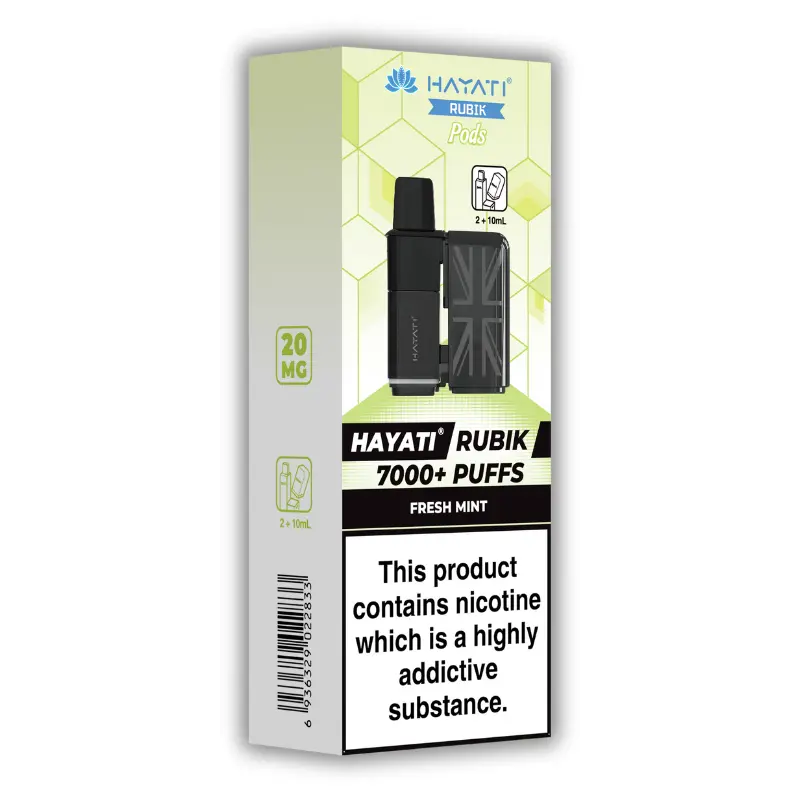
Hayati · Rubik
Fresh Mint Hayati Rubik Pods
£3.99
✔ In stock — ready to ship
Genuine Hayati
Free over £20
Same-day dispatch
Secure checkout
Fresh Mint Hayati Rubik Pods is a sealed refill at £3.99, holding 12ml of 20mg nicotine salt, rated by the manufacturer at up to 7,000 puffs on laboratory equipment rather than in anybody's pocket. No body is included and the pod does nothing at all on its own. It becomes a product only when it is dropped into a Rubik that is already in your possession, and that one condition is what makes this page different from the page about the same liquid one tier up.
The Fresh Mint Hayati Rubik Prefilled Pod Kit at £5.99 is addressed, from its first line to its last, to somebody who has never held a Rubik. Its argument is that a liquid with one component and almost no sugar in it works as a measuring instrument on hardware you do not know, because when the pod contributes nothing of its own to an odd draw, the oddness has only one place left to come from. That argument is sound. It is also self-liquidating. It works, the buyer finds out what their device does, and the moment they arrive here for a £3.99 refill the premise has expired underneath them. The Rubik is characterised. There is nothing unfamiliar left for an instrument to point at.
Which is not the end of the property, only the end of that use of it. The same single-component construction that made this pod a probe on unknown hardware makes it something else on known hardware, and the something else is more useful to a person restocking than the original was to a person buying in. This page is about that second use: what a liquid with nothing hidden in it is worth once the device is a settled quantity, what job it takes in a drawer of nineteen refills, and where the shelf arithmetic actually lands once you count it rather than accept it.
What the twin settled, and what I am not going to write again
Six things are finished and belong to the kit page. Each gets one sentence here and nothing more, because re-deriving somebody else's reasoning is the cheapest way to produce a worse version of it.
- The central argument, that a one-component near-sugarless liquid is a diagnostic instrument for Rubik hardware you have never used, is set out there in full and aimed squarely at a first-time buyer of the device.
- Four mechanisms make any first impression of a vape liquid untrustworthy, and the kit page lists them, tests this product against all four, and finds it exposed to exactly one of them.
- The naming census is done: twelve of the 492 titles in the catalogue carry the word Fresh, eleven of those are Fresh Mint, the twelfth is a menthol mojito bottle, and since Fresh names no species, compound, quantity, temperature or fruit, it is an evaluative word and therefore one that cannot turn out to be wrong.
- The split between identity and sensation is established there too: the flavour reads correctly from the first draw and stays where it is, while the cooling reads correctly for a few days and then quietly stops doing so.
- The proportionality argument for that fade is theirs as well, resting on the Double Menthol pods page for the underlying adaptation finding, and it explains why an identical loss of chill costs a plain mint far more of itself than it costs a cooled fruit.
- Three distinct causes produce the complaint that a mint has gone flat, and the kit page separates them and delivers the verdict on the flavour and the whole comparison shelf besides.
Read it if you have not. Everything above is load-bearing for what follows, and none of it is repeated below except where I have to lean on it for a sentence.
One correction of emphasis rather than of fact. The kit page tells its reader that twelve millilitres is a long commitment to make to a guess, and warns them off buying a flavour they have not met. That warning is correct for its reader and void for yours truly at the £3.99 tier, because you are not guessing. You already know whether you get on with the device, and if you are looking at this listing at all you have some idea what plain mint does to you. The commitment question has been answered. A different question replaces it, and most of this page is about that.
Counting the shelf before building anything on it
The framing I was handed for this page contained two claims worth checking, and both needed adjusting. Stating what they were and what the count did to them is more useful than quietly shipping the tidier version.
Nineteen listings, one price column
The first claim was that at 33.25p a millilitre this is the cheapest diagnostic on the shelf. It is not, and the reason is structural rather than a rounding error. Hayati Rubik Pods holds nineteen listings and every one of them is £3.99 for 12ml of 20mg liquid. There is no cheapest entry because there is no dearest entry. The whole price column is one figure repeated nineteen times, which works out at 33.25p per millilitre for all of them, and the shelf page rounds that to 33.3p and builds a proper piece of arithmetic on it, including the honest correction that cheapest prefilled pod is not the same thing as cheapest liquid Hayati sell. I re-ran the per-millilitre sum across every listing in the catalogue that publishes a capacity, all 375 of them, and the shelf page holds: nineteen listings tie at the floor and the next tier up sits at 36.32p. There is nothing left for me to add to that and no reason to say it twice.
So the price claim survives in a narrower and, I think, better form. The diagnostic pod does not cost less than the flavour you actually wanted. It costs exactly the same, to the penny, as all eighteen alternatives, which means the question of whether the instrument is worth its price never arises. The instrument has no price. What it has is an opportunity cost, which is a different thing and is dealt with further down.
How many of the nineteen are actually readable
The second claim was larger: that this is the only pod on the shelf whose own condition is legible. That one is worth testing properly, because a page built on a false exclusivity is worse than a page built on an honest near-exclusivity.
Legibility, for this purpose, needs two properties. The liquid has to name one component rather than several, because a blend whose parts can shift against each other produces a changed reading without anything being wrong. And it has to be short on sugar, because sweetness covers a hot coil instead of exposing it, a sugared liquid pushed warm reading as richer rather than as faulty.
Take the first property. Three of the nineteen name exactly one flavour component: Triple Mango Hayati Rubik Pods, whose own copy says mango is the only fruit on the label and nothing else is named; Juicy Peach Hayati Rubik Pods, described as a single stone fruit with nothing sharp or cold alongside it; and this one. Three, not one. So single-component is not a distinction this listing holds alone, and any page claiming otherwise has not looked at the grid.
Now the second property, and this is where the shelf separates. I read all nineteen descriptions and marked every sweetness word in each: sweet, sweeter, sweetness, sugary, confectionery. Sixteen of the nineteen attach one to the liquid they are describing. Two use a sweetness word only to point at something else, and they are this listing, whose copy talks about clearing the way between sweeter pods and about buyers who find fruit too sweet, and Lemon Lime Hayati Rubik Pods, whose copy offers itself as a contrast to sweeter pods. Exactly one description contains no sweetness word at all, Blue Razz Cherry Hayati Rubik Pods, and that is an omission rather than a claim, since blue razz with a rich cherry over it belongs to the sweetest family on the shelf and nobody involved thinks otherwise.
Cross the two properties and the intersection is one listing. Fresh Mint is the only pod of the nineteen that both names a single component and declines to describe itself as sweet. Triple Mango is a single fruit carrying a rich tropical sweetness. Juicy Peach is a single fruit that is soft, sweet and fragrant by its own account. Both are more readable than a three-berry blend and neither is readable in the way this one is, because in both cases the sugar is doing work that would hide a warm coil.
What I narrowed, and the bit of it that got better
So the handed claim goes from one to two rather than surviving intact, and the second name is Lemon Lime. It is worth being blunt about this because Lemon Lime beats Fresh Mint on one axis and loses on two.
Where it wins: it has no coolant. Its own listing says outright that there are just two fruits and no cooling named, which means nothing in the pod is subject to the receptor adaptation that makes a mint's chill an unreliable reading after a week. A reference pod whose every property is stable in you is, on the face of it, a better reference pod.
Where it loses, twice. Two acids can move against each other in a way one herb cannot, so a shifted reading on a lemon and lime blend has two candidate explanations inside the pod before you even get to the hardware. And citrus is the fraction a tiring coil gives up first, which means the thing you are using as a constant is the thing most likely to change on you for reasons that have nothing to do with what you are testing. A mint's aroma is also light, but there is only one of it, so when it drops there is no ambiguity about which component dropped.
The honest version, then, and the one the rest of this page is built on: two of the nineteen are readable enough to serve as a reference, and Fresh Mint is the better of the two on balance, with the qualification that its cooling must be excluded from the reading. That is a narrower claim than the one I was given and it is easier to act on, because it tells you what to ignore.
The ambiguity does not disappear, it relocates
Here is the inversion, stated as plainly as I can manage.
The kit page argues that an unfamiliar body and a many-parameter liquid evaluated together yield nothing, because a muted draw could be the coil running cool, the fruit being dosed differently, the sweetener being heavier, or the airflow sitting somewhere your finger keeps landing, and nothing about the reading tells you which. It is a good argument. What it does not say, because its reader is not there yet, is what happens to that ambiguity when one of the two unknowns is resolved.
It does not go away. It moves. Once the device is characterised, every unexplained reading has to be explained by the pod, and the pod is now the only place it can come from. That sounds like a simplification and it is only half of one, because a prefilled pod is not one object.
The coil travels with the liquid
On this format the coil is sealed inside the pod and retires with it. Hayati publish no resistance, no wattage window and no wick material for it, and that gap is worth stating rather than filling. The practical consequence is that a pod change is also a coil change, which makes the two things you own quite unlike each other. The body is durable, reusable and, after a few weeks, known. The consumable is a fresh coil and 12ml of liquid arriving together in a shell, and it is new every time.
Which means the ownership of uncertainty has flipped. For the kit buyer, the pod was the constant and the device was the unknown. For you, the device is the constant and every pod you fit is a new unknown with two components inside it. That is why the kit page's instrument argument cannot simply be repeated at this tier with the price changed. It is pointing the wrong way.
A probe pointed outward becomes a gauge pointed inward
Turn it round and the same property does a different job. A liquid that contributes nothing of its own to a strange reading is, on unknown hardware, a probe: it tells you about the thing it is plugged into. On known hardware it is a gauge: it tells you about itself, and it can do that only because everything it is plugged into is already accounted for.
That distinction is the whole page. A probe is worth owning once. A gauge is worth owning repeatedly, because the thing it measures is replaced every few weeks and the measurement has to be retaken each time. Keep a Rubik in service for a year and a succession of pods will pass through it, each one a fresh coil of unpublished specification arriving in the post alongside the liquid. A reading you can trust on the first evening of a new pod is worth more at the tenth pod than it was at the first.
And note what the gauge is not measuring. It is not measuring the liquid's quality in some abstract sense, and it is not a freshness test, which is a different argument owned by the Mango Peach Pineapple pods page. It is measuring one thing: whether this pod, in this body, is delivering what a pod of this type delivers in this body. That is a narrow question and it happens to be the exact question a restocker has.
The job this actually does for somebody restocking
Abstractions are cheap, so here is the concrete case, which is the commonest one on this shelf.
The pod that went quiet
Suppose you have been running Blue Razz GB Hayati Rubik Pods for a fortnight. It is the sugary end of the shelf by its own description, a blue raspberry with a confectionery layer over it, and last week it stopped landing. Not dead, just quieter and slightly flatter, the sort of change you notice on the Tuesday and are still arguing with yourself about on the Friday.
Four things could have happened and only two of them are worth spending money on. Your palate may have fatigued on the sugar, which is the first of the four mechanisms the kit page sets out and needs no purchase at all. The coil inside that pod may be tiring. The liquid may be down to the fraction of the fill that sits below a wick that is no longer keeping up. Or the body may have changed, which on a device with no published specification is harder to rule out than it sounds, and gets likelier the longer you have owned it.
The first of those is about you, the second and third are about the pod, and the fourth is about the device. The purchase decisions are entirely different in each case, and the reading itself does not distinguish them, because a quieter draw looks identical whichever of the four produced it.
Fitting a Fresh Mint pod collapses four candidates into two. If the mint reads the way mint reads in your Rubik, the body is behaving and the Blue Razz GB pod is the thing to replace. If the mint also reads wrong, the body is the thing to look at, and a second sweet pod would have told you nothing either way. That is the entire test. It takes about four draws and the pod stays useful afterwards.
The reason it works is not that mint is a special substance. It is that the mint pod's own behaviour is predictable enough that a deviation in it means something, whereas a deviation in a confectionery blend means nothing in particular. You are not testing the mint. You are using the mint's predictability as a known value on one side of the equation.
Why fitting a second identical pod is the worse test
The obvious alternative is to buy another Blue Razz GB and see if it is better. It costs the same £3.99 and it feels like the more direct experiment. It is not, for three reasons.
It changes two variables at once. The new pod brings a new coil and new liquid together, so a better reading tells you the old pod was the problem but cannot say which part of the old pod, and a worse reading tells you almost nothing because pods vary.
It leans on the least reliable thing you own, which is your memory of a sweet liquid at full strength. Palate fatigue on sugar is precisely the mechanism that makes that memory drift, and it drifts in the direction that makes any new pod of the same flavour seem better for the first hour. The comparison is contaminated by the thing you are trying to measure.
And it commits twelve millilitres to the experiment. If the answer turns out to be that your palate had simply had enough of blue raspberry for a while, you now own 24ml of it. The mint test does not have that failure mode, because a mint pod that comes out of the test with nothing wrong is a mint pod you still have.
Three honest limits, none of which is fatal
The test separates the pod from the body. It does not separate the coil from the liquid inside the pod, because they retire together in a sealed unit and there is no way on this format to put fresh liquid on an old coil, a limitation the kit page states plainly and which applies to every sealed pod in the catalogue. For a restocker that turns out not to matter much, since the action is the same either way: the pod comes out.
The second limit is the one the kit page's adaptation section forces on this whole idea, and it has to be taken seriously. Your sensitivity to a coolant moves over days, so the cooling in the mint is not a constant and must not be used as one. Read the gauge on flavour. Is the green, herbal part of the draw arriving at its usual strength, at the usual point in the draw, with the usual dryness on the finish? Those are the stable readings. Is it as cold as you remember? That question is useless, and answering it is how people convince themselves a working device is failing.
The third limit is that a reference only works if you have a reference reading. The kit page tells its reader to take a proper baseline in the first ten minutes of a new pod, and that advice is aimed at judging one pod's decline over its own life. What a gauge needs is different: a reading taken under conditions you can reproduce months later, on a body whose behaviour you already know, so that the number being compared is a constant across pods rather than across days. That is a protocol rather than a single measurement, and it gets its own section below.
The liquid, and which parts of it hold still
The flavour analysis is finished and belongs to the kit page, which does it at length and does it well. What this page needs from the liquid is narrower: a list of which properties are stable enough to be used as reference values and which are not, because a gauge is only as good as the constancy of the thing on its dial.
The listing itself is unusually direct for this catalogue. It says mint with no extras, no fruit and no layering, a clear herbal coolness running from the inhale to the exhale. That is a description built out of absences, and the absences are the useful part. Note also what the copy does with sweetness: it never applies the word to the liquid, only to the pods you might be alternating with. On the Pro Max Plus listing of the same flavour, Hayati do attach a sweetness word to it directly, which is the sort of cross-platform disagreement the kit page's cluster finding explains, and the explanation is about which brief the copywriter had in front of them rather than about two different recipes.
Stable enough to use. The intensity of the herbal note, its timing within the draw, the dryness of the finish, and the absence of anything that is not mint. Those four are the dial. None of them depends on how recently you last vaped a mint, and none of them has a second component it could be trading against.
Not stable, do not use. The perceived cold. It fades in you rather than in the pod, it recovers when you leave it alone for a few days, and it is the single commonest reason somebody decides their device is failing when nothing is. Exclude it from the reading entirely and the gauge becomes reliable.
Partly usable with care. Throat texture at the back of the draw. It moves with the coil's condition, which is useful, but it also moves with how warm the body has got and how fast you are drawing, so it is a supporting reading rather than a primary one.
What it is not, for anyone arriving from a search
- Not a cold product. The cooling is present and moderate, and the evidence for that is the kit page's census rather than my opinion. If temperature is what you are buying, this shelf does not sell it and no mint on this platform does.
- Not a mint laid over a fruit. There is no fruit underneath. Lemon & Mint Hayati Pro Ultra Plus 25K Pods is the range's version of that other arrangement, where the mint is a treatment applied to a citrus that would survive without it.
- Not a complete purchase. A pod with no body is inert. If there is no Rubik in the house, the kit tier is where you start and this tier is where you continue.
- Not a species. Hayati name no mint anywhere on this listing or on the other ten that carry the flavour, and the naming question is settled on the kit page and on the Mint Vapes shelf.
- Not loud. This is a quiet pod by construction, and a device with a fixed output gives you nothing to turn up. Its quietness is the point of it here, not a defect.
The question that replaces the commitment question
A kit buyer asks whether they will still want this in three weeks. A refill buyer has already answered that, or has decided they do not need to, and asks something else instead: does this pod have a slot, and which one? Three slots exist on a shelf of nineteen and they are genuinely different purchases.
Before the three, one boundary. This is not a section about rotation economics, alternating cadence or what a second pod does to a monthly spend. All of that is worked out in detail on Fresh Mint Hayati Pro Ultra Plus Pods, which owns mint as a rotation partner and puts real numbers on it. What follows is about the job, not the money.
Slot one: it is what you drink
Some people want a plain mint most of the time. If that is you, nothing on this page is relevant to your purchase and the decision is simple: it is £3.99, it is the same liquid you already know, and the only open question is how many to hold. The diagnostic property comes free with the flavour and you never have to think about it until the week you need it.
The thing worth knowing is that this profile does not grow on anybody. There is no version of it that opens up over three pods, because there is nothing inside it that could open up. You either like it on the first pod or you will not like it on the fifth, which is the flip side of the legibility argument and is stated on the kit page as a property of the liquid.
Slot two: it is the instrument
This is the slot the page has been building towards, and it deserves an honest accounting rather than a recommendation.
What you are buying is a pod you fit occasionally, not daily, for the purpose described above. It sits in a drawer between uses. The upside is real and cheap: the next time a pod goes quiet, and one will, you have a way of finding out whether to replace it or to look at the body, and the finding out costs you four draws instead of another £3.99 and a fortnight of doubt.
The downside is equally real and it is not the price. It is the volume. Twelve millilitres is a great deal of liquid to hold for a job that consumes a few draws a month, and a pod held mostly in reserve will still be most of the way full a long time after you bought it. There is a whole argument about how a pod ages on a shelf rather than in use, and the Cola Ice pods page owns it, so take that as read: a reference pod is a pod ageing in storage, and that is a cost even though it is not a price.
Which gives the honest condition for slot two. It is worth taking if you would drink plain mint anyway, in which case the instrument is free and you are simply choosing when to use the pod. It is a poor purchase if you actively dislike mint, because you will be holding twelve millilitres of something you will not finish for the sake of a test you might run four times a year. Between those two, if mint is a thing you are indifferent to, the trade is reasonable and it gets more reasonable the more pods you get through in a year.
Slot three: no slot, which is a real answer
If you own one Rubik, get through four or five pods a year, and always buy the same flavour, the argument above does not earn its keep. A person in that position who notices a pod going quiet can simply replace it, because the base rate says a pod that has been in use for weeks is the more likely culprit, and £3.99 is not a sum worth building a diagnostic protocol around. Eighteen other flavours are on the shelf and buying whichever one you like is a perfectly good decision. A page that cannot say that about its own product is not worth reading.
The numbers, read the way a restocker reads them
Three of these rows are decisions and the rest are shelf furniture, which is worth saying because the specification is identical across all nineteen listings and therefore decides nothing about which one you buy.
| What arrives | One sealed pod, prefilled. No device, no accessory |
| Works with | Hayati Rubik bodies only |
| Ticket price | £3.99, the same as all nineteen refills on the shelf |
| Per millilitre | 33.25p, tied nineteen ways at the shelf floor |
| Fill | 12ml, sealed, not user-accessible |
| Nicotine | 20mg salt, the only strength the platform offers |
| Manufacturer's rating | Up to 7,000 puffs, a bench figure |
| Components named in the copy | One. Mint, with fruit and layering explicitly denied |
| Sweetness described | None applied to the liquid itself |
| Cooling | Present, moderate, no ice word in the title |
| Coil | Inside the pod, retires with it, resistance unpublished |
Start with the strength row, because it is the one that most often surprises somebody arriving from another range. 20mg is the highest a vape may be sold at in the United Kingdom, it is a plain property of the product rather than a suggestion, and nicotine is an addictive substance. What matters here is that the entire Rubik line is fixed at it. There is no lower option to move to, which means strength is not a variable you are choosing between when you pick a refill, and anyone who wants a different one is leaving the platform rather than changing pods.
The fill row is the one that changes your answer to the slot question above. Twelve millilitres in a shell this size is a lot of a single flavour, and it cuts differently depending on the slot: generous if you drink it, awkward if you are holding it as an instrument, punishing if you bought it on a whim and do not like it. The kit shelf pitches the volume as a feature and it is one, but only for the first of those three.
The puff rating is a laboratory estimate produced by repeating one identical draw on a machine. It is useful for putting one pod next to another and useless as a forecast of your own fortnight, and it is the same figure on all nineteen listings, so it cannot help you choose between them either. For a pod being used as a gauge it is close to meaningless, since the pod's working life is measured in occasional fittings rather than in continuous use.
On fitment, one line and no more: check the range name printed on your device against the range name in this title before ordering, because nothing crosses between Hayati platforms. The rest of the hardware, the shape of the body, where the intake sits and what a faceted outline does in a pocket, is covered properly on Hayati Rubik and there is no value in a thinner second version of it here.
The eighteen you are choosing between, and where this one fits
Sorting the shelf by flavour has been done on the category page and by cooling level on the range page. Sorted by readability, which is the axis this page cares about, the nineteen fall into four groups of very unequal size.
The two near misses
Lemon Lime Hayati Rubik Pods is the genuine alternative and the reasoning is above. No cooling at all, so no unstable component, but two acids that can move against each other and a citrus top that a tiring coil surrenders early. If your objection to mint is insurmountable and you still want a readable pod, this is the one to take, and you should read it on the brightness of the lemon rather than on the aromatic bitterness of the lime, because the lime is the part that goes first.
Juicy Peach Hayati Rubik Pods is the single-fruit option, consistent from the first draw to the last because there is only one fruit to be inconsistent. It is a considerable improvement on a three-berry blend as a constant. It is still sugared, which is the property that matters, since a warm coil makes a sweet fruit read as richer rather than as wrong and that is exactly the wrong direction for a diagnostic. Triple Mango Hayati Rubik Pods sits in the same category and is laid on thicker still by its own account, so the masking is stronger.
The four you cannot read at all
Mr Blue Hayati Rubik Pods and Summer Dream Hayati Rubik Pods name nothing. Their own descriptions concede it, one saying the colour is the only clue on the label and the other that it is a mood rather than a menu. As daily liquids they may well be excellent. As references they are unusable, because an unexpected reading gives you no way to tell whether the device is misbehaving or the liquid is simply doing something the label never promised.
Blue Razz GB Hayati Rubik Pods is the sweetest thing on the grid by its own copy and therefore the most effective at hiding a hot coil, and Blue Sour Raspberry Hayati Rubik Pods adds a sour layer that resets the palate on every draw, which makes it hold up well across a long fill and makes it useless as a constant, since the thing you would be measuring keeps deliberately moving.
The multi-fruit blends
Blueberry Cherry Cranberry Hayati Rubik Pods is the clearest example of why a blend cannot be a reference. Its own copy makes cranberry the structural element, the dry, tangy part that stops the other two turning syrupy, and that is exactly the sort of light sharp fraction a tired coil renders least faithfully. When it goes, the pod is not quieter, it is differently shaped. Blueberry Raspberry Hayati Rubik Pods has the same problem in two parts rather than three, with a tart raspberry opening and a jammy blueberry finish that can trade places as the coil ages. Strawberry Kiwi, which has no page of its own yet, works the same way with the kiwi doing the cranberry's job.
The cold seven
Seven of the nineteen carry an ice word in the title, and all seven are poor gauges for a reason that has nothing to do with their fruit. Their cooling fades in you at the same rate the mint's does, so a cooled pod used as a constant carries the same unstable reading the mint does, with the difference that you cannot simply ignore it, because on a cooled fruit the cold and the fruit arrive interleaved rather than separately. Watermelon Ice Hayati Rubik Pods, Pineapple Ice Hayati Rubik Pods and Banana Ice Hayati Rubik Pods are the straightforward ones, a single fruit with a chill on the exhale. Lemon Cola Ice Hayati Rubik Pods is three things at once and sits furthest from everything else on the shelf. Red Apple Ice, Strawberry Raspberry Ice and Vim Ice complete the seven and none of them has a refill page here yet.
One thing all seven share with this listing, and it is worth knowing before you assume otherwise: no title in the catalogue puts an ice-family word and a mint-family word together, which the Blue Frozen pods page established by counting the whole range. The absence of the word Ice from this title is therefore not evidence that the pod is warmer than the seven. It is evidence about how Hayati name things.
The same liquid on other hardware
This flavour is sold eleven times across the catalogue and the eleven are gathered on Fresh Mint Vapes, which also works out where the identical liquid costs less and why ranking those eleven by the millilitre is the wrong sum. Fresh Mint Hayati Pro Max Plus Pods at £5.49 is the same 12ml and the same strength on a conventional body, which is a pound and a half more for a shape you may already own. Fresh Mint Hayati Pro Ultra Plus Pods at £7.99 takes the fill to 22ml, which is the wrong direction entirely for a pod you intend to use occasionally as a gauge and the right direction for somebody drinking it daily. Fresh Mint / Blue Razz Mint Hayati Pro Ultra Plus 25K Pods puts this flavour and a blue raspberry mint in one 22ml pod with a rotating mouthpiece to select between them, which is an interesting product and a hopeless reference, since a shared coil and a shared airflow path mean the first draws after a switch are not a clean reading of either side.
Off the platform
If the argument appeals and your device is not a Rubik, the property transfers even though this pod does not. Blue Razz GB Hayati Pro Ultra Plus Pods shows the opposite case on a larger body, a confectionery liquid that is a pleasure to drink and tells you nothing when it misbehaves. Blueberry Cotton K Hayati Mini Ultra Pods holds 4ml and is one of thirty listings tied at £3.49, the lowest ticket price anywhere on the pod shelf. It is worth knowing what that buys, since a third of the liquid for eighty-eight per cent of the money works out at more than two and a half times the cost per millilitre of this pod, and thirty Mini Ultra listings are not even the dearest per millilitre on that platform. Every replacement pod Hayati make sits on Hayati Pods, the pods and refills together on Hayati Prefilled Pods & Refills, and the recent arrivals on New Products.
Keeping a pod that has a job to do
Generic pod handling is on every page on this site and repeating it here would waste your time. What follows is specific to a single-component pod that is being used as a constant, which is a slightly odd thing to own and has its own failure modes.
Fix the conditions, not just the moment. A reference reading is only worth taking if you can reproduce the circumstances months later. Same time of day, same gap since eating, same device, same number of draws, and write down three things: how strong the herbal note is on a scale you invent yourself, where in the draw it peaks, and how dry the finish is. The kit page makes the case for judging on the first draw of the morning and the reasoning behind it is sound, so use that as the fixed time and stop thinking about it.
Ignore the cold when you read it. This is worth repeating precisely once because it is the failure that ruins the whole method. The chill is not a measurement, it is a report on your own recent exposure. Read the flavour.
Draw slowly when you are taking a reading. A short sharp pull delivers the sensation and leaves most of the aroma in the device, so a mint drawn quickly always reads thin. That is a property of how aroma reaches the tissue that detects it, not a property of the pod, and it means a fast reading and a slow reading are not comparable with each other. Pick one speed and keep it.
Do not take a reading on a hot device. Consecutive draws with no pause push the coil warm, and heat is the specific thing that turns a mint aroma soapy and faintly medicinal. That is a reversible fault: leave it half an hour and it clears. If you read the gauge while the body is hot you will record a problem that does not exist.
Retire the reference on a schedule, not on a symptom. A gauge whose own condition has drifted is worse than no gauge, because it produces confident wrong answers. If the reference pod has been in and out of a drawer for six months, replace it before you next need it rather than after it has told you something odd. At £3.99 that is the cheapest insurance on the shelf.
Label it, or you will lose it. Two Rubik pods in a drawer look alike and the flavour name on a small shell is not legible at a glance. A strip of tape on the reference pod saves the minute you will otherwise spend fitting the wrong one.
Store it cool, upright and out of the light. The green top of a herb profile is the lightest fraction in the pod and the first thing warmth takes. A coolant is heavier and survives, so a pod left somewhere warm comes back colder relative to how much flavour it has lost, which is exactly the drift that makes a stale reference dangerous. A drawer indoors is fine. A car in August is not.
Part-used pods need somewhere sensible to live. A reference pod spends most of its life half full and out of the device, so put it somewhere children and pets cannot get at it, and stand it up rather than laying it on its side.
When it is spent, it is spent. Nothing here can be refilled, rewicked or serviced, and the coil goes into the bin with the shell. A used pod holds electronics and a little liquid, so it should not go in with the household rubbish: a retailer take-back bin or the local household recycling centre will take it.
Questions a repeat buyer asks
Do I need anything else to use this?
A Hayati Rubik body, which is not included. The pod is sealed liquid around a coil with no power source of its own, so it is inert until it is seated in one. If you do not have a Rubik, the £3.99 line is not a saving on the £5.99 kit, it is something you cannot switch on.
Is this cheaper than the other flavours on the shelf?
No. All nineteen refills are £3.99 for 12ml, which is 33.25p a millilitre for every one of them. There is no price reason to choose one over another, which is unusual on this site and is worked out properly on the Rubik pods shelf page, including the correction that this is the cheapest prefilled pod rather than the cheapest liquid Hayati sell.
What does this pod tell me that another one does not?
Whether an odd reading is coming from the pod or from the body. A liquid with one component and no sugar behaves predictably enough that a deviation in it means something, whereas a deviation in a sweet blend could be any of four things. Fit it for four draws and you have halved the number of explanations.
Should I not just buy a second pod of the flavour I already use?
Because it changes the coil and the liquid at the same time, and because your memory of how a sweet pod tasted when it was new is the least reliable reference available. It also commits another twelve millilitres to the experiment, which is a poor trade if the answer turns out to be that your palate had simply had enough of that flavour for a while.
My pod feels weaker after a fortnight. Is the device failing?
Probably not, and the kit page separates the three mechanisms that produce that complaint properly. The short version for a restocker is that if the cooling has dropped but the flavour is where it was, the change is in you and a few days away restores it. If the flavour has flattened and the chill is unchanged, the pod is the thing to replace.
Is it peppermint or spearmint?
Hayati do not say, here or on any of the other ten listings that carry this flavour. The catalogue names spearmint on three separate listings and never once names peppermint in a title, which is suggestive of a gap in the naming rather than proof of anything. The mint shelf sorts the whole family on a rule that does not depend on knowing.
Will a Rubik pod fit anything else?
No. Nothing crosses between Hayati platforms, so a pod from another range will not seat and this one will not seat elsewhere. Match the range name on the device to the range name on the listing and the question goes away.
How cold is it?
Moderate, and that is a conclusion from evidence rather than an impression: the kit page compares all the descriptions Hayati have written for this flavour and finds nine moderate words and no intensity words. If cold is what you are buying, nothing on the Rubik shelf is built for it and you would be leaving the platform.
Does the 7,000 puff figure mean anything for a pod I only fit occasionally?
Very little. It is a manufacturer's laboratory estimate produced by repeating one identical draw on bench equipment, useful for ranking pods against each other and not as a forecast. Every listing on this shelf carries the same figure, so it cannot help you choose between them, and a pod used as a reference will be retired on age rather than on volume.
Is there any point in this if I only ever buy one flavour?
Honestly, often not. If you get through four or five pods a year and always buy the same one, replacing a pod that has gone quiet is the sensible move and £3.99 does not justify building a method around it. The argument on this page earns its keep for people running several pods a year, or more than one body.
Can I use it to tell whether a pod is fresh?
Not really, and that is a different question with its own page. This pod tells you whether your device is behaving. Judging the condition of the liquid you have just received is an argument about reference points that the Mango Peach Pineapple pods page sets out properly.
The short version
A sealed 12ml refill at £3.99, 20mg nicotine salt, one flavour component with no fruit and no sweetness of its own, rated by the manufacturer at up to 7,000 puffs on a bench test. No body is included. Every refill on this shelf carries exactly those figures at exactly that price, so the specification is not what you are choosing between.
What makes this one worth a second look at the refill tier is not the argument its complete-kit twin makes. That argument was for somebody who did not own a Rubik yet, and it stops applying the moment it works. On a device you have already characterised, the single-component construction stops being a probe pointed outward and becomes a gauge: the one pod on the shelf whose own reading you can trust well enough to use as a constant when something else goes wrong.
Counted rather than asserted, that is nearly but not quite unique. Three of the nineteen name one flavour component, sixteen of the nineteen describe themselves as sweet, and the intersection of one component and no self-applied sweetness is this listing alone, with Lemon Lime running it close on two fruits and no coolant at all. The price framing needed narrowing too: at 33.25p a millilitre this is not the cheapest anything, it is tied nineteen ways at a single figure, which means the instrument costs no premium over the flavour you actually wanted.
Buy it as a daily liquid if plain mint is what you drink, in which case the diagnostic property is a free extra you will use twice a year. Buy it as an instrument if you run several pods and want a cheap way to tell a failing pod from a failing body. Do not buy it if you dislike mint, because twelve millilitres is a long time to hold something for a test that takes four draws, and eighteen other flavours on this shelf cost exactly the same.
Strictly for adults aged 18 and over. Nicotine is an addictive substance.
You might also like


