
Home / Hayati Nicotine Pouches / Cola Hayati Nicotine Pouches
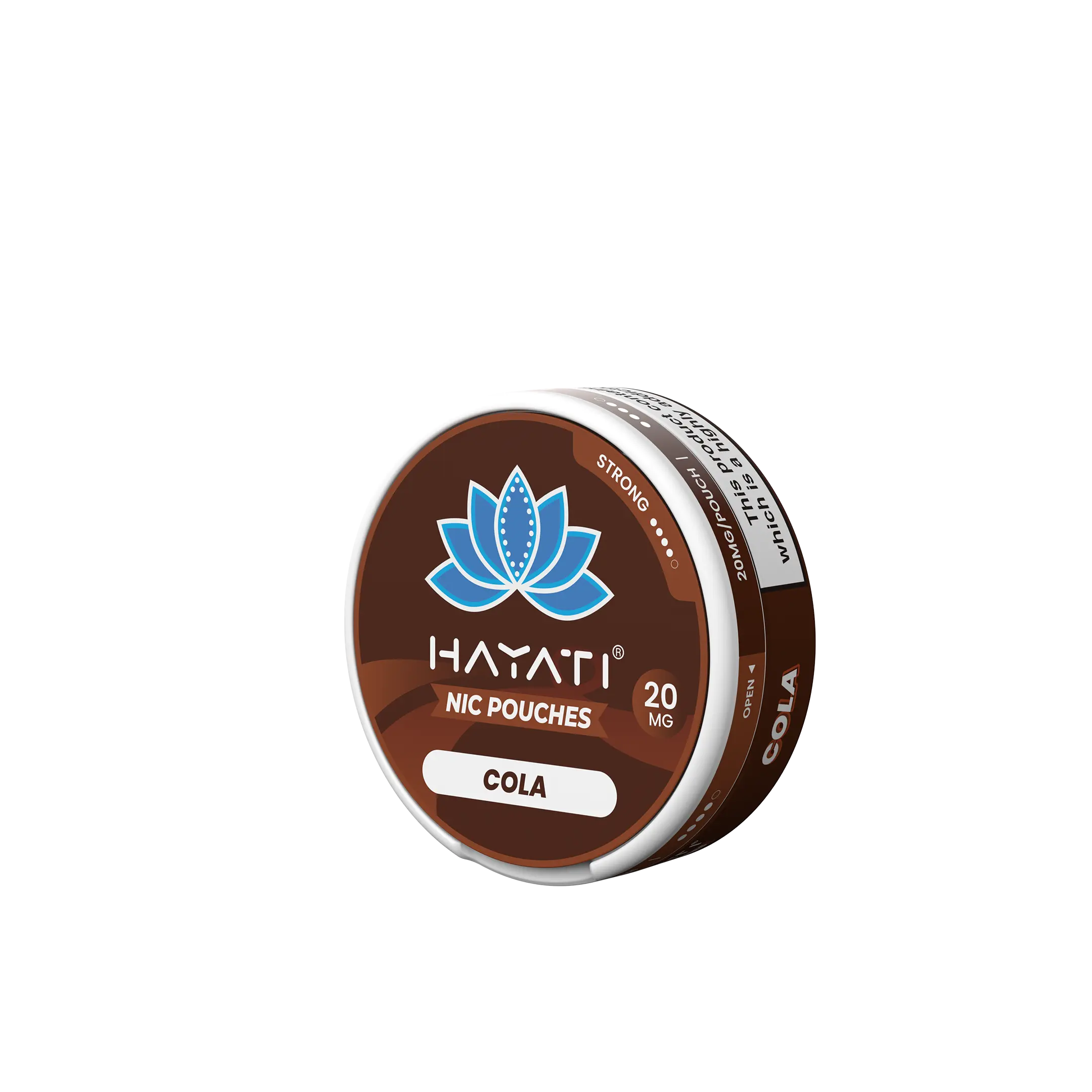
Hayati
Cola Hayati Nicotine Pouches
£4.49
✔ In stock — ready to ship
Genuine Hayati
Free over £20
Same-day dispatch
Secure checkout
Cola Hayati Nicotine Pouches is a £4.49 can of oral nicotine pouches, listed at 12mg and stated by Hayati to contain no tobacco. Nothing here is heated, nothing is burned, and nothing is inhaled at any stage. There is no device, no liquid, no coil and no battery. A pouch is a small sealed sachet of white fibre holding flavouring, sweetener and nicotine, it is placed at the front of the mouth above the top teeth where the lip meets the gum, it releases into saliva while it rests there, and it comes out in one piece and goes in a bin. That is the entire mechanism and there is nothing further to learn about operating it.
What is worth several thousand words is not the format. It is the flavour, because of all eleven cans on the Hayati Nicotine Pouches shelf this is the one attempting the most difficult translation, and the difficulty is of a kind nobody notices until it is set out.
Three pages on this site have already established that a vape cannot give you the fizz of a cola. That work is done and it is not being redone here. What has not been said, because no product before this one made it necessary to say, is that the same accord in a pouch loses a second thing on top of the first, and the second loss is larger. A vape keeps the aroma of a cola and loses its mechanics. A pouch loses most of the aroma and keeps nothing mechanical at all. Those two losses have been discussed separately, on different shelves, for different reasons. This is the first listing where they both land on the same product at the same time, and the useful question is what is left standing afterwards.
The answer is more than nothing, and working out precisely what it is turns out to be the most interesting thing about this can. It also produces a finding that applies well beyond cola: a flavour's recognisability and its pleasantness are two separate properties, and a delivery format can take the first away while leaving the second untouched. A buyer arriving here from the Cola Vapes shelf will almost certainly have that the wrong way round, and getting it the right way round before spending £4.49 is the point of the page.
Two losses, stated together for the first time
What the corpus has already settled about cola and gas
Take the established position as given. The Cola Ice Hayati Pro Ultra Plus 25000 Prefilled Pod Kit page sets out that the prickle of a fizzy drink is not a flavour at all. It is dissolved carbon dioxide leaving solution against the surfaces of the mouth, thousands of small bursts, plus a mild sharpness from the acid the gas forms while still in the liquid. Both halves of that require a liquid holding gas. An aerosol holds neither, so carbonation cannot be put into a pod by anybody, at any price, and the impression has to be assembled out of substitutes.
The Cola Ice Hayati Pro Max Plus Pods page took that further and worked out which substitutes exist. Acid covers the chemical half, producing the tightening at the sides of the tongue and the salivary response that are a genuine component of what fizz feels like. Nothing covers the mechanical half properly, but in a cooled cola there is one candidate, because a coolant is the only material in the liquid that produces a physical sensation on the surfaces of the mouth rather than a smell or a taste. That page prices the trade honestly, concluding that the cold spends the warmth of the spice to buy back a fraction of the feel of a can, and that the fraction is small because a coolant is a smooth plateau standing in for a granular stutter, arriving in the wrong place at the wrong moment. It also supplies the taxonomy the whole family now runs on: a coolant on a fruit is contrast, a coolant on a watermelon is redundancy, and a coolant on a cola is contradiction, because a cola accord has a warmth of its own and the two signals compete for one reading.
The Cola Ice / Orange Lemon Lime Hayati Mini Ultra Pod Kit page then counted what the seller is actually willing to claim. Of 492 listings, 52 name a drink in the title outright, and narrowing that to drinks which come out of a bottle with gas in them leaves 44: the eighteen colas, the nineteen lemonades and the seven listings using clipped brand names for sodas. The word carbonated appears exactly once in all 492 descriptions, on a fruit listing, and even there it sits inside a simile. Not one of the 44 says its liquid is carbonated. Everybody writing this copy knows the gas is not in the product, and nobody will say so in plain words.
I re-ran the parts of that arithmetic that bear on this page and they reproduce. Eighteen listings carry cola in the title, nine of them also carry a cooling word, and the word carbonated still appears once across the catalogue. None of the three findings needs rebuilding and none of them is disturbed by this product.
What the pouch shelf has already settled about aroma
The other half of the inheritance comes from the two cans written before this one. The Mango Ice Hayati Nicotine Pouches page is the reference for how a pouch delivers anything. Its argument, taken as established and not repeated at length, is that flavour reaches a person by two separate routes, and that the two formats load those routes in opposite directions. A vape heats a liquid, the aerosol carries aroma compounds in bulk, and the exhale pushes a dense burst of them up behind the palate to the olfactory tissue, which is where the identity of a named thing is actually read. A pouch has no heat, no carrier and no exhale. What it has is dissolution into saliva, which serves the basic tastes and anything that acts by touching tissue extremely well, and serves volatile aroma weakly, slowly, and with no way of concentrating it into a burst.
The Frosted Mint Hayati Nicotine Pouches page is the counterweight. It shows what happens when a flavour happens to be built mostly out of the things the format is good at. Mint is a cooling molecule acting on a receptor in the tissue the pouch is pressed against, plus a green, faintly bitter taste that does not need the nose, plus a smaller aromatic fraction that does. Two of its three components come through and one thins, so mint is the pairing on that shelf losing least. That page is explicit that the exception is narrow and that every other can on the shelf is fighting the format to some degree.
It also names this product in passing and makes a prediction about it, which is worth quoting as the thing this page is here to test. Its expectation was that a cola's spice and citrus profile is more aromatic than a mint and should therefore thin out more. That prediction is half right and half wrong, and saying which half is the work of the next two sections.
The two losses put side by side
Here is the sentence nobody has written yet. A cola vape loses the mechanics and keeps the aroma. A cola pouch loses most of the aroma and never had access to the mechanics in the first place. Set them out as a pair and the asymmetry is obvious.
- A cooled cola pod is missing the gas, and it holds a partial substitute for the gas in the coolant, which is a physical signal in roughly the right sensory channel. Everything else about the accord, the peel oils, the spice aroma, the rounded sweet top, arrives more or less intact, because an aerosol is an efficient carrier and an exhale is a strong pump.
- This can is missing the gas, missing any substitute for the gas, and missing the pump that would deliver the aroma. It is uncooled, which the listing says plainly, so the one material that could have stood in for the physical dimension is not in it. And the delivery route it does have is the route that serves aroma worst.
That is two structural deficits at once rather than one, and it is why this listing is the hardest thing Hayati have asked a pouch to do. Worth narrowing the claim until it is countable, because a claim of that shape should be counted rather than repeated. Eleven cans are on the pouch shelf. Two of the eleven are drinks rather than fruits, sweets or mint, and they are this one and the Coffee Hayati Nicotine Pouches. Coffee is a drink with no gas in it, so it loses nothing mechanical by being put in a pouch and its whole problem is the aroma channel. That leaves exactly one can in the range whose original has a physical dimension the format cannot reach and whose identity also depends on aroma. This one. The narrowed claim survives counting and it is narrower and more useful than the loose version.
Where the mint page's prediction holds and where it does not
Its reasoning was that a cola is aromatic and will therefore thin. That is correct about the citrus top and correct about the rounded sweet lift, and those are the two components this page also expects to lose. Where it needs adjusting is the word spice. A cola's spice is not purely aromatic. Part of it is delivered directly to the tissue of your mouth by the same broad system that reports touch and temperature, which the Cola Ice pods page established when it explained why a coolant contradicts rather than layers. A component delivered by contact with tissue is precisely the kind of component a pouch handles well. So the prediction is right about two thirds of the accord and wrong about the part that turns out to matter most, and the correction is the beginning of an answer to what actually survives.
Working out the residue, honestly
A page should not manufacture a tasting note for a product nobody writing it has tasted. What it can do is reason from what a cola accord is made of to what a saliva-based delivery route can and cannot carry, label every step as reasoning, and produce a prediction specific enough to be wrong. That is what follows.
Sweetness: survives completely, and is probably louder here
Sweetness is the channel this format serves best. A sweetener is water-soluble by design, it dissolves out of the fibre readily, and it lands directly on the receptors that report it with nothing in the way. There is no aerosol to suspend it in and no exhale required. Every listing of every cola in this catalogue leads with the word sweet, all eighteen of them without exception, and Hayati's copy for this can uses it twice in three sentences.
There is a second reason to expect the sweetness to read high, and it comes out of the cooled cola pages rather than the pouch pages. Temperature changes how sweet something tastes, with warmth reading sweeter and cold reading less so. The Cola Ice pods page raises that in the context of chemical coolants and then hedges it carefully, because a vape coolant triggers the nerve endings that report cold without actually lowering the temperature of anything, so it is genuinely unclear whether the suppression transfers. None of that ambiguity applies here. There is no coolant, chemical or otherwise, and the pouch sits at the temperature of your mouth for its entire duration. Whatever sweetness is in the recipe is being read under the conditions that report sweetness at its highest, and it is being read continuously rather than in one-second instalments.
Acidity: the format would carry it, and the listing declines it
This is where the analysis takes a turn I did not expect when I started counting, and it is the single most load-bearing thing on this page.
Acid is a taste. It is reported by the tongue, it needs no carrier and no airflow, and an acid in solution against oral tissue is about as direct a delivery as exists. On the mechanism alone, a pouch should carry the acid of a cola perfectly well, and since acid is the established substitute for the chemical half of carbonation, a pouch ought to be able to reproduce that half of the fizz impression roughly as well as a pod does. That is the optimistic reading and it is mechanically sound.
Then read what Hayati actually wrote about this product, and compare it against what they wrote about the other seventeen colas. The technique is the one the Blackcurrant Lemonade kit page introduced to this site: line every listing of a flavour family up against each other and ask which properties all of them assert, which only some assert, and which one listing asserts alone. Run it on the cola family and the results are unusually clean.
- Sweet appears on 18 of 18. It is the only universal.
- Caramel appears on 10 of the 18. More striking, caramel appears on exactly 10 of all 492 descriptions in the catalogue, and all ten of them are colas. It is a word Hayati reserve entirely for this accord.
- Spice or spiced appears on 10 of the 18, and again on exactly 10 of the 492, all of them colas. They are not the same ten as the caramel set: six listings carry both words, four carry caramel alone and four carry spice alone. So each term is used on a bit over half the family and neither is used anywhere else in the catalogue at all.
- Vanilla appears on 0 of 492. Not one listing in the entire range uses the word, although the classic accord breakdown on the Pro Ultra Plus kit page names vanilla as the component that makes a cola read as syrupy rather than as a spiced tea. Hayati's house word for that role is caramel, and they apply it only to colas.
- A brightness word, meaning tang, zest, sharp, tart or bright, appears on 14 of the 18.
That last line is the interesting one, because of how this listing uses it. Of those 14, eleven deploy the word affirmatively: the lime cuts through with a sharp zesty bite, the ice makes it crisp, a bright zesty tang sits behind the caramel. Two of them, both Cherry Colas, use a negative construction, saying the fruit makes the drink fuller rather than sharper. Those two are describing what the cherry does to the base, not denying that the base has an edge. This can is the third negative construction and the only one of the three that applies the denial to the whole product, and it does it while ruling out the cold dimension in the same clause. Hayati describe the taste as mellow and sweet, and then say expressly that it is not sharp and not icy.
Three of eighteen use a negative construction, then, not one of eighteen. That is the honest count and it is smaller than the claim I might have made without checking. What survives the counting is still worth the space: this is the only cola listing in the range whose own copy positions the entire product away from sharpness rather than towards it.
Which matters for one specific reason. Acid is the substitute for the chemical half of the fizz. It is the one tool the format would carry properly. And the listing is telling you, in the seller's own words, that sharpness is not what this product is doing. Whether that reflects a formulator's decision, a copywriter reaching for a soothing adjective, or a genuine property of a recipe I have not tasted, I cannot tell you. What I can tell you is that if the copy is accurate, the deficit stack in this can is three deep rather than two: no gas, no coolant standing in for the gas, and a deliberately restrained version of the acid that would have stood in for the other half of it.
One caution on the same evidence, because it cuts both ways. The word mellow appears on 90 of the 492 descriptions, which makes it house vocabulary rather than a considered choice, and house vocabulary says very little. The counting discipline this site runs on requires checking that before treating a word as a signal, and by that test mellow fails. The clause that carries weight is not mellow. It is the explicit denial of sharp and icy, which is not house vocabulary at all.
Spiced bitterness: the component that survives best, and it is not the one you would guess
Now the good news, and it is real.
The classic accord breakdown names cassia cinnamon as the loudest of the spice group, coriander seed behind it blurring the seam between citrus and spice, and nutmeg underneath providing a woody floor. The Cola Ice pods page added the part that matters here: cinnamaldehyde, the compound that makes cassia taste of cassia, is not only an aroma. It produces a physical catch in the tissue of the mouth and throat, reported by the same system that handles touch and temperature and irritation, and it does not go away if you hold your nose. Nutmeg contributes a lower, drier version of the same thing. That is why the warmth of a cola is partly delivered rather than entirely remembered, and it is why a coolant on a cola overrules something real instead of merely contradicting an association.
Take that finding, which belongs to that page, and point it at this format. A component that acts by contact with tissue is exactly what a pouch is built to deliver. The Frosted Mint page makes the same structural argument for cooling, concluding that a molecule acting on a receptor in the mouth needs nothing but contact, and that a pouch parked against the gum is a device for supplying contact. The warm spices in a cola sit in the same category. They are the warm counterpart of the cooling exception, they are subject to the same logic, and no page in this corpus has said so, because until this listing existed there was no uncooled warm-spiced product in a pouch to say it about.
Then add the second surviving component, which is bitterness. The Mini Ultra kit page identified bitterness as the second of a formulator's three tools for making a syrup read as a drink, and made the point that a cordial is sweet and fruity and nothing else while a soft drink almost always carries a bitter element, whether that is peel oil, quinine or the kola and spice notes in a cola. Bitterness is a taste. It survives a change of delivery route intact, because nothing about dissolving it in saliva removes it. Caramel carries a version of the same thing: caramelised sugar is not simply sweet, it has a burnt, faintly bitter edge that is part of why the word gets used for this accord in the first place, and that edge is a taste rather than a smell.
So the residue is not a thin one. Sweetness at full strength and probably read higher than on any cola vape in the range. A spiced warmth that is delivered by contact and, for the first time in this flavour family, is not being fought by a coolant. A bitterness under it that comes through unchanged. Three genuine components, all of them arriving by routes the format handles properly.
What does not survive
Three things, and they are not minor.
The citrus top goes first and most completely. Peel oils are the most volatile part of the accord and the fastest thing off a coil in a vape, which is exactly the property a pouch cannot exploit, because volatility is useful only where something is pushing the volatiles somewhere. The opening instant of a cola vape, the dry aromatic bitter-edged peel that arrives before anything else registers, has no counterpart here. There is nothing to carry it and nothing to pump it.
The rounded lift goes second. Whatever produces the syrupy roundness on the exhale of a cola pod, the thing the corpus calls vanilla and Hayati call caramel, is at least substantially aromatic. Vanillin is a volatile compound. The burnt-sugar taste underneath it survives, as argued above, but the perfumed part of it does not, and it is the perfumed part that supplies the sense of a drink rather than a syrup.
The gas was never available and is not available now. This page will not pretend otherwise and neither, to their credit, will Hayati, whose description makes no fizz claim of any kind. Five of the eighteen cola listings reach for a fizz-family word and this is not one of them. Given the census finding that no listing in the catalogue will state carbonation outright, the absence here is consistent rather than notable, but it is worth recording that the one cola product that has the least claim to fizziness is also one of the ones that does not mention it.
The prediction, specific enough to be wrong
Putting the surviving and the lost together produces something fairly precise. Expect a sweet, faintly sour, faintly bitter spiced thing. The sweetness arrives first and is the loudest element throughout. Behind it, or rather underneath it, is a dry warm spiced character that is more legible than it would be in a cooled pod and less legible than it would be in an uncooled one with an aroma pump behind it. A bitter floor keeps the sweetness from reading as sugar water. Whatever sourness is present is restrained, on the seller's own account.
The important part of the prediction is what that adds up to as an identification. To a person who has been told the can says Cola, it will read as cola-adjacent. The sweet plus spiced plus bitter combination is recognisably in the right territory, the label supplies the frame, and the mind fills in the missing peel and the missing lift without much effort, because that is what a label does. To the same person handed the same pouch blind, it will be considerably harder to name. Sweet, warm, slightly bitter, faintly spiced describes a large number of things and only points at a cola if somebody has already pointed at it for you.
That is a testable claim and the test costs one pouch and one willing adult who is already a nicotine user. If a second person can name it blind, this page is wrong. If they can only say it is sweet and slightly spiced, the reasoning holds.
Recognisable and pleasant are two different properties
The prediction above points at a general finding, and it is the most useful thing on this page for anyone who buys more than one of these cans.
A flavour has at least two distinct properties that buyers habitually treat as one. There is how identifiable it is, meaning whether a person encountering it can put a name to it. And there is how agreeable it is, meaning whether having it in your mouth is a good experience. Those are produced by different parts of the sensory apparatus, and a delivery format can attack one of them heavily while leaving the other alone.
Identification runs mostly on aroma. That is the corpus position and it holds for fruit and for constructed flavours alike: the tongue reports sweet, sour, bitter, salt and savoury, and those five are shared by almost everything, so the thing that tells one item from another is the pattern of volatile compounds read by the nose. Strip the aroma and you have not made the flavour worse in the sense of less pleasant. You have made it anonymous.
Pleasantness, by contrast, runs substantially on the basic tastes and on the contact sensations. Sweetness is pleasant. A warm spiced character against the gum is pleasant. A bitterness that stops the sweetness cloying is what makes the whole thing drinkable rather than sickly. All three of those survive the pouch.
So the honest verdict on this can, stated before the comparison section rather than buried at the end, is that it may well be a perfectly agreeable thing to have in your mouth that does not particularly announce itself as cola. Those two statements are not in tension. They describe different axes, and the format has moved this product along one of them and not the other.
That is precisely the expectation a buyer coming from the vape catalogue gets wrong, and they get it wrong in a predictable direction. Somebody who has used Cola Ice pods for a year knows what that liquid tastes like and, if asked whether a pouch version would be good, will answer by asking whether the cola is accurate. Accuracy is the wrong question, because accuracy is the axis the format has taken. The right question is whether a sweet, warm, faintly bitter oral product is something they would enjoy having in place for twenty minutes, which is a question about their own preferences rather than about Hayati's blending.
Why a cola has more to lose here than a fruit does
There is a sting in this for cola specifically, and it comes from an argument made on the Raspberry Cola Hayati Pro Ultra Plus 25K Pods page. Its observation is that a cola's reference standard is a commercial secret, deliberately kept unchanged from can to can, and that the secrecy is exactly why buyers agree with each other about cola liquids far more than they agree about mangoes. Everyone is measuring against the same fixed article held in the same shared memory.
That argument is sound and it is taken as given. What has not been drawn out of it is the consequence for a format that removes identity. If everybody is comparing a cola against one fixed reference, then recognition is not a bonus on top of the product. Recognition is a large share of what the product is for. A strawberry liquid that nobody can quite place is still a pleasant sweet red thing, and the buyer has no canonical strawberry to convict it against. A cola that nobody can place has failed at the only thing the name promised, because the name is a promise about a specific manufactured article rather than about a category.
Which means the thinning of the aroma channel costs a cola more than it costs a berry. Two cans on this shelf make the contrast: the Ruby Berry Hayati Nicotine Pouches and the Blueberry Hayati Nicotine Pouches are both asking for a general berry impression that has no single reference version, so a vague result is a mild disappointment. A vague cola is a different category of miss. The Bubblegum Hayati Nicotine Pouches sit somewhere between, because bubblegum is also a constructed flavour but one built on loud simple notes with no protected original, so it can be approximately right and nobody minds.
None of that makes this can a bad product. It makes it a product where the gap between what the name promises and what the format can deliver is unusually wide, which is a thing to know before ordering rather than after.
Twenty minutes at the temperature of a mouth
The second thread on this page is duration, and it changes the proposition more than the flavour analysis does.
A cola is a cold drink consumed quickly. Whatever the serving, it is swallowed in a handful of minutes, each mouthful is a discrete event with a gap after it, and the whole thing is over. This product is a single continuous contact at body temperature lasting as long as you leave it in place, which for most people means something in the region of twenty minutes, although Hayati publish no intended wear time and this page will not invent one.
The mechanics of that shift are already documented and there is no value in re-deriving them. The Mango Ice page sets out why a continuous source suits a contact-acting component better than a series of two-second pulses does, and why the arrival order in a pouch is the reverse of a vape's, with the contact sensations establishing first and the aroma character, such as it is, arriving last and quietest. The Frosted Mint page sets out what sustained stimulation does to perception over a single sitting and across a day, describing the difference between a sawtooth and a plateau and working through the consequences for the second and third pouch of a day. Both of those apply here in full and neither is restated.
What neither of them had to consider is what a warm, slow, long version of a cold, fast drink actually does differently. Four things.
The warmth is uncontested for the first time in this flavour family
Every cooled cola in the range is running the contradiction the Cola Ice pods page described: a coolant and a warm spice competing in the same channel, with the coolant much the louder of the two and the spice warmth not so much halved as overruled. What you get in a cooled cola is the perfume of the spice cupboard with the fire taken out from under it.
Here there is no coolant. The warm spiced signal has nothing arguing with it, and because it is delivered by contact with tissue rather than by aroma, it is one of the few components arriving at anything like full strength. On the reasoning in this page, the spice warmth in this can should be the most prominent non-sweet thing in it, which is not true of any other cola Hayati sell. Whether the recipe contains enough of it to be noticeable is unpublished and unknowable from the listing, and the copy says light spice rather than anything stronger, so temper the expectation accordingly. The structural point stands regardless of the dose: this is the only cola in the catalogue where the warmth is not being fought.
Nothing terminates the sweetness
A cold fizzy drink clears its own palate. The acid scrubs, the bubbles physically disturb the surfaces, the cold suppresses the sweet reading, and the mouthful ends. Between sips there is a gap in which the tongue resets. That is a large part of why a very sweet drink remains drinkable across a whole glass.
Remove all four of those and the sweetness has nothing stopping it. No acid to speak of, on the seller's own positioning. No gas. No cold. No gaps. What a buyer should expect is that the sweetness is the dominant impression for the whole duration rather than a component in a sequence, and that whether this can suits them is mostly a question of whether sustained sweetness against the gum is agreeable to them or wearing. People differ on that considerably and no page can answer it for you.
There is a partial offset and it is the bitterness. A bitter floor is what keeps a soft drink from reading as sugar water, and on this product it is doing that job without the help of either acid or cold. If the recipe has enough of it, the can works. If it does not, this becomes a sweet warm thing for twenty minutes, which is a narrower proposition.
What recedes is not what stays
Across a single pouch the components do not decline together. The Mango Ice page makes the equivalent observation about its own pairing, noting that the cooling holds its level while the fruit recedes, so the balance shifts without anything actually increasing. The same shape of argument applies here and it runs on a different pair, so it is worth stating in its own terms.
Two things move. The release rate from the fibre falls as the pouch depletes, so everything gets quieter in absolute terms towards the end. And perception adapts unevenly, with a continuous sweet signal against a fixed patch of tissue reading lower after fifteen minutes than it did after three. What that produces, on reasoning rather than measurement, is a pouch whose early phase is sweet-dominated and whose later phase is proportionally drier and more spiced, not because the spice grew but because the sweetness that was sitting on top of it has receded. Anyone who judges this can on its first three minutes is judging the sweet phase alone, and anyone who judges it at the twenty-minute mark is judging the dry phase alone. Both readings are real and neither is the product.
Nobody drinks a cola warm, and Hayati have said so themselves
This one is worth stating bluntly because the evidence is in the seller's own copy. The description for the Cola Ice Hayati Pro Max Plus 6000 Pod Kit opens by asking whether you have noticed that cola only really tastes right when it is fridge-cold, and builds the entire pitch for that product on the answer being yes. The Cola Ice Hayati Pro Max Nic Salt makes the same move, describing the effect as a glass poured over a full load of cubes.
Then the same company sells this can and tells you in its own description that it is not icy. Two listings of the same accord disagreeing is evidence about how the copy was written rather than about two recipes, and the honest reading is that both statements are pitches rather than findings: the cooled pages sell the cold because the cold is what they have, and this one sells mellowness because mellowness is what it has. Neither is a measurement.
The buyer-facing version is straightforward and slightly uncomfortable. Everybody's reference cola is cold. This product cannot be cold, because nothing in it produces a cold signal and there is no coolant listed or implied. The impression you get will therefore be of the accord at room temperature, which is a legitimate thing and is not the state in which anybody drinks the original. If the cold is a large part of what you like about a cola, the cooled listings exist and this one is not competing with them.
The format, factually
Short, because there is no hardware and nothing to configure.
A nicotine pouch is a sealed portion of white fibrous material with flavouring, sweetener and nicotine held inside a permeable wrapper. The wrapper does not dissolve and does not break down in the mouth. It is not chewed and not swallowed. You place one pouch at the front of the mouth, tucked against the gum above the top teeth, and leave it there. Saliva wets the fibre, the soluble contents move out of it into solution, and the dissolved material spreads across the tissue it is in contact with. That release runs continuously while the pouch is in place and slows as the contents are depleted.
Nothing is inhaled. Nothing is heated. Nothing is burned. No aerosol is produced at any stage, and none could be, since the can contains no heat source and the product has no device attached to it. Those absences are not incidental to the flavour argument above, they are the whole of it: heat, aerosol and exhalation are the three things a vape uses to move aroma, and a pouch has access to none of them.
Hayati state that these pouches are tobacco-free. That is a statement about what is in them: there is no tobacco leaf or plant material, and the fibre is a carrier rather than an ingredient with a flavour of its own. It is one of the few things the listing is explicit about.
The published strength is 12mg. State it plainly, as the rest of this corpus does. The Mango Ice page has already counted what that figure means in this catalogue and there is no point in recounting it: every listing at 12mg is a pouch and every pouch is at 12mg, so within this format the number is a property of the format rather than a choice being offered. There is no stronger or milder Cola in the range and no decision to make about it. The listing quotes the figure without a denominator and this page will not supply one Hayati did not state.
When you are finished, the pouch comes out in one piece and goes in a bin, not down a sink and not on the ground. There is no battery, no circuit and no electrical component, so none of the electrical waste handling that applies to every device on the rest of this site applies here. Hayati's one storage instruction is to keep the can closed between uses, and the reason that instruction matters more on this flavour than on most is covered in the handling section below.
One thing the listing does not mention and this page will therefore not claim: nothing in Hayati's description states that this product contains caffeine, so no page of ours should tell you that it does.
The sheet, and how much of it is blank
Almost everything a pod listing publishes has no counterpart here, so the table below is as much a record of what is absent as of what is stated. The rows that are blank are blank on the listing, not omitted by us.
| Price | £4.49 |
| Published strength | 12mg |
| Flavour as named | Cola, with no second flavour and no cooling word |
| Category of original | A manufactured soft drink, not a fruit |
| Carbonation | Not present and not claimed anywhere in the description |
| Cooling | None. The copy rules out an icy character explicitly |
| Tobacco | None. Hayati state the pouches are tobacco-free |
| What it needs to work | Nothing. No device, no charging, no refilling |
| Anything inhaled or heated | No |
| How it is finished with | Removed whole and binned |
| Storage instruction given | Keep the can closed between uses |
| Shelves it is filed on | Three: pouches, colas and new products |
| Tags in the product data | One, and it is "cola" |
| Pouches in a can | Not published |
| Weight of a pouch | Not published |
| Intended time in place | Not published |
| Acid or sweetener used | Not published |
| Caffeine content | Not stated on the listing |
The blank that costs a buyer most is the count per can. Without it, £4.49 is a price rather than a rate, and no cost-per-pouch figure can be honestly constructed. That makes the price directly comparable against the other ten cans, which are all £4.49, and comparable against nothing else on this site. Any page telling you how this stacks up on cost against a £5.49 pod has invented the denominator.
The filing row is in the table for a reason that is more than trivia. This can sits on a shelf named Cola Vapes, alongside seventeen products that are vapes, and it is the only listing on that shelf that cannot be inhaled. The Mango Ice page noticed the same thing happening to it on the mango shelf and made the general point, so it is not new, but it has a practical edge here: a buyer filtering the Cola Vapes shelf for a cola to put in their device will be shown this can among the pods and bottles, and the only thing distinguishing it in a list of titles is the words at the end.
The tag row is worth a sentence for the same reason the Frosted Mint page used tags as evidence. This listing carries one tag. Mango Ice carries five and picks up six shelves. Nothing in the data marks this as a drink, as a pouch, or as sweet, despite the description using the word sweet twice, and the single tag is the flavour name. Whatever assigns these did the minimum, which is a fact about Hayati's filing rather than about the product, and it is offered as nothing more.
Where it sits among seventeen other colas and ten other cans
It is the only plain cola Hayati sell, and that is not an accident of naming
Count the eighteen cola listings by what their titles do. Six are Cola Ice across the various formats, and a seventh puts Cola Ice on one side of a divided Mini Ultra pod. Three are Cola Lime. Three are Cherry Cola. Two are Raspberry Cola. Two are Lemon Cola Ice. That is seventeen, every one of which has either a cooling word or a second flavour bolted to the name, or both.
The eighteenth is this can, and its title is the word Cola on its own.
The Cola Lime Hayati Pro Max Plus 6000 Pod Kit page reached the platform-level version of this observation, noting that the unmodified, uncooled, unfruited accord is not sold on the Pro Max Plus at all, and drawing the conclusion that wearing a pod down is the only route a buyer on that hardware has to a plain cola. Extend the count across all 492 listings and the finding gets sharper rather than weaker. There is no plain cola anywhere in the vape range. Not on the Pro Max Plus, not on the Pro Ultra Plus, not on the Mini Ultra, not in a bottle, not on the Rubik. The only unmodified cola Hayati sell in any format is the one product that cannot be inhaled.
Which is a genuinely odd situation and worth naming. A buyer who wants the accord itself, without lime sharpening it, without cherry rounding it and without ice contradicting it, has exactly one option, and it is the format least able to carry the accord's aroma. The thing you can only get plain is the thing you can only get in the container that takes the identity out of it.
Against the cooled colas
The cooled listings are the volume of this family and they are all making the trade the pods page described. If you have used any of them, the difference here is not a matter of degree.
The Cola Ice Hayati Pro Ultra Plus 25K Pods and the matching kit are the fullest expression of the cooled version, and their page carries the accord breakdown that everything on this site cites. The Cola Ice Hayati Mini Ultra Pods are the smallest and cheapest way into the same liquid. The nic salt version is the one for anybody with their own refillable hardware. All of them put a cold signal on an accord that carries its own warmth, and all of them therefore read crisper and thinner in the spice than an uncooled cola would.
Move to this can and three things change at once. The cold goes entirely. The spice warmth stops being overruled. And the aroma that made the identity legible thins out. Two of those three changes work in the product's favour on the contact channel and one of them works heavily against it on the identity channel, which is the split this whole page has been describing.
Against the fruited colas
Cherry and raspberry do something different from ice. They add aroma rather than subtracting warmth, and in doing so they hand the listing a second identity to lean on. The Cherry Cola Hayati Pro Max Plus Pods, the Cherry Cola Hayati Pro Max Plus Pod Kit and the Cherry Cola Hayati Pro Max Nic Salt all describe the cherry as rounding the base and making it fuller rather than sharper. The Raspberry Cola Hayati Pro Ultra Plus 25000 Prefilled Pod Kit puts a tart berry over the top instead.
Worth noticing what that means for a pouch buyer thinking about which cola to have in which format. A fruited cola in a pouch would be a poor idea on the argument here, because you would be adding a second aroma-dependent component to a format that already cannot carry the first one, and the result would be sweet with a vague fruitiness rather than a cherry cola. That is a prediction about a product Hayati do not make, and it is offered as a prediction rather than a recommendation. The plain accord was the right choice for this format, whatever the reason behind it, because the components it depends on are the ones that come through.
Against the lime versions, which go the other way entirely
Lime pushes a cola towards its own citrus top. The Cola Lime Hayati Pro Max Nic Salt describes the lime as a zesty tart squeeze brightening the whole profile, and its kit sibling puts it as a sharp zesty bite cutting the syrup. Those are the sharpest things in the family, and they sit at the opposite end of the axis from this can in the most direct possible way: a listing built around brightness against a listing whose copy denies brightness. If the sharp front is what you want from a cola, that is the direction, and it is not this one.
Against the other ten cans
All eleven pouches are £4.49 and all eleven are 12mg, so within the shelf the only variable is flavour, which makes the comparison unusually clean. Run each can through the question of whether its flavour depends on aroma or on things that act in the mouth, and the shelf sorts itself.
The Frosted Mint Hayati Nicotine Pouches sit at the favourable end and that page argues its own case at length: mint is mostly a contact sensation plus a taste, so it is the can losing least. Its own conclusion is that it is the only one of the eleven not fighting the format, and on the evidence assembled here that needs a small qualification rather than a contradiction. This can is fighting the format on identity and not on pleasantness, which is a partial fight rather than a whole one, and the reason is that a cola's warm spice belongs to the same contact category as a mint's cold.
The Coffee Hayati Nicotine Pouches are the other drink and the most exposed can on the shelf, as the mint page already noted, because roast character is almost entirely aromatic with bitterness underneath, and bitterness without the roast is not coffee. This can is in a better position than that one, because a cola has more non-aromatic structure to fall back on.
The Bubblegum Hayati Nicotine Pouches are the closest thing on the shelf to this one in kind, since both are constructed flavours rather than attempts at something that grew. Bubblegum has the easier job for the reason given earlier: no protected original means no exact standard to fail against.
The fruits divide by how much of their identity is in the volatile fraction, and the Mango Ice page has already worked through which ones that favours. Blueberry and Ruby Berry are uncooled fruits carrying no contact component at all, which makes them the purest test of how much aroma a pouch really delivers.
The comparison that would settle it, and why cola cannot supply it
The cleanest way to feel the route difference is to buy the same flavour in both formats, and the Mango Ice page identified the only case in the catalogue where that is possible: Banana Ice exists as a pouch and across the vape formats under the same name. The Banana Ice Hayati Nicotine Pouches, the Banana Ice Hayati Pro Max Nic Salts and the Banana Ice Hayati Rubik Prefilled Pod Kit are the same flavour brief in three containers.
Cola cannot offer that test, and the reason is the naming finding above. There is no plain cola vape to compare this plain cola pouch against. Put this can next to a Cola Ice pod and you are changing two variables at once, the delivery route and the presence of a coolant, which means any difference you notice cannot be attributed to either. That is a real limitation on how much anybody can learn from a side-by-side here, and it is worth knowing before spending money expecting an answer.
Beyond the family
If what draws you to a cola is the soft-drink construction rather than cola specifically, the lemonade side of the catalogue is the other place Hayati build drinks, and the Blackcurrant Lemonade Hayati Pro Max Nic Salts are the entry point to it. Those are acid-led rather than spice-led, which on the argument in this page makes them a poorer candidate for a pouch than a cola would be, since acid without gas and without cold is a thinner proposition than warmth and bitterness. Hayati sell no lemonade pouch, so that is a prediction rather than a recommendation.
For the whole range in one place there is all Hayati products, and the cans arrived recently enough that they all still appear on New Products alongside the rest of the recent listings.
Getting a fair reading out of this one
Nearly all the practical advice on this site is about hardware and none of it transfers. There is no priming, no wicking, no draw technique, no airflow and no setting. The variables available to you are which can, where you place the pouch, how long you leave it, and what was in your mouth beforehand. What follows is anchored to this flavour rather than to pouches in general, because the general version is on the two pages already cited.
Take your first one when nothing sweet has come before it. This matters more on this can than on any other in the range, because sweetness is doing a larger share of the work here than it is in a mint or a plain berry. A sweet drink or anything sugary in the preceding half hour will flatten your reading of the dominant component, and you will conclude the can is weak when what you have actually measured is the state of your own palate. The Frosted Mint page makes the equivalent point about coolant adaptation and the argument is the same shape applied to a different channel.
Give it longer than you think before forming a view. The first minutes of a pouch are mostly wetting rather than releasing, and on this flavour the order of arrival is predictable: sweetness establishes first because sweeteners dissolve readily, the spiced warmth follows because it acts on contact, and whatever aromatic cola character exists is last and quietest. Judging this can on its opening minute measures the sweetener alone.
Try to name it, deliberately, somewhere in the middle. This is the specific test this page is asking for. Once the pouch has settled, ask yourself what you would call it if the tin had not told you. That is the only way to find out where you personally sit on the recognition question, and it is the question that decides whether this can is worth rebuying for you.
Place one, not two. Nothing in the listing suggests any other use, and doubling up is not a version of this product that exists.
Keep the can closed, and understand why it matters asymmetrically here. An open can loses moisture and volatiles. The volatiles in this recipe are the citrus top and the perfumed part of the caramel, which are already the fragile components on the argument above. The sweetener, the acid and the bitterness are far more stable and will still be there. Leaving the lid off therefore does not weaken this flavour evenly, it strips out precisely the fraction that was giving the pouch its remaining claim to being a cola, and what is left behind is the sweet warm residue with even less identity than it started with. Keep it out of direct sunlight and away from heat for the same reason, and keep the can somewhere children and pets cannot reach it, as with anything containing nicotine.
Expect the balance to move while the pouch is in, and do not read that as a fault. Sweetness reads highest early and lower later, the dry spiced character becomes proportionally more visible as that happens, and the release rate falls towards the end. Nothing has gone wrong. That shift is the format doing what it does, and it is the reverse of what the cooled pods do over their lifetime, where the corpus records the chill becoming proportionally louder as everything above it fades.
When you are done, take it out whole and bin it. There is nothing to separate, nothing electrical, and no end-of-life handling beyond that. It is the shortest disposal instruction on this site.
Questions worth answering about this can
Is this a vape?
No. There is no device, no liquid, no coil and no heat, and nothing is inhaled or burned at any point. It is a small fibre pouch that rests against the gum and releases into the mouth while it sits there. It appears alongside vapes on this site because it is a Hayati nicotine product, not because it works in any comparable way.
Will it taste like Cola Ice?
Not closely, and the difference is structural rather than a matter of recipe quality. Cola Ice carries aroma in an aerosol and pushes it past the olfactory tissue on the exhale, which is how it manages to read as a specific drink, and it adds a cold signal that this can does not have. Expect the sweetness and the spiced warmth to be more prominent here and the bright peel character to be largely absent.
Is it fizzy?
No, and nothing can be. Carbonation is dissolved gas leaving a liquid against the surfaces of your mouth, which requires a liquid holding gas, and a pouch is neither a liquid nor a gas holder. Hayati make no fizz claim for this product, which is consistent with a catalogue where the word carbonated appears exactly once in 492 descriptions and even then inside a comparison.
What strength is it?
12mg, as published. Every can in the pouch range carries the same figure, so there is no stronger or milder Cola and no strength decision to make on this shelf. The listing gives the number without stating what it is measured against, and this page will not supply a convention Hayati did not state.
Is there any ice or cooling in it?
No. The title carries no cooling word, the description positions the taste away from anything icy, and no coolant is named. That makes it one of nine uncooled listings in an eighteen-strong cola family, and the only one of those nine with no second flavour attached either.
Does it contain tobacco?
No. Hayati state that these pouches are tobacco-free, meaning there is no tobacco leaf or plant material in them. The white fibre inside is a carrier for the flavouring, sweetener and nicotine rather than an ingredient with a taste of its own.
Will I be able to tell it is cola?
Knowing what the can says, very probably yes, because a sweet, warm, faintly bitter spiced profile sits in the right territory and a label does a great deal of the work. Handed it blind, this page predicts you would find it considerably harder to name, because the components that identify a cola specifically are the volatile ones and those are the components this format carries weakly.
Does it contain caffeine?
Hayati's listing says nothing about caffeine, so this page states nothing about it either. The description covers the flavour, the strength, the tobacco-free composition, how to use it and how to dispose of it, and nothing beyond that.
How many pouches are in a can, and how long does one last?
Neither figure is published, and nothing here will guess at them. That also means no cost-per-pouch number can be worked out from the £4.49, although the price is directly comparable against the other ten flavours, which are all the same.
Why does the sweetness seem to fade while the pouch is still in?
Two things are happening together. The release rate from the fibre falls as the contents deplete, so there is genuinely less arriving late on. And continuous stimulation of one channel lowers the size of the reading it reports, which affects a sustained sweet signal the way it affects any other. The likely result is that the drier spiced character becomes more noticeable later, not because it grew but because what was covering it has receded.
Which can is closest to this one?
Coffee, in that it is the other drink on the shelf and faces the same aroma problem, though it faces it in a harder form because roast character has less non-aromatic structure to fall back on than a cola does. Bubblegum is the closest in kind, since both are constructed flavours rather than attempts at something that grew.
Can I compare this directly against a cola vape?
Not cleanly, and the reason is worth knowing. Every cola Hayati sell in a vape format carries either a cooling word or a second fruit, so any side-by-side changes the delivery route and the recipe at the same time and you cannot attribute the difference to either. The one flavour in the catalogue that supports a clean comparison between the two formats is Banana Ice, which exists under the same name as a pouch and as several vapes.
The short version
Cola Hayati Nicotine Pouches is a £4.49 can of tobacco-free oral nicotine pouches at 12mg, one of eleven cans sharing both figures. A pouch rests against the gum, releases while it sits there, and is removed whole and binned. Nothing is inhaled, heated or burned.
It attempts the hardest translation in the range because two losses land on it at once. A vape keeps a cola's aroma and cannot have its mechanics. A pouch loses most of the aroma and never had access to the mechanics, and this one is uncooled, so it does not even carry the partial substitute the cooled pods buy. What is left is the part of a cola that is pure taste: sweetness at full strength, a spiced warmth delivered by contact with tissue and, for the first time in this family, not fought by a coolant, and a bitterness underneath that keeps the whole thing from reading as sugar water. Gone are the citrus peel top, the perfumed half of the caramel and the gas.
Expect a sweet, faintly sour, faintly bitter spiced thing, restrained on the sourness by the seller's own account, reading as cola-adjacent to anybody told it is cola and being harder to name to anybody who is not. That points at the finding worth carrying off this page: recognisability and pleasantness are separate properties, and this format has taken the first while leaving the second alone. It may be a perfectly agreeable thing to have in your mouth for twenty minutes without announcing itself as cola, and a buyer arriving from the vape catalogue usually has that the wrong way round.
One last thing the counting turned up. Seventeen of the eighteen colas Hayati sell carry a cooling word, a second flavour, or both. This is the only plain one in any format, which means the accord on its own exists precisely once in the catalogue and exists in the container least able to carry it.
Strictly for adults aged 18 and over. Nicotine is an addictive substance.
You might also like


