
Home / Hayati Nicotine Pouches / Coffee Hayati Nicotine Pouches
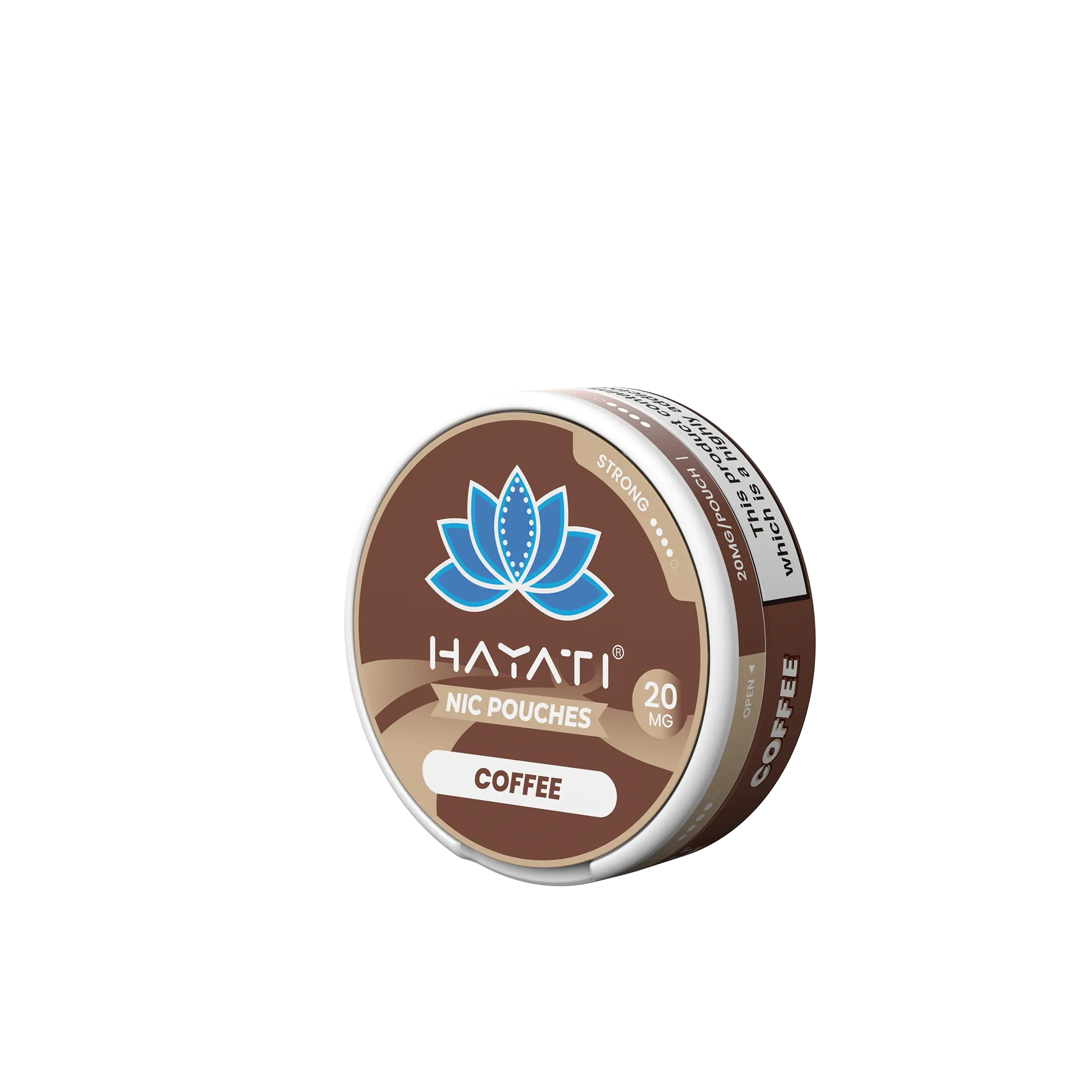
Hayati
Coffee Hayati Nicotine Pouches
£4.49
✔ In stock — ready to ship
Genuine Hayati
Free over £20
Same-day dispatch
Secure checkout
Coffee Hayati Nicotine Pouches is a £4.49 can of oral nicotine pouches, listed by Hayati at 12mg and stated by them to contain no tobacco. It is not a vape and it should not be shopped for as one. There is no device in the box, no battery, no coil, no liquid and no vapour at any stage. A pouch is a small sachet of white fibre holding flavouring and nicotine inside a permeable wrapper, it is tucked between the upper lip and the gum, it releases into saliva for as long as it stays there, and at the end it comes out whole and goes into a bin. No part of it is lit, warmed or drawn towards the lungs.
Two pages on this site have already worked out what that format does to a flavour, and both of them reached a discouraging answer. The Mango Ice Hayati Nicotine Pouches page owns the mechanism: a vape carries aroma in an aerosol and pushes it past the olfactory receptors on the exhale, which is how it manages to taste of a named fruit, while a pouch dissolves into saliva and is therefore left leaning on the basic tastes and on direct trigeminal sensation, because the aroma route is weak. The Frosted Mint Hayati Nicotine Pouches page takes that as given and finds the exception: mint survives the format because cooling is a receptor effect in tissue the pouch is pressed against, so the cooled mint is the one pairing on the shelf where the flavour and the container are not fighting. Both arguments are theirs, both are sound, and there is no reason to build either again.
What this page argues is that there is a second exception, on a completely different channel, and that this can is it. Bitterness is not an aroma. It is one of the basic tastes, reported by receptors on the tongue, and it therefore travels down exactly the route this format serves best. Coffee is the only flavour Hayati sell whose identity is substantially made of that, which makes it the only one in a catalogue of 492 listings that a pouch can deliver better than a vape could. That claim needs the count behind it and the honest limits attached to it, because there is a large part of coffee this format cannot touch at all, and both halves are below.
One coffee in four hundred and ninety-two
Before arguing that a flavour is unusual it is worth finding out whether it actually is, because this corpus has a record of rarity claims that dissolve on counting. This one survives, and the numbers are more striking than a vague version of them would be.
Coffee appears in exactly one product title across Hayati's 492 listings, and it is this can. Extend the search into the body of every listing's own description and the word turns up three times in total. The other two are the T-Misu pod and the matching kit, where Hayati describe their tiramisu as a mellow coffee note wrapped in creamy sweetness with a cocoa-style finish. That is a dessert with a coffee element in it, not a coffee, and the difference matters for the argument here: in T-Misu the coffee is sweetened, softened and used as a background colour, which is the only way a vape has ever handled it in this range.
The word roasted is even rarer. It occurs in precisely one description out of 492, and again it is this one. Nothing else Hayati sell is described as roasted, toasted, charred or baked. There is no chocolate listing, no cocoa listing outside that single T-Misu sentence, no nut, no caramel as a named flavour, and no dessert shelf. Two of the 492 descriptions use the word dessert at all.
Bitterness across the range
The wider question is how much bitterness of any kind exists in the catalogue, and the answer is nine descriptions out of 492. Those nine resolve into five distinct flavour names, and eight of the nine use bitterness the same way, as a small qualifier on something that is fundamentally sweet or sour:
- The three Lemon Lime listings and the Orange Lemon Lime pods attribute a faint bitterness to citrus peel, arriving behind the sourness rather than in front of it.
- The two Peach Green Tea listings give the tea a subtle bitterness that is explicitly described as balancing the sweetness of the peach.
- The two Straw' Grapefruit listings use bittersweet, which is a compound word doing half the job of each half.
The ninth is this can, and it is the only listing in the catalogue where bitterness is presented as a property of the flavour itself rather than as an edge on a fruit. Hayati's own wording puts it as warm and slightly bitter in the manner of a good cup, which is a modest phrasing, but it is the only place in 492 listings where the word is doing structural work.
Set that against the sweetness figures and the shape of the range becomes obvious. The word sweet appears in 394 of the 492 descriptions. Tang and its variants appear in 156, juicy in 129, tart in 113, sour in 40. Bitter appears in nine. That is a ratio of roughly forty-four to one, and 389 listings mention sweetness without mentioning bitterness at all. This is a range built on sweet fruit, priced and named and shelved for sweet fruit, and it contains exactly one product that sets out to taste of something bitter.
Why the count comes out that way
The interesting question is not that the number is one. It is why a company producing 160 distinct flavour names produced only one bitter thing, and the answer is partly about audience and partly about physics. The audience part is straightforward and needs no elaboration: sweet sells, and a range that sells sweet things keeps making sweet things.
The physical part is the one that matters for this page, and it is the flip side of the argument below. Bitterness is a slow taste. It takes longer to register than sweetness or saltiness and it clears more slowly afterwards. A vape draw delivers its entire payload in a second or two and the exhale is over almost immediately, which is a window sized for fast signals. Sweetness lands inside it. Sourness lands inside it. A slow-building bitterness largely does not, and whatever fraction of it does arrive turns up as an aftertaste at the point where the vaper has already moved on. That is why the nine bitter mentions in this catalogue are all faint, all supporting, and all attached to something quick and bright standing in front of them. The format that Hayati sell 481 of their products in is not well suited to the taste, and the count is the evidence.
Which means the single coffee is not a random outlier at the edge of a fruit range. It is the one flavour that arrived at the same time as the one format capable of carrying it.
Bitterness is read on the tongue, and that changes everything
Take the Mango Ice finding as settled. An oral pouch is a poor route for volatile aroma and a good route for anything registered in the mouth itself. The consequence that page draws out is that fruit identity suffers, because a fruit is mostly aroma. The consequence nobody has yet drawn out is what happens when a flavour's identity is mostly not aroma, and coffee is the case where that is true.
Five tastes, and one of them is large in coffee
The tongue and soft palate report a small, fixed set of qualities: sweet, sour, salty, bitter and umami. They are broad signals with no capacity for detail, which is precisely why a vape cannot rely on them to tell one fruit from another, and it is the whole basis of the mechanism argument on the sibling page. But breadth is not the same as weakness. A broad signal delivered at full strength is still a large sensory event, and bitterness is the broadest of them all in one particular respect: where sweetness runs through essentially a single receptor, bitterness is detected by a family of around twenty-five different receptor types between them covering an enormous range of unrelated compounds. That is why bitter substances do not all taste alike, and why bitterness has more texture to it than sweetness does even though both are basic tastes.
Coffee is one of the most bitter things people voluntarily consume, and its bitterness is not incidental to it. Remove the bitterness from coffee and what remains would not be recognised as coffee by anyone. This is unlike the position of the other 160 flavour names in Hayati's catalogue, where the tongue's contribution is sweetness plus perhaps some acid, and removing it would leave a recognisable if thinner version of the same thing. Coffee is the flavour in this range with the largest genuine taste component relative to its aroma component, and that is the whole hinge of the argument.
The compounds involved are the water-soluble ones
There is a second, sharper way to put the same point, and it is specific to this flavour in a way that does not generalise to anything else Hayati sell.
A cup of coffee is an aqueous extraction. Everything in it got there because water pulled it out of a solid. Brewing is not a metaphor for solubility, it is a solubility operation performed at around ninety degrees, and the taste half of coffee is therefore by definition made of things that dissolve in water. The compounds usually credited with coffee's bitterness are non-volatile, water-soluble and formed or liberated during roasting, which is why a brewed cup is bitter and a whole unroasted bean is not.
Now look at what a pouch does. It is also an aqueous extraction, performed at body temperature in saliva rather than at ninety degrees in a brewer, over twenty minutes rather than four, with a much weaker solvent. Different numbers, identical operation. The pouch is doing to its contents the same category of thing a cafetiere does to grounds, and the fraction it is best at moving is the water-soluble fraction, which happens to be the fraction that carries coffee's taste.
No other flavour in this catalogue has that property. A mango is eaten whole and never passes through a solvent step, so nothing about its chemistry has been pre-selected for water solubility. The Mango Ice page makes exactly that point from the other direction, noting that mango's defining lactones are sparingly soluble in water and that a saliva-based system is therefore not a back door for them. Green tea, in the Peach Green Tea listings, is the only other infusion in the range, and there it sits underneath a peach as a supporting note rather than being the product. Cola and lemonade are drinks but they are formulated, not extracted. Coffee is the only flavour Hayati sell whose real-world referent is itself the soluble fraction of something, and a pouch is a device for delivering soluble fractions.
One honesty note on that, because it can be pushed too far. What is in this can is a coffee flavouring, not ground coffee, and Hayati publish no ingredient list. Whether the bitterness here is generated by the same compounds that make a cup bitter, by a different bittering agent, or by some combination, is not on the record and cannot be read off the listing. The argument above establishes that bitterness as a class travels well in this format. It does not establish which particular molecules Hayati chose, and no page should pretend to know that.
The things a pouch adds that a vape cannot
Alongside bitterness, two smaller effects belong to the tongue and the oral tissue rather than to the nose, and both are available here.
Astringency is the first. The drying, slightly puckering quality of strong coffee is not a taste at all but a physical interaction in the mouth, and it depends on contact with the tissue rather than on anything reaching the nose. A format that holds material against the gum for twenty minutes is in a good position to produce it. Whether Hayati's flavouring contains anything astringent is unpublished, so this is a statement about what the format permits rather than a prediction about this recipe.
Roast character has a taste dimension as well as a smell one. Some of what roasting produces is volatile and escapes with the steam, and some of it is not and stays in solution, which is why a dark roast tastes different from a light one even when both have gone cold and lost their aroma. The non-volatile share of that is available to a pouch. The volatile share is not, and the next section is about how much of coffee lives there.
Twenty minutes is closer to how coffee is drunk than two seconds is
The second half of the argument is about duration, and it is the part that turns a level comparison into a favourable one.
The shape of a vape is wrong for this flavour
Consider what a coffee e-liquid would actually be. A draw is taken, the aerosol sits in the mouth for a moment, the exhale carries the aroma up behind the palate, and the whole event is finished in under two seconds. Then there is a gap, then another one. A vape delivers its flavour as a series of brief warm bursts with nothing in between them.
That shape suits a great many things. It suits a bright fruit, where the appeal is a quick loud arrival and a fast fade, and the pages covering products like the Blackberry Ice Hayati Pro Max Plus Pods or the Blue Razz Cherry Hayati Mini Ultra Pod Kit spend their length on exactly that kind of arrival. It suits a cooled fruit, where a sharp pulse of cold at the front of the draw is part of the pleasure. It suits anything whose selling point is an event.
It does not suit coffee, and the mismatch is not a matter of degree. Nobody drinks coffee in two-second bursts. A cup is consumed over ten or twenty minutes in a series of sips, the bitterness accumulates across them rather than peaking on any one, the finish of one sip is still present when the next arrives, and the whole character of the drink is built on that overlap. Take the same flavour and deliver it in isolated two-second packets with nothing connecting them and you have not made a weaker version of coffee, you have made a different kind of thing that happens to smell similar. The bitter half, as noted above, is barely underway when the packet ends.
The shape of a pouch is much closer
A pouch does not do events. It does a single continuous exposure that begins slowly, builds over the opening minutes and then holds while the pouch is in place. Hayati publish no intended wear time for these and this page will not invent one, so treat twenty minutes as the order of magnitude the format operates at rather than as a figure off a specification sheet. What is not in doubt is the shape: it is a plateau rather than a series of spikes, and it is measured in tens of minutes rather than in seconds.
The Frosted Mint page describes that plateau in full and the description is theirs. What it observes about cooling applies with equal force here for a different reason. Cooling suits a plateau because a receptor responds to sustained contact. Coffee suits a plateau because the real thing is itself a plateau. A bitter drink taken slowly over a quarter of an hour is not being approximated by a pouch, it is being matched in duration and in the way the taste accumulates. That is an unusual thing for a nicotine product to be able to say, and it is true of exactly one flavour in this range.
Latency, which is the technical version of the same point
There is a measurable reason why the two-second window fails and the twenty-minute one does not. Bitterness is slow at both ends. It takes longer to reach the threshold of perception than sweetness or saltiness do, and it takes considerably longer to clear afterwards, which is the familiar experience of a bitter aftertaste hanging around long after the source has gone.
Line that against the two delivery windows. A vape exhale is over before a slow taste has properly established itself, so a blender who wants bitterness in an e-liquid is trying to fit a slow signal into a window that closes first, and whatever does arrive lands as a lingering tail rather than as part of the flavour. A pouch is the opposite situation. Its exposure window is far longer than bitterness needs to build, so the taste reaches its full size well inside the session and then sits at it.
One counterweight, stated because a page that gives only the flattering half is not worth reading. Continuous exposure to any taste reduces the reading of it, and bitterness adapts like everything else. The bitterness fifteen minutes into a pouch will not be read at the size it was at three minutes, even though the pouch is behaving consistently throughout. The Frosted Mint page works through what that does across several pouches in a day and the general account is theirs. The particular version here is that bitterness is the thing fading, so the later part of a pouch is likely to read as flatter and more generic than the early part rather than simply as quieter.
What it cannot give you, which is the part that smells like coffee
Everything above is the case. This section is the cost, and it is substantial enough that a buyer who ignores it will be disappointed on arrival.
Roast aroma is enormous and entirely volatile
Coffee has one of the largest volatile inventories of any ordinary foodstuff. Roasting runs a set of browning reactions that generate several hundred distinct airborne compounds: pyrazines, which give the roasty and nutty character, furans, which read as sweet and caramelised, various aldehydes, and a small group of sulphur compounds of which one in particular is the single molecule most associated with the smell of coffee. All of that is aroma, all of it is read by the nose, and none of it is a taste.
Aroma is the channel this format serves badly, and the Mango Ice page explains why in detail: no heat to volatilise anything, no aerosol to carry it in bulk, no exhale to push a concentrated burst past the receptors, only a thin passive seepage over a long window. Coffee is not exempt from that. It is arguably the most exposed flavour on the shelf to it, which is exactly what the Frosted Mint page concluded when it ranked the eleven cans by aroma dependence and put this one at the bottom.
That ranking is correct on its own axis and this page is not contradicting it. The disagreement is about what follows from it. Ranking by aroma dependence alone treats every flavour as though aroma were the whole of it, which is true of a mango and not true of a coffee. Coffee is simultaneously the most aroma-dependent flavour on the shelf and the only one with a large taste half to fall back on, and both of those statements hold at once. A flavour that is genuinely two things can be badly served on one axis and well served on the other, and adding the two together is the only honest way to score it.
The specific things that will be missing
Be concrete about it, because vague hedging helps nobody at the point of purchase.
The fresh-ground lift is gone. The burst of smell from a bag opened or a grinder run is pure volatile aroma at its highest concentration, and it is the fastest-fading part of coffee even in the real thing. Ground coffee loses it over days. A brewed cup loses it over minutes. Nothing in a fibre sachet at body temperature is going to project it, and a buyer expecting the opening of the experience to feel like the opening of a bag will not get it.
The bright acidity is very unlikely to be there. This one needs care, because what coffee people call acidity is two things wearing one name. Part of it is genuine acid, citric and malic and the chlorogenic acids, which are water-soluble and which the tongue can read as sourness. Part of it is the light aromatic top that travels with those acids and is what makes brightness feel bright rather than merely sour. The first part could in principle survive this format. The second part cannot. And Hayati's own description points the recipe away from both: it names warmth, roast and rounded depth and says nothing about sharpness or lift, which is the vocabulary of a dark roast rather than a bright one. Expect no brightness.
Distinguishing detail is gone. Origin character, roast level as a perceptible thing rather than an implied one, the difference between one preparation and another, all of that lives in the aromatic fraction. A pouch will not tell you what kind of coffee it is imitating, and a page that claimed otherwise would be inventing.
There is no warmth, in the literal sense. Coffee is drunk hot and temperature is part of what the word means to most people. Hayati's description uses warm as a character word, not a temperature, and this page reads it that way. The format cannot supply an actual thermal sensation in the warm direction the way the cooled cans supply one in the cold direction, since Ice Cold Hayati Nicotine Pouches and the iced fruits achieve their chill through a receptor that has a large, cheap, well-understood set of compounds to trigger it. Warming compounds do exist in flavour work, Hayati publish nothing about their ingredients, and so whether anything of that kind is present here is unknown and should not be assumed.
Body is probably not real body. In coffee, body is mouthfeel produced by suspended fines and dissolved oils, and a fibre sachet has no way of putting either of those into your mouth. Hayati's description promises a smooth, rounded depth that builds. The depth and the building are plausible, because a slow bitterness genuinely does build. The weight is more likely to be an impression created by bitterness and whatever sweetener is present than an actual thickness, and it is worth knowing which one you are being offered.
So what does it taste of
Predictions, tagged by how much weight they will bear, in the house pattern this corpus uses for a flavour nobody on the page has tasted. None of these are tasting notes and none should be read as one.
Reasonably confident. Bitterness is present and is the most reliable element in the can. It is the one component whose delivery route is fully open, and it is the only component the format actively favours.
Reasonably confident. It arrives slowly. The first minute will read as very little, the taste will still be building at five, and anyone judging this can on thirty seconds will conclude it is empty.
Probable. A roasted suggestion rather than a roast. Enough of the non-volatile browning products dissolve out, and enough aroma trickles through over twenty minutes, to point in the right direction. What is unlikely is that it lands as unmistakably coffee to somebody who was not told what it was.
Probable. Less sweetener than the rest of the shelf, but not none. Hayati's own listing is explicit that this one trades fruit and sweetness for roast, which is the only listing in the pouch range to position itself against sweetness. Every pouch product in every brand leans on sweeteners because they are the format's easiest win, so some is likely, and the contrast between a sweetened base and a bitter top is a normal way to build a coffee flavour.
Probable. No brightness, no fruit-like acidity, no lift at the front.
Unknown. How much aroma actually gets through. That figure decides whether this reads as coffee or as a generic bitter-brown taste, and nothing in the listing answers it. A flavour house can weight a concentrate towards its more soluble and less volatile components specifically so it survives in unheated applications, and a blender working on a pouch has every reason to do so. Whether Hayati's supplier did is not published.
Unknown, and it is the axis that decides the purchase. Whether bitterness without the roasted top is something you want. Some people like coffee for the smell and would find the taste alone bleak. Others like coffee for the bitterness and find the aroma incidental. There is no way for a page to tell you which of those you are, and this product suits the second group and disappoints the first.
Coffee the flavour, not coffee the drink
The name refers to a flavour and to nothing else. There is no caffeine in this product, Hayati claim none, and the word does not appear anywhere in their 492 listings. A coffee flavouring is a set of flavour compounds chosen to resemble a taste, not an extract of a bean, and nothing in this format would put any of a bean's other contents into a pouch. The nicotine content is the 12mg on the label and that is the whole of what the can holds beyond flavouring and fibre.
The listing that sits on no flavour shelf
The third unusual thing about this product is not in the pouch at all. It is where the catalogue puts it, and the finding is sharper than expected.
Hayati's site runs 30 flavour shelves alongside its format shelves: berry, raspberry, blueberry, strawberry, cherry, mango, peach, pineapple, grape, apple, watermelon, kiwi, banana, orange, lemon, lemon and lime, blackcurrant, lemonade, cola, mint, fresh mint, menthol, ice, sweet, exotic and a handful of single-flavour shelves besides. There is no coffee shelf. There is no dessert shelf, no roasted shelf and nothing that a coffee could be filed under by family resemblance.
The consequence is measurable. Every one of the 492 listings in this catalogue sits on at least three shelves, with one exception, and this can is it. It appears on Hayati Nicotine Pouches, which is the format shelf, and on New Products, which everything in the range is on. That is the entire list. The next thinnest group is eight listings on three shelves, the median is seven, and one product manages twelve. Its tag list is equally short: a single entry, coffee, which is attached to nothing else in the catalogue.
Twenty-two listings have no flavour shelf at all, so the absence itself is not unique, but the company it keeps is instructive. Most of those twenty-two are hardware, or family listings sold by strength rather than by flavour, or the mood-named products this site has written about elsewhere, where the name is a feeling rather than an ingredient and the filing system has nothing to grip. Coffee is not in any of those situations. It names an ordinary, universally recognised thing, as plainly as Blueberry does, and there is still nowhere to put it.
Compare the other ten cans on its own shelf. Cola Hayati Nicotine Pouches lands on the cola shelf, Blueberry Hayati Nicotine Pouches on blueberry and berry, Grape Ice Hayati Nicotine Pouches on grape and ice, Strawberry Lychee Hayati Nicotine Pouches on strawberry and berry, Ruby Berry Hayati Nicotine Pouches on berry, Bubblegum Hayati Nicotine Pouches on sweet, Frosted Mint on mint, Mango Ice on five shelves at once. Every pouch except this one is a member of something.
The buyer-facing version of that is worth stating plainly rather than dressing up. If you choose this can, you are not choosing a variant of anything. There is no milder coffee, no iced coffee, no sweeter coffee and no coffee in a pod to fall back on if the format turns out not to suit you. The nearest thing in the entire range is T-Misu, which is a tiramisu on a vape platform and therefore differs from this in both flavour and delivery. Hayati sell 492 products and this one has no neighbours, which is a genuinely unusual position and the opposite of how the rest of the catalogue is constructed, where a flavour typically appears five or six times across formats and the pages spend their length explaining which version to buy.
Two small cautions on reading too much into the copy, since this site has a rule about it. Hayati call this one of the more grown-up flavours in the range, and that phrase is house vocabulary rather than a signal: it appears on four listings including a green tea, a black mint and a pomegranate blend, so its presence here says nothing specific. And the usual technique of comparing a flavour's several listings against each other to see which properties they all agree on cannot be run at all here, because there is only one listing. Coffee is the one flavour in this catalogue where that check is unavailable, which is another way of saying the same thing the shelf count says.
The specification, which is four facts and a list of blanks
Almost everything this site normally tabulates is a property of hardware, and there is no hardware here. What remains is short enough that the blanks deserve rows of their own rather than a quiet omission, since several of them would change a purchase.
| Price | £4.49 |
| Nicotine | 12mg, quoted as a flat figure |
| Tobacco | None. Hayati state the pouches are tobacco-free |
| Flavour as filed | Coffee |
| Format | Oral pouch, sold in a can |
| In use | One pouch between the upper lip and the gum, left in place |
| Heat, vapour or inhalation | None of the three |
| End of life | Pouch removed intact and binned |
| Shelves | Two, which is fewer than any other listing in the range |
| Product tags | One, used on nothing else |
| Pouches per can | Not published |
| Weight of a pouch | Not published |
| Intended wear time | Not published |
| Ingredients or flavour source | Not published |
The strength deserves a word because the number is easy to misread. 12mg is what Hayati print, and it is worth understanding that the figure is not an option. Every can in the pouch range carries the same number, so there is no stronger or milder coffee to move to and no decision to make on this axis at all. It is also not comparable with the figures printed on the vape side of the catalogue, which describe a concentration in a liquid delivered by a completely different route, and lining the two numbers up as though they were points on one scale would be a category error rather than a useful comparison. Nicotine is an addictive substance in any format.
Hayati quote the 12mg without stating a denominator. The trade convention is milligrams per pouch, and that is very probably the intention, but a convention is not a manufacturer statement and this page will not convert it into one.
Of the unpublished rows, the pouch count is the one with a real cost. £4.49 is directly comparable against the other ten cans, which are all the same price, and comparable against nothing else, because a price per can without a count in the can supports no arithmetic at all. This site's pod and bottle pages lean heavily on cost per millilitre, and none of that machinery works here. The missing ingredient information matters for a different reason, specific to this flavour: the single most useful thing to know about a coffee pouch would be what is generating the bitterness, and that is exactly what is absent.
Where it sits against the rest of what Hayati sell
Against the other ten cans
The shelf is easy to reason about because everything on it is £4.49 and 12mg, which leaves flavour as the only variable. Sorted by how much each one is asking of the channel that does not work, the range falls into three groups.
The cooled and the mint sit at the top. Frosted Mint is the best-matched product on the shelf by the argument its own page makes, and Ice Cold is the purest expression of the format's strength, since it carries no flavour to lose and asks nothing of aroma whatsoever. This can joins that group, on a different channel, which is the claim this page exists to make.
The loud, simple, constructed flavours sit in the middle. Bubblegum is a synthetic composite leaning on sweetness and a couple of prominent notes, which survives a loss of detail better than a faithful fruit would, and Cola is similar in kind though its citrus and spice elements are more aromatic and should thin out more.
The faithful fruits are the group under most pressure. Banana Ice Hayati Nicotine Pouches, Mango Ice, Grape Ice, Blueberry, Ruby Berry and Strawberry Lychee are all asking a set of volatile aroma compounds to identify a specific fruit through a route that carries very little of them, and the Mango Ice page sets out at length what that costs. Their cooling arrives intact. Their fruit does not, in proportion to how much of the fruit was aroma in the first place.
Where this can sits relative to all of them is not on a quality scale but on a structural one. It is the only listing where the buyer's expectation and the format's competence point the same way without any cooling being involved.
Against the vape side, where the comparison is hypothetical
There is no coffee vape in this range, so a like-for-like test is impossible and this section is reasoning rather than a recommendation. The one flavour that does exist in both formats is Banana Ice, and the Mango Ice page already nominates it as the controlled experiment for the general route question. It is sold as Banana Ice Hayati Pro Max Plus Pods at £5.49, as the matching Banana Ice Hayati Pro Max Plus Pod Kit at £7.99, as Banana Ice Hayati Rubik Pods at £3.99, as a 10ml nic salt at £2.49 and as two larger bottles, a 50/50 and a 70/30, at £6.99 each. Buying the pouch alongside any one of those isolates the delivery route as the only variable, and what you should find is that the fruit is quieter in the can while the cold is not.
If you want to feel the opposite of this product rather than a version of it, the fruit-led pods are where to look. Blackcurrant Juice Hayati Pro Max Plus Pods, Blackcurrant Mango Hayati Pro Max Plus Pods, Blackberry Raspberry Hayati Pro Max Plus Pod Kit and Blackcurrant Lemonade Hayati Pro Max Plus Pods are all built on layered aromatic fruit delivered in fast bursts, which is the configuration this can inverts on every axis: sweet instead of bitter, aroma instead of taste, seconds instead of minutes, an event instead of a plateau. The same goes for Blue Frozen Hayati Pro Max Plus Pods and the dual-flavour Blackcurrant Cotton K / Blue Raspberry Hayati Pro Ultra Plus Pods, where the whole proposition depends on detail that only an aroma channel can carry. Nothing on this page suggests those are worse products. They are products built for a container that suits them, which is precisely the point being made about this one. Both halves of the catalogue live together across all Hayati products.
Who should buy it and who should not
Buy it if bitterness is the thing you like about coffee, if you are comfortable with a flavour that arrives slowly and holds rather than announcing itself, and if the absence of a roasted top is a loss you can live with. Buy it also if you have found the rest of this shelf relentlessly sweet, because it is the only can that is not.
Do not buy it if what you love about coffee is the smell, because that is the half this format cannot deliver and no amount of good blending changes it. Do not buy it expecting a dessert, because T-Misu is a dessert and this is described as the opposite of one. And do not buy it as a first pouch if you want a predictable result, since the fruit and mint cans are better understood propositions and this one is the experiment on the shelf.
Using one, with the parts that matter for a bitter flavour
The handling list for a pouch is short because there is nothing to maintain, and most of what is worth saying here is specific to bitterness rather than general to the format.
Give it five minutes before forming a view. This matters more on this can than on any other in the range, for two compounding reasons. The pouch has to wet and begin dissolving before anything happens at all, which is true of all eleven. And bitterness is the slowest of the basic tastes to reach its full size even once the material has arrived. Judging this one early therefore understates it twice over, and the honest first impression of a coffee pouch at forty seconds is that somebody has sold you a blank.
Do not put it in after something sweet. Sweetness and bitterness interact, each suppressing the perception of the other, which is why sugar in coffee works. A pouch placed straight after a sweet drink is being read by a palate that is currently set up to under-report exactly the quality this product is selling. The same caution applies in reverse and is worth knowing: plain water taken after a long bitter exposure can taste faintly sweet, which is an artefact of your own adaptation rather than anything in the glass.
Do not judge it against another pouch used in the same session. The general adaptation argument is on the Frosted Mint page and the specific version here is that bitterness adapts too, so a coffee pouch following a coffee pouch reads flatter and a coffee pouch following a heavily cooled one is being judged by a mouth still reporting cold. Different mornings, one pouch each, is the only comparison worth anything.
Placement is worth a thought. Hayati's instruction is the gum under the upper lip, and the reason it matters here is that taste receptors are distributed across the tongue and the surrounding oral surfaces rather than concentrated in one spot, so a pouch that has drifted is presenting itself to a smaller area. If the bitterness seems thin, check where the pouch has ended up before concluding anything about the can.
One at a time. Nothing in the listing contemplates using more than one pouch, and this page is not going to construct a routine Hayati have not described.
Keep the can shut. This is the one storage instruction on the listing, and it has a particular consequence for this flavour. What an open can loses first is the volatile fraction, and on a coffee the volatile fraction is the roasted aromatic top, which is already the weakest part of the proposition. A fruit can left open loses some of its fruit and keeps its cold. A coffee can left open loses the part that was barely making it through in the first place, so the degradation is concentrated where the product can least afford it. Cool, dark and closed, and store the can where children and pets will not find it.
Disposal takes one step. The used pouch comes out in one piece and goes into a bin. There is no battery in it, no circuitry and no electrical component, so none of the waste-handling that applies to every device elsewhere on this site is relevant. It does not go down a sink and it does not go on the ground.
Questions about this one in particular
Is this a vape?
No. There is no device, no liquid, no coil and no vapour, and nothing is heated or drawn into the lungs at any point. It is a small sachet held in the mouth against the gum, which releases while it sits there and is then binned. It appears alongside vapes because Hayati make it, not because it works the same way.
Will it actually taste like coffee?
Partly, and the part it gets right is the taste rather than the smell. Bitterness and the non-volatile roast character are read on the tongue and travel well in this format, while the aromatic top that makes coffee smell like coffee depends on a route a pouch serves poorly. Expect the bitter and a roasted suggestion without the fresh-ground lift or the brightness.
Why would a pouch suit coffee better than a vape would?
Two reasons. Bitterness is a basic taste read directly by receptors in the mouth, so it needs no aroma route and no exhale to arrive, which is the one thing this format is unambiguously good at. And a pouch stays in place for tens of minutes, which is much closer to the way a bitter drink is actually consumed than a two-second exhale is.
Is there a coffee vape in the Hayati range?
No. Coffee appears in exactly one title across all 492 listings and this is it. The closest thing is T-Misu, a tiramisu sold on the Pro Max Plus platform, where a mellow coffee note sits inside a creamy sweetness. That is a dessert with coffee in it rather than a coffee, and it is a vape, so it differs from this can on both counts.
How sweet is it?
Less than anything else on the shelf, on Hayati's own account, since this is the only pouch listing that explicitly trades away fruit and sweetness. Some sweetener is likely all the same, because it is the easiest thing for this format to deliver and because a sweetened base under a bitter top is a normal way to build a coffee flavour. The listing does not quantify it.
What strength is it?
12mg, printed as a flat figure with no breakdown. Every can in the pouch range carries the same number, so there is no stronger or milder coffee available and no strength decision to make on this shelf. That figure is not comparable with the numbers on the vape listings, which describe a concentration in a liquid delivered by an entirely different route.
Why does it seem to fade after a while?
Continuous exposure to a taste reduces how strongly it is reported, and bitterness is no exception. Fifteen minutes into a pouch you are reading the same material with a partly adapted palate, so the bitterness thins and what remains tends towards a flatter, less specific impression. Nothing has changed inside the pouch.
Is there tobacco in it?
No. Hayati state these pouches are tobacco-free, meaning no leaf or plant material of that kind is present. The fibre inside is a carrier for the flavouring and the nicotine rather than an ingredient with a taste of its own.
How many pouches come in a can, and how long does one last?
Neither figure is on the listing, so this page does not state them. That also rules out any cost-per-pouch calculation from the £4.49, although the price is directly comparable against the other ten flavours, which all cost the same.
Which other can is most like it?
None of them, which is unusual enough to be the honest answer. Frosted Mint and Ice Cold share the property of being well matched to the format, but they achieve it through cooling rather than through taste, so the experience is not similar. Everything else on the shelf is a sweet fruit or a confection.
Why is it filed on so few shelves?
Because Hayati run 30 flavour shelves and none of them is a coffee, a dessert or a roasted shelf. This can therefore appears only on the pouch shelf and on New Products, which makes it the single listing out of 492 sitting on two shelves rather than three or more. Its one product tag is used on nothing else in the catalogue.
The short version
Coffee Hayati Nicotine Pouches is a can of oral nicotine pouches at £4.49, listed at 12mg, with no tobacco in it and nothing to heat, charge, fill or inhale. One pouch goes between the upper lip and the gum, releases while it is there, and is removed and binned afterwards.
Its position in Hayati's range is genuinely singular and the counting supports it rather than decorating it. Coffee appears in one title out of 492 and in three descriptions. Roasted appears in one. Bitter appears in nine, and in eight of those it is a trace of peel or tannin sitting behind something sweet, against 394 descriptions that mention sweetness. And this is the only listing in the whole catalogue that sits on two shelves, because there is no coffee shelf, no dessert shelf and nothing adjacent enough to file it beside. Choosing it is not choosing a variant of anything.
The case for it rests on a mechanism the sibling pages established and this one extends. A pouch is poor at volatile aroma and good at whatever is read directly in the mouth, which is why fruit suffers here and cooling does not. Bitterness belongs to the second group: it is a basic taste, it needs no exhale and no carrier, and the compounds that carry it in a cup are by definition the water-soluble ones, because a cup of coffee is itself an aqueous extraction. On top of that, a pouch holds its contents in place for tens of minutes, which matches both the slow onset of bitterness and the way a bitter drink is really consumed, where a two-second exhale matches neither.
The limit is equally clear and should not be discovered after purchase. The roasted top, the several hundred volatile compounds that make coffee smell like coffee, is aroma, and aroma is the thing this format cannot project. Expect the bitterness, a sense of depth building as the pouch settles, and a roasted suggestion behind it. Do not expect brightness, acidity, or the lift of freshly ground beans. If coffee for you is the taste, this is the one flavour in the range the format was made for. If coffee for you is the smell, no pouch is going to give it to you.
Strictly for adults aged 18 and over. Nicotine is an addictive substance.
You might also like


