
Home / Hayati Pro Max Plus Prefilled Pod Kit / Grape GB Hayati Pro Max Plus 6000 Pod Kit
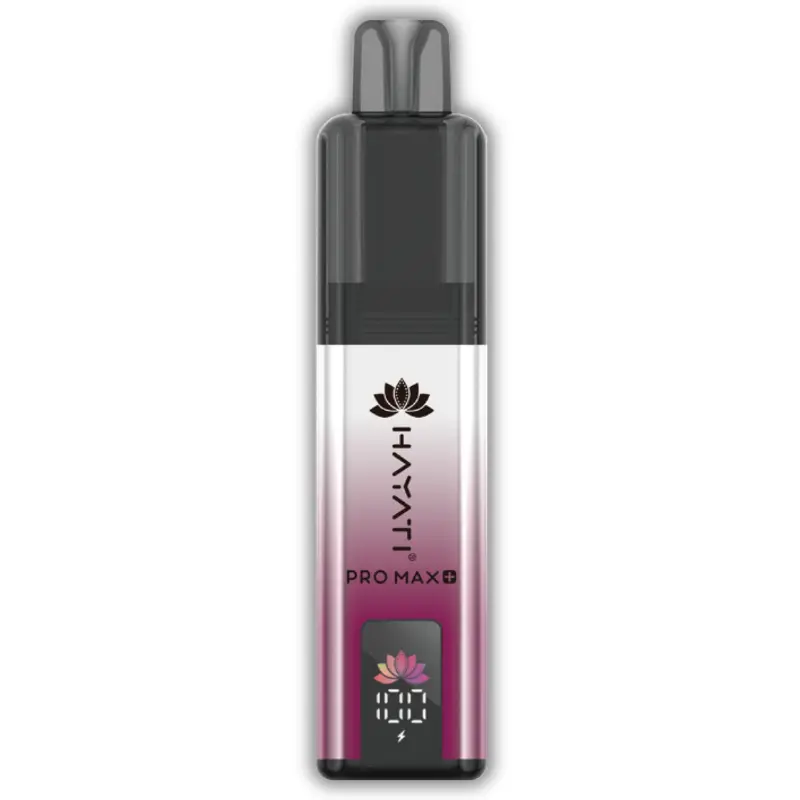
Hayati · Pro Max Plus
Grape GB Hayati Pro Max Plus 6000 Pod Kit
£7.99
✔ In stock — ready to ship
Genuine Hayati
Free over £20
Same-day dispatch
Secure checkout
The flavour paragraph on this listing does something that no other product description on this site does. Before it tells you anything the liquid contains, it tells you what the liquid has left out, and it names the missing parts specifically: the tart skin and the crisp bite of a real grape. Only then does it describe what is actually in the pod, which is the rounder, sugar-coated reading of the fruit, dark and jammy and smooth, with a confectionery finish that softens any sharpness and leaves sugar behind on the palate.
The commercial facts are ordinary enough. Seven ninety-nine buys a rechargeable 850mAh Hayati body and one prefilled 12ml pod of Grape GB at 20mg nicotine salt. Hayati put a figure of up to 6,000 puffs on that pod, a manufacturer rating generated under laboratory conditions rather than a measurement of anybody's week. Every kit on this shelf is the same body at the same money, so the device is not the decision. The liquid is, and the liquid has been introduced to you by subtraction.
That is a strange way to open a sales description, and it turns out to be the most useful sentence in the whole set of nine Grape GB listings, because it is the only one that says out loud what the other eight quietly assume. This page is built on it.
Two things are already settled elsewhere and will not be re-argued here. The bare refill, Grape GB Hayati Pro Max Plus Pods at £5.49, owns the paired-versus-solo analysis: it counted all nine Grape GB listings, found five paired against four solo, then did the harder work of stripping out the platforms where a pairing was never physically possible, and reached the narrower and much better finding that wherever Hayati genuinely had a choice they chose to use Grape GB as a component five times out of six. That page also flagged a disagreement between its own copy and this one on the question of tartness and asked a later writer to sort it out. The second settled thing is the chemistry of manufactured grape, which Sakura Grape Hayati Pro Max Plus 6000 Pod Kit and its own pod listing worked through properly: confectionery grape is built on methyl anthranilate, a compound that perfumery treats as a floral material and that sweet counters have trained several generations to file under fruit. Both findings are cited below where they do work. Neither is rebuilt.
What is left, and what this page is for, is the flavour itself. What a gummy-bear grape actually is, considered as a manufactured object rather than as a failed imitation of a fruit. What twelve millilitres of that does to a person over several days, which cuts two ways that pull against each other and need weighing rather than listing. And a verdict on who should buy the solo pod, and how drinking this accord on its own differs from meeting it as one half of a pod with a collar.
One sentence in four hundred and ninety-two
Start by checking whether the opening claim above is true, because a page that asserts its own product is unusual and then does not count is worth nothing.
Across all 492 listings in this catalogue, the phrase "tart skin" appears once. The phrase "crisp bite" appears once. Both occurrences are in the flavour paragraph of this kit. That is a small thing on its own, so widen it: how many listings define a flavour by setting it against the fresh fruit at all? Six. Six descriptions out of 492 reach for a construction of the form "rather than fresh", and they are spread across a rock candy orange, a strawberry bubblegum, a strawberry jelly bean, a Mini Ultra grape pod, a Mini Ultra pairing, and this kit.
Now narrow it again, because the six are not doing the same thing. Five of them negate the fresh fruit as a category. Rather than fresh off the vine. Rather than fresh-picked profiles. Rather than fresh fruit, think sweets. Those are gestures at a register, and they tell a reader roughly where to stand. This listing is the only one of the six, and therefore the only one of 492, that itemises the attributes. It does not say the liquid is a sweet rather than a fruit. It says the liquid does not have the skin and does not have the bite, which are two specific, physical properties of the thing you would otherwise have in mind.
There is a reason a writer reaches for that construction, and it is not laziness. You define by negation when the positive description would mislead. A reader who sees the word grape on a label does not retrieve a chemical profile, they retrieve a memory of eating one, and almost everything in that memory is about to be contradicted. Heading it off in the first clause is the honest move. It is also, as far as the data goes, a move nobody at Hayati made on any other flavour.
The tartness disagreement, checked rather than repeated
The refill page raised a conflict and asked for it to be resolved. Here is the resolution, from the source data rather than from that page's summary of it.
Nine listings carry Grape GB. Eight of them put the flavour on the sweet side with no working acidity: the nicotine salt bottle says there is no real tartness to speak of, both Blue Razz GB pairings hand the tang to the blue half and offer the grape as the step away from it, both Strawberry GB pairings say the pair leans sweet rather than sharp, the Mini Ultra refill says the grape feels plump rather than sharp, the Mini Ultra kit calls both halves confectionery rather than fresh-picked, and this kit says the confectionery finish softens any sharpness. One listing, the bare Pro Max Plus refill, reports a slightly tart skin-like edge and credits it with keeping the liquid from turning syrupy.
Eight to one. The refill page's count was right and I get the same answer independently. Where I would correct the framing handed to me is on which listing is the odd one out. On tartness, this kit sits with the majority and the bare pod is the outlier. What makes this kit unusual is something different and, I think, more interesting: it is the only listing in the catalogue that bothers to name the acid and the texture it is leaving behind. The refill asserts a small acid edge. This kit denies it in the same breath as denying the crunch. They are not two descriptions of a different liquid so much as one description written carefully and one written quickly.
Practically, treat this as a pod with no acid in it. If a genuinely tart grape is what you are shopping for, one phrase on one sibling listing is not enough to buy on, and nothing else in the range is that either.
A smaller finding about the letters themselves
While counting, something else fell out. The word gummy appears in four of the nine Grape GB descriptions, and all four are dual-flavour listings. Not one of the four solo listings uses it. This kit reaches for candied, sugar-coated and confectionery-style instead, and the bare refill uses no confectionery word at all, which is the observation the refill page made about itself.
The likely explanation is dull and worth saying anyway: when two GB flavours share a title the suffix is doing work twice and the copywriter decodes it, whereas a solo listing just describes the flavour and leaves the letters alone. The consequence for you is not dull. If this kit is your first meeting with the range, Hayati never actually tell you on this page what GB stands for. You are expected to already know, or to not care. The confectionery register in this catalogue is large enough that most buyers probably do know: candy or candied appears in 66 listings, some form of confectionery in 34, bubblegum in 24 and gummy in 19. The vocabulary is everywhere. The decoding, on the listing you are actually reading, is absent.
What a grape sweet is, taken as a piece of design
Calling something a confectionery version of a fruit sounds like a criticism, as though somebody attempted the fruit and came up short. That is the wrong frame and it makes the rest of the page impossible to reason about. A grape sweet is not a poor copy of a grape. It is a different object, built to a different specification, by people solving a different problem, and it is worth setting out what that problem actually was.
What a real grape gives you, and how little of it can travel
Eat a grape and five things happen more or less at once. There is acid, and a good deal of it; grapes carry tartaric acid, which is unusual, because most fruit leans on citric or malic instead and tartaric has a harder, drier edge to it. There is astringency from the skin, a faint pucker that dries the inside of the mouth. There is a texture event: a firm resistance, then a burst. There is water, a lot of it, which dilutes everything else and makes the whole experience refreshing in a way a concentrate never is. And there is aroma, which in a British supermarket table grape is very close to nothing at all. The bottled Pro Max nic salt page makes that last point at length and I take it as read.
Look at that list against the physics of a vapour and the problem becomes obvious. Four of the five are unavailable. Astringency is a tactile interaction between tannin and the proteins in saliva, and there is no tannin in a vapour. Texture requires something to bite. Water is the carrier here, not an ingredient you taste. Acid can be put into a liquid, but it has to be added deliberately as a formulation decision, because nothing in the aroma of a grape brings it along. That leaves aroma, the single dimension that can actually cross into vapour, and it is the dimension in which the real fruit is weakest.
So a blender asked to make grape is not choosing between a realistic version and a stylised one. The realistic version is barely a flavour. There is no route from the fruit bowl to a pod that preserves what people like about eating a grape, because what people like about eating a grape is mostly not flavour.
What a sweet keeps, and what it throws out on purpose
The confectionery industry reached the same wall about a century earlier and answered it by building something else. A grape sweet is a sugar and gelatine matrix carrying an aroma marker, and the design brief for that object has almost nothing in common with the fruit.
It has to be identifiable in a single bite, by somebody who is not concentrating, from a bag containing four other colours. That rules out subtlety and rewards a single loud marker. It has to survive a hot manufacturing process and then sit in a jar for a year without changing, which rules out the fragile aromatics that make fresh fruit smell fresh. It has to be pleasant at a sugar concentration far beyond anything in nature, which means every other component has to be chosen to work at that level rather than against it. And it has to feel good to chew, which is where the entire texture budget goes.
Follow the fresh grape's five properties through that brief and watch them get discarded one by one.
- Acid is dropped, or moved outside. Tartaric acid at fruit levels in a sugar matrix reads as unpleasant rather than refreshing, and it attacks the setting of the gel. Where confectioners want sourness they usually apply it as a coating on the outside rather than mixing it through, which is a separate product decision and produces a separate product. A plain gummy has essentially none.
- Astringency is dropped outright. Nobody has ever wanted a sweet that dries the mouth. Astringency in confectionery is a defect, not a characteristic, and the skin note that gives a real grape its structure is the first thing any formulator removes.
- The bite is replaced, not translated. A grape's texture is a thin taut skin over a watery interior. A gummy's texture is a uniform elastic chew. These are not versions of each other. The sweet keeps the idea of texture mattering and substitutes an entirely unrelated one.
- The water goes. Dilution is what makes a grape refreshing, and a sweet has no dilution. Everything is concentrated by a large factor, which is why a sweet reads as intense where the fruit reads as light.
- The aroma marker is kept and amplified far past anything the fruit reaches. This is the only survivor, and the Sakura Grape pages establish what it is: methyl anthranilate, potent at very low concentration, unmistakable, and a perfumery floral that repetition has naturalised into meaning fruit. Take that as well-supported general flavour chemistry rather than as a statement about what Hayati's supplier put in this particular pod, which is not published.
One thing survives out of five, and it is the thing the fruit was worst at. That ratio is the whole explanation for why grape sweets do not taste like grapes, and it is far more lopsided than people assume. It is also, and this matters for the shelf you are shopping on, much more lopsided for grape than for most fruits.
Why grape travels worse than its neighbours
Put a strawberry through the same process and more comes out the other end. Strawberry has a genuinely large aroma vocabulary, several distinct compounds contributing jam, green, fresh and caramelised characters, so a strawberry sweet can keep three or four recognisable notes and still be a sweet. The same is true of a raspberry, of a blackcurrant, of a mango. Their sweets are simplifications. They lose resolution without losing identity.
Grape has one marker and nothing behind it. There is no second note to keep, so the simplification is total. This is why a strawberry sweet and a strawberry are recognisably related, while a grape sweet and a grape are two separate flavours that happen to share a word, and it is why grape is the fruit most likely to produce an argument in a vape shop rather than a ranking. The nic salt bottle page covers that argument in full and there is no point in running it again here.
What it adds to this listing is the reason the negation had to be written. A copywriter describing Grape Berry or Blackcurrant Juice can point at things the fruit and the liquid have in common. A copywriter describing Grape GB cannot, because the overlap is one compound the reader has never consciously noticed. There was nothing positive to reach for, so they reached for what is absent instead, and they named the two absences that a reader would otherwise have supplied from memory.
What that leaves in the draw: a floor and a top, and no sides
Strip the analysis down to what is actually arriving when you pull on this pod and there are two components. An aroma marker doing the identity, and a sweetener load doing the body. That is it. No third element, no supporting fruit, no coolant, no acid.
The useful way to think about the shape of that is in terms of edges rather than layers. Acid and astringency are not really flavours in their own right. They are boundaries. Acid tells the palate that a draw has finished, because it provokes saliva and the rinse arrives a beat after the sugar peaks. Astringency tells the mouth it has been touched, because it changes how the surfaces feel against each other. Both of them mark where a mouthful ends. Remove both and the liquid becomes exactly what Hayati's own word says it is: smooth. Smooth is usually read as a compliment about texture. On a liquid built this way it is a factual report that the boundaries are missing.
Everything that follows about living with twelve millilitres of it comes out of that one structural fact, and it comes out in two directions at once.
Twelve millilitres of a flavour with no edges
A pod of this size is a long commitment by the standards of prefilled hardware, and two consequences of the edgeless construction bear on it. One is a genuine limitation and should be stated as such. The other is an advantage, and it is not obvious. They do not cancel out, because they act on different things, and the interesting part of this product is the way they interact.
The cost: nothing arrives to clear the last draw
Sweetener is not volatile in the way aromatics are. The aroma leaves your mouth with the exhale. The sweetness does not, because a good part of it is deposited on the tongue and stays there until saliva carries it away. On a liquid with an acid component, the acid does that job actively: it makes the mouth water, and each draw is partly rinsed by the one that provoked it. On a cooled liquid, a coolant achieves something similar by occupying the attention, so the sugar is still present but no longer the loudest thing in the room. Grape GB has neither, so each draw lands on the residue of the one before it, and the stack builds.
That is a real limit and there is no point dressing it up. What is worth doing, because it is where most people get confused, is separating it from two other things that feel identical and are not. Three clocks run on a pod like this, and they need three different responses.
| What is happening | Timescale | Where it lives | Reversible? | What actually fixes it |
|---|---|---|---|---|
| Sugar stacking on the palate | Twenty minutes to an hour within a session | Your mouth | Yes, completely | Water, or twenty minutes of not vaping |
| The coil narrowing the flavour | Two to five days across the pod | The hardware | No | Nothing, on a prefilled pod. Slower use delays it |
| Running out of interest | A week or more | You | Partly | A second pod in rotation, or a different flavour next time |
The diagnostic between them takes no equipment. Drink a glass of water and take another draw. If the grape comes back, it was the first clock and nothing at all is wrong with your pod. If it does not come back now but is present and clear on the first draw of tomorrow morning, it was still the first clock, just a heavier instance of it. If tomorrow morning's first draw is also narrow, you are on the second clock and the coil has started to go. And if tomorrow morning's first draw is perfectly good and you still find yourself reaching past the device, that is the third clock and it is not a fault in anything.
People who describe a sweet pod as tasting weaker after a few days are usually reporting the first clock and blaming the second. It is an easy mistake because the sensation is the same, and it leads to throwing away pods with eight millilitres in them.
Calibrating the complaint: how unusual is an edgeless pod?
Before this reads as a problem peculiar to Grape GB, it is worth counting. The Hayati Pro Max Plus Prefilled Pod Kit shelf holds 88 kits. Forty-two of them name an acid element somewhere in their own copy, tartness or tang or sourness or a citrus component. Twenty describe cooling. Five do both. Thirty-one describe neither, and this kit is one of the thirty-one.
So roughly a third of the shelf is built without a brake, and having no acid and no ice is an ordinary design choice rather than an oddity. Where Grape GB sits at the far end of that third is on the other two variables: its sugar load is at the top of the range by every description Hayati have written of it, and its component count is two, which is as low as a flavour on this shelf goes. A pod like Mango Banana Hayati Pro Max Plus 6000 Pod Kit is also uncooled and unsoured, but it has two fruits doing different jobs, and the alternation between them gives the palate a small amount of work. This one gives it none.
The benefit: there is very little here to lose
Now the other direction, which is easy to miss because it looks like a restatement of the same fact.
The nic salt bottle page established the failure order for this flavour and it is worth accepting rather than contradicting: the grape thins before the sweetness does, so a tiring coil produces a liquid that is generically sweet with a faint purple ghost behind it, and the change in balance is an earlier and clearer warning than harshness would be. I have no reason to doubt that and no basis to overturn it.
Order, though, is not magnitude. Knowing what goes first tells you nothing about how much there is to go, and for a twelve millilitre pod on a coil you cannot change, magnitude is the question that matters. Ask it properly: how many distinct things can this liquid lose?
Two. Possibly one, since losing the sweetener load entirely is not a realistic failure mode. Compare that with a fresh-fruit accord built the way most of this shelf is built, with a citrus lift at the front, a green or leafy note giving it freshness, a juice body, a second fruit for contrast, an acid, and a sweetener. Six components, and they do not fade together. They fade in sequence, and the liquid you are drinking at nine millilitres is a genuinely different composition from the one you started, with the top gone, the green gone and the contrast collapsed. The pod has not merely got quieter. It has become another product.
A two-component accord cannot do that. When the marker thins, what remains is still the same shape, just narrower. You will not be surprised by it, you will not find it turning into something you did not buy, and the version you are drinking on day four is recognisably the version you bought on day one.
There is a second reason to expect stability here, and it goes back to the design brief. Confectionery flavour materials are chosen for durability, because a sweet has to survive being made hot and then sit in a jar for a year. Fresh-fruit accords are built from the most fugitive materials available, which is exactly why they smell like fresh fruit and exactly why they are difficult to keep stable anywhere. A liquid built to imitate a sweet inherits the sweet's material choices, and those choices were made for robustness rather than for realism. That is the bargain the whole category runs on. Realism is what you give up. Durability is what you get.
Mark that as inference rather than measurement, because Hayati publish no formulation and no coil resistance and nothing below is calculated from either. It is a prediction from what the liquid is made of, it is testable on your own pod, and if a pod contradicts it the pod is right.
Weighing the two
Set the limitation and the advantage side by side and the useful thing is that they act on different objects. The accumulation is a property of your mouth over an hour. The stability is a property of the liquid over several days. They are not competing claims about the same phenomenon and neither one answers the other.
What falls out of putting them together is a single sentence that is worth more than either on its own. On most twelve millilitre pods, the liquid gives up before the user does. On this one, the user gives up before the liquid does.
That inverts what a buyer should be checking. For a busy fresh-fruit blend the question is whether the coil will hold the composition together long enough to be worth £7.99, and the answer is often no. Here the coil will very probably hold, because there is almost nothing to hold. The question instead is whether your own use pattern suits a flavour that never resets, and that is a question about you rather than about the pod, which means you can answer it before spending anything.
Short, spaced sessions across a long day: this construction is well suited to you, and the durability argument is money in your pocket, because the last three millilitres will taste like the first three. Long unbroken stretches with the device in your hand: you will hit the first clock repeatedly, you will read it as the pod failing, and the durability is wasted because you will have stopped enjoying the pod long before the pod stops working.
The kit, kept short
Everything worth knowing about this device has been written on other pages of this shelf, so this section is deliberately brief and points at them.
What arrives is a rechargeable 850mAh body and one prefilled pod of Grape GB, already filled and ready. Nothing needs mixing, nothing needs assembling, and there is no coil to fit. The pod holds 12ml at 20mg. Hayati describe the arrangement as a 2ml chamber at the coil with a 10ml reserve behind it, and they publish nothing whatever about how liquid moves between the two parts, so no page including this one should tell you.
The single specification that matters for this particular liquid is not the battery and not the puff figure. It is that twelve millilitres runs on one coil that cannot be replaced. On a busier flavour that is the binding constraint, because the coil degrades the composition faster than you can drink it. On an accord with two components and a high sugar load it is a softer constraint than it looks, for the reasons set out above, and the practical effect is that your own session habits matter more here than the hardware does.
Hayati make several pod families that look alike in a drawer, so check the range name printed on your device against the range name in the listing title before ordering a refill. When the pod is finished, the body is the part you keep, and the Pro Max Plus kit shelf and the wider Hayati Pod Kits listing hold every other flavour that will go into it. Coil resistance is not published for this device anywhere in the range, so nothing on this page is stated in terms of it.
The published numbers, sorted by whether you can check them
Most specification tables are read once and forgotten, so this one is arranged by something more useful than category: how much of it you can actually verify, and how much is a claim you are taking on trust.
| Confirmable when the box opens | |
|---|---|
| Price | £7.99 |
| Contents | One rechargeable 850mAh body, one prefilled pod |
| Liquid on board | 12ml, prefilled, no refilling provision |
| Brand and range | Hayati, Pro Max Plus |
| Confirmable on the first pod, by you | |
| Flavour family | Confectionery grape, one fruit, no second component named |
| Acid element | None. Explicitly ruled out in this listing's own copy |
| Cooling element | None described in any of the nine Grape GB listings |
| Sweetness | At the top of the shelf's range on every Hayati description of it |
| Stated, but not checkable by a buyer | |
| Nicotine | 20mg/ml salt, the UK ceiling for a prefilled pod |
| Manufacturer puff figure | Up to 6,000, laboratory conditions |
| Not published at all | |
| Coil resistance | Absent from the specification |
| Flavouring composition | Absent. Nothing on this page reads Hayati's recipe |
Three rows repay a moment's attention rather than a scan.
The puff figure belongs in the third block for a reason. Six thousand is a number produced by test equipment drawing to a fixed pattern, and no individual reproduces a fixed pattern. What makes it doubly unhelpful on this particular liquid is that the thing which will decide when you change the pod is not the liquid level and not the count. It is the point at which the grape marker has thinned and only sugar is arriving, which is a flavour judgement with no number attached to it.
The nicotine row is a fixed property of the format rather than a decision. Twenty milligrams per millilitre is the maximum permitted for sale here, so every prefilled pod on this shelf carries it, and there is no lower-strength Grape GB pod to choose instead. Nicotine is addictive, and the figure is published so you can match it against what you already use.
The absence of a published coil resistance is worth naming rather than glossing over, because it is the one number that would let you reason properly about how this liquid behaves at the wire. Without it, every statement on this page about coil behaviour is general reasoning about heavily sweetened liquids in low-power prefilled hardware, not a calculation. Any retail page that gives you a resistance figure for this device is inventing one.
Where it sits among the neighbours
Eighty-eight kits share this body, and the honest sorting question is not which flavour is best but which axis you want to move along. These are grouped by the move rather than by fruit.
If it is grape specifically
Three grape flavours exist on this platform and they are not variations on one idea. This kit is grape alone, sweet, uncooled and unsoured. Grape Berry Hayati Pro Max Plus 6000 Pod Kit puts a berry alongside it, which changes the structure rather than just the flavour, and it is the obvious answer if the accumulation problem described above is what worries you, because a second fruit gives the palate somewhere to go without leaving the pod. Sakura Grape Hayati Pro Max Plus 6000 Pod Kit adds a blossom note over the top, and its own page argues at length that the floral and the grape are aromatic neighbours rather than opposites, which makes it a less dramatic departure than the name suggests but a riskier one for anyone who reads perfume as soap. The Grape Vapes shelf holds nineteen listings across every format, and the Grape Berry page has already counted what is actually grape on it and what has been filed there for reasons the data does not explain, Vim Ice Hayati Pro Max Plus 6000 Pod Kit being the clearest example of the latter.
If you want the same construction with a different fruit
Several kits on this shelf are built the same way, dark and sweet with no brake, and they are the closest thing to a like-for-like swap. Blackcurrant Juice is the nearest by weight and colour, and blackcurrant is a fruit whose sweet version keeps more of the original than grape's does, so it reads as marginally more fruit-like without being any less sugary. Black Mamba is named for a mood rather than an ingredient, which puts you in a different kind of uncertainty, but it sits in the same dark register. Blackcurrant Mango pulls a dark berry towards tropical sweetness and is worth a look if what you like about grape is the richness rather than the purple character specifically. Banana Ice is the other soft and rounded option, though the ice on it changes the arithmetic of the whole section above.
If you want more components, not a different flavour
Anyone persuaded by the two-component argument but unconvinced they want a two-component pod should be looking at the busier blends, which trade the durability for variety inside a draw. Blackberry Raspberry splits a dark body across two berries. Blueberry Raspberry does something similar with a lighter top. Cherry Berry keeps the sweetness high and adds a red fruit with more of its own aroma vocabulary to lose. Mango Peach Pineapple is the three-fruit end of the shelf and is the clearest illustration of the trade, because there is a great deal in it and therefore a great deal for a tiring coil to take away.
If the sweetness is the thing you want solved
Two mechanisms cut accumulated sugar and the shelf offers both. On the acid side, Blackcurrant Lemonade keeps a dark fruit and puts a citrus lift under it, which is the smallest move available from where you are standing. Berry Lemonade does the same across a broader berry base, and Blue Razz Lemonade brings the tang of blue raspberry into it as well. Lemon Lime is the full move to the other end, with no dark fruit left at all and acid doing nearly all of the structural work.
On the cooling side, Blackberry Ice is the nearest thing to a chilled version of what this pod does, keeping the fruit dark and putting cold on the exhale. Blue Frozen pushes the cooling considerably harder, and its own pod page is where the catalogue's cooling vocabulary was counted and found not to be graded. Double Menthol removes fruit from the question entirely and is the kit people keep alongside a sweet pod precisely because it resets a palate that has been living on sugar.
The other way to buy this accord
This is the comparison the page has been working towards, and it is a real choice rather than a rhetorical one.
Grape GB exists on two platforms with a rotating collar, where it occupies one of two reserves inside a single pod and you select between them mid-session. Grape GB / Strawberry GB Hayati Pro Ultra Plus 25000 Prefilled Pod Kit at £11.99 is the full-size version, with a lighter confectionery strawberry opposite the grape inside 22ml. Grape GB / Strawberry GB Hayati Mini Ultra Pod Kit at £3.99 is the compact one, with 4ml and a much lower puff rating. Both are different hardware, so neither is a swap you make with a Pro Max Plus already on the desk.
The difference between them and this kit is not the grape. Assume the liquid is the same or close to it. What the collar changes is when you stop tasting the grape, and that is precisely the failure mode this construction has. A switch mid-session resets the first clock in the table above, because the palate is presented with a different identity and stops adapting to the one it had been receiving. Twelve millilitres of one accord gives you no such exit, and the honest framing is that the paired format is a direct answer to the specific weakness of the solo pod.
It is a partial answer rather than a complete one, and this is where the refill page's finding earns its place. Grape GB has never been paired with anything outside its own GB family. Every partner it has is another confectionery accord built to the same brief, which means turning the collar moves you from one sugared, acid-free, uncooled flavour to another sugared, acid-free, uncooled flavour. The identity resets. The sugar load does not. You get a change of subject without a change of register, and the accumulation the collar was going to save you from continues at much the same rate under a different name. A pairing that put an acid or a coolant opposite the grape would solve the problem properly. Hayati have not made one.
If you want to browse rather than narrow, the Hayati Prefilled Pod Kits listing covers every platform, New Products shows what has arrived recently, and the full Hayati catalogue has everything.
Getting a whole pod out of it
General handling advice for prefilled pods is written on dozens of pages and none of it changes here. What follows is the part that changes because of the specific construction described above.
Keep water nearby, not a second flavour. The commonest mistake with an edgeless pod is treating the first clock as a flavour problem and solving it by buying another flavour. It is a residue problem and water solves it for nothing. This matters more on this pod than on almost any other kit on the shelf, because there is no acid in the liquid to provoke the rinse and nothing cold to occupy the palate while it clears.
Space the draws, and do not chase a flagging pod by pulling harder. A run of draws back to back is where the stack builds fastest, and pulling harder at that point mostly produces heat. Heat on a liquid carrying a sugar load this size gives you a caramelised edge that sits on top of everything else and takes a while to go away. Putting the device down for ten minutes recovers more than a hard pull ever will.
Learn the narrowing signal, because on this liquid it is unusually legible. You will not perceive the pod getting quieter. You will perceive it getting simpler: the purple marker recedes and plain sweetness stays. With only two components that change is easy to read, which is a genuine advantage of the construction. When grape stops being the first thing you notice and sugar takes its place, the coil is past its useful life and the remaining liquid will not improve.
Treat a fresh pod gently for the first minute. Give a new pod a few minutes in the body before the first draw and take two or three of them slowly. A wick scorched at the start of a twelve millilitre run leaves a note behind that does not clear, and you are committed to that pod for several days.
Heat is what ages a spare. The marker in this liquid is potent at low concentration, which cuts both ways: a small loss is proportionally a large one. Keep an unopened kit out of direct sunlight and away from anywhere warm, which for most people means not a parked car and not a windowsill above a radiator. A sugary dark liquid left in the heat loses its fruit and keeps its sugar, which is the same failure a tired coil produces, arrived at by a different route. Store it out of reach of children and pets.
Staining is not spoilage. A dark, heavily sweetened liquid will tint a clear pod within a day or two. It tells you nothing about the flavour. Judge by what arrives in the draw.
Disposal, and this is a kit rather than a bare pod. When the device reaches the end of its life it contains a cell, a coil and a residue of liquid, so it does not belong in household waste. Take it to a retailer that accepts vape returns or to a local recycling point that handles electrical items. A spent pod on its own has no cell in it but still holds a coil and some liquid, and goes to the same place.
Questions this listing raises
Why does the description tell me what the flavour is not before telling me what it is?
Because the positive description would mislead. A reader who sees grape retrieves a memory of eating one, and nearly everything in that memory, the acid, the skin, the crunch and the water, is absent from the liquid. Naming those absences first is the accurate move. It is also unique to this listing: the exact phrases appear nowhere else in the 492 products on this site.
What does the GB in the name stand for?
It is Hayati's shorthand for a gummy bear treatment of the named fruit, meaning a confectionery construction rather than a fresh one. Notably, this listing never actually says so. The word gummy appears in four of the nine Grape GB descriptions in the catalogue and every one of those four is a dual-flavour listing. None of the solo listings, this one included, decodes the letters.
Is there any tartness in it?
No, on the weight of the evidence. Eight of the nine Grape GB listings place the flavour on the sweet side with no working acidity, and this kit's own copy rules the tartness out explicitly. One sibling listing, the bare refill pod, mentions a slight skin-like edge, and that phrase is the outlier rather than the rule. Shop elsewhere if a sour grape is what you want, because nothing in this range is one.
Does it taste like grapes?
It tastes like a grape sweet, which is a different flavour that happens to share a word. Only one of the five things a real grape gives you can survive into a vapour at all, and in a supermarket grape that one thing is very faint. The confectionery version amplifies it and discards the rest deliberately rather than by accident.
Is there any ice or cooling in it?
None is described in this listing or in any of the other eight Grape GB descriptions across the catalogue. Treat it as an uncooled pod. Hayati publish no ingredient breakdown, so that is a conclusion from consistent silence across nine listings rather than a stated fact, and there is no iced Grape GB anywhere in the range to point you at.
Will twelve millilitres of one sweet flavour get boring?
That depends less on the pod than on how you use it. The construction has nothing in it to clear the previous draw, so long unbroken sessions build sweetness on the palate faster than most kits on this shelf. Short, spaced sessions do not run into that at all, and the same simplicity that causes the problem is what makes the pod unusually consistent from the first millilitre to the last.
Why does it seem weaker after an hour but fine the next morning?
That is your palate rather than your pod, and it is the commonest confusion on a liquid built this way. Sugar residue accumulates and the tongue stops discriminating. Water and twenty minutes restore it completely. If the first draw of the following day is also narrow, that is a different problem and it is the coil.
How quickly will the flavour fade across the pod?
Slower than on a busier blend, is the reasonable expectation. A six-component fruit accord loses its components in sequence and turns into a different liquid by the halfway point. This one has two, so what it loses is resolution rather than identity, and the version you drink on day four should be recognisably the version you bought. That is inference from the construction rather than a measurement, and your own pod is the better authority.
How do I know when the pod is finished?
Watch for the grape narrowing to plain sweetness rather than watching the liquid level. On a two-component accord that change is easy to read, because there is nothing else in the draw to disguise it. Continuing past that point does no harm to anything, it simply means the last stretch is not what you paid for.
How is this different from buying Grape GB in a pod with a rotating collar?
The grape itself should be much the same. What changes is that a collar lets you switch mid-session, which resets the palate and neutralises the main weakness of this construction. The catch is that Grape GB has only ever been paired with other flavours in the same confectionery family, so the switch changes the identity without changing the sugar load, and it is a partial answer rather than a complete one.
What is the difference between this and the £5.49 pod?
The device. This kit includes the rechargeable body and one prefilled pod, while the refill listing is the pod on its own for somebody whose Pro Max Plus is already in hand. The liquid should be identical, although Hayati do not publish a statement that the two share a concentrate, and the two listings describe the flavour slightly differently on the question of tartness.
Does the 6,000 figure mean anything useful?
Only as a rough indicator of the format. It is a manufacturer rating produced by test equipment drawing to a fixed pattern under laboratory conditions, and nobody vapes to a fixed pattern. On this liquid the practical limit is a flavour judgement rather than a count, and it usually arrives before the pod is empty.
The short version
Grape GB on the Pro Max Plus is a two-component confectionery accord at £7.99 with the device included: an aroma marker doing the identity and a large sugar load doing the body, with no acid, no astringency, no second fruit and no cooling. Its own listing is the only one of 492 on this site that introduces a flavour by naming what the real fruit has and the liquid does not, and that sentence is accurate rather than evasive. A grape sweet keeps one of the five things a grape gives you and throws the other four out deliberately, which is why the distance between this liquid and the fruit is larger than for any other flavour on the shelf.
The consequences of that construction run in two directions and both are real. Nothing in the liquid clears the previous draw, so sweetness stacks on the palate through a long session in a way it does not on the forty-two kits here that carry an acid element or the twenty that carry cooling. Set against that, there is almost nothing here to degrade, and a pod with two components should hold its shape across twelve millilitres far better than the busy blends that lose their composition piece by piece. The limitation belongs to your mouth over an hour. The advantage belongs to the liquid over a week.
Buy the solo pod if your vaping is spread across a day in short stretches, if you already know the purple confectionery note works for you, and if you value a flavour that tastes the same at eleven millilitres as it did at one. Do not buy it if you vape in long unbroken runs, because the absence of any brake will find you out well before the pod does, and the paired Grape GB pods on the other platforms exist precisely for that use pattern, with the caveat that every partner Hayati have given it belongs to the same sugared family and so resets the subject without resetting the sugar.
Strictly for adults aged 18 and over. Nicotine is an addictive substance.
You might also like


