
Home / Hayati Pro Max Plus Prefilled Pod Kit / Sakura Grape Hayati Pro Max Plus 6000 Pod Kit
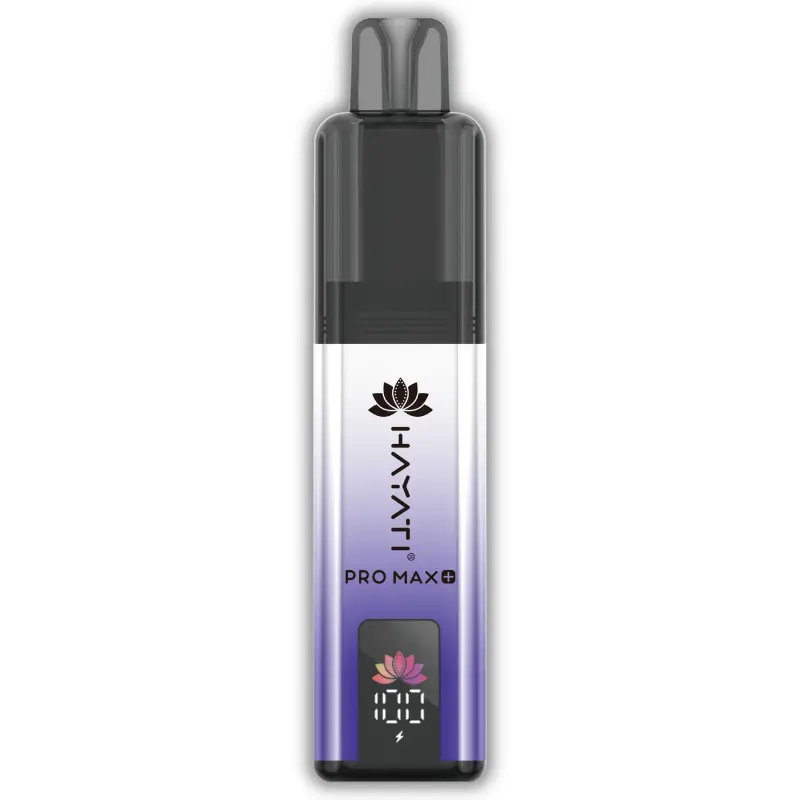
Hayati · Pro Max Plus
Sakura Grape Hayati Pro Max Plus 6000 Pod Kit
£7.99
✔ In stock — ready to ship
Genuine Hayati
Free over £20
Same-day dispatch
Secure checkout
Seven pounds ninety-nine gets you a rechargeable 850mAh Hayati body and one prefilled 12ml pod of Sakura Grape at 20mg nicotine salt. Hayati rate that pod at up to 6,000 puffs, a figure produced on a bench by a machine drawing to a fixed pattern rather than anything measured in a pocket. Every other kit on this shelf offers the identical arrangement for the identical money, so the hardware is not what you are choosing between. The liquid is.
The liquid is grape with a cherry blossom note over the top of it, and it is the only flavour in Hayati's catalogue built that way. The naming question that raises, which is a genuinely unusual one for a range this size, has already been taken apart in detail on the bare pod listing, Sakura Grape Hayati Pro Max Plus Pods. That page owns the census, the etymology and the verdict, and this one is not going to re-run any of them. It cites them and moves on.
What the pod page does not answer, and says outright that it cannot, is the question that actually decides whether this is worth your money: how loud the blossom is. It put that in the unknown column and left it there, correctly, because Hayati publish no proportions. That is where this page starts, because loudness is not a naming problem. It is a flavour problem, and flavour problems can be reasoned about even when the recipe is sealed.
Here is the shape of the argument in advance, so you can decide whether to read the rest. A floral note is not like a fruit note, because it has no comfortable middle. Pitched too quietly it vanishes under the grape and you have bought an ordinary grape pod with an interesting word on the box. Pitched too loudly it crosses into the soap reading that the pod page identifies, and at that point a substantial fraction of buyers will not finish it. The band between those two failures is narrow. Worse, it does not hold still: a perfumed top note is precisely the material a tiring coil stops carrying first, so over 12ml the blend slides downhill in the one component the name is selling. The likely life of this pod is therefore an arc, from wherever it enters the band to a plain grape at the end of it.
Nobody can tell you your entry point from a product page. What a product page can do is give you the arc, tell you how to find yourself on it inside the first ten draws, and say what to do at each position. That is the rest of this.
What the pod listing already settled, and what it deliberately left open
Four findings from the bare pod page are load-bearing here. They are cited, not re-derived, and the page behind the link makes each case properly.
First, the rarity is real and it was counted rather than asserted. Exactly one flavour out of 492 Hayati listings has a flower in its name, and it appears twice, once as this kit and once as the pod. No rose, no jasmine, no elderflower, nothing else. Against that, 25 titles in the same catalogue name a leaf or a herb. Hayati are entirely comfortable putting a plant on a label. They will name the leaf 25 times and the flower once, and the distance between those two numbers is a commercial decision rather than an accident.
Second, the word sakura has two available readings and they are not close together. There is the Japanese culinary one, built on salt-cured blossom and leaf, which tastes of hay, almond and salt far more than of petals. And there is the cosmetic one carried by British usage, which is perfumed pink sweetness and nothing savoury anywhere in it. The pod page works through the curing chemistry and the confectionery tradition in full.
Third, it reaches a verdict between them, and the verdict is the cosmetic reading. The evidence is Hayati's own vocabulary: their copy reaches for fragrance and delicacy and never once for almond, marzipan, kernel or salt, and a maker describing a cured, savoury blossom would say so because those notes are easier to sell than an abstraction. I take that as settled and build on it.
Fourth, two arguments that would otherwise be obvious first moves are spent, and re-running either would be padding. The loanword-as-hedge argument, which is that a Japanese word carries the flower only to buyers who can decode it and reads as exotic to everyone else, belongs to that page. So does the observation that artificial grape flavour is itself carried by a floral-smelling compound, which makes the pairing a blend rather than a contrast and gives the blossom somewhere to hide. I am treating that second point as an established premise throughout what follows, because it matters for the arc, but you will not find it argued again here.
What all four add up to is this. The perfume risk is live rather than hypothetical, because the perfumed reading is the one in the pod. The grape underneath narrows the risk without removing it. And the single variable left, the one that determines whether you get an elegant grape, an ordinary grape or a mouthful of bathroom shelf, is the dial position. That is the thing nobody has published.
Why a floral note has no comfortable middle
Think about what happens when a formulator overshoots on a fruit component. Suppose a raspberry note in a berry blend comes out twenty per cent louder than intended. The result is a slightly louder raspberry. Undershoot by the same margin and you get a slightly quieter raspberry. In both directions the blend stays recognisably the thing it was meant to be, and a buyer who was after a berry vape still has one. Fruit notes fail gracefully, because the perceptual category either side of the target is still fruit.
Floral does not behave that way, and the reason is that the categories either side of it are not "less floral" and "more floral". They are "absent" and "not food".
Take the quiet failure first, since it is the less discussed one. A blossom note sitting under a heavy candied grape does not become a faint blossom note that you can just about detect and enjoy. Below a certain point it stops being perceptible as a separate thing at all and simply merges into the general impression of sweetness. You do not taste a whisper of flower. You taste grape. The note has not become subtle, it has become absent, and the only difference between that pod and a straight grape pod is the label and the reasoning that made you pick it up. That is a complete failure of the product's entire premise, and it is invisible in the sense that nothing tastes wrong. It just does not taste of what you were promised.
The loud failure is the one everybody worries about. Past a threshold that varies enormously between people, floral aromatics stop reading as a plant and start reading as a manufactured scent: hand wash, fabric conditioner, an air freshener in a small room. This is not a matter of taste in the ordinary sense, where one person prefers sweet and another prefers tart. It is closer to a wiring difference, and the pod page and the Lychee analysis behind it set out the mechanism. The relevant point here is what it does to the shape of the problem. For a buyer in that group there is no intensity at which a loud floral becomes pleasant. The failure is a hard edge, not a slope.
So the usable range is bounded by an edge on one side and a vanishing point on the other, which is a different geometry from every fruit blend on the shelf. Call it the band. Inside the band the blossom is identifiable, distinct from the grape, and still reading as a plant rather than as a product. Outside it in either direction, the pod has failed at doing the one thing that distinguishes it from Grape GB Hayati Pro Max Plus 6000 Pod Kit.
Three things make that band narrower than it sounds.
The first is potency, and this is general flavour chemistry rather than a claim about this recipe, which Hayati do not publish. The aromatic materials that carry floral character are active at very low concentrations compared with the esters that carry most fruit character. A formulator working on the floral fraction of a blend is working with small absolute quantities, which means that small absolute errors are large proportional ones. The dial is steep. Two recipes that differ by an amount too small to matter in the grape fraction can be meaningfully different products in the blossom fraction.
The second is that the band is not the same width for everyone, and it is not even in the same place. One buyer's floor is another's ceiling. A person with a high tolerance for aromatics has a band so wide it is hard to miss; a person who files rose-family smells under detergent has a band that is nearly shut, and for them there may be no dial position that works at all. This means "the right amount" is not a property of the liquid. It is a property of the liquid and the person together, which is why no product page can settle it for you and why anyone who writes as though they can is guessing.
The third is the one this page is really about. The band is a fixed target, but the pod is not standing still relative to it.
Before the arc, though, it is worth being honest about what each failure costs, because the two are not symmetrical and that asymmetry shapes everything that follows. The quiet failure costs £7.99 and leaves you holding 12ml of perfectly serviceable grape. It is dull, not unusable, and most people will finish it. The loud failure costs £7.99 and leaves you holding 12ml you will not finish, with no way to dilute it, no collar to turn and no second flavour in the pod to escape to. A maker who has to miss in one direction will miss quiet every time, because the quiet miss is survivable and the loud one is a bin.
Counting the hedges: what Hayati's own wording says about the dial
Hayati publish no proportions, no ingredient list and no coil resistance, so the liquid cannot be read directly. The copy can be, though, and copy is countable. This is the one piece of evidence about loudness that actually exists, and as far as I can tell nobody has counted it.
Across all 492 listings in the catalogue, the word "subtle" appears in 14 descriptions. "Delicate" appears in 11. The adjective "overpowering" appears in 5. The phrase "main event" appears in 3. Those are not common words in this catalogue. Most listings describe a flavour without grading its intensity at all.
Now look at what Sakura Grape's own flavour paragraph does. In two sentences it deploys four separate restraint devices: the blossom is called delicate, it is called a light floral quality, the touch it adds is called subtle while an overpowering one is explicitly ruled out, and the fruit is said to remain "the main event". This listing is the only one of 492 containing the phrase "rather than an overpowering". It is one of only three using "main event". And it is one of only two in the entire catalogue that use "subtle" and "floral" in the same description, the other being the Lychee Ice kit, which is the range's other aromatic risk.
Then look at what the other four "overpowering" listings are restraining. On the Lychee Ice pod it is the chill. On the zero-nicotine pods it is the ice over a banana. On a blueberry and raspberry kit it is the general intensity of a long session. On an apple shortfill it is again the ice. In four cases out of five the element being talked down is a coolant or a tang. Sakura Grape is the only listing in the catalogue where the thing Hayati feel the need to promise is not overpowering is an aromatic.
One more data point, and it is the sharpest of them, because it comes from the sibling grape. Grape GB's own copy uses the word subtle too, but uses it as a denial: it says the flavour suits people who like their fruit vapes full-on rather than subtle or refreshing. Two grape kits on the same shelf, the same intensity word, opposite polarity. Whoever writes these descriptions is using that vocabulary deliberately rather than sprinkling it as filler, which is what makes the Sakura Grape cluster worth reading at all.
Probable, and this is inference rather than fact: the blossom on this blend is pitched at the quiet end of the band rather than the loud end. The reasoning is that four pre-emptive reassurances in two sentences is a maker answering a question before it is asked, and the question being answered is "is this going to be too floral". Nobody denies a risk that nobody raises. Combine that with the commercial asymmetry from the last section, where the loud miss is far more expensive to a maker than the quiet one, and the quiet end is where a sensible formulator would aim.
Two honest caveats, because that inference is weaker than it might look.
Copy is written to sell, not to measure, and a maker's idea of subtle is calibrated against what they think a buyer will tolerate rather than against any scale you and I share. More awkwardly, there is a reading that runs the other way: a formulator who knows perfectly well that the note is assertive has more reason to write reassurance than one whose note is genuinely faint. Reassurance is what you write when there is something to reassure about. Both readings sit comfortably on the same paragraph and the count cannot separate them.
What the count does establish, and this is a lower claim than knowing the answer, is that Hayati themselves treat loudness as the first question a buyer of this pod will have. That is worth something. It tells you the axis this page is built on is the right axis, and it tells you the maker knows it. It does not tell you where the dial is set.
So the honest position is: probably low in the band, possibly high in it, and you will know within ten draws. Which is exactly why the arc matters more than the entry point.
The band holds still. The pod does not.
A fruit note in a pod is carried by two different kinds of material. Some of it is volatile aromatic compounds, and some of it is the heavy, sweet, structural part of the flavour that reads as body. A candied grape has a great deal of the second kind. An aromatic top note has almost none: it is carried entirely by the lightest, most volatile fraction in the liquid, which is the whole reason it sits on top of the blend rather than underneath it.
That asymmetry decides what happens to this pod over 12ml, because everything that degrades a prefilled pod degrades the light fraction first. Four mechanisms, all pointing the same way. Treat all four as general behaviour of this class of hardware and liquid rather than as measurements of this product, because Hayati publish neither the coil resistance nor the formulation and nothing below is calculated from either.
Residue on the coil. A sweetened liquid leaves a film behind as it is vaporised, and the film builds. It does not remove flavour evenly, like turning down a volume control. It costs you resolution, and what resolution buys you is the ability to perceive the smallest and least supported signal in the mixture. Grape body is the loudest thing in the glass and it survives a dull coil comfortably. The blossom is the finest thing in the glass and it does not.
Wick history. As a wick ages, how quickly and how evenly it resaturates changes, and the thermal behaviour at the wire changes with it. Aromatic compounds have narrower usable temperature windows than sugars do. A coil running slightly hot or slightly dry will still deliver sweetness and will deliver a fine top note badly or not at all.
Time in an opened pod. From the moment the pod is in use, the most volatile fraction is by definition the one most inclined to leave. A pod you take three weeks over is not the same liquid at the end as at the beginning, and that would be true even if you had not drawn on it once. Heat accelerates it, which is why storage matters more on this blend than on a blackcurrant.
Your own adaptation. Sustained exposure to a dominant aromatic reduces how much it stands out. A blossom that is unmistakable on Monday is often just part of the background by Thursday, and that happens in your nose rather than in the pod. It is fully reversible with a few days on something else, unlike the first three.
The structural point is not any one of those mechanisms. It is that all four run in the same direction, and there is nothing anywhere in the system that runs the other way. Nothing makes a top note louder as a pod ages. There is no break-in period on a sealed coil, no second wind, no point at which the flower comes forward. The arc is monotonic and it is downhill, in the one component the name is selling and the £7.99 is buying.
So the pod is at its loudest on the day it is opened. Every subsequent day is quieter in the blossom and roughly as sweet in the grape, which means the ratio moves steadily towards grape from first draw to last. Somewhere along that slope the blossom passes below the vanishing point discussed earlier, and from there to the end of the liquid you have a plain candied grape with something indistinct at the top of it.
Where that crossing happens depends entirely on where you entered, and that produces three quite different products from one pod.
If you enter above the band, meaning the first draws read as too floral or as outright soap, then the arc is running towards you rather than away from you. That is a genuinely unusual situation and worth naming, because on almost every other flavour a bad first day is a bad pod. Here the pod descends into the band on its own within days. Whether that is worth waiting for depends on which kind of "too much" you got, and the distinction is the most practically useful thing in this section. If the reading is simply too much flower, too perfumed, too sweetly floral, then waiting works: the intensity comes down and the blend arrives somewhere you can use. If the reading is the other one, the detergent reading, then waiting does not work in any way that helps you. A faint detergent note is still a detergent note, and by the time it has faded far enough to stop bothering you the pod has become a grape pod, at which point you would have been better off buying the grape.
If you enter inside the band, you get the product as designed, and then you get a grape pod, and the only question is where the handover falls. Entering high in the band buys a long stretch. Entering low in it buys a short one, possibly only a few days. This is the ordinary case and probably the common one.
If you enter below the band, the pod is a grape pod from the first draw and it will not improve, because nothing in the mechanism runs upward. There is no priming trick, no wattage to raise, no collar to turn. This outcome is not a fault and there is nothing to send back. It is the quiet failure described earlier, arriving immediately rather than on day nine.
One note on measuring your position along the slope. The manufacturer's rating of up to 6,000 puffs is a laboratory estimate from a machine drawing a fixed pattern, so dividing it into thirds tells you nothing useful about your own week. Use elapsed days and charge cycles instead, or simply write the date on the box when you open it. Days are the marker that actually correlates with the mechanisms above, since three of the four are about time and heat as much as about use.
Finding your own pod on the arc in the first ten draws
The arc is only useful if you can locate yourself on it, and the good news is that the reading is quick, free and only has to be done once. It does need to be done deliberately, though, because the most informative part of this pod is also the part most people spend without paying attention.
The first reading. Take it on a rested palate, before coffee and away from food, within the first ten draws of the pod. Draw at whatever length is normal for you, not a demonstration draw, because a calibration taken on an unusual draw tells you about the draw rather than the liquid. Then give the blossom a score out of three.
- 0, nothing but grape. You could not pick this out of a line-up against a straight grape pod.
- 1, something is up there. You can tell it is not a plain grape, but you could not name the extra component blind.
- 2, a clearly identifiable floral note sitting over the fruit, distinct from it, recognisable as a flower.
- 3, the floral leads the exhale, or you are getting the soap reading.
The lever test. Immediately afterwards, take one deliberately long, slow draw and one deliberately short one, and see whether your score moves. A longer draw heats the coil for longer and pushes the volatile fraction up faster than the sweetness underneath can follow, so it tends to raise the blossom relative to the grape. A short one does the reverse. If the score moves by a full point between the two, draw length is a live lever for you and you can steer with it for a while. If it does not move, the lever is not available and you will need one of the other responses below. That second result is itself informative: a blend that does not respond to draw length is usually one sitting well away from the boundary in one direction or the other.
The second reading. Repeat the whole thing at roughly the halfway point, measured in days rather than by feel, since feel is exactly what adaptation interferes with. The difference between reading one and reading two is your slope. A drop of one point over that period means a gentle arc and a pod that stays interesting most of the way. A drop of two means the crossing is already behind you.
What to do then depends on where you landed, and the four answers are genuinely different.
Scored 3. First separate "too floral" from "not food", because they need opposite responses. If it is merely too much, wait. The arc is working for you and a week will bring it into range, and shortening your draw in the meantime will bring it down further. If it is the detergent reading, do not wait it out. Nothing improves, and the thing you would be waiting for is the pod becoming a grape pod. The honest move is to treat the £7.99 as having bought you a diagnosis, note that floral-named products are not for you, and pick something with no aromatic top structure at all. Blackcurrant Juice Hayati Pro Max Plus 6000 Pod Kit is the cleanest example of that on this shelf: dense, tart and entirely without the top layer that causes the problem.
Scored 2. You have the pod as designed, and the useful stretch is roughly the first half to two thirds of it. Plan around that rather than discovering it. Use this pod when your palate is fresh and you will actually notice what you are paying for, keep it off the back of a strong mint, and do not chain-draw it. Accept in advance that the back third is a grape pod and decide now whether you are content with that, because you will be holding one.
Scored 1. You are in the band but low in it, and your good stretch is short, possibly a matter of days. Three things buy you a little: finish the pod sooner rather than spreading it over a month, keep it cool and out of direct light, and lengthen your draw slightly since you have headroom above you. What none of them do is add material that is not there. Judge the pod on what the first week gives you.
Scored 0. It is a grape pod. That is not a disaster, because it is a decent grape pod built on the same style of dark candied fruit as Grape GB, but it is not what the name sold you and you should not talk yourself into perceiving something you cannot perceive. Two honest options: finish it as a grape pod, or stop and buy the grape you actually wanted. What I would not do is order a second one in the hope of a livelier batch, since batch variation on this is unquantifiable from outside and you would be spending £7.99 on a coin toss.
There is a fifth situation that is not a score, and it is the end of the arc on any of the four paths. At some point this stops being a Sakura Grape pod and becomes a grape pod with a few millilitres left in it. That moment is worth treating as a decision rather than a disappointment. The pod has two ends, the flavour end and the liquid end, and on this blend they do not fall on the same day. When the first arrives, demote the pod: make it the thing you use while doing something else, and open whatever is next in your rotation for the sessions you care about. It is the one bit of handling advice on this page that is specific to a top-note-led blend, and it converts the back third from a letdown into background.
The kit itself
The packet holds two things: a rechargeable 850mAh Hayati Pro Max Plus body and one prefilled pod containing 12ml of Sakura Grape at 20mg. There is no spare pod and nothing else to configure. Check the range name printed on your device against the range name on any replacement you buy later, because Hayati sell several pod families and a retail page is not where a fitment question should be settled.
The specification that matters most for this particular liquid is the one that looks like a simple capacity figure. Twelve millilitres in a single sealed unit is not a neutral quantity of liquid when the flavour has a downhill arc: the volume is the length of the arc. A 2ml pod of this recipe would be almost entirely first-third, which is the part where the blossom is at its most present, and every buyer would meet the product at its best. At 12ml you are buying the whole slope, including the end of it, in one purchase you cannot subdivide. That is the single strongest practical argument against this flavour and there is no way around it, because Hayati do not sell this recipe in a smaller format. Nothing in the bottle range covers it either.
The coil sits inside the pod and Hayati do not publish its resistance, so nothing on this page is derived from a wattage figure and you should be suspicious of any page that implies otherwise. When the liquid is finished the pod is replaced complete rather than refilled, and the whole unit goes to an electrical waste take-back point rather than into household recycling, since it contains a coil and a residue of liquid. The body carries on. The reorder route for this flavour is the bare pod listing rather than a second kit, and the rest of the hardware detail, including everything this page has deliberately kept short, sits on Hayati Pro Max Plus Prefilled Pod Kit alongside the other 88 listings that share the device.
Specifications, ordered by how much each one moves the question
Most spec tables on this shelf run in the order the feed supplied them. This one runs from the numbers that bear hardest on the loudness question down to the ones that are the same across the whole range, which puts two blank rows near the top. They are the most informative rows here.
| Liquid volume | 12ml, one sealed pod | Sets the length of the arc. The longer the pod, the more of it is spent past the blossom's crossing point |
| Blend structure | Grape base, cherry blossom top note | Hayati's own description. Grape supplies the body, blossom the lift |
| Proportions | Not published | The one number that would answer the question this page is about. It does not exist publicly |
| Coil resistance | Not published | Sealed in the pod. No wattage or resistance figure is available to reason from |
| Cooling | None named | No Ice, Frozen or Cooler in the title. On this range that absence is good evidence of an uncooled liquid rather than proof |
| Nicotine | 20mg/ml nicotine salt | The UK maximum. Nicotine is addictive, and at this level the throat sensation shares attention with fine aromatics |
| Strength options for this flavour | None | 20mg only. The 10mg and 0mg kits in this range are a different recipe |
| Manufacturer puff rating | Up to 6,000 | A laboratory estimate from machine draws. Useful for ranking listings, useless for planning a week |
| Device | Rechargeable, 850mAh | Identical across the 88 kits on this shelf, so it is not part of the choice |
| Price | £7.99 | The same as every other kit here, which is why the liquid is the whole decision |
| Listing reference | Hayati, sakura-grape-hayati-pro-max-plus-pod-kit | Worth noting if you intend to find the flavour again later |
Two of those rows deserve more than a cell. The first is the pair of unpublished ones, and it is worth being blunt about what their absence means. A buyer choosing between a dozen fruit blends on this shelf loses nothing by not knowing the proportions, because the fruits in those blends are broadly interchangeable in the failure modes they can produce. A buyer choosing this one loses the answer to the only question that matters. That is not Hayati behaving unusually, since nobody in this category publishes a formulation, but the cost of the silence is higher here than anywhere else on the shelf.
The second is the strength row, and it corrects something easy to assume. It would be reasonable to think that a lower-nicotine version of this flavour would be an appealing option, because throat sensation at 20mg competes for attention with delicate top notes in a way it does not compete with a blunt sweet fruit. No such version exists. The two strength variants in this range, Hayati Pro Max Plus 6000 Prefilled Pod Kit 10mg and Hayati Pro Max Plus 6000 Prefilled Pod Kit Zero Nicotine (0mg), are both filled with Banana Ice rather than being unflavoured, as is the range's default listing, Hayati Pro Max Plus 6000 Prefilled Pod Kit. They are a different flavour at a different strength, not this flavour at a different strength. If you have read elsewhere that the lower-strength options are unflavoured, that is wrong, and the flavour is named in the listing data.
How it sits against the neighbours
Three of the 88 kit listings on this shelf name grape, and 18 listings across the whole 492-product catalogue carry a grape flavour of some kind, gathered on Grape Vapes. That makes the internal comparison unusually easy to do properly, because the two other grapes on this shelf are both directly informative about what this one is attempting.
Grape GB Hayati Pro Max Plus 6000 Pod Kit is the control, and it is the purchase to make if the counting exercise earlier in this page made you suspicious. It is the same dark candied grape with nothing over the top of it, described by Hayati in exactly the opposite register: full-on rather than subtle, rich rather than delicate. Buying it first and Sakura Grape second is a defensible and cheap way to find out what the blossom is actually adding, since both kits are £7.99 and the only variable between them is the note in question. The drawback of Grape GB on its own terms is the one that afflicts every single-note fruit at this volume, which is that 12ml of one idea gets monotonous before it runs out.
Grape Berry Hayati Pro Max Plus 6000 Pod Kit is the same structural problem solved conventionally, and for a lot of buyers it is the better purchase. Grape base, mixed berries layered over it for movement. Hayati's own copy for it says the berries never overpower the grape, which is the same reassurance in the same place, except that here the thing being restrained is a fruit rather than an aromatic. That difference is not cosmetic and it bears directly on the arc. Berries contribute body and acid as well as top notes, so when a coil tires and the light fraction thins, a berry layer loses some sparkle but does not disappear. A blossom layer disappears. If you want the shape of Sakura Grape, which is a grape with something lifting it, and you want that shape to hold for the whole 12ml rather than the first half of it, Grape Berry is the version of the recipe with both the perfume risk and the arc engineered out.
Beyond grape, the useful neighbours split by what you are actually after.
If the word on the box that caught your eye was blossom in the sense of cherry, stop and reconsider, because cherry blossom and cherry fruit are different flavours and this shelf has ten cherry-titled kits to choose from, out of 72 cherry listings across the catalogue on Cherry Vapes. None of them will give you anything blossom-adjacent. Blue Razz Cherry Hayati Pro Max Plus Pod Kit sets dark cherry under candied blue raspberry and is confectionery through and through. Cherry Sour Raspberry Hayati Pro Max Plus 6000 Pod Kit puts real acid into it and is the one to take if sourness is the point. Cherry Cola Hayati Pro Max Plus Pod Kit heads into spiced soft drink, and Fizzy Cherry Hayati Pro Max Plus Pod Kit keeps the carbonated idea without the cola. For cherry buried in a mix rather than leading it, Cherry Berry Hayati Pro Max Plus Pod Kit is the simplest, Blueberry Cherry Cranberry Hayati Pro Max Plus Pod Kit brings a genuinely dry, tart edge from the cranberry, and Blueberry Raspberry Cherry Hayati Pro Max Plus 6000 Pod Kit and Strawberry Raspberry Cherry Hayati Pro Max Plus Pod Kit are the sweeter, rounder versions of the same three-fruit idea. Cherry Peach Lemon Hayati Pro Max Plus 6000 Pod Kit is the one that uses citrus to cut across the stone fruit, which makes it the least sweet of the group.
If what interests you is the aromatic register rather than the flower specifically, there are two near neighbours worth knowing about, and both of them make the point that an aromatic can be entirely uncontroversial once the market has stopped noticing it. Hubba Bubba Hayati Pro Max Plus Pod Kit is a bubblegum, and bubblegum flavour has a floral component that is old enough and familiar enough that almost nobody files it as floral. Blueberry B'Gum Hayati Pro Max Plus 6000 Pod Kit does the same thing with a berry in front of it. The pod page counts the range's uses of the word floral and finds bubblegum among them, offered as a reassurance rather than a warning. If you enjoy those and have never once thought of them as perfumed, that is a reasonable sign your band is wide.
If the floral risk is one you would rather not run at all, the shelf is generous. Blackcurrant Juice, mentioned earlier, is the flattest refusal of the whole aromatic question. Guava Kiwi Passion Fruit Hayati Pro Max Plus 6000 Pod Kit is an interesting edge case rather than a safe harbour, since guava is one of the fruits Hayati themselves describe as floral, but the kiwi acid in it cuts across the top in a way nothing in Sakura Grape does. Strawberry Cherry Cranberry Hayati Pro Max Plus Pod Kit is three fruits with tartness holding them together and no aromatic top structure to speak of.
Two listings are worth naming for what they say about naming rather than flavour, since this pod sits at one end of a spectrum the range covers completely. Galaxy Aura Hayati Pro Max Plus 6000 Pod Kit and Blue Fusion Hayati Pro Max Plus 6000 Pod Kit are named for a mood and a colour respectively, and neither tells you anything about what is in the pod. Sakura Grape tells you the single most off-putting thing about itself before you have read a word of the description. Between those two approaches the range covers the entire distance from total disclosure to none, and it is worth noticing that the disclosing one is the rarer.
On format, if the length of the arc is what worries you, the range's structural answer is a smaller pod and there is not one in this recipe. The closest illustration of the alternative is Cherry Berry Hayati Mini Ultra Pod Kit at £3.99, which is a different flavour on different hardware but shows what a shorter commitment costs. For this recipe specifically the only other purchase is the bare pod at £5.49, which is the reorder rather than a sample, since it holds the same 12ml.
On rotation partners, the rule for this pod is to avoid a second aromatic. Two fragrant liquids in the same week blur and the second always suffers. Pair it with something structurally unrelated instead, and if you want a palate reset, Fresh Mint Hayati Pro Max Plus Pod Kit does that job well with one caveat specific to this blend: run the mint after Sakura Grape rather than before it. A cold mint leaves the palate poorly placed to register a delicate top note for some time afterwards, which on a pod already sliding down an arc is a way of losing days you have paid for. The rest of the range's kits across every format are on Hayati Pod Kits, which is where the wider Hayati catalogue starts.
Getting the best out of a top note
General handling advice applies to this pod exactly as it applies to every other one on the shelf, so this section covers only the parts that change because the flavour has an arc. Everything else is on the shelf page.
Open it when you can pay attention. This is the only piece of advice here that is time-critical and it is the one most easily wasted. The first day is the loudest this pod will ever be, and it is the only chance you get to take reading one from the top of the arc. Fitting a new pod on the way out of the door means spending the most informative liquid in the packet without learning anything from it, and you cannot go back for it later. Fit it on an evening when you are sitting still.
Take the pod page's warning about the first draw as read. It makes the point that a dry first pull produces a sharp note which is easy to mistake for the flavour itself, particularly on a blend where you are already listening for something aromatic. Leave the pod fitted for a couple of minutes and keep the first two or three pulls short and unhurried, then start your scoring.
Draw length is a lever, not a fix. The lever test described earlier tells you whether it works for you. If it does, it gives you perhaps a point of adjustment in either direction, which is enough to steer around the edge of the band but not enough to relocate a pod that is in the wrong place entirely. One useful secondary reading: if shortening your draw kills the blossom outright rather than dimming it, you are already sitting close to the bottom of the band and the pod has less runway ahead of it than you might think.
Heat is targeted damage here rather than general dulling. A pod that spends a fortnight in a warm car or on a sunny windowsill loses its lightest material first, which on most liquids means a slightly duller version of the same thing. On this one it means specifically the component you paid the difference for, and it means the arc has advanced without you having drawn on it. Keep it somewhere cool, dark and upright. If you hold two, use the older one first. There is a mirror image of this advice for anyone who scored a 3 and found it too perfumed, and it is worth saying plainly rather than leaving implied: for you, warmth and time are doing exactly what you want, and the pod you dislike today is a pod you may well get on with next week.
Do not chain it. Consecutive draws in quick succession flatten a top note faster than they flatten a base, partly through adaptation and partly because a coil that has not fully rewetted delivers the light fraction worst. The third draw in a row reads as noticeably more grape than the first. On most flavours that is a curiosity. On this one it is a self-inflicted trip down the arc, repeated every session.
Interleave rather than commit. Adaptation is the one mechanism on the list that is reversible, so if the blossom has faded and you want to know whether that is the pod or you, put it away for three or four days and run something unrelated. If it comes back, that was your nose. If it does not, that was the coil, and the coil does not recover.
Know the two endings. The flavour end arrives first and the liquid end later, and they can be a week apart. Output thinning, a muted and slightly toasted quality and a drier draw are the signs of the second. The first has no signal other than the one you are already tracking. Neither is a fault. When the liquid end arrives the pod goes to an electrical waste take-back point, which on a 12ml unit is a trip you make once per pod rather than six times.
Questions worth asking before you spend £7.99
How loud is the floral note, honestly?
Unpublished, and anyone who tells you precisely is guessing. What can be established is that Hayati hedge the intensity four separate times in a two-sentence description, which is more restraint language than any other listing in the catalogue carries, and that makers hedge in the direction of the failure they fear. My reading is that it is probably pitched at the quiet end, but a formulator who knows a note is assertive also has reason to write reassurance, so treat it as probable rather than known.
Will it read as soap to me?
For a minority of people all floral aromatics read as cleaning product, and that is a matter of how your nose is wired rather than a judgement about the recipe. The bare pod page sets out the mechanism and offers a self-test for working out which group you are in. If you already know you are in it, the label on this one is telling you the truth and you should believe it.
Does the blossom last the whole pod?
Almost certainly not. A perfumed top note is carried by the most volatile material in the liquid and is the first thing a tiring coil stops delivering, so the blend drifts towards plain grape across 12ml. Where the crossing falls depends on how prominent the note was to you on day one, which is why the scoring exercise on this page is worth five minutes.
Mine tastes like ordinary grape. Is it faulty?
Probably not. Either the blossom was pitched below your detection point from the start, which is the quiet failure this page describes, or the pod is further down its arc than you think, which happens faster in a warm pocket than in a cool drawer. Neither is a defect and neither is fixable, since nothing in the way a sealed pod ages makes a top note return.
How is this different from Grape GB?
Grape GB is the same style of dark candied grape with nothing above it, and Hayati describe it in the opposite terms: full-on rather than subtle. Sakura Grape is that base with a floral note on top for as long as the coil carries it. Buying Grape GB first is a sensible way to establish your baseline, because both kits are £7.99 and the difference then becomes obvious rather than theoretical.
Is there any ice or menthol in it?
No cooling word appears in the title, and Hayati are consistent about flagging chill in a name when it is present, so the absence is good evidence of an uncooled liquid rather than proof. That is the better construction for this blend anyway. Cooling suppresses sweetness, and suppressed sweetness leaves an aromatic standing exposed.
How sweet is it?
Sweet. Grape in this idiom is a confectionery flavour rather than a fruit-off-the-vine one, nothing tart is named in the description and no coolant is named either, so expect a rounded, sugary liquid with something fine sitting over it. If you want the aromatic idea with acid underneath it instead, this range does not offer that combination.
Can I get this flavour at a lower nicotine strength?
No. It is listed at 20mg only, which is the UK maximum. The 10mg and 0mg kits in this range are filled with Banana Ice rather than being unflavoured versions of anything, so they are a different product rather than a lighter version of this one.
Is there a smaller version I could try first?
Not in this recipe. The only other listing for Sakura Grape is the bare pod at £5.49, which holds the same 12ml and exists for people who already own the device. That is a real drawback on a flavour with an identifiable risk attached, and it is worth weighing before you buy.
What comes in the box?
A rechargeable 850mAh Hayati Pro Max Plus body and one prefilled 12ml pod at 20mg. No spare pod. Once that pod is spent the body takes further Pro Max Plus pods, so the reorder for this flavour is the bare pod listing rather than a second complete kit.
Can the pod be refilled?
It is not built for it. The pod arrives sealed with the liquid already in it and is replaced complete, with the spent unit going to an electrical waste take-back point because it contains a coil and a residue of liquid. Hayati do not publish the coil's resistance and there is no user-serviceable part inside.
Should I order two at once?
Not on a first purchase of this one. The flavour carries a risk that splits buyers in two directions and 12ml is already a long commitment to finding out which side you are on. A second pod makes sense only after the first has answered the question, and at that point the bare pod is the listing you want rather than another kit.
The verdict
A £7.99 kit: an 850mAh rechargeable Hayati body and one sealed 12ml pod of candied grape at 20mg with a cherry blossom note over it, rated by the manufacturer at up to 6,000 puffs on a laboratory bench. The naming question is settled on the pod listing and the flavour question comes down to a single unpublished number, which is how much blossom is in there.
The argument of this page is that the number matters more than it would on any other flavour in the range, because a floral note has no graceful failure in either direction and the band of usable intensity is narrow. It is also that the number is not fixed. A perfumed top note is the first casualty of a tiring coil, so this pod is at its most itself on day one and drifts towards plain grape from there. Hayati's own copy hedges the intensity more heavily than any other listing in a 492-product catalogue, which suggests the blend starts low in the band rather than high in it, and if that is right the useful stretch is the front of the pod rather than the middle of it.
Buy it if you like dark candied grape, you are curious about the only flower in the catalogue, and you are content for the back third to be an ordinary grape pod that you demote to background. Buy it if you enjoy bubblegum and lychee-style flavours without ever finding them perfumed, because your band is wide and you will get the most out of the arc. Buy Grape Berry instead if you want the same shape with the risk and the arc taken out, and Grape GB if what you actually want is the base on its own. Do not buy it if floral notes read as detergent to you, because the name is an accurate warning, and do not buy it if what you need from 12ml is a flavour that tastes the same at the end as it did at the beginning. That is the one thing this pod cannot promise.
Strictly for adults aged 18 and over. Nicotine is an addictive substance.
You might also like


