Home / Hayati Pro Max Plus Pods / Grape GB Hayati Pro Max Plus Pods
Hayati · Pro Max Plus
Grape GB Hayati Pro Max Plus Pods
£5.49
✔ In stock — ready to ship
Genuine Hayati
Free over £20
Same-day dispatch
Secure checkout
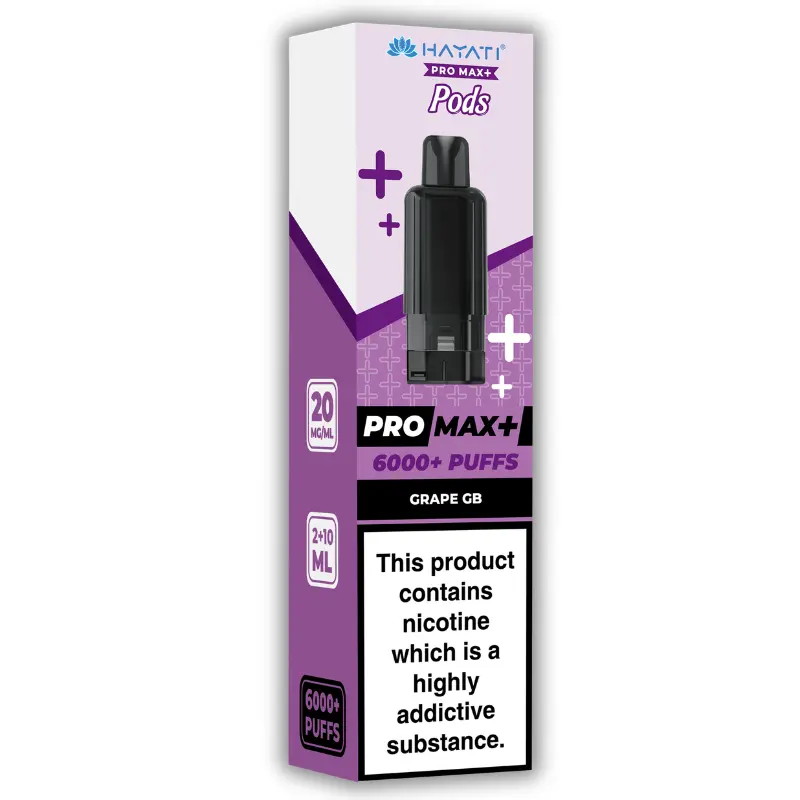
Grape GB Hayati Pro Max Plus Pods is the refill sold by itself: one prefilled pod, twelve millilitres of liquid at 20mg, £5.49, and no device anywhere in the packaging. It is the listing you come to once the hardware question is settled and the only decision left is which liquid goes into a device you already own. Hayati describe the flavour as grape carrying the whole thing alone, dark and sweet, with a slight edge of skin tartness stopping it short of syrup.
That is the straightforward reading. There is a less straightforward one, and it is the reason this page exists rather than repeating the four lines already on the listing.
Grape GB is one of the more heavily reused flavours in the Hayati catalogue, but most of that reuse is not as a product. It is as an ingredient in somebody else's. Across the 492 listings on this site, Grape GB appears nine times, and five of those nine are dual-flavour pods where it occupies one of two reserves next to Strawberry GB or Blue Razz GB. The listing in front of you is one of the four where it is the whole pod.
A flavour with that record raises a fair question for anyone about to commit twelve millilitres to it. If the maker mostly deploys this liquid as one half of something, has it been built to be one half of something? A supporting flavour and a headline flavour are asked to do different jobs, and being good at the first does not automatically make a liquid good at the second. That is the argument this page works through, and the first thing it does is count properly, because the claim as I have just stated it turns out to be partly wrong.
Nine listings, and what the catalogue actually does with them
Claims of the form "this flavour mostly exists as a component" sound precise and usually are not. So here is the whole set, with no rounding.
Nine listings in the Hayati catalogue carry Grape GB in the title. Five of them are dual-flavour pods, written with an oblique between two names: the Grape GB / Blue Razz GB Hayati Pro Ultra Plus 25000 Prefilled Pod Kit at £11.99, the matching refill pod for that combination, the Grape GB / Strawberry GB Hayati Pro Ultra Plus Pods at £7.99, the Pro Ultra Plus 25000 kit of that same pairing, and a Mini Ultra kit pairing it with Strawberry GB again. Four are standalone: a Pro Max nicotine salt bottle at £2.49, a Mini Ultra refill pod at £3.49, the Grape GB Hayati Pro Max Plus 6000 Pod Kit at £7.99, and this pod.
Five against four. That is a majority of exactly one listing, which is not what "mostly" means, and if the argument stopped there it would be a sentence dressed up as a finding. It does not stop there, because the split is not distributed the way a casual reading assumes.
The control that reframes the whole count
A dual-flavour title is not something Hayati can do on every piece of hardware. It requires a pod divided into two reserves and a rotating mouthpiece to select between them, and only two of the five hardware families in this catalogue are built that way.
The numbers: of 104 Pro Ultra Plus listings, 50 carry two flavour names. Of 50 Mini Ultra listings, 11 do. Of 179 Pro Max Plus listings, kits and bare pods together, exactly none do. Of 65 Pro Max nicotine salt bottles, none. Of 39 Rubik listings, none.
Three of Grape GB's four standalone listings sit on platforms where a standalone listing is the only kind that has ever existed. The nicotine salt bottle is solo because bottles are solo. The Pro Max Plus kit and this pod are solo because nothing on Pro Max Plus is anything else. Counting those three as evidence that Hayati sometimes choose to give Grape GB the spotlight is counting the absence of an option as a decision, and it is the error the raw five-to-four split invites.
Strip them out and look only at the places where Hayati genuinely had a choice.
| Hardware family | Grape GB listings | Alone | As half of a pair | Could Hayati have paired it? |
|---|---|---|---|---|
| Pro Ultra Plus | 4 | 0 | 4 | Yes, 54 of 104 listings there are single-flavour |
| Mini Ultra | 2 | 1 | 1 | Yes, 39 of 50 listings there are single-flavour |
| Pro Max Plus | 2 | 2 | 0 | No, 0 of 179 listings carry two names |
| Pro Max nicotine salt | 1 | 1 | 0 | No, 0 of 65 bottles carry two names |
| All nine | 9 | 4 | 5 |
On the two platforms that permit pairing, Grape GB has six listings and five of them are paired. The single exception is the Mini Ultra refill pod, and even that one comes with an asterisk: there is no Mini Ultra kit in Grape GB alone. The only way to buy a Mini Ultra device with Grape GB in it is to take Strawberry GB along with it. The solo Mini Ultra listing exists as a refill for people who already have the hardware, not as a way in.
The Pro Ultra Plus figure is the one that carries real weight, because that platform is where the ambiguity disappears. Fifty-four of its 104 listings are single-flavour pods, so a solo slot is plainly available and routinely granted. Grape GB appears there four times and receives a solo slot zero times. For comparison, Blue Razz GB gets two solo Pro Ultra Plus listings alongside its eight paired ones. Strawberry GB gets none. Red Razz GB gets none, and in fact has no standalone listing anywhere in the catalogue at all, existing only as a half of two pairings.
Calibrating it: how unusual is any of this?
Before this turns into a story about one flavour, it is worth knowing how common the pattern is. Fifty-nine distinct flavour names appear as half of a dual listing somewhere in this catalogue. Of those 59, thirty-two are paired more often than they are sold alone, and twenty have no standalone listing anywhere. Being used as a component is not a mark of anything unusual. It is what happens to roughly half the flavour library.
Where Grape GB does stand out is volume. Ranked by how many dual listings a flavour appears in, it sits sixth of those fifty-nine, behind Blue Razz GB on eight and level with a small group on five or six. That is a lot of use for a flavour that is not a mint, not a menthol and not a blue raspberry, the three things that usually get spread thinnest across a range because they blend with everything.
One further detail, and it sharpens the picture rather than muddying it. Grape GB has two partners across those five pairings, Strawberry GB three times and Blue Razz GB twice, and it has never once been paired with a flavour from outside its own GB family. Blue Razz GB has been: it sits next to Lemon Lime and next to Blue Razz Cherry across four listings. Grape GB has not left the family.
So what survives, and what has to be dropped
The version of this argument that says "the standalone pod is the unusual form for this flavour" does not survive, and it fails hardest on this exact page. On Pro Max Plus there is no other form. The standalone twelve millilitre pod is not an unusual way to buy Grape GB on this hardware, it is the only way, and any page telling you that buying it means doing something the range rarely does would be describing a choice Hayati never offered.
What survives is narrower and, I think, more interesting. Wherever Hayati have had the option of presenting Grape GB as a whole product or as a component, they have chosen component five times out of six, and on their largest pod platform they have chosen it four times out of four. That is a consistent editorial habit, not a coincidence of one listing. Whether it tells you anything about what is inside the pod is the next question, and the honest answer has a boundary in it.
What a pairing habit can and cannot tell you about a liquid
Everything above is drawn from product titles and hardware families. It is evidence about how a company organises a catalogue. Getting from there to a claim about how a liquid tastes over twelve millilitres requires several steps, and each one is worth making visible rather than gliding over.
The case that a good partner may be a poor solo
A pairing half is doing a specific job. It shares one coil, one wick and one airflow path with the other reserve, and the buyer switches between them dozens of times in a session by turning the collar. The flavour has to be recognisable in the first draw or two after a switch, because those draws are carrying residue from the other side and the identity has to punch through it. It has to contrast with its partner clearly enough that the switch feels like it did something. And it has to be uncomplicated, because a flavour built around a slow development over a long run never gets a long run. It gets ninety seconds before somebody turns the collar again.
Those are real design pressures and they select for particular qualities: a strong, immediate, single-note identity with a wide gap between it and whatever it is sitting next to. Dark grape confectionery is close to ideal for that brief. It is unmistakable from the first draw, it is about as far from a bright red berry or a sour blue raspberry as a sweet fruit gets, and there is nothing subtle in it to be lost under carryover.
The difficulty is that the same qualities behave differently when there is no collar. Immediate and uncomplicated over ninety seconds reads as clarity. Immediate and uncomplicated over twelve millilitres, which is several days of use for most people, can read as sameness. A liquid that has been selected for punching through carryover has not been selected for holding attention, and those are not the same test. Nothing in a paired listing ever asks the flavour to still be interesting on day four.
This is the substance of the concern, and it is a legitimate one. It is also, importantly, an argument about design pressure rather than an observation about the liquid, and design pressure is a tendency, not a mechanism.
The case that a repeat partner is a proven flavour
Now the other side, which is stronger than it first looks.
Being chosen as a pairing half five times is not a demotion. It is a vote of confidence, and it is a vote cast under conditions that are harsher than a solo listing faces, not gentler. A solo pod that disappoints gets returned once by one buyer. A paired pod that contains a weak half disappoints every single buyer of that listing within one session, because they will turn the collar to it, taste it, and then stop turning the collar to it, and from that point they are paying full price for a pod they are only using half of. A manufacturer who has done that to customers once does not repeat the flavour. Hayati have repeated Grape GB five times, across two different partners and three different hardware families.
There is a second point underneath that. The thing a pairing needs from its half is a strong identity, and a strong identity is exactly what a solo pod needs too. The qualities that make a flavour a poor partner, vagueness, a profile that only resolves after a long run, a note that sits too close to whatever is next to it, are also qualities that make a poor solo pod, just for different reasons. Distinctiveness is not the property that causes monotony. Thinness is. A flavour can be immediately recognisable and still have layers, and a flavour can be complicated and still be boring.
And the pairing record contains one more thing worth reading. Grape GB has never been paired with a non-GB flavour, while Blue Razz GB has been paired outside the family repeatedly. The most economical explanation is that Hayati's pairings are built around matching house style, putting one confectionery-register fruit next to another, rather than around propping up a flavour that cannot stand by itself. If Grape GB were being used as filler, you would expect it to turn up next to whatever needed a second reserve. It does not. It turns up next to its two closest stylistic relatives, which looks like a deliberate pairing logic rather than a convenience.
Where the evidence stops
Setting the confidence out plainly, because the rest of this page depends on it.
- Reasonably confident. The pairing pattern is real and consistent. Four of four Pro Ultra Plus listings paired, five of six on pairing-capable hardware, never paired outside the GB family, sixth most-used component of fifty-nine. These are counts from the listing data and they do not depend on interpretation.
- Reasonably confident. Hayati treat Grape GB as a confectionery-register flavour rather than a fresh-fruit one. Eight of its nine listings say so in Hayati's own words, using gummy, candied, confectionery or bubblegum. The ninth is this one.
- Probable. The liquid in this pod is the same as the liquid in the Pro Max Plus kit. Same flavour name, same platform, same twelve millilitres, same 20mg. Hayati do not state that the two share a concentrate, but nothing suggests otherwise and the pod is the obvious refill for the kit.
- Unknown. Whether the Grape GB in this pod is the same recipe as the Grape GB in a 22ml Pro Ultra Plus reserve or a 4ml Mini Ultra pod. Different hardware, different coils, and no published statement either way. A shared name across formats is suggestive and it is not proof.
- Unknown, and it is the axis that decides the purchase. Whether this liquid holds your interest for twelve millilitres. The pairing count cannot settle it. Neither can any listing. It is a property of the liquid against your palate, and the only honest thing a page can do is tell you what to watch for and how quickly you will know.
If that last line is frustrating, it should be, and it is the correct outcome of the exercise. The count produced a genuine finding about how Hayati position this flavour. It produced no finding at all about how the flavour behaves on a long run, because catalogue structure is simply not the kind of evidence that can answer that.
The grape itself, and one place the listings contradict each other
The meaning of the GB suffix and the broader argument about fresh fruit against confectionery versions of the same fruit are worked out in detail on the Strawberry GB Pro Max Plus pods page, which counts the suffix across the catalogue and finds the single listing where Hayati spell it out. I am not going to re-derive it here. The short form, taken from that page rather than reasoned out again: GB marks a sweet-shop treatment of the named fruit rather than the fruit itself, the convention holds across every hardware family, and the two bare Pro Max Plus pods are the only GB listings in the catalogue whose own copy never uses a confectionery word. One of those two is Strawberry GB. The other is this one.
That finding lands directly on top of something specific to Grape GB, and it produces the sharpest thing on this page.
Hayati describe this liquid twice, and disagree with themselves
The Pro Max Plus kit and this pod should contain the same liquid. Same name, same range, same volume, same strength, and the pod is what you buy when the kit's pod runs out. Hayati have written a flavour description for each, and on one axis the two descriptions point in opposite directions.
This listing reports a slightly tart, skin-like edge and says it is what keeps the flavour from becoming syrupy. The kit listing opens by explicitly setting the flavour against the tart skin and crisp bite of fresh grapes, and says the confectionery finish softens any sharpness. One description says a skin tartness is present and structurally important. The other says the liquid was built to avoid exactly that.
Widen it to the whole set and the pattern is one-sided. The nicotine salt bottle says the flavour is firmly sweet with no real tartness to speak of. The Mini Ultra pod says the rounded GB sweetness makes the grape feel plump rather than sharp. The Grape GB and Strawberry GB pairing says both halves lean sweet rather than sharp. In the Blue Razz GB pairings, the sharpness in the description belongs to the blue raspberry, and Grape GB is offered as the change of pace away from the tang. Eight listings put this flavour on the sweet side with no meaningful acidity. One reports a tart edge, and it is this one.
Two readings are available and I cannot choose between them from the data. Either there is a genuine but small skin-like note that only one writer bothered to record, or this description was written loosely by someone reaching for a standard grape phrase. The second is more likely on the balance of evidence, simply because eight against one is a heavy weight and because the kit listing is not silent on the point but actively contradicts it. It also fits the observation borrowed above: this is one of the two GB listings written without the house vocabulary, which is consistent with it having had the least care spent on it.
The practical consequence. If a fresh, skin-tart grape is specifically what you are shopping for, do not buy this pod on the strength of that one phrase. Seven other descriptions of the same flavour tell you it is not that. If sugared, dark, confectionery grape is what you want, the phrase is a distraction and the rest of the evidence is pointing at what you want.
What the pod does, as far as the evidence supports
Taking the eight-to-one weighting seriously, here is the profile the listings collectively describe, with the inference marked.
The inhale. Grape arrives immediately and without a build-up. There is no opening act, no citrus lift, no berry standing in front of it. This is consistent across every description in the set and it is the one thing all nine agree on. The character is the dark end of grape, the purple-black register rather than the green or muscat end, and the sweetness is front-loaded rather than arriving late.
Through the draw. The listings describe weight and concentration rather than movement. Words like dark, rich, jammy, plump and concentrated recur; words implying development, brightening or a turn do not appear anywhere in the set. Inferred: this reads as a flavour that states itself and holds, rather than one that travels across a draw. That inference is drawn from what the descriptions consistently omit as much as from what they say, which makes it weaker than a direct statement, and I would rather flag that than present it as settled.
The exhale and finish. A sugared trailing note is the common thread. The kit calls it a sugary trace left on the palate, the nicotine salt has soft bubblegum lingering, the Mini Ultra has the GB note rounding off the finish. Expect the sweetness to outlast the fruit rather than clear with it. For some people that is the appeal of the whole category and for others it is the thing that ends a pod early.
Sweetness level. High, and none of the nine listings suggests otherwise. Among the Pro Max Plus pods this sits at the sweet end rather than the middle. If your current pod is something like Lemon Lime or Cherry Sour Raspberry, where acidity does structural work, this is a substantial move in one direction and you will notice it on the first pod rather than the third.
Cooling. None of the nine Grape GB listings mentions ice, menthol or any cooling agent. The one place the word iced appears is a sentence telling you to look elsewhere if that is what you want. Treat this as an uncooled pod. Hayati publish no ingredient breakdown, so that is a conclusion from consistent silence rather than a stated fact, but nine listings declining to mention cooling is about as clear as silence gets. If you want grape with a cold edge you are looking at the wrong listing, and there is no iced Grape GB anywhere in the range to redirect you to.
What it is not
It is not a blend. Only one fruit is named and nothing in any description suggests a second one hiding behind it, which separates it cleanly from Grape Berry and Sakura Grape, the other two grape options on this shelf.
It is not tart, on eight listings out of nine. It is not cooled. It is not a light or refreshing pod, and it is not one that changes shape as you work through it. And it is not, on any reading of the evidence, a subtle liquid. Whatever else is arguable here, nobody is going to fail to identify what is in this pod.
How to settle the open question on your own first pod
The unknown that matters is whether a single-note sweet flavour keeps working for you across twelve millilitres. You can get a reliable answer well before the pod is finished, and it is worth doing deliberately rather than waiting to notice.
Take a considered draw on the first day and write down, in your own words, what you can pick out beyond grape and sugar. Two or three components, or one. Then do the same thing on day three, after a working stretch rather than first thing. The comparison you are making is not whether it tastes weaker, because some flattening happens on any coil as it accumulates residue. You are asking whether the number of things you can identify has gone down. A flavour with depth holds its component count as the intensity drops. A single-note flavour loses the note and leaves sweetness, and once you are tasting sugar rather than grape you have your answer about the remaining eight or nine millilitres.
The other signal is simpler and more reliable than any tasting note: how often you find yourself wanting something else. Not whether you like it, which you already know, but whether you reach for a change after twenty minutes. That is the specific failure mode a heavily-paired flavour risks, and it shows up as restlessness long before it shows up as dislike.
The pod, in brief
A Pro Max Plus pod is a prefilled unit that goes into a device you already own. There is nothing else in the box: no battery, no cable, no spare, just the pod. Nothing here is refillable and nothing is user-serviceable, so when it is done it is done.
The number worth attention for a liquid this sweet is the twelve millilitre capacity, and it is worth attention because of how it is arranged. Hayati describe the pod as a 2ml chamber at the coil plus a 10ml reserve, twelve millilitres in total, and they do not publish how liquid moves between the two parts. Nobody outside Hayati knows, and a retail page should not pretend to, this one included. What it means in practice is that you are committing to twelve millilitres of one flavour on a single coil, which is a long run by the standards of most prefilled formats and the reason the monotony question above is worth asking at all rather than being an abstraction.
Hayati make several pod families that look alike in a drawer, so match the range name printed on your device to the range name in the listing title before ordering. Everything else about the hardware, including what comes in a starter kit and how the device behaves over its life, belongs on the Grape GB Hayati Pro Max Plus 6000 Pod Kit page and on the Hayati Pro Max Plus Pods shelf, where the other eighty-nine pods for this device are listed.
The published numbers
| Price | £5.49 |
|---|---|
| Flavour | Grape GB, single flavour, no second fruit named |
| What arrives | One prefilled replacement pod, no device |
| Liquid volume | 12ml, described as a 2ml chamber plus a 10ml reserve |
| Nicotine | 20mg |
| Manufacturer puff figure | Rated at up to 6,000 puffs, a laboratory estimate |
| Cooling | None described in any Grape GB listing |
| Fits | Hayati Pro Max Plus devices |
| Brand | Hayati |
Two of those rows need reading carefully rather than scanning.
The puff figure first. Six thousand is a manufacturer rating produced in laboratory conditions, and the useful way to treat it is as a rough indicator of the format rather than a forecast of your week. What a machine records and what a person records diverge for ordinary reasons of draw length and frequency, and they diverge further on a sweet liquid, because sweetener residue on a coil dulls the flavour before the pod is anywhere near empty. On this particular pod, the figure that will actually govern when you change it is not the puff count and probably not the liquid level either. It is the point where the grape has gone flat and only the sugar is left.
The nicotine figure second. Twenty milligrams per millilitre is the highest strength permitted for sale in the United Kingdom, so every prefilled pod on this shelf carries it and there is no lower-strength version of this pod to choose instead. It is a fixed property of the format rather than a decision you are making at checkout. Nicotine is addictive, and the strength here is the same whether the liquid in front of it is grape, cola or menthol. If you want Grape GB at a different strength you would be looking at a bottle rather than a pod, and that is a different product on a different shelf with its own listing.
Choosing between this and its neighbours
Eighty-nine pods fit this device and a good number of them are dark, sweet fruits. The sorting question is not which is best but which axis you are actually moving along, so these are grouped by the move you would be making rather than by fruit family.
If you want grape specifically
There are three grape pods on this shelf and they are not variations on a theme. This one puts grape alone and sweet. Grape Berry Hayati Pro Max Plus Pods adds a berry alongside it, which changes the structure rather than just the flavour, because a second fruit gives the palate somewhere else to go on a long run and is the obvious answer if the monotony risk discussed above is your main worry. Sakura Grape Hayati Pro Max Plus Pods takes grape in a floral direction, which is the biggest departure of the three and the one most likely to be either exactly right or completely wrong for a given person. All three sit at £5.49 alongside the rest of the grape shelf, which runs to eighteen listings across the ranges.
If it is the dark sweetness you are after and the fruit is negotiable
Blackcurrant Juice is the nearest relative by weight and colour, deep and sweet in the same register, and it is the pod to consider if you like where Grape GB sits but want the fruit changed. Blackberry Raspberry keeps the dark-fruit body and splits it across two berries, so you get the same depth with a bit more movement. Blue Razz Blackcurrant brings blue raspberry's tang into a dark base, which is closer to what Grape GB does in the paired Pro Ultra Plus pods than to what it does alone. Blackcurrant Mango is the odd one in this group, pulling a dark berry towards tropical sweetness, and it is worth a look if the thing you like about grape is the richness rather than the purple-fruit character.
If the sweetness is the problem
Anyone who has found Grape GB too sugary is really asking for acidity or a coolant, since those are the two things that cut it. On the acid side, Cherry Sour Raspberry is the clearest move, with the sourness doing real structural work rather than sitting as a garnish. Blackcurrant Lemonade keeps a dark fruit but puts a citrus lift underneath it, and Berry Lemonade does the same across a broader berry base. Lemon Lime is the full move to the other end of the shelf, with no dark fruit left in it at all.
On the cooling side, Blackberry Ice is the closest thing to a chilled version of what Grape GB is doing, since the fruit stays dark and the cold arrives on the exhale. Blue Frozen pushes the cooling harder. Lychee Ice keeps a sweet, slightly perfumed fruit and adds ice to it, which is a reasonable landing spot if you like sweet fruit but want it held in check. Double Menthol removes fruit from the equation entirely and is the pod people keep in rotation precisely to reset a palate that has been living on sugar.
If you want sweet but not fruit
Sweet pods that are not fruit are a small group and they solve the same restlessness a single fruit creates. Cherry Cola keeps a dark sweetness while changing the category completely. Cola Ice adds a cold edge to that, and Cola Lime puts citrus against it instead. Banana Ice is the other soft, rounded option on the shelf and is about as far from an acidic pod as you can get while still being fruit. Galaxy Aura is named for a mood rather than an ingredient, so you are buying without a fruit on the label, which some people are fine with and others are not.
If the paired format is what you actually want
This is the comparison the whole page has been building towards, and it is a genuine choice rather than a rhetorical one. If everything above has left you thinking that twelve millilitres of one sweet grape sounds like a lot, the range already contains the answer, and it is the format Hayati use for this flavour most of the time.
Grape GB / Strawberry GB Hayati Pro Ultra Plus Pods at £7.99 puts Grape GB in one reserve and a lighter, brighter confectionery strawberry in the other, inside a single twenty-two millilitre pod with a rotating mouthpiece selecting which reserve reaches the coil. Switching is available at any moment, so restlessness has somewhere to go. Grape GB / Blue Razz GB Hayati Pro Ultra Plus 25000 Prefilled Pod Kit at £11.99 pairs it instead with a sharper blue raspberry and includes the device, which makes it the entry point rather than a refill.
Both are different hardware, so this is not a swap you make with the device already on your desk. The honest framing is that if you have a Pro Max Plus and want Grape GB, this pod is your listing and the paired versions are not available to you. If you are choosing a platform from scratch, the pairing question is live, and the catalogue's own behaviour is a reasonable hint about which way Hayati think this particular flavour works best.
One more option worth naming for completeness: Blue Razz Cherry is a single Pro Max Plus pod that carries two fruits in one liquid, which is not the same as two selectable reserves but does give a single pod more internal variety than Grape GB has. It is the nearest thing this shelf offers to the paired experience. Beyond that, the Hayati Pods and Hayati Prefilled Pods & Refills shelves hold the full set across every platform, and the whole Hayati range is there if you want to browse rather than narrow.
Running a sweet pod well
Most handling advice is generic. These are the parts that matter more than usual because of what this particular liquid is.
Let it settle before the first draw. Give a new pod a few minutes in the device before you use it, and take the first two or three draws gently. This matters more on a heavily sweetened liquid than on a thin one, because the residue a scorched wick leaves behind does not clear, and on a pod you will be running for twelve millilitres a bad first minute stays with you for the whole of it.
Expect the top note to go first. Sugar-forward liquids leave more behind on a coil than tart or light ones do, and the effect is not uniform across a flavour. The bright edge of the grape dulls before the sweetness does, which means the pod drifts towards tasting generically sweet rather than tasting of less. This is worth knowing because it changes what "it has gone off" feels like. You will not notice a fade so much as a narrowing.
Slower draws, and fewer in a row. A long, unhurried draw suits this pod better than a short sharp one, and a run of draws back to back is where a sweet liquid turns cloying fastest. If the flavour flattens mid-session, putting the device down for a few minutes recovers more of it than pulling harder does. Pulling harder on a flagging pod mostly produces heat, and heat on a sugary liquid produces exactly the dull, caramelised edge you are trying to avoid.
Warmth and light are the enemies of a spare. If you have bought this pod ahead of needing it, keep it out of direct sunlight and away from anywhere that gets hot, which for most people means not a car and not a windowsill. A sweet, dark liquid is the kind most visibly affected by heat over time. A twelve millilitre pod of very sweet liquid is also exactly the sort of thing that gets picked up by somebody who should not have it, so store it where children and pets cannot get to it.
Knowing when it is finished. Three signals, in the order they usually arrive: the grape narrows to plain sweetness, the draw starts feeling drier or warmer than it did, and the liquid level stops being the thing you are watching. On this pod the first of those will nearly always come before the pod is empty. Continuing past it does not damage anything, it just means the last stretch does not taste like what you bought.
Disposal. A used pod still contains a coil and some residual liquid, so it does not belong in household waste. Take it to a shop that accepts vape returns or to a local recycling point that handles electricals. There is no battery in a bare pod, which makes it a smaller problem than a whole device but not a nothing.
Questions buyers ask about the single
Is this the same liquid as the Grape GB starter kit?
Almost certainly. It is the same flavour name, the same range, the same twelve millilitre volume and the same 20mg strength, and this pod is the refill the kit's buyers come back for. Hayati do not publish a statement that the two share a concentrate, so it sits as probable rather than confirmed. The two listings do describe the flavour differently on the question of tartness, which is covered above and is more likely a writing inconsistency than two recipes.
Why does Grape GB mostly appear in dual-flavour pods?
On the hardware that allows a dual-flavour pod, it does. Four of four Pro Ultra Plus listings pair it, and five of its six listings across pairing-capable platforms are pairings. On Pro Max Plus, which is this device, no listing at all is dual-flavour, so nothing is being chosen there. The most likely reason for the pairing habit is that Hayati match confectionery-style flavours to each other, which is supported by Grape GB never having been paired outside its own GB family.
Does that mean it is not good enough to carry a pod alone?
No, and the evidence points the other way if anything. A weak half in a dual pod is discovered by every buyer within one session, so repeating a flavour across five pairings and two partners is a sign the maker trusts it. What the pairing record genuinely cannot tell you is whether a single sweet note stays interesting across twelve millilitres, because a paired flavour is never asked to do that. That is a question about the liquid, and catalogue structure is not evidence about liquids.
Is there any tartness in it or not?
Probably very little. This listing mentions a slightly tart, skin-like edge, and eight other Grape GB listings either say there is no real tartness or actively contrast the flavour with fresh grape skin. On the weight of evidence, treat it as a sweet pod. If a genuine tart grape is what you are shopping for, this is not it and there is nothing else in the range that is.
Does anything in this pod cool the exhale?
Nothing in any of the nine Grape GB listings mentions ice, menthol or a coolant, so it should be read as an uncooled flavour. Hayati publish no ingredient list, so this is a conclusion from consistent silence rather than a stated fact. For a cold dark fruit on the same device, Blackberry Ice is the nearest thing.
How sweet is it compared with the rest of the shelf?
At the sweet end, clearly. Every description in the set puts it there and none suggests a balancing acidity. Against something like Lemon Lime or Cherry Sour Raspberry it is a large move in one direction, and against another dark fruit such as Blackcurrant Juice it is a smaller one. If you are coming off a pod where sourness was doing the work, you will notice within the first session rather than needing to live with it.
What does the 6,000 figure actually mean?
It is a manufacturer rating produced under laboratory conditions and offered as an estimate of the format, not a measurement of your use. Real figures vary with how long and how often you draw. On a sweet pod the more practical limit usually arrives earlier than either the rating or the liquid level, at the point where the grape has narrowed to plain sugar.
Can I refill it once the liquid is gone?
No. It arrives prefilled and there is no provision for topping it up, so when the flavour is finished the pod is replaced rather than refilled. Twelve millilitres is a reasonably long run for a prefilled format, which is part of why choosing a flavour you are confident about matters more here than on a smaller pod.
Is a 12ml single-flavour pod a lot to commit to?
It is more than most prefilled formats ask for, and whether that is a lot depends entirely on how you feel about the flavour after two days. The practical hedge is to judge it early rather than waiting: if you are reaching for something else after twenty minutes on day one, that pattern will not improve over the remaining liquid. A pod with two fruits in it, such as Grape Berry, is the lower-commitment version of the same purchase.
Why is this pod £5.49 when the kit is £7.99?
The kit price includes a device and the pod price does not, so the two are not really comparable purchases. This listing is for people whose Pro Max Plus is already in hand, and the £7.99 Grape GB kit is for people starting from nothing on this platform. Every prefilled pod on this shelf is £5.49, so switching flavour between pods costs the same whichever one you pick.
Where do I find the rest of the range?
The Hayati Pro Max Plus Pods shelf holds the eighty-nine pods that fit this device, which is the right place to browse if the hardware is settled and only the flavour is in question. The wider new products listing is useful if you want to see what has arrived recently across all the platforms rather than just this one.
The short version
Grape GB is a dark, sugared, confectionery-register grape sold here as a twelve millilitre replacement pod at £5.49, with no device in the box, no cooling and no second fruit. It is sweet and it is not subtle, and on eight of its nine catalogue listings there is no tartness holding it back, whatever the single phrase on this particular listing says.
The claim that sent me counting was that this flavour mainly exists as somebody else's component, which would make the standalone pod an unusual thing to buy. Half of that is right. Wherever Hayati could have gone either way, they paired it five times out of six, and on the Pro Ultra Plus they paired it four times out of four while handing solo listings to fifty-four other flavours. The other half is wrong, and wrong specifically here: no Pro Max Plus listing is dual-flavour, so on this device the standalone pod is not the unusual option, it is the only one.
Which leaves a straightforward recommendation. Buy this if you already own the device, you know you like sweet dark grape, and you are content to run one clear flavour for twelve millilitres. Do not buy it expecting fresh fruit or expecting the profile to develop. And if the twelve millilitres is what gives you pause, that hesitation is reasonable and the range has already answered it in the paired Pro Ultra Plus pods, which is the form Hayati themselves reach for most often with this liquid.
Strictly for adults aged 18 and over. Nicotine is an addictive substance.
You might also like