
Home / Hayati Pro Max Plus Prefilled Pod Kit / Double Menthol Hayati Pro Max Plus 6000 Pod Kit
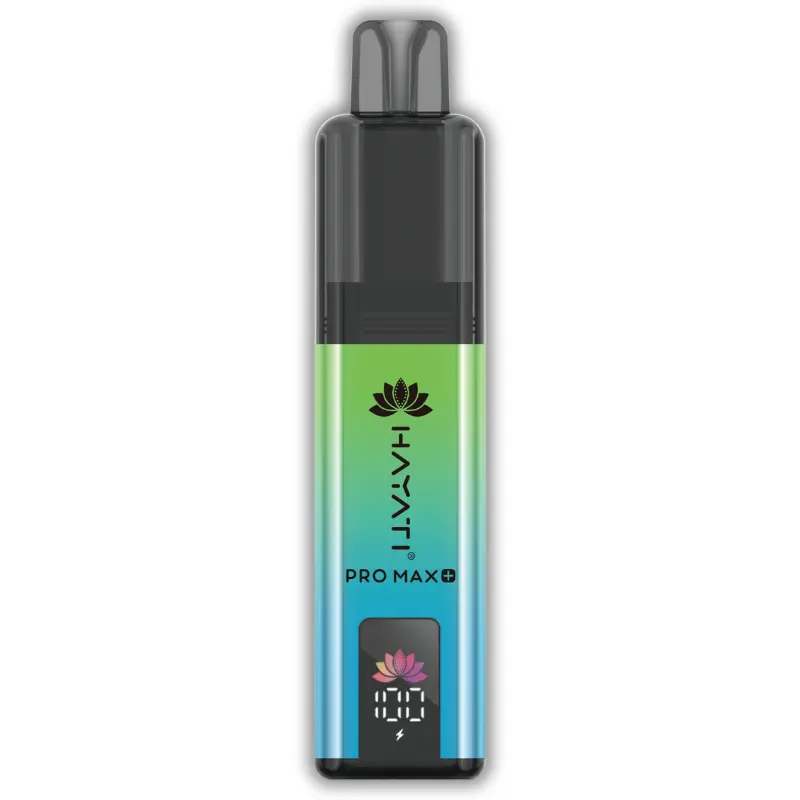
Hayati · Pro Max Plus
Double Menthol Hayati Pro Max Plus 6000 Pod Kit
£7.99
✔ In stock — ready to ship
Genuine Hayati
Free over £20
Same-day dispatch
Secure checkout
Twelve millilitres of liquid, a rechargeable body to run it in, and £7.99 for the pair. Neither of those numbers is what makes this listing unusual. What makes it unusual is that the pod arrives carrying almost nothing a person would recognise as a flavour. No fruit is named on it. No sweet, no soft drink, no dessert, no leaf. The title hands you a compound and a magnitude, and the compound does not produce a taste so much as a report: menthol persuades a cold-sensing channel in the tissue of the mouth and throat to fire, and the brain reads the result as a drop in temperature that never actually happened.
Count the shelf and the position is stark. There are 88 listings on the Hayati Pro Max Plus Prefilled Pod Kit shelf. Three of them carry a name from the mint and menthol family: Spearmint, Fresh Mint and this one. Two of those three name a plant, which is to say they name an aroma with a green, leafy identity your nose can read. One names the molecule. Widen it to the full 492-product catalogue and seven titles contain the word menthol; four hang it on fruit, and three let it stand on its own, being this kit, its bare pod, and a 10ml bottle called simply Menthol. Roughly twenty of the 88 kits on this shelf name a sweet, a pudding or a drink. Exactly one names a sensation and stops there.
That is not a thinner proposition than a fruit pod. It is a different one, and the differences only show up over the length of the pod rather than in the first five draws. A liquid made entirely of sensation cannot bore you the way a raspberry can, because there is no composition for your attention to learn and exhaust. But a sensation is also the one property your body recalibrates against faster and more completely than any flavour, so the thing you bought gets quieter with use in a way a fruit does not. Meanwhile the pod itself should be the steadiest twelve millilitres on the shelf, because there is almost nothing in it delicate enough for a tiring coil to destroy. Put those together and you get a genuinely strange object to own: a product whose output barely drifts and whose experience drifts more than anything else you could have bought. Sorting out which of those two you are looking at, at any given point in the pod, is the whole of living with it, and it is what the rest of this page is about.
What the other pages on this liquid have already settled
Three arguments about this flavour are finished elsewhere in this catalogue and rebuilding them here would waste the space this page needs.
The first belongs to Double Menthol Hayati Pro Max Plus Pods, the bare refill at £5.49 for a body already in your possession. That page takes the name apart. Its central finding is that a cold receptor population has a finite response, so past a certain concentration additional menthol stops buying proportionally more cold and starts buying a prickling, needling sharpness through a second receptor instead. It sets out three honest readings of what the word double could denote, being two cooling agents, one agent at a raised dose, or a retail intensifier doing no formulation work at all, and it comes down on the second or the third rather than the first. All of that is settled, it is settled properly, and I am taking it as given. If you want to know why a magnitude word on a coolant is a different sort of claim from a magnitude word on a fruit, read it there.
The second belongs to the two Spearmint pages in this range, the kit and the bare pod. Between them they establish that carvone and menthol are unrelated molecules doing unrelated jobs, so a spearmint is not a menthol turned down and a menthol is not a spearmint turned up. The kit page then works through the timing: an aroma has to travel to the olfactory tissue from behind the mouth on the exhale, which makes it slow, easily lost and heavily dependent on how you send the vapour out, whereas a receptor event is fast and arrives whatever you do. It also sets out the morning-draw diagnostic, which is the best tool anyone has published for telling a tired coil apart from a tired nose on a herb pod. Cited, agreed, not repeated. One part of it does not transfer to this liquid, and the reason it does not transfer is one of the more useful things on this page, so I will come back to it in detail rather than glossing it.
The third is the cooling-vocabulary question, which was settled by counting on the Blue Frozen pods page. Ice, Frozen, Cooler, Mint and Menthol are not a graded scale, no matter how much they look like one, and no Hayati title ever puts an ice word and a mint word together. That page did the census and I have no reason to redo it.
What none of them covers is ownership. What it is actually like to have twelve millilitres of pure sensation as the thing you reach for, over a fortnight, is a question nobody has answered, and it is the question that decides whether £7.99 was well spent.
The thing in the pod, described once
A short orientation, because you cannot reason about owning something you have not been told the shape of.
Cold arrives early, before the draw has finished, and it arrives unevenly: the rim of the tongue and the roof of the mouth register it first, the throat a beat behind as the vapour travels. Nothing accompanies it. On a cooled fruit the chill and the fruit land close enough together to read as a single event, so the staging is inaudible. Here there is nothing else on the stage, so you hear every part of the sequence.
Underneath, the body of the vapour is thin and rather dry. No fruit and no obvious sweetener means no roundness, and the liquid can feel less substantial than a fruit pod taken at the same length even while it is doing a great deal more to your palate. There is one small aromatic component and most people never notice it, because it sits a long way below the sensation in volume. Menthol has a smell of its own, thin and high with a dry, camphorous, faintly woody edge, and it reaches you only on the part of the exhale that leaves through the nose. Vent the whole exhale through your mouth and this pod genuinely does taste of nothing at all. That single note is going to matter later, because it is the only thing in the pod that behaves like a flavour, and therefore the only thing in the pod that a coil can take away from you.
Sweetness sits at the floor of the shelf, though not quite at zero, because a coolant produces a faint counterfeit impression of sugar all by itself. Against Berry Lemonade or Blackcurrant Lemonade the gap is not a matter of degree. Set it beside the most straightforward single fruit available here, Blackcurrant Juice, and even that arrives with a sugar impression behind it that this pod has nowhere to get. The finish is long, which coolants generally are, and thirty seconds after an exhale there is still a cold band across the soft palate that drawing in plain air makes louder.
That is the liquid. Everything below is about what happens when you own twelve millilitres of it.
Two ways a pod stops working, and only one of them is about the liquid
Ask anyone who has run through a few twelve-millilitre pods why they stopped enjoying one and you will get the same sentence about very different events. It went off. It stopped doing anything. I got sick of it. Those are three descriptions of at least two completely separate mechanisms, and the reason it is worth separating them here rather than on a fruit page is that this product is immune to one of them and maximally exposed to the other.
Getting bored of a flavour
A fruit blend is a proposition. It has parts, an order, a balance and a shape, and your attention treats it as something to be worked out. The first pod of Guava Kiwi Passion Fruit is partly an act of identification: which of the three is leading, where the passion fruit sits, whether the guava is doing anything by the exhale. That process is enjoyable and it has an end. Once the blend is fully learned, the draws stop containing new information, and what was interesting becomes merely familiar. Somewhere in the second half of a pod, familiarity starts to read as monotony.
The rate at which this happens tracks complexity in a reasonably predictable way. A three-fruit blend takes longer to exhaust than a single fruit. A liquid with a heavy sugar load exhausts faster than a dry one, because sweetness is the least informative thing in a flavour and the tongue stops attending to it quickly. This is an opinion changing, not a signal shrinking. Hand a bored vaper the same pod after a fortnight away from it and it will taste exactly as it did, because nothing about the delivery has altered. What altered is that they had learned it and then unlearned it.
Adapting to a sensation
The other mechanism is not an opinion at all. Sustained and repeated exposure to a coolant reduces the size of the sensation it produces, and the reduction is substantial rather than marginal. Whether the change sits in the receptors themselves or in how the brain scales an input it has been receiving constantly is not something a retail page can settle, and for the purpose of deciding whether to buy this kit it does not matter, because what you do about it is the same either way. What matters is that the reading falls while the liquid is unchanged.
The two mechanisms feel the same from inside and they have opposite fixes. Boredom answers to variety, and specifically to variety inside the same stretch of time: another pod in the same afternoon does the job, because the problem is that your attention has run out of work. Adaptation answers only to absence, and absence measured in days rather than hours. Running a different pod for twenty minutes and coming back does very little. Running nothing cooled for two days does a great deal.
Which of the two this product is exposed to
Here is the part that makes this listing structurally different from the rest of the shelf. A sensation has almost no information content. There is nothing to identify, no order of arrival to learn beyond the sequencing described above, and no balance to work out, because there is only one thing present. You cannot learn it and therefore you cannot exhaust it, which means the ordinary boredom curve that flattens every fruit pod somewhere around the middle barely applies. People who have run this liquid do not usually say it became uninteresting. They say it stopped being cold.
And that is because the second mechanism, the one a fruit is largely safe from, is pointed directly at the only property this pod has. A coolant is the attribute a palate recalibrates against fastest and most thoroughly. So the trade is exact and it is worth stating flatly: this pod has swapped a slow, mild, curable problem that afflicts everything else on the shelf for a fast, severe one that afflicts almost nothing else.
There is a further twist which makes the experience harder to read than the plain version suggests. The two components of a strong menthol do not fade at the same rate. The chill falls away noticeably, while the prickling sharpness at the back of the throat holds on for longer. The bare pod page names this pattern as the giveaway and it is right to. What it means in practice is that adaptation does not simply turn the pod down like a dial. It changes its proportions, leaving you with the sharp part of the experience and less of the cold part that the sharpness was supposedly the price of. A pod that seems to have become simultaneously harsher and weaker has not gone wrong. It is telling you where you are on your own curve.
Twelve millilitres that are not all worth the same
Follow the consequence into money and the picture sharpens further, because it produces a property this pod has and its neighbours do not.
On Mango Peach Pineapple, the tenth millilitre is worth very nearly what the first millilitre was worth. The coil has aged a little by then and the liquid has lost some definition, which is a real cost and a gradual one, but the fruit is still arriving in the same quantity because your nose has not permanently reduced its response to mango. The delivered value per millilitre is close to flat across the pod, with a modest decline near the end.
That is not the shape here. On this pod the decline begins on about day three, it is driven by you rather than by the hardware, and it is steepest early. The first two millilitres deliver the sensation at full size. The last two deliver a reduced version of the same output to a palate that has been recalibrating against it for a fortnight. Nobody can put a number on the size of that reduction, because individual sensitivity to menthol varies a great deal between people and none of the relevant variables are published, but the direction is not in doubt and neither is the shape. Value is front-loaded, and it is front-loaded by a mechanism that has nothing to do with the quality of the product.
Which produces an odd instruction. On any other pod on this shelf, the way to get the most out of your £7.99 is to use it. On this one, the way to get the most out of it is to use it less than you otherwise would. Spreading twelve millilitres over five weeks of intermittent use will deliver more total sensation than concentrating it into ten days, because the gaps are doing work that the liquid cannot do for itself. That is a genuinely unusual thing to be told about a prefilled pod, and it runs against the grain of how most people treat one, which is to put it in the device and run it until it stops.
The obvious objection to that advice is the drawer. A pod you keep setting aside is a pod spending most of its life not being used, and every other page in this range will tell you, correctly, that a part-used pod deteriorates in storage. That objection is real for nearly everything on the shelf. It is close to weightless here, and the reason why is the subject of the next two sections.
The pod that should age better than anything else on the shelf
A coil does not fail at a stroke. It ages, and ageing means residue accumulating on the wire, small hot spots forming where the deposit is thickest, and the wick moving liquid more slowly than it did when it was new. The Spearmint kit page sets that mechanism out properly and I am not going to rebuild it. The part that matters here is the consequence, which is that the loss is never uniform. A tiring coil does not turn everything down equally. It removes the most volatile and most heat-sensitive material first and leaves the heavier, duller material standing.
That is why a citrus goes vague before anything else in the pod does, why the grassy top of a herb thins while its sweetness survives, and why a three-fruit blend loses its lightest component and carries on sounding broadly like itself with two fruits doing the work. In every case the thing destroyed is the light, fast, chemically delicate fraction, because that is the fraction a hot wire and a film of caramelised residue can actually get at.
What this liquid offers a coil to work with
Now apply that to a pod whose entire active content is a single small, stable, unfussy molecule that produces its effect by fitting into a receptor rather than by presenting a pattern of aroma for a nose to read.
There are two independent reasons to expect it to survive the process better than its neighbours, and it is worth keeping them separate because they are often run together into one vague claim about sugar.
The first is about how much residue gets made. Sweeteners are the fastest builders of deposit on a coil, and this liquid names none. Less sugar arriving at the wire means less caramelised film forming on it, which means the coil stays closer to its original condition for longer. That much is common ground with any low-sweetness liquid on the shelf, and the Spearmint pages already make the point for a herb.
The second reason is the one that is specific to this product, and it is the stronger of the two. Even where residue does build, what residue mainly does is muffle fine detail. It raises the threshold at which small aromatic components register, so the quiet parts of a profile drop below audibility while the loud parts continue. A liquid with no quiet parts has nothing to lose to that process. There is no light top note here waiting to be taken, no delicate ester, no green fraction, no third fruit that was only just audible to begin with. The pod's output is one loud, robust signal, and a muffling effect that would gut a blend leaves a single loud signal more or less intact.
Add a third, smaller point. Heat itself is a destroyer of aroma compounds, and a coil that has developed hot spots is running some of the liquid hotter than the formulator intended. A green aromatic suffers badly from that, which is why the Spearmint kit page devotes a section to the difference between a coil at temperature and a coil running hot. Menthol is comparatively indifferent to it. It is not a fragile molecule and it is not being asked to deliver a pattern that could be distorted; it is being asked to arrive and bind.
Testing the claim rather than asserting it
The temptation is to say this is the most stable twelve millilitres in the range, so it is worth checking whether that survives contact with the shelf.
The obvious rival candidates are the other low-sweetness listings, and they lose on the second axis rather than the first. Spearmint and Fresh Mint both carry little sugar, so both should form residue slowly, but the entire content of both is volatile aromatic material, which makes them the most exposed listings on the shelf to whatever residue does form. Their own pages say so, in more detail than I need here: a single herb has no second component to cover for it, so what the coil takes is simply gone. Blackcurrant Juice is a single fruit executed directly and is probably drier than most of the shelf, but it is still a fruit and its identity still lives in a pattern of volatiles. The mood-named listings like Black Mamba, Blue Fusion and Galaxy Aura cannot be assessed at all, because nobody outside the factory knows what is in them.
So the claim narrows, and the narrowed version is the interesting one. On the mechanisms that actually govern how a prefilled pod changes over its life, this listing scores well on both axes at once, and I cannot find another on the 88-kit shelf that does. Low residue formation and low vulnerability to residue are separate properties, and the liquids with the first mostly lack the second. The honest form of the claim is therefore this: of the kits on this shelf, this one has the strongest mechanical case for holding its output across twelve millilitres. It is an inference from how coils age and what this liquid is made of, not a published test result, and Hayati publish neither the coil specification nor the formulation, so nobody can turn it into a measurement.
The one thing the coil can take
There is an exception and it is the camphorous note described earlier. That fraction is volatile, it is quiet, and it is exactly the sort of material a tiring coil removes first. So the pod does change over twelve millilitres, in one narrow respect: the thin aromatic layer sitting on top of the sensation thins further and eventually goes, and what remains is sensation with nothing on it at all.
Most owners will never consciously register the loss, because most people exhale through the mouth and never met that note in the first place. For anyone who does notice it, this is the single flavour-channel signal the pod has, and it becomes the closest thing available to the citrus-goes-first indicator that every other page on this shelf can rely on. That is worth knowing in advance, because you can only use it as a signal if you took a reading of it when the pod was new.
A part-used pod in a drawer, which is where this one wins
Return to the objection from earlier. Adaptation says to use this pod intermittently. Storage advice, everywhere in this range, says a part-used pod set aside for a month comes back worse than you left it.
The storage advice is sound and it is sound for the same reason coil ageing is selective. What a pod loses in a drawer is its volatile fraction, driven off gradually by time and much faster by warmth. The Spearmint kit page puts it plainly: a herb pod returned to after a month in a drawer is flatter than you remember, that is loss of the light fraction rather than a fault, and part-used pods of that kind should be finished within a few weeks.
Now ask what this pod has to lose in a drawer. The answer is the camphorous note and essentially nothing else. The sensation itself is produced by a compound that is not going anywhere on the timescale of a few weeks in a cool dark cupboard, and there is no bright top note, no acid balance and no delicate aromatic structure that could drift out of true. A part-used Double Menthol pod picked up after a month will be almost exactly the pod you put down. A part-used Kiwi Cooler or Mixed Berries will not.
Which resolves the tension neatly and produces the single most useful practical finding on this page. The consumption pattern that adaptation demands, being intermittent use with real gaps, is the consumption pattern this pod tolerates better than any of its neighbours. On a fruit, spreading a pod over five weeks costs you the top of the flavour and you finish a duller liquid than you started. Here it costs you very little, and it buys back the only property you were paying for. The two facts are not related by design, but the combination is real and it is what makes a pure sensation product a coherent thing to own rather than a self-defeating one.
It follows that this is an unusually good pod for anybody whose vaping is irregular by nature: a pod that sits untouched for a fortnight and then gets used hard for three days, then sits again, is being used in the worst possible way for a berry and close to the ideal way for this.
Why the usual tests do not work here
Every vaper who has run a few pods has a rough method for telling when one is finished, and every one of those methods routes through flavour. That is fine on 87 of the 88 kits on this shelf. On this one the whole toolkit is unavailable, and it is worth going through the standard tests one at a time to see exactly how each fails, because the failures are not all of the same kind.
The lightest note goes first. This is the most reliable test in general use, and on a citrus or a herb it gives you several days of warning. It requires a lightest note. Here there is one candidate, the camphorous fraction, and it is so quiet that a majority of owners will never have established a baseline for it. The test is not wrong here; it is simply unavailable to most people.
The profile goes muddy. A blend whose components have started to blur into an indistinct sweetness is a blend on a tiring coil. This test needs components. One signal cannot blur with anything.
The sweetness turns. A heavily sugared pod announces the end by developing a scorched or burnt-sugar edge as residue on the wire begins to cook. That is a genuinely useful signal on Blue Razz GB or Grape GB. It requires a sugar load to do the burning, and the low sweetener content that makes this pod stable is precisely what removes the signal.
It tastes weaker than it did. This is the test people actually use, and on this product it is worse than useless, because it is far more likely to be measuring you than the pod. On a fruit, weaker means weaker: your nose has not permanently reduced its response to blackcurrant over ten days. Here, weaker is the expected reading of a stable pod by a recalibrated palate. Acting on it means throwing away a pod that is working.
The morning draw. The Spearmint kit page recommends judging a pod only on the first draw of the day, on the grounds that a night's sleep fully resets olfactory adaptation, so draw one on day nine is directly comparable with draw one on day two. That is a good test and it works on that pod. It does not transfer here, and the reason it does not is worth spelling out because it reconciles two sibling pages that look, on the face of it, as if they disagree.
The Spearmint page says aromas adapt within an hour and cold barely adapts within a session. The bare Double Menthol pod page says a palate adapts to a coolant faster than to almost anything else. Both are correct, because they are describing different clocks. Within a single session, an aroma fades markedly and a coolant does not, which is why a herb pod seems to go quiet by mid-afternoon while a strong menthol is still obviously cold two hours in. Across days and weeks the ordering reverses, because olfactory adaptation resets completely and quickly, while the reduced response to a coolant builds up over repeated exposure and takes days rather than hours to come back.
The morning-draw test is built for the fast-resetting channel. Eight hours of sleep genuinely does restore a nose. Eight hours of sleep restores very little of a fortnight of coolant exposure, so the morning draw on day nine is not a clean baseline here. It is simply the day-nine reading taken at the best moment of the day, which is not the same thing at all. Anyone who imports the test from the Spearmint page without noticing the difference in timescale will conclude that their pod has aged when it has not.
The tests that do work
The principle that falls out of all of the above is simple enough to hold in your head. On this product, the channel you would normally measure with is the channel that is drifting. So the trustworthy tests are the ones that do not run through it, and where you have to use it, the reading has to be taken against a reference rather than against your memory.
Tests that do not involve tasting anything
Look at the exhale. The visible density of the vapour is the one indicator on this pod that passes through no receptor at all, which makes it immune to everything described above. A coil whose wicking has fallen behind produces visibly less. This is available on every pod in the range and almost nobody uses it, because on a fruit there are better signals; here there are not, so it goes to the top of the list. It needs a baseline, so take one in the first day: note roughly what a normal exhale looks like in the same room and the same light.
Feel the temperature of the vapour, and notice when it conflicts. A tiring coil runs hotter and drier. On Blackberry Ice that arrives as a vague warmth you probably attribute to chain-drawing. On this pod it is much more legible, and for a reason peculiar to the product: this is the only liquid on the shelf that is constantly reporting a temperature to you, so a rise in the actual temperature of the vapour arrives as a contradiction rather than as a change. What you notice is a dry, scratchy heat underneath the chill, two opposite reports on the same draw. That conflict is not something a fruit pod can produce and it is a real, product-specific signal of a coil past its best.
Listen to the draw. Changes in how the pod draws, a new tightness or a wet, gurgling quality that was not there in week one, are mechanical observations that survive whatever your palate is doing. They are less precise than the two above but they cost nothing.
Tests that use your palate against a reference
Keep a second, uncooled pod and compare them on the same day. This is the most powerful diagnostic available to you and it works because adaptation to a coolant is specific to coolants. If the menthol has gone quiet and your Blackcurrant Mango is arriving exactly as it always has, the change is in your response to cold, not in your palate generally and not in the pod. If both have gone quiet, something more general is going on, which might be a cold coming on or simply a bad day for tasting anything. A single pod gives you no way to make that distinction at all.
Take a proper layoff. Two days with nothing cooled in the rotation, then return. Recovery of the sensation means what you were seeing was adaptation. No recovery means the pod really has aged. This is the Spearmint page's put-the-device-down test, scaled from half an hour to two days, and the scaling is the whole point: their fault clears in minutes because a nose resets in minutes, and this one needs days because a recalibrated response to a coolant takes days. I am borrowing the logic, not the interval.
Hand it to someone else. Another adult vaper who has not been using a strong menthol is an uncalibrated instrument, which is exactly what you have stopped being. Their reading of your day-twelve pod tells you more in one draw than a week of your own impressions will.
Check the camphorous note through the nose. If, and only if, you established a baseline for it in the first few days, this is your one direct read on coil condition. Send a portion of the exhale out through the nose and see whether the thin, dry, slightly woody note is still there. Aroma adaptation resets overnight, so unlike the cold, this one genuinely can be checked on a morning draw. It is the single place where the Spearmint page's method does transfer intact, which is a pleasing sort of symmetry: the test built for an aroma works here on the only aroma present.
The false alarm and the real one, side by side
Two patterns, easily confused, with different meanings.
Less cold, more prickle, vapour looking and feeling the same as ever: that is you. The chill component of your response has fallen and the sharpness has not fallen as fast, which is the signature the bare pod page describes. The pod is fine. A layoff fixes it and a colder pod does not, because whatever you replace it with will do the same thing within a fortnight.
Less vapour, a dry heat underneath the cold, the camphorous note gone, and the same impression from someone who has not been using it: that is the pod. It has given what it has, and since the last millilitre or so is worth pennies there is nothing to be gained by pushing on.
The hardware, kept short
Two objects come in the box: the Pro Max Plus body, which Hayati rate at 850mAh and which recharges, and one pod already filled with the twelve millilitres of Double Menthol at 20mg that the title names. No spare pod, no bottle, nothing else. The pod is prefilled and finished as a unit when the liquid is gone, and the body then carries on with whatever you buy next. The listing sets the fill out as two figures, a 2ml chamber sitting at the coil and a 10ml reserve, adding to the twelve. How the liquid gets from the second of those to the first is not something Hayati state anywhere, and a retailer inventing a mechanism for it would be inventing a mechanism.
The manufacturer's puff figure for the pod is up to 6,000, produced on a bench by equipment repeating one identical draw at a fixed interval. It is a laboratory estimate rather than a forecast of your week, and a weaker one here than on most listings, because people quietly shorten their draws on a strong coolant and lengthen them again as their response falls. No bench rig has that feedback loop.
One figure would matter more than the rest, which is the coil, and for this listing neither a resistance nor a material appears anywhere in the data. Worth naming rather than quietly filling, and the odd thing about this product is that the gap costs you less here than almost anywhere else on the shelf. A coil figure matters in proportion to how sensitive the liquid is to being run hot, and this one is about as indifferent as anything in the range. Nothing on the device is adjustable regardless: no airflow collar, no wattage, no modes. Match the range name printed on your device to the one in this title before ordering anything else. The rest of what fits this body is on the Hayati Pod Kits shelf, and the wider prefilled range including other platforms is on Hayati Prefilled Pod Kits.
Specifications, and the two rows that decide the purchase
| Brand | Hayati |
| Kit price | £7.99 |
| Supplied as | Device plus one factory-filled pod |
| Battery | 850mAh, rechargeable |
| Liquid volume | 12ml, filled at the factory |
| Strength | 20mg per ml, nicotine salt |
| Flavour content | Menthol. No fruit, sweet or plant named |
| Top-up | None. The pod is replaced whole |
| Coil | Not published for this listing |
| VG/PG | Not published for this listing |
| Puff figure | Manufacturer estimate, up to 6,000, laboratory conditions |
| Filed under | Pro Max Plus Prefilled Pod Kit, Hayati Pod Kits, Prefilled Pod Kits, Menthol Vapes, New Products |
Two rows are blank deliberately. A retailer who supplies a coil resistance or a liquid ratio the manufacturer never published has invented a specification, and a buyer planning around an invented figure is worse off than one who knows the figure is missing. If either decides your purchase, this listing cannot decide it.
The strength row lands differently on a liquid with nothing in it. Nicotine carries a slightly peppery texture of its own, and sweetness masks that texture while cold does not mask it in the same way. A liquid with no sugar in front of it therefore presents the same 20mg more plainly than a lemonade or a confectionery pod does, and there is a second complication specific to this one: the prickling component of a strong menthol occupies roughly the same part of the throat, so the two are easy to confuse and nearly impossible to separate by attention alone. Somebody arriving here from Blue Razz Lemonade may read the combination as a higher strength. It is not higher. 20mg per millilitre is the United Kingdom maximum for a nicotine-containing liquid, there is no other option on this listing, and nicotine is addictive.
The volume row is the one this whole page hangs on. Twelve millilitres is not a sample, it is a fortnight or more of acquaintance, and everything above about adaptation, front-loaded value and intermittent use only becomes a real problem at that distance. At two millilitres none of it would matter. At twelve it decides whether the pod gets finished.
Against the neighbours
The cooled fruits, judged as things to own rather than to taste
The iced fruits are the nearest competition and the flavour comparison is obvious enough: on Banana Ice the chill is cutting a soft, round fruit that would be heavy going without it, and on Blue Frozen it sits behind a blue-fruit profile the name declines to specify. Each of those uses chilling as a treatment laid over a subject. This listing has no subject to treat.
The ownership comparison is less obvious and more decisive. A cooled fruit degrades on two clocks at once, since your response to the cold falls while the coil quietly removes the lightest part of the fruit, and because both clocks point the same way, you cannot tell them apart. The pod just seems to get worse. This one degrades on one clock only, and the clock is inside you rather than inside the pod, which is exactly why it can be diagnosed and, to a useful extent, managed. There is a real case for the dedicated coolant over a heavily iced fruit in that, and notice that no part of it concerns how either one tastes.
The counter-argument is monotony and it is real. Twelve millilitres of one sensation with nothing underneath it is a long run, and nothing new arrives on draw four hundred. If you suspect that would bother you, the honest move is a cooled fruit.
The two plant mints, which are not a milder version of this
Spearmint and Fresh Mint are the only other non-food names on this shelf and neither is a quieter Double Menthol. Each of them brings genuine leaf aroma with it, and each behaves the way the Spearmint pages set out: they fade within a session and reset overnight, they depend heavily on how you exhale, and they lose their character as the coil ages. Everything this page says about stability and adaptation runs the other way on them. Somebody who tries this pod, dislikes the prickle and concludes that mint is not for them has tested the wrong thing, because the sharpness they objected to is not a property a herb-led mint has. Moving between them is a change of category rather than a change of volume.
The sugar-led pods, on coil economics rather than taste
Berry Lemonade, Blue Razz GB and Grape GB are all built on a confectionery sweetness and they are popular for entirely good reasons. Against any of them this reads as close to bare, and a first draw taken straight after one of them will register as almost nothing while your palate recalibrates.
The structural difference is what happens at eight millilitres. A sugared pod is working against itself over its own life, laying down the deposit that will eventually dull it, so the second half is measurably not the same product as the first. This one is not doing that, and the stability argument above is mostly the same argument seen from the other end. Whether that is worth having depends entirely on whether you would rather own something interesting that declines or something unvarying that does not.
The names that tell you nothing, which is a different problem
Black Mamba, Blue Fusion and Galaxy Aura are mood names, and buying one is buying an unknown. This title is the opposite case and the contrast is worth noticing: it withholds nothing about identity, since it names its active ingredient outright, and the only thing it leaves unsaid is what the magnitude is measured against. That is a much smaller gap than the mood names leave, and it is the gap the bare pod listing spends its page on.
Where to go if the answer is no
If the sensation is what you want but twelve millilitres of it alone sounds bleak, the cooled fruits are the compromise and Blackberry Ice or Kiwi Cooler are the two that use their chill most structurally. If what appealed was the simplicity rather than the cold, Double Apple and Blackcurrant Juice are both one clear idea executed directly without asking you to live on a sensation. If you want the largest possible distance from this in the other direction, Blueberry Raspberry Cherry and Mixed Berries are dense, sweet and busy. Everything filed as cooling in one way or another sits on the small Menthol Vapes shelf, which runs to twelve listings and is a useful way to find this product and a poor survey of your options, since the great majority of cold liquids in the range are filed elsewhere. The complete range is on the full Hayati catalogue.
The same liquid without the device
The bare Double Menthol pod is £5.49 and contains no body, so the difference between the two listings is £2.50 and a piece of hardware. The liquid is the same twelve millilitres at the same strength. Anyone who already owns a Pro Max Plus wants the pod, and that page is also where the naming argument lives.
Living with twelve millilitres of cold
Most general advice about prefilled pods is written with fruit in mind. These are the parts that change.
Rest it before the first draw. Several minutes upright in the device before you start, so the wick is properly wetted. A scorched opening draw does particular damage here. The cooling comes through a dry hit undiminished, while the small aromatic layer does not survive it, so what you get is the sharp end of the liquid with the one soft thing in it stripped off. That is the worst introduction this pod can give itself and it is entirely avoidable.
Take your baselines in the first day. Three readings, none of which takes more than a minute: what a normal exhale looks like, whether you can find the camphorous note through the nose, and how cold the pod is when your palate is fresh. You cannot get any of these back later, and without them almost every diagnostic on this page is unavailable to you. This is the single most useful thing you can do with a new pod of this liquid and hardly anybody does it.
Treat draw length as the only control you have. On a fruit, a longer pull is more of the same thing. On this one it shifts the balance between two things that climb at unequal rates, which alters what the draw is rather than how much of it there is. Where the sharpness is running ahead of what you want, cutting the pull short surrenders less chill than instinct suggests, and the bare pod page explains why.
Leave gaps between draws. Back-to-back pulls stack a dose onto tissue that has not recovered, which pushes you towards the sharp end quickly and accelerates the within-session part of the adaptation. Twenty or thirty seconds makes a clear difference on this pod and almost none on Cola Lime.
Plan the gaps at the scale of days, not minutes. This is the one instruction unique to a pure sensation product. Two days off every week or two will do more for what you actually bought than anything else available, and unlike every other pod on this shelf, the pod pays no real penalty for sitting idle. Run something uncooled in the meantime: Blue Razz Fruit Twist or Mad Blue will do.
Mind the carryover into whatever follows. A coolant leaves the tissue reporting cold for some minutes afterwards, so anything you taste immediately after this reads colder and less detailed than it really is. Wait a few minutes, drink something, and only then pick the other one up, otherwise you will decide a perfectly good fruit pod has failed. This is the commonest false alarm in a mixed rotation.
Storage. Upright, dark, ordinary room temperature, and away from children and pets. The usual warning about heat destroying top notes applies with much less force here than on a berry, because there is barely a top note to destroy, but a hot car is still a poor place for a lithium cell and the device is half of what you bought.
Charging. Top the body up before the pod runs out rather than after. Nothing dramatic happens either way, but repeatedly running a cell flat is a habit worth avoiding, and there is no sense in the last two millilitres competing with a tired battery for your impression of the liquid.
Disposal. A spent pod holds a coil and traces of liquid, so it does not go in the household bin. It belongs at a retail take-back point or an electricals recycling centre, and the body goes the same way when you eventually retire it, never into general waste where a cell might be crushed.
Questions buyers actually ask
Why does it feel less cold after ten days?
Because your response to coolants falls with sustained exposure, and it falls further and faster than your response to a flavour does. The liquid is unchanged. A pod built near the top of the cold range has no headroom left when that happens, so the drop is more noticeable here than on a lightly iced fruit.
How do I tell whether it is me or the pod?
Compare it with a second pod that has no cooling in it on the same day. If the uncooled one is arriving normally and this one is not, the change is in your response to cold rather than in the hardware. A two-day layoff settles it either way: adaptation recovers, a worn coil does not.
Does the morning-draw test work on this pod?
Not for the cold. That test comes from the Spearmint pages and it works there because a night's sleep fully resets an adapted nose. A recalibrated response to a coolant takes days to recover, not hours, so the morning draw on day nine is just the day-nine reading at its best moment. It does work for the faint camphorous note, which is an aroma and does reset overnight.
Will the flavour change over the twelve millilitres?
Less than anything else on this shelf, which is the unusual thing about it. There is no light fruit top for a tiring coil to remove and very little sweetener to build residue, so the output should hold up well. The one exception is the thin camphorous note on the nasal exhale, which is volatile and is the first thing to go.
Can I get bored of it?
Not in the way you get bored of a flavour, because there is no composition to learn and then exhaust. What people report instead is monotony, which is a different complaint: nothing new arrives, ever. If variety within a single pod is something you value, this is the wrong purchase and a three-fruit blend is the right one.
Is it twice as cold as an ordinary menthol?
No. The bare pod listing works this out properly: a cold receptor population has a finite response, so past a point extra menthol produces sharpness rather than extra chill. Expect something forceful. Do not expect all of the force to be made of cold.
Does it taste of anything at all?
There is one real aroma, thin and dry with a camphorous, faintly woody quality, and it reaches you only on the part of the exhale that leaves through the nose. Vent everything through your mouth and the pod genuinely tastes of nothing. A fair number of people meet that note and want nothing to do with it, and there is nothing unusual about reacting to it that way.
Is it a good pod to leave half-used in a drawer?
Better than anything else on this shelf. What a stored pod loses is its volatile fraction, and there is hardly any here to lose, so a part-used one picked up a month later is close to how you left it. That is the opposite of the advice a herb or citrus pod needs, and it is what makes intermittent use practical on this one.
What is in the box?
The Pro Max Plus body, rated by Hayati at 850mAh and rechargeable, and one prefilled pod holding 12ml at 20mg. No spare pod and no bottle. The bare pod on its own is £5.49, so the device accounts for £2.50 of this listing's price.
How long does a pod last?
Hayati's figure is up to 6,000 puffs, generated in a laboratory by a machine taking identical draws at fixed intervals. It is a way of ranking listings rather than a forecast of your fortnight, and it is a weaker guide here than usual because draw length varies so much between people on a strong coolant.
Can I refill the pod or change the coil?
No to both. Twelve millilitres come in it from the factory and the whole pod is spent together, with nothing inside built to be opened, rewicked or swapped. The body just accepts the next one.
What nicotine strengths are available?
Just the one. Everything on this listing is supplied at 20mg per millilitre as a salt, that concentration being the United Kingdom ceiling for a nicotine-containing liquid, and no second option exists here. Nicotine is addictive.
The short version
What £7.99 buys on this listing is an 850mAh rechargeable body together with one factory-filled pod, twelve millilitres of Double Menthol at 20mg inside it. It is the only one of the 88 kits on its shelf whose name is a sensation with no flavour attached, and that single fact governs everything about owning it. There is no composition to tire of, so the ordinary boredom that flattens a fruit pod around the halfway mark barely applies. There is no delicate top note for a tiring coil to remove and very little sweetener to lay down residue, which on the mechanics of how coils age should make it the steadiest twelve millilitres on the shelf. And there is no flavour whose disappearance would tell you the hardware is failing, which is why the usual end-of-pod tests all fail here and why the ones that work are the ones that avoid your palate: watch the exhale, feel for a dry heat contradicting the chill, keep an uncooled pod alongside as a reference, and take a two-day layoff before you conclude anything.
Buy it if cold is the property you are actually paying for, you are content with almost nothing underneath it, and you will run it as one of two pods rather than as your only liquid. It is a particularly good purchase for anyone whose use is irregular, because it is the one pod here that does not punish you for leaving it in a drawer. Do not buy it if you want the coldest thing you own and intend to use nothing else, because that is the pattern that removes the very thing you bought, and do not buy it if you judge a liquid by its flavour, because this one has decided not to have much.
Strictly for adults aged 18 and over. Nicotine is an addictive substance.
You might also like


