
Home / Hayati E-Liquids / Hayati Pro Max Shisha Nic Salts
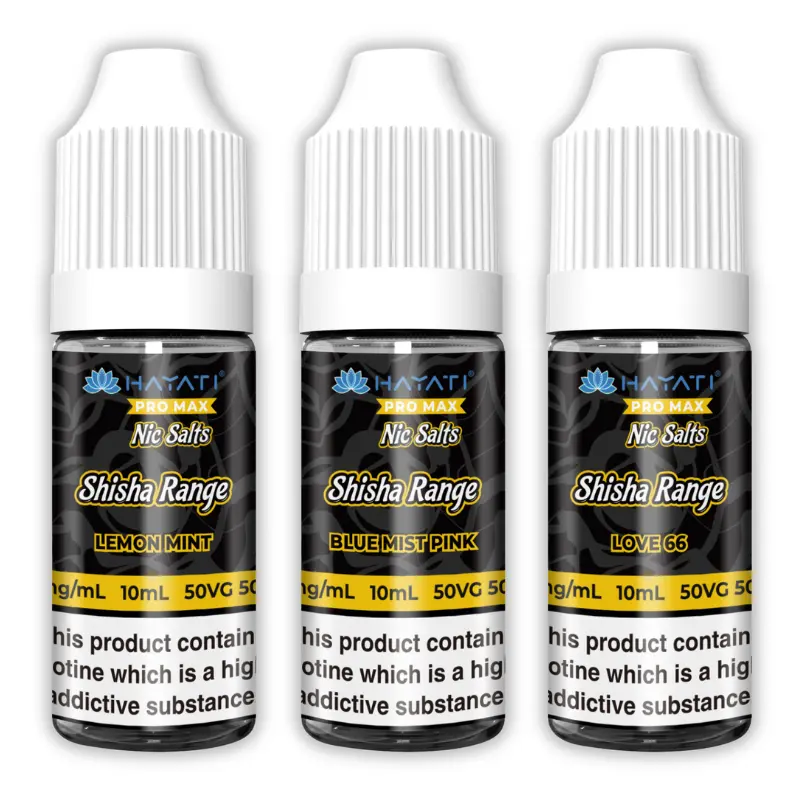
Hayati · Pro Max
Hayati Pro Max Shisha Nic Salts
£2.49
✔ In stock — ready to ship
Genuine Hayati
Free over £20
Same-day dispatch
Secure checkout
Hayati Pro Max Shisha Nic Salts is a 10ml bottle at £2.49, blended at 50/50 VG/PG, sold in one nicotine strength of 10mg per millilitre in salt form, and intended for refillable pod kits and mouth-to-lung coils rather than for sub-ohm tanks. The flavour Hayati record against it is Apple Mint Grape. On the Hayati Pro Max Nic Salts shelf that puts it among sixty-five bottles which share the same volume, the same ratio, the same strength and, with one exception, the same price. Everything on the label is ordinary except the word in the middle of the title.
That word is doing something no other product name in this catalogue does. Run down the 492 titles Hayati sell here and every one of them points at something you could put in your mouth: a fruit, a berry, a sweet, a soft drink, a herb, a single aromatic compound, or a colour standing in for a blend nobody has named. Shisha points somewhere else entirely. It names a piece of equipment and the occasion that equipment is used on. It is the only register in the range defined by a method rather than by a taste, and that is an odd thing to find on a bottle of liquid, because a method is exactly the part of an experience a bottle cannot contain.
One clarification belongs at the top rather than buried. This is a nicotine vape liquid. The preparations the name descends from are variously tobacco-bearing and tobacco-free, and this bottle is neither of those things: it contains flavouring, a glycerine and glycol base, and nicotine salt. Nothing on this page describes that practice as a pastime, recommends it, or sets this product against it in any respect. The practice appears below for one reason only, which is that it explains the physical arrangement the flavour is named after, and that arrangement is what decides which parts of the reference a 10ml bottle can carry and which parts it cannot.
So that is the page. First, what Hayati actually put in the data, because the flavour and the title are recorded in two different places and only one of them says Shisha. Then the reference itself, broken into the five properties that make it what it is, with each one sorted honestly into carries, does not carry, or partly carries. Then the one property in the partly column, which is the draw, and why the bottled format is the only one of the three Shisha listings Hayati sell where a buyer has any purchase on it at all.
Shisha is in the title and nowhere in the flavour data
Start with the counts, because the claim above is the kind that sounds good and can be wrong. Three of the 492 listings on this site carry Shisha in the product name. This bottle is one. The other two are the Hayati Pro Ultra Plus Shisha 30000 Pods and the matching Pro Ultra Plus Shisha 30000 Prefilled Pod Kit, which are the same idea on a sealed 22ml platform. There is no fourth.
Now look at the other field. Hayati record a flavour separately from the title, and across the whole catalogue those flavour entries resolve to 152 distinct names. Not one of the 152 is Shisha. The flavour recorded against this bottle is Apple Mint Grape, and the flavour recorded against the two Pro Ultra Plus listings is Apple Mint Grape alongside Peach Grape Mint. The word never once appears in the field that is supposed to say what the liquid tastes of.
Go through the 152 and the pattern holds without an exception worth arguing about. Most are fruit. A block of them are confectionery: gummy bear, bubblegum, candyfloss, jelly beans. Twenty-six name a drink, which is a wider group than people expect and takes in the lemonades, the colas, the mojitos, a coffee, a green tea and a couple of British soft drinks. A handful name a herb or a single compound, mint and menthol and spearmint. A dozen or so name a mood or a colour and tell you nothing, which is a problem this corpus has written about at length elsewhere. One names a dessert. Every single one of them, including the vaguest, is still a noun for something that goes in a mouth.
The angle handed to me for this page said that Shisha is the only flavour category Hayati sell that names a way of consuming rather than a thing to taste. Counted properly, that is very nearly right and the correction makes it sharper rather than weaker. Hayati never treated Shisha as a flavour at all. It exists only in the title slot, on three listings, attached to a recipe that has its own perfectly ordinary three-fruit-and-a-herb name sitting in the field underneath. What the buyer is being sold, in data terms, is Apple Mint Grape with a register printed on the front of it.
The companion Pro Ultra Plus Shisha pods listing got to the title-level version of this observation first and worked out what Hayati mean by the register: apple plus grape plus mint, with peach as the one substitution they permit themselves across the three products. That conclusion is cited here rather than rebuilt, because it belongs to that page and it holds up against the counts above. What is worth adding from this side of the catalogue is narrower and specific to this listing. Of the three Shisha products, this is the only one carrying Apple Mint Grape on its own, with no second reserve and no alternative behind a collar. Strip the platform away and what you have in this bottle is Hayati's minimum statement of what the word means to them. Three components, no substitutions, 10ml of it for £2.49.
One further count, offered as a data point and not as an argument. Thirteen of the 152 flavour names carry a separate mint or menthol word, and Apple Mint Grape is the only one of the thirteen with a fruit standing on either side of the herb. The rest either put it at one end of the name or leave it on its own. Whether Hayati's word order carries information has been examined elsewhere in this corpus and is not settled here, so take it as a curiosity about how the name was written rather than as evidence about the recipe.
The reference, described as an arrangement of equipment
To work out what a shisha-named liquid can and cannot deliver, you have to be specific about what produces the thing it is named after, and the honest answer is that most of it is not flavouring.
The preparation itself is a dense, sticky material: shredded leaf or a leaf-free substitute, soaked in molasses or a comparable syrup along with glycerol and the flavouring compounds. It sits in a bowl at the top of the apparatus and is warmed from above by a separate heat source, so the material is brought up to temperature gradually rather than being taken to the temperature a naked flame would reach. What comes off the bowl is pulled downwards through a long stem, made to pass through water in the base, and then drawn up a flexible hose to the mouthpiece. The person at the other end is usually sitting, usually with other people, usually for an hour or more.
Pull that apart and you get five properties, and each one comes from a different part of the arrangement.
- A heavy sweet substrate. The syrup is not a garnish. It is the medium the whole preparation is built in, so sweetness is the floor the flavour stands on rather than a note laid on top.
- Gentle, indirect heat. The material is warmed rather than burned, which favours the lighter aromatic compounds and keeps the harsher products of hard heat out of the result.
- Water in the path. Everything that reaches the mouthpiece has been through a body of liquid, which lowers its temperature and raises its moisture content.
- A long, wide, slow draw. A wide bore and a long hose mean the volume per draw is large and the speed at which it arrives is low, and neither of those is a matter of technique. The apparatus imposes them.
- Duration. A single filling of the bowl runs for a long time, and the flavour is experienced as a continuous hour rather than as a series of separate twenty-second events.
Notice what that list is mostly made of. One item is about the recipe. Four are about the machine and the occasion. A flavour house selling a liquid under this name is therefore selling a reference to something four-fifths of which lives in hardware they are not shipping, and the interesting question for a buyer is not whether the liquid is nice, which it may well be, but which fifth actually arrives.
Sorting the five properties honestly
The sweet substrate: carries in kind, not in weight
This one survives the transfer better than it has any right to, because the two bases happen to be related. Vegetable glycerine is a thick, faintly sweet liquid and it is the closest thing a vape liquid has to the syrup a bowl preparation is built in. The similarity is real and it is also limited, because this bottle is a 50/50 blend, which means half of it is propylene glycol and the glycerine is doing half the work it would do in a thicker mix.
Hayati's own positioning is consistent with that. They describe the result as mellow and rounded and set it against the brighter and sweeter fruit blends elsewhere in the range, which is a claim about restraint rather than about sugar. No sweetener figure is published for this bottle or for any other on the shelf, so nobody outside the blending room can put a number on it. What can be said is where it is meant to sit relative to its neighbours, and the neighbours make that easy. Gummy Bear Hayati Pro Max Nic Salt and Bubblegum Ice Hayati Pro Max Nic Salt are built to read as confectionery and do not pretend otherwise. This is positioned below that line and below the juice-and-fizz register that Cola Ice Hayati Pro Max Nic Salt occupies.
So: the substrate carries as a general sweetness with a syrupy quality behind it, at roughly half the density the reference has, on a base ratio nobody chose for this flavour in particular. That is the verdict, and it is a mild one.
The flavourings: carry almost entirely
Apple, grape and mint are flavour compounds, and compounds travel. Whatever else fails to cross over, this part does, and it is why a liquid named for the register is not simply a piece of marketing.
Two of the three have already been taken apart properly on this site and there is no case for doing it again. The Grape GB Hayati Pro Max Nic Salts page works through why grape flavouring converges on one recognisable profile across the whole market, which compound is responsible, and why a sizeable number of British adults file that compound under medicine rather than under fruit. That account applies here in full and is cited rather than repeated. The Spearmint bottle page does the same job for the herb, establishing that the sensation people call mint splits into a cold-receptor effect and an aromatic one, that the two come from different plants and different molecules, and that a mint which is not menthol-led tastes of the leaf without feeling icy. Both of those are worth reading before you order this, because between them they account for two of the three things in the bottle.
What is worth adding from here is which of the three is carrying the register. It is not the apple. Apple is the lightest and quickest of the three and it behaves as a top note, which is to say it announces and then leaves. The grape and the mint are the components behaving like a substrate: grape because it reads as depth and weight rather than as brightness, and mint because it works on receptors that do not fatigue at the same rate as the sweet ones. If you want a single sentence for what Hayati have done, it is that they have built the long, low part of the profile out of a dark fruit and a herb, and hung a light fruit off the front of it.
Gentle heat: does not carry, and the direction matters
This one fails completely, and the failure is not a small one. A bowl warmed from above brings a mass of sticky material up to temperature over minutes. A coil is a wire that goes from room temperature to working temperature and back inside a second, with the liquid vaporising at the surface of the wire. Those are opposite arrangements, and no setting on any device turns one into the other.
The consequence is practical rather than philosophical. A profile whose character sits in low-temperature aromatics is a profile that punishes too much power, and the herb is the component that goes first. The Spearmint page records the specific failure, which is that push a carvone-led mint too hard and it starts to read soapy and faintly medicinal, and that this is almost always a settings problem rather than a liquid problem. Since the mint here is one of three components and is doing structural work rather than decorating the top, that warning applies with more force than it would on a bottle where the herb is a garnish.
Which is the first sign that the hardware question on this particular liquid is not the usual one. On most bottles, power setting is a preference. On this one it is the difference between the register arriving and the register being cooked off.
Water in the path: does not carry, and mint is a stand-in rather than a copy
Water does two things in the reference. It lowers the temperature of what passes through it, and it raises the moisture content, which is where the soft, thick, humid quality comes from. Neither of those is available to a liquid, because both are properties of the path rather than of the recipe.
What a blender can do instead is put a cooling sensation into the mix, and that is what has happened here. Mint triggers a response that the brain reads as cold. It does not make the vapour cold. The temperature of what arrives at your mouth is set by the coil and the airflow, and a heavily cooled liquid coming off a hot coil is still warm vapour carrying a signal that says otherwise. That distinction is not pedantry on this page, because the property being substituted for is a genuine drop in temperature produced by a bath of water, and what has replaced it is a chemical message.
Two things follow, one of which is reassuring. The reassuring one is that a receptor-level signal is not a weak substitute. It is a different mechanism producing a broadly similar impression, and on the exhale it is convincing. The less reassuring one is that it cannot supply the moisture, and the humid, slightly heavy quality of what comes off a water pipe is a texture that no flavouring reproduces. A vape is a dry sensation by construction.
Worth recording while the subject is cooling: this listing names no ice-family word and none appears in the flavour field. The Blue Frozen pods page ran the census on Hayati's cooling vocabulary across the whole catalogue and established that the terms are not a graded scale, that Ice is the default by a very long way, and that an ice word and a mint word never appear on the same listing. Those counts are cited and not recounted. What they mean here is that the presence of mint tells you a cooling component exists and tells you nothing about how much. If you want the cold turned up, Blue Frozen Hayati Pro Max Nic Salts and Blackberry Ice Hayati Pro Max Nic Salts are the honest destinations and this is not.
Volume and slowness: partly carries, and only here
This is the property the rest of the page turns on, so it gets its own section below rather than a paragraph here. The short version is that a long, slow, voluminous draw is produced by a wide bore, a long path and a low resistance to airflow, and that a mouth-to-lung pod is the opposite of all three by design. The volume will not be there. The length and the speed partly can be, because they depend on the aperture you are drawing through and on how long you draw for, and on a bottle those are yours to set.
Duration: does not carry at all, and has no substitute
An hour of continuous, uninterrupted exposure to one flavour is not something any vape does. Use is short, repeated and separated by gaps, and the gaps are not incidental to the experience; they are most of it. A liquid designed to survive sixty minutes of unbroken attention is meeting a format that never asks it to.
The full working-out of what that does to a recipe, and why a blend built against fatigue arrives in a pod having paid for a benefit the hardware rarely collects, is the argument the Pro Ultra Plus Shisha pods page makes at length. It is a good argument, it is not mine, and rebuilding it here would produce a worse copy of it. Two things are worth adding that are specific to a bottle. The first is that 10ml is a much smaller commitment than 22ml, so a buyer testing whether that reasoning holds for them is testing it on a quarter of the liquid and a fifth of the money. The second is that on a bottle you control the exposure pattern rather than inheriting it, because the liquid is not welded to one coil in one shell for one device.
So which does a buyer miss most
Ranked, and the ranking is the point of the exercise. Volume is missed first, because it is the most physically obvious of the five and because there is no adjustment anywhere in this format that produces it. Moisture is second, for the same reason: the cooling has a substitute and the humidity does not. Duration is third and it is the one people notice last, because it does not announce itself on a single draw. It shows up weeks later as the difference between a liquid that stays tolerable and one that does not.
The sweetness and the flavourings are the two that arrive, and they are the two a bottle was always going to be able to deliver. Which means the honest summary of what £2.49 buys is a competent transfer of the aromatic idea and a complete loss of the apparatus, with one axis in between that the buyer has some say over.
The draw is the recoverable one, and the bottle is the reason
The general case for buying liquid in a bottle instead of sealed into a pod has been set out properly on the Hayati Pro Max Nic Salts E-Liquid range listing, which works through what stops being fixed the moment you are the one filling the chamber: the coil stops being an expiry date, the volume stops being somebody else's decision, and the liquid stops being locked to one device. All of that applies to this bottle exactly as it applies to the other sixty-four, and it is cited rather than restated.
What is not general, and what makes this particular bottle worth an argument, is that on every other flavour in the range hardware control is a question of taste. You open the airflow because you prefer a looser draw. Here it is the only route to the one property of the reference that is not simply gone, and that changes it from a preference into the thing the product is about.
Four controls are available inside the bracket this liquid is specified for, and each does something different to the shape of a draw.
The airflow aperture. Most refillable pod kits have a ring, a slider or a set of interchangeable inserts that change how much air joins the vapour on its way out. Opening it up raises the proportion of air to vapour, which lowers both the density and the temperature of what arrives, and it lengthens the comfortable draw because there is less resistance to work against. Closing it down concentrates the flavour and warms it. For almost every liquid on this shelf the tighter setting is the one that flatters the flavour, because concentration reads as intensity. For this one the wider setting is the one that resembles the reference, and a buyer who sets it by habit rather than by intent will never find that out.
Draw length. A restricted mouth-to-lung draw on a pod device runs to about two seconds for most people, because that is what the airway invites. Three or four seconds at a wider aperture is a meaningfully different geometry and it is closer to the shape the register came from. The limit is the wick rather than the lungs: pull for longer than the cotton can keep up with and you get a thin, hot draw and a wick that has been cooked, which is the fastest way to lose the herb. So the instruction is not to draw as long as possible. It is to find the longest draw the coil supports and then stay just inside it.
Coil resistance. Hayati specify mouth-to-lung coils and rule out sub-ohm tanks, which sets the bracket without picking a number inside it. No resistance figure is published for this liquid. Within the bracket, a higher-resistance coil run at lower power produces a cooler and less dense draw and a lower-resistance one produces a warmer, denser draw at the same airflow. Given everything above about heat and the herb, the cooler end of the bracket is the one this liquid is built for, and the warmer end is where the mint starts to misbehave.
How much liquid is at the coil. A minor control but a real one. You decide how full the chamber is and how often you refill, which means you decide how fresh the liquid sitting against a warm coil is. A sealed pod does not offer that, and a liquid built on volatile aromatics loses more to standing against heat than a heavily sugared one does.
Now the honest limit, because a page that stops at the list above has oversold it. None of this makes a pod device into a water pipe. The volume is not recoverable at all: the chamber is small, the airway is narrow, and a 50/50 base at 10mg is specified against exactly the hardware that would produce a large draw. What the four controls buy you is movement along one axis, the geometry of the draw, from fixed to adjustable. On a lemonade that would be worth very little. On a flavour whose entire identity is a borrowed draw shape, it is the difference between the name being decoration and the name being a hint about how to set the device.
The comparison the catalogue makes available is the clean one, and it is worth stating because the three Shisha listings differ on precisely this axis. The two Pro Ultra Plus Shisha products are sealed, prefilled, and published with no airflow specification and no coil resistance. Their own listing pages say plainly that draw length is the only variable a user has on that platform. So of the three ways Hayati sell this recipe, the £2.49 bottle is the one that concedes least on the one property the word in the title is actually about, and it is also the cheapest and the smallest. That is an unusual alignment and it is worth knowing before anyone assumes the bigger product is the fuller expression of the idea.
One more thing the catalogue settles, and it settles it against the register rather than for it. Hayati do sell a line built for volume: twenty shortfills at 120ml and 0mg in a 70/30 base, made for sub-ohm hardware, of which Blueberry Raspberry Hayati Pro Max 70/30 E-Liquid at £6.99 is one. Twenty flavours in that line and Apple Mint Grape is not among them. The recipe exists only in formats specified for restricted, low-power draws. Whether that is a deliberate judgement about where the profile works or simply where the range happens to have got to, Hayati do not say, and this page is not going to guess. What it means for a buyer is concrete: the density is not available in this recipe in any format on this site, so do not go looking for it.
The liquid itself, at 10mg in a 50/50 base
The order in which Apple Mint Grape arrives across a draw has been set out on the Pro Ultra Plus Shisha pods listing, and the reading there is apple early and thin, grape underneath and slower, mint through the middle and still present after both have gone. That is consistent with what the three components are and it is cited rather than re-derived. What has not been written anywhere is what changes when the same recipe is delivered from a bottle at this strength on a base whose ratio is actually published, and three things do.
Twice the nicotine concentration of the sealed version
The two Pro Ultra Plus Shisha listings are filled at 5mg per millilitre, which is an oddity on that platform and is treated properly on their own pages. This bottle is 10mg. Nicotine is not a neutral passenger in a recipe: it contributes a bitterness and a physical sensation at the back of the throat, and both of those occupy perceptual room that would otherwise be available to the flavour. Doubling the concentration therefore does something to how the same blend reads, and the direction is towards firmer and slightly less open rather than towards more flavour.
That is a formulation observation and it is not advice. Nicotine is an addictive substance, 10mg is the only figure this flavour is offered at, and nothing on this page suggests which strength suits anyone. What it does mean, practically, is that if you have met this recipe in its sealed form and are coming to the bottle, do not expect an identical read. Two of the variables have moved at once.
The base ratio is published here and is not published there
This is a small asymmetry that turns out to matter. Neither Pro Ultra Plus Shisha listing states a VG/PG ratio, and neither states a coil resistance, which between them are the two figures that would let anybody predict how a liquid will behave before buying it. This bottle states 50/50, and the coil is one you chose and whose resistance you know. So a buyer of the bottle can predict the wicking speed, knows the liquid is thin enough for narrow feed channels, and knows the lighter aromatic end will arrive intact rather than being buried under density. A buyer of the sealed version is finding all of that out by using it.
The ratio is not, however, a decision Hayati took about this flavour. All sixty-five bottles on the shelf are 50/50 and all sixty-five are 10mg, so it is a shelf constant. Reading it as a judgement about Apple Mint Grape specifically would be reading something into a house format.
A fresh coil, whenever you want one
Volatile aromatics are the first thing a tiring coil stops carrying, and on this recipe the volatile aromatic is the herb, which is holding up the structure rather than sitting on top of it. In a sealed pod that is a countdown. Here it is a five-minute job with a spare part, and the liquid in the bottle is exactly as full afterwards. For a blend that depends on its lightest component more than most blends do, that is worth more than it would be on a dark berry.
Three parts, one of them a herb, which is rare on this shelf
Twenty-one of the sixty-five bottles have a flavour name of three words or more, so a three-part blend is not in itself unusual here. Blueberry Raspberry Lemon Hayati Pro Max Nic Salt and Lemon Peach Passionfruit Hayati Pro Max Nic Salt are both three fruits stacked, and several others append a cooling word to a pair.
What is unusual is the herb sitting inside the stack. Seven of the sixty-five bottles carry a mint or menthol word at all. Three of the seven are the herb or the compound presented on its own. Three more attach it to a single other thing, which is what Black Mint Hayati Pro Max Nic Salt and Lemon Mint Hayati Pro Max Nic Salt do. This bottle is the seventh and the only one where the herb is a component of a multi-fruit blend rather than the subject or the finish. The equivalent count across the whole catalogue, and what it implies about the difference between an applied coolant and an integrated one, is on the Pro Ultra Plus Shisha pods page and is not repeated.
What that arrangement should do on the palate is predictable in kind if not in degree. A coolant applied over a finished fruit arrives late and sits separately, a distinct sensation laid over a flavour that would be complete without it. A herb mixed in from the start arrives with everything else and changes the fruit it is mixed with, because its aromatic compounds interact with the fruit rather than sitting beside them. Expect the cold here to feel woven in rather than applied, and expect it to be moderate, because a component sharing a blend with two fruits cannot be dosed the way a finishing coolant can.
Where the sweetness lands, and what this is not
Hayati position it as mellow and rounded and below the brighter, sweeter blends in the range, which puts it a long way from the confectionery end and somewhere near a fruit presented as fruit. Against Juicy Peach Hayati Pro Max Nic Salt, which is a soft low-acid fruit with nothing cutting it, this should read drier and more structured. Against the lemonades it will read considerably less sharp.
Five things it is not, stated flatly so nobody arrives at it by mistake.
- Not aniseed. The question of whether a shisha-derived apple flavour carries an anise note is a real one and it is answered properly on the Double Apple Hayati Pro Max Nic Salts page, which establishes both what the tradition does with it and that Hayati name aniseed in plain language on the two listings in this catalogue that contain it. They do not name it here. That finding is cited, not rebuilt, and it is the single most useful thing to read alongside this page.
- Not an iced liquid. No ice-family word appears in the title or the flavour field. The cooling is a named blend component.
- Not sour. Nothing published points at acid. Blackcurrant Lemonade Hayati Pro Max Nic Salts and Berry Lemonade Hayati Pro Max Nic Salt are where the acid lives on this shelf.
- Not a tobacco flavour. Hayati sell a tobacco-flavoured bottle in this line and it is a separate product with a separate name. Three fruits and a herb are what the flavour field records here.
- Not a dessert, a bakery or a drink profile. Nothing creamy, nothing spiced, no beverage base of the kind that sits under the cola bottles.
The format, kept short
A 10ml bottle of liquid, a cap, and nothing else. There is no device, no coil and no cell in this purchase, which is worth one sentence because it changes the end of the product's life: an empty bottle is a bottle, and the disposal question that applies to every prefilled pod in this catalogue belongs to your hardware rather than to this. Match the liquid to a refillable pod kit or a low-power mouth-to-lung device with a coil in the higher-resistance bracket, and read your own device's documentation rather than a retail page for what it takes.
The specification that matters most for this particular liquid is the one that sets the limit on everything the section above proposed. Hayati state that it is not intended for sub-ohm tanks, and that is a floor rather than a preference. A low-resistance coil vaporises far more liquid per second, which changes what a 10mg salt blend delivers per draw by a large margin, and a thin 50/50 liquid in a coil with wicking ports cut for something much thicker tends to seep past the seals. So the airflow and draw-length experiments described earlier happen inside the mouth-to-lung bracket or they do not happen at all. The rest of the bottled range is on the Hayati E-Liquids shelf.
The figures, with the empty rows kept in
Everything below is from this product's own data. Where a row says nothing is published, nothing is published, and the gap has not been filled from a sibling listing.
| Reference | HPM-NS-SHISHA |
| Where the word Shisha appears | Product title only. Never in the flavour field |
| Flavour, as Hayati record it | Apple Mint Grape |
| Cooling agent | None named. Mint is listed as a blend component |
| Non-fruit components beyond the herb | None listed |
| Sweetener level | Not published, here or anywhere on the shelf |
| Nicotine | 10mg per millilitre, salt |
| Strengths offered | One. There is no 20mg and no zero for this flavour |
| Base | 50/50 VG/PG, which is the ratio on all 65 bottles |
| Volume | 10ml |
| Intended hardware | Refillable pod kits and mouth-to-lung coils. Not sub-ohm tanks |
| Coil resistance | Not specified beyond the mouth-to-lung bracket |
| Price | £2.49, which is a shade under 25p per millilitre |
| Shelves it is filed on | Five, one of them named for a fruit that is not in it |
Three rows repay a second look and two of them are rows about absence.
The strengths row is a list of one, which is the standard arrangement on this shelf rather than a quirk of this flavour: every bottle in the line is 10mg and there is no second figure to hunt for. Nicotine is addictive at any concentration and that number is recorded here as a property of the product.
The cooling row is empty on purpose. On a shelf where a good third of the bottles declare an ice element in the name, an empty coolant row is a specification in its own right. The cold in this bottle has a name and the name is mint, which is a different claim from the one an ice suffix makes.
The shelves row carries the known anomaly. This listing appears on Blueberry Vapes, a shelf of ninety products, and there is no blueberry in Apple Mint Grape or anything resembling a berry. The listing's own tag data carries the word, which is presumably the mechanism, and both Pro Ultra Plus Shisha pages have already established that all three Shisha products sit on that shelf without a blue fruit between them. Treat shelf membership on a catalogue this size as a navigation aid rather than as evidence about contents, and note that the same product is absent from any grape or mint shelf despite naming both. The reliable route back to it is the Pro Max nic salt shelf rather than a fruit one.
Choosing between this and the bottles either side of it
Price is flat across the shelf at £2.49, so nothing below is a budget argument. Every one of these is a flavour decision.
If the register is the reason you are here
The other two routes to it are the Pro Ultra Plus Shisha pods and the matching kit, which carry the same base recipe alongside a second reserve of Peach Grape Mint behind a rotating collar. They are sealed, they are larger, they are filled at a different strength, and neither publishes the two figures that would tell you what draw to expect. This bottle is the one where the recipe is unaccompanied and the hardware is yours. If the argument in the middle of this page persuaded you, that is the reason to start here rather than there.
If it is the apple
Apple is thin on the ground in this line. Exactly three of the sixty-five bottles name one: this, Double Apple and Red Apple Ice Hayati Pro Max Nic Salts. The wider Apple Vapes shelf now runs to twenty-four listings across every format, and the composition of it has been counted twice already in this corpus on the two Double Apple pages, with the same conclusion both times: a great many listings and very few distinct apple recipes.
Of the three bottles, Double Apple is the one built around apple as the subject, with two apple characters and an open question about a third component. Red Apple Ice is a single apple direction with a declared coolant over it. This one is the least apple-led of the three, because the apple here is one of three components and not the one carrying the weight. Anyone who wants apple to be the point should take one of the other two.
If it is the mint
Then this is a compromise and it is worth saying so. The herb here is a third of a blend competing with two fruits. Spearmint and Fresh Mint are sold in this line as the herb alone and they make no demands on your patience. Black Mint runs the herb under a dark fruit and Lemon Mint runs it under a citrus, which are the two-component versions of what this bottle does with three.
If it is the grape
Grape is thinner still. Three flavour names on the shelf contain it: this one, Kiwi Grape Raspberry and Grape GB Hayati Pro Max Nic Salts. Grape GB is the confectionery treatment and it says so in its name, which makes it the opposite direction from this one: front-loaded and sweet-counter rather than herbal and steady. If what you want is grape as the subject, that is the bottle, and its page is also where the account of why grape flavouring tastes as it does already lives.
If you want the cold rather than the herb
Blue Frozen pushes the cooling hardest in this line. Blackberry Ice puts a dark tannic berry under the chill, which is the nearest thing on the shelf to a cold version of this bottle's weight. Banana Ice Hayati Pro Max Nic Salts is the house default profile across a lot of this catalogue and is the low-contrast option if contrast is what you are trying to avoid.
If you want a fruit with something non-fruit running through it
That is the structural thing this bottle does, and two others do a version of it. Blue Razz Mojito Hayati Pro Max Nic Salts puts mint and lime under a berry, which is the closest relative on the shelf. Cola Ice uses a spiced beverage base under the fruit, a completely different mechanism doing a comparable job of extending a flavour past the point where the fruit stops.
If you want it sweeter, sharper or simply louder
Sweeter: Gummy Bear and Bubblegum Ice are the confectionery reference points and neither pretends otherwise. Sharper: Blackcurrant Lemonade, Berry Lemonade and Blue Razz Lemonade Hayati Pro Max Nic Salt keep acid running through the whole draw instead of concentrating it in the middle. Louder: Blackberry Raspberry Hayati Pro Max Nic Salts is a straightforward dark pair with nothing subtle about it. A blend engineered so that nothing dominates is, by construction, a blend where nothing shouts, and anyone who wants to be hit in the face will find this polite.
If the naming is what interests you
The contrast worth drawing is with the opposite failure. Black Mamba Hayati Pro Max Nic Salts and Blue Fusion Hayati Pro Max Nic Salt are named for a mood and tell you nothing at all about the contents, and this corpus has written about that pattern at length. This listing is the inverse case: the title tells you a great deal, all of it about a register and none of it about ingredients, while the ingredients sit perfectly plainly in a field one scroll further down. A name that withholds and a name that redirects are different problems, and the second one is easier to solve, because the answer is published.
If the format is the question
The range-level bottle listing at £2.79 is where the bottled-versus-prefilled case is argued out. The whole line sits on Hayati Pro Max Nic Salts, the wider liquid range is on Hayati E-Liquids, and the full Hayati catalogue is everything at once.
Setting up for it, and knowing when it has gone
The general handling advice for a 10ml salt bottle applies and is not worth restating. What follows is the part that changes because of what is in this one.
Set the airflow before you form an opinion. This is the whole argument of the page reduced to an instruction. If your habit is a tight draw, you will be tasting a concentrated, warm version of a profile built to arrive cool and spread out, and you will probably conclude it is muddy. Open the aperture further than you normally would for the first fill. If your device has interchangeable inserts, use the widest one that still gives a restricted draw.
Run it at the low end of the coil's range. The herb is the component with the most to lose from heat and the most structural work to do, and pushed too hard it turns soapy long before anything reads as burnt. Start low, and raise the power only if the blend feels thin rather than because the vapour looks sparse.
A method for judging it, if you want one. Two fills on the same fresh coil on the same day. The first at whatever setting you normally use, the second with the airflow as wide as the device allows while still drawing to the mouth. Everything else held constant. That isolates the one variable this page is about, and it takes an afternoon rather than a bottle.
The failure signal is the cold thinning, not a burnt note. As a coil tires it stops carrying the light, volatile end first, and here that end is the mint. What you will notice is not general dullness. It is the cool edge receding while the grape stays roughly where it was, which leaves something heavier and flatter than what you bought. On a bottle that is a maintenance trigger rather than an expiry date: change the coil, the liquid carries on, and you have lost nothing but a few minutes.
The apple goes before the mint does. It is the lightest of the three and already the quietest, so it is the first thing an ageing coil or an opened bottle loses. If the blend starts reading as grape with cold on it, the apple has gone, and the cause is either the coil or the age of the bottle rather than a bad batch.
Keep the cap on and keep it somewhere cool and dark. An open bottle of this recipe does not go off evenly. It drifts, because the lightest components leave first, so what you get after a warm month on a windowsill is a heavier, darker version of the same idea with the top taken off it. A cupboard at room temperature is all this needs, and keep it out of reach of children and pets.
It ghosts in both directions, so think about the pod you are using. Mint leaves a residue in cotton that the next fill will carry, which is a nuisance if the next fill is a delicate fruit. And in the other direction, a dark berry left in the wick will sit on top of the apple for most of a fill and bury it, because the apple is the lightest thing in this blend and loses every contest of that kind. If you rotate, a second pod kept for this is a better answer than a cleaning routine.
Refill before the chamber empties. A thin 50/50 liquid in a narrow-channel pod empties the wick from the middle outwards, and a few dry draws at the bottom of a fill do real damage to the cotton. On this liquid the damage shows up as the herb going first, which reads as the flavour having changed rather than as the hardware having been cooked.
Questions this bottle actually raises
Does it taste like the thing it is named after?
It tastes of the three components Hayati record against it, which are apple, grape and mint. The word in the title names a register and an occasion rather than making a claim about reproducing anything. What carries across from that register is the aromatic idea and a general sweetness. What does not carry is the apparatus: the gentle warming, the water in the path, the volume of the draw and the length of the occasion are all properties of equipment and none of them is in a bottle.
What is actually in it, as Hayati record it?
Apple Mint Grape, stated in the flavour field rather than in the title. Three of the 492 listings on this site carry Shisha in the name and all three are built on that same three-part base, with the two Pro Ultra Plus versions adding Peach Grape Mint as a second reserve. This bottle carries the base alone, which makes it the plainest statement of what Hayati mean by the word.
Is there aniseed in it?
Nothing published names it, and no anise, liquorice or fennel appears in the flavour field or the description. The question is worth taking seriously because a related apple flavour from the same tradition classically carries one, and the Double Apple bottle page in this range works through the evidence properly, including the finding that Hayati write the word plainly on the two listings in this catalogue that do contain it. On that reasoning the probable answer here is no, and probable is not the same as confirmed.
Is there any ice or menthol in it?
No ice-family word appears in the title or the flavour field, and Hayati are consistent about naming cooled liquids in the title across this shelf. The cooling comes from mint, named as one of the three blend components rather than applied as a finishing coolant. Whether that mint is the herb, a synthetic cooling compound, or a mixture of both is not published for this listing.
Which mint and which grape are they using?
Neither is specified. Hayati sell Spearmint under that exact word elsewhere in this line and sell menthol as its own product, which suggests an unqualified mint on a Hayati label is the general confectionery version rather than either named botanical. That is an inference from how they write, not a specification. The same applies to the grape, and the Grape GB page sets out why grape flavourings converge on one profile regardless.
What nicotine strengths does it come in?
One. This flavour is sold at 10mg per millilitre in salt form and there is no 20mg version and no zero. That is the standard arrangement across the whole sixty-five bottle shelf rather than something specific to this flavour. Nicotine is an addictive substance and the figure is recorded here as a fact about the product.
Will it work in a sub-ohm tank?
It is not intended for one. The specification names refillable pod kits and mouth-to-lung coils and rules sub-ohm tanks out. A low-resistance coil turns far more liquid into vapour per second than a 10mg salt blend is formulated around, and a thin 50/50 liquid in wicking ports cut for something much thicker tends to seep past the seals.
How should I set my device for this one specifically?
Wider airflow and lower power than you would use for a bright fruit, with a slightly longer draw. The reasoning is in the section above: the register this is named for is built on a long, slow, cool draw, and airflow, draw length and coil choice are the three things that move a vape in that direction. The limits are the wick, which will not keep up past a certain draw length, and the mouth-to-lung bracket, which is where this liquid is specified to stay.
Is it sweet?
Moderately, and by design. Hayati position it as mellow and rounded and set it against the brighter and sweeter blends in the range, which puts it below the confectionery bottles and somewhere near fruit presented as fruit. No sweetener figure is published for this or for any other bottle on the shelf, so the placement is relative rather than measured.
Why is it filed under Blueberry Vapes when there is no berry in it?
Because the listing's tag data carries the word, which is presumably how it got onto a shelf of ninety products none of whose other members it resembles. All three Shisha listings sit there and none of them contains a blue fruit, a point already established on the two Pro Ultra Plus Shisha pages. It is also missing from any grape or mint shelf despite naming both, so browse by range rather than by fruit if you want to find it again.
Can I get this flavour in a prefilled pod instead?
Yes, on the Pro Ultra Plus platform, as a sealed 22ml pod or as a kit with the device included. Both carry the same Apple Mint Grape base with Peach Grape Mint as a second reserve, both are filled at a different nicotine strength, and neither publishes a coil resistance or a base ratio. If the shape of the draw matters to you, the bottle is the version where that is still adjustable.
Is the nicotine a salt?
Yes, and the listing states it. Ten milligrams per millilitre in salt form, in a 50/50 base, which is the standard construction for a liquid intended for low-power mouth-to-lung hardware. Nicotine is addictive at any concentration.
Where this leaves you
A 10ml bottle at £2.49, 10mg nicotine salt, 50/50, one strength only, made for refillable pod kits and mouth-to-lung coils. The flavour Hayati record is Apple Mint Grape: apple as the light announcement, grape as the weight, mint woven through as a component rather than applied as a coolant. Moderate sweetness, no ice word anywhere on it, nothing sour, nothing creamy, and on the evidence assembled on the Double Apple page, probably nothing aniseed either.
The interesting part is the word in the middle of the title, which is the only one in 492 listings naming a piece of equipment and an occasion instead of something to taste, and which Hayati themselves never entered as a flavour. Break the reference into what it is physically made of and five properties fall out. The sweet substrate and the flavourings transfer, which is two. The gentle heat, the water cooling and the length of the occasion do not, which is three. The shape of the draw sits in between, and it is the only one a buyer has any purchase on, because airflow, draw length and coil choice belong to whoever owns the device. That is the case for the bottle over the two sealed versions of the same recipe, and it is a narrow case rather than a grand one: it moves one axis out of five from fixed to adjustable, and the axis it moves happens to be the one the name is about.
What you will miss most is the volume, and you will miss it permanently, because Hayati do not offer this recipe anywhere in the high-VG line built for it. Go in knowing that and the bottle is a competent, restrained, herb-structured fruit blend at the same price as everything else on the shelf. Go in expecting the apparatus and no liquid was ever going to deliver it.
Strictly for adults aged 18 and over. Nicotine is an addictive substance.
You might also like


