
Home / Hayati Pro Max Nic Salts / Lemon Peach Passionfruit Hayati Pro Max Nic Salt
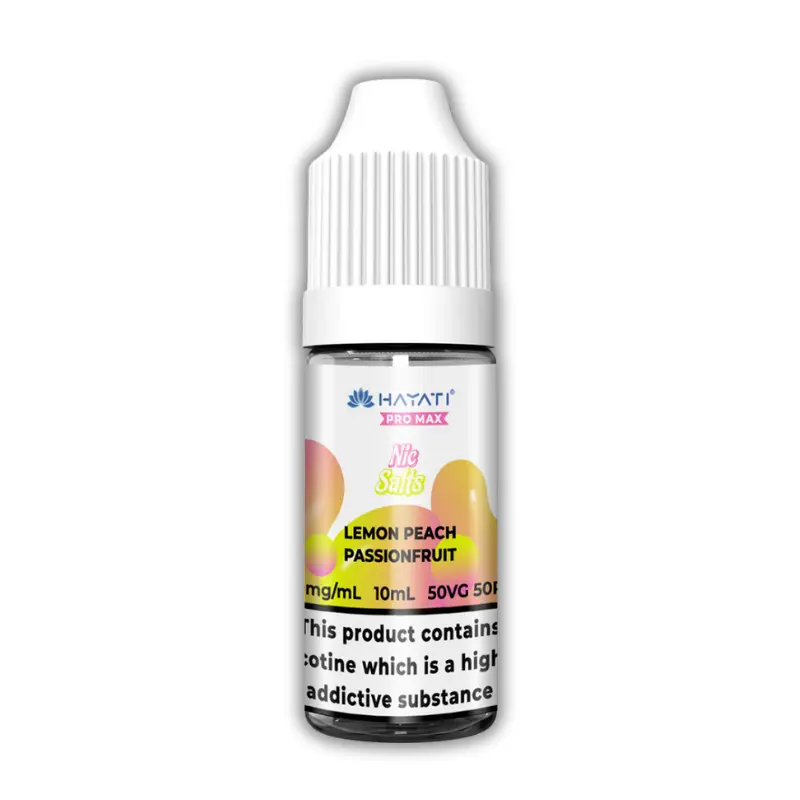
Hayati · Pro Max
Lemon Peach Passionfruit Hayati Pro Max Nic Salt
£2.49
✔ In stock — ready to ship
Genuine Hayati
Free over £20
Same-day dispatch
Secure checkout
Lemon Peach Passionfruit is a 10ml bottle listed at £2.49 on the Hayati Pro Max Nic Salts shelf, mixed as a nicotine salt at 10mg in an even split of vegetable glycerine and propylene glycol, and carried under the stock reference HPM-NS-LEMON-PEACH-PASSIONFRUIT. Three fruits on the label, no cooling word anywhere on it, no hardware in the box. On the specification alone it is indistinguishable from most of the sixty-five bottles beside it, every one of which is 10ml, every one 10mg, every one a 50/50 base, and sixty-four of which cost exactly this.
What separates it is not in the specification at all. It is in how the catalogue is shelved. This bottle sits on the Lemon Vapes shelf, which is the ninth largest of Hayati's thirty flavour shelves and holds fifty-four listings. Those fifty-four listings are not fifty-four liquids. Once the duplicate spellings are folded together they are nineteen recipes, and eighteen of those nineteen can be bought more than once: as a pod, as a kit, as a bottle, on a second platform, under a second spelling. One cannot. One appears on that shelf exactly once, in one format, at one volume, at one strength, and nowhere else in the 492 products Hayati list. It is this one.
That is a claim of a kind this site has learned to distrust, because it arrives in briefs more often than it survives arithmetic, so the first substantial section below is the count itself, set out so you can disagree with it. The count holds, and it holds with a correction: the shelf has six flavour names that look like one-offs, not four, and the five that are not real resolve by three separate filing mechanisms rather than by one. After that the page does something more useful than admiring the rarity. Being sold once has a consequence that another bottle on this shelf has already worked out in full, so that argument is cited rather than repeated, and the rest of the page asks a narrower question nobody has answered: given that this liquid has one description and no sibling to check it against, what evidence is actually available, and how much of it is there for each of the three fruits separately? The answer turns out to be very uneven, and the unevenness is the practical finding.
The lemon shelf, counted
Take the shelf as the site presents it. Fifty-four listings carry the Lemon Vapes tag. That number includes bottles, prefilled pods, complete kits, two 120ml formats and several pods whose titles put two flavours behind one mouthpiece, so it is a count of products for sale rather than a count of things to taste.
Group those fifty-four by the flavour name Hayati file each listing under and you get twenty-two values. Twenty-two is not the answer either, because three of those values are the same liquid written twice. Orange Lemon & Lime and Orange Lemon Lime are one recipe with and without an ampersand. Lemon & Mint and Lemon Mint are the same. Straw' Lemonade appears once with the apostrophe stripped out of the data field even though the product title keeps it. Fold those three pairs together and the shelf holds nineteen distinct liquids across fifty-four listings, an average of a little under three listings each.
Six names that look like one-offs, and what each turns out to be
Sorting the shelf by how many listings each name has produces six that appear exactly once. That was the point at which the claim had to be tested rather than accepted, because five of the six are not what they look like, and no two of them are the same kind of artefact.
- Orange Lemon & Lime. Three catalogue listings, two of them on this same shelf under the ampersand-free spelling. A typographic split, nothing more.
- Lemon & Mint. Same mechanism. Three listings, one of which is a bottle on the nic salt shelf.
- Straw' Lemonade. Three listings. The Mini Ultra pod's data field drops the apostrophe, so it sorts away from its two Pro Ultra Plus siblings, which sit on this shelf beside it.
- Cola Ice. Not a lemon product at all. It is the filing name of a divided Mini Ultra pod whose second half is a citrus, which is why the listing is tagged here. Cola Ice itself runs to seven listings across the catalogue.
- Berry Lemonade. The interesting one. Three listings exist, but only the bottle carries the Lemon Vapes tag. Its two Pro Max Plus siblings are filed under berries and under lemonade and were never added here. That is not a spelling problem and not a composite pod. It is a shelving decision, applied inconsistently to three listings of one recipe, and it means the shelf under-reports its own contents. You can see the same liquid discussed at Berry Lemonade Hayati Pro Max Nic Salt and then fail to find its pod siblings by browsing this shelf.
- Lemon Peach Passionfruit. One listing. No second spelling, no sibling under another tag, no pod, no kit, no larger bottle, no second strength, no appearance behind anybody's collar. One recipe, one product.
Three spelling variants, one composite, one filing inconsistency, and one genuine single. The brief that commissioned this page named the three spelling variants and stopped there, which would have been enough to reach the right answer by luck. Naming all five matters because each of the five is a different way for a large catalogue to look smaller or larger than it is, and a reader who wants to repeat the count needs to know which traps are in it.
The claim, stated at the width it survives at
Here is what the arithmetic supports. Of nineteen distinct liquids on a fifty-four listing shelf, exactly one is sold a single time. Not one of the cheapest, not one of the newest, not one that Hayati appear to be trialling and withdrawing. Simply one whose recipe exists in the catalogue precisely once.
Here is what it does not support, and the distinction is worth being pedantic about. It is not the only single-listing recipe Hayati sell. Across all 492 products there are 154 distinct flavour values and thirty of them appear once, though ten of those thirty are nicotine pouches, which are a different product class with their own short flavour list. It is not the rarest thing in the range by any measure of demand, because nothing in the data speaks to demand. And it is not unusual for a bottle: the nic salt shelf carries most of the catalogue's single listings, for reasons already established elsewhere and not re-argued here.
What is genuinely particular is the position: a large, well-populated fruit shelf that is otherwise entirely closed, with one door in it that leads nowhere else. The only comparable case is the cherry shelf, which runs to seventy-two listings across eighteen liquids and also has exactly one single. Ten of the thirty flavour shelves have none at all. The shelves that carry several singles are the loose, catch-all ones: berries with eleven, ice with seven, strawberry with six. Lemon is a tightly built shelf of established recipes with one exception on it, and being that exception is a more specific thing to be than being rare.
The same test on the other two shelves this bottle sits on
This listing is tagged on three flavour shelves, so the test can be run three times. Peach Vapes holds thirty-two listings across eleven distinct liquids and has two singles, this one and the Peach Mango pods for the Mini Ultra, which are a partial case because that same pairing appears behind a collar on Cherry Ice / Peach Mango Hayati Pro Ultra Plus 25000 Prefilled Pod Kit. Exotic Vapes is looser, as catch-all shelves tend to be: fifty-five listings, twenty-two liquids, four singles.
Three shelves, three different densities, and the same listing is the single on all three. That is not by itself remarkable, since six other products manage the same trick on three or more shelves and one manages it on five. What it does do is close off the obvious workaround. A buyer who finds nothing adjacent on the lemon shelf cannot go and look on the peach shelf instead, because the same bottle is the anomaly there too, and the third shelf it sits on is the one where anomalies are common enough to be uninformative.
What being sold once costs, settled elsewhere
The consequence of a recipe having one listing has already been worked through on this site, at length and on a bottle in exactly this position, so it belongs here as a citation rather than as an argument. Kiwi Grape Raspberry Hayati Pro Max Nic Salt is the other three-fruit single on the nic salt shelf. That page counts the single-listing recipes on the bottled range, sets out what it means for a liquid to have one published description and no second pass to read it against, and then goes further: it lines up all eight of the shelf's three-fruit descriptions and shows they share one template, in which the first fruit opens, the second fills the middle and the third supplies the edge or the lift. Eight for eight, in title order, every time. This listing is one of the eight it quotes.
That finding is load-bearing for everything below, and it cuts against the page rather than for it. The sentence on this listing that assigns lemon the opening and passionfruit the distinctive close is the sentence the template would have produced whatever the liquid did. It is structure, not testimony. Treating it as a tasting note would be reading the copy desk's habits as though they were the flavourist's decisions.
Two further pieces of prior work save space here. The technique of lining up a flavour's own listings and asking which properties all of them assert was established on Blackcurrant Lemonade Hayati Pro Max Plus 6000 Pod Kit, which had seven descriptions to work with and found that the thing all seven agreed on was not the one the marketing emphasised. Nothing of that kind can be run on a liquid described once. And the question of what a buyer does when they like one component of a sealed blend and cannot purchase it separately is answered in full on Guava Kiwi Passion Fruit Hayati Pro Max Plus Pods, which also maps the routes out of a three-fruit recipe and what each one costs. That page owns the argument and this one does not reopen it.
So the standard tools are unavailable or spent. What follows is the tool that is available, which nobody has needed before because most liquids on this site have siblings and did not have to improvise.
The evidence that does exist, taken one fruit at a time
A liquid described once cannot be diffed against itself. Its individual components can be diffed against every other listing that names them, which is a different operation and produces a different kind of answer. Instead of asking what all seven descriptions of this recipe agree on, ask what the copy desk says about peach whenever peach appears, and about lemon whenever lemon appears, and then check whether this listing says the same thing.
The three fruits here have wildly unequal sample sizes, and that turns out to be the most useful single fact on this page. Peach is named in eleven distinct flavour names across thirty-three listings. Standalone lemon, ignoring the lemonades, is named in fifteen flavour names across thirty-seven listings. Passionfruit is named in two flavour names across three listings, and one of those three is this bottle. So within one blend there are three tiers of evidence: a well-attested component, a well-attested component with an inconsistency in it, and a component about which the catalogue contains two sentences, both written about a different recipe.
Peach: eleven names, and the same adjective every time
Peach is the best-corroborated thing in this bottle. Read the eleven flavour names that contain it and the copy desk describes the fruit with remarkable consistency. It is soft in White Peach Raspberry Hayati Pro Max Nic Salts, where it forms the base. It is soft and ripe in Juicy Peach Hayati Pro Max Nic Salt, where it is the only fruit present. It is a softer, juicier note in Mango Peach Pineapple Hayati Pro Max Nic Salt, filling the middle between a rich fruit and a sharp one. It is soft and fragrant in the green tea blend, delicate and fragrant in the Mini Ultra pods, soft and juicy in Cherry Peach Lemon Hayati Pro Max Plus Pods, rounded and honeyed in the Aura listing. Eleven names and the adjective barely moves.
That consistency holds across every position the fruit occupies. Peach leads on four of those names, sits second on four, and appears behind a collar on the rest, and it is described as soft whether it is leading or supporting. Compare that with how the same desk handles a fruit whose job changes with its position, which is the next section, and the contrast is the point: some components have a fixed character in this copy and some have a character assigned by the slot they land in.
The practical upshot is that the peach here is the one claim on the label you can lean on. This listing says it sits in the middle, soft and sweet, and both halves of that are corroborated by more listings than any other assertion on the page. If you have had any Hayati peach before, you have had a fair approximation of this one's middle. That is not an exciting conclusion, but it is the only properly evidenced one available, and it is worth more than a confident sentence about a fruit nobody has written about twice.
One thing this page will not do with the peach is build an argument about its fragility. The behaviour of a soft stone fruit sitting next to a sharp one, and what happens to the reading when the soft half fades first, is worked out properly on the White Peach Raspberry bottle. That argument exists, it is good, and duplicating it here would be waste.
Lemon: fifteen names, and a job that moves with the billing
Lemon is the better-sampled of the two well-sampled fruits and the more interesting, because the attestations disagree with this listing in a specific, checkable way.
Across the fifteen flavour names carrying standalone lemon, the adjective is stable. Zesty, sharp, bright, tangy: the desk reaches for the same handful of words in every one of them. What is not stable is the function. When lemon is billed first, it is described as leading. It leads in Lemon Mint Hayati Pro Max Nic Salt, where mint follows and tidies the finish. It is the emphasis in Lemon Pineapple, where the copy says so explicitly because the fruit is named first. It is half the point of Lemon Lime Hayati Pro Max Nic Salt, which is citrus with nothing else in it at all.
When lemon is billed last, it does a completely different job. It lifts the whole thing and supplies the finish on Cherry Peach Lemon. It runs across the top and adds a tangy lift on Blueberry Raspberry Lemon Hayati Pro Max Nic Salt. It cuts through the watermelon in the 120ml listing, cuts through the cola in the Rubik one, sharpens the pineapple in Pineapple Lemon Burst. Seven of the fifteen give lemon that corrective role, and in every one of those seven the fruit arrives late.
This listing bills lemon first and puts it on the inhale. That is consistent with the template, since it is the first fruit named, and it is consistent with the other first-billed lemons. It is also the only description of the fifteen that uses the word inhale about a lemon that is not part of a lemonade. So the position claim on this page has support of a sort, but the support is circular: the copy says lemon comes first because lemon is printed first, which is what the copy does on every three-fruit listing regardless.
There is one genuinely independent check available, and it is worth a paragraph because it is the only place where something other than the copy desk speaks. The Cherry Peach Lemon Hayati Pro Max Plus 6000 Pod Kit and its bare-pod sibling are the catalogue's only other recipe pairing lemon with peach, and the pod page argues from volatility rather than from the label that in a blend of this construction the citrus reaches you first whatever the billing says, because the compounds that carry it leave a coil sooner than the ones that carry a stone fruit. That page reached the conclusion this listing asserts, from a direction that owes nothing to the listing. Two independent routes to the same answer is the strongest evidence on this page, and it is a cite, not a finding of mine.
Note what it does not settle. Cherry Peach Lemon puts peach at the tail, arriving last, and this listing puts peach in the middle. Both cannot be describing the same behaviour, and there is no way to adjudicate from the record. The honest statement is that the opening is well supported and the running order after it is not.
Passionfruit: two sentences, both about a different liquid
The third fruit is the one the listing calls the most distinctive element, and it is the one about which the catalogue says almost nothing.
Count it and the numbers are these. Three of the 492 titles carry passionfruit in any spelling, and they cover two flavour names. Two of the three are Guava Kiwi Passion Fruit, sold as a pod and as a kit. The third is this bottle, which is also the only listing in 492 that spells the fruit as one word, a small detail with a practical consequence for anyone searching. There is no passionfruit shelf. Lemon gets fifty-four listings and a tag of its own, peach gets thirty-two and a tag of its own, and the component this listing singles out as the one giving the blend its character gets no tag, no shelf and no browsing route.
That asymmetry is the sharpest thing about this product's position in the catalogue, and it is a straightforward consequence of how Hayati shelve. A fruit needs enough listings to be worth a tag. Passionfruit has three, one of which is this. So the reader who wants to research the component that the copy says decides the flavour has two sentences to work with, and both of them were written about guava, kiwi and passion fruit together rather than about lemon, peach and passionfruit together.
Those two sentences do agree with each other and they disagree with this one. On Guava Kiwi Passion Fruit Hayati Pro Max Plus 6000 Pod Kit the fruit brings sharp tartness. On the bare pod listing it gives the blend a sharp, tangy core. Both make passionfruit the acid. This listing makes it the fragrance and hands the acid to the lemon.
Two readings of that, and the evidence does not choose between them. The first is that the difference is real, because a flavourist building a blend around a citrus does not need a second acid and would use the passionfruit for aroma instead, which is a perfectly ordinary way to construct a three-part recipe. The second is that it is the template again: in a guava and kiwi blend the third slot is where the edge has to come from because nothing else is providing it, and in a lemon blend the edge is already accounted for, so the third slot gets filled with whatever is left. On the second reading the word fragrant is telling you about the other two fruits rather than about this one.
I cannot separate those with the data available, and saying so is more useful than picking. What can be said is that the one property this bottle claims as its distinguishing feature is the property with the thinnest evidence behind it, and that anyone buying for the passionfruit specifically is buying on a single sentence.
Three tiers in one bottle
Put the three together and the shape of the problem is clear enough to act on. The peach is supported by eleven independent descriptions that all say the same thing. The lemon's arrival is supported by an argument from chemistry on a neighbouring recipe, though its position in the running order after the opening is not. The passionfruit is supported by one sentence, which conflicts with the only two other sentences the catalogue contains about that fruit.
That is a more useful map than a uniform verdict in either direction. It is not true that nothing is knowable about this liquid, which is what a page leaning on the scarcity would say. It is also not true that the description can be read straight, which is what most pages do. Two thirds of the blend are reasonably well anchored and the named distinguishing feature is not, and a buyer should weight their decision accordingly.
Reading the draw, with the confidence marked
What follows is a reading rather than a tasting note, and each part is tagged with how much weight it carries. Nobody at this end has a bottle open. Where a claim rests on the single description alone it is marked as such, because a page that states an inference in the same voice it uses for the price has misled its reader.
The opening: reasonably confident
Citrus first, arriving quickly and thinly, with the brightness at the front of the palate rather than at the back of the throat. Two independent sources support this: the listing says so, and the volatility argument on the Cherry Peach Lemon pod page says the same for a blend built the same way.
Expect the lemon to read as zest rather than as juice. That is what it does on the other fourteen lemon listings without exception, and it is the difference between a citrus that tastes of the peel and one that tastes of the flesh. Hayati's lemon is a peel flavour throughout the range. It is short, it is high, and it does not linger, which is why the desk keeps pairing it with something that can hold the middle.
The middle: reasonably confident
Soft stone fruit, filling in behind the citrus and taking the sharp edge off it. This is the best-evidenced statement on the page for the reasons set out above. If you know the peach on the Juicy Peach bottle, the peach here should be recognisable, sitting under a citrus rather than standing alone.
How much of the draw it occupies is not knowable. On a three-part blend the middle can be a brief handover or it can be most of the experience, and nothing in the record distinguishes those. The comparison worth making is with Mango Peach Pineapple, where the same desk describes peach as filling the middle between two louder fruits and the result is a blend most people read as tropical rather than as a peach liquid. A middle can be structurally important and perceptually quiet at the same time.
The close: probable at best
Here the evidence runs out. The listing says the passionfruit is fragrant and tangy and gives the mix its character. Both other passionfruit descriptions in the catalogue say the fruit is sharp. If the listing is right, expect an aromatic finish with a slight tropical scent on the exhale and a tang that is more perfume than acid. If the template explanation is right, expect the finish to be a continuation of the lemon with a little extra aroma, and to find the passionfruit hard to isolate.
The second outcome is the more likely of the two on general grounds, because passionfruit is an aggressive aroma compound at high concentration and a recipe with a lead citrus rarely gives a second sharp component much room. But that is reasoning from how blends are usually built, not from anything Hayati published, and it is marked as such.
Sweetness, placed with an error bar
The description calls the result sweet, sharp and juicy, which is the desk's standard formula and appears in some form on hundreds of listings. Sweet turns up in 464 of the 492 descriptions, so it carries no information at all.
What can be said with more confidence comes from the construction rather than the adjectives. A blend with a lead citrus and a soft stone fruit underneath has a natural ceiling on how sweet it can read, because the acid keeps cutting the sugar. Expect it to land below the confectionery end of the shelf, meaning below Blue Fusion Hayati Pro Max Nic Salt and well below the gummy and candy-framed bottles, and above the pure citrus of Lemon Lime, which has no sugar base under it at all. Somewhere near Strawberry Cherry Cranberry Hayati Pro Max Nic Salts is a fair guess, though that one gets its cut from a tart berry rather than from a citrus and the two sharpnesses do not feel the same.
Nothing cold in it
No cooling word appears in the title and none appears in the description. On this range that is reliable in both directions: when a liquid contains a coolant, Hayati put a temperature word on the front of it, and the catalogue's cooling vocabulary has already been counted and found to be a yes or no rather than a scale. Seventeen of the sixty-five bottles on this shelf carry such a word. This is not one of them.
The consequence for a citrus blend is worth one line. Cold and acid do similar perceptual work, so a lemon liquid without menthol reads sharper than the same liquid with it, because there is nothing softening the edge. If you want the citrus with a cold finish over it, Lemon Mint is the bottle on this shelf that does exactly that and does nothing else.
What it is not
It is not a tropical liquid in the usual sense, despite the Exotic Vapes tag and the passionfruit. Two of its three fruits are temperate, and the construction is a citrus with a stone fruit under it. Anyone expecting the mango and pineapple family should look at Mango Peach Pineapple instead.
It is not a lemonade. The three lemonade bottles on this shelf are drink flavours with a sugar-and-carbonation character built in, and Pink Lemonade Hayati Pro Max Nic Salt and Blue Razz Lemonade Hayati Pro Max Nic Salt are both built that way. This is fruit, not a drink.
It is not a single-fruit liquid with decoration, which is how several three-fruit names in the range actually behave. Whether it earns its three names is precisely the thing the single description cannot establish, and the first bottle will tell you in about twenty draws.
Ten millilitres, and the one variable this format hands you
The physical product is a 10ml bottle with a child-resistant cap, holding nicotine salt at 10mg per millilitre in a base split evenly between vegetable glycerine and propylene glycol. There is no device, no coil and no pod in the purchase. It goes into hardware you already own, which needs to be a low-power pod kit, or a refillable pod, drawing through a higher-resistance mouth-to-lung coil. A sub-ohm tank is the wrong home for it, and at 10mg that is a straightforward decision rather than a marginal one.
The economics of a bottle against a prefilled pod have been worked out on several pages on this shelf and there is no reason to do the sum again. What has not been said, and is specific to this recipe, is that the bottle format is not merely the cheapest way to buy this liquid. It is the only way it exists, and that has one consequence worth a paragraph.
Every prefilled product in the range arrives with its coil already chosen, already wetted and already matched to the liquid by somebody at the factory. That removes a variable, and for most flavours it removes an argument too, because the pod version and the bottle version can be compared and the difference attributed to the hardware. This liquid has never been put in a factory coil. There is no reference build for it anywhere. So the coil you put it in is not one variable among several: it is the entire hardware half of the result, and there is nothing to check your result against.
Which makes the coil choice matter more here than it usually does, and in a useful direction. A tighter, higher-resistance mouth-to-lung coil run at modest power will favour the citrus and keep the opening distinct. A looser or lower-resistance one will move liquid faster, build more vapour, and push the soft middle forward at the expense of the top note. Neither is wrong. But if you are trying to find out whether the passionfruit does anything at all, the first configuration is the one that will tell you, because aromatic components are easier to isolate when the vapour volume is small and the draw is short.
An even base does the ordinary things here. It wicks readily into small coils, which is why the whole shelf is built at 50/50, and it will find any imperfect seal, so a pod filled right to the shoulder is a pod that will seep at the mouthpiece once it warms up in a pocket. Leave a few millimetres of air.
The sheet, with the blank rows left visible
Ordered so that the rows bearing on the liquid come before the rows bearing on the transaction, and with the things Hayati do not publish left in rather than quietly omitted.
| Named components | Lemon, peach, passionfruit |
| Coolant | None named in the title or the description |
| Nicotine | 10mg per millilitre, nicotine salt |
| Base | 50:50 vegetable glycerine to propylene glycol |
| Volume | 10ml, the only volume this recipe is sold in |
| Intended hardware | Low-power refillable pods and mouth-to-lung kits, higher-resistance coils |
| Other listings of this recipe | None |
| Other strengths of this recipe | None |
| Flavour profile field | Left empty in the product data |
| Price | £2.49 |
| Stock reference | HPM-NS-LEMON-PEACH-PASSIONFRUIT |
| Brand | Hayati |
| Filed under | Lemon Vapes, Peach Vapes, Exotic Vapes, Hayati E-Liquids, New Products |
| Storage | Upright, cap closed, out of direct sunlight |
Two rows deserve comment. The nicotine figure is fixed across the entire bottled range, so it is not a choice this listing offers. Every one of the sixty-five bottles is 10mg, which is well under the UK maximum for a nicotine-containing e-liquid, and the number on the label only describes half of what reaches you. The other half is the hardware: a tight pod moving a small volume of liquid per draw delivers considerably less per minute than the same liquid in something that consumes it faster. Nicotine is an addictive substance, and the useful way to think about the figure is as a concentration rather than as a dose.
The empty profile row is not an oversight worth complaining about, but it is worth noticing, because on a liquid with one description the product data is the only other place a property could have been recorded, and it is blank. There is no sweetness rating, no strength-of-flavour field, no cooling value. The description is genuinely the whole record.
The price is the floor of the catalogue. Sixty-four listings share £2.49 and nothing is cheaper. On a liquid nobody can tell you about in advance, that is the number that actually decides the purchase: resolving the question costs less than any other unresolved question in the range, and the alternative to buying it is not a cheaper experiment but no experiment.
Where to go, depending on which of the three brought you here
The general problem of wanting one fruit out of a sealed blend is handled on the Guava Kiwi Passion Fruit pods page and is not reopened. What follows is narrower: which listings on this shelf and its neighbours actually approximate each component of this particular recipe, and what each substitution costs you.
If it is the peach
You are well served, which is the direct benefit of the component's eleven-name footprint. Juicy Peach Hayati Pro Max Nic Salt is the same fruit with nothing over it, at the same price on the same shelf, and it is the cleanest way to find out what Hayati's peach tastes like without a citrus in front of it. White Peach Raspberry Hayati Pro Max Nic Salts is a different cultivar with a berry rather than a citrus cutting it, and it is the closer structural match if what you liked was the soft-fruit-plus-sharp-fruit shape rather than the lemon specifically.
Mango Peach Pineapple Hayati Pro Max Nic Salt keeps the three-part construction and the middle peach and swaps the citrus for a tropical pair, which makes it sweeter and rounder. If the peach is the reason and the lemon is the part you would drop, that is the substitution to make.
If it is the lemon
Also well served, and with a genuine choice of direction. Lemon Lime Hayati Pro Max Nic Salt is citrus with nothing underneath it, sharper and drier than this and with no soft fruit to land on. Lemon Mint Hayati Pro Max Nic Salt is the same citrus with a cold finish instead of a fruit one. Blueberry Raspberry Lemon Hayati Pro Max Nic Salt inverts the billing, putting the lemon last as the lift over two berries, and is the bottle to take if you want citrus as a finish rather than as an opening.
The closest relative in construction is on another platform. Cherry Peach Lemon Hayati Pro Max Plus Pods and Cherry Peach Lemon Hayati Pro Max Plus 6000 Pod Kit are the catalogue's only other lemon-and-peach recipe, with a cherry where this has a passionfruit. They are sealed pods rather than bottles, so the comparison costs more and gives you no control over the coil, but they are the only place the same two fruits meet again.
If it is the passionfruit
This is where the catalogue stops helping, and the numbers above are the reason. Two other listings name the fruit, both of them the same recipe in two formats, and both of them build it around guava and kiwi rather than around a citrus. Guava Kiwi Passion Fruit Hayati Pro Max Plus Pods is the cheaper of the two and the one to take if you already own a Pro Max Plus body, and Guava Kiwi Passion Fruit Hayati Pro Max Plus 6000 Pod Kit is the complete kit. Both put the fruit in the acid role rather than the aromatic one, so neither is a substitute for whatever this bottle is doing with it. They are the only calibration available, not an alternative.
If what you want is aromatic tropical fruit generally rather than passionfruit specifically, Exotic Vapes is the shelf to browse, with the caveat that the tag is applied loosely and holds fifty-five listings of very mixed character. Strawberry Kiwi Hayati Pro Max Nic Salt is the nearest bottle with a green tropical edge on it, and Triple Mango Hayati Pro Max Nic Salt is the opposite approach entirely, one fruit worked three ways with no second idea in it.
If it was the three-part construction
Two bottles on this shelf do the same thing with fruits that are better documented. Blueberry Cherry Cranberry Hayati Pro Max Nic Salt runs soft, deep and tart in that order, with the tartness doing the cutting that the lemon does here. Strawberry Cherry Cranberry Hayati Pro Max Nic Salts is the red-fruit version of the same idea. Both have three listings each rather than one, so both can be researched properly before you spend, which is the whole of the difference between them and this.
The other three-fruit single on the shelf is Kiwi Grape Raspberry Hayati Pro Max Nic Salt, which is in the same evidential position as this bottle and has the more thorough treatment of what that position means. If the thing that interests you is the catalogue structure rather than the fruit, read that one.
If you would rather not decide on this much uncertainty
That is a reasonable position and there is no argument against it. A recipe with one description, one format and no sibling is a liquid you cannot research, and £2.49 is a small amount of money but a bad first purchase is still a bad first purchase if you were hoping to find a daily flavour. Black Mamba Hayati Pro Max Nic Salts sits at the other end of the shelf in every respect, dark berries with a late cooling turn, and is documented across several listings. The wider Hayati E-Liquids range and the New Products listing are the places to browse if you want to see what else has arrived recently before committing.
Getting a reading worth keeping
Ordinary handling advice applies to this bottle as it does to any other, and repeating it at length would be padding. What is not ordinary is that your bottle is, as things stand, the only source of information about this liquid that will ever exist outside the one paragraph Hayati wrote. That is a reason to run the first fill deliberately rather than pouring it into whatever pod happens to be on the desk.
Start on a coil you have not used for anything else. This matters more here than on a well-documented flavour, because a residue of something else in the wick will read as part of the blend and you will have no second listing's description to notice the discrepancy against. A pod that last held a sweet berry liquid will make this one taste rounder than it is, and you will attribute the roundness to the peach.
Prime it properly and then leave it alone for a few minutes. A dry wick under power scorches, and the first thing a scorched coil takes out of a liquid like this is the top note, which is the component you most need to hear on the first draws. Getting the opening wrong on draw one means getting the most reliable part of the whole reading wrong.
Run the first pod at the lower end of your device's range. Small vapour volume favours the aromatics, and the open question on this bottle is whether an aromatic third fruit is audible at all. If you cannot find it at low power you will certainly not find it at high power, where the citrus and the sweetness will crowd it out.
Make a note of what you got, in whatever form you keep notes. This sounds fussy and it is the single most useful thing a buyer of this particular bottle can do, because there is no second listing to refresh your memory from and no pod version to buy later as a reference. Three words about the order the fruits arrived in will be worth more in two months than anything on this page.
On the coil's decline, the signal to watch on a citrus-led blend is the opening going quiet rather than the whole thing going muddy. The bright top note is thin and volatile and it stops coming through while the sweeter middle is still perfectly present, so the liquid does not taste bad, it tastes rearranged. If this starts reading as a peach liquid with a faint sharpness rather than as a citrus with fruit under it, the coil has gone and the liquid has not.
Keep the bottle upright with the cap tight and out of sunlight. Citrus aromatics are among the first things to fade in a warm, half-empty bottle, and on this recipe the fading half is the half with the best evidence behind it, so a degraded bottle will read as though the description was wrong when it was your storage. Keep it out of reach of children and pets. When it is empty, the bottle and cap go to a household plastics collection rather than into general waste, and the small residue in an apparently empty bottle is the reason to rinse it first.
Questions this listing raises
Is this flavour really sold only once?
Yes, and the count is set out above so you can check it. There is no pod, no kit, no larger bottle, no second strength and no appearance as half of a divided pod. It is one recipe with one listing among 492. On the fifty-four listing lemon shelf it is the only one of nineteen distinct liquids that can be said of.
Does that mean it is being discontinued, or that it is new?
Neither can be read from the data. The catalogue records what is listed, not what is planned, and the New Products tag is applied to all 492 listings so it carries no information about age. A single listing is consistent with a trial, with a slow seller and with a recipe that simply never got a pod version. Anyone telling you which is guessing.
Is there any ice or menthol in it?
No cooling word appears in the title or in the description, and on this range that absence is reliable, because Hayati do name a coolant when one is present. Seventeen of the sixty-five bottles on this shelf carry such a word and this is not among them. Expect it at room temperature from start to finish.
Which fruit will I actually notice first?
The lemon, with reasonable confidence. The listing says so, and the Cherry Peach Lemon pods page reaches the same conclusion for a similarly built recipe by arguing from how quickly the different compounds leave a coil rather than from the label. The order of the other two after that is not established by anything.
How much passionfruit is there really?
Unknown, and it is the least supported claim on the listing. The catalogue contains three titles naming the fruit and two of them are one other recipe, in which the desk casts passionfruit as the sharp component rather than the fragrant one. Buying this bottle specifically for the passionfruit means buying on a single sentence that the only two comparable sentences disagree with.
Can I get this in a prefilled pod for a device I already own?
No. This recipe exists as a 10ml bottle and in no other form, so it needs a refillable pod kit or another low-power mouth-to-lung device with a higher-resistance coil. If your hardware is sealed and prefilled only, there is no route to this liquid at any price, which is the practical cost of it being a single listing.
Is 10mg the only strength?
Yes, for this and for every other bottle on the shelf. All sixty-five are 10mg in a 50/50 base at 10ml, so the range offers no strength choice at all. Nicotine is an addictive substance, and how much reaches you depends as much on the device and the draw as on the figure printed on the label.
Will it work in a sub-ohm tank?
It is not intended for one. The even base and the salt formulation are built for small, higher-resistance coils in pod hardware, which move a modest volume of liquid per draw. Putting a 10mg salt through a high-output tank changes how much nicotine you take in per minute by a large factor, which is why the shelf is described for low-power devices throughout.
What is the closest thing Hayati sell to it?
Cherry Peach Lemon, in either of its two formats, which is the only other recipe in the catalogue pairing lemon with peach. It substitutes cherry for the passionfruit and it comes as a sealed pod rather than a bottle. Mango Peach Pineapple is the closer match if you want the same three-part shape with a tropical rather than a citrus lead.
Why does the site spell it passionfruit when the other listings say passion fruit?
Because that is how this listing is written, and it is the only one of the 492 that runs the word together. It is worth knowing if you are searching, because a search for the two-word spelling will return the guava recipe and may not return this one. Slug and title also differ in punctuation elsewhere in this catalogue, so trying more than one spelling is the habit that finds things.
Is a three-fruit blend better than a single fruit?
Not inherently, and the copy on this range implies otherwise more often than it demonstrates it. A three-part recipe can read as three distinct stages or as one blurred fruit, and which one you get is not predictable from the name. Triple Mango is the deliberate counter-example on the same shelf at the same price, one fruit layered rather than three fruits combined.
The short version
£2.49 buys 10ml of a 10mg nicotine salt in an even base, naming lemon, peach and passionfruit, with no coolant and no hardware. It goes into a refillable pod kit or another low-power mouth-to-lung device and nothing else.
The thing that distinguishes it is structural rather than sensory. Of the nineteen distinct liquids on Hayati's fifty-four listing lemon shelf, eighteen can be bought more than once and this is the one that cannot. The shelf presents six names that look like one-offs and five of them dissolve on inspection, three into spelling variants, one into a divided pod filed for its other half, and one into a recipe whose siblings were simply never tagged here. What is left after the count is a single genuine case, and that count is the contribution this page makes.
What follows from it has largely been settled elsewhere, so the useful work here was to ask how thin the evidence actually is, fruit by fruit, rather than to declare it thin overall. It is not uniform. The peach is corroborated by eleven separate flavour names that all describe it the same way. The lemon's position at the front has independent support from a neighbouring recipe's chemistry. The passionfruit, which the listing names as the distinguishing element, has two comparable sentences in the entire catalogue and both of them cast the fruit in a different role. Two thirds anchored, one third resting on a single line of marketing copy.
Buy it if the lemon-and-peach pairing appeals and you are content to resolve the third fruit yourself, and run the first fill on a fresh coil at low power so the answer you get is about the liquid. Do not buy it expecting to research it first, because there is nothing to research. And if the passionfruit is the whole reason, understand that you are the experiment.
Strictly for adults aged 18 and over. Nicotine is an addictive substance.
You might also like


