
Home / Hayati Pods / Pineapple Ice Hayati Rubik Pods
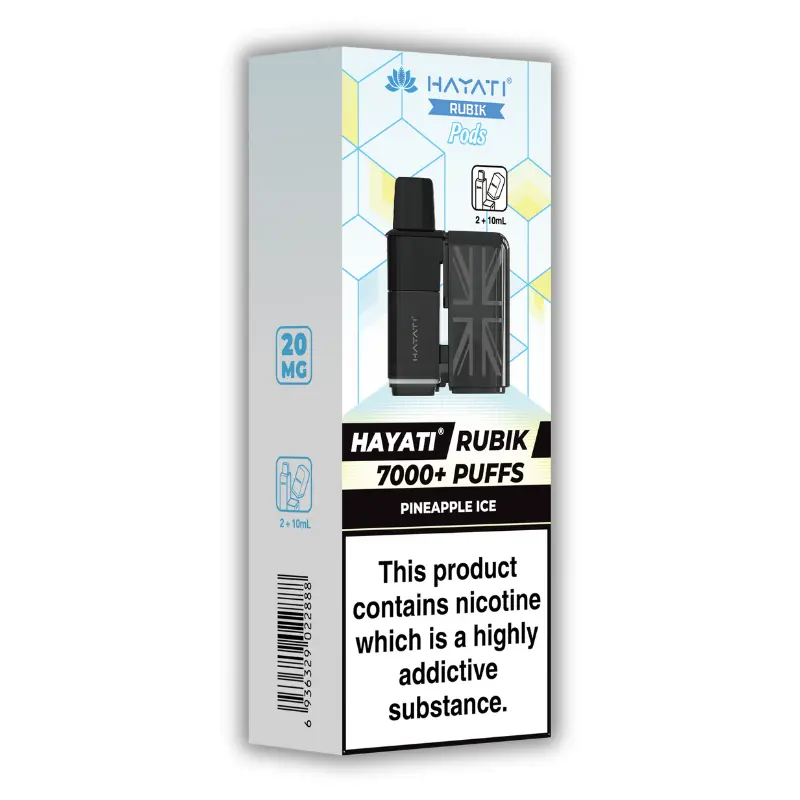
Hayati · Rubik
Pineapple Ice Hayati Rubik Pods
£3.99
✔ In stock — ready to ship
Genuine Hayati
Free over £20
Same-day dispatch
Secure checkout
A Pineapple Ice pod for the Hayati Rubik is £3.99 and arrives as one sealed unit: twelve millilitres of 20mg nicotine salt with the coil already fitted inside it, no body, no cable, nothing to assemble and nothing to fill. Hayati rate a filled pod at up to 7,000 puffs, a figure produced on laboratory apparatus under controlled draws rather than a forecast of your fortnight. It is listed on Hayati Rubik Pods alongside eighteen other flavours at exactly the same price, the same fill and the same strength, so the specification tells you nothing whatsoever about which of the nineteen to put in the basket.
What does tell you something is who is reading. This listing sells a component of a device you already own. Nobody arrives at a bare pod without a Rubik in a drawer, and almost nobody arrives at this particular bare pod without having finished at least one of them. That single condition rearranges the page completely, because it removes the reader that the complete kit was written for and puts a different person in the chair.
The Pineapple Ice Hayati Rubik Prefilled Pod Kit at £5.99 is the same liquid one tier up, and it contains the flavour argument for this recipe in full. It is a long page and a good one, and this page does not rebuild any of it. It reaches a verdict, though, and the verdict has a hinge in it that nobody has pushed on. Its finding is that the coolant crowds the fruit, and the mechanism it proposes for the crowding is not chemical. It is attentional. The cold is the more striking event in the draw, it supplies an explanation for the sharpness, and once the sharpness has been explained the delicate ester top that carries the word pineapple goes un-noticed rather than getting removed.
That mechanism has a dependency the kit page had no reason to examine, because its reader was meeting the liquid for the first time. Attention is not a fixed quantity. It is the one property of a vaper that reliably changes between a first pod and a fourth, and by the time somebody is buying a replacement they have stopped attending to the draw almost entirely. Everything the kit page concluded about crowding is downstream of a process that, for you, has already stopped running. This page works out what is left when it does.
Six things the kit page owns, one sentence each
Re-deriving a sibling's reasoning produces a worse copy of it and burns the words that could have carried something new, so what follows is a register of what is settled rather than a summary of the arguments. Read the kit page for the arguments themselves.
The central claim there is that pineapple completes a taxonomy of what a coolant can be doing to a base, on a second axis from the one two earlier pages worked on: the fruit implies no temperature at all but it does supply an edge, which makes acid and coolant two instruments hired for one job, bidding for one description, with neither able to suppress the other because they report to different equipment.
The counts behind that are done and they hold, which I confirmed against the catalogue before leaning on any of them: a word from the acid family lands on eleven of the 492 listings with seven of those seven being pineapple entries, twenty-one titles name the fruit, six of them are solo Pineapple Ice and all six are cooled while fifteen are compounds and not one of those is cooled, and within the fifteen the fruit is the cutting component nine times, with the four listings that reverse the roles turning out to be exactly the four lemon pairings.
The comparison with red apple belongs to the kit page and to the Red Apple Ice kit page before it, where the same always-cooled statistic is shown to have the opposite cause, and I am not restating the reasoning: if you want to taste the other half of that pair on your own device, Red Apple Ice Hayati Rubik Pods is on this shelf at the same £3.99.
The diff of all six Pineapple Ice listings is theirs too, including the finding that three of the six describe the ice as reducing the fruit's edge, one denies it does any such thing, one has it sharpening the exhale instead, and the sixth is this very listing, which declines to pick a side and instead treats the fruit's acidity as something the ice works against rather than on.
The verdict, better drink and thinner pineapple, is theirs, along with the attentional mechanism behind it that this page takes as its starting point.
And the wear prediction is theirs: a late pod reads sharper and less like pineapple rather than simply weaker, with a two-reading protocol taken about a fortnight apart asking only whether the fruit arrives before the cold, with it, or after it, plus three further markers to watch for. All of that is on the kit page and none of it is repeated below. What is below is what happens to a conclusion about attention when the person doing the attending has gone.
A competition needs somebody to be watching it
Set the kit page's argument out as a machine and look at its moving parts. Two components arrive within a second of each other. One of them, the acid, produces an impression of an edge and also belongs to the fruit. The other, the coolant, produces an impression of an edge and belongs to nothing. Neither can silence the other. What they contend for is the single word a taster reaches for at the end of the draw, and the cold usually wins that contest because it is the louder event.
Now notice what the machine requires in order to run. It requires a word to be reached for. The whole competition takes place in the act of description, not in the mouth: the acid still lands, the esters still arrive, the cold still terminates the draw, and every one of those events happens exactly as it did before whether or not anybody is paying attention. What changes when attention is withdrawn is that the credit is never assigned, because nobody is keeping the books.
The restocker is not describing the draw
A person on their first pod of an unfamiliar flavour is, whether they would put it that way or not, running a small evaluation. They notice the order things arrive in. They compare it against what the name led them to expect. They form a view. That is the reader the kit page correctly wrote for, and the crowding verdict is a warning to that reader: the thing you came to taste will be harder to find than you think.
A person on their fourth pod is doing none of that. The flavour has been evaluated, the verdict has been filed, and the draw has become background. This is not inattentiveness as a failing, it is what habituation to any repeated stimulus looks like, and it is the ordinary condition of anybody who has settled on a liquid. The consequence for this particular pod is specific and, I think, underappreciated: the two instruments stop competing, because the post they were competing for no longer exists. Nobody is issuing descriptions. There is no word to win.
What gets through when nothing is being listened for
Here is the part that is reasoning rather than measurement, and I would rather flag it than dress it up. Hayati publish no recipe, no coolant identity and no dose, and nothing below has been read off a specification sheet.
Rank the three things in the pod by how much attention each one needs in order to register. The ester top needs the most. It is light, it is fugitive, it arrives early and it is gone within the draw, and aroma is the fraction of tasting that is easiest to miss when something more forceful is happening at the front of the mouth. It is, in short, the part that has to be looked for. The acid needs far less. It is heavy, stable, dissolved rather than volatile, and it lands on the tongue with no cooperation required from the drinker. The coolant needs least of all: a temperature report is close to impossible to ignore, which is exactly the property that makes a coolant useful across a whole catalogue of fruits.
Withdraw attention and the three do not fade in proportion. The one that depended on being looked for is the one that stops arriving in any meaningful sense, and the two that arrive unbidden carry on exactly as before. So the composition of the experience shifts, without one molecule of the liquid changing, towards cold and acid and away from pineapple.
Which is the same direction the kit page's wear prediction points, and it is worth being precise about why that is a coincidence of direction rather than the same effect twice. Wear is a fact about the pod: the coil tires, the most delicate aromatic material goes first, and the liquid that reaches you is genuinely different. Attention is a fact about you, it applies from the first draw of a fresh pod, and it reverses the moment you decide to concentrate. Two independent processes moving the same way is why a restocker's third pod can taste noticeably less like fruit than their first did even when the pod is brand new, and why the obvious explanation, that the batch is weaker, is usually the wrong one.
What would show this to be wrong
A claim that cannot fail is not worth making, so here is the test that would falsify it. Take a draw from a fresh pod while doing nothing else and asking one deliberate question of it. If the fruit is there, clearly, in its usual place ahead of the cold, then nothing has been lost from the liquid and what changed was where you were looking. If the fruit is genuinely absent under concentration, then this is wear or a bad pod and the argument above does not apply to your situation. The two cases call for different actions and they are easy to tell apart, which is the only useful thing a page can offer here.
The kit page's parting advice, and the people who have already ignored it
The kit page closes by telling anybody whose real interest is the pineapple itself to buy a compound instead, where a partner fruit does the cutting and the fruit gets to keep its top note. That advice is correct, and this listing exists because it is routinely declined.
Everybody reading this page owns a Rubik and is choosing to spend another £3.99 on the cold sharp version rather than reaching for one of the blends where pineapple is allowed to be the subject. Two readings of that are available. The unflattering one is that they are stuck: the Rubik shelf has no pineapple compound on it, so a Rubik owner who wants this fruit at all has exactly one listing to buy and the advice is unactionable without changing platform. The more interesting one is that the crowding is the product. Somebody restocking a cold, dry, sharp pod is buying a sensation package with a fruit history attached to it, and the fruit is functioning as a name rather than as a subject.
Both readings are probably true of different buyers and I cannot tell you the proportions, because nothing in the catalogue records why anybody bought anything. What I can say is that the second reading is coherent, which the kit page's framing does not quite allow for. It treats thinner pineapple as a cost, which it is for a first-time buyer who came for pineapple. For a fourth-time buyer it is a description of the thing they keep choosing, and a cost that somebody pays willingly and repeatedly has stopped being a cost. The honest reframing is that this pod is not a compromised pineapple. It is a cold acidic draw that happens to be filed under a fruit, and on those terms it is unusually good at its job.
That reframing has a consequence at reorder, which the kit page never had to reach, because a kit buyer makes one decision and a refill buyer makes the same decision again and again. If what you are buying is the cold sharp package, the relevant question is not whether the fruit is well served. It is whether anything else on your shelf supplies the same package. That is a supply question, it is answerable by counting, and nobody had counted it.
Counting the nineteen you actually choose from
The framing handed to me claimed that of the nineteen Rubik refills, only two declare an acid word anywhere in their own copy, and that this listing is therefore half the platform's entire declared supply of acidity. A rarity claim deserves a count rather than a nod, and several claims of that shape on this site have not survived one, so I ran it against the catalogue rather than accept it.
The count, and what it did to the claim
It holds exactly. Searching the nineteen descriptions for any form of the word acid returns two hits: this listing, and Lemon Lime Hayati Rubik Pods, whose copy attributes a clean acidity to the lemon before the lime arrives with its more aromatic, faintly bitter side. Nothing else on the shelf uses the word at all. For contrast, the twenty complete kits in the same range yield exactly one hit between them, and it is the Pineapple Ice kit. So on the tier where the word appears at all, it appears twice out of nineteen, and you are holding one of the two.
Counting it also made it sharper, which is the usual outcome. Of the two declared acids, only one is cooled. Lemon Lime states plainly that no cooling is named on it, and the eight cooled entries on this shelf are a group the shelf page has already counted and published, so I am citing that rather than recounting it. Cross the two properties and the intersection is a single listing. This pod is not one sharp option among several. On the cold side of the shelf it is the whole of the declared supply of acidity, and on the shelf entire it is one of two.
Why the generic vocabulary cannot do this work
The reason the acid word carries information is that the shelf's ordinary sharpness vocabulary does not. I marked every description for tang, sharp, sour, tart, zest, citrus, bite and crisp, and seventeen of the nineteen carry at least one of them. Only Watermelon Ice Hayati Rubik Pods and Summer Dream avoid the family altogether. A property that lands on seventeen of nineteen listings separates nothing, which is precisely the trap: a buyer scanning the grid for something sharp will be told that almost everything is, and the word that would actually have narrowed the field is used twice.
This is the same kind of finding the Fresh Mint Hayati Rubik Pods page produced when it ran a sweetness census across the same nineteen descriptions and found sixteen of them attaching a sweetness word to their own liquid. Two shelves' worth of vocabulary, both saturated, both useless for choosing. I am citing that count rather than repeating its reasoning, and noting only that the two censuses point at the same structural problem from opposite ends.
What the supply position means at reorder
The Blue Sour Raspberry Hayati Rubik Pods page reached an adjacent finding by a different route, counting declared sours on this shelf and arriving at exactly one, then arguing that the platform therefore gives a sour drinker nothing to calibrate against, since the only contrasts available are temperature and fruit rather than the axis they are trying to hold steady. That page owns the calibration argument and I am not rebuilding it.
What the acid count adds is a different consequence, and it is about substitution rather than perception. A Rubik owner who has settled on cold acidity has one alternative on the platform and it is not cold. If you want the same sensation package next month, this listing is the route to it, and the nearest thing to a second route requires giving up the temperature half. That is an unusual position on a shelf where almost everything else has a close neighbour: two blue raspberries, several reds, a mango and a peach that overlap considerably, a pair of cooled berries. The cold acid slot has one occupant.
Standing order, or a slot in a rotation
This is the question a refill listing turns on and a kit listing never has to ask, because a kit is bought once. It also turns out to have an answer already printed on the shelf, which I did not expect to find.
The copy has taken a side
I read all nineteen descriptions for what they recommend as a pattern of use rather than as a taste. Eight of them pitch the pod as something to settle on, using words like everyday, all day, go-to, usual, committed, or telling you plainly that a pod this size suits a flavour you plan to stick with. Five pitch the pod as something to alternate with, framing it as a rotation item, a contrast to sweeter pods, or something to clear the way between other flavours. Two listings do both and six do neither.
Both of the declared acids sit in the rotation group and neither is in the settle-on group. This listing offers itself, in its own first paragraph, as a tropical option for a rotation. Lemon Lime offers itself as a contrast to sweeter pods. Whatever else Hayati's copywriters were doing, they have consistently filed declared acidity as a property you visit rather than a property you live in, and they have done it on both of the only two listings where the property is declared.
Except that a rotation needs a partner, and this axis has none
Here is the tension, and it is the practical heart of the page. A rotation slot is a slot you alternate out of and back into. That requires the other positions in the rotation to be doing something the slot is not, on the axis that matters. For a sweet berry the axis is easy: rotate to a mint, a citrus or a dry blend and the sugar stops. For cold acidity there is nowhere on this platform to rotate to that changes only the acid.
Work it through with the actual grid. Rotate to Watermelon Ice, Banana Ice Hayati Rubik Pods or Vim Ice Hayati Rubik Pods and you keep the temperature and drop the edge, so the change you get is a sweeter cold pod. Rotate to Lemon Lime and you keep the edge and drop the temperature. Rotate to Triple Mango Hayati Rubik Pods or Juicy Peach Hayati Rubik Pods and you drop both at once. There is no move on this shelf that holds the cold steady and varies the acid, or holds the acid steady and varies the fruit.
So the copy's rotation framing is sound advice with an unavailable prerequisite. You can certainly alternate this pod with others, and most people will, but the alternation is a change of category rather than a change of degree. Which means the slot does not get filled by a near neighbour while it is empty. It just sits empty, and the thing you notice is its absence rather than a substitute.
What that decides at the point of reorder
The practical answer, then, is that this is a standing order behaving like a rotation slot, and the two call for different buying habits. A rotation item can be bought when you feel like it, because something similar is always in the drawer. An item with no substitute has to be bought before it runs out, or the rotation loses a position rather than swapping one.
Twelve millilitres is a long enough fill that the arrival date is easy to misjudge. The Hayati Rubik range shelf works out the per millilitre arithmetic properly and puts a pod at 33.3p a millilitre, which is the floor for a prefilled pod in this catalogue, and the Blue Razz Cherry Hayati Rubik Pods page sets out what else has already collapsed into a fixed figure at this tier, including the fact that thirty-nine Rubik listings carry two prices between them. Neither of those is rebuilt here. The only thing worth adding for this flavour is the ordering rule that follows from having no substitute: buy the next pod when you open the current one, not when the current one starts tasting thin, because by then you have a fortnight of nothing in the slot and the cheapest pod in the catalogue is not cheap if you spend two weeks not using it.
What is actually in the packet
One pod. That is the whole inventory. No body, no charger, no spare, no bottle and nothing to decant, and the pod does nothing at all until it is seated in a Rubik you already have. If there is no Rubik in the house, this is not the listing to be on, and the complete kit tier is where that starts.
Pods and bodies do not move freely between Hayati's ranges, so check the range name on your device against the one in this title before ordering. That is the whole of the compatibility advice and saying it twice would not make it truer.
The coil comes fitted and leaves with the pod, which is the one structural fact about this format that matters at this tier: a refill is not just new liquid, it is a new coil as well, arriving with an unpublished resistance. Hayati publish no resistance figure, no wick material, no airflow specification and no dimensions for the pod, and I am leaving those blank rather than reasoning from the product name to a plausible number. Any page that states one should be treated as unverified, including a page on this site.
For this liquid, the specification that changes anything is the capacity. Twelve millilitres of a single cold sharp flavour with nothing to switch to inside the pod is a long unbroken run of one thing, and the sharp liquids are the ones people tire of soonest. That is an argument for buying this pod because you already know how you get on with it, which, given who is reading, is the situation you are in.
The figures, read the way a reorder reads them
| Line | Published | What it changes at reorder |
|---|---|---|
| Supplied as | Pod only, coil fitted | Inert without a Rubik already in your possession |
| Price of one pod | £3.99 | Identical to all eighteen alternatives, so price selects nothing |
| Fill | 12ml | Long enough that the reorder date is easy to misjudge |
| Strength | 20mg nicotine salt | The only figure this range offers, so there is nothing to choose |
| Bench rating | Up to 7,000 puffs | Laboratory conditions, not a planning figure, and not comparable across ranges |
| Declared profile | Pineapple Ice | One reserve, one flavour, no mouthpiece to turn mid-session |
| Acid declared in the copy | Yes | One of two listings on this shelf that says so, and the only cooled one |
| Coil resistance | Not published | Draw character cannot be predicted from a number nobody prints |
| Cooling compound and dose | Not published | Intensity has to be placed by comparison rather than read off a label |
| Pod dimensions and wick | Not published | Nothing to compare against another range's pod on paper |
Two rows need a word. The 20mg figure is the UK ceiling for a sealed prefilled format, which is why it is the same on every entry in the range and why strength is not among the things this purchase lets you decide; nicotine is an addictive substance and no milligram figure on this shelf changes that. The bench rating is the row most often misused: a rating produced for one range cannot be divided against a rating produced for another, because the draw conditions behind them are not stated and there is no reason to assume they match.
The acid row is the only one on the table that separates this listing from its shelf neighbours, and it is there because the rest of the table is a single repeated row across nineteen products. That is worth sitting with for a moment. On a shelf where price, fill, strength, format and bench figure are constants, the only differentiating data Hayati publish is the prose, which means the prose has to be read as data. That is what the counts above are doing.
The other eighteen, sorted by what a reorder is actually for
If you want the same package and this one is out
There is no exact substitute, which is the finding above. The nearest approach from the cold side is Lemon Cola Ice Hayati Rubik Pods, where a zesty lemon is doing the cutting over a sweet cola base with the ice on the exhale, so you keep the temperature and the citrus lift and accept a sugary body underneath that this pod does not have. The nearest approach from the acid side is Lemon Lime, which gives you the edge at full strength with no cooling at all and is the one pod on the shelf that will tell you how much of what you like here is the fruit's acidity rather than the coolant. Running those two in succession is the cheapest experiment available for separating the two halves of your own preference, and it costs £7.98.
If you want to stay cold and drop the edge
Strawberry Raspberry Ice Hayati Rubik Pods is the closest cooled pod in overall temperature with a much sweeter red-berry body under it, so the cold has something to push against rather than something to compete with. Banana Ice is the shelf's clearest case of a coolant supplying an edge to a fruit that has none of its own, soft and creamy with the chill arriving on the exhale to keep it from turning cloying. Vim Ice takes the cordial route, dark berries and grape in a drink-shaped blend with a mild tang and a cold finish. Watermelon Ice is the simplest of the group by its own account and the least demanding over a long day. Red Apple Ice deliberately avoids the sourness of a green apple, so it is the cooled pod furthest from this one in character while sitting closest to it in temperature.
If the acid is the part you have had enough of
Acid fatigue is not relieved by another sharp liquid, so the useful counterweights are the thick and the soft. Triple Mango is mango alone, laid on heavily, with no ice and no citrus named to lift it. Juicy Peach is softer again and has nothing sharp or cold competing for the front of the draw. Blue Razz GB Hayati Rubik Pods is the sugary end of the shelf, a blue raspberry with a confectionery layer over it, and is the most complete reversal of this pod available at the same price. Fresh Mint is the only pod here where the cold is the subject rather than the finish, which makes it the right reference if you want to work out how heavy this pod's cooling actually is.
If you want an edge from something other than acid
Blueberry Cherry Cranberry Hayati Rubik Pods gets its dryness from cranberry's tangy bite rather than from a citrus acid, with cherry for depth and blueberry rounding it off, which is a different route to the same not-too-sweet destination. Strawberry Kiwi Hayati Rubik Pods hands the cutting job to kiwi, sharp and green against a ripe strawberry, with no cooling named. Blue Sour Raspberry puts the sour first and the sweetness a moment behind it, and is the shelf's only declared sour. Blueberry Raspberry Hayati Rubik Pods opens on raspberry's tart snap and settles into a jam-like sweetness, warm throughout, with no cooling named.
The same fruit, and the same cold, elsewhere in the range
No Rubik pod pairs pineapple with anything. If you want the fruit doing its usual work as a cutting component rather than being cut at, that means leaving the platform: Blue Razz Pineapple Hayati Mini Ultra Pods at £3.49 puts it against a candied berry in a short pod, which makes it the low-commitment way to find out whether uncooled pineapple is what you have been missing, and the Blue Razz Pineapple/Strawberry Ice Hayati Pro Ultra Plus 25K Pods listing is the one place in the catalogue that puts an uncooled pineapple blend and a cooled fruit in the same pod. Pineapple Vapes collects every listing that names the fruit if you want the whole set in one grid.
On the cold side, Red Apple Ice Hayati Pro Max Plus Pods and Vim Ice Hayati Pro Max Plus Pods are the same two flavours on larger hardware at £5.49, useful only if you own that body as well, and Cola Ice Hayati Mini Ultra Pods at £3.49 is the smallest cooled pod Hayati sell. The Ice Vapes shelf holds every cooled listing across all the ranges, and the Hayati Prefilled Pods & Refills tier sits above that, gathering every sealed pod the brand sells without a body attached. If none of the nineteen is what you want next, the full Hayati catalogue is the last stop.
One listing not on this shelf, and why it matters here
Banana Ice Hayati Rubik Prefilled Pod Kit is worth knowing about for a reason that has nothing to do with banana: it is the illustration of what the kit tier costs when you already own a body. Two pounds more, an identical twelve millilitres, and a second device you did not need. Buying a kit to get a flavour is a mistake that only looks sensible at the moment of wanting something new, and on a shelf where every kit has a matching refill except one, it is a mistake with an easy fix.
Running a pod of something you have already decided about
Most handling advice is written for somebody meeting a liquid. This is written for somebody managing one, which is a shorter list.
Give a new pod a minute seated in the body before the first draw. On this liquid the part a hot dry first pull costs you is the ester top, which is the fraction that is hardest to notice at the best of times, so it is the thing you will not realise you have lost.
Draw length pushes the balance in a direction that surprises people. A long slow pull gives the coolant more time to accumulate and gives the fruit no extra time at all, because the volatile part arrives at the front of the draw and does not wait. So on this pod a longer draw is reliably a colder and less fruity one. If the fruit is what you are after on a given day, take shorter draws and leave more space between them, which costs nothing and is the only lever you have.
Chain-drawing is worse here than on a sweet pod, and for a specific reason rather than a general one. Quick successive draws keep the coolant topped up in the mouth while the acid builds on the tongue, and neither of those fades between pulls, while the aromatic part has to arrive fresh each time and cannot get a hearing against the other two. Four or five pulls in quick succession leave you with cold and sourness and no pineapple at all. Spacing them out is the whole technique.
Storage is worth a line because the two failure modes pull opposite ways. Warmth costs you the lightest molecules, which on this liquid are the ones carrying the fruit's name, so a pod that lives on a sunny windowsill or in a warm pocket for a fortnight comes back vaguer rather than weaker. Chilling is not the answer either, since a cold pod thickens the liquid and wicks poorly for the first few draws. Room temperature, standing upright, out of direct sun, and upright matters more once a pod is part used than it does when it is full.
On rotating this one out and coming back to it: the loss lands on the identity component rather than on the intensity, so a pod parked for a month returns colder and sourer in proportion rather than quieter. Given that the slot has no substitute on this shelf, the sensible pattern is to rotate quickly or not at all, and to open a fresh pod when you want the flavour back rather than reaching for a half-used one that has been sitting since the spring.
When a pod is done it comes out as a plastic shell with a spent coil in it and a residue of liquid the wick never reached, which makes it an electrical item rather than household rubbish. Hand it in at a shop with an electricals take-back bin or at a local recycling point that accepts small electricals. Used or part full, a pod still holds nicotine, so keep pods where children and pets cannot get at them.
Questions a second, third or fourth order raises
Is there any reason to buy this rather than the kit?
Only if you already own a Rubik, in which case there is every reason: the pod is £3.99 against £5.99 and holds exactly the same twelve millilitres at the same strength, so the £2 difference is a second body you do not need. If you do not own one, this listing is inert and the kit tier is where to start.
Does it taste weaker by the third or fourth pod?
Most people report that it does, and there are two separate causes that produce the same impression. One is real wear inside a pod, which the kit page covers in detail. The other is that you have stopped attending to the draw, which does not affect the acid or the cold at all but does quietly remove the fruit, because the fruit is the only part that has to be looked for.
How do I tell those two apart?
Take one deliberate draw from a fresh pod with nothing else going on and ask a single question: does the fruit arrive before the cold. If it does, the liquid is fine and your attention had moved. If it genuinely does not, on a pod you have only just opened, that is a pod problem rather than a perception one.
Is this the sharpest pod on the Rubik shelf?
It is one of two that declare an acid rather than a general tang, the other being Lemon Lime, and it is the only one of the two that is also cooled. Whether the combination of acid and coolant reads as sharper than a pure citrus is a matter of taste, but on declared ingredients this pod and Lemon Lime are the only two candidates.
What can I rotate this with and keep the same character?
Nothing on this shelf, which is the awkward finding. Every alternative either keeps the cold and loses the edge or keeps the edge and loses the cold, so alternating out of this pod is always a change of category rather than a change of degree. Plan for the slot to be empty rather than filled while you are away from it.
Should I keep a spare in the drawer?
On this flavour, yes, more than on most. A pod with no close substitute on the platform means running out is not a small inconvenience you can paper over with something similar. Buying the next one when you open the current one is the habit that avoids it, and a sealed pod keeps perfectly well at room temperature.
Is the liquid the same as in the kit?
Nothing published distinguishes them. Both carry twelve millilitres at 20mg with the same bench rating, and the descriptions differ in emphasis rather than in content, which the kit page examines at length across all six Pineapple Ice listings Hayati sell. Treat differences in the copy as evidence about how the copy was written.
Why does the listing call this a rotation flavour?
Because five of the nineteen descriptions on this shelf frame their pod as something to alternate with rather than settle on, and both of the listings that declare an acid are in that group. Whether the framing is right for you is a separate question, and the practical obstacle is that the rotation has no partner on the same axis.
Does a warm pocket change how cold it tastes?
Yes, and it reverses. A coolant reads lower out of a warm pod and comes back when the device returns to room temperature, so a draw that seems flat on a hot afternoon is usually a temperature effect rather than a sign the pod is finishing. Judging a pod's condition is better done indoors on a cool device.
Is there a pineapple on this platform without the ice?
No. This is the only pineapple listing of any kind on the Rubik, cooled or otherwise, so a Rubik owner who wants the fruit has exactly one option. Uncooled pineapple exists elsewhere in the catalogue, always inside a compound, and always on hardware other than this one.
How many pods should I expect from a year of use?
That depends entirely on how long and how often you draw, and the 7,000 figure printed on the listing is a laboratory measurement rather than a basis for planning. The only reliable method is to note the date you open a pod and the date you finish it, then use your own interval. Two pods is enough to set a fairly accurate reorder rhythm.
Where this leaves the reorder
A Pineapple Ice Rubik pod is £3.99 for twelve millilitres of 20mg nicotine salt with the coil inside it, rated by the manufacturer at up to 7,000 puffs on laboratory equipment, and identical on every published figure to the other eighteen pods on its shelf. The complete kit page owns the flavour argument, the taxonomy it completes, the counts behind it, the six-listing disagreement and the wear prediction, and none of that is rebuilt here.
What this tier adds is the consequence of its verdict for somebody who is no longer listening. The crowding the kit page describes is an argument about attention, and attention is the thing that goes first once a flavour has been settled, so a restocker gets the cold and the acid at full strength and the fruit only when they go looking for it. That is a cost to a first-time buyer and it is the product to a fourth-time one, which is why the advice to buy a compound instead has been quietly overruled by everybody on this page.
The count that decides the reorder is on the shelf rather than in the pod. Two of the nineteen Rubik refills declare an acid, this one and Lemon Lime, and only this one is also cooled, so the cold sharp package has a single supplier on the platform. The copy files it as a rotation flavour and the grid gives that rotation no partner on its own axis. Treat it as a standing order, order the next one when you open this one, and keep something thick and warm alongside it for the days when the acid has had its turn.
Strictly for adults aged 18 and over. Nicotine is an addictive substance.
You might also like


