
Home / Hayati Rubik Prefilled Pod Kit / Pineapple Ice Hayati Rubik Prefilled Pod Kit
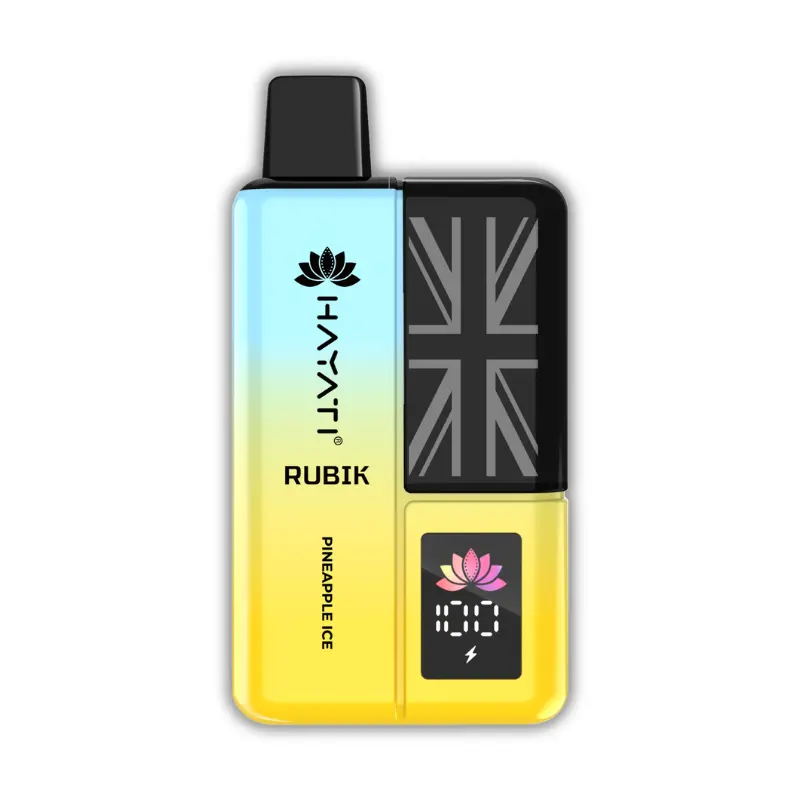
Hayati · Rubik
Pineapple Ice Hayati Rubik Prefilled Pod Kit
£5.99
✔ In stock — ready to ship
Genuine Hayati
Free over £20
Same-day dispatch
Secure checkout
Pineapple Ice on the Hayati Rubik is sold as a complete kit at £5.99: the shaped Rubik body and a prefilled pod system together in one box, carrying 12ml of liquid at 20mg nicotine salt, with an 850mAh cell in the device. Hayati rate the pod on the bench at up to 7,000 puffs. That is a laboratory measurement taken under controlled draw conditions, not a forecast of how long your pod will last, and nothing you do with the device will reproduce the conditions that produced it. None of those figures distinguishes this listing from its neighbours. Every kit on the Hayati Rubik Prefilled Pod Kit shelf carries the same capacity, the same strength and the same cell, so the specification column is one repeated row and the flavour is the only variable.
The flavour is worth more attention than a two-word name suggests. Two pages on this site have already taken apart what a cooling agent does when it is laid over a base that has opinions about temperature. The Watermelon Ice pages argue that cooling a watermelon is redundant, because the fruit already carries an impression of coldness and you cannot contrast a thing with itself. The Cola Ice pages argue that cooling a cola is a contradiction, because a cola accord is assembled out of cinnamon, nutmeg, coriander seed, vanilla and citrus peel, and every one of those materials sits on the warm side of the flavour world. Between them those two pages established a taxonomy of what a coolant can be doing: supplying a quality the base lacks, restating one it already implies, or opposing one it actually has.
Pineapple belongs to none of those three, and the reason is the subject of this page. Pineapple does not imply a temperature. It implies an edge. The fruit brings a real acid and a loud volatile top, so it already performs the job a coolant is usually hired to perform, which is to cut. Put a coolant on it and you have not added a missing quality, duplicated an implied one or contradicted a present one. You have hired a second worker for a post that was already filled, and the two of them go about it by completely different methods. That is the ordinary case, the case where cooling is doing exactly the work it is normally asked to do, and it turns out to be the most difficult of the four to predict.
Completing the taxonomy, on an axis the first two pages did not need
What the two existing arguments settled, taken as settled
The redundancy argument and the contradiction argument are both on the site already and neither is re-derived here. The short version of the first is that melon arrives pre-loaded with the adjectives wet, cold and light, so a coolant laid on top of it has nothing to push against and its most valuable function, contrast, is unavailable by definition. That page also puts the defence, and puts it well: a buyer who wants the cold above all else is served rather than short-changed by a liquid that points one direction from start to finish. The Watermelon Ice Hayati Rubik Prefilled Pod Kit is the same liquid on this shelf if you want to taste the case being made, and the Watermelon Ice Hayati Pro Ultra Plus 25000 Prefilled Pod Kit is where the range puts it in a larger body.
The contradiction argument runs the other way. Cola is the only cooled base in the catalogue that is neither a fruit nor a mint, and its character is built from warm materials, so the coolant is not supplying or duplicating anything. It is overruling. That page also worked out something important about how the overruling happens, namely that the spice does not get cancelled so much as outvoted, because a synthetic coolant is far louder in the temperature register than a trace of nutmeg. The Lemon Cola Ice Hayati Rubik Prefilled Pod Kit is the version of that problem sitting on this shelf, with a citrus component added on top of it.
Notice what those two arguments have in common. Both are about temperature. Watermelon implies cold, cola implies warmth, and the coolant's relation to each is decided by whether the implied temperature matches the delivered one. That axis has two ends and both ends are now occupied.
Pineapple sits on a second axis entirely
Ask somebody to describe pineapple and temperature words do not come up. The adjectives are sharp, tangy, juicy, sweet, bright, and the odd one out in that list is the interesting one. Sharpness is not a property like wetness or warmth. It is a function. Something that is sharp is doing something to something else: cutting through sugar, breaking up a heavy body, stopping a blend from sitting on the tongue. Pineapple is the catalogue's most reliable supplier of that function, and it can be demonstrated rather than asserted, which the next section does.
So the question this liquid raises is not whether the coolant matches the fruit's temperature. The fruit has no temperature. The question is what happens when two components in the same 12ml are both employed to perform the same job, and perform it by mechanisms that have nothing to do with each other. Acid is a taste, registered by the taste apparatus in the ordinary way. Cold is not a taste at all, registered instead by the machinery that reports temperature, which is why a coolant can chill a mouth that is not physically any colder. Both of them arrive, both of them produce the impression that something in the draw is cutting, and neither is capable of suppressing the other, because they are not operating on the same equipment.
The Cola Ice page uses the word competition too, and it means something quite different by it. There the competition is inside a single register, cold against warmth, and it has a predictable winner decided by loudness: the bigger signal wins and the smaller one is ignored. Here nothing is decided, because nothing is contested at the level of signal. Both components report at full strength and they report to different places. What they compete for is the description. When the draw is over and you reach for a word, the word available is sharp, and two entirely separate things in the pod have a claim on it.
Counting pineapple's job before claiming anything about it
A word the copy almost never uses, and where it uses it
An argument of the form "pineapple is the range's sharp fruit" deserves a count rather than a nod, so here is the count. Across all 492 listings, the words tangy and tang appear on 225 of them and some form of sharp appears on 268. Those are house vocabulary. They are attached to blue raspberry, cherry, lemonade, mango and half the berry shelf, and a word that lands on more than half the catalogue carries no information about any individual product.
Now take a word the copywriters clearly regard as stronger. Some form of acid, meaning acidic or acidity rather than the generic tang, appears on exactly 11 listings out of 492. Seven of those eleven are pineapple listings. The remaining four are two Guava Kiwi Passion Fruit entries, a White Peach Raspberry and a Lemon Lime refill. So when the copy reaches past its own default vocabulary for a chemical word, roughly two thirds of the time it is describing pineapple.
That is the evidence that pineapple's edge is not a figure of speech carried over from the marketing of every other fruit. It is a property the people writing the listings notice specifically, and they notice it on this fruit more than on all other fruits combined.
What pineapple is for, across every blend that contains it
Twenty-one titles in the catalogue name pineapple. Six of them are Pineapple Ice in one format or another, which leaves fifteen compounds, and reading what the copy says pineapple is doing in each of those fifteen produces a clean split.
In nine of them pineapple is the component that cuts. The Mango Peach Pineapple listings say it adds a brighter lift so the blend never turns heavy, that it contributes a light sharpness stopping the mix feeling heavy, that it supplies the sparkle keeping the whole thing lively, and on the bottled version that its acidity is what stops the blend becoming sticky. The Blue Razz Pineapple listings say it keeps the blue razz from tasting too candied and that the two tangy elements amplify each other. In every one of the nine, pineapple is the corrective and something sweeter or heavier is the thing being corrected.
In four of them the roles are reversed. Pineapple becomes the body and something else does the cutting, and those four are exactly the four listings that pair it with lemon. The Pineapple Lemon Burst Hayati Pro Max Plus 6000 Pod Kit has lemon sharpening the pineapple rather than the other way round, and the Lemon Pineapple pair say plainly that the pineapple fills out the body so the blend never tastes thin. Four out of four. No lemon pairing anywhere in the range leaves pineapple in charge of the edge.
The last two are the dual-reserve Pro Ultra Plus listings, where pineapple sits under a blue raspberry on one side of the pod and the description treats it as the base of that half.
Read together, the fifteen say something precise about how this fruit behaves. Pineapple is a relative instrument. Against sugar it is the knife. Against a genuine citrus it becomes the thing being cut. Its position in a blend is not fixed by the fruit, it is fixed by what else is in the bottle, and that is exactly why putting it with a coolant produces an unstable answer rather than a predictable one.
The pattern in what Hayati choose to cool
Here is the count that turned this page's argument from a hypothesis into something with evidence behind it. Of the six listings where pineapple is the only fruit in the pod, all six carry the word Ice. Of the fifteen compounds, not one cools the pineapple. Three of the fifteen carry an Ice word, and in all three it is attached to a strawberry in the other reserve of a two-sided pod, which is a separate liquid feeding the same coil. The pineapple half of the Blue Razz Pineapple / Strawberry Ice Hayati Pro Ultra Plus 25000 Prefilled Pod Kit is uncooled, and so is every other pineapple that has a fruit partner.
Six out of six on one side and zero out of fifteen on the other is not a coincidence about house style. It is the range treating a coolant and a partner fruit as substitutes for each other. When there is a second fruit in the pod, that fruit supplies whatever contrast the blend needs and no coolant is added. When pineapple is alone, a coolant goes in. The catalogue is telling you, through its own construction decisions, that the ice and a partner fruit are filling the same vacancy.
The Red Apple Ice Hayati Rubik Prefilled Pod Kit page found a superficially similar pattern and drew the opposite conclusion from it, correctly. Every red apple listing in the range is cooled, all seven of them, and that page argues the coolant is structural there because the red accord has no acid of its own and would read as syrup without something supplying an edge. Same statistic, reverse cause. Red apple is always cooled because it cannot cut on its own. Pineapple is cooled only when there is nothing else in the pod that needs cutting. Two pages, two counts, two genuinely different findings, and it is worth saying that they do not conflict.
Two instruments bidding for one description
What follows is reasoning rather than measurement. No recipe sheet is published for this liquid, Hayati do not state which cooling compound went in, and nothing below has been read off a specification. The Ice Vapes shelf page sets out what the two families of cooling compound are and how to work out from behaviour which one you have got, and that material is cited here rather than repeated.
Start with what pineapple actually consists of, in the general sense that applies to the fruit and to flavourings built to imitate it. Its identity is carried by esters, a family of small, light, extremely volatile molecules, and they are what makes pineapple smell instantly recognisable from across a room. Its edge is carried by acid, principally citric and malic, which is a heavy, stable, non-volatile thing that stays in the liquid and lands on the tongue. Two components, two very different physical characters, and they do two different jobs. The esters say pineapple. The acid says sharp. Both are needed for the fruit to read as itself, but only one of them is load-bearing for identity.
A coolant produces the sharp reading and none of the pineapple reading. It is engineered, in the synthetic case, to carry as close to no taste and no smell as the chemistry allows, which is precisely the property that makes it useful across a whole catalogue of fruits. It contributes the sensation of an edge without contributing any information about what you are drinking.
Set those two facts side by side and the shape of the problem appears. The pod contains a component that cuts and identifies, and a component that cuts and does not identify. They cannot silence each other, because a taste and a temperature report do not interfere. They both arrive. What they interfere with is your ability to attribute the result, and attribution is not a neutral bookkeeping exercise, because attention is finite and what you attend to is what you taste.
That is the mechanism this page is claiming, stated plainly so it can be disagreed with. A drinker who notices that a draw is sharp has, in that moment, an explanation available. The cold is the more obvious explanation, because it is physically the more striking event and because it arrives at the finish where it is unopposed. Having explained the sharpness with the cold, there is less reason to go looking for the acid, and less reason to go looking for the esters that sit underneath the acid. The fruit does not get removed. It gets un-noticed.
There is a second, smaller effect pushing the same way, and it should be marked as less certain. Aroma is what carries fruit identity, and aroma is the part of tasting that is most easily displaced by a strong competing sensation at the front of the mouth. A vigorous cold signal on the palate is exactly such a sensation. Whether it genuinely reduces aroma perception or merely takes the attention that would otherwise be spent on aroma is not something anybody can settle from a product page, and the practical result is the same either way.
Six descriptions of one liquid, disagreeing about direction
Pineapple Ice is sold six times over across Hayati's formats, and lining up what the six say about the ice turns out to be the strongest single piece of evidence available, because they do not agree, and the shape of the disagreement is exactly what the argument above predicts.
Three of the six say the cold reduces the fruit's edge. This listing, the Rubik kit, describes the ice as taking the edge off the acidity. The Pineapple Ice Hayati Pro Max Plus Pod Kit says the cooling smooths the edges and helps anyone who has found pineapple too sharp before. The Pro Max Plus refill says the ice tames the sharpness.
One of the six denies that outright. The 120ml 70/30 bottle says the ice chills the exhale without dulling the fruit's bite, which is a direct contradiction of the three above, written about the same flavour by the same brand.
One says the opposite of the three. The 120ml 50/50 shortfill has the ice sharpening the exhale, so the coolant is not reducing the edge at all in that account, it is adding to it.
The sixth refuses to pick a side and is the most useful of the lot. The Pineapple Ice Hayati Rubik Pods listing, which is the refill for this exact device and holds the same liquid, says that pineapple's natural acidity gives the ice something to play against. That is neither reduction nor amplification. It is two things holding each other up, which is a third answer again.
What all six do agree on is easy to state and worth stating, because a property every listing asserts is the closest thing to a fact this exercise produces. All six call the fruit both sweet and sharp. All six put the cold at the finish rather than the front. All six describe the result as crisp and explicitly deny that it is syrupy or sticky. Several place it as lighter than mango. Nobody disputes any of that.
The house rule on this kind of evidence applies and is worth repeating: a disagreement between listings of one liquid is evidence about how the copy was written, not proof that two different mixes exist. Six writers described one flavour and produced three incompatible accounts of the same interaction. That is a copy fact.
But it is a copy fact with a cause, and the cause is the point. Line up the seven Red Apple Ice descriptions and they disagree only about where the cold lands, not about what it does. Line up the Watermelon Ice descriptions and nobody suggests the ice sharpens anything. Those liquids produce a stable reading because there is only one candidate for the edge in each. Pineapple Ice produces three incompatible readings because there are two candidates and the liquid genuinely does not settle which one is responsible. Each writer attended to a different one and each wrote down what they attended to. A flavour that makes competent describers contradict each other about direction is a flavour whose components are competing for the same description, which is the claim this page opened with, arriving from a completely different direction.
The verdict: better drink, thinner pineapple
Reasoning from all of the above, here is what the pairing does, stated as a conclusion rather than a hedge.
Net sharpness goes up. Two independent sources of edge, neither able to suppress the other, both landing within a second of each other, produce more total cutting than either alone. Anybody expecting the cold to calm a fierce fruit down is expecting the wrong thing. The three listings that describe it as taming are describing a real experience, but what is being tamed is the fruit's prominence rather than the draw's severity, and those are not the same.
Pineapple specificity goes down. This is the cost and it is the honest heart of the page. The coolant supplies edge without identity, the edge is the most noticeable thing in the draw, and a drinker whose attention is occupied by sharpness has less attention left for the delicate ester top that is the only part of the liquid capable of saying which fruit this is. The fruit is still there. It is less often the thing you are thinking about.
So: does the pairing improve the fruit or crowd it? It crowds it. Not fatally, and not in the way the watermelon case can go wrong, because pineapple's acid is heavy and stable and will not be displaced by anything, so there is always a recognisable fruit residue underneath. But the version of pineapple you meet here is a narrower one than the version in a blend where a partner fruit does the cutting and the pineapple gets to keep its top note for itself. If the fruit is what you came for, this is not the best presentation of it in the range, and the honest recommendation is a compound.
The defence is real and it is not a consolation prize. Neat pineapple is an abrasive flavour over twelve millilitres. The acid is relentless, it does not fade between draws the way a fruit top does, and a long session on an uncooled sharp pineapple becomes wearing in a way that people usually describe as the flavour being too much rather than too sharp. A coolant changes that, not by reducing the acid but by giving the sharpness somewhere to resolve. The cold arrives at the finish, terminates the draw cleanly and leaves the mouth ready for the next one. That is a genuine service and it is the reason this pairing exists in every format Hayati sell.
Who should buy it, then. Somebody who wants a cold, sharp, low-sweetness liquid for a long stretch, and who is content for the fruit to be a strong hint rather than the subject. Somebody who has found pineapple blends hard going and wants the same profile with a termination on it. Somebody assembling a rotation who needs a cold slot filled by something that is not a mint and not a berry. Who should not: anybody whose interest is the pineapple itself, who would be better served by the Pineapple Lemon Burst construction or by one of the mango blends where pineapple's lift is the point of having it there.
What twelve millilitres does to this particular pairing
The wear question on this liquid has an answer that follows directly from the chemistry above, and it is a different answer from the one most cooled fruits give.
Rank the three components by volatility. The ester top is the lightest and most fugitive thing in the pod, which is what makes it so immediate on a fresh draw and so fragile afterwards. The coolant sits in the middle, robust but not indestructible, and it is the component most affected by the temperature of the pod itself rather than by wear. The acid is the heaviest and most stable of the three and is essentially unaffected by anything that happens over a pod's life.
Now run a pod. What a tiring coil takes first is always the most delicate aromatic material, which here is precisely the part carrying the fruit's name. What a tiring coil barely touches is the acid, because acid is not a fragile aromatic, it is a dissolved solid that reaches your tongue whether the coil is new or not.
The prediction, therefore: a late pod tastes sharper in proportion and less like pineapple. Not weaker overall, which is what people expect from a worn pod and what they get from most sweet fruits. Sharper. The identity component leaves, the two cutting components stay, and the ratio between them moves decisively towards the part that does not tell you what you are drinking. A pod at 10ml through its 12ml tends to read as cold, acidic and anonymous, recognisably a fruit of some kind, no longer recognisably this one.
That produces a specific and common misdiagnosis. A liquid that has gone sharper is usually read as a liquid that has gone wrong, or as the coolant having somehow increased, and neither is happening. Nothing has been added. Something has been subtracted, and because what was subtracted was the softening, identifying part, the remainder reads as more aggressive than the whole did. This is the reverse of what the Red Apple Ice page describes for its flavour, where a fading coolant leaves sweetness with nothing to check it and the fruit slides from crisp towards syrup. Same wear, opposite symptom, because the two liquids keep their edge in different components.
What to watch for, and when
Two readings, taken about two weeks apart, will tell you more than any amount of attention paid continuously. On the first day with a fresh pod, take one draw on a device that has been sitting at room temperature, and note only one thing: whether the fruit arrives before the cold or with it. On a fresh Pineapple Ice the ester top gets there first, by a fraction, and you can feel the order. Write it down or you will not remember it.
Take the same reading later, on the same device, at the same time of day, and ask the same single question. When the answer changes from "fruit first" to "together" the top has started to go. When it changes to "cold first, fruit maybe", the pod has passed the point where it is delivering the flavour you bought, and the remaining liquid is a cold acidic draw that happens to have a pineapple history.
Three further markers worth knowing about, each specific to this profile rather than general advice. A sourness that arrives at the back of the throat instead of on the sides of the tongue usually means the aromatic cover has gone and you are meeting the acid unaccompanied. A finish that goes on much longer than it used to, with nothing in it, is the coolant outlasting everything it was supposed to be finishing. And a draw that tastes noticeably flatter in a warm pocket than it did indoors is the coolant reading lower in a warm pod, which is a temperature effect rather than wear, and it reverses when the device cools.
One practical consequence of the 12ml fill: all of this happens inside a single purchase. On a small-capacity device the arc from fresh to finished is short enough that you barely notice the middle of it. Twelve millilitres is long enough that the pod you finish is measurably a different liquid from the pod you opened, and on this flavour the difference runs in the direction of less fruit rather than less everything. Ordering the next one when you open the current one, rather than when it dies, is the habit that stops you spending the last third wondering whether the flavour has gone off.
The Rubik kit, in the space it needs
Inside the box: one Rubik body with an 850mAh cell, and the prefilled pod system already filled with the 12ml of liquid. No bottle, no spare pod, no separate charging accessory listed. Hayati publish no dimension sheet for the body, no coil resistance, and no charging connector, so none of those is stated here and you should treat any page that does state them as unverified.
The one specification that changes anything for this particular liquid is the capacity. Twelve millilitres of a sharp, cold, single-note flavour is a long commitment, and sharp flavours are the ones people tire of fastest, faster than sweet ones and considerably faster than mild ones. There is no collar on this pod and nothing to switch to mid-session, so the only exits from a flavour you have gone off are finishing it, storing it part-used or throwing liquid away. That argues for buying this one because you already know you like cold pineapple, not because you are curious about it.
Pods and bodies do not cross freely between Hayati's ranges, so match the range name printed on your device to the range name in the title before ordering a refill. On the money: the £2 gap between a £5.99 kit and a £3.99 pod buys the body and nothing else, both tiers hold the same 12ml at the same strength, and the per-millilitre arithmetic across kits, refills and repeat orders is worked out properly on the Hayati Rubik shelf. It is not rebuilt here. The short form is that the £2 is recovered on the first refill and paying it a second time should be a decision about wanting a second body rather than a reflex.
The published figures, and the blank lines
| Field | What Hayati publish | What it decides for this liquid |
|---|---|---|
| Complete kit price | £5.99 | Body and first fill together; the refill tier is £3.99 |
| Liquid in the pod | 12ml | Long enough that the fruit top will measurably fade before the pod does |
| Nicotine | 20mg salt | The UK ceiling for this format, and the only strength the Rubik range offers |
| Cell in the body | 850mAh | Rechargeable, so the pod outlives several charge cycles |
| Manufacturer's bench figure | Up to 7,000 puffs | A laboratory estimate under controlled draws, not a figure to plan around |
| Listed profile | Pineapple Ice | Single flavour, no second reserve, no mouthpiece to turn |
| Supplied as | Device plus prefilled pod system | Sealed pod, nothing to fill and nothing to open |
| Coil resistance | Not published | Draw character cannot be predicted from a number you do not have |
| Cooling compound | Not published | Intensity has to be placed by comparison, not read off the label |
| Body dimensions | Not published | Pocket behaviour of a shaped body is discussed on the range shelf |
Two of those rows deserve a note. The 20mg figure is the maximum permitted in this format in the UK, which is why it is the only number on offer across all thirty-nine Rubik entries; nicotine is an addictive substance and anyone who wants a different milligram figure will not find one on this shelf whatever the flavour. The 7,000 rating is higher than the Pro Max Plus figure for the same 12ml capacity, which tells you the two ratings were produced under different bench conditions rather than that one liquid goes further than the other. Ratings are not comparable across ranges and should not be used to choose between them.
The blank lines matter more here than on most pages. Without a published coolant identity, the only honest way to say how cold this is, is by comparison: lighter than a dedicated mint, heavier than the softest of the iced fruits, and moderate on my reading, which is a judgement and not a figure. The Blue Frozen pods page ran the cooling-vocabulary census across the whole catalogue and established that Hayati's cooling words are not graded, with Ice on around ninety titles and Frozen and Cooler on a handful between them, and with no listing anywhere combining an ice word and a mint word. That finding is theirs and is cited rather than recounted. What it means for you is that the word Ice in this title is a category marker, not a dial setting.
Where it sits, and who should take which
The same liquid, other ways to buy it
Once you own a Rubik body, the Pineapple Ice Hayati Rubik Pods refill is the same 12ml at £3.99 and is the listing whose own copy comes closest to the argument on this page, since it is the one that declines to say whether the ice softens or sharpens. The Pineapple Ice Hayati Pro Max Plus Pod Kit is the same flavour on different hardware at £7.99, with a lower bench rating for an identical capacity, and it is the one to take if you are already committed to that platform rather than this one.
If it is the pineapple you want, not the cold
Every uncooled pineapple in the range is a compound, so the choice is which partner you want doing the cutting. Pineapple Lemon Burst Hayati Pro Max Plus 6000 Pod Kit hands the job to lemon, which demotes the pineapple to the body of the blend and is the most pineapple-forward thing in the catalogue for exactly that reason. Blue Razz Pineapple Hayati Pro Max Plus Pod Kit goes the other way and puts pineapple in charge of cutting a candied berry, which is the clearest demonstration of the fruit doing its usual job. The Blue Razz Pineapple / Strawberry Ice Hayati Pro Ultra Plus 25000 Prefilled Pod Kit puts an uncooled pineapple blend in one reserve and an iced strawberry in the other, which is the only listing in the range that lets you compare a cooled and an uncooled approach on one device.
The rest of the cold on this shelf
Seven of the twenty Rubik kits carry a cooling word and they cover four different relationships between coolant and base, which makes this shelf an unusually good place to test the taxonomy. Banana Ice Hayati Rubik Prefilled Pod Kit is the textbook contrast case: banana is soft, thick and entirely without an edge, so the coolant is supplying something genuinely absent. Watermelon Ice Hayati Rubik Prefilled Pod Kit is the redundancy case and the least demanding of the seven over a long day. Lemon Cola Ice Hayati Rubik Prefilled Pod Kit is the contradiction case with a citrus complication on top. Red Apple Ice Hayati Rubik Prefilled Pod Kit is the case where the coolant is load-bearing because the fruit has nothing of its own.
Strawberry Raspberry Ice Hayati Rubik Prefilled Pod Kit sits closest to this one in overall temperature but has a much sweeter base under it, so the cold has more to push against and less to compete with. Vim Ice Hayati Rubik Prefilled Pod Kit is the one whose page works through what the same liquid costs across every prefilled format Hayati sell, if the money rather than the flavour is your open question. Fresh Mint Hayati Rubik Prefilled Pod Kit is the only entry where the cold is the subject rather than a finish, and it is the right reference point if you want to calibrate how heavy this pod's cooling really is.
The uncooled half of the shelf
If this page has convinced you that the coolant is crowding the fruit, the obvious response is a warm fruit with its own structure. Triple Mango Hayati Rubik Prefilled Pod Kit is the thick, uncooled tropical option and the direct opposite of this pod in every respect that matters. Juicy Peach Hayati Rubik Prefilled Pod Kit is softer again. Blue Sour Raspberry Hayati Rubik Prefilled Pod Kit is the shelf's answer to the question of what a sharp liquid tastes like when the sharpness is doing all the work alone, with no coolant helping, which is the natural companion experiment to this page. Fizzy Cherry Hayati Rubik Prefilled Pod Kit reaches for a different kind of lift entirely and, worth noting before you commit, is the one kit on this shelf with no matching refill. Blueberry Cherry Cranberry Hayati Rubik Prefilled Pod Kit is the darkest thing here, and Summer Dream Hayati Rubik Prefilled Pod Kit is the one whose name tells you nothing, with its own page devoted to that problem.
Elsewhere in the range
On other hardware, Ice Pop Hayati Pro Max Plus Pod Kit is the closest thing to a cold liquid where the fruit is deliberately generic, which is the end state this page warns a late Pineapple Ice pod drifts towards, sold intentionally. Strawberry Raspberry Ice Hayati Mini Ultra Pod Kit at £3.99 is the low-commitment way to test whether a cooled fruit suits you at all, since 4ml is a short enough pod to be a genuine experiment. For the wider view, Pineapple Vapes collects every listing that names the fruit, Hayati Pod Kits holds every complete kit the brand makes, Hayati Prefilled Pod Kits narrows that to the sealed-pod formats, and the full Hayati catalogue is there if none of the above is close enough.
Living with a cold, sharp pod
Give a new pod a minute or two seated in the body before the first draw. On a liquid whose top note is this volatile the first draw off a dry wick is not representative, and on this flavour specifically the thing you lose to a hot, under-wicked first pull is the ester top, which is the part you bought it for.
Draw length matters more here than on a sweet fruit, and in a direction people find counterintuitive. A long, slow pull gives the coolant more time to build and the fruit no extra time at all, because the esters arrive early and are gone. So a long draw on this pod shifts the balance towards the cold every single time. If the fruit is what you want, shorter draws taken further apart will give you more of it than longer ones will.
Chain-drawing is worse on this profile than on most, for the same reason. Successive draws taken quickly keep the coolant level in the mouth topped up while the acid accumulates on the tongue, and the aromatic part has no chance to register against either. Four or five quick pulls in a row will leave you with a cold sour mouth and no pineapple whatsoever. Spacing them out is not self-denial, it is the only way this particular combination reads as a fruit.
Storage is worth a sentence on a liquid like this because the two things that go wrong are different. Heat costs you the top note, since the lightest molecules are the ones that go first when a pod spends afternoons in a warm pocket or on a sunlit windowsill. Cold storage does not help either, because a chilled pod thickens the liquid and wicks less readily for the first few draws. Room temperature, upright, out of direct sun is the whole of the advice, and upright matters for a part-used pod more than a full one.
On part-used pods specifically: swapping this flavour out to run something else and coming back to it in a month will cost you the difference between a fresh pineapple and a tired one, and because the loss falls on the identity component rather than the intensity, what comes back is not a weaker pod but a vaguer one. If you intend to rotate, rotate quickly, or buy the Pineapple Ice refill fresh when you want the flavour again rather than parking one half-used in a drawer for the season.
When it is finished, the kit is a battery, a coil and a residue of liquid in a sealed shell, so it does not belong in household waste. Take it to a retailer with an electricals take-back point or to a local recycling facility that handles small electricals. Keep it out of reach of children and pets while it is in use and after it is spent, since a used pod still contains nicotine.
Questions this pairing raises
Is it sweeter or sharper than the uncooled pineapple blends?
Sharper, and less sweet. The uncooled pineapple listings all pair the fruit with something sugary or heavy that it is there to cut, so the blend as a whole reads sweeter than this one does. Here there is no sugar for the acid to work against and a coolant adding a second edge on top, so the overall impression is drier and more cutting than any compound in the range.
How cold is it, in practice?
Moderate on my reading, placed at the finish rather than the front, and that is a judgement rather than a measurement because Hayati publish nothing about the compound or the dose. Against the rest of this shelf it sits below Fresh Mint and around the same level as the other iced fruits. Anybody whose usual pod is a dedicated freeze product will find it light.
Does the cold read as minty?
It should not. The catalogue never combines an ice word with a mint word in a title, and the cooling compounds used across iced fruit liquids are generally chosen for producing cold without a herbal character of their own. If you are getting a distinctly herbal or camphorous note alongside the cold, that is worth noticing, because it is not what the format usually does.
Why does this listing say the ice takes the edge off when another Hayati listing says it sharpens the exhale?
Because both descriptions are defensible and the liquid does not settle between them. The pod contains two separate sources of sharpness, one of which identifies the fruit and one of which does not, and which one a taster credits depends on what they were attending to. Six descriptions of this flavour exist across Hayati's formats and they split three ways on this exact question, which is discussed at length above.
Can I get this pineapple without the cold?
Not on its own. Every listing in the range where pineapple is the only fruit carries an Ice word, all six of them, so there is no uncooled solo pineapple anywhere in the catalogue in any format. What you can get is pineapple inside a compound, where the range consistently declines to cool it, and those blends are listed in the comparison section above.
Will it taste the same at the end of the pod?
No, and the direction of change is specific to this flavour. The aromatic part that makes it recognisably pineapple is the most volatile thing in the pod and goes first, while the acid and the coolant are both stable and stay. A late pod therefore reads sharper and less identifiable rather than simply weaker, which people frequently misread as the liquid having gone wrong.
Is the Rubik pod the same liquid as the Pro Max Plus version?
Nothing published distinguishes them, and both carry 12ml at 20mg, but the descriptions differ in emphasis and the bench ratings differ substantially for identical capacity. Treat the ratings as products of different test conditions rather than evidence about the liquid. If you have tasted one and the other reads differently to you, batch and coil variation is a likelier explanation than two recipes.
Kit or refill?
The kit at £5.99 if you do not already own a Rubik body, the £3.99 refill if you do. The £2 difference buys hardware and nothing else, since both tiers hold the same 12ml at the same strength, and the full per-millilitre arithmetic is worked through on the range shelf. Buying the refill without a body leaves you with a sealed pod and nothing to put it in.
Does it work as an all-day liquid?
For some people it does and for others it becomes tiring, and the deciding factor is how you feel about sustained acidity rather than how you feel about cold. Pineapple's acid does not fade between draws the way a fruit top does, so it accumulates over a long session. Spacing draws out helps considerably more than it would on a sweeter profile.
What should sit next to it in a rotation?
Something thick, warm and low in acid, because the palate fatigue this profile produces is specifically acid fatigue and another sharp liquid will not relieve it. A mango or peach pod is the natural counterweight. Putting two cutting flavours side by side is the most common rotation mistake with this kind of liquid.
I have left a part-used pod in a drawer. Is it still good?
It will work, and it will have lost the part you most wanted. The light aromatic material that carries pineapple identity is the first thing to go in storage, so a pod that has sat for weeks comes back colder and sourer in proportion than the one you put away. Stand part-used pods upright, keep them at room temperature and out of sunlight, and come back to them in weeks rather than months.
The short version
Pineapple Ice on the Rubik is a £5.99 complete kit, 12ml of 20mg nicotine salt in a sealed pod with the body included, rated by the manufacturer at up to 7,000 puffs as a laboratory estimate. On the specification it is identical to every other kit on its shelf.
What makes it worth its own argument is that it completes a set. Cooling a watermelon restates something the fruit already implies, cooling a cola opposes something the accord actually has, and both of those pages are about temperature. Pineapple has no temperature to agree or disagree with. What it has is a job, cutting, which it performs across nine of the fifteen blends it appears in, and which the coolant has been hired to perform as well. Two workers, one post, different methods, neither able to overrule the other.
The result is a liquid that reads sharper overall and less specifically like pineapple, because the coolant supplies edge without supplying identity and attention spent on the edge is attention not spent on the fruit. Six Hayati descriptions of this flavour contradict each other about whether the ice softens or sharpens it, which is what you would expect from a liquid whose components are bidding for the same word. On balance it crowds the fruit rather than improving it, and it makes a better long-session drink for doing so. Buy it for the cold and the dryness. Buy a compound if the pineapple itself is the point.
Strictly for adults aged 18 and over. Nicotine is an addictive substance.
You might also like


