
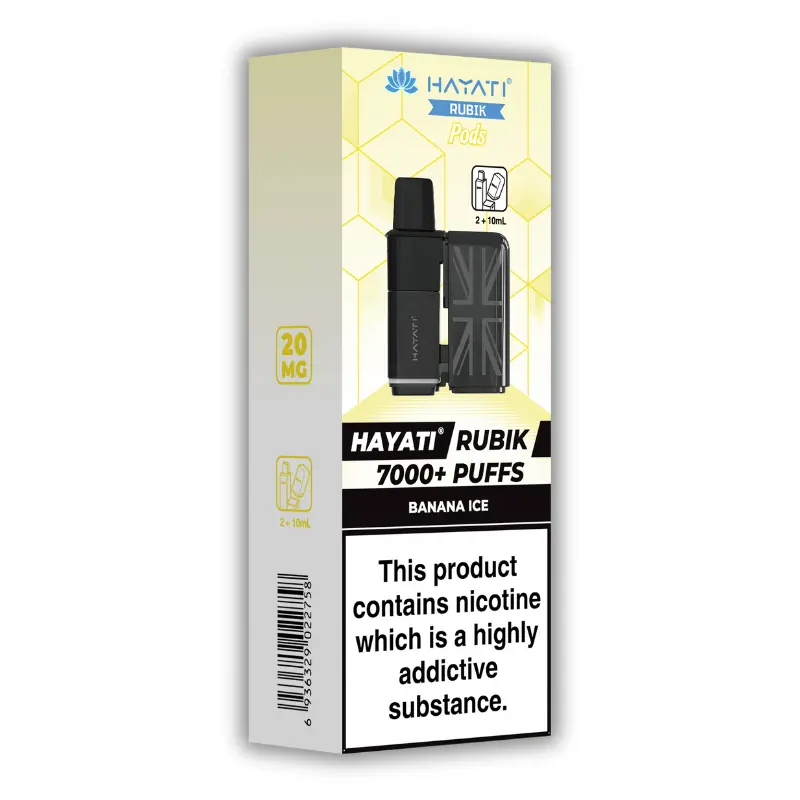
Home / Hayati Pods / Banana Ice Hayati Rubik Pods
Hayati · Rubik
Banana Ice Hayati Rubik Pods
£3.99
✔ In stock — ready to ship
Genuine Hayati
Free over £20
Same-day dispatch
Secure checkout
Banana Ice Hayati Rubik Pods is the refill sold on its own: one prefilled pod at £3.99, holding 12ml of 20mg nicotine salt, carrying a manufacturer laboratory estimate of up to 7,000 puffs. No device is included. That makes it a different purchase from the Banana Ice Hayati Rubik Prefilled Pod Kit at £5.99 in every respect except the liquid inside, and the difference is not really the £2.00. A kit buyer is deciding whether to own a Rubik and whether to like banana. A refill buyer settled both of those questions weeks ago and is now doing something nobody writes about, which is finding out whether a decision keeps being right.
This page is written for the second pod and the ones after it. That is a deliberate choice, and it is also the only honest one available here, because at the time of writing no page on this shop has described Banana Ice at all. It is sold eight times over across the range and analysed nowhere, so the flavour work is done here at length rather than deferred to a twin that does not exist yet.
There is a reason to take the liquid seriously beyond simple gap-filling. Hayati sell four banana recipes and this is the only one in which the banana has no fruit beside it. Mango Banana puts a second tropical fruit in front of it. The two Kiwi Banana listings put a green acid or a red berry next to it behind a collar. Banana Ice puts a coolant over it, and a coolant is not a flavour in the way a second fruit is. So this listing is the single place in Hayati's four hundred and ninety-two products where you can hear the house banana unaccompanied, and that turns out to matter a great deal for the question a refill buyer is actually asking, which is whether a liquid with one voice in it survives being the thing you vape every day.
The only place in the range the banana stands alone
The counting groundwork here belongs to another page and there is no point repeating it badly. The Mango Banana Hayati Pro Max Plus Pods listing's kit sibling established the chemistry, and the Kiwi Banana / Straw' Banana Hayati Pro Ultra Plus Pods page established the catalogue arithmetic: twelve banana listings out of four hundred and ninety-two, resolving into four distinct recipes, of which eight listings are this one. Both of those figures still hold on a fresh read of the catalogue, and the Banana Vapes shelf is short enough that anyone can check it in a minute.
What that page did not need to say, because it was writing about a divided pod with two partners in it, is the consequence for the one recipe that has no partner. Set the four names side by side and the asymmetry is obvious. Mango Banana attaches a fruit. Kiwi Banana / Straw' Banana attaches two different fruits on two settings. Kiwi Banana / Strawberry Banana does the same at a larger volume. Banana Ice attaches Ice.
Ice is not a fruit and it does not behave like one. A second fruit adds material: new aromatics, usually some acid, a different weight, something for the palate to move between. A coolant subtracts. It occupies a sensory channel that is not taste at all, it carries no aroma of its own worth naming, and every account Hayati publish of this recipe describes its job as corrective rather than additive, which is a point the next section demonstrates from their own copy rather than asserting. The practical upshot is that Banana Ice is a one-ingredient liquid with a brake fitted, and none of the other three banana listings is.
A version of that claim that does not survive counting
The tempting way to write the paragraph above is to say that Banana Ice is the only single fruit with a coolant over it on this shelf, and that is false. Count the nineteen listings on the Hayati Rubik Pods shelf and three of them are built exactly the same way: Watermelon Ice Hayati Rubik Pods, Red Apple Ice Hayati Rubik Pods and Pineapple Ice Hayati Rubik Pods all name one fruit and one coolant and nothing else. On the shelf you are actually shopping, this construction is common rather than unique.
So the claim has to be narrowed, and the narrowed version is about the fruit rather than the format. Watermelon, apple and pineapple all bring some acid with them; a pineapple in particular arrives with a sharpness that does part of the same work a coolant does. Banana brings none. What is genuinely unusual here is not one fruit plus ice, it is one fruit plus ice where the fruit contributes nothing that pulls against its own sweetness. That is the version this page is prepared to defend, and it is narrower and more useful than the one I started with.
The other tempting overstatement is that a soft, low-contrast fruit is rare in the range generally. It is not. Peach is soft, as Juicy Peach Hayati Rubik Pods demonstrates and as the Juicy Peach Hayati Rubik Prefilled Pod Kit page examines in detail. Strawberry is soft in most of the eighty listings that carry its name. Banana is not alone in being gentle. It is alone in being gentle and carried by a single dominant signal at the same time, which is the combination the rest of this page turns on.
Eight listings of one recipe, lined up against each other
Hayati write fresh copy for every listing rather than syndicating one description across a flavour, which means eight independent descriptions of Banana Ice exist and can be read against each other. Nobody writes a product description as part of an argument, so where eight separate passes agree, the agreement is worth something. Where one dissents, the dissent is either the most interesting thing available or a copywriter reaching for a different adjective on a Tuesday, and saying which is the actual work.
The eight are the 10ml nic salt at £2.49, the Pro Max Plus pod kit at £7.99, the Banana Ice Hayati Pro Max 70/30 E-Liquid at £6.99, the Banana Ice Hayati Pro Max 50/50 Shortfill E-Liquid at the same price, the Rubik kit at £5.99, the nicotine pouch at £4.49, this pod at £3.99 and Banana Ice Hayati Pro Max Plus Pods at £5.49. Four formats, three platforms, one recipe name.
What all eight assert
Every one of the eight says the banana is ripe and every one says it is soft, mellow or both. Not a single description in the set reaches for a green banana, an underripe note, a plantain, a fried or baked treatment or anything else that could have distinguished one listing from another. Eight writers, working at different times on different platforms, all landed on the same stage of ripeness. That is about as close to a fact as a product catalogue will give you: whatever else is uncertain, this is not a green banana and it is not a dessert banana either.
Every one of the eight also says the fruit is sweet and none of them says it is sharp, sour, tart or tangy. Three go further and explicitly rule sharpness out. The nic salt listing states there is nothing sour about it. The Rubik kit calls the fruit less sharp than most fruits. This listing puts the fruit on the rounded side of a rounded-versus-sharp contrast. Across the range, tart and tangy are house vocabulary that appear in the hundreds and mean very little, so their complete absence from a set of eight is more informative than their presence would have been.
The third agreement is the one that matters most for this page, and it took lining the eight up to see it. Every listing that mentions what the cooling is doing describes it as preventing a fault rather than contributing a flavour. The nic salt says it keeps the sweetness in check. The 70/30 says it stops the exhale becoming heavy. The 50/50 says it keeps the liquid from sitting heavily. The Rubik kit says it stops the fruit feeling heavy. This listing and the Pro Max Plus refill both say it stops the banana turning cloying, which is a word that appears in nineteen descriptions across the catalogue and is doing unusually specific work in these two.
Not one of the eight describes the cold as something you taste. None of them gives it a character, a direction, a mint, a eucalyptus edge or a name. It is uniformly a brake. Eight independent attempts to describe the same liquid produced no dissent on that point at all, and the consequence is the spine of the argument further down: this pod contains one thing you taste and one thing that stops the thing you taste from becoming too much of itself.
Where the eight disagree, and what the disagreements are made of
The disagreements are smaller than the agreements and they cluster in one place: texture.
Seven of the eight attach a cream word to the fruit. The one that does not is the cheapest listing in the set, the 10ml nic salt at £2.49, which reaches instead for a round character. That is a curious outlier and I would not build much on it, because the likeliest explanation is that a bottle description written for a different shelf simply used a different adjective. It is worth recording rather than interpreting.
One listing is genuinely alone. The Pro Max Plus refill calls the texture velvety, and velvety appears in exactly four descriptions across the whole catalogue, the other three being two peaches and a mango blend. That is a rare word being spent on this recipe once. Against it, the Pro Max Plus pod kit calls the same texture rich, the Rubik kit calls the fruit's character naturally rich, and this listing uses rich as well. Rich and velvety are not the same claim: rich is about weight, velvety is about smoothness. The set is telling you the liquid has both properties without ever quite agreeing which one leads.
Two listings reach for temperature metaphors and they are not the same metaphor. The nic salt imagines the fruit taken out of a freezer. The family listing for the Pro Max Plus zero-nicotine refills imagines it taken out of a fridge. A freezer implies a hard, numbing cold with the fruit's aroma partly shut down by it; a fridge implies a fruit that is merely chilled and still fully itself. Those describe meaningfully different liquids, and the honest reading is that nobody was measuring anything. The cooling level in this pod is not published and cannot be inferred from the copy, which is exactly what the Blue Frozen Hayati Pro Max Plus Pods page established for the range as a whole when it counted every cold word in the catalogue and found the vocabulary ungraded. Ice appears in ninety titles, Frozen in three, Cooler in two, and neither Chill nor Freeze appears in a title at all. Those counts still hold. The word on this pod tells you there is cooling in it and nothing whatever about how much.
The one thing this listing says that the other seven do not
Read the eight descriptions for what each one claims uniquely and this pod's own copy turns out to make a claim no sibling makes. It ties the cooling specifically to endurance, saying the chill is what makes the flavour work over a large puff count and that without it the banana would become cloying.
That is a duration claim, and it is the only one in the set. Two other listings gesture at the general idea, the 70/30 calling it an easy flavour to return to and the 50/50 saying it suits somebody who has already settled on banana and ice, but neither connects the coolant to how long the liquid remains tolerable. This one does, and it does so on the cheapest prefilled format Hayati sell, in a pod holding twelve millilitres, in a listing bought overwhelmingly by people on their second or third purchase.
So Hayati's own copy on this exact listing raises the question this page exists to answer. Their claim is that the coolant is what allows a rich, sweet, single-note fruit to survive a long run. That is a testable proposition rather than marketing noise, and the rest of the page takes it seriously in both directions.
The cream word, a census that needed redoing, and a sharper number
The Kiwi Banana / Straw' Banana page noticed that Hayati's copywriters reach for cream language around banana far more often than chance would explain, counted it, and used the count as evidence. That census belongs to that page and the underlying explanation belongs to the Mango Banana Hayati Pro Max Plus 6000 Pod Kit page, which sets out why an aroma with no dairy in it produces a creamy impression anyway. Neither is rebuilt here.
The figures do need refreshing, because a count is only true on the day it is run and the catalogue has moved. Searching the current four hundred and ninety-two descriptions for cream, creamy and creaminess returns twenty-six listings rather than the twenty that page reported, and widening the match to include creamier returns twenty-eight. My own brief handed me a third figure, twenty-three, with the banana share put at roughly a third. Both the total and the share turned out to be wrong, and the corrected version is stronger than either.
The refinement the earlier count did not make is that not every appearance of the word is a claim. Four of the twenty-six use it to say the product is the opposite: Mixed Berries offers itself to somebody not in the mood for anything too creamy, Orange Lemon & Lime positions itself against sugary or creamy blends, and both Lemon Lime listings do the same. Those are contrasts, not descriptions, and counting them inflates the total. Strip them out and twenty-two listings apply a cream word to their own liquid.
Of those twenty-two, nineteen involve banana. Only three do not, and they are two tiramisu listings, where an actual dairy element is supposed to be present, and one mango. That is a far sharper result than a third. In this catalogue, the cream vocabulary belongs to a dessert and to one fruit, with a single stray mango, and the fruit takes the overwhelming majority of it.
The number that belongs to this page specifically is narrower still. Of those nineteen banana uses, sixteen are Banana Ice: seven of the flavour's own eight listings plus the nine range-level listings whose default flavour is Banana Ice, including the two Pro Max Plus 4000 listings and the strength variants at 5mg, 10mg and zero. Mango Banana accounts for two and the divided Kiwi Banana pod for one. So it is not banana in general that Hayati's writers describe as creamy. It is this recipe, sixteen times, which is more than seventy per cent of every positive use of the word in the catalogue.
That is worth knowing before you buy a second pod, because it means the impression is not a quirk of one description you happened to read. Sixteen independent writing passes on the same recipe produced the same texture word. Whatever is happening in this liquid is reliable enough to survive being described by different people at different times for different formats, and a repeat buyer is entitled to expect the same thing in pod three that they got in pod one.
The draw, described for a fruit with nothing beside it
What follows is the first draw-by-draw account of Banana Ice on this shop. It is built from the eight descriptions above, from how the compound behind this fruit is known to behave, and from the structural facts of the format. Where I am reasoning rather than reporting, I say so.
The inhale, which arrives complete
Nothing opens this draw. There is no first event and then a second one. The banana is present at full strength from the moment vapour reaches the palate, because the ester carrying it is detectable at very low concentration and there is no lighter, faster component sitting in front of it to arrive first. A blend with citrus in it opens with a spike and then fills in behind it. A blend with a berry in it opens with acid. This opens already at its destination.
The character of that opening is soft and round and immediately sweet, with weight to it rather than brightness. Nothing pricks, nothing lifts and nothing catches at the back of the throat on the way in. If you have been running something with acid in it, such as Lemon Lime Hayati Rubik Pods or Blue Sour Raspberry Hayati Rubik Pods, the first three or four draws of this will read as oddly muffled, and that is a recalibration rather than a fault in the pod.
The middle, where the coolant appears and nothing else does
Somewhere past the halfway point of the draw the cooling begins to register. Every one of the eight descriptions that places the cold puts it late, on or near the exhale, and only one listing in the entire set disagrees, which is the pouch, for a reason discussed further down.
The arrival of the coolant is the only event in this liquid. That is a plain structural statement rather than a criticism: in a two-fruit blend the middle of the draw is where the handover happens and where one fruit gives way to another, and that handover is what makes people describe a blend as interesting or as disappointing. Here, the middle of the draw is where a sweet, heavy fruit stops getting heavier. Nothing new is introduced. Something existing is restrained.
Whether that reads as elegant or as thin depends almost entirely on what you want from a liquid. Somebody who finds most blends busy will hear this as clean and uncluttered. Somebody who vapes partly for the small event in the middle of the draw will find there is nothing there to listen to, and no amount of attention will produce one.
The exhale and the finish
The exhale is where the cold does its work and where the impression of texture is strongest. The fruit broadens rather than sharpens, the cooling runs underneath and slightly through it, and the two do not fight because they are not operating in the same register. What you get is a wide, soft, sweet exhale with a cold edge laid along it.
The finish is long and it stays sweet. There is nothing in this recipe that clears a palate: no acid, no astringency, no dryness, no bitter edge. Banana aroma persists on the breath well after the vapour has gone, and the cooling fades faster than the fruit does, which means the last thing you are left with is not the cold finish the copy advertises but the sweet residue underneath it. That is my inference rather than Hayati's claim, and the reasoning is simply that coolant sensation is short-lived by nature while this particular ester is famously persistent. If you want to check it on your own pod, wait forty seconds after an exhale and see what is left.
Sweetness, placed honestly
This is a sweet liquid and it will read as sweeter than its actual sweetener load, for a reason that has been set out on the Mango Banana kit page and which applies here with one important difference. Sweetness is perceived relative to whatever opposes it, so a liquid with no acid in it reads as sweeter than the same sugar would in a liquid with acid. Mango Banana has nothing opposing it at all and sits very high as a result.
Banana Ice has something opposing it, and that something is the coolant. This is the useful comparison between the two recipes and it is not available to either of those pages, because neither had both liquids in view as a single-fruit-plus-brake against a two-fruit-no-brake. A coolant does not reduce sweetness the way an acid does, since it is not competing on the same axis, but it interrupts the accumulation of it, and accumulation is what makes a sweet liquid eventually unpleasant rather than the sweetness of any single draw. So this should sit lower than Mango Banana on a run of ten draws while sitting at a similar level on any one of them.
Against the Rubik shelf, put an unsweetened tobacco profile at zero and a confectionery build such as Blue Razz GB Hayati Rubik Pods at the top. Banana Ice sits high, above the cooled fruits like Strawberry Raspberry Ice Hayati Rubik Pods, well above anything with real acid in it, and below the gummy and cola builds. High but not at the ceiling, and held there by the only thing in the pod that is not sugar.
What is not in it
- No acid of any kind. No citrus, no berry sharpness, no sour edge, nothing to cut the finish.
- No second fruit. This is the only banana listing Hayati sell of which that is true.
- No dairy, custard or bakery element, despite the cream vocabulary. The creaminess is an impression produced by aroma, not an ingredient, and the Mango Banana kit page explains the mechanism properly.
- No mint or menthol named. Ice is an ice-family word and, per the Blue Frozen census, the range never combines an ice word with a mint word in a title.
- No caramelised, baked or fried treatment. Every description in the set points at fresh ripe fruit.
- No stated coolant intensity. The listing does not publish one and neither does any sibling.
The question a third pod asks that a first one cannot
Here is the argument this page was written to make, and it is only available to somebody buying a refill.
A flavour with one voice and no internal event is the hardest kind to keep noticing. That is not a claim about banana being boring, and it is not a claim about anybody's palate wearing out. It is a claim about structure. Attention is drawn by change, and this liquid presents the same thing at the same intensity from the first millisecond of the inhale to the end of the exhale, varied only by a brake that arrives late and has no flavour of its own. There is no handover, no acid spike, no second fruit taking over the bottom of the draw, nothing that could be described as happening. A liquid with an event in it gives you something to re-notice on the four hundredth draw. This one has nothing to offer except the thing it offered on the first.
Set against that is the fact that most people's daily liquid is not interesting and does not need to be. The genuinely engaging blends in the range are frequently the ones people cannot run continuously, precisely because the thing that makes them interesting is also the thing that becomes tiring. A liquid you stop noticing is, from one point of view, exactly what a daily liquid should be: reliable, low-demand, out of the way. Nobody wants to pay attention to their eleventh draw of the afternoon.
So the pod-three question is not whether the flavour fades, which it does not, but which of two things you actually want. The catalogue offers both and they are not ranked.
Two ways this ends, and how to tell which one you are in
By the middle of a third pod, roughly thirty-six millilitres in, most people arrive at one of two states with a single-note liquid.
In the first, the liquid has become furniture. You no longer register the banana as a flavour, you register it as the absence of anything wrong. Draws are pleasant and unremarkable, you rarely think about the pod, and you would notice immediately if it were replaced with something else. This is a success. A daily liquid that has become furniture is doing its job, and the correct response is to keep buying it and to stop expecting a verdict.
In the second, the sweetness has started to feel like an imposition. The finish outstays its welcome, the fourth draw in a run tastes of the third, and you find yourself wanting something with an edge on it before the pod is finished. This is also a real outcome and it is the one Hayati's own duration claim is quietly betting against. If it happens, the flavour has not failed; it has told you it is a rotation member rather than an all-day liquid, and the sensible response is to stop buying it as a single pod and start buying it as one of two.
The signal that separates them is not the first draw of a session, which tells you very little about anything. It is the fourth or fifth draw in a continuous run. On a liquid with a brake that works, the fifth draw tastes roughly like the second. On a liquid whose brake is losing to accumulation, the fifth draw tastes of the residue of the previous four, and the finish is noticeably sweeter than the inhale. That comparison costs nothing, takes thirty seconds and can be run on any pod at any point in its life.
The problem with running that test from memory
There is a hole in everything above, and it is worth stating plainly rather than writing around.
Every judgement in the previous section compares the liquid now against the liquid as you remember it. By pod three you have several weeks of drift in that memory and no way to audit it. You cannot tell whether the banana has become less interesting or whether you have simply stopped attending to it. You cannot tell whether the sweetness has genuinely accumulated or whether you are noticing something that was always there. And the obvious fix, fitting a fresh pod, does not repair a memory, because a fresh pod is another reading of the same drifting scale.
Three pages on this shelf already work on the neighbouring version of that problem, which is separating a tiring coil from a tiring palate, and they do it well. Blue Razz Cherry Hayati Rubik Pods sets out how to overlap a loaded pod with a fresh one so that the liquid is held constant and only the coil moves. Blue Sour Raspberry Hayati Rubik Pods shows that the pod boundary resets a coil effect and cannot reset a palate effect, and uses the boundary as the discriminator. Blueberry Cherry Cranberry Hayati Rubik Pods runs the same separation across three successive changeovers. None of that is repeated here and all three are worth reading if the coil is your question.
The problem in this section is a different one. It is not coil against palate. It is the recipe against your memory of the recipe, and no comparison conducted entirely inside a vape can settle it, because every reading available inside a vape is taken through the same coil, the same device and the same accumulated habit. What is needed is a reference that sits outside all of that, and this flavour, alone in the range, has one for sale.
The fixed reference this flavour has and no other does
Hayati sell eleven nicotine pouch flavours: Strawberry Lychee, Ruby Berry, Mango Ice, Ice Cold, Grape Ice, Frosted Mint, Cola, Coffee, Bubblegum, Blueberry and Banana Ice, all at £4.49. Check each of the eleven against the prefilled pod listings and ten of them have no pod anywhere in the range. Banana Ice is the only flavour name Hayati sell both as a pouch and as a prefilled pod, and it does it four times over on the pod side.
I checked that against the catalogue rather than taking it on trust, and it survives cleanly, which is not the usual outcome for a claim of this shape. Nine of the other ten are not close: there is no Ruby Berry pod, no Coffee pod, no Bubblegum pod, no plain Blueberry pod, no Ice Cold or Frosted Mint pod. Mango Ice, Grape Ice and Cola have relatives in the pod range under different names, but no listing matching the pouch's flavour name, and a relative is not a reference. Banana Ice is the only exact match, and that is the whole basis of what follows.
Why an external reference is a different instrument
The Kiwi Banana page already made the observation that this recipe survives as a pouch at all, and used it as evidence that banana is an unusually robust fruit to render: a pouch has no vapour and no coil and still reads unmistakably as banana, which very few fruits would manage. That observation is theirs and it is correct. What nobody has done is notice that the same fact hands a repeat buyer of this pod something to use.
A pouch of this recipe costs £4.49 and has no coil in it, no heat, no wick, no airflow path and no ageing element of any kind. It cannot gunk, it cannot deliver less than it did last week, and its output does not depend on how long you have owned the thing it came in. It is, for the specific purpose of checking what this recipe is supposed to taste like, a fixed point. Every reading you can take inside a Rubik moves. This one does not.
That is what makes it different from every method already published on this shelf. A fresh pod is a good instrument for a coil question and a useless one for a memory question, because the fresh pod and the old pod are both read through the same drifted scale. The pouch is read through the same drifted scale too, but it is not the thing being measured. It is a standard you can return to on the day you buy your first pod and again on the day you are wondering whether to buy your fourth, and the only variable between the two readings is you. That is precisely the variable the vape-only methods cannot isolate.
How to actually use it, and what it will and will not tell you
The honest procedure is short. Buy one pouch listing at the same time as your first or second pod, taste the pouch and write down three words about the fruit while the pod is new. Put it away. When the question arrives two or three pods later, take the same reading again and compare the words, not the impression.
If the pouch reads the way you remember it and the pod does not, the drift is in the pod or the device, and a fresh pod is the next test rather than a new flavour. If the pouch also reads flatter and less interesting than your note says, the drift is in you, and no change of pod will fix it. That is a genuinely useful fork, it costs one pouch listing, and it is available to buyers of this recipe and nobody else in the range.
Three limitations, all real. The pouch is a different format with a different delivery, so the comparison is about the identity and character of the fruit, not about intensity or about how much vapour anything produces. Do not try to compare strengths across the two; the pouch publishes its own figure on its own listing and it is not measuring the same thing as a pod's milligrams per millilitre.
The second limitation came straight out of the eight-listing diff and it is specific. The pouch is the only one of the eight descriptions that does not put the cooling on the exhale, because a pouch has no exhale; its copy says the sweetness and the cooling are released together and steadily. So the sequence differs between the two formats by construction, and a reading taken from the pouch can confirm what the fruit is and cannot confirm when the cold arrives. Use it for identity, not for structure.
The third is that one reading is one reading. A single comparison on a day when you have a cold, or twenty minutes after coffee, tells you nothing. The method is worth something over two or three repetitions spaced across pods and worth very little as a one-off, which is true of every sensory comparison anybody will ever recommend to you.
The Rubik, briefly
What arrives is one prefilled pod and nothing else. There is no device, no charging accessory and no second pod in the pack, and the Hayati Rubik shelf holds the complete kits for anyone who needs the body as well. Match the range name printed on your device against the range name in this title before ordering.
The single specification that matters for this particular liquid is the twelve millilitre fill, because it sets the interval at which every judgement in this page gets made. A smaller format would put you at a changeover before a slow effect had room to happen; twelve millilitres is long enough that a pod is a genuine period of ownership rather than an evening. The 20mg strength is the UK maximum for nicotine e-liquid and is standard across every prefilled pod Hayati sell, so it is not a point of difference between this and anything beside it on the shelf.
Two economic arguments about this platform are already made properly elsewhere and are not repeated here. The Vim Ice Hayati Rubik Prefilled Pod Kit page prices this liquid per millilitre against every other prefilled format in the range and works out what the saving costs in flavour choice. The Blue Razz GB pods page sets out what £3.99 is the floor of across four platforms. If the money is your question rather than the flavour, both are better on it than anything this page could add.
What Hayati do not publish about this pod: no coil resistance, no wicking specification, no wattage, no information about how the pod is retained in the bay, and no indication of the coolant level beyond the word Ice in the title. Those blanks are marked as blanks in the table below rather than filled with something plausible.
The figures, and the rows that are empty
| Price | £3.99 |
| What you receive | One prefilled replacement pod, no device |
| Liquid volume | 12ml |
| Nicotine | 20mg nicotine salt |
| Manufacturer puff estimate | Up to 7,000, a laboratory figure |
| Cost per millilitre | Just over 33p |
| Platform | Hayati Rubik |
| Flavour construction | Single fruit plus coolant |
| Coolant strength | Not published |
| Coil resistance | Not published |
| Refillable | No, the pod is prefilled and replaced whole |
Two of those rows are worth reading against each other rather than in isolation. Twelve millilitres at £3.99 works out at a fraction over thirty-three pence a millilitre, and the same recipe in the Pro Max Plus refill is 12ml at £5.49, which is a little over forty-five pence. That is the same liquid at two prices on two platforms, and the gap is a property of the hardware you already own rather than of the flavour, which is one of the few things a refill buyer genuinely cannot change.
The puff figure is a manufacturer laboratory estimate and should be read as a comparison between Hayati's own listings rather than as a prediction about your week. The number that will actually govern how long a pod lasts you is the twelve millilitres, and even that depends on how you draw.
The empty rows are the interesting ones for a repeat buyer. Because the coil specification is unpublished, there is no way to tell from the listing whether pod three should behave identically to pod one, and because the coolant level is unpublished, there is no way to tell whether a batch that reads colder is a variation or your imagination. Both of those are questions the reference described above can partly answer and the specification sheet cannot answer at all.
What else £3.99 opens, and who should spend it elsewhere
The eighteen other pods on this shelf all cost the same, which makes the choice between them purely a flavour decision. Sorted by what they would do differently from this one:
If the single-note construction is the problem
The direct answer is a blend with an internal handover in it, which is the thing this pod structurally lacks. Blueberry Cherry Cranberry Hayati Rubik Pods runs three fruits with an arc across the draw and its page is built around exactly that arc. Blueberry Raspberry Hayati Rubik Pods is a two-fruit negotiation rather than a solo. Either gives you something to listen to in the middle of a draw, at the cost of being more demanding over a long run.
If the sweetness is the problem but the softness is not
Juicy Peach Hayati Rubik Pods is the nearest neighbour in temperament: another soft, low-contrast fruit, but one with a trace of acid and a shorter finish. Red Apple Ice Hayati Rubik Pods keeps a familiar fruit and adds a crisp edge this recipe deliberately does not have. Both are the same construction as this one with the brake doing less work because the fruit itself is doing some.
If you want an actual opposite
Lemon Lime Hayati Rubik Pods is citrus with no sweetness to speak of and a finish that clears rather than lingers. Blue Sour Raspberry Hayati Rubik Pods puts acid at the front of the draw where this puts weight. Fresh Mint Hayati Rubik Pods is the shelf's clearest palate reset and its page argues that its real job is making other flavours audible again, which is a genuinely useful role beside a liquid as heavy as this one.
If you want a rotation partner rather than a replacement
A single-note sweet liquid pairs best with something that has no overlap with it at all. Mint is the obvious one. After that, Vim Ice Hayati Rubik Pods is the shelf's cold, sharp soft-drink build and sits at the far end from this, while Lemon Cola Ice Hayati Rubik Pods is sweet in a completely different direction, with citrus and a cola spice where this has a fruit ester. Running two pods in alternation costs £7.98 rather than £3.99 and is the standard answer for anyone who finds a single flavour tiring, though the arithmetic of doing that properly belongs to other pages on this shelf.
The same recipe on other hardware
If the platform rather than the flavour is what is wrong, the same liquid is on four other formats. Banana Ice Hayati Pro Max Plus Pods is the direct equivalent at £5.49 for the same twelve millilitres and is the listing that calls the texture velvety. The Banana Ice Hayati Pro Max 50/50 Shortfill E-Liquid puts the recipe into a refillable device at 120ml, which changes the economics completely and hands you control of the strength. Banana Ice Hayati Pro Max 70/30 E-Liquid is the high-VG version for sub-ohm tanks and is a genuinely different experience of the same fruit, because a thicker vapour changes how the creaminess reads. And the Banana Ice Hayati Rubik Prefilled Pod Kit is the same pod with a body attached for anyone who needs a second device.
The other bananas, and the wider soft-fruit family
Mango Banana Hayati Pro Max Plus Pods is the same lead fruit with a second tropical fruit in front of it and no coolant at all, which makes it the direct test of whether the brake is what you value here. Off the banana shelf, Smooth Strawberry Ice Hayati Pro Max Plus Pods is the closest thing in temperament on another platform: a soft red fruit with a coolant over it and the same low-contrast construction. Kiwi Cooler Hayati Pro Max Plus Pods goes the other way, pairing a cooled build with a fruit that brings real acid. Strawberry Ice Hayati Mini Ultra Pods at £3.49 is the cheapest way in the range to try the same soft-fruit-plus-ice idea at a smaller volume before committing twelve millilitres to it.
Further out, the divided pods put two flavours behind one collar and are a different proposition entirely. Straw' Cranberry Cherry/Strawberry Raspberry Ice Hayati Pro Ultra Plus 25K Pods is the clearest example of the structural answer to everything this page says about a single voice, since a collar lets you change register mid-session rather than between pods. Cherry Ice and Cola Ice on the same platform are the larger-volume single flavours if the Rubik's twelve millilitres is what feels small. Every pod Hayati sell, two hundred and two of them, sits on Hayati Pods for anyone who would rather browse than be advised.
Living with a pod of this one
Most handling advice is the same on every pod in the range and there is no point restating it here in a new order. What follows is the part that is specific to a sweet, single-note liquid with no acid in it, because that combination behaves differently from a sharp one in three particular ways.
Give a fresh pod a few minutes before the first draw. A prefilled pod that has been in a box needs the wick fully wetted, and on this liquid a dry first draw is more noticeable than on most, because there is no acid or coolant sharpness to distract from a scorched note. Fit it, leave it, then start.
Chained draws punish this recipe more than most. With no acid to clear the palate, the residue of one draw is still present when the next one lands, and the effect compounds faster here than on anything with an edge to it. If the liquid starts tasting flat and over-sweet in the middle of a session, the first thing to change is the gap between draws rather than the pod.
Sweet liquids load a coil, and here you lose the coolant first. The cold sensation is the lightest thing in this pod and the least concentrated, so a tiring coil takes that before it touches the banana. The practical signal, and it is a specific one for this flavour, is that the pod stops tasting cold while still tasting strongly of fruit. When that happens you are not losing the flavour, you are losing the brake, and the liquid will feel heavier and sweeter than it did in week one for that reason alone.
Storage matters for a spare, particularly if you intend to compare it. Heat and light both work on a prefilled pod over weeks, so a spare left on a sunny windowsill or in a car is no longer a fair fresh reference for anything. Keep spares somewhere dark and at room temperature, and keep them out of reach of children and pets.
Knowing when it is done. This pod is not refillable and is replaced whole. The usual end signal on a cooled fruit is that the cold goes and the flavour thins, but on this one the two do not arrive together: expect the cold to go first and the fruit to keep going for a surprisingly long time afterwards. If you are still tasting banana but the draw has become warm and syrupy, the pod is finished even though it does not taste empty.
Disposal. A spent pod contains a coil and a residue of liquid, so it does not belong in household waste. Take it to a retailer take-back point or a local recycling facility that accepts electrical items.
Questions a second or third order raises
Is this a sweet-shop banana or a fruit banana?
Both, in the sense that the two are carried by the same aroma compound and cannot be fully separated. Hayati's eight descriptions all point at ripe fresh fruit rather than confectionery, and there is no sugar-dusted or foam-sweet framing anywhere in the set. If banana liquids have consistently read as sweets to you in the past, this one will too, and the Kiwi Banana page explains why that reaction is chemically earned rather than a fault in anybody's formulation.
How cold is the ice in it?
Not published, and not inferable. Hayati use Ice on ninety titles across the range with no gradation between that word and the two others they use, so the word tells you cooling is present and nothing about how much. The only substantive thing the copy says is that the cooling is there to stop the fruit becoming heavy, which suggests it is doing a corrective job rather than being a feature in its own right.
Is this the same liquid as the Rubik kit?
Yes. The kit at £5.99 is this pod with a device attached, and the pod is what you buy once you have the device. The kit's own description and this one differ in wording but describe the same recipe, and the flavour analysis on this page applies to both.
Why is the Pro Max Plus version of Banana Ice more expensive for the same 12ml?
Because it is a different platform, not a different liquid. The Pro Max Plus refill is £5.49 against £3.99 here for the same volume and the same strength, and the difference reflects the hardware the pod is made for rather than anything in the recipe. Which one is available to you is decided by the device you already own.
Will I get bored of it?
Possibly, and the honest answer is that it depends on whether you want a flavour you notice or a flavour you do not. This is a single-note liquid with no internal event, so there is nothing in it to rediscover on pod three. For a lot of people that is exactly the right property in an everyday pod, and for others it is the reason to keep it as one of two in rotation.
Is there any acid or sharpness at all?
No. Nothing in the eight descriptions names a sour, tart or tangy element and three of them explicitly rule sharpness out. The cooling is the only thing in the pod working against the sweetness, and it works in a different way from an acid: it interrupts accumulation rather than cutting the sweetness of any individual draw.
What is the creaminess, and is there dairy in it?
There is no dairy. The creamy impression comes from aroma implying a texture the vapour does not have, a mechanism set out on the Mango Banana kit page. What is notable is how consistent the impression is: sixteen separate listings across the catalogue describe this one recipe with a cream word, which is more than seventy per cent of every positive use of that vocabulary in four hundred and ninety-two products.
How does it compare with Mango Banana?
Same lead fruit, opposite construction. Mango Banana puts a second tropical fruit in front of the banana and has no coolant at all, so it is richer, has a handover in the middle of the draw and nothing restraining the sweetness. This has no second fruit and a brake. If you liked Mango Banana but found it heavy over a long run, this is the version with the problem addressed.
Can I refill the pod when it is empty?
No. It is supplied prefilled and sealed and is replaced as a whole unit rather than topped up. If refilling is what you want from this flavour, the 50/50 shortfill puts the same recipe into a refillable device at 120ml.
Does the flavour change across a pod?
I would expect the cold to fade before the fruit does, for the straightforward reason that the coolant sensation is the lighter and less concentrated of the two and a loading coil takes lighter things first. That is reasoning rather than a published fact, and Hayati state no coil specification against this listing that would settle it. The test on your own pod is whether a late draw still reads cold or only reads sweet.
Is buying the pouch version actually worth it?
Only if the question you have is whether the recipe has changed or whether you have. As a fixed point with no coil and no heat in it, it answers that and nothing else, and it costs £4.49. If your question is about the coil, a fresh pod answers it better and three pages on this shelf explain how to run that comparison properly.
How many Banana Ice listings are there in total?
Eight, across four formats: two 120ml bottles, one 10ml bottle, one nicotine pouch, two Rubik listings and two Pro Max Plus listings. Four of the eight are cooled fruit in a prefilled pod, which is an unusual amount of shelf space for one recipe in a range where most flavours appear two or three times.
Where this leaves the reorder
Banana Ice Hayati Rubik Pods is a twelve millilitre refill at £3.99 containing the only unaccompanied banana Hayati sell. The fruit is ripe, soft, sweet and rich, with no acid anywhere in it, and the cooling that arrives late in the draw is a restraint rather than a second flavour. Everything the eight published descriptions agree on points the same way, and the one claim this listing makes that its siblings do not is that the chill is what lets a rich single fruit survive a long run.
Whether that claim holds for you is a question only a second and third pod can answer, and the difficulty is that the instrument you would normally use, your memory of pod one, has been drifting the whole time. That is the one problem this particular flavour hands you a tool for, because it is the only recipe in the range sold in a format with no coil and no heat in it, at £4.49, which you can return to as a fixed reference whenever the doubt arrives.
Buy it if you want a low-demand daily liquid that stays out of the way, and buy a second pod of something sharp alongside it if the fourth draw of a session has started tasting of the third. Neither of those is a failure of the flavour. They are two different jobs, and this pod is good at exactly one of them.
Strictly for adults aged 18 and over. Nicotine is an addictive substance.
You might also like


