
Home / Hayati Pods / Lemon Lime Hayati Rubik Pods
Hayati · Rubik
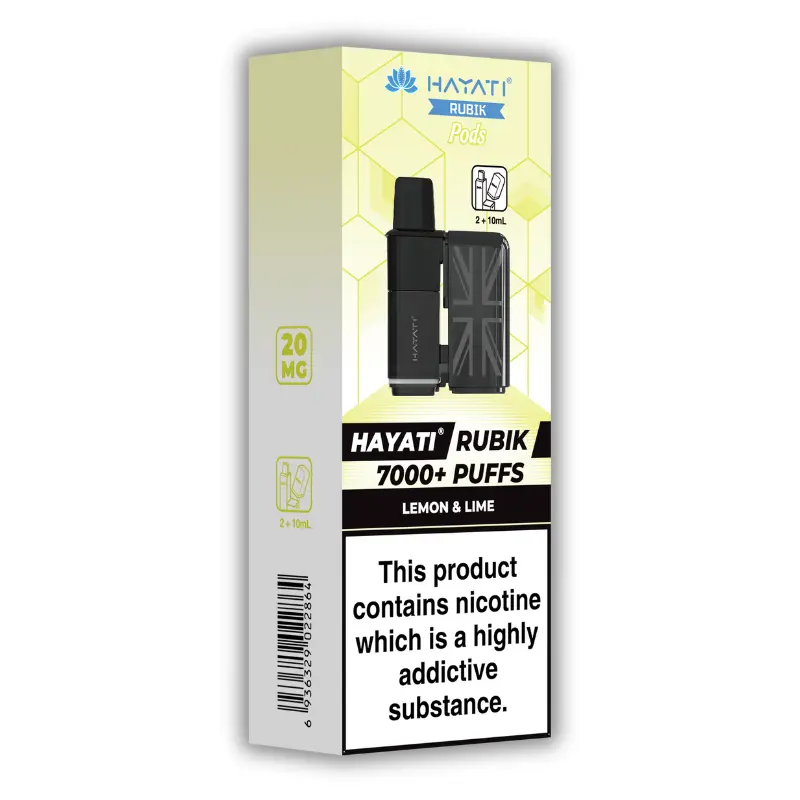
Lemon Lime Hayati Rubik Pods
£3.99
✔ In stock — ready to ship
Genuine Hayati
Free over £20
Same-day dispatch
Secure checkout
Twelve millilitres of two-fruit citrus at 20mg nicotine salt, sealed into a pod that does nothing at all until it is sitting in a Hayati Rubik body, for £3.99. Hayati print a laboratory rating of up to 7,000 puffs against it, which is a bench figure rather than a promise about your fortnight. No device comes in the pack. It is one of nineteen refills on the Hayati Rubik Pods shelf, and the only thing separating it from the other eighteen is the liquid.
Almost nobody arrives at a bare refill without a history. You own the body, you have run at least one pod of this flavour, and the question that brought you here is not what lemon and lime taste like. The complete kit listing has already done that work and it has done it thoroughly, including an argument about when to throw a pod away and what the thrown-away liquid costs. This page is about what happens to that argument on your third pod, your fifth and your tenth, because the argument depends on a measurement and the thing taking the measurement is you.
Here is the short version. The kit's replacement policy fires on a single event: the disappearance of a faint bitter edge at the very end of the draw. Everything else in the policy, the arithmetic, the crossover points, the £1.33 a pod you agree to bin, hangs off that one reading. A reading of that kind is not a fact about the pod. It is a comparison between what you are tasting now and what you remember tasting before, taken by an instrument that has been breathing the same two fruits for weeks. The kit page handles two reasons the reading can go wrong and both of them are things that happen on a single afternoon. There is a third, it works on the same timescale as the pod itself, and nothing in this catalogue currently catches it.
What the kit listing settled, so that none of it is rebuilt here
Everything in this section belongs to Lemon Lime Hayati Rubik Prefilled Pod Kit and is cited rather than argued again. Read it there if you want the working; what follows is only enough to make this page legible on its own.
The central argument. Lime lands at the finish, it is the first thing a tiring element drops, and because the recipe has two components and no sugar beneath them its loss is categorical rather than a fade, leaving a plain lemon that the catalogue sells in none of its 492 listings.
The economics. Cost per millilitre actually drawn is £3.99 divided by T, the volume that has crossed the element by the time the finish goes, and the kit page runs that division across all four platforms selling this liquid, marking the crossover against the always-fresh 4ml format at 4.6ml, the break-even against a Pro Max Plus pod drained completely at 8.7ml, and the same against a 22ml pod at 11ml. At an eight-millilitre retirement point it prices the binned liquid at £1.33 a pod and £16.63 per 100ml actually drawn, then restates the thresholds as fractions of a pod because millilitres are invisible through a sealed shell.
The limits and the exception. Three caveats travel with those figures and they are the kit page's: the shared recipe across platforms is an inference rather than a published fact, a constant T is an assumption with no resistance figure anywhere to support it, and the policy only pays if you keep it. Fizzy Cherry is named as the one Rubik flavour it cannot run on, having a kit and no matching standalone refill.
The listing diff. Lining up all eleven descriptions Hayati write for this liquid, the kit page finds green as the house word for the lime and absent from both Rubik listings, bitterness named by only three of the eleven with two of those three being the Rubik pair, sweetness attached to the lemon and never to the lime, and the two Pro Max Plus listings alone in sugaring the blend; it then resolves the two Rubik listings' disagreement about whether the fruits fuse or arrive in sequence by pointing at draw length.
The asymmetry and the instruction. Lemon carries recognition, persists longest and can head a name while lime does none of those and only terminates a draw, which produces two different buyers, and the instruction that makes the policy operable at all: buy the replacement when you open the current pod, not when you retire it.
The two confounds it already handles. A short draw ends before the finish has happened, so lengthen the pull by a second before condemning anything; and an acutely compromised palate, from coffee or a heavy sweet pod or a cold, is checked against a landmark pod of unmistakable character.
What is not covered is the instrument. Both confounds are events. They happen today, they are gone tomorrow, and a check taken this afternoon answers them. The policy, though, runs for months, and the trigger it runs on is the presence or absence of something the source copy itself describes with the word faintly.
Counting the word before building anything on it
The convenient version of this argument would start from a claim about perception, that bitterness is the channel with the fastest-building adaptation and the widest spread between people. That is not checkable against anything on this site, so the page does not run on it and the claim has been narrowed to what the catalogue can actually support. What is checkable is how the word behaves in Hayati's own copy, and the count turned out to be more useful than the assertion it replaced, as well as pointing in two directions at once.
The word bitter appears in 11 of the 492 listings in the catalogue. That is 2.2 per cent, which puts it among the rarest descriptors in the house vocabulary. For scale, sweet appears in 464 listings, tart in 198, sugar in 124, sour in 73 and zest in 68. Green, the word the kit page identifies as the house term for this lime, appears in 35. Bitter sits near the floor with acid, also 11, and well below anything a copywriter reaches for by habit.
That number cuts against the version of my angle I arrived with, and I would rather say so than quietly drop it. The observation that eight of eleven Lemon Lime listings never mention bitterness sounds like eight independent describers failing to find the note. It is not. In a house that uses the word about once in every forty-five listings, silence is close to free, and you cannot read a negative report out of it. Eight listings not saying bitter is eight listings behaving normally.
Now the other direction, which is the finding worth having. Of those 11 catalogue-wide uses, five are attached to lime. Two more belong to green tea, two to grapefruit as the compound bittersweet, one to a coffee pouch, and one is a negative, a listing saying a flavour has no bitter edge at all. Nothing else in 492 products carries the word. So when Hayati's copy does reach for bitterness, lime is where it lands more often than any other ingredient in the range, and it lands there five times. The note is not a Rubik invention and it is not a stray adjective.
Here is the part that matters for a policy. Not one of the ten positive uses in 492 listings states bitterness at full strength. Every single one is either hedged with a diminutive or fused into the compound bittersweet. The five lime ones read: a faintly bitter twist, a slightly bitter zest, a hint of peel bitterness, a slightly bitter twist from the peel, and a zesty, slightly bitter edge. The green tea pair say a faint bitterness and a subtle bitterness. The coffee pouch says slightly bitter. There is no listing anywhere on this site where anything is simply bitter.
Four of those five lime mentions also locate the note in the same physical place, the peel rather than the juice, using zest, peel or twist, which is a peel word whatever a cocktail menu has done to it. Independent describers converging on one anatomical location is better evidence than the same describers converging on an adjective, because an adjective can be borrowed and a location has to be chosen.
Which three of the eleven, and the pair that disagrees with itself
Inside this flavour's own eleven listings the three that name bitterness are the Rubik refill, the Rubik kit and the Mini Ultra kit. The kit page has two of those three as the Rubik pair and does not say what the third is, so it is worth adding, because the third one sits somewhere significant.
Sort the eleven by platform and the split is clean. The two compact ranges, Rubik and Mini Ultra, supply four of the eleven listings, and three of those four name bitterness. The other seven, which are the two Pro Max Plus listings, the two Pro Ultra Plus listings, the 10ml salt bottle and the two 120ml bottles, name it zero times between them. Three of four against nought of seven.
Two readings are available and honesty requires both. The flattering one is that the compact platforms draw a smaller volume over a younger element, so their describers met the liquid in better condition and found a note the others missed. The unflattering one is that Rubik and Mini Ultra copy appears to come from one pool: the sentence calling each of them one of Hayati's compact, lower-priced ranges appears in 63 listings and in no listing outside those two families. Three mentions from an adjacent batch of copy are not three independent observations, and the phrasing supports that, since faintly bitter twist and slightly bitter twist from the peel are the same construction with one word moved.
And the Mini Ultra pair does not agree with itself. Lemon Lime Hayati Mini Ultra Pods describes the lime as fragrant and grassy and never mentions bitterness; the Mini Ultra kit listing of the same 4ml of liquid on the same body gives it a hint of peel bitterness. The kit page has already documented one intra-platform contradiction on this flavour, between the two Rubik listings on whether the fruits fuse or arrive in sequence, and resolved it with draw length. This is a second one, on a different axis, and it does not resolve the same way, because draw length affects when the finish arrives and not whether the finish has an edge on it. The plainest reading is that two people described one liquid and one of them reached for the word.
Pull that together and the position is narrower than the perceptual claim it replaced, and stronger for being checkable. The bitter edge is real: lime is the catalogue's principal carrier of the word and four describers put it in the same anatomical place. But it is nowhere described as more than faint, by anybody, on any product, and the three reports of it on this flavour come from one corner of the copy. A policy that costs £1.33 every time it fires is being triggered by the quietest thing Hayati's own writers will admit to.
The third cause: the instrument moves
A faint note has no headroom. A loud one can lose half its volume and still be unmistakably present, so a report of it is robust to a good deal of slop in the reader. Something described as faint by five out of five describers is already close to the bottom of its range, and the difference between a faint note and no note is a much smaller distance than the difference between a loud note and a faint one. Which means the trigger is not really asking whether the finish has dimmed. It is asking whether the finish has crossed a threshold. Threshold questions are exquisitely sensitive to where the threshold happens to be sitting, and it does not sit still.
The mechanism is well covered elsewhere on this site and there is no sense in rebuilding it. The Smooth Strawberry Ice pods page sets out the general case, that a sensory system carries information in change rather than in level, so a stimulus met continuously produces a smaller and smaller report and the resting threshold drifts upward. The Double Menthol kit page adds the distinction that matters for anything measured over weeks, which is that there are two clocks: a fast one that runs within a session and resets in minutes, and a slow one that runs across days and weeks of uninterrupted use and does not reset overnight. The T-Misu pods page supplies the third piece, that the spread between people on the slow clock is wide, nobody can tell you your own rate in advance, and the only way to find out is to run one and watch. All of that is taken as read.
What none of those pages is about is a policy that spends money on a threshold reading. They are about a flavour going quiet on you, which is a comfort question. This is a different use of the same phenomenon: here the drift is not the complaint, it is the false positive in a purchasing rule.
Why this is a third cause and not one of the two already on the record
The kit page's two confounds and this one are separated cleanly by their clocks. A short draw is a technique fault, present from the first pod and correctable in one pull. An acutely compromised palate is a single afternoon, correctable by waiting until tomorrow. Both are acute. The slow drift is cumulative, it arrives on the scale of pods rather than sessions, and neither of the two checks the kit page prescribes has any purchase on it, which is worked through in the next section.
It also needs distinguishing from a mechanism that has already been described on a page carrying this same liquid, because the symptom is identical and the cause is not. The Lemon Lime / Lemon Blueberry Pro Ultra Plus 25K Pods page owns the question of why your second pod does not taste like your first, and its answer there is a recency effect: whatever you tasted in the last few days before a pod died is the memory closest to hand when you make the next decision, and under a fixed running order those last few days are always the same half on the most worn element the pod will ever have. That is a story about which memory is available, it is caused by a running order on a divided pod, and it does not apply here at all, because a single-flavour pod has no order to run. The drift this page is about is not a distortion of what you remember. It is a change in what you can currently detect, and it would happen even if your memory were perfect. Same symptom, different cause, different remedy. Cite that page for the recency version; it is not restated below.
Which way it biases the policy, and what the bias costs
The direction is not ambiguous. Prolonged exposure to a note makes that note report as quieter than it did, so the reading errs towards absent. The policy reads absent as coil, retires the pod, and you bin the remaining liquid. So the failure mode is retiring too early and paying the waste for nothing.
At the kit page's illustrative eight-millilitre threshold that is £1.33 of liquid per false alarm. But the real cost is worse than a single £1.33, because the error is not a coin toss that lands wrong occasionally. It is a systematic bias in one direction, so it recurs, and it recurs on a schedule that it sets itself.
Follow the loop. You retire a pod early. That means you open the next one sooner, so you draw more pods of this flavour per month than you otherwise would. More pods of the same liquid is more exposure to the same note, at higher average intensity, because each of them is young. On the slow clock that is exactly the input that pushes the threshold further up. So the next false signal arrives sooner than the last, the next pod is retired earlier still, and the cadence tightens. The remedy feeds the thing that triggered it. Nothing about the liquid or the hardware has changed at any point in that sequence.
Run it out with the kit page's own numbers and the shape is easy to see. Suppose your genuine T is comfortably past the three-quarter mark, so the policy ought to be nearly free and you should be retiring at around nine or ten millilitres. A drift that pulls your apparent threshold down to eight millilitres costs you £1.33 a pod. One that pulls it to six costs £2.66, because half the pod is going in the bin, and at that point you are paying 66.5p per drawn millilitre, which is more than a Pro Max Plus pod drained to the bottom and approaching double the rate a Rubik pod is meant to achieve. Nothing in the reading tells you which of those two situations you are in. The reading says the same thing in all three.
There is one more turn in it. The policy was justified by the fact that the loss is categorical, a yes or a no, which is genuinely easier to notice than a fade. That is correct and it remains the strongest thing about the kit's argument. But categorical also means unforgiving. A binary signal carries no information about how close to the line you are, so a drift that moves the line is invisible from inside the reading. On a graded fade you would at least notice that your reports had become uniformly low. On a switch you notice nothing, because a switch reads the same whether it flipped early or on time.
Why none of the existing checks reaches it
The corpus already contains four instruments for this general problem and all four were built for something adjacent. Each one is worth its place and none of them answers the question this page is asking, which is not whether your palate works today but whether your sensitivity to this specific note is where it was three pods ago.
The landmark pod. The Juicy Peach Rubik kit page owns this and it is the best single idea in the catalogue on the subject. Carry a pod with an unmistakable edge, take a draw on it when the pod you are judging reads flat, and the landmark tells you whether the change is in the pod or in you. Fresh Mint Hayati Rubik Pods is the obvious choice on this shelf, the copy describing it as mint with nothing else in it, no fruit and no layering. The trouble is that the landmark reports on a different channel. Mint gives you a cold sensation and a herbal note, and if those arrive at full strength you have learned that your palate is functioning in general this afternoon. A drift that is specific to one note leaves a cold sensation entirely intact, so the landmark returns an all-clear and the all-clear is true and useless. It answers the acute question, which is the question it was built for. Point it at a cumulative, channel-specific drift and it will tell you everything is fine while the thing you are measuring walks away.
The sealed spare as a reference sample. The same Juicy Peach page has the other half of the method, which is that comparing against a physical sample in the same minute beats comparing against a memory, and that on this platform such a sample costs £3.99. That is right, and for the question it addresses, has the element moved, it is also robust to drift, because if your sensitivity has dropped by some proportion it has dropped on both samples equally and the ratio between them survives. The problem is that the kit's policy does not fire on a ratio. It fires on a presence test. Once your threshold has risen past the point where a faint note registers at all, both samples read as having no finish, the ratio is undefined, and a comparison of two absences produces no answer. A relative instrument cannot rescue an absolute criterion at the bottom of the scale. There is a practical limitation as well: a 12ml spare can be opened once. From that draw onward it is ageing and it is your working pod, so it cannot supply a second reading six weeks later, and buying a fresh one every time you want a reading costs £3.99 and eleven binned millilitres a go.
The morning draw. The Spearmint kit page recommends judging a pod only on the first draw of the day, on the grounds that a night resets what a night can reset. It is a good habit and the Double Menthol page has already established its boundary: the overnight reset clears the fast clock and does nothing to the slow one. The drift this page is about is on the slow clock by definition, so taking the reading at breakfast improves its precision without touching its accuracy. You get a steadier version of the same wrong answer.
A break. The T-Misu pods page prescribes this as the diagnostic, and as a diagnostic it is correct: stop for long enough and the threshold comes back down, so if the flavour returns the problem was you. What makes it awkward here is that the object you are trying to judge does not hold still while you are away. The kit page's own storage passage is explicit that the light aromatic material carrying this lime is the first casualty of a warm drawer, and that a part-used pod set aside does not recover on a shelf. So a fortnight off resets you and moves the pod at the same time, and what you taste on your return is a different measurement of a different object. The remedy contaminates the thing it was meant to measure. On a liquid whose distinguishing note is specifically the fragile one, a break is the least reliable test available rather than the most.
So the four checks between them cover the wrong channel, the wrong kind of criterion, the wrong clock, and an object that will not stay put. That is not a criticism of any of them. It is a gap, and the gap has a shape: what is needed is a same-channel, absolute, repeatable sample of this exact liquid at maximum intensity, taken from outside the pod under test.
The external zero, and it is already in the kit page's own table
The object with those four properties exists, it costs £3.49, and the kit page priced it, compared it and dismissed it on the same page where the policy was set out.
Lemon Lime Hayati Mini Ultra Pods hold four millilitres of this recipe at 20mg. The kit page's four-platform table puts that at 87.3p a millilitre and makes the column flat, on the explicit grounds that a 4ml pod cannot be retired early because its element never gets old enough for the question to arise. Every millilitre in it qualifies. Above a threshold of 4.6ml the Rubik is cheaper for the same young-element liquid, and by ten millilitres it is cheaper by well over half, which is why the table sends you to the Rubik and why that conclusion is correct.
It is correct about buying liquid. The dismissal does not survive a change in what you are buying. If the purchase is millilitres, 87.3p is a bad rate and the Rubik wins. If the purchase is readings, volume is not the unit and the property the table treated as an inefficiency becomes the entire specification.
Consider what an always-young element means for a reference object rather than for a running cost. On the three larger formats, a sample is at maximum intensity for a short opening stretch and then it is not, so any reading taken from one is a reading of a moving target and the only fresh moment it has is its first. On 4ml that stretch is the whole pod. A draw taken on day one and a draw taken weeks later are both drawn through an element the kit page has already established never gets far enough into its life for the finish to fade. That makes it the only object in the comparison set capable of giving the same reading twice, which is the definition of a standard and the one thing a drifting instrument needs to be checked against.
It is also the same liquid and therefore the same channel, subject to the recipe-identity caveat that belongs to the kit page and which I am not going to soften: four platforms sharing a flavour name, a declared strength and a declared volume is the information a buyer has, and Hayati nowhere state that the contents match.
The complication I am obliged to report
There is an awkward fact sitting in the middle of this and burying it would be dishonest. The listing for the Mini Ultra refill, the object I am proposing you use to calibrate your sensitivity to a bitter edge, does not mention a bitter edge. It calls the lime fragrant and grassy. The Mini Ultra kit listing of the same liquid does mention it, which is the intra-platform disagreement documented above.
That matters less than it looks, and the reason is worth stating precisely, because it is the difference between a reference sample and a reference claim. You are not testing whether Hayati's copywriter found the note. You are testing whether you can find it in liquid that is certainly at its best, and the answer to that is produced by your mouth rather than by the description. The copy's silence tells you that one describer did not reach for the word, which in a house that uses it in 2.2 per cent of listings is not evidence of anything. What the 4ml format guarantees is freshness, and freshness is the only property the instrument needs.
The honest residue is this: if you take a draw on a brand new Mini Ultra pod and find no bitter edge whatsoever, you have two candidate explanations and no way to separate them, either your threshold has already moved or this liquid never had much of an edge for you in the first place. Both of those, usefully, point the same way: the kit page's policy is not for you, and you should run every Rubik pod to the bottom at 33.25p a millilitre with nothing binned. The instrument earns its keep either way.
What it costs and when it pays
The arithmetic is simple and all the inputs are the kit page's. A false retirement at the eight-millilitre mark costs £1.33 in binned liquid. A Mini Ultra refill costs £3.49. So the instrument pays for itself the moment it prevents its third unnecessary retirement, and at 2.6 it is already ahead. If you do not own a Mini Ultra body, the kit page cites the complete Mini Ultra kit at £3.99, which moves the break-even to exactly three.
Set it against a realistic run. Ten Rubik refills is £39.90 and, retired at eight millilitres each, eighty millilitres drawn and £13.30 of liquid binned, which is the kit page's £16.63 per 100ml scaled down. Against that, one £3.49 reference pod is under a tenth of the refill spend and about a quarter of the waste the policy already commits you to. It is the cheapest line in the whole exercise and it is the only one that reduces any of the others.
Volume is not the binding constraint either. A reading is a handful of draws taken at a decision point, not a session, so four millilitres supplies more readings than a year of Rubik pods will ask for. What limits the instrument is its own storage life, which is dealt with below.
How to use it, in the order the readings have to come
Keep it out of rotation. This is the whole discipline and everything else is detail. A reference pod that gets used because it was nearest is not a reference pod, it is a second flavour, and it stops being a zero the moment it becomes part of the exposure it is supposed to measure.
When the Rubik pod reads as having lost its finish, do the kit page's cheap check first and lengthen the draw by a second, because technique costs nothing to rule out and accounts for a fair share of cases. If the finish is still missing, take the reading, and take it in this order: the Mini Ultra first, on a rested palate, then the Rubik within the same minute. First is deliberate. A sample taken after twelve millilitres of the same liquid has been through your mouth is not an independent reading of anything.
- The Mini Ultra finish arrives and the Rubik's does not. The element has moved and the policy is firing correctly. Retire the pod, open the spare you bought when you opened this one, and the £1.33 was well spent.
- Neither finish arrives. The drift is in you, the Rubik pod still has liquid worth drinking, and retiring it buys nothing. Keep running it and take the reading again in a week.
- Both arrive and the difference is small. You were early. This is the most common result once people start measuring rather than deciding, and it is the one that saves the money.
Then check the instrument itself, which costs nothing because it uses an object you were buying anyway. Every time you open a fresh Rubik refill, take a reading on the Mini Ultra that same day, when you know the Rubik pod is as young as it will ever be. If the Mini Ultra ever reads clearly weaker than a day-one Rubik pod, your reference has aged in storage and wants replacing. Until it does, you have a standard with a known date on it.
Write the readings down with dates. Three words and a number is enough. The drift being measured runs slower than the memory being used to measure it, which is the entire problem, and a note on a phone is immune to that in a way nothing else in this process is.
The figures, ordered by what each one does to a reading
This table is arranged around the instrument problem rather than in specification-sheet order, because the numbers that decide anything on a third pod are not the ones that decided the first purchase.
| Item | Value | What it does to the measurement |
|---|---|---|
| Refill price | £3.99 | Divided by the volume you actually draw, this is what a reading is worth getting right. |
| Volume in the pod | 12ml | Long enough for the slow clock to run a full cycle inside one pod, which is why the drift is invisible. |
| Rate if drained | 33.25p per ml | Also the price of each millilitre a false alarm throws away. |
| Nicotine | 20mg salt | The UK maximum and the only strength offered here. Nicotine is an addictive substance. |
| Cooling agent | none named | Nothing durable sits over the finish, so there is no second sensation to fall back on when the first stops registering. |
| Sweetener | none named in this listing | Nothing occupies the gap the lime leaves, which is what makes the trigger binary rather than graded. |
| Bitterness in this listing | named, as faintly | One of only three of the flavour's eleven listings to name it, and one of ten hedged mentions in 492. |
| Manufacturer's puff rating | up to 7,000, laboratory | A bench estimate. It moves with draw length, which is the same variable that moves the reading. |
| Coil resistance | not published | The reason T cannot be stated as a number and has to be found by measurement instead. |
| Construction | sealed pod, device not included | Liquid and element are replaced together, so every correction to the reading costs a whole pod. |
Two of those rows are deliberately empty. Hayati publish no resistance, no wick description and no formulation for any prefilled pod in the range, and anybody quoting an ohm figure for this hardware has it from somewhere other than the manufacturer. Match the range name printed on your device to the range name in this title before ordering, and never take a compatibility decision from a retail page, this one included.
Where it sits for somebody already on their third pod
The comparison a repeat buyer needs is not which flavour to choose. It is which other listings support or undermine the way you are running this one.
The instrument. Lemon Lime Hayati Mini Ultra Pods at £3.49 is the purchase this page argues for, and it is worth noticing that nothing in the catalogue's own filing suggests it. It is shelved as a Mini Ultra refill for Mini Ultra owners, and the kit page's table treats it as a rival to be beaten on price. Read as a measuring device rather than as a rival it is the only object in the range that does the job, and the reason is the same property the table scored against it.
The same liquid on bigger hardware. Lemon Lime Hayati Pro Max Plus Pods at £5.49 hold the same twelve millilitres, so a false alarm bins the same volume at a higher rate, £1.83 rather than £1.33 on the kit page's figures. Lemon Lime Hayati Pro Ultra Plus Pods at £7.99 for twenty-two millilitres is where the drift does the most damage, because a threshold that has crept downward strands fourteen millilitres instead of four, and the kit page prices that error at £5.08 a pod. If you are going to run a threshold policy without an external zero, run it on the smallest pod you can, not the largest.
The divided pods. Three listings pair this citrus with something else behind a rotating mouthpiece, and each of them changes the measurement problem rather than removing it. Blue Razz GB/Lemon & Lime Hayati Pro Ultra Plus 25K Pods puts a confectionery sweetness on the other side, which its own copy presents as a palate reset, and that cuts both ways for a reading. Lemon & Lime/Summer Dream Hayati Pro Ultra Plus 25K Pods pairs it with a blend whose name lists no fruit at all. Lemon Lime / Lemon Blueberry Hayati Pro Ultra Plus 25000 Prefilled Pod Kit is the complete version of the pairing whose refill page owns the recency argument cited above. On all three the two halves share one element and one budget, so the tidy single-flavour arithmetic on this page does not transfer.
More citrus, differently built. Orange Lemon & Lime Hayati Pro Ultra Plus 25K Pods is a single-flavour three-citrus pod by its own description, with orange filling the middle that this recipe leaves hollow, and Orange Lemon Lime Hayati Mini Ultra Pods is the four-millilitre version of that trio and one of the five lime listings in the catalogue that names the bitter note. Lemon Cola Ice Hayati Rubik Pods is the only other citrus refill on this shelf, though the lemon there is lifting a cola base rather than leading. Everything citrus sits together on Lemon Lime Vapes and the wider Lemon Vapes shelf, where the kit page's counting was done.
The rotation partner, which is a structural fix rather than a diagnostic one. The corpus's standing answer to a threshold that has drifted is absence: run something else for a while and it comes back down. The catch on a sealed platform is that alternating means owning two pods at once and stranding liquid in whichever one you are not using. If you are going to do it, the partner wants to share nothing with this liquid, so no citrus and preferably no sharp acid line. Blueberry Raspberry Hayati Rubik Pods is the uncooled berry option and the most ordinary thing on the shelf, which here is a recommendation. Watermelon Ice Hayati Rubik Pods and Banana Ice Hayati Rubik Pods both put a cold finish where this one puts a bitter one, which makes them a clean break at the exact point in the draw that matters. Juicy Peach Hayati Rubik Pods is the softest thing available and the flavour whose kit page supplied half the method on this one.
Do not use these as the partner. Blue Sour Raspberry Hayati Rubik Pods keeps a sour layer working through every draw and Blueberry Cherry Cranberry Hayati Rubik Pods uses a dry cranberry to stop the blend sweetening, which puts an astringent edge in roughly the position you are trying to keep clear. Both are good pods and both are the wrong neighbours for this particular exercise. At the other extreme, Blue Razz GB Hayati Rubik Pods is the sweetest thing on the shelf and Blue Razz Cherry Hayati Rubik Pods the more balanced version of it, and a heavy sweet pod immediately before a reading is one of the acute confounds the kit page already warns about.
The rest of the shelf, for completeness rather than for the argument: Pineapple Ice Hayati Rubik Pods carries real tang under its cold, Vim Ice Hayati Rubik Pods is a cordial-style blend of dark fruit, Summer Dream Hayati Rubik Pods names no fruit on its label at all, and Strawberry Kiwi Hayati Rubik Pods uses a green, slightly sour kiwi in a role not far from the one the lime plays here. The whole platform, bodies and refills together, is on Hayati Rubik, and all Hayati products is the unfiltered list.
Running this as a measured purchase rather than a remembered one
Practical handling for someone who is going to be taking readings off this pod for months.
Discount the first day. A new pod runs wet, with surplus liquid over the element, and the material that gets muffled by that is the light aromatic fraction at the end of the draw, which is the only part you are monitoring. A reading taken on the first evening is a low reading for a reason that has nothing to do with your threshold or with the element, and it is the single easiest way to start a cadence wrong.
Take readings at the same point in the day. The fast clock runs inside a session, so a draw taken at the end of a long evening is not comparable with one taken before anything else. This is not the overnight reset doing the work, since the thing being tracked survives a night. It is simply that a measurement is only useful against other measurements taken the same way.
Storage of the reference pod is the part people will get wrong, and it is the one place where being casual undoes the whole method. The light material carrying this lime is also what degrades in a warm drawer, so a Mini Ultra pod that has spent a summer on a window ledge is not a standard, it is a second unknown. Keep it sealed, cool, dark and separate from the pod you are actually using, and check it against a day-one Rubik pod as described above rather than trusting it indefinitely.
Draw long rather than often, which is the kit page's point and bears repeating only because it interacts with the readings. Chaining draws in quick succession runs the element hot and strips the light fraction faster, so chasing a finish that has gone quiet is an efficient way of removing what is left of it and then recording the result as evidence. If the finish drops out mid-session, put the device down for twenty minutes before concluding anything.
Keep one spare, not six. The kit page makes the case for buying the replacement at the moment you open the current pod, and everything on this page depends on that being true, because a measurement you cannot act on is a measurement you will talk yourself out of. Six is a different decision: it commits you to seventy-two millilitres of one liquid, which is a great deal of continuous exposure to one note, and continuous exposure to one note is precisely the thing this page is about.
A retired pod with liquid in it does not improve on a shelf and the reason you retired it does not reverse. Treat it as finished. If you find yourself going back to them, the threshold policy is not for you and the sensible course is to drain every pod at 33.25p a millilitre with nothing wasted, which is a perfectly good way to own this flavour and costs less than the alternative.
Twelve millilitres at 20mg is a meaningful quantity of nicotine in one sealed object, so both the working pod and the reference belong somewhere children and pets cannot reach. A spent pod contains an element and a residue of liquid, which puts it outside household waste and into a retailer take-back scheme or a council facility taking electricals. Anyone running a replacement cadence generates more of these than an ordinary user, so it is worth making it a habit rather than a decision each time.
Questions a repeat buyer actually asks
I have been running this flavour for months and the finish has gone. Is it the pod?
Possibly, and there are now three candidates rather than two. Lengthen the draw by a second first, because a short pull ends before the finish has happened. If that does not fix it, the remaining question is whether the element has stopped carrying the note or whether your own sensitivity to it has drifted after months of continuous exposure, and those two produce an identical report. A fresh 4ml pod of the same recipe separates them in one minute and nothing else in the range does.
Why not just use the Fresh Mint pod I already carry?
Because it measures a different channel. Mint gives you cold and a herbal note, so if both arrive at full strength you have learned that your palate is working normally today. A drift specific to one faint note in one liquid leaves a cold sensation completely intact, so the mint returns a true all-clear to a question you were not asking. It is the right tool for an off day and the wrong one for a slow change measured in pods.
Is buying a pod for a device I do not own really sensible?
It is if you are going to run the retirement policy, and the arithmetic is short. A false retirement at the kit page's eight-millilitre illustration bins £1.33 of liquid. The refill is £3.49 and the complete Mini Ultra kit, cited on the kit page, is £3.99, so the instrument pays for itself at the third avoided mistake. If you are not running the policy and you drain every pod to the bottom, you do not need it and this page is not describing your purchase.
How is this different from the recency argument on the Lemon Lime / Lemon Blueberry pods page?
That page is about which memory is nearest to hand when you reorder, caused by always ending a divided pod on the same half and the most worn element it will ever have. It is a distortion of the record. This is a change in what you can currently detect, caused by exposure rather than by ordering, and it would still happen if your memory of every previous pod were perfect. Single-flavour pods have no running order, so the recency mechanism does not arise here at all.
Does a break fix it?
A break is the standard diagnostic and it does work on the drift itself, which reverses once the stimulus stops. What makes it unreliable here is that a part-used sealed pod does not hold still while you are away, and on this recipe specifically the first thing storage takes is the same light material the element takes. Come back after a fortnight and you have changed and the pod has changed, so the comparison is not clean. That is the case for measuring against a sealed reference instead.
Only three of the eleven listings mention bitterness. Does the note exist?
Yes, and the wider count is the reason to believe it rather than the eleven. The word appears in just 11 of 492 listings across the catalogue, so its absence from a description carries almost no information. Five of those eleven uses are attached to lime, which is more than any other ingredient in the range, and four of the five put it in the peel rather than the juice. What no listing anywhere does is call anything plainly bitter. Every positive use is hedged or compounded.
Which way does the error go if I get it wrong?
Towards retiring too early, every time. Prolonged exposure makes a note report as quieter, never as louder, so the reading errs towards absent and the policy reads absent as a worn element. The cost is the binned liquid, £1.33 a pod at eight millilitres and £2.66 if the apparent threshold slides to six, at which point you are paying more per drawn millilitre than a dearer pod drained completely.
Will retiring early make the problem worse?
It tends to, which is the uncomfortable part. Retiring early means opening pods more often, which means more exposure to the same note at higher average intensity, which is the input that pushes a threshold up in the first place. So the interval between false alarms shortens and the cadence tightens without anything in the product changing. A reference sample breaks that loop because it catches the first false alarm rather than the fourth.
How often should I take a reading?
At decision points only, plus one routine check on the day you open each fresh Rubik pod. Taking readings constantly defeats the method, because the reference pod becomes part of your regular exposure and stops being an independent sample. A handful of draws at the moment you are about to bin four millilitres is the whole discipline.
Is there any ice or menthol in this one?
No cooling of any kind is named in this listing or in any of the other ten descriptions Hayati write for this liquid. That matters here beyond taste, because a cold sensation is durable across an element's life in a way a faint aromatic note is not, so a cooled pod keeps producing an obvious signal long after the fruit has flattened. There is nothing of that sort in this pod to keep you company or to mislead you.
Can I open the pod and change just the element?
No. The pod arrives as a closed unit with the element inside it and Hayati document no way of separating them, so every correction to your reading costs a whole pod and the liquid sitting in it. That single fact is what gives a false alarm a price and is the reason the whole measurement exercise is worth the trouble on a sealed platform when it would be pointless on a refillable one.
What if I take a reading on a brand new pod and find no bitter edge at all?
Then either your threshold has already moved a long way or this note was never prominent for you, and the two are not separable from where you are standing. Both lead to the same decision, which is to stop running the retirement policy and drain every pod to the bottom at 33.25p a millilitre with nothing binned. That is the lowest rate for sealed prefilled liquid on this site and a reasonable way to buy this flavour.
The position, plainly
At £3.99 for twelve millilitres this is the cheapest sealed refill Hayati sell, and if you drain every pod the story ends there and it is a good one. The complete kit listing makes the case for not draining them, on the grounds that the half of the recipe doing the distinguishing is the half a tiring element drops first, and that argument is sound and its arithmetic is sound.
What this page adds is that the argument rests on a reading, the reading is taken by you, and after a few pods you are not the same instrument that took the first one. The trigger is the faintest thing in Hayati's vocabulary, described as more than faint by nobody in 492 listings. The drift that undermines it pushes in one direction only, towards retiring too early, and it accelerates itself because retiring early increases exposure. None of the four checks already in the catalogue reaches it: the landmark pod is on the wrong channel, the sealed spare answers a relative question where the policy asks an absolute one, the morning draw clears the wrong clock, and a break moves the pod as well as the palate.
The fix costs £3.49 and it is the item the kit page's own table dismissed. A four-millilitre pod of the same recipe is the only object in the range whose element never ages, which makes it the only repeatable sample of this liquid at full strength, which makes it the only external zero available for a sensitivity you cannot audit from inside a twelve-millilitre pod. Keep it sealed, keep it out of rotation, take a reading before you bin anything, and check the reference itself against each new Rubik pod on the day you open it. Three avoided mistakes and it has paid for itself; after that it is saving you money on a policy that was already the cheapest way to run this flavour.
Prices are current at the time of writing. Hayati Flavours is an independent UK retailer of the Hayati range and nothing on this page is a health claim of any kind.
Strictly for adults aged 18 and over. Nicotine is an addictive substance.
You might also like


