
Home / Hayati Pro Max Plus Pods / Blackberry Ice Hayati Pro Max Plus Pods
Hayati · Pro Max Plus
Blackberry Ice Hayati Pro Max Plus Pods
£5.49
✔ In stock — ready to ship
Genuine Hayati
Free over £20
Same-day dispatch
Secure checkout
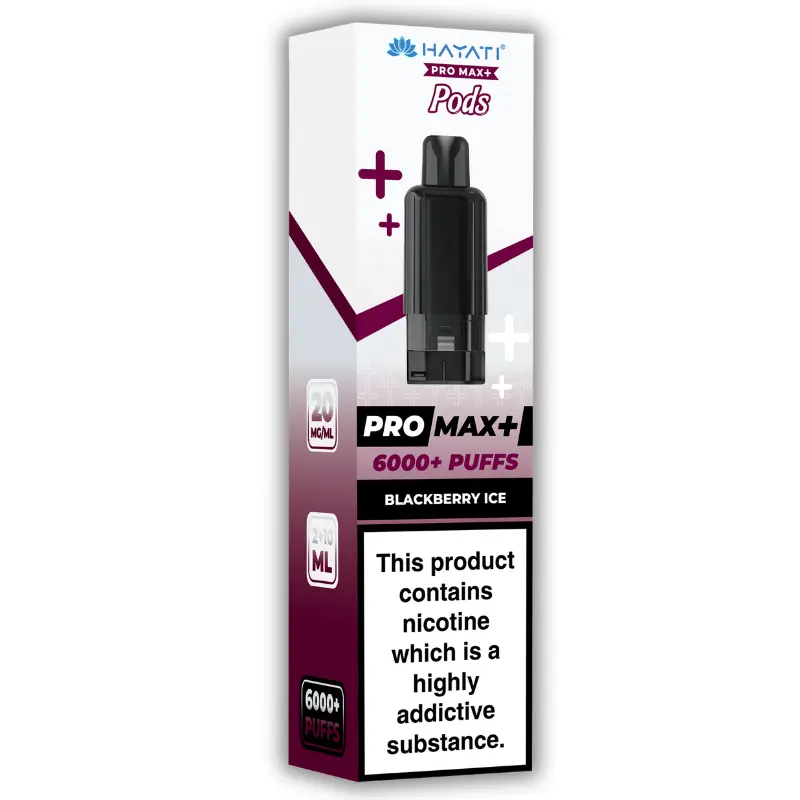
Blackberry Ice is a single prefilled pod for the Hayati Pro Max Plus, £5.49, twelve millilitres of liquid at 20mg nicotine salt, with no device in the packet. You buy it because you already own the body and you want another one of these. That is the whole commercial description, and it takes about fifteen seconds to read.
The part worth longer than fifteen seconds is the first three words Hayati themselves put on the listing. They call it hedgerow fruit. That is an unusual thing for a vape listing to do, and most buyers will read straight past it, because it sounds like ordinary flavour-copy scenery. It is not scenery. It is a claim about where the reference standard lives, and on this particular fruit the claim happens to be true in a way it is true of almost nothing else in a 492-listing catalogue.
Here is the situation in one sentence. Blackberry is the one fruit on this shelf that a large share of British adults have eaten off the plant, outdoors, free, without planning to, and that makes the standard this pod gets measured against unusually direct and unusually unreliable at the same time. Both halves of that matter. The directness is why a blackberry liquid can feel either very right or very wrong and rarely lands in between. The unreliability is why two people who have both vaped this pod can disagree about whether it tastes like blackberry and neither of them is lying.
What follows works both edges of that. First the count, because an assertion about how British people know a fruit is the kind of thing that sounds good and collapses when you check it. Then why a memory taken first-hand is the least stable kind of reference a flavour can be judged against. Then the part that decides the purchase: which of a real blackberry's properties can physically survive being turned into vapour, which cannot at any price, and what a coolant does to the ones that make it through. That last answer is not entirely flattering to the product, and it is given straight.
The counting, done first, because the claim needed narrowing
The version of this argument that arrived in my notes said blackberry is the one fruit in the range most British buyers have eaten straight off the plant. Stated like that it is too strong, and five minutes with the catalogue shows why.
Apple appears in 35 listings. A great many people in this country have eaten an apple off a tree. Strawberry appears in 60, and pick-your-own farms are an ordinary British summer errand. Raspberry appears in 74 and grows in gardens. Cherry is in 62, blueberry in 46. None of those are fruits the British public knows only through a packet.
So the claim needs cutting down until it survives. The version that does survive is this: blackberry is the only fruit anywhere in the 492 listings that a large share of British adults have eaten wild, from a plant nobody planted, on public ground, without paying for it and usually without having set out to. Apples come off a tree in a garden or an orchard, which somebody owns and somebody planted. Strawberries come off a row you paid to walk down. Blackberries come off a hedge on a footpath in September, and the entire transaction is a hand and a bramble.
The second half of the count is more striking than the first. Britain has a decent list of genuinely foraged fruits: sloes, elderberries, damsons, rosehips, crab apples, wild gooseberries, rowan. Search the catalogue for any of them and you get nothing. Zero sloe, zero elderberry, zero damson, zero gooseberry, zero rhubarb, zero redcurrant. The foraged category has exactly one representative in the whole range and this is it.
And blackberry is scarce even so. Six listings out of 492 carry the word, and those six are two flavours across three formats: this one and a blackberry-raspberry blend, each existing as a nic salt bottle, a bare pod and a kit. Set that against 74 raspberry listings and you get a slightly odd picture. The one fruit in the range with a genuine first-hand reference standard is also one of the least represented.
There is a reasonable explanation and it is worth stating because it bears on everything below. Flavour houses build what sells, and what sells is sweet and bright. Blackberry is neither. It is dark, low, moderately acidic and noticeably drying, and three of those four qualities are commercial liabilities. A fruit that is hard to make appealing gets built rarely, and when it does get built it gets built sweeter than it is.
Where this sits on a scale other pages on this site already drew
This is not the first page here to ask what a flavour is being measured against, and there is no point in redoing work that is already on the site.
The Blue Razz Fruit Twist pages settled the far end: blue raspberry exists because confectionery wanted a colour that red had already been given. There is no plant. Nobody has ever eaten one. The reference standard is other sweets, which is why the flavour is so consistent across brands and why arguments about accuracy in that family are actually arguments about which sweet you grew up near. Forty-eight listings in this catalogue carry the words blue razz, which tells you how well a flavour does when the thing it imitates cannot contradict it.
The blackcurrant pages here took the middle. That fruit does exist, it is grown commercially in Britain at scale, and hardly anybody eats it raw, so the sweetened cordial became the standard by default and a blackcurrant liquid gets judged against a drink rather than a berry. You can see the consequence on the shelf: Blackcurrant Lemonade Hayati Pro Max Plus Pods is a drink built on a drink, and nobody finds that strange.
The mango pages sit a step further along again. Mango has an original and people do eat it, but they eat it from a shop, chosen by somebody else, at whatever ripeness the supply chain delivered. The reference is real and tasted, and it is still mediated by a purchase.
Blackberry is the end of that scale. No purchase, no packet, no supply chain, no intermediary at all. Just the fruit and the person. Nothing else in the range gets that close, and it is the reason this pod is worth writing a long page about when a straightforward dark berry with cooling does not obviously deserve one.
Why the most direct reference is also the shakiest
An unmediated reference sounds like an advantage. For judging a product it is very nearly the opposite, and the reason is that a bramble does not produce one flavour. It produces a range, and the range is wide.
Consider how the fruit actually ripens. Each cluster on a bramble carries several berries and they do not arrive together. The one at the tip goes black first, and it is the largest, the sweetest, the juiciest and the least seedy of the group by a clear margin. The berries behind it ripen over the following weeks, smaller each time, proportionally seedier, sharper, with more skin per unit of flesh. Pick a handful from one bush on one afternoon and you have collected several different flavours and eaten them as though they were one thing.
Now add the variables around the bush. A south-facing hedge in full sun produces fruit with measurably more sugar than the same variety twenty metres along in the shade of a hawthorn. A wet week before you pick swells the berries with water and dilutes everything. Early September fruit and mid-October fruit off the same bramble are not the same product: the late fruit is softer, winier, sometimes faintly fermented, and the old British instruction not to pick after Michaelmas is folklore wrapped around a real observation about autumn damp and the moulds that come with it.
Then add the varieties. The hedgerow bramble is a wild aggregate of a great many closely related forms, and they genuinely differ. A thornless cultivated blackberry from a garden centre, bred for picking convenience and yield, tastes politer and flatter than a wild one. And a supermarket punnet is different again: selected for size, firmness and the ability to survive transport, generally larger, generally wetter, generally less aromatic.
So a British adult asked what blackberry tastes like is drawing on a sample that may include all of the above, weighted unpredictably by which walks they happened to take. Two people can hold honest, vivid, first-hand references that sit a long way apart. One remembers a warm, jammy, almost winey mouthful off a sun-baked hedge in a good year. The other remembers something sharp, seedy and a bit thin off a shaded lane in a wet one. Both are correct about blackberries.
Put a commercial liquid in front of those two people and they will disagree, and the disagreement is not resolvable, because there is no shared object to appeal to. This is exactly the problem the blue family does not have. A confected reference is stable precisely because it was never alive. It was designed once, copied widely, and every British adult who has eaten a blue sweet has eaten approximately the same blue sweet. Accuracy arguments about Blue Razz GB Hayati Pro Max Plus Pods can actually be settled. Accuracy arguments about blackberry cannot.
There is a practical instruction buried in that, and it is the single most useful thing on this page for somebody deciding whether to order. Before you judge this pod, work out which blackberry you are judging it against. Three references are common and they point in different directions.
- The hedge. Warm, eaten in the open, variable, moderately tart, noticeably drying, aromatic in a low and slightly fermented way. If this is your reference the pod will read sweeter and smoother than you expected, and the cold will read as an addition rather than a property of the fruit.
- The punnet. Cold from the fridge, larger, wetter, milder, less astringent, more uniform. If this is your reference the pod will land considerably closer, including on temperature, for reasons covered further down.
- The pudding. Cooked blackberry, in a crumble or a jam or a pie, almost always with added sugar and very often with apple in it. Deeper, jammier, rounder, with the fresh edge cooked off. If this is your reference the pod will read as under-sweet and oddly fresh, and you will keep waiting for a note that is not coming.
None of those three is the right answer. They are just three different rulers, and the pod is a fixed length. Knowing which ruler you are holding is worth more than any adjective anybody can put in front of the word fruit.
Four things a blackberry does, and what happens to each in vapour
Everything in this section is reasoning about the format plus a tasting impression of the liquid. Hayati publish a flavour name and a short profile, not a recipe, so treat the specifics as one careful account rather than a declared formula.
Strip the romance out and a fresh blackberry does four separate things in your mouth. It is acidic. It is astringent. It carries a deep, low, slow aroma rather than a bright volatile one. And it has a physical texture dominated by hard seeds and tough skin. Those four are not equally transportable. Sorting them properly is the whole question, and the useful way to sort them is not by how strong each one is in the fruit but by whether it scales with concentration or with mass.
That distinction decides everything, so it is worth being plain about it. A draw of vapour deposits a very small amount of material in your mouth, measured in milligrams. A mouthful of blackberries delivers grams, three orders of magnitude more. Any property that depends on how much stuff arrives is therefore in serious trouble in a vape and cannot be rescued by making the recipe stronger. Any property that depends on how concentrated the stuff is can be dialled up freely, because concentration is cheap and the nose is absurdly sensitive. Vapour is a concentration-rich, mass-poor medium. Once you see that, most of what liquids can and cannot do stops being mysterious.
Acid: transmits, but arrives quieter than you expect
Sourness is a taste, which means acid molecules have to reach receptors on the tongue in solution. Vapour condenses on the tongue, so some of that does happen. But sour perception is partly a mass game: it depends on how much acid lands, and the landing per draw is tiny.
The workaround flavourists use is to over-specify. A liquid meant to read tart carries far more acid relative to its fruit content than the fruit itself does, which is why a deliberately sour vape can feel more aggressive than a lemon while a faithfully proportioned one reads as almost flat.
This blend has not gone down that road. Hayati describe the tartness as slight and place it at the edges of the profile rather than in the middle, and that matches what the liquid does. There is acidity. It is real, it sits under the fruit rather than in front of it, and it does a structural job of keeping the sweetness from sitting still. It is nowhere near the level of a listing built to be sour, and anyone who wants that end of the register is better served by Blue Sour Raspberry Hayati Pro Max Plus Pods, which declares the intent in its name.
Verdict on acid: it survives the format, at maybe a third of the prominence it has in the fruit, and this recipe has chosen not to compensate. Against the hedge reference that reads as under-tart. Against the punnet reference it reads about right.
Astringency: cannot transmit, and no recipe can buy it
The drying pull across the tongue that a real blackberry leaves behind is not a taste and not a smell. It is a physical event, and it is a mass-limited one in the purest sense. It requires a meaningful quantity of tannin from the skins and seeds to arrive and stay in contact with the surfaces of your mouth.
A vape delivers milligrams of condensate that evaporate or are swallowed almost immediately. There is no mechanism by which that can produce genuine astringency, and, crucially, there is no strength setting that fixes it. Doubling the flavouring doubles concentration, and concentration is not the variable this property runs on. This is the one thing about a blackberry that a pod cannot have, not because the industry has not tried but because the format forbids it.
What can be done is suggestion. A carefully built dark fruit can include woody, bitter and faintly stalky aromatic notes that the brain has learned to associate with dryness, and the association fires even though nothing is actually drying. It is a trick, it works partially, and it costs sweetness, which is why most commercial recipes skip it.
This one does a small amount of it. There is a short, faint tightening a second or two after the exhale, more suggestion than sensation, and it is gone in a few seconds. Do not expect the real thing. The pod cannot give you the real thing and neither can any other pod on the shelf.
Deep aroma: transmits best, and is still the awkward one
Aroma is the concentration-driven property, which should make it the easy case. Roughly speaking it is, and it is why almost everything a fruit vape achieves is achieved through smell rather than taste. But blackberry has a specific complication that a strawberry or a pear does not.
Aromatic molecules sit on a spectrum from light and volatile to heavy and reluctant. Light ones flash off readily at low temperature and account for the lift, the brightness, the top of a fruit. Blackberry has very little of that. Its character lives in heavier material, the winey and jammy and faintly woody register, and heavy aromatic molecules need more heat to leave a wick and are more inclined to stay behind.
A prefilled pod on a restricted draw is a gentle vaporiser by design. It runs cool relative to a high-power tank. That is fine for a bright fruit and it is a genuine constraint on a dark one, and it has three consequences worth knowing before you buy.
First, the depth is the part of this flavour that is hardest to get out of the pod in the first place. Second, the material that does not leave with the vapour tends to accumulate on the coil, which is why dark, heavy fruit recipes as a family tire a coil faster than pale ones. Third, because getting the low notes across is difficult, recipes in this family are usually pushed towards the easier reading of the fruit, which is the cooked and jammy one rather than the fresh one. That is not a conspiracy, it is the path of least resistance, and it is why so many blackberry liquids taste faintly of pudding.
This pod is partly on that path and partly off it. The fruit reads dark and low rather than bright, it is identifiable as blackberry specifically and not as a generic purple that could equally be blackcurrant, and there is a winey edge behind it. There is also a jammy roundness that a fresh berry does not have. Call it two parts fresh to one part cooked.
Texture: not in the category at all
The seeds are a large part of what people actually mean when they describe eating blackberries, and they cannot appear in any form. Nor can the give of the skin, nor the way the drupelets separate. Vapour has no texture beyond the weight of the vapour itself. This is obvious once said, and it is worth saying because it accounts for a share of the vague sense people report that a blackberry liquid is missing something they cannot name.
So the inventory, summarised honestly. Of four properties, one transmits well but expensively and imperfectly, one transmits weakly and has not been boosted here, one cannot transmit at all, and one is not even the right kind of thing. The best any pod on this shelf can do is a partial reconstruction, and this one is a fair partial reconstruction.
What the ice does to what is left, and why it moves away from the hedge
Now the coolant, which is the half of the product the name announces and the half that makes the reference question genuinely interesting.
A cooling agent works on a third channel that is neither taste nor smell. It triggers the same receptors that report temperature, so your mouth registers cold without anything actually being cold. That matters here because it means the coolant is not competing with the fruit for the same perceptual space. It does not sit on top of the blackberry and it does not mask it. The two run alongside each other.
But not interfering is not the same as not changing anything, and the cold does three things to the two fruit properties that survived.
It suppresses perceived sweetness. Cold reliably lowers how sweet something reads, which is why a warm fizzy drink tastes sickly and the same drink chilled does not. Applied here, the coolant pushes the sugar down and, by doing so, lifts the modest acidity into relatively more prominence than it would otherwise have. The tartness in this pod is easier to notice than the same tartness would be in an uncooled version of the identical recipe.
It supplies lift the fruit does not have. Blackberry is bottom-heavy and short on brightness, and a coolant reads as sharp and immediate. It fills a register the fruit leaves empty, which is a real reason the blend works better than a warm version of it probably would. The chill is doing structural work, not decoration.
And it shortens the tail. Cold at the point of contact reduces how readily the remaining aromatics carry on evaporating in the mouth, so the finish is quicker and drier than the same fruit unchilled. That is partly why this pod stays legible across a long session instead of building the sweet film that a heavy dark fruit at this sugar level otherwise would.
All of which is a reasonable piece of engineering. And it takes the pod further from the hedge, not closer.
Here is why, and it is the thing the word on the listing quietly glosses over. A hedgerow blackberry is eaten warm. It has been sitting in September sun and it goes into your mouth at ambient temperature or above, and warmth is not incidental to that experience, it is half of it. Warmth raises the volatility of aromatic compounds, so a sun-warmed berry releases more of its aroma than a chilled one does. The heavy, winey, jammy depth that makes a wild blackberry recognisable is at its most available exactly when the fruit is warm, and it is least available when the fruit is cold.
Which means the cooling in this pod does two things at once that point in opposite directions. It rescues the lift the vapour format strips away, and it removes the warmth the hedgerow reference depends on. A cold blackberry is a punnet out of the fridge. It is a perfectly real way to eat the fruit and it is a great many people's actual reference, and it is not the one the listing invokes.
The fair conclusion, stated plainly: if the standard you are measuring against is a warm berry off a bramble in early autumn, the iced treatment moves this product away from your standard rather than towards it, and no amount of fruit accuracy in the recipe compensates, because the gap is a temperature and not a flavour. If your standard is a chilled punnet, the cooling is neutral or helpful. If you have no particular standard and simply want a dark berry with a cold finish, the question does not arise and the pod does what the name says.
Anyone in the first group has one option on this shelf worth knowing about. Blackberry Raspberry Hayati Pro Max Plus Pods puts no cold word in its title at all. The Blue Frozen pods page on this site already counted the cold vocabulary across the whole catalogue and found that Hayati announce cooling in the name but do not grade it, so an absent cold word is the best available signal that a blend is uncooled, and it is a signal rather than a specification. On that basis the blackberry-raspberry blend is the closer approach to a warm reading of the fruit. The trade is that it adds raspberry, which brings its own brighter acidity and its own aroma, so you are exchanging a temperature problem for a company problem. That may well be the better exchange. It depends entirely on which of the two you notice more.
The draw itself, described plainly
Everything above is argument. This part is description, and it is one palate on one device, which is the most any page can honestly offer about a flavour.
The first half second. Depth lands before sugar. On most sweet fruit pods a wave of sweetness arrives and the fruit resolves out of it a beat later; here the order is reversed and a dark, low, slightly syrupy fruit registers first with the sugar arriving alongside. Cold is present from the beginning, not as a spike at the front of the mouth but as a low, even coolness that turns up with the fruit rather than after it.
The middle. Sweetness builds to its full extent and holds. Upper-middle for this shelf, clearly sweeter than an unsweetened profile and clearly below the confectionery end where the bubblegum and the gummy blends live. It is fruit sweetness rather than sugar-shell sweetness, which is a distinction people feel more reliably than they can define. The fruit stays identifiable throughout and does not dissolve into generic purple.
The exhale. The fruit thins and sheds its weight, leaving the dark outline. The cold holds longer, as temperature signals tend to. Then a short, faint dry corner, the suggestion of astringency described earlier, which fades inside five or six seconds and leaves very little residue behind.
Cooling level. Middle of the range. Unmistakable from the first draw and still there on the finish, so nobody will miss it, but it does not numb and does not build into the eye-watering territory that a dedicated freeze listing reaches by the third puff. Somebody arriving from Banana Ice Hayati Pro Max Plus Pods will find the two pitched similarly. Somebody arriving from an uncooled fruit will find it properly cold for a day or two and then recalibrate and stop noticing.
What it is not. It is not a blend, and nothing red, blue or tropical is hiding behind the blackberry. It is not a mint or a menthol, and the exhale finishes on cold fruit rather than on anything herbal. It is not a drink profile, so there is no fizz, no citrus and no carbonation effect, which separates it immediately from Berry Lemonade Hayati Pro Max Plus Pods. It is not a dessert, despite the jammy edge, and there is nothing creamy or bakery in it. And it is not complex. One fruit, one coolant, a short finish. It does not unfold over a session and it does not reward close attention with hidden layers, because there are none to find.
The pod on its own
The packet holds one prefilled pod and that is the entire contents. No device, no cable, no spare anything. This is a refill for a body you already own, which is why the page above spends its length on flavour rather than on hardware you already have an opinion about.
The specification that actually matters for this particular liquid is the twelve millilitres, and not for the reason it usually gets quoted. The volume is normally discussed as value or as convenience. For a dark fruit it is better read as a demand on the coil. Twelve millilitres is a long run on one piece of cotton and one heating element, and the heavy aromatic material described earlier is precisely the sort that accumulates rather than leaves. A pale, bright, low-sugar liquid will finish twelve millilitres looking much as it started. A dark one is working against itself for the second half. That is a property of the recipe meeting the volume, and it is the single most useful thing to know before you commit £5.49 to it.
Hayati rate a full pod at up to 6,000 puffs. That figure comes from a test rig taking identical draws on a schedule, and it is a ceiling under laboratory conditions rather than a forecast about any person. Nobody vapes like a rig.
If you do not own the body yet, the same liquid comes with one as the Blackberry Ice Hayati Pro Max Plus 6000 Pod Kit at £7.99, which is the pod price plus two pounds fifty for the hardware. On fitment, match the range name printed on your device to the range name in this listing and do not take a compatibility decision from a retail page, ours included. The rest of the shelf, all 89 listings of it, is on the Hayati Pro Max Plus Pods page, and the wider set of refills across every Hayati body sits under Hayati Prefilled Pods & Refills.
The published record, and the gap in the middle of it
The table holds what Hayati state for this listing and nothing else. Nothing has been carried across from a sibling product or reasoned out from the range, because a specification with invented rows in it is worse than one with visible holes.
| Claim the label makes | Dark hedgerow fruit, cooled |
| Fruit named | Blackberry, singular and explicit |
| Cooling | Stated in the name, never given a level |
| Form | Prefilled pod, no device included |
| Liquid on board | 12ml |
| Nicotine | 20mg per ml, salt form |
| Strength choices | One only, no selector on this listing |
| Manufacturer puff ceiling | Up to 6,000 for a full pod, a rig figure |
| Body required | Hayati Pro Max Plus, sold separately |
| Price | £5.49 |
| Version including hardware | Blackberry Ice Pro Max Plus 6000 Pod Kit, £7.99 |
| Filed under | Berry, Ice and four Hayati headings |
| Not published anywhere | Coil resistance, carrier ratio, cooling strength, sweetness level, flavour house |
The interesting row is the last one, and it is interesting for a reason specific to this page rather than a generic complaint about disclosure. Hayati have published a reference standard. They have told you the fruit is meant to read as hedgerow blackberry. What they have not published is any calibration for it: not how sweet, not how cold, not how tart, not how far towards the fresh reading or the cooked one. They have given you the ruler and withheld every measurement.
That is the exact combination that makes a flavour hard to buy blind, and it is worse on this fruit than on almost any other, because, as the counting section established, the ruler itself is not standardised. A listing that says blue razz and gives no numbers is still fairly predictable, since the reference is fixed. A listing that says hedgerow blackberry and gives no numbers has told you where to aim and not how far.
The strength row is worth a second look too. One published concentration, no dropdown, no variant. The decision has been made for you, so if 20mg is not the figure you want, the answer is a different listing rather than a different option on this one. Twenty milligrams per millilitre is the maximum concentration permitted for sale in the UK, which is a legal fact about the market and not a recommendation about you. Nicotine is addictive and the strength on the label is a number, not a claim.
On price, twelve millilitres at £5.49 works out a shade under forty-six pence per millilitre. Every flavour on this shelf carries the same price, which is quietly useful: no this-or-that question anywhere on this page is a budget question. Two pods is eleven pounds, both will get used, and your own palate settles the argument faster than any amount of reading.
Where it sits among its neighbours
Eighty-nine listings share this shelf and most of them are fruit, so grouping them by what they do to the reference question is more useful than listing them by colour.
The other pods whose original you have tasted
A small group names a fruit that exists and that the buyer has probably eaten, which puts them in the same category as this one even though none of them are foraged. Strawberry Raspberry Ice Hayati Pro Max Plus Pods is the closest structural comparison: two real berries, cooling declared, same platform, same price. It is brighter and more acidic than this pod and its fruits are the ones that carry their character in light volatile aromatics, so it has an easier job in vapour and generally reads as more vivid. That is a property of the fruits, not of the recipe quality.
Kiwi Cooler Hayati Pro Max Plus Pods pairs a real, tasted, mildly acidic fruit with cooling in much the same arrangement, and kiwi shares with blackberry the odd quality of having a distinctive seed texture that no liquid can deliver. White Peach Raspberry Hayati Pro Max Plus Pods works the softer, more floral end of the same idea with no cooling declared, so it is the option for somebody who liked the reasoning about warmth above and wants to test it on a different fruit.
The ones measured against a sweet rather than a plant
The blue family is the largest group on the shelf and it is playing an entirely different game. Blue Razz Cherry Hayati Pro Max Plus Pods and Blueberry B’Gum Hayati Pro Max Plus Pods both take a confected reference as their standard, and because that standard is stable they can be judged for accuracy in a way this pod cannot. Mad Blue Hayati Pro Max Plus Pods sits in the same territory with a less explicit name. If the argument on this page has persuaded you that first-hand references are more trouble than they are worth, the blue shelf is where that conclusion leads, and it is a perfectly defensible place to end up.
Blue Razz Lemonade Hayati Pro Max Plus Pods stacks a drink reference on top of a sweet reference, which is two removes from anything that ever grew. Blue Razz Blackcurrant Hayati Pro Max Plus Pods is the one that mixes registers, putting a confected blue against a fruit whose British standard is a cordial, and the result is a blend where no component is being measured against a plant at all.
The dark-fruit alternatives, ranked by how specific they are
If what you want is the dark register rather than blackberry specifically, the shelf offers several grades of precision. Blueberry Raspberry Cherry Hayati Pro Max Plus Pods names three fruits and is the most specific of the group, which also means it is the busiest. Cherry Berry Hayati Pro Max Plus Pods names one fruit and one category, so you know half of what you are getting. Blackcurrant Mango Hayati Pro Max Plus Pods is the interesting one for this page, because it puts a cordial-standard fruit next to a tasted-original fruit in the same pod and somehow nobody finds that odd.
At the least specific end, Vim Ice Hayati Pro Max Plus Pods reads as chilled dark purple with no fruit named anywhere in the record, which is the same profile territory as this pod with the reference standard removed entirely. Comparing the two is the clearest possible demonstration of what naming a fruit actually buys you.
The pods with no original at all
Three listings are named for a mood and tell you nothing about the contents. Blue Fusion Hayati Pro Max Plus Pods, Galaxy Aura Hayati Pro Max Plus Pods and Dragon Berries Hayati Pro Max Plus Pods occupy the opposite pole from this one on the axis the page has been describing. This pod names a fruit you have picked; those name nothing at all, and the first pod is the only way to find out what is in them. Neither approach is wrong, but they are different purchases and should be treated as such.
If you want more of it, in a bigger pod
Nothing in the dual-flavour Pro Ultra Plus range carries blackberry, so there is no direct upgrade. The nearest thing in the dark-berry direction is Straw’ Cranberry Cherry / Cherry Ice Hayati Pro Ultra Plus Pods at £7.99, a single larger pod split into two internal reserves with a collar that selects which side feeds the shared coil. It is different hardware and a different body, so it is a change of device rather than a change of flavour, and the carryover at every switch means the first draws after turning the collar are not a clean read of the new side.
The broader browsing is on Berry Vapes, which runs to 225 listings, and Ice Vapes, which holds 98. Between them they contain almost everything this page has mentioned and a good deal it has not.
Running one of these properly
Practical handling, anchored to this liquid rather than to pods in general, because the general advice is on every other page on the site and is not worth repeating.
The way this pod fails is unusual, so know the tell. On a bright citrus or a light fruit, a tiring coil announces itself as weakness: everything gets quieter. On a dark, heavy-aromatic recipe the failure is different. The heavy notes are the ones that struggle off a fouled wick, so the depth goes first while the sweetness and the coolant keep arriving at full strength. The tell that this pod is past its best is not that it tastes fainter. It is that it tastes simpler and sweeter, and specifically that the winey edge behind the fruit has quietly gone. If you find yourself thinking the pod has become nicer and easier, that is the warning sign, not the reassurance it feels like.
Do not use the cold as your gauge. Because the coolant occupies a separate channel from the fruit and is carried by lighter material, it keeps reading at close to full strength long after the blackberry has thinned out. A late pod can feel perfectly cold and have very little fruit left in it. Judge by the depth, not by the chill.
What you drink immediately before matters more here than usual. Anything hot flattens the coolant for several minutes, which on this pod removes the lift the fruit does not supply for itself and leaves a noticeably duller, sweeter liquid. Anything cold does the reverse and pushes the ice forward. If you are trying to judge whether you like it, do that on a neutral mouth, and do it twice on different days before deciding.
Storage matters for a specific chemical reason on this recipe. Heavy aromatic compounds are the ones most prone to oxidising into stewed, prune-like, jam-adjacent notes, and heat accelerates it. Which produces a neat irony given everything above: a Blackberry Ice pod left in a warm car for a fortnight drifts away from the fresh reference and towards the pudding one. A spare kept somewhere cool and dark, upright, out of direct sun, stays where it started. The pod is sealed, so this is about temperature rather than about air.
Draw length is a real lever on a dark fruit. Longer, slower draws get more heat into the coil, which helps the heavy aromatics leave the wick, so the fruit reads deeper. Push it too far and the same heat starts cooking them and the winey note turns jammy. Short, frequent draws do the opposite and give you a thinner, colder, sweeter version. Neither is correct. It is a genuine dial and this liquid responds to it more than a light fruit would.
On rotation. A low-lift flavour is one your palate stops noticing faster than a bright one does, because there is less happening at the top of the profile to keep re-announcing itself. If the pod seems to be fading in week two, consider that the pod may be fine and that running one dark fruit continuously is a lot to ask of anybody's attention. Keeping something from a different family alongside it is the cheap test, and it also tells you whether a restock is actually needed.
The dull housekeeping. The pod is prefilled and not meant to be opened or topped up, so a pod that has run dry is finished rather than refillable. When it is done it still contains a coil, a heating element and a residue of liquid, so it belongs at an electrical take-back point or a recycling facility that accepts small electronics rather than in a kitchen bin. Anything with nicotine in it belongs somewhere children and pets cannot reach, and a coat pocket is not that somewhere. Hayati publish nothing about the coil inside this pod, so any resistance figure you see attached to it came from somebody's assumption.
Questions this listing actually raises
Does it taste like a blackberry off a hedge?
Partly, and less so than the listing's own wording implies. The fruit is identifiable as blackberry rather than as generic dark purple, which is the main thing, and the depth and the winey edge are both present. What is missing is the astringency, which no vape can produce, and the warmth, which the cooling actively removes. Call it a recognisable portrait with two features left out.
Why do people disagree so much about blackberry liquids?
Because the reference standard is not standardised. Wild blackberries vary enormously with ripeness, sun, rainfall and how late in the season they were picked, so two people can hold vivid first-hand memories that sit a long way apart and both be accurate. A confected flavour does not have this problem, which is one reason the blue family is so much easier to build.
How much ice is in it?
Middle of the range for this shelf. Clearly present from the first draw and still there on the finish, but it does not numb and it does not escalate. Anyone who normally runs a dedicated freeze flavour will find it moderate. The cooling level is not published by Hayati anywhere, so this is an impression rather than a figure.
Is it sour?
No. There is genuine acidity underneath the fruit and it keeps the sweetness from sitting flat, but it is nowhere near a sour flavour and there is no sherbet or citric spike anywhere in it. The brief dry sensation at the end of the exhale is astringency rather than sourness, and the two get confused constantly.
How sweet is it compared with the blue pods?
Lower, and lower in a different way. The confectionery blends carry a sugar-shell sweetness that sits on top of everything; this carries fruit sweetness that is woven through it. In absolute terms it lands upper-middle for the shelf, and the coolant suppresses the perception of it further, so it reads less sweet after twenty minutes than the first draw suggests.
What is the difference between this and the kit?
The kit is the same liquid in the same pod with a Pro Max Plus body included, at £7.99 against £5.49. If you already own the device this listing is the right one. If you do not, the kit works out at two pounds fifty for the hardware, which only makes sense once.
Is there a blackberry option without the cooling?
Not as a single fruit. Blackberry Raspberry is the only other blackberry on this platform and it carries no cold word in its title, which is the nearest thing to a declaration that there is none. The trade is that it brings raspberry with it, so you get a warmer reading of the fruit in different company.
Is there a choice of nicotine strength?
No. This listing publishes one figure, 20mg per millilitre in salt form, with no option selector. Twenty milligrams is the highest concentration that may be sold in the UK. If that is not the number you want, the answer is a different product rather than a different setting on this one.
What puff figure does Hayati give?
Up to 6,000 for a full pod. That comes off a test rig taking identical draws on a fixed schedule, so treat it as a laboratory ceiling rather than as anything about your week. Draw length, draw frequency and how warm the device runs all move the real number, and they move it in both directions.
Why does the flavour seem to get simpler towards the end?
Heavy aromatic molecules are harder to lift off a wick than light ones and more inclined to deposit on the coil, and blackberry's character lives almost entirely in the heavy end. So the depth goes before the sweetness does, which produces a liquid that reads sweeter and less interesting rather than fainter. That is normal for dark fruit over twelve millilitres.
Does a spare pod keep well?
Reasonably, if it is kept cool and out of the light. Heat is the variable that matters, because the heavy aromatics in a dark fruit oxidise towards a stewed, jammy character faster than lighter ones do. A pod stored somewhere warm for a month or two will still work and will have drifted noticeably towards the cooked end of the fruit.
Is it a daily flavour or a rotation flavour?
It holds up as a daily better than most sweet dark fruits, because the coolant and the faint dry finish both work against the sweet film that usually makes a heavy blend tiring. The caveat is habituation rather than the liquid: a low-lift profile is easy to stop noticing, so people often conclude it has faded when their attention has. Keeping something brighter nearby settles that question quickly.
The short version
Blackberry Ice is a 12ml prefilled pod for the Pro Max Plus at £5.49, carrying 20mg nicotine salt, dark fruit forward with cooling declared in the name and pitched at the middle of the range. The fruit is identifiable as blackberry specifically rather than as generic purple, which is worth something on a shelf carrying several listings that are exactly that, and the sweetness sits upper-middle and is held down over a session by the chill and by a short dry finish.
The honest complication is the one the listing's own wording invites. Hayati point at a hedgerow, and hedgerow blackberries are warm, variable and astringent. Vapour cannot deliver astringency at any recipe strength, the acidity arrives at a fraction of its real prominence, and the cooling, whatever else it does well, takes away the warmth that the reference depends on. What survives is the deep aroma, and this pod carries it competently. Against a chilled punnet it reads close. Against a September hedge it reads like a good but partial account, and knowing which of those you are holding up against it is the difference between a pod you keep rebuying and one you finish out of obligation.
Strictly for adults aged 18 and over. Nicotine is an addictive substance.
You might also like


