
Home / Hayati Pro Max Plus Pods / Strawberry H’Bubba Hayati Pro Max Plus Pods
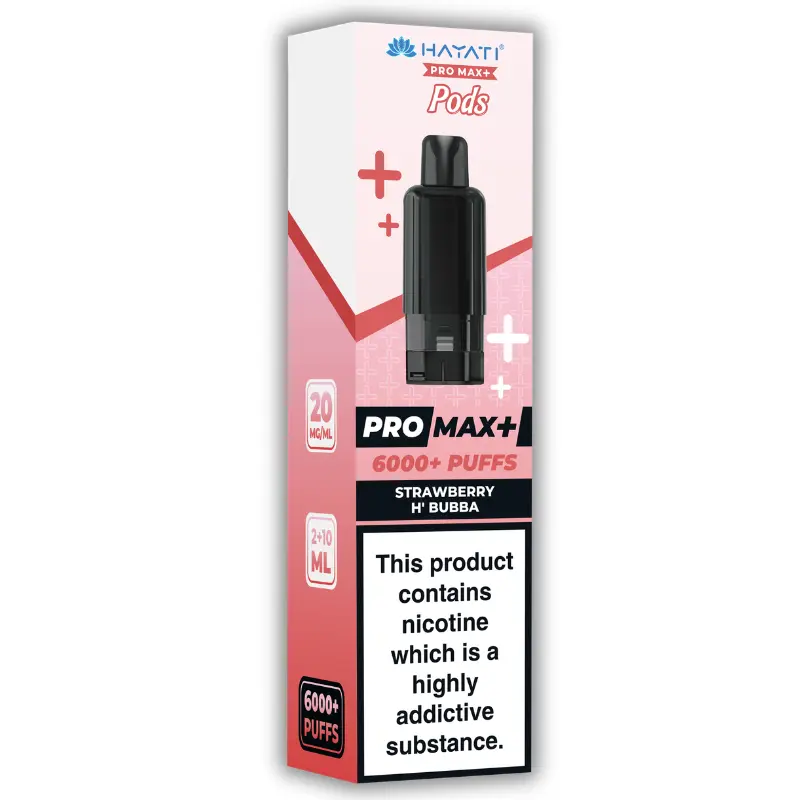
Hayati · Pro Max Plus
Strawberry H’Bubba Hayati Pro Max Plus Pods
£5.49
✔ In stock — ready to ship
Genuine Hayati
Free over £20
Same-day dispatch
Secure checkout
Strawberry H’Bubba is a prefilled replacement pod for the Hayati Pro Max Plus, £5.49 for twelve millilitres of liquid at 20mg nicotine, supplied on its own with no device in the pack. Hayati's published puff figure for a full pod is an upper bound of 6,000, produced under fixed laboratory conditions rather than by anybody using one. Those four numbers are shared with almost every other listing on the Hayati Pro Max Plus Pods shelf, which is a polite way of saying they tell you nothing about what you are buying.
What does tell you something is the punctuation. There is an apostrophe in the middle of this product's name, and it is not there by accident or for decoration. It marks a word that has been cut short. Strip the mark out and expand what remains and you have a specific, famous, extremely recognisable confection, which is exactly what Hayati want you to think of when you look at the packet and exactly what they have declined to print on it.
That decision is ordinary and defensible. It is also expensive, and the whole of the expense falls on the person holding the £5.49. A clipped name works beautifully on a shelf, where a human eye reads it in half a second and supplies the missing letters without noticing. It works very badly in a search box, in a reorder, in a conversation, and in a memory six weeks old. This page counts how far the convention runs through Hayati's catalogue, tests the usual explanation for it against the catalogue's own behaviour, works out which of the clippings a buyer can actually decode and which are locked, and then says what the register behind this particular apostrophe implies for a strawberry pod. The flavour analysis comes last because it is the part that is genuinely straightforward, and the naming is the part that costs people money.
How much of this catalogue is written in shorthand
Before explaining a convention it is worth establishing that there is one, and how large it is, because a naming habit that covers four products is a quirk and one that covers a sixth of the range is a policy.
There are 492 listings in the Hayati catalogue as stocked here. Reading every title and pulling out every element that is either truncated, initialised or fitted with an apostrophe produces nine distinct markers:
- GB, on 27 listings, across five different hardware families.
- Straw’, on 22 listings.
- B’Gum, on 7 listings.
- H’Bubba, on 7 listings, of which this pod is one.
- Cotton K, on 7 listings.
- Vim, on 6 listings.
- T-Misu, on 2 listings.
- H’Berg and P’Man, on the same 2 listings, which carry both.
Those figures overlap, because several titles carry two markers at once. Counted as distinct products rather than as tokens, 77 of the 492 listings in this catalogue have a shortened element in the name. That is a fraction under one in six. Thirty-five of the 77 contain a literal apostrophe; the rest shorten without one, either by initialising a phrase down to two letters or by lopping the tail off a word.
The distribution is not even, and the unevenness is the first useful thing the count produces. On the shelf this pod sits on, 89 listings, 7 are shortened, which is below the catalogue average. On the Sweet Vapes shelf, 61 listings, 28 are shortened. Nearly half the products filed as sweet have a truncation in the title, against roughly one in six across the catalogue as a whole. The convention is concentrated in confectionery, and once you know that, an unexplained apostrophe becomes a reasonably strong signal on its own: whatever the fruit word says, the product is probably a sweet rather than a fruit.
The shortening is not done one way, either. There are at least four different grammars running side by side:
- Initialism. GB reduces a two-word phrase to its two initials and keeps nothing else. It is the most aggressive of the four and the only one that leaves a reader with no pronounceable word at all.
- Initial plus whole element. H’Bubba, B’Gum, H’Berg, P’Man and Cotton K all keep one component intact and reduce the other to a single letter. The surviving component is always the more distinctive one.
- Head clipping. Straw’ and Vim keep the front of a word and drop the rest, with the apostrophe present in one case and absent in the other for no reason visible from the data.
- Syncope. T-Misu keeps both ends of a dessert name and removes the middle, which is a construction the Blueberry B’Gum page and our Vim Ice kit page have both noted in passing.
Four grammars, nine markers, one catalogue, and no key published anywhere. Nothing on any listing tells a reader that GB and Cotton K are doing the same job by different methods, or that the apostrophe in Straw’ and the absence of one in Vim mean nothing whatsoever. A buyer is expected to infer all of it, and most of them are not going to, because they came here to buy a pod rather than to reverse-engineer a naming system.
Testing the obvious explanation, which turns out to be half right
The explanation most people reach for immediately is legal, and it is worth stating properly before testing it, because it is a serious explanation rather than a cynical one. You cannot print somebody else's registered trade mark on your own packaging. A confectionery brand owns its name, and a manufacturer of something entirely different who wants to say "this tastes like that" has a narrow path to walk: describe the taste and name no brand, or shorten the brand to something a person recognises and a register does not. Clipping is the second route. It is common across the whole of the flavour trade, it is not a trick, and it is not evasion. It is the same instinct that produces a supermarket biscuit called something two letters away from the original.
If that were the whole story, the clipping would appear where a mark exists and nowhere else. So here is the test. Of the nine markers, how many point at something a trade mark could plausibly attach to?
Three of them. H’Bubba shortens the name of a specific branded chewing gum. Vim shortens the name of a specific branded cordial, which our Vim Ice Pro Max Plus 6000 kit page establishes by splitting a compound name elsewhere in the range; that page owns the decoding method and there is no point rebuilding it here. H’Berg and P’Man, on the same two listings, shorten two flagship liquid names belonging to another manufacturer in this trade. Counted as products, those three markers cover 15 of the 77 listings.
The other six point at ordinary English or ordinary Italian. GB, on 27 listings, expands to a phrase that names a category of gelatine sweet, not a brand. B’Gum, on 7, expands to a compound noun that has been in general use for a century. Cotton K, on 7, points at spun sugar, which every British listing in the group cheerfully describes as candy floss in the body text. T-Misu, on 2, is a dessert that belongs to Italy rather than to a company. Straw’, on 22, is a fruit. Between them those account for 62 of the 77, and not one of them has an owner who could object to the full word being printed.
That alone narrows the legal reading from a general explanation to a specific one covering a fifth of the cases. What finishes it off is that the catalogue contradicts itself on the exact words in question.
The catalogue prints in full what it elsewhere clips
Three contradictions, all of them checkable against the product list.
The gum brand behind this pod's name is printed in full on two listings, and both of them are on this shelf. A complete Pro Max Plus kit and its matching replacement pod carry the unclipped two-word brand name in their titles, sitting a few rows away from Strawberry H’Bubba in the same grid at the same price. Whatever caution produced the apostrophe in this title was not applied there. This page is still going to decline to print the name, for reasons given below, but the catalogue's own behaviour means the caution cannot be a policy.
The phrase behind GB is printed in full on four listings. Four bottled liquids in the Pro Max range spell out the gelatine sweet in their titles while 27 listings reduce the same two words to two letters. The split follows format rather than law: bottles say it, pods abbreviate it.
Bubblegum, spelled out, appears in four titles. One of them is a pod, Strawberry Watermelon Bubblegum Hayati Mini Ultra Pods at £3.49, which is very nearly this product's idea on smaller hardware and names it in plain English. Two are bottles and one is a pouch. So the same catalogue that clips bubblegum to B’Gum on seven listings and gestures at a branded gum with H’Bubba on seven more is perfectly happy to write the word out on four others.
Add those together and the count says something clear. Twenty listings in this catalogue are a gum flavour by title. Four spell the generic word out, two print the brand unclipped, seven use B’Gum and seven use H’Bubba. One confection, four spellings, no rule.
What is probably going on instead
Three explanations fit the data better than a single legal one, and they are not mutually exclusive.
Label width. A pod is a small object and a dual-flavour Pro Ultra Plus title has to carry two complete flavour names plus a separator. Sixteen of the 22 Straw’ listings are dual-flavour titles with an oblique in them, which is exactly where the pressure on space is worst. Space is a real constraint and it explains the fruit abbreviations well.
House style spreading past its original purpose. This is the likeliest account of the rest. A convention adopted for two or three names where a mark genuinely was at issue becomes the visual signature of a range, and then gets applied to names that never needed it, because an apostrophe looks like the rest of the family. That is how B’Gum ends up shortened when bubblegum belongs to nobody, and how T-Misu ends up shortened when tiramisu belongs to nobody. The mark turns from a function into a decoration.
Different hands. A range of 492 listings across six hardware families is not named in one sitting by one person. Bottles behave differently from pods. Pouches behave differently again. The inconsistency may simply be the trace of separate product lines adopting separate habits at separate times, which nobody has since gone back and reconciled.
None of that is a complaint about Hayati. The legal caution, where it applies, is correct and sensible. The point is narrower and more useful: the apostrophe is a reliable signal that a word has been cut, and an unreliable signal about why. A buyer cannot read it as a warning that a trade mark sits behind it, because most of the time one does not.
For this particular pod, though, the legal reading is the right one. Strawberry H’Bubba is one of the 15 rather than one of the 62. The thing being pointed at is owned, and the clipping does the job a clipping is for.
What the convention costs you, in exact numbers
Here is where the argument becomes practical rather than taxonomic. A clipped name is free to print and free to recognise. It is not free to use.
The search box on this site matches what is printed in a product title. That is a perfectly normal way to build a shop search, and it has a consequence that nobody thinks about until they are hunting for a flavour they liked. Run the queries a buyer would actually type and count what comes back.
- Type bubblegum and four products are returned, out of the twenty in this catalogue that are a gum flavour by title. Fourteen of the missing sixteen are missing because their names are clipped.
- Type strawberry bubblegum, which is precisely what this pod is, and nothing is returned at all.
- Type gum and fifteen products are returned. That is the best single query available, and it still misses every one of the seven H’Bubba listings, because H’Bubba does not contain the letters g, u and m in that order. It also adds four gelatine listings that are a different confection entirely.
- Type the first word of the gum brand and two products are returned, and this is not one of them.
- Type bubba and nine products are returned, including this one. That is the query that works, and there is no reason on earth a buyer would guess it.
Read those five lines together and the cost is exact. There is no query in plain English that returns the gum flavours in this catalogue. The only reliable route to Strawberry H’Bubba through a search box is a four-letter fragment sitting in the middle of a clipped word, and the only reliable route to the gum category as a whole is to run two separate searches and merge the results by hand.
There is a second, smaller obstacle sitting on top of the first. The apostrophe printed in H’Bubba is the curly typographic one, not the straight upright mark most keyboards produce by default, and a search that compares characters literally treats the two as different. Our page for the H’Berg / P’Man Pro Ultra Plus pods, which is on other hardware and so is not linked from here, works through that problem properly and recommends searching the letters on either side of the apostrophe instead of trying to type it. That advice transfers to this listing without modification and is not repeated at length.
Who this splits, and how
The interesting effect of a clipped range is not that it hides things. It is that it sorts buyers into two groups who have completely different experiences of the same shop.
The first group has met the convention before. They have owned an H’Bubba pod, or they read the description once, or somebody behind a counter explained it. For them the clipping costs nothing at all and arguably pays: a four-letter fragment is quicker to scan in a grid of 89 near-identical titles than a two-word brand name would be, and it carries a whole flavour memory in almost no space. Shorthand is a benefit to anybody who already shares it. That is what shorthand is for.
The second group has not met it. They arrive at a refill shelf because a pod is £5.49 and a kit is £7.99, which makes the pod the sensible way to try a flavour if you already own the body. They see a strawberry pod with an odd fragment after it, they have no idea whether that fragment is a fruit, a range name, a sweetener or a cooling agent, and the only way to find out is to open the listing and read the description. Most of them will not. They will buy the plainly named strawberry next to it instead, which is a perfectly good outcome for them and a quietly lost sale for the pod with the punctuation.
The split is not between clever buyers and slow ones. It is between people who have already been told and people who have not, which makes it a pure information asymmetry. Every sentence on this page is an attempt to move a reader from the second group to the first.
The mirror-image problem: recognition without recall
One more cost, and it is the one that catches experienced buyers rather than new ones. A clipped name is optimised for recognition and pessimised for recall, and those are different mental operations.
Recognition is seeing the name and knowing it. H’Bubba is excellent at that. The clipping keeps the rhythm of the original and keeps its most distinctive element intact, so a person who knows the gum reads the full name off the label without consciously decoding anything. That is precisely why the clipping was chosen.
Recall is producing the name from memory with nothing in front of you. H’Bubba is almost useless at that, and the failure is specific: what you remember is the taste and the brand it reminded you of, not the fragment. So you search for the brand, get two results neither of which is the pod you had, and conclude the shop has stopped stocking it. The pod is sitting there. Your query is aimed at the word the label deliberately does not contain.
The fix takes ten seconds and is worth doing the day the pod arrives. Write the product title, exactly as printed with the apostrophe, on the carton or in your phone, alongside the shelf it came from. The other route, which is more reliable and needs no memory at all, is to ignore the search box entirely and browse the shelf: this pod lives on the Pro Max Plus Pods shelf and is cross-filed under Strawberry Vapes and Sweet Vapes, and a clipped title is easy to spot in a grid even when it is impossible to type.
Which shorthand you can crack, and which is locked
The 77 listings do not all present the same problem, and sorting them by how recoverable they are is the last piece of the reading method. The test is simple: does the listing's own description contain the plain word?
Tier one: fully expanded in the body text. Every one of the 7 H’Bubba listings says bubblegum in its description, including this one. All 7 B’Gum listings say bubblegum. All 7 Cotton K listings say candy floss, candyfloss or spun sugar. Both T-Misu listings say tiramisu. All 22 Straw’ listings say strawberry. That is 45 listings where the title is opaque and the first paragraph underneath it is not, which means the information exists and is simply sitting in a field the search box does not read. The cost here is one click, and it is only a cost at all because nobody clicks.
Tier two: the register is named, the word is not. The GB listings tell you the flavour is gummy, confectionery or candy in 25 of 27 cases without ever saying what the two letters stand for; exactly one listing in the whole catalogue expands them, and our Strawberry GB Hayati Pro Max Plus Pods page did the counting that established it. The Vim listings behave the same way, describing a cordial-style dark fruit without ever expanding the three letters. You can tell what kind of thing you are buying. You cannot recover the reference.
Tier three: nothing at all. The two H’Berg / P’Man listings describe a cold fruit blend and never gloss either contraction anywhere. Two listings out of 77, which is a small number, and they are the ones where a buyer is genuinely stuck.
The practical rule that falls out of this is short enough to remember. If a Hayati title contains a fragment you do not recognise, the description almost certainly explains it, and the search box almost certainly cannot. Forty-five of the 77 are one click from plain English. Another 30 tell you the category if not the word. Two tell you nothing.
Worth being clear about what this page is not doing. Our Strawberry GB page owns the argument about what these suffixes mean for flavour, and sets out the distinction between markers that change a product's register, such as GB and B’Gum and H’Bubba, and words that merely move a dial, such as Ice and Sour and Smooth. That taxonomy is about meaning. This one is about form and cost, and the two sit side by side rather than on top of each other. If you want to know what a suffix does to a liquid, that page is the one. If you want to know why the suffix is there and what it does to your ability to find the thing again, this one is.
What the register behind the apostrophe implies for a strawberry
Now the liquid, which is the part the naming argument has been clearing the ground for.
The reference is not a secret and it is not hard. H’Bubba keeps the initial of a first word and the whole of a second, and the second word is distinctive enough that most British adults over thirty supply the rest without prompting. It is a soft pink chewing gum that has been on sale here since the early 1980s, made as thick cubes and as a flat ribbon wound inside a small tub, with an unusually soft chew and a sweet, faintly fruity, faintly floral gum flavour. This page will not print the name, for the same reason the pod does not, which is that it belongs to somebody else and a description of a flavour target does not require reproducing a third party's mark to be useful. The paragraph you have just read contains everything you need in order to know what the liquid is aiming at, and not one word of it would help you find this listing in a search box. That is the argument demonstrated rather than asserted.
Why a gum reference is not the same kind of thing as a gummy one
Both registers land in confectionery, both are sweet, and both drop the acid that defines a fruit-accurate flavouring. Our Strawberry GB page works through the fruit-versus-sweet distinction at length and there is no sense in restating it. What matters here is the difference between the two sweets, because it changes what the fruit word in front of the marker is doing.
A gelatine sweet is a carrier. Sugar and gelatine supply the body and the chew, and the flavour is a fruit essence loaded into them. Take the essence out and you have an unflavoured lump. So in a GB pod, the fruit really is the flavour, and the marker tells you how it has been treated.
A gum is not a carrier in the same sense, because the flavour it is famous for is not a fruit at all. The pink gum accord is its own thing, recognisable to everyone and resembling nothing that grows. The Blueberry B’Gum page goes through what such an accord is built from and why it transfers into vapour with unusually little loss, and that work is taken as read rather than repeated. The consequence for this pod is the part worth drawing out. In an H’Bubba liquid the fruit word is not naming the flavour. It is naming a tint applied to a flavour that already exists and is already complete without it.
That is not a private theory. The catalogue supports it in two independent ways.
The first is Hayati's own copy. Their dual-flavour gum pod describes bubblegum as the constant with the fruit giving each side its character, which is the language of a modifier. Their dual-flavour gelatine pod, Grape GB / Strawberry GB Hayati Pro Ultra Plus Pods, describes the two halves as deep and rich against bright and fruity, which is the language of two separate profiles. Same writer, same shelf, two different relationships between fruit and marker.
The second is structural, and it is the cleaner evidence. Of the 48 listings carrying one of the four clipped confectionery markers, 45 have a fruit word attached and 3 do not. All 27 GB listings carry a fruit. All 7 B’Gum listings carry a fruit. All 7 Cotton K listings carry a fruit. The only three that stand alone with nothing in front of them are H’Bubba listings, sold as a complete flavour with no fruit named anywhere in the title. A gum can be a product by itself. A gelatine treatment cannot, because without a fruit there is nothing for it to treat.
So the honest reading of this pod's name, stated as the inference it is: the base is the flavour, the strawberry is a colour applied to it, and two H’Bubba pods with different fruit words in front of them are likely to taste more alike than two GB pods with different fruit words. That is a prediction rather than a published fact, it is testable across a pair of pods, and if you run it and find the fruit dominating, the prediction is simply wrong.
Strawberry specifically, and why it is an awkward partner
Of all the fruits Hayati could have put in front of this marker, strawberry is the one with the least room to work, and the reason is worth a paragraph.
Strawberry flavouring is not merely a common confectionery flavour, it is the archetypal one. The accord used in sweets has been refined over a century to be loud, round, jammy and instantly identifiable, and it has drifted a long way from the fruit in the process. Which means that when you put it on a gum base you are not pairing a fruit with a confection. You are stacking two confectionery accords that already share a great deal of their vocabulary: both are sweet without acid, both are built for immediate recognition, both are weighted towards a long finish. There is much less contrast available here than there would be with a sharp fruit or a green one.
Compare what happens with the same construction and a different fruit. Watermelon brings water and a thin, cool top note that is genuinely unlike gum. Blueberry brings a dusky, quiet depth. Strawberry brings sweetness and roundness, which the gum already has. So the likeliest outcome, and I am labelling this as inference from the register rather than as anything Hayati publish, is a pod that reads as a single fused flavour rather than as two identifiable things, and specifically as a warmer, pinker, slightly jammier version of the gum rather than as a strawberry with gum behind it.
Which arrives first, according to two Hayati listings that disagree
There is a genuine conflict in the published material and it deserves airing rather than smoothing over.
This listing describes a soft, sugary strawberry wrapped in bubblegum sweetness, which puts the fruit at the centre and the gum around the outside. The Strawberry H’Bubba Hayati Pro Max Plus 6000 Pod Kit at £7.99, which carries the same liquid with a device added, describes bubblegum setting the tone with strawberry coming through on top. Those are opposite orderings of the same two components in descriptions of what is presumably one recipe.
The conflict is probably nothing more than two pieces of copy written at different times, and it is not worth treating as evidence of a reformulation. What it does mean is that the ordering is not established, so anyone telling you confidently which of the two leads is going beyond what is published. My own expectation, from the register rather than from the listing, is that the kit page has it the right way round: gum accords are assertive and strawberry rarely wins a fight with one.
Sweetness, cooling, and what it is not
Hayati are unambiguous that this is sweet from start to finish and confectionery in style, and that it suits a sugary preference rather than a sharp or cold one. That is their claim about their own product and it is the firmest thing on the page. Nothing in the construction supplies a counterweight: no sour word in the title, no citrus, no dairy to cut the sugar.
On cooling, the title carries no cooling word, and our Blue Frozen pods page has already run the census establishing how Hayati's cooling vocabulary behaves across the catalogue, so rather than recount it, take the finding that matters here: the gum listings in this range are a warm category almost without exception. Expect a long, warm, sugary finish with nothing to truncate it. A cooling agent does not only chill, it shortens the tail and shifts attention from flavour to sensation, and there is none of that here. Whether that reads as generous or as relentless is the single thing most likely to decide whether you finish the pod.
Four rule-outs, each with its reason.
It is not sour. Nothing in a gum accord supplies acid and nothing in a confectionery strawberry does either. If a sharp edge is what you want from a red pod, Strawberry Cherry Cranberry is built on a dry, tangy cranberry finish and is close to this pod's structural opposite at the same price.
It is not a gelatine sweet. The two registers sit next door and are not interchangeable: a gum accord carries a powdery, faintly floral lift that a gelatine sweet has no reason to contain, and a gelatine sweet keeps its fruit essence in the foreground in a way a gum does not.
It is not a fresh strawberry, and it is not trying to be. There is no green stalky note, no acid and no short clean finish, because none of those belong to the thing it is copying.
It is not a blend. One fruit is named, no second fruit shares the billing, and on a shelf where most listings pair two or three that is genuinely informative.
A test for your own first pod
Rather than invent a tasting note for a liquid, here is a way to settle the open questions yourself in about two minutes, which is more useful and more honest.
Take one deliberately slow draw, four or five seconds, on a clean palate. On a quick pull the fruit and the gum arrive on top of each other and you get one impression, which tells you nothing. Drawn out, they will either separate into a sequence or stay fused. If they separate, note which comes first and you have settled the disagreement between the two Hayati listings for your own purposes. If they stay fused, the register prediction above is holding and the fruit word is behaving as a tint.
Then run the second test. Draw, wait ten seconds, and pay attention to what is left. A gum accord's signature is a floral lift sitting slightly above the sweetness, and it is far easier to hear in the tail than in the draw. If you can find it, the pod is doing what the name promises. If all you can find is undifferentiated sugar, you are holding a sweet strawberry with a gum label on it, which is a different product and worth knowing about before you buy a second.
The pod itself, in short
Little needs saying here, and what does need saying is mostly about sugar rather than about the device. One prefilled pod arrives and nothing else: no body, no charger, no spare. It seats into a Pro Max Plus you already own, and it is built as a closed unit rather than something to be opened and topped up.
The specification that actually matters for this particular liquid is that the coil and the liquid are one disposable assembly. Hayati publish nothing about the coil's resistance, its wire or its wicking material, so any figure you see quoted for it anywhere is somebody's guess. What follows from the sealed construction is the useful part: a heavily sweetened liquid leaves residue on cotton, and on this format there is no coil to change and no tank to clean, so the question stops being maintenance and becomes cost. The answer to a tired pod is the next pod, at £5.49.
One hedge and the section is finished: check that the range name moulded into your own device matches the range named in this title before ordering, because a hardware compatibility decision taken from a retail page is worth less than the words on the hardware itself. When the pod is done it is small electrical waste rather than household rubbish, because the coil and its metal stay inside it along with whatever the wick never released, and on a sugary liquid that residue is tackier than most.
The published numbers, and one deliberate blank
Everything in this table comes from this listing. Where Hayati state nothing, the row says nothing rather than borrowing from a neighbour.
| Price | £5.49 |
| Supplied as | Replacement pod only, no device |
| Liquid volume | 12ml, factory filled |
| Nicotine | 20mg per millilitre, salt |
| Flavour register | Bubblegum, with strawberry named in front of it |
| Cooling | No cooling word in the title or the description |
| Manufacturer puff figure | An upper bound of 6,000, measured on test equipment |
| Fits | Hayati Pro Max Plus devices |
| Coil | Fixed inside the pod, no specification published |
| Name as printed | Strawberry H’Bubba, with a typographic apostrophe |
The last row is there on purpose, because on this page it is a specification rather than a curiosity. The character between the H and the B is not the straight mark on your keyboard, and that single detail is the difference between finding this listing again and concluding it has been discontinued.
Twenty milligrams per millilitre is the legal ceiling for consumer nicotine e-liquid in the United Kingdom, so it is a limit rather than a decision Hayati took about this flavour, and every prefilled pod in the range carries the same figure. Nicotine is addictive. Neither the number nor the flavour changes that.
The volume and the price together produce the only arithmetic here that travels between products. Twelve millilitres at £5.49 works out a shade under forty-six pence per millilitre, and that figure can be set against any bottle or any larger pod on the site regardless of format or puff rating. The 6,000 figure cannot, because it is generated by a rig cycling the pod under fixed conditions and no two people draw the same way. Use it to rank formats against each other, not to plan a fortnight.
Choosing between this and what sits beside it
Eleven strawberry pods share the Pro Max Plus Pods shelf with this one, and two of them are confectionery rather than fruit. Knowing which group you want settles the decision faster than any tasting note.
If the confectionery register is what you are after
Strawberry GB Hayati Pro Max Plus Pods is the nearest relative on the shelf and the honest comparison. Same fruit, same price, same absence of acid, same long sweet finish, different confection behind it. Its page argues that the gap between the two is smaller than the names suggest and real all the same, and that is the right verdict. Buy it if you want the fruit essence in the foreground. Buy this one if you want the gum.
Blueberry B’Gum Hayati Pro Max Plus Pods is the same gum register with the quietest fruit in the catalogue in front of it. Its page makes the case that the berry disappears into the accord entirely and produces one fused flavour. Strawberry is louder than blueberry, so this pod is the more likely of the two to let you hear the fruit as a separate thing, and that is the practical difference between them.
Blue Razz GB Hayati Pro Max Plus Pods is the gelatine treatment applied to blue raspberry, described by Hayati as the sugary option among the blue refills and less sharp than the sour ones. Running it against this pod is the cheapest way to learn what the marker does independently of the fruit.
Strawberry Watermelon Bubblegum Hayati Mini Ultra Pods at £3.49 is the same idea with the name written out in full, on Hayati's smaller and cheaper format, with watermelon added to keep the strawberry from sitting heavy. If you own a Mini Ultra it is the low-cost way to find out whether strawberry on a gum base suits you, and it is also the single best illustration of this page's whole argument: one flavour idea, two listings, one of them findable by typing what it tastes of and one of them not.
If you want more gum than this pod offers
Watermelon B’Gum / Strawberry B’Gum Hayati Pro Ultra Plus Pods at £7.99 puts two fruit gums in one twenty-two millilitre pod on the larger platform, with a rotating mouthpiece selecting which reserve reaches a single shared coil. The switch is available at any point in a session and gets made dozens of times, so it is a different kind of purchase rather than a bigger version of this one. Worth knowing that both halves share one coil and one liquid budget, so anything left in the side you use less goes in the bin with the pod.
Grape GB / Blue Razz GB Hayati Pro Ultra Plus 25000 Prefilled Pod Kit at £11.99 does the same trick with two gelatine flavours and adds the device, which makes it the route in if you do not own that platform and want to test whether the confectionery register holds up over a much larger volume of liquid.
If you want the strawberry rather than the sweet
Strawberry Kiwi Hayati Pro Max Plus Pods is the sharpest correction on the shelf. The kiwi is fresh and slightly sour and the finish is green and zesty, which is close to an inventory of everything a gum accord removes.
Strawberry Watermelon Hayati Pro Max Plus Pods goes towards water rather than acid, juicy without being sticky, and is the right answer if what you want to escape is the weight rather than the sweetness.
Strawberry Guava Hayati Pro Max Plus Pods keeps a floral quality, which makes it an interesting near-miss: gum accords are floral too, but a guava's floral note comes from a real fruit and reads quite differently from a manufactured one.
Strawberry Raspberry Blueberry Hayati Pro Max Plus Pods and Strawberry Raspberry Cherry, its near neighbour at the same price, both spread the work across three berries, which gives a palate more to track over a long session than a single fused note does.
If you want sweetness with a brake on it
Strawberry Raspberry Ice Hayati Pro Max Plus Pods adds raspberry tang and a cold exhale to a strawberry base, which answers the specific complaint of a sweet finish that will not end.
Berry Lemonade Hayati Pro Max Plus Pods uses citrus instead of cold as the counterweight and sits between the very sweet and the very sharp ends of the shelf, which makes it a sensible partner for something with no counterweight at all.
Blueberry Pomegranate Hayati Pro Max Plus Pods brings a slightly tannic edge that is unusual in this range, and dryness is the quality a gum pod most conspicuously lacks.
If you keep two pods running and want contrast
Blackberry Ice Hayati Pro Max Plus Pods is about as far from a warm pink confection as this shelf goes while staying in the berry family, dark and earthy with a cold exhale. Blackberry Raspberry on the same shelf does the same without the chill, and Blueberry Raspberry is the gentler version of that pairing. Blue Razz Mojito Hayati Pro Max Plus Pods brings mint and lime, which is the most aggressive palate reset available at this price.
Other formats, same flavour decision
Strawberry Kiwi Hayati Rubik Pods at £3.99 and the Mini Ultra version of Strawberry Raspberry Ice at £3.49 put red-fruit options on Hayati's smaller hardware, which is the cheap way to test a direction before committing to it on this platform. Straw’ Lemonade Hayati Mini Ultra Pods is worth a look for a different reason: it is a clipped title whose clipping carries no information at all, a plain abbreviation of a fruit name, and holding it next to this listing makes the difference between the two kinds of shortening obvious in a way no explanation does.
On the largest format, Strawberry Raspberry Ice Hayati Pro Ultra Plus 25K Pods is a single-flavour cooled berry pod, and Strawberry Ice / Strawberry Raspberry Ice Hayati Pro Ultra Plus 25000 Prefilled Pod Kit puts two iced strawberries in one pod with the device included. Both are cold rather than confectionery, so neither is a substitute for this pod, but both are where the strawberry decision goes if you want volume.
For browsing rather than deciding, the Berry Vapes shelf collects the red and dark fruit across every format, the Hayati Prefilled Pods & Refills listing is the place to go if you are open to changing hardware as well as flavour. The full Hayati range is there for anyone who would rather scan 492 titles than trust a search box, which after everything above is not an unreasonable preference.
Handling a pod built almost entirely of sugar
Ordinary pod advice applies here as everywhere. This section only covers the handling that changes because the liquid is a gum accord with a confectionery fruit, no acid and no coolant.
Let it sit before the first draw. Fit it and leave it a few minutes, longer if it has come in from the cold. Firing a dry patch is unpleasant on anything and worse here, because a scorched note on a sugar-heavy liquid does not clear after a draw or two. It bonds to the coil, and on a closed pod the coil is not going anywhere until the pod does.
The failure mode to watch for is vagueness, not quietness. On a single fused sweet flavour the decline does not present as the volume dropping. It presents as the floral gum lift going first, leaving a broad sugar with no identity, so the pod stops tasting of anything in particular while still tasting of quite a lot. When you can no longer tell a friend what flavour you are using, it has finished, whatever the liquid level suggests.
Do not answer a fading pod with a longer pull. Extra heat on a sugared liquid pushes it towards a caramelised, burnt-sugar character, and this one has neither acid nor chill to hide behind. Shorter draws and a gap do more, and will often bring the gum note back for a while.
Rotation costs you nothing on this format. The advice to quarantine a sweet liquid in its own hardware belongs to tanks and bottles. Here the wick leaves with the liquid, so fitting a cold berry pod straight after this one gives you a cold berry pod, with no ghosting to rinse out and nothing carried over. That is one genuine advantage of a closed unit and it makes this pod a reasonable thing to keep in a rotation rather than as a daily.
Expect it to tire you faster than a blend. One fruit, one confection, no acid, no chill and a long finish is close to the maximum-fatigue combination, because nothing in the construction resets your palate between draws. That is a property of the design rather than a fault in the batch, and it is the strongest practical reason to have something sharp on the go alongside it.
Store it flat, cool and dark. Warmth thins liquid and encourages it past seals, and a sugary one leaves a tacky ring rather than a damp mark. Heat also takes the top notes first, and on this pod the top notes are the floral gum lift that distinguishes it from plain sweetness, which is to say exactly the thing you are paying £5.49 for. A drawer is sufficient, somewhere children and pets cannot reach, and not a car windscreen in July.
Buy one spare, not six. A single fused confectionery note is among the more tiring things to commit to in quantity, precisely because it is so consistent from the first draw to the last. One in reserve is sensible. A stack of them is a wager on your palate feeling the same way next month, and on this register that wager loses more often than it wins.
Questions worth asking before ordering
What does the H’Bubba in the name stand for?
It is a shortened form of a branded pink chewing gum that has been sold in Britain since the early 1980s. Hayati never expand it in a title, but every one of the seven H’Bubba listings in the catalogue says bubblegum somewhere in the description, including this one, so the register is confirmed by the manufacturer even though the brand reference is left implied.
Why clip the name instead of printing it?
The most likely reason is that the full name is somebody else's registered trade mark, and shortening it is the ordinary commercial way of pointing at a flavour target without reproducing a mark you do not own. That explanation fits this product. It does not fit the convention as a whole, since most of Hayati's clipped names shorten perfectly ordinary words with no owner, and the catalogue prints this particular brand in full on two other listings.
Why can I not find it by searching for bubblegum?
Because the search matches what is printed in a product title, and this title does not contain the word. Searching bubblegum returns four products out of the twenty in the catalogue that are a gum flavour. The fragment that does work for this listing is bubba, which returns nine products including this one, and the more reliable route is to browse the Pro Max Plus Pods shelf rather than to guess a query.
Does the apostrophe matter when I type the name?
Yes. The mark printed in the title is the curly typographic apostrophe, not the straight upright one most keyboards produce, and a literal character comparison treats those as two different symbols. Leaving it out entirely does not help either. Search the letters on one side of it instead.
How is this different from Strawberry GB?
Both are strawberry moved out of fruit and into confectionery, both are sweet throughout and neither carries acid. The difference is which sweet is behind it. GB points at a gelatine sweet, where a fruit essence is the flavour and sugar is the body. H’Bubba points at a gum, where the recognisable flavour is an accord that is not a fruit at all, so the strawberry is working as a tint on something already complete.
Is there any ice or menthol in it?
No cooling word appears in the title or the description, and Hayati flag coolant in a title consistently across the catalogue. Expect a warm, long, sugary finish with nothing to cut it short. If a cold finish is what you want on a strawberry, the iced pods on this shelf are the ones to look at instead.
Which comes first on the draw, the strawberry or the gum?
The two Hayati listings for this liquid say opposite things. This one describes a strawberry wrapped in gum sweetness; the kit listing describes gum setting the tone with strawberry on top. Neither is more authoritative than the other, so the ordering is not established. A single slow draw on a clean palate will settle it for you in about five seconds.
Is it the same liquid as the kit version?
Hayati sell both under one flavour name at the same volume and the same strength, which is good evidence that it is. They publish no recipe for either, so treat it as a reasonable expectation rather than a confirmed fact. What you are choosing between is packaging: this listing is the pod alone at £5.49, the kit adds a device at £7.99.
Is the nicotine a salt?
Yes, 20mg per millilitre as a salt preparation, which is the standard for a prefilled pod at that strength and the figure used throughout this range. Twenty milligrams is the legal maximum for consumer e-liquid in the United Kingdom rather than a choice made for this flavour. Nicotine is addictive.
Can I refill it when the liquid runs out?
No. It arrives filled and closed with the coil fixed inside, and it is not built to be opened. When the flavour goes, the whole assembly is replaced. On a sugary liquid that is actually convenient, because the residue leaves with the pod and nothing carries into the next flavour you fit.
How many Hayati products have a shortened name like this one?
Seventy-seven of the 492 listings in the catalogue, using nine different markers and four different methods of shortening. The concentration is highest in confectionery: 28 of the 61 products filed under Sweet Vapes carry one, against roughly one in six across the range as a whole.
Does the 6,000 figure tell me anything useful?
Only as a way of ranking one format against another. It is an upper bound produced on test equipment under fixed conditions, and how long a pod lasts in practice depends entirely on how you draw. The number that transfers between products is the price per millilitre, which here is a little under forty-six pence.
Where that leaves it
Strawberry H’Bubba is a £5.49 replacement pod holding twelve millilitres of 20mg liquid for a Pro Max Plus you already own, with an upper puff figure of 6,000 measured on a rig. It is a bubblegum flavour with strawberry applied to it, sweet from beginning to end, with no acid and nothing cold to shorten the finish. If you already know you prefer a sugary pod to a sharp one, it is a coherent example of the type and the fruit in front of the marker is doing less work than the marker itself.
The apostrophe is the part of the listing worth understanding, because it is the part that will still matter in six weeks. It marks a word cut short to keep a distance from a name that belongs to somebody else, which is an entirely ordinary thing for a manufacturer to do, and here it is genuinely the right reading. What the counting shows is that it is not the general reading. Seventy-seven listings in this catalogue carry a shortened element and only fifteen of them shorten anything anybody owns. The rest abbreviate plain English, or plain Italian, or a fruit.
The cost of that convention is not borne by the people who chose it. A clipped name is free to print, instant to recognise and impossible to search, so it rewards buyers who already know the code and quietly penalises everybody else, including the version of you who liked this pod in March and cannot find it in May. Two defences work. Read the description, because on 45 of those 77 listings the plain word is sitting in the first paragraph where no search box will ever look for it. And when you find something you like, write down the title exactly as printed, apostrophe and all, because that string is the only one that will bring it back.
Strictly for adults aged 18 and over. Nicotine is an addictive substance.
You might also like


