
Home / Hayati Pro Max Plus Pods / Blueberry B’Gum Hayati Pro Max Plus Pods
Hayati · Pro Max Plus
Blueberry B’Gum Hayati Pro Max Plus Pods
£5.49
✔ In stock — ready to ship
Genuine Hayati
Free over £20
Same-day dispatch
Secure checkout
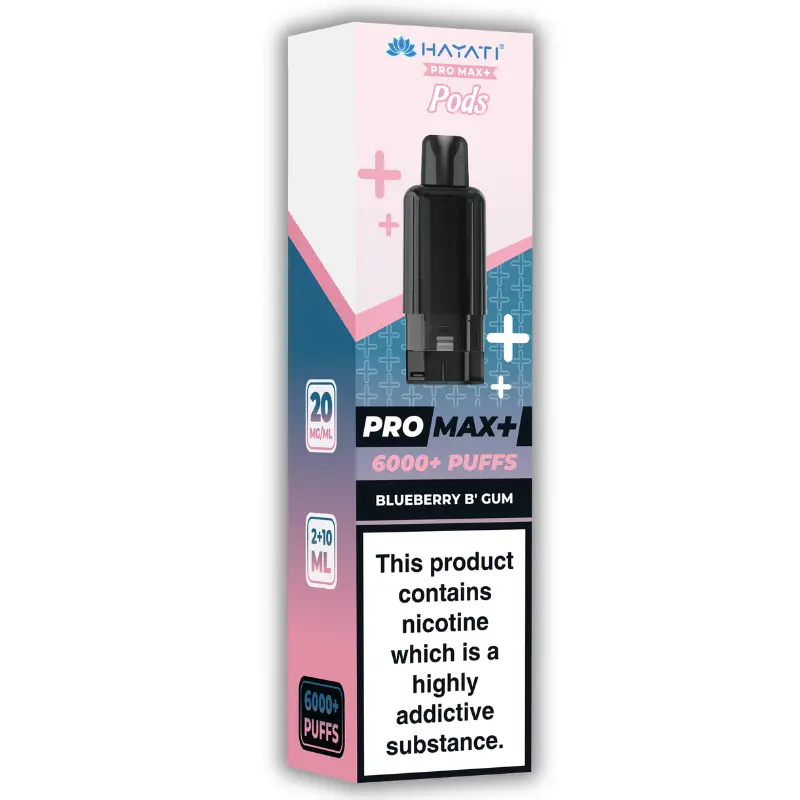
Blueberry B’Gum arrives as one prefilled pod at £5.49, twelve millilitres of 20mg nicotine salt liquid sealed around its own coil, with no device in the packet. It is a restock item. Whoever buys it already owns a Hayati Pro Max Plus body, already knows how a pod seats in it, and is choosing between this flavour and the eighty-eight others sitting alongside it on the Hayati Pro Max Plus Pods shelf. Everything commercially interesting about the listing fits in that paragraph, and none of it is why the page is long.
The name is where the work is. Two words, doing entirely different jobs. Blueberry names a fruit, and a fruit is fundamentally a smell, which happens to be the one thing an aerosol carries better than it carries anything else. B’Gum names a confection. A confection is not a smell. It is an object with a life, and chewing gum in particular is the single item in the whole sweet shop whose defining property is not what it tastes of but what happens to what it tastes of. The flavour goes. The gum stays. Ask anyone to describe chewing gum in one sentence and a very large proportion of them will describe the ending rather than the beginning.
Which sets up the awkward question. A draw on a pod lasts two or three seconds and delivers a fixed dose. It has no beginning, middle and end. It has no interior at all. So a bubblegum accord in a pod can reproduce the opening of a stick of gum, and it categorically cannot reproduce the collapse that follows, and the collapse is a large part of what makes the opening recognisable as gum rather than as an unusually floral fruit sweet. That is not a fault in this pod. It is a structural fact about the format, and it has a consequence worth knowing before you spend £5.49.
The rest of this page works out what B’Gum is therefore pointing at, what the blueberry does to it, and the one genuinely odd thing that falls out of the argument at the end: that a pod does reproduce the gum fade, faithfully and in the right shape, just on completely the wrong clock.
Counting the gum family before claiming anything about it
A claim about naming convention is worth nothing until it has been counted, so here is the count. Hayati’s catalogue across every format runs to 492 listings, which collapse to roughly 174 distinct flavour names once the hardware suffix comes off each title and a dual-sided title is counted once.
Four separate tokens in that catalogue mean chewing gum, and they are not evenly used:
- B’Gum appears in 7 listings, covering four flavour ideas: Blueberry B’Gum, Watermelon B’Gum, Strawberry B’Gum and a Straw’ Watermelon B’Gum that shares a title with Fruit Bomb.
- H’Bubba appears in 7 listings, covering plain H’Bubba, Strawberry H’Bubba, Blueberry H’Bubba and Watermelon H’Bubba.
- Hubba Bubba, spelled out, appears in 2 listings.
- Bubblegum, spelled out in full, appears in 4 listings: a plain one, a cooled one, a strawberry-watermelon one and a pouch.
Twenty listings, then, out of 492. Ten distinct names out of about 174. That is a real family and not a one-off, but it is also a minority, and anyone who has formed the impression that half this catalogue is gum has been misled by how loudly the names read. Roughly four listings in every hundred carry an unambiguous gum word.
There is a fifth token that looks like it might belong and does not reliably belong, and it is worth separating out rather than quietly folding in to inflate the number. GB appears in 27 listings across Grape GB, Strawberry GB, Blue Razz GB and Red Razz GB, including the dual-sided Grape GB / Blue Razz GB Pro Ultra Plus kit and the single-flavour Blue Razz GB Pro Ultra Plus pod. Hayati never expand the abbreviation in a title. The retail descriptions attached to those listings expand it two different ways: one Strawberry GB listing glosses the letters as gummy bear, one Grape GB listing describes the blend as grape with bubblegum underneath, and a third Strawberry GB listing goes out of its way to distinguish the product from the bubblegum strawberry elsewhere in the range. Three accounts, two of them incompatible. Whatever GB stands for, it is not settled enough to count, so it is not counted here. If you want a gum flavour and you want to be certain you are getting one, buy a name with the letters in it.
Narrow to the shelf this pod actually sits on and the picture gets tighter again. Eighty-nine listings on the Pro Max Plus Pods shelf, eighty-nine distinct names, and exactly three of them are unambiguously gum: Blueberry B’Gum, Strawberry H’Bubba and Hubba Bubba. Three GB listings sit alongside them, including Blue Razz GB, carrying whatever GB carries. Three certain gum names in eighty-nine is a small corner of a large shelf, and the three of them use three different spellings for one confection, which tells you something about how much thought went into the naming and how little a buyer can infer from the spelling alone.
Two more counted observations, because they change what this particular listing is. Of the seven B’Gum listings, five carry an oblique in the title, which on the Pro Ultra Plus platform signals one pod divided into two reserves feeding a shared coil through a rotating collar. Blueberry B’Gum does not. Its two listings, this pod and the Blueberry B’Gum 6000 Pod Kit at £7.99, are the only B’Gum entries in the catalogue that offer one gum flavour on its own with no second side to switch to. And of the twenty gum listings, exactly one carries a cooling word: Bubblegum Ice, which is a 10ml bottle and not a pod at all. Gum, in this catalogue, is a warm flavour by default.
The one confection whose ending is famous
Set the vape aside for a moment and think about what a stick of gum actually does, because the argument depends on getting it right.
Gum base is an insoluble, rubbery matrix of elastomers, resins and waxes. It is not food in any ordinary sense. It is a carrier, designed to hold flavour and sweetener and to survive being worked between the molars for as long as anyone wants to work it, and it is the only confection built on the assumption that you will not swallow it. Everything else in the sweet shop is designed to disappear. Gum is designed to persist.
That single design decision produces the behaviour everybody recognises. The flavour load sits in two places at once. Some of it is free, dispersed through the water-soluble sugar or polyol phase and sitting on the surface of the piece, and that fraction is released almost immediately: saliva dissolves the sweetener, the sweetener carries the volatiles with it, and within twenty or thirty seconds of chewing you are at peak intensity. The rest is dissolved into the base itself, which is hydrophobic and holds onto oil-soluble aroma compounds with real determination. That fraction comes out slowly, at a declining rate, and a substantial portion of it never comes out at all. It is still in the lump when you throw the lump away.
Layer the sweetener loss on top and the curve gets steeper. Sugar and polyols are fully water-soluble and are gone within a couple of minutes of steady chewing. Once they have gone, perceived flavour intensity falls faster than the aroma release alone would predict, because sweetness is not a passive backdrop. It is doing a large share of the work of making an aroma read as the thing it is meant to be. Strip the sugar out of a fruit accord and what remains does not simply taste less sweet, it stops being identifiable as the same flavour.
So the shape of the experience is a spike and a long flat tail. Maximum in the first half-minute, a steep decline over the following two to five minutes, and then an extended period of chewing something that tastes of almost nothing while still being physically present in your mouth. Everybody who has ever chewed gum knows that arc intimately. It is the basis of an entire genre of complaint. It is the reason gum is sold in multi-piece packs rather than singly, and the reason people replace a piece rather than persevere with it.
Compare that with any other confection and the difference is sharp. A boiled sweet, a toffee, a jelly: those all end by ceasing to exist. There is no moment at which a fruit pastille is still in your mouth but has stopped tasting of anything, because the pastille and the flavour go together. Gum is the only one that separates the two. Gum ends by going blank while remaining entirely present. That is not a minor quirk of the category. It is the whole reason the word carries the connotation it carries, and it is why nobody needs to be told what "losing its flavour" refers to.
Hold that thought, because it means the word bubblegum is carrying two payloads at once. It names an aroma, and it names a behaviour. Those are separable, and only one of them can get into a pod.
Where this differs from the Rocky Candy Orange case
Another page in this catalogue has already taken apart a confectionery name on the same shelf, and the argument it makes is genuinely different from this one, so it is worth being precise about how rather than quietly re-running it.
The Rocky Candy Orange pods page establishes that a texture word names a property vapour cannot carry under any circumstances. Rocky means hard. Hardness is read by mechanoreception, which is the tongue, palate and jaw reporting force, resistance and fracture against a solid, and an aerosol has no solid phase to push back against anything. There is no receiver. The word cannot land, not weakly and not partially, and no amount of formulation skill changes that. That page works the point through properly, including the honest qualification that glycerine density and throat feel give vapour some physical presence, and that this presence is a property of the base liquid rather than of the flavour. It is settled there and it is not re-derived here. It also notes, in one paragraph and as a consequence of its main case, that a hard sweet has a shape in time and a pod does not.
This page is about that paragraph, promoted to the whole argument, and for a product where the promotion changes what the observation means.
Three differences matter.
The first is about what is missing. Rocky’s problem is a missing channel. The sensation has no route into an aerosol because the sense involved is mechanical and there is nothing mechanical to sense. B’Gum’s problem is not a missing channel at all. Every single component of gum’s fade travels beautifully in vapour. The aroma compounds are volatile esters, which is exactly what a warm coil is good at lifting. The sweetness is delivered by sweetener in the liquid depositing as condensate on the tongue. Nothing in the mechanism of gum flavour decay involves a sense that vapour cannot reach. What is missing is not a receiver. It is a duration. The fade needs two to five minutes to happen in, and a draw is two to three seconds long. The container is the wrong size.
The second difference is about whether the arc is essential or incidental. For a hard sweet, the arc is a by-product. The sweet is a glass of flavoured sugar and it dissolves, so of course intensity rises and falls as it gets smaller. That arc is a side effect of the sweet doing the thing hard sweets do, which is disappear. Hardness is the defining property and the arc is downstream of it. For gum the relationship is inverted. The base does not dissolve, so there is no "getting smaller" to drive an arc, and the decline is not a side effect of anything. It is the primary event. Gum’s whole identity as a category is that it separates flavour from object and lets the first run out while the second carries on. Take the fade away from a boiled sweet and you have a boiled sweet that lasts longer. Take the fade away from gum and you no longer have gum, you have a flavoured rubber.
The third difference is what it implies about the honesty of the label. Rocky Candy Orange’s conclusion is that the word does no sensory work whatsoever and functions purely as a pointer to a flavour register. That is a strong reading and the page earns it. The reading here is weaker and, to my mind, more interesting. B’Gum’s word does do sensory work, and does most of it. The accord arrives. The sweetness arrives. What does not arrive is one axis of a multi-axis thing, and it is the axis that operates over minutes rather than seconds. The label is not empty. It is truncated.
Worth flagging one point of correction while the two pages are side by side, because this brief’s standing instruction is to count a claim before repeating it and count it before contradicting it. The Rocky page tallies seven names on the Pro Max Plus Pods shelf containing a word about physical form and lists Blueberry B’Gum among them. Recounted on the same basis, the tally misses two: Strawberry H’Bubba and Hubba Bubba are both gum names, both on that shelf, and both name a chew. The physical-form family on the shelf is nine names rather than seven. That does not touch the Rocky page’s actual claim, which is that Rocky is the only name on the shelf that specifies hardness, and hardness is still unique to it. H’Bubba and Hubba Bubba name a chew, and a chew is a different property from a fracture. The central argument survives the recount. The subsidiary count does not, and the reason is instructive: the tally caught only the gum name that literally contains the letters g, u and m, and Hayati use three spellings.
Why a draw has no interior
Work out what a draw actually is and the limitation stops being an abstraction.
The liquid in the pod is a homogeneous solution. Flavour concentrates, sweetener, nicotine and the glycerine and glycol base are mixed uniformly throughout, and there is no structure in it: no coating, no layered phases, no soluble fraction sitting on top of an insoluble one. When the coil heats, it vaporises whatever the wick has delivered to it, and what the wick delivers is that same uniform mixture. The aerosol that reaches you therefore carries the flavour at the concentration the formulator chose, from the first millisecond to the last.
Across two or three seconds, that concentration does not change in any way you could perceive. There is a slight ramp as the coil comes up to temperature and a slight tail as it cools, but those are thermal artefacts measured in fractions of a second, not a release profile. The dose is flat. Then the draw stops, the coil cools, and the next draw begins from the same starting conditions as the last one.
Which is the crux of it. A pod is stateless between draws. Gum is stateful. A piece of gum knows how long it has been chewed, because the chewing has physically removed the soluble fraction and depleted the reservoir, and it cannot go back. The eleventh minute tastes different from the first minute because the eleventh minute is downstream of the first. A pod knows nothing of the kind. Your two hundredth draw of the day tastes the same as your first, because nothing about the first altered the liquid that the two hundredth draws on. There is no depletion within a session, no accumulated history, no reservoir emptying.
Two architectures, pointing in opposite directions. Gum is a reservoir that releases over time, and its entire character comes from the release profile. A pod is a solution vaporised on demand, and its entire character comes from the concentration, which is a single number that does not move. You cannot express a curve with a constant, and the gum fade is a curve.
There is one honest qualification and it belongs here rather than buried. Something does change over the course of a long session, and it changes in the same direction as gum’s fade, but it happens in the person rather than in the product. Sensory adaptation is the ordinary business of a receptor system reporting change rather than steady state, and a constant, sweet, single-note aroma does flatten perceptually if you stay in it for twenty minutes without interruption. Nothing has altered in the pod. Your reading of it has altered. That is worth naming because it is easy to mistake for the product fading, and it is also the reason a sweet confectionery flavour benefits from a pause more than a sharp or an acidic one does. It is a fact about perception, not a property of the liquid, and it is the same for every pod on the shelf.
What a bubblegum accord is actually made of
Having established what the word cannot carry, here is what it does carry, and this is the half that decides whether you want the pod.
The flavour called bubblegum is one of the most peculiar constructions in the whole of confectionery, because it is a flavour with no referent. Strawberry flavouring is an attempt at strawberries. Lemon flavouring is an attempt at lemons. Bubblegum is not an attempt at anything, because there is no bubblegum growing anywhere. It was assembled, and what it was assembled from is a pile of fruit esters in a combination that deliberately does not resolve into any one fruit.
The components are well known and mostly unglamorous. Isoamyl acetate carries banana and pear drop. Ethyl butyrate and its relatives carry pineapple and a general sweet fruitiness. Benzaldehyde supplies the cherry and almond corner. Something rosy and floral sits over the top, and that floral lift is the marker that separates a gum accord from a fruit accord more reliably than any of the fruit notes do. Vanillin fills in underneath and rounds the edges. The proportions vary between manufacturers, which is why the pink gum of one brand does not taste identical to the pink gum of another, but the architecture is consistent: several loud fruit esters stacked so that none of them wins, plus a floral note that no real fruit would have, plus a broad sweet base.
The reason it reads as gum rather than as a fruit salad is precisely that the stack fails to resolve. Your nose identifies fruits by finding a dominant marker and matching it. Present it with four dominant markers at once and it cannot land on any of them, so it files the whole thing under the category it learned the combination from, which is gum. The identification is not of a flavour but of a memory of a context. That is why bubblegum is instantly recognisable and simultaneously impossible to describe in terms of ingredients, and why people reach for the word "tutti frutti" when pressed, which is really just another way of saying that the individual fruits have stopped mattering.
Here is the consequence for a pod, and it is a favourable one. A flavour with no natural referent cannot be accused of failing to taste like the original, because there is no original. Every fruit liquid on the shelf is competing against a fruit the buyer has eaten, and losing by some margin, because fresh fruit’s identity lives in fragile minor compounds that heat destroys and vapour dilutes. A bubblegum accord is competing against a manufactured compound flavour that was itself designed to be robust, loud, heat-stable and immediately recognisable, because it had to survive being extruded into a rubbery base and then sitting in a wrapper for a year. That is an easy target. The very properties that make a gum accord work in gum are the properties that make it transfer into an aerosol with very little loss.
So the aroma half of B’Gum is not a compromise or an approximation. It is arguably the most faithfully reproducible thing on the entire shelf. Which makes the temporal gap the only gap, and makes the reading of the name fairly clear: B’Gum is pointing at the materials of the opening, and the materials of the opening are real, identifiable and fully transferable. What it quietly drops is the clock.
Whether that matters to you depends on which half of gum you were buying. If what you like about gum is the first thirty seconds, the loud sugary ester hit before the decline sets in, then a pod delivers that and delivers it repeatedly, on demand, without the decline. Read one way, a pod is gum with the disappointing part deleted. If what you associate with gum is the whole arc, including the fade and the blankness, then the pod will read as a flavour that never resolves and never gets anywhere, because it is permanently stuck at the opening bar.
What the blueberry does to a flavour that is already floral
Blueberry is a strange choice of partner for a gum accord, and the strangeness is informative.
Start with what blueberry is as a flavour problem. It is a quiet fruit. Compare it with its neighbours on this shelf: raspberry has a signature ketone that announces raspberry and nothing else, cherry has benzaldehyde, blackcurrant has a distinctive sulphurous, catty top note that is unmistakable at very low concentrations. Blueberry has no equivalent single marker. Its character comes from a broad, soft assembly of aldehydes, terpenes and a slightly green, slightly floral background, plus a skin astringency and a jammy, cooked-sugar roundness that most people actually associate more with blueberry preserve than with the fresh berry. It is a fruit that is hard to make read as itself, which is why so many blueberry liquids end up tasting like generic dark berry.
Now put that next to the gum accord and the interaction becomes predictable. Two things follow.
Reasonably confident: this will read as one flavour rather than two. The gum accord is already floral and already ester-led, and blueberry is floral-adjacent and low in acid. There is nothing in blueberry to push against a wall of esters. A sour cherry would fight the gum, because acid cuts through sweetness and demands its own space. A sharp raspberry would fight it, because the ketone is loud enough to be heard over anything. Blueberry does not fight. It sinks in, and the likely result is not gum with a berry note on top but a darker, rounder, less pink gum. If you were hoping to taste the fruit and the confection as separate events on a single draw, that is the reading to reconsider.
Reasonably confident: sweetness sits at the top of the range. Every element of the name points that way, there is no sour word, no citrus and no cooling word, and confectionery registers do not come with a counterweight built in. This is one of the sweet ones. That is a plain description rather than a complaint, and if you already know that you prefer sweet over sharp, it is the useful sentence on this page. If you do not, the Blue Sour Raspberry pod and the Blue Razz Blackcurrant pod are pulling in the opposite direction on the same shelf.
Probable: no cooling. Hayati mark cooled liquids in the title, and the Blue Frozen pods page has already run the census on that vocabulary across the catalogue and established that the cooling words are not graded relative to one another. Rather than recount it, take the specific finding that matters here: of the twenty unambiguous gum listings in this catalogue, exactly one carries a cooling word, and it is a bottle rather than a pod. Gum in this range is a warm category. If you want the dark-berry direction with a cold finish you are looking at a different product entirely, such as the Blueberry Straw’ Menthol Mini Ultra pod at £3.49, which is on other hardware. A naming convention is evidence and not a specification, and Hayati publish no coolant declaration on any listing, so a small amount of coolant used to lift the esters would not necessarily show up in the title.
Unknown: the ratio. Nothing published tells you whether this is a bubblegum liquid with blueberry folded in or a blueberry liquid given a gum finish, and the two would taste materially different. Hayati’s own listing text describes the berry as adding depth to a sugary gum base, which puts the gum first, and their kit listing describes the same liquid as bubblegum with a blueberry centre, which also puts the gum first. Take that as the maker’s account of their own product, which is what it is, and note that it is at least internally consistent across both listings of the same liquid. It is not an independent verdict and this page is not in a position to supply one.
On the draw itself, with the confidence marked. The inhale is likely to be the quieter half and mostly sweetness, because most flavour identity arrives retronasally on the way out rather than on the way in, and that is true of every pod rather than special to this one. The exhale is where the esters should assemble into something recognisable, and where the floral lift that marks a gum accord should be most obvious. The finish should be long and sugary, because sweeteners deposit as condensate and linger rather than clearing. Bitterness should be absent, since neither component supplies any. Acid should be low, which is a consequence of both the gum register and the choice of fruit.
What it is not, stated plainly. It is not a fresh blueberry. It is not tart. It is not iced, chilled or menthol. It is not a layered flavour that develops across a draw, and nothing on this shelf is. It is not a two-stage fruit-then-gum sequence. And it is not going to fade in your mouth the way the thing it is named after does, which is the entire argument of this page and also, for a large share of buyers, the point in its favour.
The fade does arrive, on the wrong clock
Here is the inversion, and it is the part of the argument that surprised me while working it out.
A pod cannot reproduce gum’s decay curve inside a draw, for all the reasons above. But a pod is not only a sequence of draws. It is also a coil and twelve millilitres of liquid, working together over a period of days, and across that period there absolutely is a decay curve. It has the same shape as gum’s. It runs in the same direction, loses the same components in the same order, and ends in the same flat, characterless place. It is simply happening about a thousand times slower than the thing the name refers to.
The mechanism is ordinary and well understood. Sweetened e-liquid leaves residue on a coil. Sucralose and the other sweeteners used in confectionery-register liquids do not vaporise cleanly at coil temperatures; a fraction of them caramelises and polymerises onto the wire and into the wick, building a dark, insulating crust. That crust does three things. It reduces the effective heat transfer from wire to liquid, so less liquid is vaporised per draw. It reduces wick permeability, so the coil is fed more slowly. And it contributes its own flavour, which is broadly the flavour of scorched sugar and which sits on top of everything else.
The order in which things go is the important bit. The high, volatile esters go first. They are the most fragile part of the recipe and the part most dependent on a clean, adequately hot coil. What survives longest is the sweetness and the heavier base notes, because they are more robust and because the sweetener is partly what is doing the damage in the first place.
Read that back against the earlier description of a stick of gum. Bright, identifiable aromatic character at the start. Progressive loss of exactly those aromatics. A period in the middle where the sweetness is still present but the identity has gone. A flat, unrewarding end state where the object is still delivering something but not the thing you wanted. The two curves are the same curve. A bubblegum pod reproduces the bubblegum fade with real fidelity, at the scale of the pod rather than the scale of the mouthful.
Three timescales, then, and it is worth setting them out together because the pattern is neat:
- The draw, two to three seconds. Flat. No arc is possible, because the liquid is a uniform solution and the dose is fixed. This is the timescale gum’s fade actually lives on, and it is the one the pod cannot touch.
- The session, twenty minutes or so. An arc appears, but in the perceiver rather than the product. Sensory adaptation to a constant sweet stimulus flattens it. Nothing in the pod has changed.
- The pod, several days. A genuine arc, in the product, driven by coil residue, running in exactly the direction gum runs and losing exactly the components gum loses.
So the one timescale where gum’s defining behaviour belongs is the one timescale a pod has no access to, and the two timescales on either side of it both produce a version of the same behaviour by accident. That is a tidy piece of irony and it also has two practical consequences worth acting on.
The first is that sweet confectionery liquids run this curve faster than the shelf average. More sweetener means more residue means a shorter interval before the esters start dropping out. A bubblegum pod is therefore among the more emphatic examples of coil-driven flavour decline on the Pro Max Plus Pods shelf, which means the fade is not a distant theoretical endpoint but something you should expect to notice within the life of a single pod. The thing the name promises turns out to be the thing the formulation delivers, by an entirely unrelated route.
The second concerns noticing. Gum’s fade is fast enough that you register it as an event and spit the piece out. A pod’s fade is slow enough that your palate tracks it down, recalibrating a little each day, so you are very likely to keep drawing on a pod whose esters left a week ago and to have no idea that anything has changed. The only reliable comparison is between the start and the end of one pod’s own life rather than between one pod and another, so the useful habit is to pay attention to the first few draws from a fresh pod and keep that impression as your reference point. When a pod stops resembling its own opening, it is done, and with a confectionery flavour that will happen sooner than the liquid running out would suggest.
One more consequence, specific to this blend. Because the blueberry merges into the gum rather than layering on top of it, the decline is less legible here than it would be in a high-contrast pod. A liquid built on tension, such as a sour against a sweet or a cold finish against a warm fruit, announces its coil ageing loudly, because the contrast is the first thing to collapse and you notice the day the two halves stop being distinguishable. Blueberry B’Gum has no internal contrast to lose. It will get progressively duller as one unit, which is a harder change to spot and an argument for watching it deliberately rather than waiting to be told.
The hardware, briefly
There is very little to say about this device that has not been said ninety times on this shelf, so this section is short on purpose and the words go elsewhere.
What you get is one pod. Prefilled, sealed, with the coil and wick built into it as a single unit that is replaced as a unit. No device, no cable, no accessories. The pod carries twelve millilitres of liquid in a 2ml chamber at the coil plus a 10ml reserve, which is how Hayati describe the arrangement; they do not publish how liquid moves between the two parts, and this page is not going to guess. Match the range name printed on your device to the range name in the title before buying, because Hayati use different pods for different hardware and a compatibility decision should not be taken from a retail page, this one included.
The one specification that genuinely matters for this particular liquid is the sweetener load, and that is the specification nobody publishes. It is the variable driving everything in the previous section: how fast the coil crusts, how soon the esters thin out, how long the pod resembles itself. Since you cannot read it off the listing, treat the flavour family as the proxy. A confectionery name means a heavier sweetener load than a citrus or a plain fruit name, and you should plan around a shorter useful life per pod than a lighter flavour from the same shelf would give you.
Everything else about the platform, the unserviceable coil and the non-refillable pod among it, is common to the whole range and is covered across the Hayati Prefilled Pods & Refills shelf and the Pro Max Plus pods listings. Hayati rate this pod at up to 6,000 puffs. That figure is produced by the manufacturer under laboratory conditions and it is a bench number, not a forecast of what a particular person will get from a particular device, and a sweet liquid on a crusting coil is exactly the case where a bench number and real use diverge.
Specifications
| Flavour family | Confectionery gum accord with dark berry |
| Cooling | None named in the title |
| Sweetness | High, no acid counterweight named |
| Nicotine | 20mg per ml, nicotine salt |
| Liquid | 12ml, as a 2ml chamber plus a 10ml reserve |
| Supplied as | One prefilled pod, coil integrated |
| Device | Not included, Hayati Pro Max Plus required |
| Manufacturer puff figure | Rated by the manufacturer at up to 6,000 puffs, a laboratory estimate |
| Price | £5.49 |
| Kit alternative | Blueberry B’Gum 6000 Pod Kit, £7.99, liquid plus device |
Two of those rows deserve a note, and the interesting ones are not the ones that usually get a note.
Take the nicotine first. 20mg per millilitre is the maximum strength permitted for sale in the United Kingdom, and it is the only strength this listing offers, so it is a fact about the regulatory ceiling rather than a recommendation about you. Nicotine is addictive. The salt preparation is what makes 20mg workable in a low-power pod at all, since the same quantity of freebase nicotine at this strength would be unpleasantly harsh through a narrow mouth-to-lung draw. Worth noting in passing that the listing itself does not spell out the preparation; the rest of this range does, and the format leaves no realistic alternative.
Then the puff figure, which on a confectionery liquid is worth reading more sceptically than usual. A bench rating is generated on fresh hardware with a consistent draw machine and no interest in whether the flavour is still any good. The number at which you stop using a pod is the number at which it stops tasting like itself, and on a heavily sweetened liquid that point arrives well before the liquid is gone. The gap between those two numbers is larger here than it would be on a lean citrus pod, which is not a criticism of the rating. It is just a reminder of what the rating is measuring, which is volume through a coil rather than flavour out of one.
The remaining rows are the ordinary furniture of this shelf. Twelve millilitres, no device, integrated coil, £5.49. The kit listing is the same liquid with a body attached for £2.50 more, which is the right purchase exactly once and the wrong purchase every time after that.
What else is on the shelf, and who should buy which
The neighbours divide into four useful groups, and the decision usually comes down to which group you are actually in.
The other gum options. Strawberry H’Bubba is the closest direct comparison and the honest one to start with: same shelf, same price, same confectionery register, different fruit and a different spelling of the same word. Strawberry is a louder, brighter, higher-toned fruit than blueberry and it sits slightly on top of a gum base rather than dissolving into it, so that pod is likely to read as two things where this one reads as one. If you want to hear the fruit and the gum separately, that is the one to try. If you want a single fused sweet flavour, this is. Hubba Bubba, also on this shelf, drops the fruit qualifier entirely and is the plain version. On the larger platform, the Blueberry H’Bubba / Watermelon H’Bubba Pro Ultra Plus pod at £7.99 offers the same berry-and-gum idea alongside a melon-and-gum idea in one 22ml pod with two reserves and a rotating collar feeding a shared coil. The switch is available mid-session and made dozens of times a session, so that is a different kind of purchase rather than a bigger version of this one, and the two halves share one liquid budget and one coil, so whatever you leave in the side you like less goes in the bin with the pod.
The confectionery-adjacent ones that are not gum. Blue Razz GB pushes blue raspberry towards a sugared, rounded finish without committing to a gum accord, and given the ambiguity in what GB stands for, that vagueness may be deliberate. It is the pod for someone who wants confectionery sweetness with a recognisable fruit still identifiable underneath, which is precisely what Blueberry B’Gum does not offer. Blue Razz Fruit Twist and Blue Razz Lemonade work the same blue-sweet territory from the fruit side rather than the sweet-shop side, and the lemonade in particular brings an acidity this pod has none of.
The fruit-led blueberries. If the blueberry is what drew you and the gum is what you are prepared to tolerate, buy something else, because the gum is the dominant partner here. Blueberry Raspberry is the straightforward version, with the raspberry supplying the acid and the definition the gum accord suppresses. Blueberry Raspberry Cherry adds a third berry and more depth. Blueberry Pomegranate is the driest of the group, with pomegranate contributing a slight tannic grip that reads as structure. Blueberry Cherry Cranberry is the most tart, because cranberry does not do sweet. Mixed Berries and Cherry Berry are the general-purpose berry blends for anyone who is not specifically after blueberry. Counted across the Pro Max Plus Pods shelf, six names contain blueberry and five of them pair it with another fruit; this is the only one that pairs it with a confectionery register instead, which is the single most useful sentence for deciding between them.
The blue names that tell you nothing. Blue Fusion, Mad Blue and Mr Blue all sit on this shelf and none of them names an ingredient. Whatever else is true of Blueberry B’Gum, both of its words carry information: one names a fruit that is definitely in it, the other names a flavour register that is definitely in it. Against a mood name, that is worth something, and if you have been buying blue pods by guesswork, a name that commits to a register narrows the field faster than one that does not.
Across platforms, a few more. Blueberry Raspberry Rubik pods at £3.99 put a similar berry pairing on smaller, cheaper hardware. Blueberry Raspberry / Blueberry Raspberry Cherry Pro Ultra Plus pods at £7.99 take the berry idea up to a 22ml dual-reserve pod with a laboratory rating of up to 25,000 puffs, again as a manufacturer estimate. Fresh Mint / Blue Razz Mint pods are the obvious rotation partner for anyone who finds a confectionery flavour needs something to reset against, which on a sweet pod is a more common need than on a sharp one. And Strawberry Kiwi is the reminder that the same shelf holds plenty of ordinary fruit for the days when you do not want a sweet shop in your pocket.
Shelf level, the browsing routes are Blueberry Vapes with 90 listings, Berry Vapes with 225, Sweet Vapes with 61, which is the shortest and most relevant list if the confectionery register is what you are actually shopping for, and the full Hayati range if you would rather see everything at once.
Practical handling for a heavily sweetened pod
Most of this advice is generic and you have read it before, so it is anchored here to the specific thing that makes this pod behave the way it does, which is sugar on a coil.
Give a fresh pod a few minutes upright after fitting it. The wick needs to take up liquid before the coil gets hot, and a dry first draw on a sweetened liquid is worse than a dry first draw on a lean one, because the residue that forms on a briefly overheated coil does not come off and you will be tasting it for the rest of the pod. This is the single handling step with the largest effect on how long the flavour survives.
Draw gently and do not chain draws. A coil that does not get a moment to re-wet between pulls runs hotter and dry-spots more, and every dry spot on a sugary liquid is a new patch of crust. Since the esters that carry the gum identity are the first thing crust costs you, chain-drawing this particular pod is effectively trading the flavour you paid for against a slightly faster nicotine delivery. Spacing your draws out by a few seconds costs nothing and buys a noticeably longer period before the pod goes dull.
Watch for the identity going rather than the flavour going. A crusting coil on a sweet liquid does not produce a pod that tastes of less. It produces a pod that tastes of sweetness without the top notes, which reads as generic rather than as faint, and it is surprisingly easy to keep using without noticing. The specific thing to listen for on this blend is the floral lift on the exhale. That is the marker of a gum accord, it is carried by the most volatile components in the recipe, and when it has gone you are drawing on sweetened dark berry with nothing gum-shaped left in it. That is the point at which the pod has finished being the product you bought.
Store spares upright, somewhere cool and dark, and somewhere children and pets cannot reach them. Heat is the enemy of an ester-led recipe in storage as well as in use, because the same volatility that makes those compounds transfer well into vapour makes them the first to degrade in a warm drawer. A gum accord that has sat in a hot car for a summer will have lost some of its top before it ever reaches a coil, and the loss looks exactly like coil ageing, which makes it hard to diagnose after the fact.
A part-used pod keeps reasonably well if the mouthpiece is kept clean and it is not left lying on its side, where liquid can work its way into the airway and either leak or give you a mouthful on the next draw. If you run two flavours in rotation, expect a few draws of carryover after each swap, more with this pod than with most, because a sweet confectionery liquid leaves more residue in the airway of the device than a light fruit does. Give it three or four draws before you judge whatever you have just fitted.
When the pod is finished it is electronic waste and it contains a coil, residual liquid and a small amount of nicotine, so it belongs at a shop take-back point or a local recycling facility rather than in household waste. That applies to every pod on this shelf, but it is worth the sentence because a pod that has gone flavourless while still holding liquid is the one people are most likely to bin early, and this is the flavour family where that happens most.
Questions buyers actually ask
Does it taste like actual chewing gum?
The aroma does, and probably more faithfully than most fruit flavours resemble their fruit, because a gum accord was manufactured in the first place and has no natural original to fall short of. What it cannot reproduce is the behaviour: real gum peaks in the first half-minute and fades over the next few minutes, and a two-second draw has no room for that. If the fade is what you associate with gum, this will read as permanently stuck at the opening.
Which comes first, the blueberry or the gum?
Probably neither, in the sense of a sequence. Blueberry is low in acid and floral-adjacent, and the gum accord is already floral and ester-heavy, so the two are likely to merge into a single darker, rounder gum rather than arriving as separate events. Hayati’s own listing text puts the gum base first with the berry adding depth, and their kit listing for the same liquid says the same thing, which is at least consistent.
Is there any ice or menthol in this one?
No cooling word appears in the title, and of the twenty listings in this catalogue that carry an unambiguous gum name, exactly one is cooled, and that one is a 10ml bottle rather than a pod. The naming convention is strong evidence here but it is a convention rather than a declaration, since Hayati publish no coolant information on any listing.
How sweet is it, honestly?
Near the top of the shelf. A confectionery register with no sour, citrus or cooling word attached to it has nothing pulling against the sweetness, and neither blueberry nor a gum accord supplies acid. If you have found other pods on this shelf cloying, this one will be more so, not less.
Why does the flavour seem to go flat after a few days?
Sweeteners do not vaporise cleanly, so a fraction of them bakes onto the coil and into the wick as an insulating crust, and the volatile esters that carry the gum identity are the first casualties. What survives is the sweetness without the character, which reads as generic rather than as faint. Sweet liquids do this faster than lean ones, so a confectionery pod reaches that point sooner than a citrus pod from the same shelf.
Do I need the kit or just this pod?
Just this pod, if you already own a Pro Max Plus body. The Blueberry B’Gum 6000 Pod Kit at £7.99 is the same liquid with a device attached, which is worth the extra £2.50 exactly once. After that the pod on its own at £5.49 is the repeat purchase.
What does B’Gum mean, and is it different from H’Bubba or GB?
B’Gum and H’Bubba are both contractions pointing at bubblegum, and Hayati use them interchangeably across different flavours with no visible logic to which gets which. Seven listings use B’Gum, seven use H’Bubba, two spell out Hubba Bubba and four spell out Bubblegum. GB is a separate matter: it appears in 27 listings, Hayati never expand it, and the retail descriptions gloss it as gummy bear in one place and as bubblegum in another, so it is not a reliable indicator of a gum flavour.
Is this the same as the Blueberry H’Bubba pod?
Not the same product. Blueberry H’Bubba only exists as one half of a dual-reserve Pro Ultra Plus pod paired with Watermelon H’Bubba, at £7.99 and on different hardware, where a rotating collar selects which side feeds a shared coil. Blueberry B’Gum is a single flavour on a single pod, and the two B’Gum listings are the only entries in the whole catalogue offering one gum flavour on its own with no second side.
How will I know when to change the pod?
On this blend, listen for the floral lift on the exhale, which is the marker of a gum accord and is carried by the most volatile parts of the recipe. When that has gone you are drawing sweetened dark berry with nothing gum-shaped left in it, and the pod has stopped being the product you bought regardless of how much liquid is left. The comparison that works is against your memory of that same pod’s first few draws rather than against another pod.
Is it a good flavour to run on its own all day?
Less so than a sharper flavour, and for a reason that is about perception rather than the liquid. A constant, sweet, single-note aroma flattens perceptually over a long uninterrupted session, and this blend has no internal contrast to hold your attention. Many people run a confectionery pod alongside something drier, which is why a mint or a tart berry makes a sensible rotation partner.
What is actually in the packet?
One sealed prefilled pod, holding twelve millilitres of 20mg nicotine salt liquid, with its coil and wick built in and not serviceable. No device, no cable, no spares. The pod is not designed to be refilled and there is no accessible fill point.
The short version
Blueberry B’Gum is a £5.49 replacement pod carrying a bubblegum accord with dark berry folded into it, at 20mg in twelve millilitres, for a device you already own. It is sweet, warm, uncooled and very likely to read as one fused flavour rather than as fruit plus confection, because blueberry is too quiet and too floral to stand apart from a wall of esters.
The name is more honest than it first looks and less complete than it sounds. It names an accord, and that accord is real, identifiable and among the most faithfully transferable things you can put in a pod, precisely because it was a manufactured compound flavour to begin with and never had a real fruit to be measured against. What it silently drops is the timeline, and the timeline is half of what the word bubblegum means to most people. A draw is two seconds long and carries a fixed dose; gum’s famous collapse needs minutes it does not have.
The consolation, if you want one, is that the collapse turns up anyway. Not in the draw, where it belongs, but across the life of the pod, as sweetener crusts the coil and takes the top notes with it in exactly the order gum loses them. Buy it for the opening, since the opening is what a pod does well and does repeatedly. Watch for the floral lift going, because that is the moment the pod finishes being what you bought, and on a flavour this heavily sweetened it will arrive earlier than the liquid running out would suggest.
Strictly for adults aged 18 and over. Nicotine is an addictive substance.
You might also like


