
Home / Hayati Pro Max Plus Pods / Blueberry Pomegranate Hayati Pro Max Plus Pods
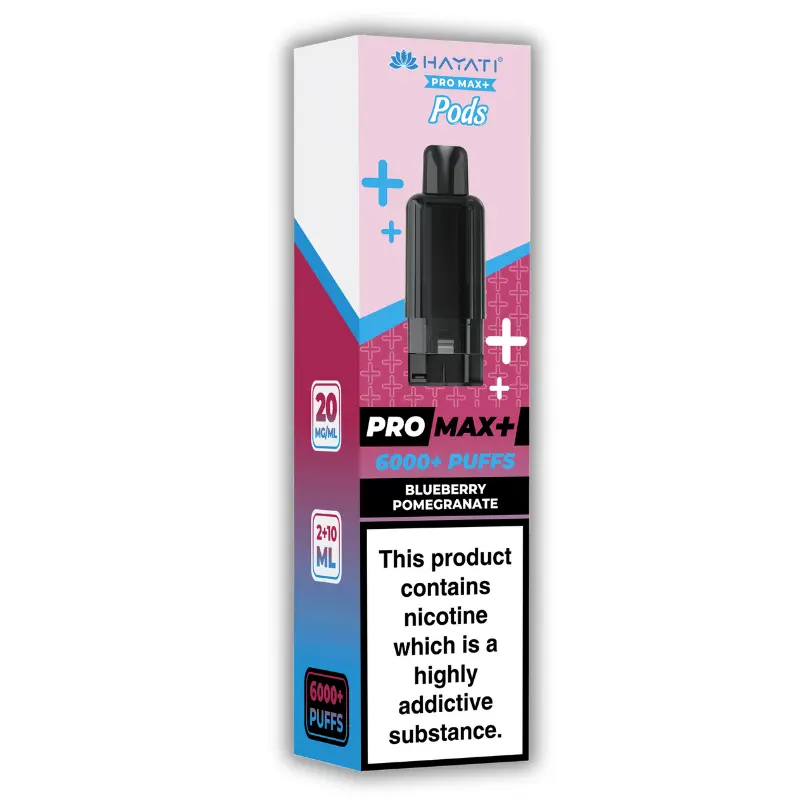
Hayati · Pro Max Plus
Blueberry Pomegranate Hayati Pro Max Plus Pods
£5.49
✔ In stock — ready to ship
Genuine Hayati
Free over £20
Same-day dispatch
Secure checkout
Buying a bare pod is a narrower decision than buying a flavour. The body is already on the desk, the seating routine is muscle memory, and the only live question is whether this particular liquid earns another £5.49 of the restock budget. Blueberry Pomegranate arrives as one prefilled pod holding twelve millilitres at 20mg nicotine salt, closed around its own coil, with nothing else in the packet. Hayati rate a full pod by the manufacturer at up to 6,000 puffs, a figure produced on test equipment running to a timer rather than an account of how long it will sit in anybody's pocket.
What makes this listing unusual has nothing to do with the hardware, which it shares with eighty-eight other pods on the same shelf. It is that pomegranate has no second entry anywhere in Hayati's catalogue. I counted, because the listing makes a softer version of that claim and a claim like it is worth checking before a page is built on it. The word appears in exactly two of the 492 product titles Hayati currently list, and the two are this pod and its kit. No other listing mentions pomegranate anywhere in its description either. So this is not a fruit that turns up occasionally. It is a fruit that turns up here, once, in two SKUs of one recipe, and nowhere else at all.
That matters more for a restock buyer than it does for someone choosing a first pod, and it is the reason this page is organised the way it is. A repeat purchase is a decision about what you already know, and what you already know after two or three pods of this liquid is not what the listing describes. The listing describes a first encounter. This page is about the ones after it, about what is still on the mouthpiece when the novelty has gone, and about the awkward fact that if the answer is no, there is nowhere within the range to go sideways.
Pomegranate, counted rather than asserted
Hayati's own copy says pomegranate turns up rarely in vape flavours. That is a vague statement and it understates the position, at least within this catalogue, so here is the count in full.
Across all 492 listings, pomegranate appears in two titles. Both are this flavour: this pod at £5.49, and the Blueberry Pomegranate Hayati Pro Max Plus Pod Kit at £7.99, which is the same liquid with a rechargeable body in the carton. Searching the description text rather than the titles adds nothing: no other product mentions the fruit in passing, as a supporting note, or as a comparison. Two mentions, one recipe, zero elsewhere.
Set that against the fruits the range actually runs on. Raspberry is in 74 titles. Cherry is in 62, strawberry in 60, blueberry in 46, apple in 35, grape in 17, cranberry in 16, guava in 8, and then the numbers collapse: lychee three, pear three, passion fruit three, pomegranate two. Plum, fig and date appear in none. Pomegranate sits at the bottom of the list of fruits that exist here at all, one step above the ones that do not exist.
The practical consequence is specific and it is not flattering. On Berry Vapes, which runs to 225 listings, almost every fruit has a bench behind it. If raspberry stops working for you there are dozens of raspberry pods arranged along every axis the range has: sweeter, sourer, cooled, candied, blended with something darker. If blueberry stops working there are ninety listings on Blueberry Vapes to try instead. Pomegranate has no bench. It has this pod and the kit that contains this pod, and that is the whole provision.
So the reorder decision here is unusually binary. On most of the shelf, deciding a flavour has stopped working for you is the start of a search. Here it is the end of one, because there is no sideways move available that keeps the component you liked. A buyer whose attachment to this pod is specifically an attachment to the pomegranate is buying from a supply of one, and the only substitutions on offer replace the fruit rather than reposition it. That is worth knowing before the third pod, not after it.
One qualification, since a count is only as good as its boundary. This is a count of Hayati's 492 listings on this site, not of the flavour's frequency in vaping generally, which I have no data on and will not guess at. The listing's own phrasing is about vape flavours at large. Mine is about what you can actually buy from this range, which is the number that governs your next order.
Two listings, one recipe, and the word they both reach for
Most Hayati flavours are sold several times over, across platforms and formats, and each listing gets fresh copy written for it. Lining those descriptions up against each other is usually the richest evidence available about a liquid, because the properties every version asserts are the closest thing to a fact on offer, and the ones only a single version asserts are either the most interesting detail on the page or a copywriter's flourish.
Blueberry Pomegranate gives you very little to work with by that method, because it has only two listings. That is itself a small piece of evidence: a flavour with two entries is a flavour the range has not committed to, whereas the blue raspberry family is spread across bottles, pods, kits and both large-format platforms. But the two descriptions do differ, and the differences are informative.
Both agree on the blueberry. The pod calls it a mellow, jammy sweetness; the kit calls it a mellow, jammy sweetness too, in almost the same construction. Both agree on the closing character, describing a fruity finish that does not sit heavily. Both agree on the shape of the contrast: soft berry underneath, something sharper on top.
Where they part company is the word chosen for the pomegranate. This listing calls it bright and slightly tannic, and frames the result as a contrast that keeps successive draws interesting. The kit listing calls it sharp and slightly tannic, adds that the tartness is almost wine-like, and frames the result as sweet but grown-up. Sharp and bright are not the same claim. Bright suggests a lifted, high acid; sharp suggests an edge with more force behind it. Two descriptions of one recipe disagreeing on that is evidence about how the copy was written, not evidence of two formulations, and it should be read that way.
The interesting part is what survives both. Both listings reach for tannic, and that word is worth counting, because this corpus has caught itself before treating house vocabulary as though it were a finding.
Jammy is the control case. It appears in 27 of the 492 descriptions, scattered across berry blends of every construction, which means its presence here carries no information at all. If a description calls a blueberry jammy, it is describing a category, not a liquid.
Tannic is different. It appears in exactly two of the 492 descriptions, and both are this flavour's two SKUs. Nothing else in the catalogue uses it. Whoever wrote these two listings reached for a tannin word for this recipe and for no other recipe Hayati sell, and did it twice independently, in two separately written descriptions. That is about as strong a signal as a listing diff can produce.
Now the narrowing, because the bold version of that claim does not survive counting. It would be tempting to say that this is the only listing in the range described by how it feels rather than how it tastes, and that is not true. The word dry appears in 21 of the 492 descriptions, concentrated in the cranberry blends and a few of the tobacco and citrus entries, and dry is a texture word. Wine-like appears exactly once in 492, on the kit twin, so the specifically vinous framing is unique to this flavour but is not present on this listing. Pucker appears seven times. Mouthfeel, as a word, appears nowhere.
So the claim I will actually stand behind is the narrow one: the tannin vocabulary is unique to Blueberry Pomegranate within Hayati's range, while the broader dryness vocabulary is not, and belongs mostly to cranberry. That is a smaller claim than the one I set out to make and it is the one the count supports.
What this site already knows about astringency, and where it disagrees with itself
Astringency is not a taste. It is a tactile sensation, a roughening and tightening where the tongue meets the palate, and it is produced by a mechanism that has nothing to do with the receptors that register sugar and acid. That is not my finding and I am not going to re-derive it. The Blueberry Cherry Cranberry Rubik kit page on this site works through it at length for cranberry, separating the acid from the astringency, establishing that the two arrive together but are distinct, and pointing out the consequence that matters most: a component with no aroma of its own cannot be something you recognise, so it can only ever be something that changes what you recognise. Anyone who wants the full version should read that page rather than this paragraph.
The companion Rubik pods page took the next step and observed that a tactile percept behaves differently over weeks from a flavour note, in that repeated exposure tends to reduce how much of it registers. It built a three-pod comparison protocol around that observation, designed to tell adaptation apart from a coil that is simply tiring. Both of those arguments are finished work and both belong to those pages.
There is a complication, and flagging it seems better than pretending the site speaks with one voice. The Strawberry Raspberry Blueberry Pro Max Plus pods page reaches the opposite conclusion about a neighbouring case. Discussing what to do when a component has gone quiet, it recommends moving to a cooled blend on the grounds that a coolant is a sensation rather than a flavour and therefore does not habituate the same way. The Rubik position is that a sensation habituates readily. The Strawberry Raspberry Blueberry position is that a sensation resists habituation. They are talking about different sensations, cooling in one case and astringency in the other, so they are not strictly contradictory, but they cannot both be general.
I am not in a position to settle that, and I am not going to pretend the resolution is obvious. What I will say is that the two mechanisms are not obviously alike. Cooling is delivered by a compound acting on a receptor, and it keeps arriving because the compound keeps arriving. Astringency is produced by an interaction at the surface of the mouth itself, which is a different kind of event, and the Rubik pods page is probably right that it is the more adaptable of the two. But that is a judgement, not a measurement, and this page does not need it to be settled.
Which leads to the narrowing this page actually depends on. I set out expecting to argue that the drying edge is the thing that fades and the fruit is what remains. That is not a claim I can make cleanly, because the site's own pages disagree about the premise and because coil ageing takes things in roughly the same order. What I can do instead is ask the question neither prior page asks, which is not diagnostic but economic: whatever the mechanism, by pod three you are no longer buying the sensation that made pod one distinctive, because either it has faded or it has become ordinary. So what exactly are you rebuying, and is that worth 45.75p a millilitre?
Everything below is about perception under repeated exposure and about a purchase decision. None of it is a claim about anything happening inside the body.
The liquid, as a first pod reads it
No kit page exists for this flavour yet, so the tasting work is not spoken for and it can be done properly here.
The draw opens on blueberry and it opens low. This is the cooked, dark end of blueberry rather than the fresh fruit: sweet, slightly syrupy, without the green edge a fresh berry carries and without much lift. It occupies the bottom of the draw and it is broad rather than pointed, which is what the house term jammy is gesturing at even though the house uses that term for half the berry shelf. On its own it would read as soft and slightly flat, closer to the blueberry in Blueberry B'Gum stripped of the confectionery than to the brighter berry in a blue raspberry blend.
The pomegranate does not arrive with it. It comes in across the middle of the draw, and it comes in as acid first. This is a clean, high, slightly metallic acid, not the rounded citric acid of a lemonade blend and not the deliberately dosed sour of a candy build. It sits above the blueberry rather than mixing into it, which is the source of the contrast both listings describe, and it is the reason the blend reads as two things rather than one. On a fresh pod with a cold device the acid can take a draw or two to show up properly, because the first mouthfuls off a saturated wick tend to read sweeter and heavier than the pod does once it has settled.
The exhale is where the signature lives. The acid peaks and then hands over to something that is not a flavour at all: a narrowing along the sides of the tongue, a slight roughness where the surfaces meet, the sense that your mouth has become marginally less slippery than it was a second earlier. It is mild. This is not the hard drying grip of a cranberry build, and anyone arriving from Blueberry Cherry Cranberry expecting the same intensity will find this a considerably lighter version of the same category of sensation. But it is present, it is repeatable, and it arrives after the fruit has gone rather than alongside it, which is why it is the thing people remember.
Sweetness sits above the middle of the shelf but below the candy tier. It is sweeter than a cranberry blend and markedly less sweet than Blue Razz Lemonade or Blue Fusion, both of which are built on candied blue raspberry and taste it. The drying finish does some of the work of restraint here: sugar is present in the liquid but the close strips a little of the film it leaves, so the next draw starts from something nearer to neutral than the sweetness alone would suggest.
There is no cooling. Nothing in the title carries a cooling word, and the Blue Frozen pods page on this site established by counting that Hayati's cooling vocabulary is marked in the title rather than hidden in the recipe, that the terms in use are not graded against each other, and that Ice appears in ninety titles while Frozen appears in three and Cooler in two. I am citing that rather than recounting it. The short version for this pod is that its absence from the title is the range's own way of telling you there is no coolant in it, and the draw confirms it: the tightening at the end of the exhale is a texture, not a chill, and the two feel nothing alike.
What this is not, stated plainly, because the neighbours are close enough that it matters. It is not a sour build. Blue Sour Raspberry puts a dosed sour agent at the front of the inhale and makes you pucker on the way in; this puts a natural fruit acid in the middle and a texture at the back. It is not a dark three-fruit stew. It is not a soft everyday berry pairing either, which is what Blueberry Raspberry is built to be. And it is not complicated: two components, clearly separated, one underneath and one on top, with a textural close. The listing's own word for the result is grown-up, which is marketing language, but the thing it is pointing at is real enough. This is a fruit blend that declines to be entirely pleasant at the end of the draw, and that is either exactly what you want or exactly what you do not.
What is left underneath
Here is the argument the restock decision turns on, and it is not a diagnostic argument. The question of whether a fading component means your palate has settled or your coil is tired has been worked through twice on this site already, on the Rubik pods page and on the Strawberry Raspberry Blueberry pods page, and both of them give you tests to run. Those tests are good and I am not going to restate them. This is a different question, and it applies whether or not anything has faded.
On pod one, the tannic close is the whole reason this pod is memorable. It is the property that distinguishes it from every other blueberry listing on the shelf, it is the property both descriptions reach for, and it is almost certainly the property that made you buy the kit or the first pod. It is the headline.
By pod three it is not the headline any more. This happens by one of two routes and the distinction does not change the outcome. Either the sensation has genuinely receded, which is the Rubik position and which I think is more likely than not for a percept of this kind, or it has simply stopped being surprising, which happens to every distinctive property of every liquid regardless of mechanism. Novelty is a one-time asset. A texture that reads as an unusual choice on the first pod reads as the way this pod finishes by the third, and that is true even if the physical sensation is arriving at full strength.
Either way, the thing you are paying for has changed. You are no longer buying the distinguishing property, because the distinguishing property has become the baseline. You are buying whatever is left when it is not the reason any more, and for this liquid that is a jammy blueberry floor and a bright, slightly metallic acid above it. That is the actual product of a repeat order. It is worth looking at honestly.
Twelve millilitres at £5.49 works out at 45.75p a millilitre, which is what every pod on Hayati Pro Max Plus Pods costs, so price is not a point of difference and cannot be part of the case. What you are deciding is whether that residue, at the shelf's standard rate, beats the eighty-eight other things available at the same rate. And the uncomfortable part of the answer is that the residue on its own is not far from what Blueberry Raspberry does: a soft dark berry base with an acid on top. If you subtract the tannic close entirely, the two blends are doing a similar job, and Blueberry Raspberry is doing it with a better-behaved acid.
The difference, and it is a real one, is the shape of the acid rather than its presence. Raspberry's acid is rounded and it blends downward into the berry beneath it. Pomegranate's stays separate and sits above, so the blend keeps two distinguishable layers where the raspberry version fuses into one. Some people will find that separation is the thing they actually liked all along and the texture was only how they noticed it. Those people should reorder. Others will find that without the texture the separation is just an unresolved blend, and those people should not.
Now the part that is specific to this listing and that changes the usual advice. The standard move when a flavour flattens out is lateral: keep what you liked and change the surrounding structure. When the Strawberry Raspberry Blueberry page reaches this point it recommends exactly that, sending the reader to a blend with the acid at the end or to a cooled one. On this pod that move is not available in kind, because the count above says there is nowhere to take pomegranate. There is no sweeter pomegranate, no cooled pomegranate, no pomegranate paired with a citrus instead of a berry. If you leave this liquid you leave the fruit, permanently, as far as this range is concerned.
Which means the decision has a different shape here than it does on any other listing on the shelf. Everywhere else, deciding you are bored is cheap, because the range absorbs it. Here it is terminal. That cuts both ways, and it is worth saying the favourable half too: if the residue does hold up for you, this pod is genuinely irreplaceable within the range, and a buyer who has found something that works and has no substitute for it is in a stronger position than one who has found something merely pleasant among thirty alternatives.
The test I would actually run is not a tasting test and it does not involve comparing pods. It is a behavioural one and it takes three weeks. Fit a pod, use it normally alongside whatever else is in the rotation, and pay no attention to the flavour at all. Then at the end of the third week, notice whether you have been reaching for it without deciding to. Not whether it impressed you, not whether you can still detect the drying close, not whether it tastes the way you remember. Whether your hand goes to it when you are not thinking about it.
That is the only signal that survives adaptation, because it does not depend on the sensation still being noticeable. A liquid you reach for unprompted in week three is a liquid that works as a daily, whatever has happened to the property that sold it to you. A liquid you have to remind yourself to enjoy is one you bought for the novelty, and novelty does not restock. The first pod cannot answer that question, and neither can any page, including this one. The second and third can.
The pod itself, kept short
Eighty-nine listings share this shelf and the hardware conversation has been had on most of them, so this section is deliberately brief.
The packet holds one pod and nothing else. It is prefilled and closed at the factory, with the coil and the wick inside the shell, so there is no filling, no coil change and no maintenance: the pod is used and then replaced as a unit. The specification that actually matters for this liquid is the twelve millilitres, because a drying finish is a commitment. Twelve millilitres is a long run of one texture, and a buyer who is unsure whether the close suits them is committing to considerably more of it than a smaller-format pod would ask. That is the main argument for treating the first pod as a trial and the rest of the shelf as the fallback.
One line of housekeeping: this is a Pro Max Plus pod, so check the range name printed on your device against the range name in this title before ordering, and do not take a compatibility decision from a retail page, ours included.
If you do not already own a body, the same liquid with a rechargeable device is the kit listing at £7.99, which means the hardware costs £2.50 on top of the pod and then costs nothing again. Everything else on the platform, including the other eighty-eight flavours, is on the shelf at Hayati Pro Max Plus Pods, and the wider refill range across every Hayati platform sits on Hayati Prefilled Pods & Refills, which runs to 201 listings.
The sheet, with the unpublished rows kept in
Arranged by what a restock buyer checks first rather than by the order a spec sheet usually runs in. The last five rows are the honest part of the table.
| In the packet | One prefilled pod. No body, no cable, no spare. |
| Price, and the same figure per millilitre | £5.49, which is 45.75p a millilitre |
| Liquid | 12ml, filled and closed before it reaches you |
| Nicotine | 20mg nicotine salt, the UK ceiling for a consumer e-liquid, and the only strength this listing offers |
| Components named | Two: blueberry underneath, pomegranate above |
| Where the character sits | At the end of the exhale, as a texture rather than a taste |
| Cooling | None. No cooling word appears in the title, which is how this range marks a cooled listing |
| Manufacturer's puff figure | Rated by the manufacturer at up to 6,000, a laboratory estimate from test equipment |
| Body required | A rechargeable Hayati Pro Max Plus, bought separately |
| Same liquid with a body | £7.99 for the kit listing |
| Other pomegranate liquids Hayati list | None. Two of 492 titles carry the word and both are this recipe |
| Listings in 492 using the word tannic | Two, and both are this recipe |
| Coil resistance | Not published for this listing |
| Cell capacity of the body | Not stated on this listing |
| How drying the finish is | Not published, and not a thing a listing could tell you |
| Sweetness relative to the shelf | Not published. The placement earlier on this page is my reading, not a figure |
Two notes on rows people misread. The 6,000 figure is a budget allotted to one sealed coil under machine conditions, not a duration, and it moves with how hard and how often the device is drawn on. And the 20mg is a ceiling rather than a choice: the UK maximum for a consumer e-liquid is 20mg per millilitre, this listing offers no other strength, and the only nicotine-free option on the shelf is the separate zero nicotine pod, which is a different flavour entirely rather than this one without the nicotine. Nicotine is addictive, which is a property of the substance rather than a comment on this product.
If you find another page, on this site or elsewhere, quoting a resistance, a fruit ratio or a number for how astringent this liquid is, it has invented them. None of those figures exists in Hayati's published data for this pod.
Where it sits against the rest of the shelf
Eighty-nine pods share this listing's shelf and ninety share the blueberry tag, so the useful comparison is not a list of neighbours but a handful of specific swaps, each with a reason.
If the tartness is what you want but the texture is not. Blueberry Raspberry is the direct substitution and it is the one most people will end up making. Same dark berry floor, an acid on top instead of a tannin, and a finish that closes rather than tightens. It is the more comfortable pod of the two and it is designed to be a default, which is both its strength and the reason it is less memorable. If the last section's description of the residue sounded appealing on its own, this is that residue sold deliberately.
If the texture is what you want and you want more of it. Blueberry Cherry Cranberry takes the same category of sensation considerably further, because cranberry produces a harder and more persistent drying effect than pomegranate does and carries almost none of its own sugar to soften it. It also adds a cherry middle, so it is a fuller and darker blend rather than the two-layer construction here. Anyone who found this pod's close interesting but too slight should go there. Anyone who found it slightly too much should not.
If what you actually liked was the edge, not the dryness. Blue Sour Raspberry is the shelf's declared sour build and it puts the sharpness at the front of the inhale rather than the back of the exhale. It is a much sweeter pod overall, candied underneath, and the sourness is a dosed effect rather than a fruit acid, so it reads as louder and less natural. Different sensation, different position in the draw, and on the habituation question a dosed sour is a taste rather than a texture, which puts it on the other side of the argument discussed above.
If you want the blueberry without anything on top of it. Mixed Berries is the shelf's rounded, unchallenging berry option, built to be easy rather than interesting, and it is the obvious pod to run beside this one on days when a textural close is the last thing you want. Blueberry B'Gum goes the opposite way and sweetens the same fruit with a confectionery accord, which makes it the furthest thing on the shelf from this pod despite sharing a fruit.
If you are in this for the blue family rather than the blueberry. The blue raspberry group is a different flavour tradition and it is the largest on the shelf. Blue Fusion and Mad Blue both sit inside it, Blue Razz Fruit Twist and Blue Razz GB take it in the candied and the sweet-sharp directions respectively, and Blue Razz Lemonade adds citrus and a lighter body. None of them will scratch the same itch as this pod, because all of them are built on sugar and none of them closes on a texture, but the group is where most buyers of blue-labelled pods actually live.
If you want a cooled pod to alternate with. Blue Frozen is the shelf's cooled blue entry and is worth pairing with this one for a reason that is mostly practical: a coolant and an astringent are doing different things to your mouth, so the two do not muddle each other the way two fruit blends can. Worth knowing before you swap: fitting a cooled pod straight after a drying draw tends to make the cool read thin and slightly harsh, so give it a few minutes rather than switching mid-session.
If the appeal was the unusual rather than the specific. Two listings on this shelf are named for an impression rather than an ingredient, and both are bought largely on curiosity. Galaxy Aura belongs to Hayati's Aura group, whose names describe a mood rather than a fruit, and Dragon Berries threads a lighter tropical note through a berry mix. Neither is a substitute for pomegranate in any literal sense. Both are the same kind of purchase, which is buying the thing on the shelf that is not like the others.
If you want more fruits rather than a different one. Blueberry Raspberry Cherry and Strawberry Raspberry Cherry are the three-fruit red and dark blends, and Strawberry Raspberry Blueberry is the one whose own page works through what happens to a middle component over successive pods. That page is worth reading alongside this one, since it reaches a different conclusion about a structurally similar problem.
If you want a larger format rather than a different flavour. The Pro Ultra Plus platform runs 22ml divided pods at a higher price, and Blueberry Raspberry Lemon and Mr Blue sit at either end of the size question within the blue family. The Pro Ultra Plus pods need their own body and are not interchangeable with this one, so that is a platform decision rather than a flavour one.
For anything not covered above, the full refill range is on Hayati Pods at 202 listings, everything recently added is on New Products, and the whole catalogue of 492 is at All Hayati products.
Living with a pod whose signature is a texture
Generic pod advice is on most pages in this range, so this section sticks to what is specific to this liquid.
A factory-filled pod arrives with the wick fully wet, and the first two or three draws off a cold device run sweeter and heavier than the pod does afterwards. On this recipe that means the drying close is the last element to show up properly, so a first impression taken on draw one will understate exactly the thing the pod is known for. Give it five minutes of ordinary use before forming a view.
Pace matters more here than it does on a sweet pod. Astringency accumulates rather than clearing between draws, because the sensation comes from something being taken out of your mouth rather than something being added to it, and restoring the surface takes minutes rather than seconds. Chain-drawing this pod will therefore produce a steadily drier mouth and a steadily flatter reading of the fruit, which is a pacing artefact and not a fault in the liquid. Spacing draws out fixes it entirely.
Here is a prediction specific to this pod, offered as reasoning rather than as a published fact, and it runs against what the cranberry pages describe. Those pages argue that the aroma compounds are volatile and go first while the acid and the drying agent are heavy and stay, so a tiring cranberry pod reads progressively drier and harder. Pomegranate is not in the same position, because unlike cranberry it brings its own sugar as well as its own acid, and sugar is not volatile either. So the last two millilitres of this pod should read as blunter and slightly sweeter rather than drier and sharper: the bright top of the pomegranate thinning out while the jam underneath and the tightening at the close both hold. If that is what you find, it is the coil, not a bad pod. If you find it going harsher instead, my reasoning is wrong and the cranberry pattern applies here too.
Storage is worth one sentence more than usual on this liquid. Heat removes aroma faster than use does, so a spare left somewhere warm loses its fruit while the acid and the texture sit unchanged, which on this recipe means a badly stored pod arrives as a harder and less interesting version of itself rather than a weaker one. Keep spares indoors, out of direct sun, upright, and somewhere children and pets cannot get at them.
On when a pod is finished: the signal here is not a burnt note, which arrives late and is unmistakable anyway. It is the separation collapsing. This blend's whole character is two layers that stay distinct, and when the top layer stops being distinguishable from the bottom one, the pod has given you what it has. Chasing the last half millilitre past that point produces a warm, flat draw and nothing worth having.
A finished pod still has a coil inside it and a film of liquid around that, which puts it in the electrical waste stream rather than the kerbside bin. Vape retailers and local authority sites accept them. If you are switching away from a pod before it is empty, it keeps better sealed in its own packaging than rattling loose in a bag, and the arithmetic is the reason to bother: walking away from this one at the halfway mark writes off six millilitres, which at 45.75p each is £2.75 discarded, and rather more than that if it becomes a habit.
Questions a restock buyer actually asks
Is there really no other pomegranate in the range?
No, and I checked rather than taking the listing's word for it. Two of Hayati's 492 titles contain the word pomegranate, and they are this pod and its kit. No other listing mentions the fruit in its description either. Within this range the supply is one recipe in two formats.
What does tannic actually mean on a flavour listing?
It is a texture word, not a taste word. It describes a tightening and slight roughening of the mouth surfaces, the same category of sensation as over-steeped tea or a young red wine, and it registers through touch rather than through the taste receptors. Hayati use it on this flavour and on no other in 492 listings.
Does anything in this cool the draw?
No. There is no cooling word in the title, and this range marks cooled liquids in the title rather than hiding them in the recipe. The tightening at the end of the exhale is sometimes mistaken for a cool sensation on a first pod, but it is a texture and the two feel quite different once you have both to compare.
How sweet is it against the rest of the shelf?
Above the middle, below the candy tier. Sweeter than any cranberry blend, noticeably less sweet than the candied blue raspberry pods. The drying close makes it read as less sweet than the sugar content alone would suggest, because it strips some of the film the sweetness leaves behind.
I loved the first pod and the third feels ordinary. What happened?
Most likely nothing happened to the pod. A distinctive property stops being distinctive once it becomes the thing you expect, whether or not the sensation itself has changed, and a texture is particularly prone to this. Two other pages on this site set out tests for telling that apart from a tiring coil. This page's view is that the more useful question is whether what remains is worth reordering, which is a decision rather than a diagnosis.
Is the kit worth £2.50 more?
Only if you do not own a compatible body. The kit contains the same twelve millilitres of the same liquid with a rechargeable device added, so the £2.50 buys hardware and nothing else. If a Pro Max Plus is already on your desk, this listing is the same liquid without paying for a second body.
What should I run alongside it?
Something that is not doing anything textural. A cooled pod or a rounded sweet berry works because neither competes for the same part of the sensation, and rotating stops the drying effect accumulating across a whole day. Two fruit blends of similar construction tend to blur into each other instead.
Can I refill the pod when it is empty?
It is sold as a prefilled pod and Hayati publish no filling procedure for it, so treat it as a replace-and-discard item rather than a refillable one. The coil is inside the same shell, which is why the whole unit is the consumable. A finished one belongs in the electrical waste stream.
Does a spare deteriorate while it waits?
The aroma is the most fragile part of it, so a pod left somewhere warm loses fruit first while the acid and the texture are largely unaffected. That is worth knowing on this recipe specifically, because losing the fruit leaves the harder end of the profile intact and the pod reads as more austere than it should.
Who should avoid this one?
Anyone who dislikes the mouthfeel of strong tea or a tannic drink should treat that as the deciding test, because it is the same category of sensation at a lower intensity. Anyone who wants a straightforwardly sweet berry pod should also look elsewhere, since the close here is deliberately not comfortable. Twelve millilitres is a long commitment to a texture you are unsure about.
What does the puff figure mean in practice?
Hayati rate a full pod by the manufacturer at up to 6,000 puffs, which comes off test equipment drawing to a timer. Read it as the budget allocated to one sealed coil under laboratory conditions rather than as a count you should expect to reach, since draw length and frequency move it considerably.
The short version
Blueberry Pomegranate is a twelve millilitre prefilled refill for a Pro Max Plus body you already own, at £5.49, holding 20mg nicotine salt liquid and rated by the manufacturer at up to 6,000 puffs as a laboratory estimate. The liquid is a cooked, jammy blueberry underneath and a bright, slightly metallic pomegranate acid above it, with a mild tightening of the mouth at the end of the exhale that is a texture rather than a taste. No cooling.
Two findings from counting rather than reading. Pomegranate appears in two of Hayati's 492 titles and both are this recipe, so there is no other pomegranate liquid in the range and no sideways move available if this one stops working. And the word tannic appears in exactly two of the 492 descriptions, both of them this flavour, which makes the tannin vocabulary unique here, though the broader dryness vocabulary is not and belongs mostly to cranberry. That second claim was narrowed after counting, because the bolder version did not hold.
The restock argument is simple once the arithmetic is laid out. The texture is what sells the first pod and it cannot sell the third, because by then it is the baseline rather than the surprise. What you are rebuying is the jam and the acid underneath it, at the same 45.75p a millilitre every pod on this shelf costs, and that residue is closer to Blueberry Raspberry than anyone would like to admit. The honest test is not whether you can still detect the drying close. It is whether you reach for this pod without deciding to, in week three, when nothing about it is new any more.
Strictly for adults aged 18 and over. Nicotine is an addictive substance.
You might also like


