
Home / Hayati Pro Max Plus Pods / Strawberry Guava Hayati Pro Max Plus Pods
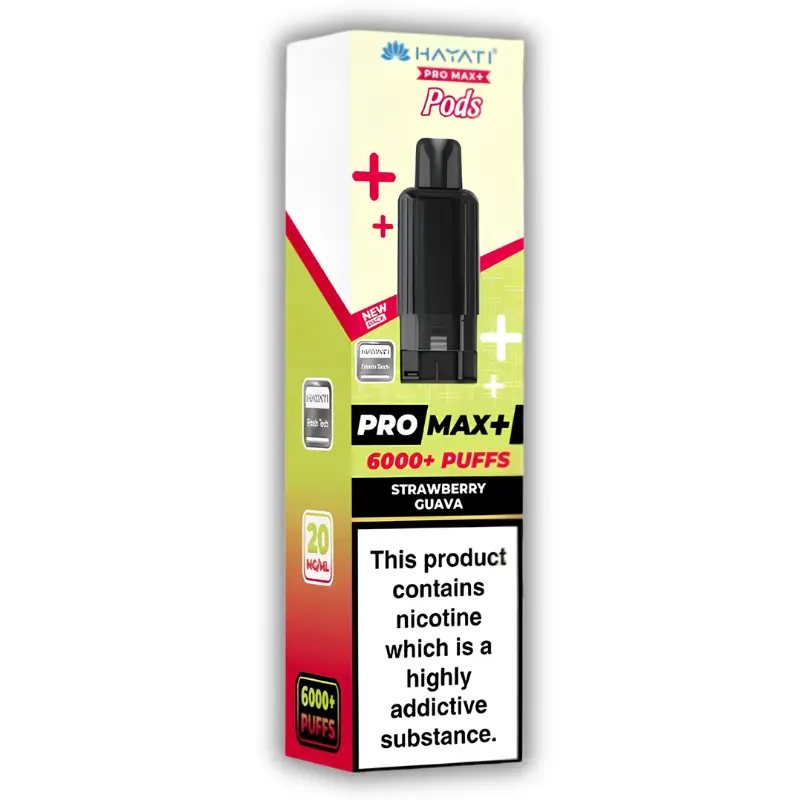
Hayati · Pro Max Plus
Strawberry Guava Hayati Pro Max Plus Pods
£5.49
✔ In stock — ready to ship
Genuine Hayati
Free over £20
Same-day dispatch
Secure checkout
One pod, £5.49, and nothing else in the packet. This listing is the Strawberry Guava refill for a Hayati Pro Max Plus body that is already in the house: 12ml of liquid at 20mg, filled and closed at the factory, with no device travelling alongside it. Anyone without a compatible body has nothing to draw on, and the Strawberry Guava kit at £7.99 is the listing that arrives usable. What separates the two prices is a device, and a device is bought once.
The flavour analysis belongs to that kit page and is not repeated here. It works through what guava actually contributes to a strawberry, why these two particular fruits sit in the same aromatic register instead of opposite ones, and it arrives at a conclusion this page treats as settled rather than reopening. The deciding variable is the temperature of the draw. Taken short, off a coil that has been left alone, the guava sits underneath and registers as ripeness in the berry. Taken long and hot, the floral parts of both fruits surface at the same moment, and with no acid and no chill anywhere in the liquid there is nothing left to hold them apart. The reasoning is there. This page assumes it.
Something follows from that which the kit page had no occasion to raise, because it was written for somebody who did not yet own the product. If the result depends on a technique, the pod is not a fixed object. Two people handing over £5.49 for this listing do not receive the same thing, and the difference between what they receive is larger than the difference between several of the flavours on the shelf. Less obviously, the same person does not receive the same thing twice, because a second pod arrives into whatever habit has formed by then, and habits move without asking permission.
That is the subject here: the buyer as the uncontrolled variable in their own purchase, what can actually be adjusted, and a short test that separates a disappointing recipe from a disappointing draw before another £5.49 goes on finding out.
Your first pod ran two tests and reported one score
A first pod of anything asks two questions at once. Is this recipe worth the money, and does the way I happen to vape suit it. The answers come back fused into a single impression, filed under the product name, with no breakdown attached.
On most of this shelf the fusion does no harm, because the second question barely matters. A cold, sharp blend presents recognisably the same across a wide range of handling. Pull on it hard, pull on it gently, chain it through a long evening or take one draw an hour, and the distance between its best and worst presentation is narrow enough to ignore. When that distance is narrow, a verdict about the pod really is a verdict about the pod.
This blend has a wide distance. That is the whole finding of the kit page, and it is worth restating only as a consequence rather than as a description: the further apart a liquid's best and worst presentations sit, the less a single impression of it tells you about the liquid and the more it tells you about the fortnight in which you formed it.
Consider what a first pod actually leaves behind. Four states are consistent with the same one-line verdict, and a first pod cannot tell them apart. The recipe suits you and you happened, by temperament or by circumstance, to draw it in the way it wants. The recipe suits you and you did not, so you have filed something you would enjoy as something you did not. The recipe does not suit you and you drew it well, which is the only genuinely informative negative on the list. Or it does not suit you and you drew it badly, in which case you are right by accident.
Two of those four produce a false record. That is not a failure of attention, because nobody fits a new pod intending to run an experiment on themselves. You fit it and get on with the day.
There is a sampling problem stacked on top. A fortnight of use is not evenly weighted in memory. Whatever mode you were in during the heaviest stretch of that fortnight dominates the impression, and the heaviest stretches are the ones where draws come closest together and last longest, which on this liquid is precisely the condition that flattens it. A pod sampled mostly during quiet, unhurried hours and a pod sampled mostly during a long drive are two different products that happen to carry the same name on the packet.
The part of this you actually control
None of the above is useful without specifics, so here are the specifics, along with an honest account of what is knowable and what is not.
How long each pull lasts
The single input with the most leverage is duration. Every extra second of drawing is another second of a coil heating liquid, and on a blend whose two halves separate by heat, that is the difference between a layered result and a flat one. Treat two seconds as the short end and five or six as the long end, not because those numbers are published anywhere but because they bracket what most people actually do without ever measuring it.
Nobody can give you a temperature. Hayati publish no coil resistance for this pod, no wattage and no airflow figure, so there is no route from a specification to an instruction. The dial has no printed numbers on it. What you can do is establish where your own low end sits by using it deliberately for a day, which is a cheap experiment and one most people never run, because the natural direction of drift is towards longer draws rather than shorter ones.
The practical form of this is unglamorous. Spend the opening day of a new pod at the short end on purpose, even when it feels stingy, and only lengthen once you know what the restrained version of this liquid tastes like. Almost everybody does the opposite, arriving at their habitual draw within the first ten minutes and never establishing a baseline at all.
The gap between one draw and the next
Duration is the obvious input. Spacing is the one people forget, and on this platform it is the only cooling mechanism available. A coil that has not had time to shed its heat begins the next draw warmer than the last, so three pulls inside thirty seconds and three pulls across five minutes are, for flavour purposes, two different devices.
On a blend built around contrast this shows up as slightly warmer vapour and little else. Here it shows up as the layering collapsing, which is a change of kind rather than of degree. Pace is therefore a throttle, and it is the first thing abandoned when you are busy, bored, driving, waiting for something, or in any of the other situations where a person reaches for a device without deciding to.
The loop that makes a bad session worse
There is a feedback problem specific to liquids of this construction and it is worth naming, because recognising it is most of the remedy. When the blend goes vague, the instinctive response is to pull harder and for longer, on the reasonable assumption that more of it will bring the flavour back. That input is the one that produced the vagueness in the first place. The error therefore amplifies itself inside a session, and from the inside it feels exactly like a pod failing.
The remedy is counterintuitive and takes two minutes: put it down, let the coil cool, then take one short draw. Anyone who has decided mid-session that a pod had died, only to find it fine the next morning, has met this loop without identifying it.
What is not available to you
This hardware has no airflow ring to close, no power setting to drop, no button to feather, and one coil sealed into a pod you cannot open. The listing carries a single strength. Subtract all of that and what remains as an adjustable input is your mouth and the clock, which is why technique carries more weight on this platform than it would on an adjustable setup, where you could simply take the heat out at the device and stop thinking about it.
Why a second pod is a different product from the first
Follow two buyers out of a first pod and into a reorder. Both liked the idea of a ripe pink fruit blend enough to try it. Both are now standing at the same £5.49 listing.
The first worked out the draw, which may have been deliberate and just as easily was not. Plenty of people arrive at the short, spaced pattern this liquid wants because their week is structured that way: a device kept in a bag rather than a pocket, use in short bursts between other things, no long unbroken evenings with it. Their second pod is the good version of this liquid from the first day, because they never have to spend a week learning it. For the same money as last time they have effectively bought an upgrade, and nobody sold it to them, invoiced them for it, or mentioned it.
The second buyer did not work it out. Their reorder is the same flat, perfumed, slightly shapeless result they had before, now arriving with the authority of a second sighting. Two consistent experiences look like evidence in a way one does not, so the conclusion hardens: the recipe is mediocre. That is an honest report of what happened to them, and the underlying 12ml is identical to the first buyer's.
Neither of them is misinformed about their own experience. They are drawing correct conclusions about two different products that share a name, a price and a barcode.
The same buyer, twice
The two-buyer version is the easy case. The harder one is a single person whose second pod is worse than their first with nothing having gone wrong.
Habits drift with circumstances that have nothing to do with vaping. A change of job that replaces a desk with a van. Colder months, when a device lives in a coat pocket and gets used in short bursts outdoors, or warmer ones, when it sits on a table all evening within reach. A period of stress, which shortens the gaps between draws more reliably than any decision would. Running this pod as the only flavour in rotation rather than alongside something cold, so the palate never gets a reset. None of those is a choice about technique, and all of them move technique.
The consequence is that a reorder can be genuinely worse than the previous pod while the manufacturer has changed nothing, and genuinely better while nothing has improved. A person in that position has an anomaly to explain and only one candidate on offer, which is the product, because the product is the thing with a name.
Why nobody corrects the record
There is no mechanism anywhere in this transaction that would tell either buyer which of the two things happened to them. The listing shows one price and one specification. A retailer has no way of knowing how anybody draws, and no channel through which that information could arrive even if it wanted it. Reviews attribute outcomes to recipes because a recipe has a name and a habit does not. And the buyer has no reason to suspect themselves, since the one thing they are sure of is what the liquid tasted like in their own mouth.
So the reorder decision gets made on evidence that cannot distinguish between two causes with opposite implications. If the cause was the recipe, buying again is money spent to confirm something you already know. If the cause was the draw, not buying again is walking away from a liquid you would like, on the strength of a fortnight in which you were doing something else with it. The gap between those two outcomes is the reason the test further down this page is worth ten minutes.
A liquid that needs handling is a worse liquid, and that is a fair thing to say
Everything above can be read as a defence of the blend, so it is worth being blunt about the other side, because the other side is real and the page would be dishonest without it.
Robustness is a genuine product property. A liquid you can vape carelessly, distractedly, in long pulls and quick succession, and still enjoy, is better on that axis than one you cannot. Strawberry Guava is not robust. It has a narrow window in which it does its best work, the window is easy to miss, and nothing on the packet tells you it exists. That is a mark against it, not a footnote, and anybody weighing this listing against a neighbour should weigh it as one.
The counterweight is what sits inside the window. Drawn the way it wants to be drawn, this reaches a rounder, riper red fruit than the plain strawberry listings on this shelf manage, and that is a real difference rather than a marketing one. But a conditional good is worth less than an unconditional one, and pricing them the same, as the shelf does, obscures that.
There is a failure mode in this kind of argument that needs heading off. "You are drawing it wrong" is what people say about things that are not good enough, and it should not be used to dismiss a complaint. If this blend went shapeless when you vaped it the way you normally vape, that is a real mismatch between a product and a person, and the existence of a technique that would rescue it does not oblige you to acquire that technique. Nobody owes a pod a change of habit. A buyer who reads all of this, decides the effort is not worth it, and moves to something that behaves itself has made a perfectly sound decision, and several of the alternatives further down this page are specifically better on exactly that axis.
Both readings are true at once. Technique dependence is an opportunity, because it means more is available from the same £5.49 than you may currently be getting. It is also a defect, because the need should not arise. The only genuinely wrong position is the one where you do not know which of the two you are in.
Telling the recipe from the draw, on one fresh pod
Here is the concrete part. It takes about ten minutes, it needs a newly fitted pod, and it settles the question that a disappointing first pod leaves open. Note in advance that it works by deliberately changing the variable rather than holding it steady, which is the opposite of how you would compare two pods against each other.
Start by fitting the pod and leaving it upright for a few minutes, then take a handful of ordinary draws so the wick is properly fed. Do not run the test on the very first pull of a new pod, because an underfed coil produces its own kind of wrong answer and you will not be able to tell it from the answer you are looking for.
Reading one, cool and short. Leave the device untouched for five minutes so it is properly at room temperature. Take one draw of roughly two seconds and exhale normally. What you are looking for is whether there is a warm, slightly savoury weight sitting behind the berry rather than on top of it. If the layering is present at all, this is the condition in which you will find it.
Reading two, warm and long. Wait three minutes without touching the device. This pause is the part people skip and it is the part that makes the test work, because a coil that has not cooled makes both readings the same reading. Then take three draws back to back with only a couple of seconds between them, and a fourth of five seconds or so. Judge the fourth.
Four outcomes are possible and each licenses a different decision.
The two readings are clearly different. One is layered, with something warm sitting under the fruit. The other is a single sweet perfumed note with no interior structure. This is the common result, and it means the outcome is yours to set. The liquid is capable of the version you want, your ordinary habit decides whether you get it, and the reorder is worth making because you now know what to do with it.
Both readings are much the same, and both are flat. Then the variable is not doing the work for you, whatever it does for anybody else, and what you have been tasting is the recipe. That is a sound reason to stop buying this listing. No amount of draw discipline will add a dimension that is not reaching you, and a page that told you otherwise would be selling you a third pod on false pretences.
Both readings are much the same, and both are good. You are already a short-draw vaper, probably without having thought about it, and none of this page's advice applies to you. Buy it without ceremony.
Both readings are unpleasant in a way that is neither ripe nor vague. A flat, papery, faintly scorched character in both conditions points at the pod or the coil rather than at either variable under test, and it is the one outcome that says nothing about the recipe or about you.
Two limits on what the test can settle. It cannot tell you anything about batch variation or how long a pod sat in a warehouse, because it only ever looks at one pod. And it cannot tell you whether you will still want this in a fortnight, which is a separate question about a sweet, uncooled, unpunctuated liquid and one the kit page addresses. It answers exactly one thing: whether your disappointing result was the liquid or the handling.
It has to be run on a fresh pod for a mechanical reason. A tired coil fails in roughly the same direction as an overheated draw, so late in a pod the two causes are no longer separable, and a test run on the last third of a pod will report the coil and call it your technique.
What £5.49 puts in the packet
The contents are one pod, prefilled and closed at the factory, and nothing else. No body, no accessories, and nothing beyond that is recorded in this listing's data, so nothing beyond that is claimed here. It attaches to a Hayati Pro Max Plus body. The rest of the fitment sits on the Hayati Pro Max Plus Pods shelf, and the equivalent idea across Hayati's other devices is gathered on Hayati Prefilled Pods & Refills.
One specification bears on everything above, which is the 12ml, and specifically that all of it passes through a single coil that arrives as part of the pod. A refillable setup would let you change liquid partway; here there is nothing to change. Whatever technique you settle into during the first days is the technique the entire 12ml receives, which is the mechanical reason a habit formed in week one is worth examining before week two rather than after pod three.
Hayati rate a full pod at up to 6,000 puffs. That figure comes off test apparatus, and there is a quiet joke in it for this particular liquid: the bench draws to a fixed schedule, identically, every time, which is the one thing no person does and precisely the variable this page is about. Use the number to rank listings against each other and not to predict anything about your own week.
The listing, and the holes in it
| What you pay | £5.49 |
| What turns up | One factory-filled pod, no device |
| Body needed | Hayati Pro Max Plus, bought separately |
| Liquid held | 12ml |
| Strength | 20mg nicotine salt, the only one on this listing |
| Fruits declared | Strawberry and guava, with no ratio given |
| Cold marker | None in the name, nothing in the data |
| Sour marker | None |
| Adjustable settings | None on this platform, so draw is the only input |
| Hayati puff figure | Up to 6,000 per pod, from test apparatus |
| Coil resistance | Not published |
| Carrier ratio | Not published |
| Guava variety | Not published |
| Maker | Hayati |
| Shelves | Strawberry Vapes, Exotic Vapes and four range shelves |
The unusual row is the one recording that there is nothing to adjust, and it is included because it is this page's argument compressed into a table cell. On a device with a collar and a wattage control, the problem described here would be a five second fix and would not deserve five thousand words. The absence of controls is what promotes draw technique from a refinement to the whole of the user interface.
The two unpublished numbers underneath it matter in the same way. Coil resistance would let somebody reason about how hard the coil is working and therefore how quickly a long draw heats things; the carrier ratio would say something about how fast the aroma is delivered. Neither is in the data for this listing, so neither is stated here, and a figure quoted for either on any retail page, this one included, came from somewhere other than Hayati. The practical effect of those blanks is that calibration by taste is the only method available to you.
The unnamed guava variety is flagged rather than explained, since the kit page already deals with how wide that gap is and what can and cannot be inferred from it. On the strength, 20mg is the only figure this listing carries and nicotine is an addictive substance, which stays true regardless of how ripe the fruit around it reads.
Neighbours, ranked by how much they care how you draw
The usual comparison on a product page sorts by flavour. For a repeat buyer of this particular pod there is a more useful axis, which is how much of the result each blend hands back to the user. Some of these are close to indifferent to technique. Some share this one's sensitivity. That is a genuine difference in what you are buying and it is not visible anywhere on a shelf listing.
Blends that do not need you to behave
Cooling is the most reliable way a liquid can be made technique tolerant, because a coolant is not a delicate top note competing for attention and it does not get crowded out when things warm up. Blackberry Ice Hayati Pro Max Plus Pods is the clearest example among the neighbours, with a dark, tart fruit and a cold finish that both survive being chained. Lychee Ice Hayati Pro Max Plus Pods keeps a floral fruit legible for the same reason, which is instructive if the floral moment is the thing you are unsure about here.
Acid does a similar job by a different route, since it punctuates each draw and so keeps resetting the palate no matter how the draws are spaced. Blue Sour Raspberry Hayati Pro Max Plus Pods carries a declared sour marker, Blackcurrant Lemonade Hayati Pro Max Plus Pods gets its sharpness from a drink accord rather than a dose, and Cherry Peach Lemon Hayati Pro Max Plus Pods puts citrus in the middle of two soft fruits, which is exactly the structural choice Strawberry Guava declines to make.
Cola Ice Hayati Pro Max Plus Pods and Blue Razz Pineapple Hayati Pro Max Plus Pods round out the forgiving end. Both hold a recognisable identity across a wide range of handling, which is the property to prioritise if you vape while doing something else and have no intention of thinking about draw length again after this page.
The same trap, elsewhere on the shelf
Sensitivity to handling is not unique to this pod, and knowing which neighbours share it saves buying the same problem twice. Mango Banana Hayati Pro Max Plus Pods pairs two soft, heavy, essentially unacidic fruits, which is the same structural decision made with different ingredients. Caribb Crush Hayati Pro Max Plus Pods occupies warm tropical ground with no sharp element anywhere in it. Strawberry GB Hayati Pro Max Plus Pods and Strawberry H’Bubba Hayati Pro Max Plus Pods both take the berry into confectionery territory, where broad sweetness does the identifying and heat has plenty of room to smear it.
Galaxy Aura Hayati Pro Max Plus Pods and Midnight Dream Hayati Pro Max Plus Pods are here for an honest reason rather than a descriptive one. Both name an atmosphere instead of an ingredient, so nothing predicts whether either is forgiving or demanding. That makes them poor choices for somebody currently trying to work out how much of their result is technique, since an unknown cannot serve as a comparison.
Strawberry with a partner that argues back
The alternative recipe strategy is to give the berry something to push against, and the results are considerably harder to spoil. Strawberry Kiwi Hayati Pro Max Plus Pods is the plainest version, with kiwi occupying a band strawberry leaves empty. Strawberry Cherry Cranberry Hayati Pro Max Plus Pods goes further, using cranberry to pull the sugar down and shorten the finish. Blueberry Cherry Cranberry Hayati Pro Max Plus Pods applies the same trick to a darker base, and Blackcurrant Mango Hayati Pro Max Plus Pods is the tidiest demonstration of the principle on the shelf, since the two fruits sit in obviously different registers and cannot merge however hot things get.
Smooth Strawberry Ice Hayati Pro Max Plus Pods is the direct comparison for anybody who likes this berry and has decided the guava is not worth the attention it demands. Cold in place of musk, a much narrower spread between careful and careless handling, and correspondingly less to gain from getting it right.
The same pairing on other hardware
Straw’ Guava Hayati Mini Ultra Pods at £3.49 is the cheapest place to meet this combination, on a smaller pod and a shorter run. Be careful about what transfers: it is different hardware, so any draw length you settle on here is not a number you can carry across, though the general finding that this pairing rewards restraint is about the recipe rather than the device.
Straw’ Guava / Dragon Berries Hayati Pro Ultra Plus Pods at £7.99 puts the pairing on larger hardware with a second profile alongside it, which is a structural answer to a blend that never changes across a pod and gives the palate somewhere to go. Kiwi Banana / Straw’ Banana Hayati Pro Ultra Plus Pods at the same price is worth naming because its second half repeats the structure under discussion, banana being another soft, low, unacidic fruit stacked against a berry.
Two single flavours complete the set. Dragon Berries Hayati Pro Max Plus Pods is the partner from those paired listings sold on its own, and it makes a sensible rotation companion for this pod precisely because it brings a lighter, fresher character that this one has no source of. Guava Kiwi Passion Fruit Hayati Pro Max Plus Pods is the most instructive listing on this whole page: the same fruit, on the same platform, with acid supplied by two partners instead of nothing. It is harder work on first acquaintance and much more tolerant of a hot, hurried draw, and owning both is the quickest way to feel what the missing acid was doing.
Handling, from the second pod onwards
Ordinary pod advice applies here as it does anywhere. What follows is only the part that changes because the outcome is technique led.
Open a new pod at the short end deliberately. The first session is the one that sets the habit for the remaining 12ml, and the habit that forms by default is the one your previous pod ended on, which on this blend is usually longer than it should be by then. A single deliberate session of restrained draws at the start of each pod resets that drift and costs nothing.
Leave gaps you would not bother leaving on a cold or sour pod. Two minutes between draws is generous; thirty seconds is workable; a run of pulls with seconds between them is the condition under which this liquid has nothing to give. If the flavour goes vague, treat that as a signal to put the device down rather than to pull harder on it, because pulling harder is the input that created the state you are trying to escape.
Keep the device out of heat where you can. A pocket against the body, a car in the sun or a windowsill all start the next draw from a higher baseline than a bag or a desk does. Spare pods want somewhere cool and dark, and out of reach of children and pets.
Judge the end of the pod on your best draw rather than your usual one. This is the one genuinely new handling rule on this page and it follows directly from everything above: a tired coil and an overheated draw produce results that point in the same direction, so a pod judged during a hot, hurried session will seem finished several millilitres before it is. Take one short draw on a cooled device. If the good version of this blend is still available in that condition, the pod is not finished. If it is not, it is, whatever the window shows. The kit page describes what the end of this particular liquid smells like, so that description is not repeated here.
Rotate it with something that has an edge. That is ordinary advice for a sweet, uncooled liquid, but it has a second function here: a palate that has had nothing else for a week is less able to detect the layering you are trying to preserve, which makes technique problems and boredom hard to tell apart.
Questions a returning buyer asks
Is the liquid the same as the one in the kit?
Identical. The kit listing is this pod packaged with a rechargeable body at £7.99, and this one is the pod on its own at £5.49. Anybody who already owns a compatible device has no reason to buy a second body unless they specifically want one.
How short is a short draw, in actual seconds?
Around two seconds is a reasonable low end and five or six is a long one, but those are brackets rather than published figures, since nothing in this listing's data would let anybody calculate a correct answer. The useful version of the question is where your own two ends sit, which one day of deliberate restraint will tell you.
My first pod was disappointing. Is there any point buying another?
Only if you run the ten minute test on the new one before deciding. Without it you are buying a second copy of an ambiguous result, and two ambiguous results feel much more conclusive than they are. With it you either learn how to get the better version or you establish that there is not one available to you, and both of those are worth £5.49 more than another fortnight of not knowing.
Is this just a way of blaming the buyer for a mediocre blend?
It would be if it were offered as an excuse, so it is worth being plain. A liquid with a narrow window is worse than one without, the packet does not mention the window, and a buyer who vapes normally and gets a flat result has been let down by the product rather than the other way round. The technique is worth knowing because it is available, not because anybody is obliged to acquire it.
How can the same liquid taste different when nothing about it has changed?
The short answer is that heat decides which parts of the blend reach you and in what proportion, and the two fruits here sit close enough together that the proportion is what separates them. The kit listing works through the mechanism properly. For practical purposes, what matters is that the effect is large on this recipe and small on most of its neighbours.
Is there any cooling in it?
No. Hayati signal cooling in the product name across this range and there is no such word here, with nothing in the supplied data indicating a coolant either. Treat it as a room temperature fruit blend, which is also why heat management falls to you rather than to the recipe.
It went vague halfway through an evening. Is the pod finished?
Probably not. Leave it alone for a couple of minutes and take one short draw on a cooled device, and if the structure comes back the pod is fine and the session was the problem. A pod that is genuinely spent will not recover from a rest, which makes this a quick way to separate the two.
Does the 6,000 figure mean anything for me?
It is useful for putting listings in order of capacity and close to useless as a forecast. It is produced by apparatus drawing to a fixed schedule, which is the exact opposite of the variable this page is about, so two people with the same pod will reach very different real numbers depending on how they draw.
Should I order two at once?
Not before the test, because the whole point of it is that you may be about to buy two of something you would not enjoy or two of something you have been underrating. Afterwards the answer is easy in both directions.
This one tastes different from my last pod and I have changed nothing. What happened?
Consider whether the circumstances around your vaping changed even though your intentions did not, since a new commute, colder weather or a busier month all move draw length and spacing without anybody deciding to. Storage heat and a coil that was tiring at the end of the previous pod are the other two candidates. Running the test on the new pod distinguishes the technique explanation from the rest.
Can I refill it?
Treat it as a replacement rather than a refill. It arrives filled and closed, the listing covers fitting a fresh pod when it is spent, and nothing in the supplied specification describes adding your own liquid to it.
The short version
This is the Strawberry Guava pod on its own, 12ml at 20mg for £5.49, for a Pro Max Plus body already in your possession. The flavour case is made on the kit listing and is better made there, including the finding this page rests on: draw temperature decides whether the guava deepens the strawberry or smears it.
What follows from that is a repeat purchase problem. Your first pod measured two things and reported one, so a proportion of buyers are carrying a verdict about the recipe that is really a verdict about a fortnight of their own handling. At the reorder, one buyer has learned the draw and is quietly getting an upgraded product for the same money, while another is rebuying a disappointment and attributing it to the blend. Nothing in the transaction tells either of them which they are.
The variables are draw length, the gap between draws, and not chasing a flat session with harder pulls. The test is ten minutes on a fresh pod: one short draw off a cool device, three minutes of rest, then a long draw at the end of a quick run. If the two readings match and both are flat, the recipe is what you have been tasting and there are better uses for £5.49 on this shelf. If they differ, you have been buying two products at one price, and from here you choose which one arrives.
Strictly for adults aged 18 and over. Nicotine is an addictive substance.
You might also like


