
Home / Hayati Pro Max Plus Pods / Strawberry Watermelon Hayati Pro Max Plus Pods
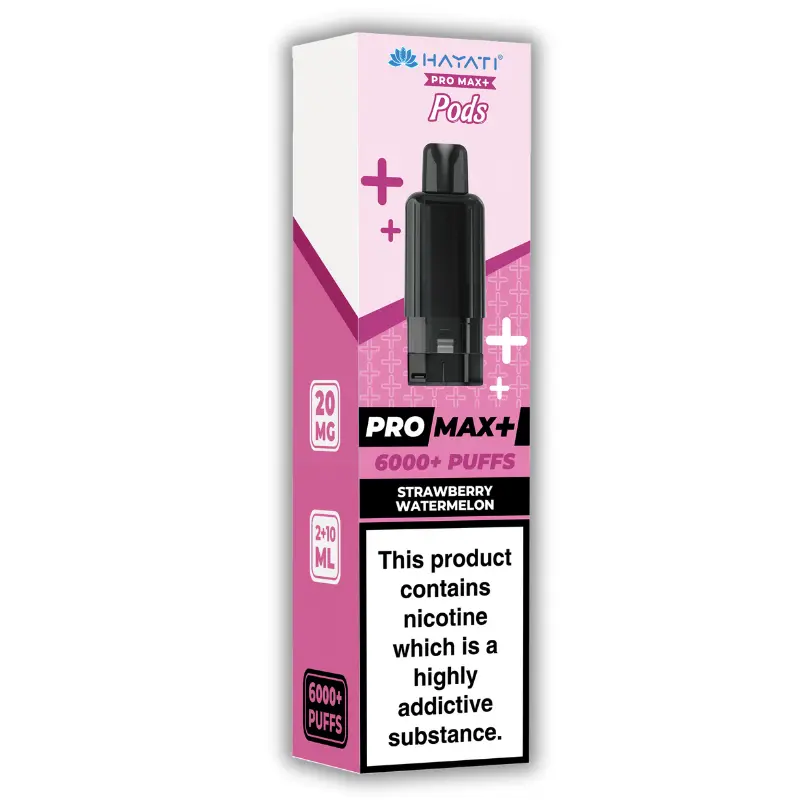
Hayati · Pro Max Plus
Strawberry Watermelon Hayati Pro Max Plus Pods
£5.49
✔ In stock — ready to ship
Genuine Hayati
Free over £20
Same-day dispatch
Secure checkout
Five pounds forty-nine buys one prefilled pod holding 12ml of Strawberry Watermelon at 20mg nicotine salt, with the coil built into the pod body and discarded along with it when the liquid is gone. No device is in the pack. Hayati rate the pod on their own test apparatus at up to 6,000 puffs, which is a laboratory estimate produced under controlled conditions rather than a prediction about your week. If you do not already own the hardware, the listing you want is the Strawberry Watermelon Hayati Pro Max Plus Pod Kit, which is the same liquid with a rechargeable body attached for £7.99.
That is the entire commercial description and it took four sentences. What takes longer is the question of who is actually reading it, because this page is being read by somebody in a specific and unusual position. You own the device. You have tasted this liquid. You are not choosing, you are reordering.
Two pages on this site have already done the work that comes before that moment, and neither of them needs repeating. The Strawberry Watermelon Hayati Pro Ultra Plus Pods page spends most of its length on a first-pod audition protocol: how to establish, on a liquid whose two fruits overlap almost completely, whether either one is separately present, and how to read the answer without fooling yourself. The 10ml Strawberry Watermelon Hayati Pro Max Nic Salt page took the composition question instead, counting what the blend declines to contain and working through how a blend built on nothing loud behaves as the coil under it tires. Between them, the first encounter is covered.
What neither could take is the thing that happens afterwards. A liquid that survives an audition becomes a fixture, and a fixture is a different commercial object from a candidate. This page is about what changes when a blend with no lead note stops being something you are assessing and becomes something you are simply buying, repeatedly, at a rate you have probably never worked out.
The shelf varies almost everything except the number on the label
Start with a fact that is easy to confirm and surprisingly load-bearing. The Hayati Pro Max Plus Pods shelf carries eighty-nine listings. Every single one of them is £5.49. Not most of them, not the fruit ones, not the ones without a confectionery treatment: all eighty-nine, without an exception anywhere in the set.
That uniformity is worth pausing on because it removes a variable that buyers habitually assume is present. Across most categories of anything, the thing you choose affects what you pay. Here it does not. Swapping this pod for Blackberry Ice Hayati Pro Max Plus Pods costs nothing and saves nothing. Swapping it for Blueberry B'Gum Hayati Pro Max Plus Pods costs nothing and saves nothing. The flavour decision on this shelf carries a price consequence of precisely zero pence.
Which leaves exactly one thing that can move your annual spend on this shelf, and it is not a property of the product at all. It is how much of your total consumption a given pod accounts for. Call that its share. A pod at a high share empties often and is bought often. A pod at a low share sits in a drawer between uses and is bought rarely. Same price, same volume, same coil, wildly different bill at the end of the year.
The arithmetic, with the one number nobody can supply for you
The awkward part of this calculation is that the total is personal and unknowable from here. Nobody can tell you how many 12ml pods you get through in a year, and anyone who does is guessing. So take a round figure purely to make the ratios visible, and substitute your own once you have it. Say forty pods a year across all flavours. The number is arbitrary. What it produces is not.
| Share of your total | Pods of this flavour per year | Annual spend on it | Interval between reorders |
|---|---|---|---|
| 10% | 4 | £21.96 | about 91 days |
| 15% | 6 | £32.94 | about 61 days |
| 25% | 10 | £54.90 | about 37 days |
| 50% | 20 | £109.80 | about 18 days |
| 70% | 28 | £153.72 | about 13 days |
| 90% | 36 | £197.64 | about 10 days |
Read down the third column. The gap between a pod you reach for occasionally and a pod that carries most of your week is £120.78 in a single year, on an identical £5.49 item, with no discount, no bulk change and no difference in what arrives. The whole of that gap is created by role. Not by the liquid, not by the pricing, not by any decision made at the checkout. By where the pod sits in your habits three weeks after it got there.
That is why cheapness is the wrong frame for a refill on a flat-priced shelf. The unit is fixed. What varies is how many units your behaviour demands, and a blend you find easy to keep returning to demands a great many more of them than one you enjoy in short visits.
Reorder interval is the part you actually feel
The annual figure is abstract. The right-hand column is not, because it governs something you experience every few weeks: how often this specific item has to reappear on a list.
At a tenth of your consumption, this pod comes round roughly once a quarter. You will forget it between purchases. You will probably buy it when you happen to be buying something else, and the gap is long enough that the pod you open is not really continuous with the one before it. At seventy per cent, the same pod comes round about every fortnight, which is frequent enough that it stops being a purchase and becomes a supply line. Those are two entirely different relationships with one product.
The practical consequence lands on how you buy rather than what you buy. A two-week cycle does not tolerate being handled by memory. A three-month cycle cannot be handled any other way, because no habit forms at that spacing. Most people get this backwards and treat every flavour on the shelf as the same kind of purchase, then run dry on the one they use constantly while holding a surplus of the one they open twice a season. If you know roughly which band this pod sits in for you, the correction is obvious and it takes about ten seconds.
Worth saying plainly: none of this is an argument that you should consume more. The total is whatever it already is. The point is that the total is divided between flavours in proportions nobody tracks, and the division is where all the money and all the running-out happens.
The claim I was handed, and the half of it that survived counting
The proposition behind this page arrived as a hypothesis and it deserves to be stated before it is tested, because part of it turned out to be wrong and the page is better for saying so.
The hypothesis: a pod that announces itself, through cold or sourness or confectionery, gets used in bursts, because a loud signal is something you go to deliberately. A pod whose identity is a texture rather than a declaration becomes the default you reach for without deciding. Therefore the same person gets through a very different number of these than of any loud neighbour, and the shelf's flat pricing turns that difference straight into money.
Two of those steps are verifiable against the catalogue. One is not, and it failed.
Applying a test that already exists rather than inventing a second one
The nic salt page for this flavour published a six-category definition of an amplified listing and ran it across the sixty-five bottles on its own shelf. The definition is not mine and there is no reason to build a rival one: a listing counts as amplified if its name carries a cooling word, an acid or citrus element, a confectionery treatment, a drink construction, a single fruit loud enough to be identified blind from a small quantity, or a mood word standing in the place an ingredient should occupy. Categories overlap and are meant to. The question is only whether a name scores anything at all.
Run that published test across this shelf instead and the result is sharper than it was on the bottles. Of the eighty-nine listings, four carry no flavour name at all, being filed by nicotine strength only. Of the eighty-five that do name a flavour, seventy-nine score at least one amplifier. Six score nothing on any of the six categories: Triple Melon, Smooth Tobacco, Peach Green Tea, Mixed Berries, Juicy Peach, and this one.
Six out of eighty-five. That is the real basis for calling this blend quiet, and it is a great deal more useful than an adjective. Whatever else is true about Strawberry Watermelon, it belongs to a group of six on a shelf of eighty-nine, and the other seventy-nine all have something in their name designed to be noticed.
The count that supports the hypothesis, at the strength it actually supports it
If loud pods really do occupy a punctuation role, Hayati's own copywriters might be expected to say so, because a description that positions a pod against other pods is describing a role rather than a taste. So I counted the listings whose description places the product relative to something else in the rotation: used between sweeter flavours, kept on hand as a reset, offered as a change of pace, recommended as a partner to something.
Thirteen listings on the shelf do that. All thirteen are in the amplified group of seventy-nine. Not one of the six unamplified listings is described that way. The loud pods are between three and four times more likely per listing to be given a between-other-things job by the copy, and the quiet ones are never given one.
Directionally, that is the hypothesis. It is also a small number, and I would rather say so than dress it up. Thirteen of eighty-five listings carry any role language whatsoever. Seventy-two carry none. The dominant fact about this shelf is not that loud pods are marked as occasional, it is that almost nothing is marked as anything.
Where the claim breaks, and it breaks cleanly
The other half of the hypothesis was that quiet pods get marked as defaults, which would show up as all-day language clustering among the unamplified. Counting the descriptions that reach for an everyday, all-day, throughout-the-day or long-session framing, fifteen listings do it, and thirteen of those fifteen are amplified. Put as rates that is 16.5 per cent of the seventy-nine against two of the six, which looks like it favours the hypothesis until you notice the denominator. Two out of six is not a measurement. It is two listings.
Widening the base does not rescue it. Split the shelf on the cruder test of whether the name carries a cooling, sour, fizzy or confectionery word, which puts thirty-three on one side and fifty-six on the other, and the all-day vocabulary comes out at roughly one in six of the louder group against roughly one in five of the quieter one. That is no separation at all. Watermelon Ice, Ice Pop, Fresh Mint and Banana Ice all carry the everyday framing despite being about as announced as a pod on this shelf gets, and whichever way the shelf is cut, Hayati apply the vocabulary more or less evenly.
One detail of that count is worth conceding rather than burying, because it cuts against me. This listing is itself one of the two unamplified descriptions carrying the everyday framing: Hayati's copy for Strawberry Watermelon does say it stays comfortable across a day. That is a point for the hypothesis, and on a group of six it is also exactly the kind of point that means nothing.
So the narrowed version, which is what this page actually stands on: the catalogue reliably tells you when a pod is meant to punctuate, and it tells you nothing usable about when a pod is meant to be the floor. The role language runs one way. Thirteen descriptions place a product between other products and every one of them is amplified, which is a signal a buyer can act on. The everyday vocabulary, by contrast, is scattered across loud and quiet listings at much the same rate, so its presence on any given listing carries no information about the role that listing will end up playing.
That asymmetry is more interesting than the tidy version I was given, and it strengthens the arithmetic rather than weakening it. If the label told you your share, the table above would be a curiosity. Because the label tells you only about the pods that are not your default, your share of the one that is has to be worked out from your own behaviour, after the purchase, by paying attention. Nobody does this. It is the single largest determinant of what this shelf costs you and it is invisible at the point of sale.
What there is to recognise, and why a two-marker blend is harder to check
A restocking buyer has a flavour question, but it is not the one a first-time buyer has. The question is not what this tastes like. It is whether the pod that arrived is the pod you remember. Those need different information, and it is the second one that has never been written down for this liquid.
The shape of the thing, described as markers rather than adjectives
The inhale arrives with almost no leading edge. There is no acid spike to open on, no coolant to signal the start of the draw, and no confectionery top note doing the job of announcing that something has begun. What arrives instead is body: a soft, rounded red-fruit weight that fills the mouth fairly evenly rather than arriving at a point. That weight is the strawberry, and it is doing the structural work.
The watermelon is not a second flavour laid beside it. It reads as a property of the first one. Watermelon in vapour is largely a watery, faintly green, faintly floral impression with very little of its own mass, and what it does here is thin the strawberry's density and widen it across the palate. The strawberry without it would sit heavier and further back. With it, the whole thing spreads and lightens. That is one effect, not two flavours taking turns.
The exhale is where the blend is most itself and least describable. Sweetness is present throughout and it is level: it does not build across the draw and it does not drop away at the end. There is no tail. Nothing lingers sharply, nothing turns, nothing arrives late. The finish is short, clean in the sense of leaving little behind rather than in any other sense, and by the time you have taken the next breath the mouth is more or less reset.
Which gives a blend with, honestly, two markers. Weight and width. That is all there is to hold onto, and it is the whole reason this liquid behaves the way it does as a fixture.
Two markers is a verification problem, not an aesthetic one
Here is the consequence nobody mentions when they praise an unobtrusive liquid. Recognition depends on having features to check against, and a blend with two features is hard to verify.
Take a cooled pod. Buy Smooth Strawberry Ice Hayati Pro Max Plus Pods twelve times and you have a coolant, a strawberry and the relationship between them. If a pod arrives with the chill sitting differently against the fruit, you know within three draws, because the two components are separable and you can check them against each other. Same with a confectionery listing like Strawberry GB Hayati Pro Max Plus Pods, where the gummy base and the berry are distinguishable enough that either can be noticed going missing.
This pod offers no such cross-check. Weight and width are both diffuse qualities, both slow to assess, and both easily confused with things that have nothing to do with the liquid: how recently you ate, how hydrated you are, how many draws you have already taken that hour, how far into the pod's life the coil is. A ten per cent difference in the strawberry's density between one pod and the next is not something a palate can detect in isolation. On a louder liquid, the same ten per cent shift would be immediately audible because there would be a fixed reference sitting next to it.
So the practical position of somebody on their fifteenth pod is this: you will notice a large change, you will not notice a moderate one, and you will attribute a small one to yourself. That is not a criticism of the blend. It is a structural feature of buying something whose identity is a texture, and it is worth knowing about because it means your sense of consistency here is weaker evidence than it feels like.
What to check on the first pod of a new order, and it takes four draws
Given all that, the useful thing is a check that does not rely on memory, because memory of a diffuse quality is what fails. Four draws, done deliberately, on a freshly seated pod.
First draw: ignore flavour entirely and read the weight. Does the vapour feel dense in the mouth or thin? This is the strawberry's contribution and it is the single most reliable marker the blend has. A pod that arrives noticeably thin has a real difference in it.
Second draw: read the spread. Does the flavour occupy the whole mouth or sit in a line down the middle? The watermelon's only job is widening, so a narrow draw means the lighter half is under-represented.
Third draw: check the finish length by counting. Anything past about three seconds of lingering sweetness is not what this blend normally does, and a lengthening tail usually means the sweetener has been left to concentrate rather than that the recipe changed.
Fourth draw: take it after a mouthful of water, which removes most of the confounds listed above, and see whether the first three readings hold. If they do, the pod is the pod. If the fourth draw disagrees with the first three, trust the fourth.
Do this once per order rather than once per pod and it costs almost nothing. The value is not paranoia about batches, it is that it gives you a fixed procedure for the one liquid where impressions are least trustworthy.
What it is not, kept short because most of it is a matter of record
There is no cooling in this blend and nothing in the name implies any. There is no sour or citrus element, no confectionery base, no drink construction, and no third fruit hiding behind the two that are declared. The six-category test above returns zero for a reason. If you want a specific absence confirmed, the absence is real, and that is the least ambiguous thing about the product.
It is also not a strawberry pod with watermelon as a garnish, which is how a two-fruit name is often read. The melon is not decorative. Remove it and the strawberry becomes a denser, narrower, more obviously sugared thing, closer in character to the berry-forward listings than to this one.
The pod, briefly
The pack contains one prefilled pod and nothing else. The coil sits inside the pod housing and is not separable from it, so the pod is a single consumable that ends its life complete rather than a shell you service. Twelve millilitres of liquid, 20mg nicotine salt, which is the maximum nicotine strength permitted for sale in the UK and is a fixed ceiling rather than a position on a scale. Hayati's rating of up to 6,000 puffs comes from laboratory measurement on standardised draws and should be treated as a comparative figure between their own products rather than a forecast.
Check the range name printed on your device against the range name in this title before you order, because Hayati sell several pod formats and they are not interchangeable. That sentence is the whole of the compatibility advice and repeating it three times would not make it truer.
Everything else about how this hardware behaves has been covered at length across the eighty-nine listings on the Hayati Prefilled Pods & Refills shelf, and there is nothing about the body that is specific to this liquid. The one specification that genuinely interacts with what is written above is the 12ml capacity, because that is the unit the whole reorder calculation is denominated in. A smaller unit at the same share would mean a shorter interval and more frequent decisions. At twelve millilitres the interval is long enough to forget and short enough to matter, which is the least convenient combination available.
The sheet, ordered by what this page argues
The rows below are arranged by relevance to the purchase rather than in the order a spec sheet conventionally runs, so the figures that drive the arithmetic come first.
| Unit price | £5.49, identical to all eighty-nine listings on this shelf |
|---|---|
| Liquid per pod | 12ml |
| Manufacturer's puff rating | Up to 6,000, a laboratory estimate |
| Nicotine | 20mg, as nicotine salt |
| What is in the pack | One prefilled pod, no device |
| Coil | Integral to the pod, replaced with it |
| Flavour category | Strawberry Watermelon, two fruits, nothing added |
| Cooling | None declared, none in the name |
| VG/PG ratio | Not published for this listing |
| Product code | hpm-plus-6k-pods-strawberry-watermelon |
| Filed under | Seven shelves, including Strawberry Vapes and Watermelon Vapes |
Two of those rows deserve a note. The VG/PG figure is genuinely absent from this listing rather than withheld, and since the pod is prefilled and sealed it is also a number you cannot act on: there is no wattage to set and no coil to match. Its absence costs you nothing here, which is not true of a bottle.
The nicotine row says 20mg and it says salt. The strength is on the listing. The salt preparation is not stated on this particular listing, though it is the standard formulation for prefilled pods at this strength and the rest of this site states it consistently. Note it as a small gap in what is published rather than as a doubt about what is in the pod.
Which pods take the other role, and who should hold them
If this liquid is your floor, the useful question is not what to replace it with. It is what to put beside it, because the thirteen listings the copy gives a between-things job to are mostly the ones that would fill the other half of a rotation. Here they are by what they add, with an honest note on where each one stops being a partner and starts being a replacement.
If what you want alongside it is cold
Blackberry Ice is the most direct contrast available, because the fruit is dark and dense where this one is light and wide, and the coolant supplies exactly the leading edge this blend does without. Strawberry Raspberry Ice Hayati Pro Max Plus Pods keeps the strawberry so the transition is less abrupt, and adds both an acid line and a chill, which makes it the better choice if you want the change to be legible without losing the base fruit entirely. Smooth Strawberry Ice is the gentlest of the three and is the one most likely to end up competing with this pod for the default slot rather than complementing it, which is a reason to pick one and not both.
If what you want is a confectionery register
Strawberry H'Bubba Hayati Pro Max Plus Pods and Strawberry GB both keep the red fruit and change what sits under it, from nothing to a gum or a gummy-sweet base. They are loud in the specific sense that matters here: the added component is separable and identifiable, which is what gives them a punctuation role. Blueberry B'Gum goes further by changing the fruit as well, and is the better option if the point is to genuinely leave the strawberry family for a while.
If what you want is another quiet pod, which is the harder ask
This is where the count bites. Of the six unamplified listings on the shelf, three are nothing like this: Smooth Tobacco, Peach Green Tea and Triple Melon all go somewhere else entirely. Mixed Berries is the closest in construction, being another plain fruit statement with no added component, and Juicy Peach is the other. Two plausible alternatives out of eighty-nine, if quietness is the property you are actually buying.
Several listings sit near the boundary and are worth a look if the strict test is too strict for your purposes. Dragon Berries and Cherry Berry Hayati Pro Max Plus Pods are both fruit-only and only score because a named fruit in them carries a strong character compound. Strawberry Cherry Cranberry and Strawberry Raspberry Blueberry Hayati Pro Max Plus Pods stack three fruits without adding anything else, which produces a different kind of quiet: busier, but still unannounced. Strawberry Raspberry Cherry is the third in that family and the one where the acid from the raspberry is most noticeable.
The watermelon problem, which is a real and asymmetric constraint
Something worth knowing before you build a rotation around this pod. The two fruits in the name are not equally replaceable on this shelf, and the gap is not close.
Eleven of the eighty-nine listings name strawberry. Two name watermelon, and one of those two is this product. The only other watermelon on the entire Pro Max Plus Pods shelf is Watermelon Ice, which is cooled, so there is no uncooled watermelon anywhere on the shelf except this one. The Watermelon Vapes shelf holds twenty-nine listings across every Hayati platform, but the great majority of them are on other hardware or in other formats.
The consequence is straightforward. If the strawberry is why this became your default, you have ten alternatives on the same shelf at the same fixed price, and walking away costs you nothing. If it is the watermelon, you have essentially one, and it comes with a coolant you did not ask for. Knowing which of the two is doing the work for you is therefore not an idle question. It determines whether this pod is a convenience or a dependency, and the four-draw check above is the fastest way to find out: if the second draw reading, the spread, is the one you would miss most, it is the melon.
The same liquid, elsewhere in the range
The 22ml Strawberry Watermelon Hayati Pro Ultra Plus Pods carry the same pairing on larger hardware, and that page is where the composition argument lives if you want it. Strawberry Watermelon Bubblegum Hayati Mini Ultra Pods take the same two fruits and add the gum base, which is the clearest illustration available of what an amplifier does to this particular pairing: the same fruits become considerably easier to describe once something loud is put underneath them. On the divided Pro Ultra Plus pods there are two further treatments, Watermelon B'Gum / Strawberry B'Gum and Fruit Bomb / Straw' Watermelon B'Gum, both of which put the fruits behind a collar with something else.
If the conclusion is that it is simply too quiet for you
That is a legitimate finding and the shelf is well stocked for it. Blue Razz Cherry Hayati Pro Max Plus Pods and Berry Lemonade both lead hard and neither leaves any doubt about what is happening on the inhale. Mr Blue, Black Mamba and Blue Fusion Hayati Pro Max Plus Pods are all mood-named, which under the six-category test counts as amplified for the good reason that a mood name is never applied to a plain fruit pair. Strawberry Kiwi sits in between, keeping the base fruit and adding a genuine acid partner. On the larger platform, Strawberry Raspberry Ice Hayati Pro Ultra Plus 25K Pods is the same idea at greater volume.
Living with a pod you have stopped choosing
Most practical advice about pods is generic and this section will not pretend otherwise where it is. What is specific to this product is the failure mode, and it is not a flavour problem.
The thing to actually watch for
A default flavour is the one you are most likely to keep rebuying long past the point where you care about it, and this is the honest cost of the argument above. The mechanism is not mysterious. A pod becomes a default because it does not demand a decision, and the same property means it never triggers a review. A loud pod gets re-examined constantly because it keeps asserting itself and you keep either wanting it or not. A pod like this is simply present, and the absence of friction is exactly what stops you noticing that the enjoyment left some months ago.
The test is uncomfortable and takes a week. Put the default aside and run something clearly different in its place, then come back. If returning to it feels like relief, it is doing its job. If returning to it feels like nothing at all, you have been buying a habit at £5.49 a unit, twenty-eight times a year on the numbers in the table, and the shelf has eighty-eight other options at the identical price.
Storage, which matters more for this blend than for most
Keep spare pods upright, out of direct sunlight and away from heat. The reason to bother here specifically is that the lighter aromatic material is the first thing warmth costs you, and in this blend the lighter material is half the recipe. A cooled pod losing some of its top notes still has its coolant. This one, losing the watermelon's contribution, loses the property that distinguishes it from a plain strawberry, which is a proportionally larger change. A pod bought at a long reorder interval and left in a warm room for two months is not the pod you tasted.
Store spares somewhere children and pets cannot reach, and put a finished pod through electrical recycling rather than into household rubbish, since it contains a heating element and a wick that do not belong in landfill. Most supermarkets and council sites accept small electrical items.
Draw behaviour and when the pod is finished
Long, slow draws suit this liquid better than short sharp ones, because the flavour is carried on volume rather than on intensity and a brief draw simply produces less of everything. Chain-drawing is the specific enemy here: the sweetness is level rather than layered, so consecutive draws flatten it faster than they would flatten a blend with an acid edge to reset against, and the first casualty is the watermelon's spread. Leave a gap and it comes back.
The end of the pod announces itself through weight rather than through taste. Long before anything tastes burnt, the vapour thins and the mouth-filling quality goes, because a coil with insufficient liquid reaching it produces less vapour before it produces bad vapour. On a blend defined by body, that thinning is unusually easy to read, which is one genuine advantage of a liquid with few markers: the marker it has is the one that degrades first. When the density has clearly gone, the pod is done and pushing further gains you very little.
Questions that come up on a repeat order
Is this the same liquid as the kit version?
Yes. The Strawberry Watermelon Hayati Pro Max Plus Pod Kit is this pod supplied with a rechargeable device, and the £2.50 difference between the two prices is the body. If you already own a compatible device there is no reason to buy the kit again.
Does anything on this shelf cost less than £5.49?
No. All eighty-nine listings on the Hayati Pro Max Plus Pods shelf carry the same price, without exception. That is unusual enough to be worth stating, and it is the reason this page treats consumption share rather than unit price as the thing that moves your annual spend.
How many of these will I get through in a year?
Nobody can tell you, because it depends entirely on what proportion of your total consumption this flavour takes. The table earlier on this page shows what a range of shares produces against an illustrative total of forty pods a year. Substitute your own total and the ratios hold.
Is there any cooling in it?
None. The blend contains no coolant, no mint and no menthol, and nothing in the name or the listing suggests otherwise. The only other watermelon pod on this shelf is cooled, so if you specifically want uncooled watermelon on this hardware, this is the listing.
Which fruit leads?
Neither, in the usual sense. The strawberry supplies the body and the watermelon supplies the width, so they are doing different jobs rather than competing for the front. That is what puts this listing in the group of six on the shelf that score nothing on the amplifier test.
Can I tell whether a new pod matches the last one?
Less easily than you would with a louder liquid, because there are only two markers to check and both are diffuse. The four-draw method above gives you a fixed procedure for it: read the weight, read the spread, count the finish, then repeat after water to remove the confounds.
What should I run alongside it?
Something with a separable added component, which is what gives a pod a genuine between-things role. Blackberry Ice for cold, Strawberry H'Bubba or Blueberry B'Gum for a confectionery register, Strawberry Raspberry Ice if you want the change to keep the base fruit. All are the same £5.49.
How long should one pod last?
That depends on your draw length and how often you use it, and the manufacturer's rating of up to 6,000 puffs is a laboratory estimate rather than a promise. The more useful figure is the 12ml capacity, because that is what your reorder interval is denominated in.
Is the pod refillable?
No. It arrives prefilled, the coil is part of the pod rather than a separate part, and the whole unit is replaced when the liquid runs out. There is nothing to service and nothing to take apart.
What nicotine strength is it, and are there other options?
20mg, which is the highest strength permitted for sale in the UK. The shelf also carries four listings filed by strength alone rather than by flavour, at 5mg, 10mg, 20mg and zero, but those are not this flavour.
Should I be worried that the VG/PG ratio is not listed?
Not for a prefilled pod. There is no wattage to match and no coil choice to make, so the ratio is not a number you could act on. It matters on a bottle, where you are pairing a liquid to hardware you chose separately.
Where this leaves the reorder
One prefilled pod, 12ml, 20mg, £5.49, no device, and a flavour that belongs to a group of six on a shelf of eighty-nine with nothing in its name designed to be noticed. The composition question was settled on the nic salt page and the first-encounter question was settled on the Pro Ultra Plus pods page, so what is left for a restocking buyer is the arithmetic, and the arithmetic turns on one number the catalogue will not give you.
The claim that quiet pods become defaults and loud ones become punctuation is half supported by the data and I have said which half. Thirteen listings on this shelf are described as things to use between other things, and all thirteen of them are amplified, which is the supported part. No vocabulary in the copy reliably marks a default, which is the part that failed, and it failed in the direction that matters, because it means your share of this pod is a fact about you that no listing will ever report. Work it out, set the reorder interval to match, and put the week-long absence test in the diary for the point where you have stopped noticing you are buying it.
Strictly for adults aged 18 and over. Nicotine is an addictive substance.
You might also like


