
Home / Hayati Pro Max Nic Salts / Strawberry Mojito Hayati Pro Max Nic Salt
Hayati · Pro Max
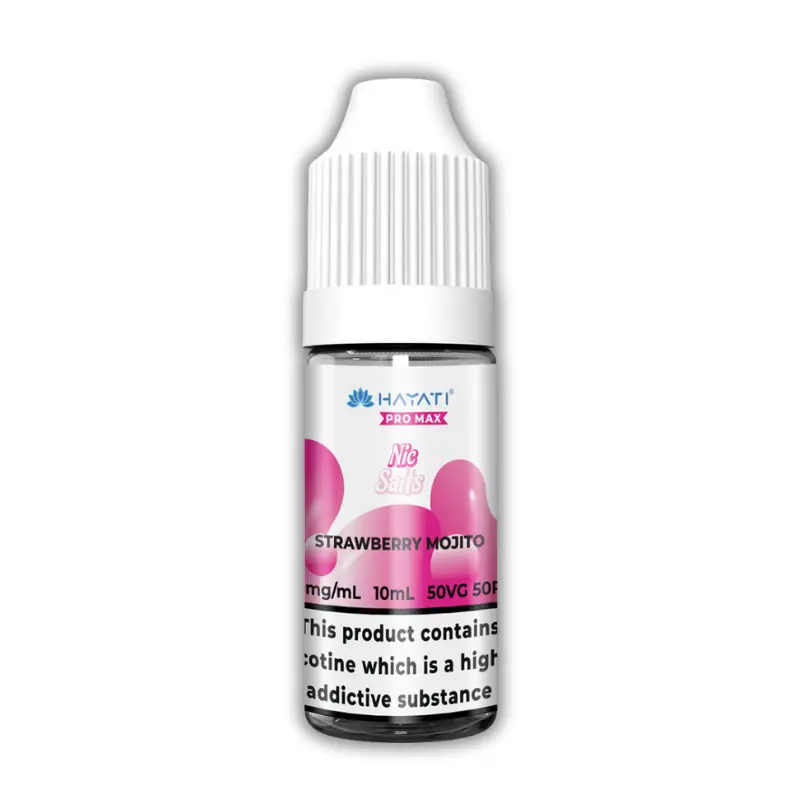
Strawberry Mojito Hayati Pro Max Nic Salt
£2.49
✔ In stock — ready to ship
Genuine Hayati
Free over £20
Same-day dispatch
Secure checkout
Strawberry Mojito is a 10ml bottle of 10mg nicotine salt from the Hayati Pro Max line, priced at £2.49, built around ripe strawberry with the lime and mint of the cocktail the name borrows. That is the listing in a sentence. It sits on the Hayati Pro Max Nic Salts shelf alongside sixty-four other bottles at the same price, and if all you wanted was the volume, the strength and the cost, you have it.
The reason this bottle is worth a longer look has nothing to do with the strawberry. It is the mint. Hayati sell 492 listings and almost every one of them is assembled from four kinds of material: fruit, confectionery, a drink idea, or a cooling agent. A herb is none of those four. It is a plant with a taste of its own, and putting one into a recipe changes the recipe in ways that a fruit or a coolant would not, because a herb brings an aromatic character rather than a sweetness or a sensation.
Most buyers reading the word mojito hear it as a cocktail reference and stop there. What the word is actually doing on this label is putting a leaf into the bottle without spending a word of the title on it. No mojito listing in this catalogue names mint in its title. Every single one names mint in its description. That asymmetry is the most interesting structural fact about the seven mojito products Hayati sell, and it is the thing this page is mostly about, because it determines what the liquid does on the draw and which of the sixty-four bottles on this shelf it is genuinely competing with.
The second thing worth saying up front is that the strawberry here has no partner. Hayati sell two other strawberry mojitos, and both of them put a raspberry alongside the strawberry. This one does not. One soft fruit, one citrus, one herb. That makes it the thinnest and most exposed arrangement of the three, and thin is not the same as weak. It means everything in the bottle is audible, including the parts you might have preferred to have buried.
The only leaf in a range of 492
An angle that begins "this is the only product that does X" deserves to be checked before it is repeated, so the claim that brought this page into existence was counted against the catalogue file that drives the shop rather than assumed. The claim was that mojito listings are the only place in the range where a herb is a named ingredient. That claim is wrong, and the corrected version is more useful than the original.
What the title count says
Nineteen of the 492 listings put a mint word in the title. Seven put menthol there. Those figures are not new here; the Blue Frozen Hayati Pro Max Nic Salts family of pages ran a full census of every cold word in the range and published the table, establishing along the way that Hayati's cooling vocabulary is not graded and that Ice, Frozen, Cooler, Mint and Menthol are labels rather than rungs on a ladder. That work stands and this page does not intend to redo it. What it did not ask, because it was asking about cold rather than about plants, is how many listings name a herb in the body copy rather than in the title.
So that is the count this page contributes. Thirty-seven of the 492 descriptions mention mint. Twenty-four mention menthol. Eighteen use a word from the root herb, and exactly two use the word leaf. Against a range of 492, a herb is named in the prose of roughly one listing in thirteen, which is uncommon but not rare, and the original claim overstates it considerably.
Where the herb sits in a recipe rather than being the recipe
The title count divides in a way that matters more than the total. Of the nineteen mint titles, thirteen are mint and nothing else: three Spearmints, nine Fresh Mints across five formats, and a Frosted Mint in the nicotine pouch line. On those thirteen the herb is not an ingredient in a recipe, it is the entire recipe. That is a different product category from the one you are looking at.
Six titles pair a mint with something else. Three are a lemon-and-mint pairing across two platforms. One is Black Mint Hayati Pro Max Nic Salt, where the mint gets a dark berry alongside it. Two are the Blue Razz Mint half of a dual Pro Ultra Plus listing. Six listings out of 492 put a herb next to a fruit and say so on the label.
Then there are the seven mojitos, which put a herb next to a fruit and do not say so on the label. Add the two groups together and you get thirteen listings in the whole catalogue, a shade over two and a half per cent, where a herb is a component of a fruit recipe rather than the subject of it. That is the accurate version of the claim, and it is still a small enough number to be worth knowing.
One more plant, and it is a seed
Honesty about a count means reporting what it turns up when it cuts against you. There is a second botanical in the range. The H'Berg and P'Man dual Pro Ultra Plus listings describe an aniseed note running under the fruit, which is a plant flavour and not a fruit, a confection or a coolant. Aniseed is a seed rather than a leaf, and two listings is a narrow enough footprint that it does not change the picture, but a page that claimed mint was the only non-fruit botanical in 492 products would have been stating something false. Mint is the only leaf herb Hayati sell. No basil, no lemongrass, no rosemary, no thyme, no chamomile appears anywhere in the range, in a title or in a description.
Mojito is an ingredient word wearing a drink's clothes
Seven listings carry the word mojito: four distinct recipes sold across three platforms. Not one of the seven has mint, menthol or any other plant word in its title. All seven put mint into the description. Six of the seven name lime as well.
That pattern is worth sitting with, because it is the only case in the catalogue of a component being reliably present in the liquid and reliably absent from the label. Every other recipe in the range spells out its parts. A strawberry and watermelon listing says strawberry and watermelon. A blackcurrant listing says blackcurrant. The mojito listings say a drink and let the buyer unpack it, which works if the buyer knows what goes into the drink and fails completely if they do not. A shopper who has never ordered one would read Strawberry Mojito as a strawberry product with something vaguely festive attached, buy it, and find a herb in it.
The Blue Razz Mojito Hayati Pro Max Nic Salts pages have already done the work on what the cocktail reference cannot deliver, counting the drink names in the range and establishing that no listing anywhere names a spirit, which this page verified independently and confirms. That argument belongs to them. What this page adds is the other half of the same observation: the word does not only subtract a spirit that could never have been in a bottle, it also adds a herb that very much is in the bottle and that a buyer scanning titles has no way to see coming.
The coolant word that is not on this label, and why the gap is evidence
Six of the seven mojito listings name no cooling agent at all. The seventh is Fresh Menthol Mojito, a bottle in this same nic salt line, and it names menthol twice: once in the title and once in the flavour copy. It is also the only listing in the catalogue that positions itself against this one by name, telling the reader that where Strawberry Mojito adds fruit, that version turns the cold up instead.
Read those two listings side by side and Hayati answer the question this page exists to ask. In the Fresh Menthol Mojito copy, mint is credited with "herbal coolness" and menthol is credited separately with pushing "the chill further". Two different words for two different jobs, in one sentence, on one product. The manufacturer is not treating mint and menthol as synonyms, and neither should a buyer.
Which means the absence of a coolant word from this bottle's listing is informative rather than a hole in it. Hayati's convention, visible right across the range and documented in the Blue Frozen census, is that a coolant gets flagged in the title. This title flags nothing. The description mentions a mint coolness and a cool herb and stops there. The most defensible reading, and the one the whole labelling pattern supports, is that whatever cold arrives in this bottle arrives as a property of the mint rather than as a separate additive doing a separate job.
That conclusion has a limit and it should be stated. Hayati publish a flavour description, not a formulation, and no e-liquid listing in this range discloses an ingredient list. A recipe can contain a cooling compound without the marketing copy mentioning it. What can be said is that Hayati flag cooling agents consistently when they want the buyer to notice them, and that on this product they have not, so a reader who buys this expecting an iced liquid has misread the label rather than been misled by it.
Why a herb is not a coolant, in one paragraph rather than five
This distinction has been worked through twice already in the corpus and repeating it at length would waste your time. The Blue Frozen bottle's siblings cover the cooling vocabulary; the Spearmint nic salt page covers the chemistry properly, explaining that spearmint oil is led by carvone rather than menthol and that carvone produces taste and aroma without much of the cold signal; and the Strawberry Raspberry Mojito kit page works through what a mint character does to a soft fruit that a bare cooling agent would not. Read any of those if you want the full version.
The compressed form is this. Menthol is a compound that binds a receptor in your mouth and reports cold that is not there. It is a sensation with almost no flavour attached. Mint is a leaf, and the leaf contains menthol among a great many other things, so it delivers some of that sensation plus a green, faintly bitter, aromatic taste that occupies real space in the blend. A coolant takes up no room on the flavour side of the ledger. A herb takes up a lot. Conflating them is the single most common error in writing about vape flavour, and it leads buyers to expect that adding mint to a fruit will do the same thing as adding ice to it. It will not. Ice turns the fruit's volume down. Mint turns the fruit's volume down and then talks over it.
One fruit, one acid, one herb
Now to the liquid, which is where the counting stops being interesting and the arrangement starts to matter. Three things are in this bottle and Hayati name all three: strawberry, lime, mint. No second berry, no confectionery layer, no coolant. It is a spare recipe by the standards of a shelf where four-fruit blends are ordinary.
The strawberry, without a partner to hide behind
Strawberry does two separable things in an e-liquid, and the Strawberry Raspberry Mojito kit page has already set out why the second of them is fragile: there is a broad, slightly jammy sweetness with weight to it, and above that sits a narrow set of volatile aromatics that make the sweetness recognisable as strawberry specifically rather than as generic red fruit. The weight survives almost anything. The identity does not, because strawberry carries no acid and no bitterness of its own to defend itself with.
That page concluded that on a two-berry mojito, the strawberry loses its identity and keeps its weight. This bottle is a different arrangement and it deserves a different answer. There is no raspberry here. On the two-berry version the raspberry supplies a sharp edge that the strawberry cannot supply for itself, and it also supplies a second aromatic crowding the same part of the exhale. Take the raspberry out and two things change at once, pulling in opposite directions.
The first change helps. There is one fewer fruit aromatic competing for the same slot, so what strawberry identity survives the mint has more room in which to be heard. Expect to recognise the fruit as strawberry here more readily than on the two-berry blend, though recognise is doing careful work in that sentence: you are more likely to agree with the name than to arrive at it unprompted.
The second change does not help. The raspberry was carrying the acid load. Without it, the strawberry is the only sweet element in the bottle and it is holding up the entire sweet register alone, against a citrus and a herb that are both working to keep sweetness in check. The result is a fruit that reads present and slightly underpowered. There is a floor of soft red sweetness under every draw and it is unmistakably there, but it does not have the density that a blend with two berries in it would give you. If what you want from a strawberry bottle is a thick, ripe, filling sweetness, this is not the shape of liquid that delivers it, and Strawberry GB Hayati Pro Max Nic Salts or Strawberry Jelly Beans Hayati Pro Max Nic Salt sit closer to it at the same £2.49.
Where the lime becomes load-bearing
Remove the raspberry and the lime is promoted. On the two-berry version the citrus is one of two sharpening agents and can be perceived as a seasoning. Here it is the only acid in the bottle, and an acid is doing structural work whether or not you notice it: it stops a sweet note from spreading, it makes the edges of the fruit legible, and it gives the finish somewhere to go instead of simply fading.
The lime in this reads as peel rather than juice. It arrives as a green, aromatic brightness a fraction of a beat after the strawberry lands, and it is more perfume than sourness. That is the standard shape of a lime accord in a liquid and it is also what a mojito's lime does in the glass, where the oil squeezed out of the skin matters as much as the juice.
The practical consequence of the promotion is that you cannot escape the citrus on this bottle. On a busier blend a note you dislike gets buried under the others. Here there are three things and one of them is the lime, so if lime is a flavour you actively avoid, this will not grow on you and no amount of running it at a lower power will bury it. Buyers in that position want a strawberry blend with a different corrective, and Strawberry Kiwi Hayati Pro Max Nic Salt uses a tart fruit for the same purpose, while Strawberry Cherry Cranberry Hayati Pro Max Nic Salts uses a genuinely sour one.
The herb, and why it is easier to hear here
Mint is the third element and the one buyers underestimate from the title, for the good reason that the title does not mention it. It is mixed well down. It does not take the lead at any point in a draw and this is not a mint bottle wearing a fruit costume.
What it does bring is a green, slightly bitter, aromatic line through the middle and a mild coolness on the finish. The green part is the part people fail to predict. A vaper who has run a lot of iced fruit and no herbs will read that greenness as strange before they read it as mint, because iced fruit has trained them to expect cold with no taste attached to it and this has taste attached. Give it half a pod before deciding.
Here is the part specific to this bottle rather than to mojitos in general. A herb is an aromatic, and aromatics compete with other aromatics for the same perceptual space. Reduce the number of competing aromatics and every remaining one gets louder. This blend has two fruit aromatics fewer than a four-fruit blend and one fewer than its two-berry sibling, which means the herb is proportionally more prominent here than the recipe's mixing ratio alone would suggest. Anyone who found the mint on the Strawberry Raspberry Mojito pod noticeable should expect it to be at least as noticeable here, and probably more so, despite this being the simpler and apparently gentler blend on paper.
How cold, in plain terms
Mild. Well short of anything the range labels as Ice, and short of the mints too. The chill arrives late in the draw, sits briefly on the swallow and goes. It does not accumulate across a session, and the back of your throat will not go numb.
If you want numbers to place it against, the Strawberry Raspberry Mojito kit page put its own cooling at about three on a scale where an uncooled berry is zero and a listing with Ice in the title is seven or eight. This bottle belongs in the same region, plausibly a touch above it because the herb has less to compete with, so call it three or four and treat that as a reading rather than a specification. For an honest comparison of the two approaches on the same fruit, Strawberry Raspberry Ice Hayati Pro Max Nic Salt is the control: red fruit with the cold supplied by a coolant instead of a leaf, and it will be colder and considerably less green. Blackberry Ice Hayati Pro Max Nic Salts pushes the same idea onto a darker fruit, and Blue Frozen is where the cold stops being a seasoning and becomes the point.
One draw, front to back
Taking a single mouth-to-lung pull on a fresh coil and describing it in order, which is a description rather than a guarantee, since palates differ and the same liquid in two devices is not the same experience.
- First moment. Sweetness, soft and red, arriving with no edge on it. It is recognisably fruit and not yet recognisably strawberry.
- A beat later. The lime cuts in from above, green and aromatic rather than sour, and the fruit sharpens into focus behind it. This is the point at which the blend stops sounding like a plain strawberry.
- Mid-draw. The herb appears underneath both. Not cold yet, just a vegetal line running through the middle of the mouth that was not there a moment ago.
- Exhale. The fruit thins out first. Lime and mint carry the exhale between them, and the two are hard to separate at this stage because both are green and both are aromatic.
- Finish. A brief coolness, a slight dryness on the back palate, and a faint bitterness at the very edge that is the leaf rather than a fault. The mouth returns close to neutral within a few seconds.
The return to neutral is the most useful property in the bottle. A sweet liquid with no clearing mechanism builds on itself, so the fifth draw lands on the residue of the fourth and the whole thing turns thick inside half an hour. This one resets between draws, which is why it holds up across a long session while a sweeter strawberry does not.
How sweet, honestly
Medium, and lower than almost anything else on the Strawberry Vapes shelf. Two of the three components in this bottle exist to hold sweetness down, which is an unusual ratio for a fruit liquid. The strawberry is sweet, the lime is not, the mint is not, and the mint is actively drying.
Placed on a scale, this sits below the candied and confectionery strawberries and above nothing much. Strawberry Watermelon Bubblegum Hayati Pro Max Nic Salt is markedly sweeter and makes no attempt to be anything else. Blue Razz Gummy Bear Hayati Pro Max Nic Salt is sweeter still and confectionery all the way through. Against those, this bottle will read as restrained to the point of being austere on a first pod, especially if you come to it straight off a dessert or a sweet.
What it is not
- Not a mint bottle. The herb is a component, not the subject. Anyone who wants the mint in front should be on the Fresh Mint or Spearmint bottles in this same line, which are built the other way round.
- Not an iced liquid. No coolant is named and nothing in the description suggests one is doing the heavy lifting.
- Not a dessert strawberry. There is no cream, no jam and no sugar layer. The sweetness is fruit sweetness with acid and herb pushing back on it.
- Not a strawberry showcase. If the point of the purchase is to taste strawberry clearly, two other things in the bottle are working against that and one of them is a herb.
- Not alcoholic. The name refers to a cocktail and the product contains no alcohol of any kind. That is the whole of what needs saying on the subject.
A disagreement inside the mojito set, and what it tells you
Lining up every listing of one flavour idea and comparing the descriptions is a technique that keeps paying, so it was applied to all seven mojitos. Six of the seven name lime explicitly. The seventh, the Blue Razz Mojito bottle in this same nic salt line, says only citrus. Its own page noticed the omission and correctly declined to assert lime as a stated ingredient on that product.
What that page could not see, because it was looking at one listing, is that the two other Blue Razz Mojito listings both say lime outright. Same flavour, same manufacturer, three listings, and one of the three is vaguer than the other two. There is no plausible reading in which Hayati reformulated the recipe between a bottle and a pod of the same flavour and expressed the change by swapping the word lime for the word citrus. It is a copywriting variant, which is evidence about how the descriptions were written rather than about what is in the liquid.
The useful lesson for a buyer is that the absence of a word from one listing is weak evidence when the same flavour appears elsewhere in the catalogue with the word present, and strong evidence when the pattern holds across every listing of that idea. Lime fails the first test and so should not be read into. The absence of a coolant word passes the second test, since six of seven mojitos omit it and the only one that includes it puts it in the title. That is why this page is willing to draw a conclusion from one gap and not from the other.
What survives being poured out of the glass
A cocktail name sets an expectation that a 10ml bottle then either meets or quietly fails, and being specific about which parts make the crossing is more useful than either pretending the translation is perfect or sneering at it. The mojito is a well-defined drink, so the audit is straightforward.
What comes across intact
The mint comes across, and it comes across as flavour rather than as a garnish, which is the substantive finding of this page. The lime comes across, as peel character more than as juice, which is the right emphasis because a mojito is built on both and the oil is the aromatic half. Sweetness comes across in a modified form: the drink is sweetened with sugar syrup and the liquid is sweetened by a strawberry, so the sensation of a sweetened herbal drink is present even though the mechanism is entirely different.
The balance also survives, and that is not trivial. A mojito is a drink where nothing dominates and the pleasure is in the three-way argument between sweet, sour and green. This bottle reproduces that argument faithfully. Whether you enjoy it depends on whether you wanted an argument or wanted a strawberry.
What does not survive, and cannot
The spirit does not, and the Blue Razz Mojito pages have already been thorough about what a recipe loses when its defining component is definitionally absent from the format. That argument is theirs and is not repeated here beyond saying that this bottle, like every one of the 492, contains no alcohol at all.
What is left over once you set the spirit aside is the physics of the drink, and that is where the more interesting losses are. Four of them, in rough order of how much they matter.
- Dilution. A mojito is a long drink. Two measures of flavouring are stretched across a tall glass of ice and soda, so every mouthful is mostly water. A liquid cannot be long. It is concentrated by definition, and the same three components arriving undiluted are proportionally much more intense than they are in a glass.
- Ice. The drink is served over crushed ice and part of its appeal is genuine cold in the mouth, not a receptor being told cold is happening. No liquid produces that, and a coolant is an imitation of it rather than a reproduction. This bottle does not even attempt the imitation.
- The soda. Most mojito recipes finish with soda water, so carbonation is part of the drink's texture. Carbonation is a mechanical sensation caused by bubbles and dissolved gas. Nothing in a bottle of e-liquid can do it, and the corpus has been consistent about the equivalent problem in a cola listing rather than pretending otherwise.
- The muddle. This is the one specific to a herb and it is the most interesting loss. In a glass, mint leaves are bruised against the base and release their oils into the drink progressively, during service and then during drinking. The mint gets stronger as the glass sits. A liquid has its mint accord fixed at the point of manufacture at a level the formulator chose, and it does not move.
Two things that change over their lives, in opposite directions
Follow that last point a step further and you get an observation about this bottle that holds for no coolant-based liquid at all. A mojito in a glass gets mintier and less sweet as you drink it, because the ice dilutes the syrup while the leaves keep giving. Over twenty minutes the drink moves towards the herb.
A bottle of this moves the same way, over weeks rather than minutes, and for entirely unrelated reasons. Volatile top notes leave first, so the lime quietens as the bottle is opened and closed. Confectionery and fruit notes round out and lose their edges. The mint and the cooling sit lower and are more stable, so they appear to advance even though nothing about them has changed. The Blue Razz Mojito bottle page documented that sequence for the same range and the pattern holds here.
The accidental result is that a half-finished bottle of this is a closer approximation of a half-finished mojito than a fresh bottle is of a fresh one. That is a curiosity rather than a recommendation. The practical version is simpler: buy one at a time rather than opening three, because the third bottle will be a noticeably different drink from the first by the time you reach it.
The bottle, and the one thing a herb asks of your hardware
The format here is the plainest one in the catalogue. Ten millilitres of liquid, 10mg nicotine salt, a 50/50 base, no device and no coil in the box. What a 50/50 ratio does in a small mouth-to-lung coil, how a thin mix wicks and where it seeps, why propylene glycol carries aromatics better than glycerine does, and why forcing a thin liquid through the wrong coil produces a scorched wick have all been worked through at length on the Hayati Pro Max Nic Salts bottle pages. There is no value in a fifth account of it here, and the shelf has sixty-five bottles that share every one of those properties.
One thing is specific to this liquid and worth the space instead.
Aromatic herbal compounds are less tolerant of a hot coil than sugars and fruit esters are. Push a sweet strawberry hard and the first thing that happens is that it tastes stewed, which is unpleasant but recognisably still strawberry. Push a herb hard and the green notes go bitter and faintly soapy before anything else in the blend changes, and the transition is abrupt rather than gradual. There is a power range in which the mint here is a clean green line and a power range a little above it in which it is an acrid one, and the gap between them is narrower than the equivalent gap on a sweet fruit.
Two practical consequences follow. The first is that this bottle rewards hardware whose output you control, because a device with an adjustable wattage or a choice of coil resistance lets you find the point below which the herb behaves and stay there. On a fixed-output pod you take whatever the device gives you and either it suits the liquid or it does not. The second is diagnostic: if this ever tastes bitter or soapy rather than green, the first thing to suspect is that the coil is running hotter than the liquid wants, not that the bottle is bad. Drop the power, lengthen the gap between draws, and taste it again before writing the bottle off.
Beyond that, Hayati's published specification for this product covers volume, strength and ratio. It says nothing about the cap, the nozzle or the bottle's construction, so this page will not describe them. Look at what you have before you tip it over a pod.
Specifications, and what each line is actually telling you
| Stock code | HPM-NS-STRAWBERRY-MOJITO |
| Price | £2.49 |
| Components Hayati name | Strawberry, lime, mint |
| Cooling agent named | None |
| Nicotine | 10mg nicotine salt |
| Base | 50/50 VG/PG |
| Volume | 10ml bottle |
| Brand and line | Hayati, Pro Max |
| Intended hardware | Refillable pods and higher-resistance mouth-to-lung coils |
| Not suited to | Sub-ohm tanks |
| Supplied with a device | No |
The row that does the most work on this page is the fourth one, and it is not a row most spec tables would bother printing. Recording that no cooling agent is named is a statement about the label rather than about the recipe, and it is included because on a product whose cold comes from a leaf, the difference between a named coolant and no named coolant is the difference between two quite different buying decisions.
The strength line is worth one plain observation and no more than that. Ten milligrams is the lower of the two figures this range uses, and nicotine salt is a formulation that behaves differently in the throat from freebase nicotine at a matched strength. Nicotine is addictive. What strength suits you is not a question this page has any business answering.
The price line has an arithmetic worth doing once, since a bottle is a unit of liquid rather than a unit of hardware. At £2.49 for 10ml you are paying just under twenty-five pence per millilitre, which is the standard rate right across the Hayati E-Liquids range and cheaper per millilitre than any prefilled format. The 50/50 shortfills such as Blue Razz Cherry Hayati Pro Max 50/50 Shortfill E-Liquid at £6.99 change that arithmetic again, at the cost of being a different product with different requirements.
The last row matters more on this bottle than on most. Because the herb has a narrow tolerance for heat, the absence of a supplied device is not neutral. You are choosing the hardware, and the choice has more consequence here than it would on a sweet fruit that forgives a hot coil.
Where it sits on a shelf of sixty-five
The useful comparisons for this bottle divide into four groups, and which group you belong to decides the purchase.
If you came for the strawberry
Look elsewhere, and this page would rather say so than sell you something you will be disappointed by. Two of the three components here are pushing the strawberry down. For fruit sweetness with company rather than opposition, Strawberry Raspberry Blueberry Hayati Pro Max Nic Salt stacks three berries and lets them add up. Strawberry Watermelon Hayati Pro Max Nic Salt keeps it to two and leans on the watery sweetness of the melon rather than on acid. Strawberry GB Hayati Pro Max Nic Salts puts the fruit in front with a soft confectionery treatment behind it. All three are £2.49 and all three are on the Strawberry Vapes shelf next to this one.
If you came for the herb
You are in a smaller group and the range serves you better than you might expect. This bottle is the gentlest way to put a herb next to a fruit, because the fruit is soft and the herb is mixed low. The step up in herbal presence is Black Mint Hayati Pro Max Nic Salt, where the mint is the stated core and a dark fruit supports it rather than the other way round, which inverts the balance you get here. Beyond that are the single-note mints in the same line, where the herb is the whole product and there is no fruit to negotiate with at all.
Working the other way, if the herb is what put you off the two-berry version, note that this one is not a retreat from it. Fewer competing aromatics means the mint is more audible here, not less.
If the cold is the point
Then this is the wrong shape of product and a mint is the wrong mechanism. A herb gives you a mild coolness attached to a taste; a coolant gives you cold with nothing attached. Blue Frozen is the reference point for how far this range takes cold when it decides to, and the pages on that flavour explain why its name is a label rather than a rung on a scale. In the prefilled formats, Blueberry Straw' Menthol Hayati Mini Ultra Pods at £3.49 show the other approach applied to a berry, with the coolant named in the title exactly as the convention predicts.
If you want the acid without the leaf
This is the largest group of near neighbours, because citrus-sharpened fruit is a well-populated idea on this shelf and mint-sharpened fruit is not. Blueberry Raspberry Lemon Hayati Pro Max Nic Salt treats its citrus as a third fruit with body and sweetness of its own, which is a different job from the corrective one the lime does here. Berry Lemonade Hayati Pro Max Nic Salt uses a drink framing to get the same lift from a sweeter direction. Blue Sour Raspberry Hayati Pro Max Nic Salt takes the sourness much further and does it with the fruit rather than with a separate citrus.
For a tart red fruit doing the corrective work instead of a lime, Blackberry Raspberry Hayati Pro Max Nic Salts and Kiwi Grape Raspberry Hayati Pro Max Nic Salt are both £2.49 and neither has a herb anywhere in it. Blackcurrant Juice Hayati Pro Max Nic Salts is the option for a dark berry with its own natural tartness and no third element at all, and it is the closest thing on the shelf to a single-fruit bottle.
Two other things worth knowing about the neighbourhood
The first is that a mood name tells you nothing, and the range has several. Black Mamba Hayati Pro Max Nic Salts is the example on this shelf, and its own page treats the information gap as the subject rather than inventing a tasting note to cover it. Mojito is the opposite case: it is a name that tells you more than it appears to, provided you know what goes in the drink. Both are worth understanding before you fill a basket from the New Products listing on title alone.
The second is where to browse from here. The Berry Vapes shelf holds 225 listings and is the right place to start if the fruit half is what you are optimising for. The full Hayati range is where to go if you want to see how few of the 492 have a plant in them at all, which after reading this page you now have the numbers for.
Running a herbal bottle well
Most of the standard bottle advice applies here as it does to every 10ml in the range, and the parts of it that are specific to this liquid are the parts worth your attention.
Give a fresh coil a proper soak. Fill, let it stand for a few minutes, then take two or three draws with no power before vaping properly. A dry wick on first use scorches, and a scorched wick on a herbal liquid produces that bitter, soapy note rather than the burnt-sugar taste a sweet liquid gives you. The symptom is different, so it is easy to misdiagnose as a bad batch.
Keep the power lower than you would for a sweet fruit. This follows from the heat sensitivity described above and it is the single most useful adjustment available to you. Start below where you would normally sit, and come up in small steps until the green note is clear and stop there. The point at which the herb turns is not far above the point at which it is at its best.
Use a dedicated pod if you rotate flavours. Mint aromatics are small and volatile and they soak into plastic, so a pod that has run this will faintly flavour whatever goes in next regardless of how well you rinse it. The Spearmint bottle page in this range sets out the problem and the fix in full. The fix is one pod for anything with a herb in it and another for everything else, and it costs less than the flavours you would otherwise spoil.
Watch the running order. A herb leaves a trace, and what you vape immediately afterwards will be measured against it. Dark, acidic and confectionery flavours shrug this off. Soft, delicate fruit does not, so following this with another strawberry is the one sequence guaranteed to disappoint you. The bare pod page for the two-berry mojito works this through as a scheduling problem across a rotation, and everything it says about running order applies to this bottle with more force, since the fruit here is softer still.
Expect the coil to last longer than a sweet bottle's. There is less sweetener in this than in most of the shelf, and sweetener is what caramelises on a hot coil and dulls a pod over a few days. A low-sweetness liquid discolours cotton slowly and keeps delivering a recognisable flavour for longer. You are more likely to notice the coil going by a drop in vapour than by a change in taste.
Store it closed, upright, cool and dark. The lime is the first casualty of air and light, and the lime is load-bearing on this particular blend in a way it is not on a busier one, so losing it costs you more here than it would elsewhere. Keep it out of reach of children and pets, keep the cap on between fills rather than leaving it open on a desk, and do not decant it into something you will not label.
Judge it on the second pod, not the first. A green aromatic is unfamiliar to anyone whose rotation has been fruit and coolant, and unfamiliar frequently reads as wrong on first contact. If you have never run a herb next to a fruit before, the honest advice is to give this three or four millilitres before forming a view. Plenty of people decide they do not like it. Rather fewer decide that after a full pod than after three draws.
Questions buyers actually ask about this one
Is there mint in this? The title does not say so.
Yes. Hayati's own description for this bottle names mint, and so do the descriptions of all seven mojito listings in the range, none of which mention it in the title. The word mojito is carrying the mint. If you dislike mint in a fruit liquid, this is the wrong bottle regardless of how appealing the strawberry sounds.
Is it an iced liquid?
No. No cooling agent is named in the title or the description, and Hayati's consistent practice across the range is to flag a coolant in the title when one is doing real work. There is a mild coolness and it comes attached to the mint rather than arriving as a separate sensation. If cold is what you want, look at the listings that say so on the label.
How is this different from the Blue Razz Mojito bottle at the same price?
The mojito half is broadly the same idea in both. The fruit half is not. Blue Razz Mojito Hayati Pro Max Nic Salts is built on a confectionery blue raspberry, which is a sweet with a fruit name rather than a fruit, so it is louder, sweeter and much more robust against the mint. This one is built on a real soft fruit, which is quieter and comes off worse in the argument. Pick the blue one for sweetness and this one for restraint.
Does it taste of alcohol?
No. It contains no alcohol. The name refers to a cocktail and describes a flavour idea, which in practice means lime and mint on a fruit base.
Can I use this in a sub-ohm tank?
It is not intended for one. The strength and the 50/50 ratio are both matched to refillable pods and higher-resistance mouth-to-lung coils, and this is the same answer every 10ml salt bottle in the range gives. Check what your device is built for before you fill it.
Will the strawberry come through clearly?
Partially. You will get a definite soft red sweetness under every draw, and you will probably agree with the word strawberry rather than arrive at it yourself. A citrus and a herb are both competing for the same part of the exhale where the fruit's identity would otherwise sit. If a clear, unobstructed strawberry is what you are buying, the comparison section names several better answers at the same price.
Is it sweet enough to be an all-day bottle?
That depends on what you want from an all-day liquid. It is on the low side of the shelf for sweetness, and the mint clears the palate between draws so it does not accumulate the way a sugary fruit does. Plenty of people find that combination easier to live with over a long day than something sweeter. Anyone who wants sweetness as the main event will find it thin.
Why does it taste bitter or slightly soapy sometimes?
That is usually the herb running too hot rather than a problem with the liquid. Green aromatic compounds turn before sugars do, and the change is abrupt. Lower the power, allow a longer pause between draws, and check that the coil is not near the end of its life. If it comes back clean at a lower setting, you have found your ceiling.
How many other Hayati liquids have a herb in them?
Nineteen of the 492 listings name a mint in the title and seven name menthol. Of the mint titles, thirteen are pure mint products with no fruit at all. Counting the six that pair a mint with a fruit and the seven mojitos that do the same without saying so, thirteen listings in the range put a herb into a fruit recipe. Mint is the only leaf herb Hayati use, and the only other plant flavour anywhere in the catalogue is an aniseed note on two dual Pro Ultra Plus listings.
Should I buy several bottles at once?
Consider buying one first if you have not run a herbal fruit before, because this is a divisive profile and 10ml is enough to decide on. If you already know you like it, note that the lime quietens as a bottle is opened and closed repeatedly, so keep spares sealed rather than opening them all and leave the one in use capped between fills.
Does it wear out a coil quickly?
Less quickly than most of this shelf. Sweeteners are what build residue on a hot coil, and this is a comparatively low-sweetness liquid, so a pod tends to keep delivering a recognisable flavour for longer than it would on a candied fruit. The usual sign that it is finished here is reduced vapour rather than a change in taste.
What should I not vape straight after it?
Another soft fruit, and a strawberry above all. A herb leaves a trace on the palate and in the pod, and the flavour that follows it gets measured against that trace. Dark berries, sour fruit and confectionery profiles handle it without difficulty. Anything delicate does not.
The short version
A 10ml bottle of 10mg nicotine salt at £2.49, in a 50/50 base, built from a soft strawberry, a lime that reads as peel, and a mint that is mixed low but audible. The mint is the reason to read past the title, because it is not named there and because it is a herb rather than a coolant, which means it brings a green aromatic taste as well as a mild coolness and it takes up real space in the blend.
Thirteen of the 492 listings in this range put a herb into a fruit recipe, and this is the only one of them that puts it next to a single soft red fruit with nothing else alongside. That makes it the most exposed arrangement of the idea Hayati sell. Everything in the bottle is audible, the lime is doing structural work it does not have to do on the two-berry version, and the strawberry is holding up the sweet register on its own and is slightly outnumbered while doing it.
Buy it if you want a restrained, dry, sharpened fruit that resets the palate between draws and holds up over a long session. Avoid it if you want a big strawberry, if you want real cold, or if lime is a flavour you steer around, because there is nothing in this bottle for a lime to hide behind. It is a good liquid that is honest about what it is, and the title is the only part of it that is not.
Strictly for adults aged 18 and over. Nicotine is an addictive substance.
You might also like


