
Home / Hayati Pro Max Nic Salts / Strawberry Kiwi Hayati Pro Max Nic Salt
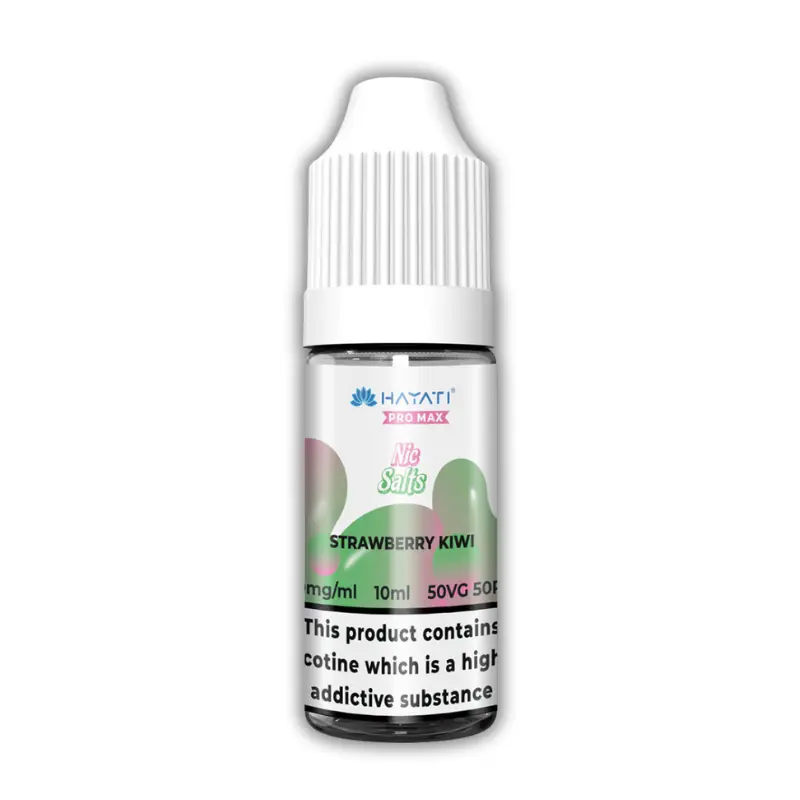
Hayati · Pro Max
Strawberry Kiwi Hayati Pro Max Nic Salt
£2.49
✔ In stock — ready to ship
Genuine Hayati
Free over £20
Same-day dispatch
Secure checkout
Ten millilitres of liquid, 10mg of nicotine per millilitre in salt form, an even split of vegetable glycerine and propylene glycol, £2.49, filed by Hayati under the reference HPM-NS-STRAWBERRY-KIWI. There is no device in the purchase, no pod, no coil and no cell. What arrives is a small bottle, and the listing assumes you already own something to pour it into. That is the whole of the hardware description, and it is the same description carried by every other flavour bottle on the Hayati Pro Max Nic Salts shelf, all sixty-five of which are priced identically.
So the hardware is not the reason to read further. The reason is a pair of sentences in Hayati's own copy that do something the other four listings of this recipe do not do. Strawberry Kiwi is sold five times over, once as this bottle and four times as sealed hardware, and Hayati wrote fresh copy for each. Four of the five describe the liquid: what is in it, what order it arrives in, who it suits. This one describes the liquid and then, in two consecutive sentences, tells you where to put it among the liquids you already own. It calls the blend a bridge, and it tells you to alternate it with something else.
That is a different kind of claim from a tasting note, and it is a more checkable one. A tasting note is an opinion about a liquid nobody else has in front of them. A positioning claim commits the seller to facts about the rest of the range, which are sitting in the catalogue and can be counted. This page counts them. It establishes how often Hayati write copy this way across all 492 listings, it tests both of the instructions printed on this bottle against the shop's own filing, and it works out what a part-time flavour actually needs from a ten millilitre bottle rather than from a sealed twelve millilitre pod.
The short version of the result, stated up front so nobody has to read six thousand words to get it: one of the two instructions survives the check and the other does not, the habit of writing this way is far more common than it first appears, and the bottle is nevertheless the only one of the five listings of this recipe whose size matches the instruction printed on it. The flavour analysis is not here, because it already exists in full elsewhere, and the next section says where.
What is already settled about this liquid, and by whom
Rebuilding an argument another page has already made properly is a waste of your time and mine, so here is what is taken and where it lives.
The Strawberry Kiwi Hayati Rubik Prefilled Pod Kit page owns the flavour. It works through the draw in order, from the tongue event at the front of the inhale to the retro-nasal green note on the exhale, and it explains why the two do not arrive when the listings say they do. It counts the kiwi properly: twelve listings out of the 492, five separate recipes, one short shelf, and it corrects the tempting claim that kiwi is the scarcest acid source in the range, which it is not. It counts the strawberry too, and establishes the single most useful fact about that fruit here, which is that no listing anywhere in the catalogue presents strawberry as the sharp element in a blend. It lines all five Strawberry Kiwi descriptions up against each other and reports what they agree on. And it sets out the substitution question, which is whether kiwi is doing something a cheaper and commoner acid could not have done, along with a four-step method for answering it on your own hardware. All of that is cited here and none of it is repeated.
Two findings from that page are load-bearing for this one and are quoted rather than re-derived. The first is that every one of the five listings hedges the acid. The kiwi is slightly sharp, or slightly tart, or slightly sour, listing after listing, and nothing in the set calls the blend sour without a qualifier in front of it. The second is that the green note is the most delicate element in the recipe and the first thing a tiring coil gives up. Both of those turn out to decide whether the bridge claim on this bottle is true.
The Kiwi Cooler pages own the underlying behaviour of the fruit, in particular that its tartness is structural rather than applied and survives ripeness, which is why sweetening a kiwi does not soften it. The range-level Pro Max Nic Salts listing owns the general case for buying liquid in a bottle rather than sealed in a pod: what the format hands back to the buyer, what it charges for the privilege, and how much smaller the bottled menu is than the prefilled one. That argument is not repeated below either. Where this page needs it, it points at it.
One more page is worth naming because it reaches a conclusion that looks like this one and gets there by a completely different route. The Fresh Mint Pro Ultra Plus pods page and its siblings work out what a flavour is for when its job is to interrupt something else rather than to be enjoyed on its own terms. That is an argument about what mint does to a palate. This page is not about what a flavour does. It is about how the seller writes, counted across 492 listings and across five listings of one recipe, and about whether the seller's own filing supports what the seller's own copy says. Those two enquiries reach adjacent territory from opposite ends, and the evidence has nothing in common.
The two sentences, and what the other four listings do instead
Take the copy as written. After a short description of the fruit, the listing says the blend is a lighter-feeling one that "does not coat the palate", and then makes two moves in a row. It calls the liquid "a good bridge", and names the two things it bridges as "sweet red fruit" on one side and "sharper citrus" flavours on the other. Then, in the very next sentence, it tells you to "alternate" the bottle against what it calls "the sweeter candy flavours" that are already, in its words, "in your rotation".
Read those two sentences as instructions rather than as description and you notice they are not the same instruction. The first is a map: it tells you where this liquid sits relative to two categories of product, which is information about the shop. The second is a diary: it tells you what to do with the bottle across a week, which is information about you. A map can be right or wrong about the range. A diary can only be right or wrong about a buyer the seller has never met.
Now set that beside the other four listings of the same recipe.
- The Strawberry Kiwi Hayati Pro Max Plus Pod Kit at £7.99 calls the blend a middle ground, but the two things it sits between are its own two fruits: tangier than strawberry alone, sweeter than kiwi alone. That is a description of the recipe, not a placement among other products.
- The Strawberry Kiwi Hayati Pro Max Plus Pods at £5.49 describe the contrast between the fruits and stop there. The only thing outside the pod it refers to is the device you need to run it in.
- The Rubik kit at £5.99 notes the absence of a cooling word in the name and says the blend suits anyone who likes contrast. Nothing about neighbours at all.
- The Strawberry Kiwi Hayati Rubik Pods at £3.99 say the pod sits neatly between the sweeter berry pods and the sharper citrus ones.
That last one matters, and it is where the premise handed to me for this page needed narrowing. I was told this bottle was the only one of the five that positions the liquid rather than describing it. It is not. The Rubik pod listing does the same thing, on the same axis, with the same two categories named: sweeter fruit on one side, sharper citrus on the other. Two of the five place this recipe between other products, not one.
What survives the correction is narrower and, I think, more interesting than the version I was given. The Rubik pod listing draws a map and leaves it there. It tells you where the liquid is filed and lets you decide what that means. This bottle draws the same map and then hands you an instruction to act on it, in the second person, about a rotation it assumes you already have. Across all 492 descriptions in the catalogue, that combination of a placement and an instruction in the same paragraph occurs exactly three times, and one of those three qualifies only on a sweetness reading rather than a placement among products. On a strict reading it is two listings out of 492: this bottle, and a Cherry Cola kit on the Pro Max Plus platform that does it in a single sentence rather than two. This bottle is the only listing in the shop that does both, twice over, about two different sets of neighbours.
Counting the habit before building on it
A claim that a piece of copy is unusual is worth nothing unless somebody has added it up, and the count I was handed for this page turned out to be low by a factor of nearly two. Here is the honest version, with the definition stated so you can check it rather than take it.
Count a description as giving a rotation instruction if it contains any of: the word rotation or rotate, the verb alternate, the phrase palate cleanser, the phrase change of pace, or the phrase break from. Those five markers all do the same job. They tell the reader to use this liquid against other liquids they already vape, which is a statement about a buyer's habits rather than about a product. On that definition the count is 54 listings out of 492, which is a little over one in nine.
The individual markers break down like this, with overlap between them, which is why they do not sum to 54: rotation or rotate in 26 descriptions, alternate as a verb in 13, change of pace in 8, palate cleanser in 6, break from in 6. The possessive form, your rotation, appears in 10. The brief for this page put the figure at 29, which is roughly what you get if you count only the rotation words and stop. Counted properly the habit is about twice as common, and the correction cuts against the angle I was given rather than for it. This is not a rare piece of copywriting. It is a routine one that turns up on a listing every couple of pages.
The word that really is rare
One element of the sentence does survive counting, and it survives it comfortably. The word bridge appears in exactly two product descriptions out of 492. This bottle is one. The other is a Blue Razz Mojito kit on the Pro Max Plus platform, which calls itself a bridge between fruit flavours and mint ones.
Two in 492 is genuinely unusual for a catalogue that reuses its vocabulary heavily. For scale, the Rubik page established that the word jammy sits on 27 listings and tells you nothing, and that the sourness vocabulary is generic across hundreds. Bridge is not house vocabulary. Somebody chose it, twice, in the whole shop.
The comparison between the two is the useful part. The Blue Razz Mojito bridge spans fruit and mint, and that liquid contains mint. It touches both banks by construction. The bridge on this bottle spans sweet red fruit and sharper citrus, and there is no citrus in it. Kiwi is not a citrus fruit. That does not automatically make the claim false, because a blend can sit between two families without containing a member of both. It does mean the claim has to be earned by intensity rather than by ingredient, and intensity is exactly what the section after next examines.
The format that never explains the habit
There is one more count worth doing, because it settles whether the rotation framing is a judgement about buyers or a reflex of the keyboard.
Split the 492 listings by what you actually take home. Six of the 65 flavour bottles on the nic salt shelf give a rotation instruction: this one, Watermelon Ice, Tobacco, Summer Dream, Menthol, and Bru Ice, which pairs itself with Cola Ice for anybody who wants a couple of drink-style flavours on the go at once. Five of the 40 large bottles do it. Forty-three of the 376 sealed pods and kits do it. None of the 11 nicotine pouch listings does.
Put the bottles together and it is 11 of 105, or a shade over ten per cent. Put the sealed hardware together and it is 43 of 376, or a shade over eleven. The two numbers are the same number. Format does not predict this framing at all.
That result is worth sitting with, because you would expect the opposite. A bottle buyer is the one customer in this shop who demonstrably owns a rotation. They have a refillable device, they have to choose what goes in it, and at £2.49 a bottle they very probably own several. A buyer of a sealed twelve millilitre pod has committed to one liquid until it is gone. If the rotation instruction were a considered judgement about who is reading, it would cluster on the bottles. It does not cluster anywhere. It is a phrase that occurs to copywriters at a steady rate regardless of what they are describing, which means the sentence on this bottle is not evidence that Hayati think this liquid is a part-time flavour. It is evidence that somebody had that sentence available on the day.
Which is not a reason to dismiss it. A reflex can still land on the right product. It is a reason to test the claim on the merits rather than treating it as the seller's considered advice, and the merits are checkable in the shop's own filing.
Testing the bridge
A bridge claim commits to two banks and to a liquid that reaches both. Take them one at a time.
The near bank
Sweet red fruit is reached, and nobody needs to argue about it. Strawberry is the most-used fruit in the catalogue by distinct recipe, and the Rubik page's count of the eighty strawberry listings found that not one of them casts the fruit as the sharp element. It is always the floor. This bottle is filed on Strawberry Vapes and on the berry shelf, and of the 65 bottles on the nic salt shelf, 25 carry the berry filing. This one is inside that 25. Whatever else is true, the liquid is standing on the red-fruit bank rather than approaching it.
The far bank
Sharper citrus is where the claim runs into trouble, and the evidence against it comes from Hayati rather than from me.
Start with the filing. There are twelve kiwi listings in the catalogue, collected on the Kiwi Vapes shelf, and not one of the twelve appears on any of the shop's three citrus shelves. Not the lemon shelf, which runs to 54 products. Not the lemon and lime shelf, which holds 21. Not the orange shelf, which holds 12. Hayati file kiwi under exotic and under its own fruit name, consistently, across five recipes and five formats and what must have been several separate cataloguing passes. Nobody in the building has ever thought of this fruit as citrus-adjacent.
Narrow it to the shelf this bottle actually sits on and the picture is sharper still. Of the 65 flavour bottles on the nic salt shelf, nine carry a citrus filing: Lemon Peach Passionfruit, Berry Lemonade, Blueberry Raspberry Lemon, Lemon Lime, Lemon Mint, Pink Lemonade, Blue Razz Lemonade, Blue Fusion and Rocky Candy Orange. The far bank exists, it has nine bottles standing on it, and this one is on none of them.
Then take the copy evidence, which is the Rubik page's finding and is cited here rather than rebuilt. All five listings of this recipe hedge the acid. Every single one puts a qualifier in front of the sharpness word, and none of the five describes the blend as sour outright. Twenty-one listings in this catalogue declare sourness in their titles. This is not one of them, and five separate pieces of copy decline to claim it in the body text either.
Put those together. A bridge to citrus requires an acid that gets somewhere near citrus intensity, because that is the only property the two families share. The seller has had five opportunities to claim that intensity for this liquid and has hedged on all five. The seller has also had twelve opportunities to file this fruit anywhere near citrus and has taken none of them. The bridge does not reach the far bank, and the evidence that it does not is entirely the seller's own.
What the claim should have said
Narrowing a claim is more useful than deleting it, so here is what I think survives. The liquid is not a crossing. It is a step in a direction. It sits on the red-fruit bank facing the sharper end of the shelf, which is a real and useful thing for a bottle to be, and it is a different proposition from a liquid that gets you to the other side.
The practical difference matters to somebody choosing. If you want to move your rotation towards sharper liquids and you buy this expecting to arrive, you will not arrive. If you want a red fruit that has something pulling against it, this is one, and the nearest comparisons on the same shelf tell you how it differs. Strawberry Watermelon pairs the same base with a second soft fruit and has almost nothing pulling against it. Strawberry Cherry Cranberry brings in a genuinely astringent third fruit and goes further towards the sharp end than this does. Strawberry Raspberry Blueberry stays in the berry family throughout and, in its own copy, calls itself a middle ground between the sharper cranberry blends and the sweeter candy ones, which is the same manoeuvre this bottle performs and a reminder that the phrase gets around.
Anyone who wants to check my reading rather than accept it has a cheap way to do it. Buy this and one of the nine citrus bottles named above at £2.49 each, run them in the same pod on consecutive fills, and see whether the distance between them feels like a bridge or like a boundary. That costs five pounds, which is less than the price of one sealed pod of the same liquid, and it is the only test that settles it.
Testing the rotation instruction
The second sentence fares much better, and it fares better for a reason that has nothing to do with taste.
The instruction is to alternate this bottle with the sweeter candy flavours already in your rotation. For that to be actionable, two things have to be true: there has to be a real candy contingent for you to alternate with, and this bottle has to be outside it. Both check out. Of the 65 bottles on the nic salt shelf, twelve carry Hayati's sweet filing, and the linkable ones include Strawberry GB, Strawberry Watermelon Bubblegum and White Peach Raspberry, with Gummy Bear, Bubblegum Ice, Rainbow, Grape GB, Black Mamba and three others making up the rest. This bottle is not among the twelve. The instruction points at a set that exists, sits on the same shelf, costs the same £2.49, and does not include the thing you are being told to alternate away from.
One caution about following it by filing alone. The shelf logic is imperfect. Strawberry Jelly Beans is a confectionery name on a confectionery premise and Hayati have not filed it under sweet at all, so a reader who works from the category page will miss an obvious candidate. Read the titles as well as the shelves.
There is also a structural point buried in this instruction that the copy does not draw out. Alternating requires simultaneous possession. You cannot alternate between two liquids unless you own both at once, in a usable state, with somewhere to put them. That is trivially available to a bottle buyer, who owns refillable hardware by definition and can keep four bottles in a drawer for ten pounds. It is not available to anybody holding one of the four sealed listings of this same recipe without buying a second sealed pod or a second device. The instruction printed on this bottle is an instruction that only this format can carry out, and it is printed on the only one of the five listings that can carry it out. Whether that is design or accident is unknowable, and the count in the previous section suggests accident, because the Rubik pod listing performs the same manoeuvre on a sealed twelve millilitre pod where it makes considerably less sense.
What a part-time flavour needs from ten millilitres
Suppose you take the seller at its word on the half of the claim that survives, and buy this as something to alternate with rather than as a daily liquid. That decision has consequences that no sealed listing of this recipe has to think about, and they are the most useful thing on this page.
Purchase unit against usage rate
The arithmetic is simple and nobody prints it. Take a buyer getting through roughly two millilitres a day, which is a rate rather than a fact about anybody in particular and is stated here as an assumption you should replace with your own. At that rate a ten millilitre bottle is a five-day purchase. Follow the instruction on the label instead, using this liquid perhaps twice a week as a change from something sweeter, and the same bottle becomes a five or six week purchase.
The same ten millilitres, at the same £2.49, is either a short commitment or a long one depending entirely on which sentence of the listing you believe. That is unusual. Most products in this shop have one usage pattern implied by their format, and the pattern is fixed before you buy. Here the seller has printed two incompatible patterns in the same paragraph, and the difference between them is a factor of seven in how long the bottle sits on your shelf.
Why the sealed listings cannot do this
Now look at what the other four listings of this recipe offer somebody who wants to use it part-time. The Rubik pods at £3.99 and the Pro Max Plus pods at £5.49 each hold twelve millilitres, sealed, in one unit. The two kits hold the same twelve behind a body you also pay for. There is no smaller size. You cannot buy a third of a pod.
So a buyer who wants this recipe as an occasional flavour and owns sealed hardware has to commit to twelve millilitres of it. At an occasional rate that pod is in service for months, and the Rubik page has already established what happens to this particular liquid over the life of a pod: the green note thins first, the acid softens next, and the strawberry outlasts both. A pod used slowly spends most of its working life as the flattened version of itself, and there is nothing the owner can do, because the coil and the liquid are welded into one disposable purchase.
A bottle breaks that link, and the range-level Pro Max Nic Salts page has already worked out why in general terms: the coil is yours, so it can be changed without discarding liquid, which decouples flavour decline from the end of a purchase. That general argument is not rebuilt here. The narrow version specific to this liquid is worth one sentence, though, and it is this. The element that distinguishes this recipe from a cheaper one is also the most fragile element in it, so of the five listings of Strawberry Kiwi, the bottle is the only one where the distinguishing element can be restored rather than merely mourned. On the four sealed listings, the interesting phase happens once and then the pod spends the rest of its life being something else.
What a slow bottle costs you instead
The honest counterweight is that a bottle bought as an occasional flavour is a bottle that spends most of its life closed, and that is a condition a daily bottle never experiences. Hayati publish nothing about shelf life, nothing about how long an opened bottle holds its character, and nothing about storage beyond what any liquid needs, so this page is not going to invent a figure or a timescale. What can be said is that the question exists here and does not exist for the same buyer holding a daily liquid, and that it is the one real cost of taking the label's advice.
Two things follow that are practical rather than speculative. Keep the cap on tight between fills rather than loose, because a part-time bottle is opened rarely and left for long stretches. And buy one bottle rather than three of a liquid you intend to use twice a week, because at £2.49 there is no saving in bulk on this shelf and the second and third bottles will be older when they reach the coil than the first one was.
The strength is a different number here
One published fact deserves stating plainly because a rotation that mixes formats also mixes strengths. This bottle supplies nicotine at 10mg per millilitre. The four sealed listings of the same recipe supply it at 20mg. Those are the numbers Hayati print and they are not interchangeable readings of the same product. Nicotine is addictive, and on a repeat purchase the strength figure is the easiest thing on a listing to stop noticing, which is reason enough to read it deliberately each time rather than assume it matches the last thing you bought.
The price the instruction is cheap to ignore at
There is a resolution to all of this and it is slightly deflating, which is usually a sign it is right. Most people do not follow instructions printed on bottles. A liquid bought as a connector very often becomes the daily liquid, or gets used twice and forgotten in a drawer, and neither outcome is a disaster at this price.
£2.49 is the floor of this catalogue. Sixty-four of the 492 listings sit at it, and every flavour bottle on the nic salt shelf is one of them, with only the range-level entry at £2.79 sitting above. Whatever this bottle turns out to be for you, the cost of finding out is the smallest sum the shop will take. That is the strongest practical argument for buying on the strength of copy you have just watched fail half a test: the downside of the seller being wrong about you is two pounds forty-nine, and the downside of the seller being wrong about you on a £7.99 kit is rather more.
The published numbers, and the blanks
Everything Hayati state about this listing, and the things they do not.
| Hayati reference | HPM-NS-STRAWBERRY-KIWI |
| Price | £2.49, the lowest price in the catalogue |
| What the purchase contains | Liquid only. No body, no pod, no coil |
| Volume | 10ml in one bottle |
| Nicotine as supplied | 10mg per millilitre, salt form, no other strength offered on this listing |
| Carrier | Even split, vegetable glycerine and propylene glycol |
| Fruits named | Strawberry, kiwi |
| Cooling declared | None. No temperature word anywhere in the title |
| Hardware Hayati suggest | Refillable pod kits and low-power mouth-to-lung devices |
| Hardware Hayati warn against | High-wattage sub-ohm tanks |
| Filed under | Pro Max nic salts, berry, strawberry, kiwi, exotic, Hayati e-liquids, new products |
| Left blank | Flavour concentrations, shelf life, a recommended coil resistance, a recommended wattage, any device list |
Two rows deserve a note. The even carrier split is the reason the hardware advice reads as it does: a liquid mixed that thin moves through a small wick quickly and produces very little vapour in a high-power tank, which is a behaviour rather than a rule. It is also why this bottle can sit in almost anything refillable that runs at low power, and why it will disappoint anybody who puts it in something that does not.
The blank row is the one that constrains this page. No concentration is published for any liquid in this catalogue, so nothing written above about the balance between the two fruits is a reading of a recipe. It is a report of how five separate pieces of Hayati's own copy describe the liquid, plus the shop's own filing decisions, plus arithmetic on published prices and volumes. Where this page has inferred, it has said so. Hayati publish no device list for this bottle either, so treat a compatibility decision from a retail page, this one included, as unverified.
The strength row is fixed rather than chosen. Ten milligrams per millilitre in salt form is what this listing supplies, with nothing else offered against it, and it is half what the sealed listings of the same recipe carry. Nicotine is an addictive substance and the figure is there to be read rather than interpreted.
Which neighbours to put beside it
Most of the useful comparisons on a page like this are cheap to act on, because everything named in the first two groups below costs the same £2.49 and lives on the same shelf.
The same recipe in other clothes
Four other ways to buy this liquid exist and they differ in hardware and in strength rather than in fruit. The Rubik kit at £5.99 is the cheapest way to own a body and this recipe together, and it is the page to read for the flavour itself. The Rubik pods at £3.99 are the repeat purchase once that body is yours, and they are the listing that draws the same map as this bottle without the instruction attached. The Pro Max Plus kit at £7.99 and the Pro Max Plus pods at £5.49 put the same recipe on the larger platform. All four hold twelve millilitres at 20mg. None of the four can be bought in a smaller quantity.
If you want to test the bridge claim yourself
The nine citrus bottles on this shelf are the control group, and three of them are worth naming for different reasons. Lemon Peach Passionfruit puts a real citrus against soft fruit, which is structurally the nearest thing to what this bottle claims to be and a direct comparison. Berry Lemonade keeps the berry base and swaps the sharp partner for lemon, which isolates the variable almost perfectly. Blackcurrant Lemonade goes further in the same direction with a darker base. Running any of those against this bottle for a fortnight will tell you more about the bridge claim than anything on this page.
If you want the candy side of the instruction
Strawberry GB is the obvious partner, because it holds the same base fruit and treats it as confectionery, so alternating between the two isolates the treatment rather than the fruit. Strawberry Watermelon Bubblegum is the fuller version of the same idea. White Peach Raspberry is filed sweet but is built on an asymmetry rather than on sugar, so it is the most interesting of the twelve to alternate with and the least like a candy in practice. Strawberry Jelly Beans is the one the filing misses.
If the kiwi is what brought you
Kiwi Grape Raspberry is the only other kiwi bottle in the entire range, which makes the choice on this shelf a choice between two. It buries the fruit in a three-way blend, so it is the listing to take if you want kiwi as a component rather than as a stated half. Beyond the bottles, the Kiwi Cooler listings put the fruit on its own under a declared coolant and are the reference for hearing it with nothing sweet on top, and Kiwi Banana / Strawberry Banana at £11.99 sets it against something dense on much larger hardware. The full dozen sit on the Kiwi Vapes shelf and can be read end to end in a few minutes.
If you want the same job done colder
Nothing in this liquid turns cold, and twenty of the 65 bottles on this shelf declare cooling. Strawberry Raspberry Ice is the closest cooled relative: same base fruit, a red partner instead of a green one, and a declared coolant on top. Blue Frozen is the listing whose pod sibling established that Hayati's cooling words are not a graded scale, so read the presence of a temperature word as a yes or no rather than as a dial. Bru Ice leaves fruit behind for a drink profile and is one of the six bottles on this shelf that, like this one, tells you what to put it next to.
If you want a different direction entirely
Strawberry Mojito keeps the strawberry and swaps the corrective for a herbal one. Mango Peach Pineapple leaves the berry family for three tropicals and is the densest thing near this on the shelf. Blue Razz Cherry covers the sweet blue middle that most rotations end up containing. The whole shelf is on the Pro Max Nic Salts page, the wider bottled range including the large bottles is under Hayati E-Liquids, and everything Hayati sell is filterable from the full catalogue.
Getting an honest reading from the bottle
What follows is short, because most of it applies to any thin liquid in a small coil and the corpus has said it many times. The part specific to this bottle is that you are testing a claim as well as a flavour, so the method matters more than usual.
Prime properly, then wait. An even carrier split wicks quickly, which is the one genuine advantage of this format, but a dry wick on the first pull produces a scorched note. Wet the wick openings, fill, leave it upright for a few minutes and start with short gentle draws. On this liquid a scorched note is particularly costly, because it lands in the same faint, dry register as the green note you are trying to hear, and the Rubik page records how easy those two are to confuse for days.
Run the two readings separately. This is the specific method for this bottle. Fill a pod and use it as your only liquid for two or three days, which tells you whether it works as a daily flavour. Then fill it again a fortnight later and use it only as a change from something sweeter, which tells you whether it works the way the label says. Those two experiences will differ more than you expect, and the label is only making a claim about the second one. A verdict formed in the first mode is not a verdict on the claim.
Judge it on a rested palate. Acid stops registering long before aromatic material does, so an hour into a session the sharp half of this blend has gone quiet and the sweet half has not. Anybody deciding this liquid is too sweet at the end of an evening has learned something about fatigue rather than about the bottle.
Change the coil before you blame the liquid. On a sealed pod the fade is a countdown. Here it is a maintenance question, which is the one real advantage the format gives this particular recipe. When the blend flattens towards plain sweetness, fit a fresh coil before concluding anything, because the first thing a tired coil takes from this liquid is the part you paid attention for.
Store it closed, cool and dark. A part-time bottle spends almost all its life shut in a drawer rather than in use, which is the opposite of how a daily bottle lives. Heat and light are the two things to keep it away from, a cupboard is fine, a car windscreen and a windowsill are not, and the bottle belongs somewhere children and pets cannot reach it.
Know what finishing it means. A bottle gives no signal when it is spent because it simply empties, and the empty bottle is ordinary plastic recycling once rinsed. It is the coil rather than the liquid that tells you anything, and a coil at the end of its life is electrical waste and belongs at a take-back point or a recycling facility rather than in household rubbish.
Questions worth asking before ordering
Is there any ice, menthol or cooling in this bottle?
No. Hayati put a temperature word in a title when a liquid carries cooling, and there is none here. Any freshness you register is the fruit acid, which is a different sensation once you separate the two. Twenty of the 65 bottles on this shelf do declare cooling if that is what you want.
Is it really a bridge to citrus flavours, as the listing says?
Not on the evidence available. Kiwi is not a citrus fruit, none of Hayati's twelve kiwi listings is filed on any of the three citrus shelves, and all five descriptions of this recipe hedge the acid rather than claiming it outright. The claim narrows to something true, which is that this is a red fruit with a corrective in it, pointing towards the sharp end of the shelf rather than arriving there.
How sour is it?
Moderately, and evenly rather than as a spike. The finding belongs to the Rubik kit page, which lined up all five listings and found every one of them qualifying the sharpness word. Hayati put the word sour in a title when they mean it, twenty-one times across the catalogue, and this is not one of those listings.
What is the difference between this and the sealed pods of the same flavour?
Volume, strength, price and what you can do about the coil. This is 10ml at 10mg for £2.49 with a coil you supply and replace. The four sealed listings hold 12ml at 20mg, from £3.99 to £7.99, with a coil chosen at the factory that cannot be changed. The recipe is described in the same terms on all five.
Why is the nicotine strength half what the pods carry?
Because they are different products sold under different rules for different hardware, and Hayati print both figures openly. This listing supplies 10mg per millilitre in salt form and offers no alternative against it. If you run both formats, the strength changes when you switch, which is worth knowing rather than assuming. Nicotine is addictive.
Which candy flavours should I actually alternate it with?
Twelve of the 65 bottles on this shelf carry Hayati's sweet filing, all at the same price. Strawberry GB is the most instructive because it shares the base fruit, so switching between the two isolates the treatment. Note that Strawberry Jelly Beans is not filed under sweet despite the name, so the category page is not a complete list.
Is this a common way for Hayati to describe a product?
More common than it looks. Fifty-four of the 492 descriptions position a liquid against other liquids the reader supposedly already vapes, using words like rotation, alternate, palate cleanser or change of pace. The rate is the same on bottles as on sealed pods, which suggests it is a writing habit rather than a judgement about buyers. The word bridge, though, appears in only two descriptions in the whole shop.
What hardware does it suit?
Hayati name refillable pod kits and low-power mouth-to-lung devices, and warn against high-wattage sub-ohm tanks. They publish no list of specific devices, no coil resistance and no wattage, so there is nothing more precise to be had from the listing than that. An even carrier split moves quickly through a small wick and produces very little in a high-power tank.
How long will a 10ml bottle last?
That depends entirely on which of the listing's two suggestions you follow, and the gap is wide. Used as a daily liquid at a couple of millilitres a day it is a purchase measured in days. Used the way the label suggests, a couple of times a week, the same bottle runs for over a month. No published figure exists and your own rate is the only one worth using.
Does the flavour change as a coil tires?
Yes, and the order is established on the Rubik kit page for this recipe: the green note goes first, the acid softens next, and the strawberry outlasts both. The difference here is that the coil is yours. Where a sealed pod passes through that decline once and cannot be reset, a bottle lets you restore the starting condition for the price of a coil.
Is there a bigger bottle of this flavour?
Not of this one. Twenty flavours exist as 120ml bottles in the large-format range and Strawberry Kiwi is not among them, so 10ml is the only size this recipe is bottled in. The other four listings are sealed 12ml pods and kits.
Is any of this a description of the actual liquid?
Only where it says so. This page is mostly about the seller's copy and the shop's filing, both of which are public and countable. The flavour analysis proper, based on the draw rather than on the catalogue, is on the Rubik kit page and is cited here rather than repeated. No flavour concentration is published for anything Hayati sell, so nobody outside the flavour house can tell you the ratio.
The short version
£2.49 buys ten millilitres of a strawberry-led fruit liquid at 10mg of nicotine in salt form, mixed at an even carrier split, with no cooling, no device and no coil. It is the cheapest of the five listings Hayati print this recipe on, and the only one supplied as liquid alone.
What makes it worth a second look is not the fruit, which is analysed properly on the Rubik kit page and needs no second account. It is that this is the only one of the five listings that tells you what to do with the liquid rather than what is in it, and it does so twice in one paragraph. One of those two instructions holds and one does not. There is a real set of twelve sweeter bottles on this shelf to alternate with, and this bottle sits outside it, so that instruction is sound. There is no route from here to citrus, because kiwi is not a citrus, none of the twelve kiwi listings is filed anywhere near one, and the seller hedges the acid on every single description of this recipe. The bridge is a signpost.
Two counts are worth carrying away from all of that. The habit of positioning a liquid inside a buyer's rotation is not rare in this catalogue: 54 of the 492 descriptions do it, at the same rate on bottles as on sealed pods, which means it is a reflex rather than advice. The word bridge genuinely is rare, appearing twice in 492, and the other one is attached to a liquid that contains both of the things it claims to span.
Take this bottle if you want a red fruit with something real pulling against it, and if the idea of running a liquid part-time appeals, because ten millilitres is the only size in this recipe that can be bought at part-time scale and the coil is the only one in the five that can be changed when the interesting part fades. Leave it if you were buying the crossing rather than the step, in which case the nine citrus bottles on this shelf cost the same and go where this one does not. Either way the cost of finding out is the lowest price in the shop.
Strictly for adults aged 18 and over. Nicotine is an addictive substance.
You might also like


