
Home / Hayati Pro Max Nic Salts / Strawberry Watermelon Hayati Pro Max Nic Salt
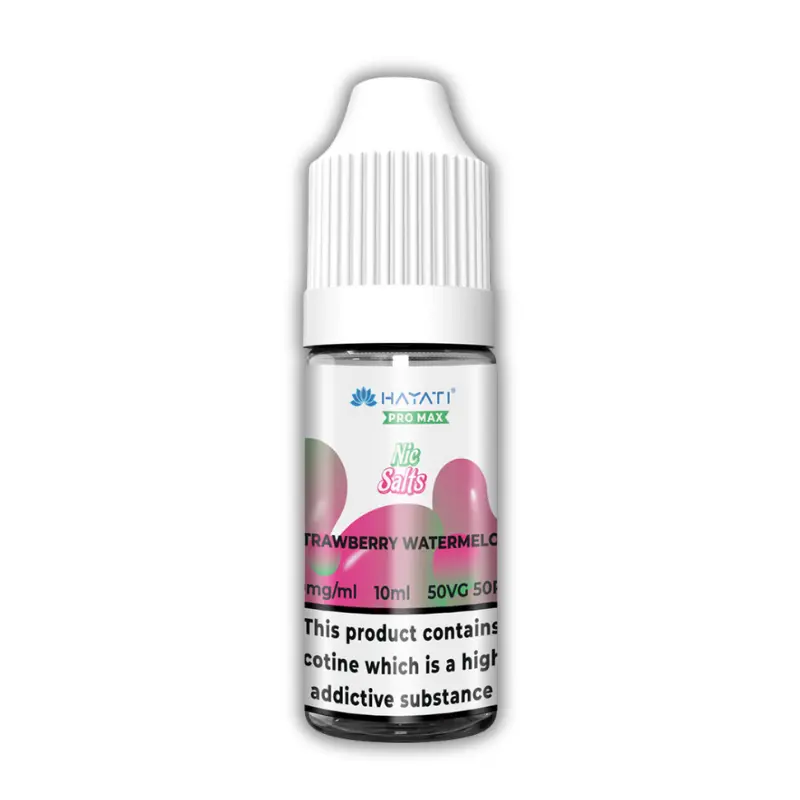
Hayati · Pro Max
Strawberry Watermelon Hayati Pro Max Nic Salt
£2.49
✔ In stock — ready to ship
Genuine Hayati
Free over £20
Same-day dispatch
Secure checkout
Two pounds forty-nine buys a 10ml bottle of Strawberry Watermelon at 10mg nicotine salt, mixed half vegetable glycerine and half propylene glycol, with no device, no pod and no coil in the box. It is liquid, and the listing assumes you already own something to put it in. On a shelf of sixty-five bottles that share those numbers exactly, the specification cannot separate one from another, so everything that distinguishes this purchase is in the two words at the front of the name.
Read those two words for what they announce and you get very little: strawberry, watermelon, both entirely ordinary, no surprises promised. Read them for what they decline to announce and something more interesting turns up. There is no cooling term. There is no sour or citrus element. There is no confectionery treatment, no drink construction, no third fruit, and no mood word standing in for an ingredient that the copy desk could not name. Hayati's own text for this bottle says as much out loud, which is unusual enough that it turns out to be measurable, and the measurement is the first thing this page does.
The short version of the finding, before the working: on the sixty-five-bottle nicotine salt shelf, this is the only listing that names more than one fruit and adds nothing to them. Across all 492 products in the catalogue, spread over 192 distinct flavour names, there are four names carrying no amplifier of any kind, and three of those four are a single fruit or three varieties of one fruit. One name pairs two different fruits with nothing else attached, and it is this one.
That is a strange thing for a range to contain exactly once. The obvious reading is that it is a weak blend that nobody bothered to finish, and this page argues the opposite: that a liquid with no loud component is a specific construction with a specific advantage, that the advantage is invisible on a first draw and grows over weeks, and that it costs you real things which are named honestly further down. The 10ml bottle is the format where the argument actually pays, because a bottle is bought again or not bought again, and the second decision is the one this construction is built to win.
Counting the things that are not in it
A claim of the form "almost nothing else in this range is built this way" is worth nothing until somebody adds it up, and the count needs a definition before it needs arithmetic. Here is the one used throughout this page, stated so you can disagree with it.
Call a listing amplified if its name contains at least one of six things. A cooling term: ice, frozen, mint, menthol, frosted. A sour, tart or citrus element: sour, lemon, lime, cranberry, orange, grapefruit, pineapple, passionfruit, kiwi, raspberry, blackcurrant, razz. A confectionery treatment: bubblegum, B'Gum, GB, gummy, jelly, candy, H'Bubba, cotton. A drink construction: cola, lemonade, mojito, juice, punch, fizzy, Bru. A fruit that carries a dominant character compound, meaning one you could identify blind from a small quantity: mango, banana, grape, guava, lychee, apple, cherry, pineapple, kiwi, dragonfruit, pomegranate, blackcurrant. Or a mood name standing where an ingredient should be, which tells you nothing about intensity but does tell you the listing is not offering a plain fruit pair.
Those categories overlap heavily and they are meant to. Most listings score two or three. The question is not which category a bottle falls into but whether it falls into any of them at all, because a bottle scoring zero is a bottle with nothing in it that raises its voice.
The sixty-five bottles, sorted by loudness
Run that test across the Hayati Pro Max Nic Salts shelf and the shape of the range is immediate. Eighteen of the sixty-five name a cooling term. Twenty-six name something sour, tart or citrus. Twenty-three name a fruit with a dominant character compound. Thirteen are built as a drink rather than as a fruit. Eleven name a confectionery treatment. Ten are named for a mood, a colour or a character rather than for anything you could put in a bowl.
Add the scores up and sixty-three of the sixty-five listings carry at least one amplifier. Two carry none. One is this bottle. The other is Juicy Peach, which names a single fruit, so it is not a pairing at all and cannot answer the question this page is asking. Strawberry Watermelon is the only bottle on the shelf that names two fruits and then stops.
Widening the test to the whole catalogue makes the claim weaker in one direction and stronger in another, which is what a widened count usually does. Across 492 listings there are 192 distinct flavour names, and four of them score zero on the amplifier test: Juicy Peach, Blueberry, Triple Melon and Strawberry Watermelon. Two of those are one fruit standing alone. Triple Melon is three members of the same botanical family, which makes it closer to a single flavour with a wide margin of error than to a pairing. That leaves one name in 192 that puts two different fruits together and attaches nothing to either.
Where the count is soft, and the near misses
Two things in that arithmetic are judgement rather than fact, and a page that hid them would be pretending to a precision it does not have.
The first is the marker-fruit category. Deciding that cherry carries a dominant character compound and strawberry does not is defensible (the almond-like note in cherry is famously traceable to a single aldehyde, and nothing comparable exists for strawberry) but it is a judgement, and somebody drawing the line differently would get a different number. Cherry Berry is the near miss that the line excludes: no cooling, no acid word, no confectionery, no drink. It falls out because cherry brings a dark kernel depth that nothing here has, and because "berry" is a category rather than a named fruit, which makes that listing one fruit plus a gesture rather than a pair.
The second soft edge is the mood names. Black Mamba, Blue Fusion, Mr Blue, Mr Pink, Mad Blue, Summer Dream and Rainbow are all unreadable from their names, and any one of them could turn out on tasting to be as unamplified as this bottle. They are excluded because there is no way to know, not because they have been checked and found loud. If you want the count at its most conservative, it is: one bottle in sixty-five that is demonstrably unamplified and names a pair, with up to ten more that cannot be ruled in or out from the listing.
A second test arriving at the same place
The Strawberry Watermelon Pro Ultra Plus pod page has already counted this flavour's neighbourhood once, using a completely different definition. It asked how many listings on its own shelf are built on an opposition between their parts, found that nearly all of them are, and concluded that this pairing is the one with no opposition in it anywhere. That count is theirs and it is not being re-run here.
What matters is that the two tests do not measure the same thing. One asks whether a blend's components argue with each other. This one asks whether any component, by itself, is loud. A blend can easily fail the first test and pass the second, which is what Triple Melon does, and a blend can pass the first and fail the second, which is what almost every iced two-fruit listing does. Two independent definitions run over two different populations landed on the same listing, and that is worth more than either count on its own. Read them together if you want the claim properly tested; this page will not be rebuilding the opposition census and that page has nothing to say about the bottled shelf.
The one honest limit on all of it
Every figure above counts names, not recipes. Hayati publish a flavour name, a strength, a ratio and a volume, and they publish no ingredient list, no sweetener loading and no concentrate percentages for any of the sixty-five. A bottle could carry a substantial sweetener dose and a citric acid adjustment without either appearing in its title, and nothing on this page can rule that out.
What the count does establish is a decision about presentation, and presentation decisions in a range this size are rarely accidental. A copy desk with sixty-five bottles to differentiate reaches for a modifier almost every time, because a modifier is the cheapest way to make two similar products look different on a grid. Declining to reach for one, exactly once in sixty-five, is a choice somebody made on purpose.
One sentence in 492 that sells a liquid on what is missing from it
The evidence that the choice was deliberate is not inference. It is written on the listing, and it is written nowhere else in the catalogue.
Hayati's own text for this bottle opens by saying the flavour strips things back to two fruits, and then states that, with neither a candy register nor a coolant declared anywhere in it, everything is left to the fruit itself. Three phrases from that pair of sentences were checked against the descriptions of all 492 products. The phrase about stripping back occurs once. The reference to candy being absent occurs once. The formulation handing the whole job to the fruit occurs once. Each of those single occurrences is this bottle.
That is a copywriter describing a product by subtraction, which is a difficult thing to do on a retail grid, because absence does not photograph and does not sit well in a headline. Four listings in 492 mention that there is no ice in something. Only this one builds its whole flavour paragraph on the absence and treats it as the reason to buy.
Checking the words before trusting them
House vocabulary is the trap here, and this corpus has been caught by it before. A word that turns up on a quarter of the catalogue tells you about the copy desk's habits rather than about the liquid. So the same check was run on the descriptive words this listing does use. "Juicy" appears in 129 of the 492 descriptions, which makes it furniture and means it can be ignored entirely. "Watery" appears in nine. "Thirst-quenching" appears in six. "Easy-going" appears in ten.
The ratio is the interesting part. The words this bottle uses to say what the liquid is are either universal or near-universal in a small way, and the sentence it uses to say what the liquid lacks is unique in 492. Somebody writing product copy at volume defaults to the common words when describing and reaches for original construction when they have something specific to say. The original construction here is all on the absence.
The sibling it points at
The listing's closing line does something else no other version of this flavour does: it names a different product and positions itself against it, suggesting that anyone who finds the bubblegum version too sugary should take this instead.
That sibling is Strawberry Watermelon Bubblegum, the same two fruits at the same price in the same format with a chewy sweet-counter base under them. It exists on the Mini Ultra platform as well, and in an extreme version on the Fruit Bomb / Straw' Watermelon B'Gum kit, where the treated pairing sits opposite a deliberately busy mixed fruit. Three products, one pairing, an escalating amount of sugar over the top of it.
A retail listing that tells you which of two adjacent products to buy is doing something against its own interest, and it is the strongest single piece of evidence available that the plain version was designed as the plain version. It is not the loud one with the loud bit left out. It is the sibling that the loud one is measured against.
Hayati wrote fresh copy for this flavour across every format it appears in, and reading those descriptions against each other turns out to be informative. That exercise has been done in full on the Pro Ultra Plus pod page, which lined up five listings of the same liquid and reported what they agree on, what they all reach for, and where they contradict each other. It is not repeated here, and anybody weighing this bottle against the Pro Max Plus kit version should read it.
Why a formulator builds a blend with no lead
The count says the construction is rare and the copy says it is intentional. Neither says why anybody would want it, and the answer to that is in the two fruits themselves, which are more similar in a technical sense than their colours suggest.
Fruits with one lever, and fruits with none
Some fruits are carried by a single compound. Banana is the textbook case: one ester does almost all of the identifying work, which is why banana sweets, banana milkshake syrup and banana vape liquid all taste of the same thing and none of them tastes much like a banana. Grape has its own, so distinctive that an entire confectionery category rests on it. Cherry has an aldehyde that reads as almond as much as cherry. Guava has sulphur-bearing compounds that announce themselves at trace levels. Peach has a lactone with a recognisable creamy edge. Pear, lychee and pineapple each have something similar.
Call those the fruits with a lever. A formulator building with one of them has a dial: increase the character compound and the fruit gets more identifiable, not just stronger. The fruit survives dilution, survives being put next to something aggressive, and survives a coil that is past its best, because the single compound doing the identifying is present at a level that carries.
Strawberry has no such compound. What reads as strawberry is a composite: dozens of esters in a particular ratio, plus a furanone that contributes a caramelised, slightly cooked sweetness, and none of them alone reads as the fruit. Push any single element up and you do not get more strawberry, you get jam, or boiled sweet, or something faintly synthetic. The identity lives in the balance, and balance is fragile in a way a single dominant compound is not.
Watermelon is in a more extreme version of the same position. Its aroma sits mostly in a family of nine-carbon aldehydes and alcohols that are generated when the flesh is cut rather than being present in the intact fruit, and they are both faint and short-lived. That is why a whole watermelon smells of nothing and a cut one smells of watermelon for about ten minutes. There is no reservoir of character to draw on. The Pro Ultra Plus pod page and the Watermelon Ice pages have already established what follows from that for the fruit's behaviour in a blend, including the finding that watermelon carries a temperature association for reasons that have nothing to do with any cooling compound, and that adding a coolant to it is at least partly redundant work. Those arguments are theirs and are taken as settled.
The novel part for this page is the pairing. Two fruits with no lever between them is not a common thing to build with, and it is not an accident that it happens once in 192 names. It removes the formulator's main tool before work starts.
Water is part of the flavour, not the absence of one
Both fruits are also watery in a sense that goes beyond texture, and this is the part most often misread as a fault.
Strawberry and watermelon are, in life, overwhelmingly water. Everyone's sensory memory of them includes that dilution as part of the identity. A strawberry that tasted like strawberry concentrate would not read as a strawberry; it would read as jam or as a sweet. Reduce a watermelon down and you get something closer to cucumber, or to a green vegetal note, or to a pink boiled sweet, depending on how you did it, and none of the three is recognisable as the fruit you started with.
The consequence for a liquid is specific. For most fruits, "more intense" and "more like the fruit" point in the same direction, at least until the point where it tips. For these two they point in opposite directions almost immediately. Concentration is not available as a design move, because the thing being concentrated stops being the thing. A formulator who wants these fruits to read as themselves has to keep them dilute, which means keeping them quiet, which means accepting that the finished liquid will never be the one that wins a side-by-side test against its neighbours on the grid.
What that leaves, and what was declined
Strip out concentration and four amplifiers remain available, which is exactly the list the count above was built from.
Acid is the first and most effective. A citric or malic adjustment gives a soft fruit an edge, makes it arrive faster, and creates the impression of freshness that sweetness alone cannot produce. This blend has none, and Strawberry Kiwi on the same shelf shows the alternative: the same strawberry with a genuinely tart partner attached, and a completely different sense of arrival because of it.
A coolant is the second, and it is the most reliable of the four because it does not depend on aroma at all. It fires on the tissue rather than at the back of the nose, so it works on a tired coil, in a warm room, and on a palate that has stopped paying attention. Declined here, and taken up on eighteen of the sixty-five bottles.
A confectionery accord is the third. Bubblegum, gummy and jelly registers give a thin fruit a body it does not have and a shape it can hold on to. Declined here, taken up eleven times on this shelf, and taken up specifically on this flavour's own sibling.
Sweetener is the fourth, and it is the only one of the four that never appears in a product name anywhere in the catalogue, which means the count cannot see it and neither can you. What the copy describes is a rounded rather than a sugared sweetness, and that is a description of the intended effect rather than a figure. Hayati publish no sweetener loading for any bottle on the shelf, so a claim in either direction would be invention. The honest position is that three of the four amplifiers were visibly declined and the fourth is unknowable from the listing.
The result is a texture, not a shape
Here is what all of that produces, described as carefully as a page can describe a liquid it is not going to pretend to have measured.
Almost every blend on this shelf has a shape: something arrives first, something else follows, and there is a moment where one gives way to the other. On Blueberry Cherry Cranberry the tart edge is the joint. On Red Berry Ice the chill is. On Strawberry Jelly Beans the confectionery register is, and you can hear it start. A shape is what makes a flavour describable, which is why every one of those listings is easy to write about.
This liquid has no joint. Nothing arrives first with enough force to be called an opening, and nothing displaces it. What you get instead is a single continuous sweet-fruit impression with a slightly thinner, fresher quality at the end of the exhale, which is the melon's only distinguishable contribution and is easy to miss on a warm device. The whole event is one thing, from the start of the draw to fifteen seconds after it.
Call that a texture rather than a flavour and the description becomes accurate rather than damning. You are not buying a sequence of events. You are buying a consistency: sweet, light, red-fruit, with no edges anywhere in it and nothing that asks to be noticed. Whether that is worth £2.49 depends entirely on the next section, because the value of having no edges only appears over time.
The case for buying a liquid that loses a side-by-side test
Everything above is description. This section is the argument, and it rests on one observation about how flavour purchases actually go wrong.
You choose a liquid on the strength of a handful of draws, and then you live with it for several hundred. Those are two different measurements of the same product, and the range sells almost exclusively on the first one. A bottle that reads as impressive on draw three is doing well on a test that stops mattering by the end of the first week. The test that matters is whether the thing is still working on draw four hundred, and no shelf, no grid and no product page is organised around it.
Intensity is a starting point, not a level
The reason those two measurements diverge is adaptation, which is not a failure of attention but a property of the machinery. Sensory systems report change rather than absolute magnitude. Hold an input steady and the reported magnitude falls, and the rate at which it falls is roughly proportional to how strong the input was to begin with.
Put that in purchase terms. Every liquid has an intercept, which is how loud it is on the first draw, and a gradient, which is how fast that loudness declines as you get used to it. Shops sell the intercept because it is the only part observable at the point of sale. The buyer, a fortnight later, is living entirely on the gradient. A liquid with a high intercept and a steep gradient can easily end up quieter, in practice, than one that started lower and barely moved.
Sweetness falls, and the natural correction makes it worse
Sweetness adapts on two timescales and both work against a heavily sugared blend.
Within a session, the second sweet thing reads as less sweet than the first, which is why a sugared liquid loses definition across an afternoon rather than across a month. Across weeks, something slower happens: the level at which you register something as notably sweet drifts upward, so the same liquid produces a smaller response from the same dose. Neither of these is a fault in the product. Both are inevitable, both are proportional to the starting dose, and the sweeter the blend the further it has to fall.
What makes it costly rather than merely uninteresting is the correction people reach for. The instinct when a sweet liquid flattens is to want a sweeter one, and the shelf obliges, which is how a rotation ratchets in one direction until nothing on it reads as sweet any more. Strawberry GB and Blue Razz Cherry are both excellent at the top of that ratchet and neither of them is a liquid you can stay on indefinitely without the same thing happening again.
Cooling falls faster than anything else
Coolants adapt harder and quicker than sweetness does, and this is the part most buyers underestimate because a coolant is so convincing on day one.
A cooling agent works by triggering a temperature-reporting nerve ending directly. It is a switch rather than an aroma, it fires at much the same strength for nearly everybody, and precisely because it is a direct signal it habituates fast. Two weeks into a cooled bottle, the chill that defined it has become the ambient condition, and what you are left tasting is whatever fruit was underneath it, which on a cooled blend is usually the half that got less attention in development.
The corpus has already established the vocabulary side of this and there is no reason to recount it: the Blue Frozen page audited every cooling word Hayati use across the catalogue and found the terms are not graded, so Ice, Frozen and Cooler tell you a coolant is present and nothing whatsoever about how much. On this shelf, Blackberry Ice, Blue Frozen, Bru Ice and fifteen others carry one of those words, and a buyer running three of them in rotation will find within a month that they have converged on each other more than any of them has stayed distinct.
The honest exception
Acid is the amplifier that ages best, and a page arguing only one side would leave it out.
Tartness does not habituate the way sweetness and cooling do. It keeps producing a response, it keeps making a liquid arrive quickly, and a genuinely tart bottle such as Blue Sour Raspberry or Strawberry Cherry Cranberry will still be doing roughly what it did on day one after a month of it. So the general claim is narrower than "loud things fade". It is that the two amplifiers which fade fastest are the two most commonly used, and that the one which holds up is also the one most people cannot take all day.
Why the gradient argument pays on a bottle rather than a pod
A sealed prefilled pod turns this into a question about finishing a fixed quantity of liquid, and that version of the argument belongs to the Pro Ultra Plus pod page, which works it out properly at 22ml. A bottle is a different economic object and the argument lands differently on it.
At £2.49 for 10ml, the first purchase of anything on this shelf is close to free as decisions go. Nobody is committed by it, nothing has to be finished, and a bottle you go off costs you less than a sandwich. What that means is that the first purchase carries almost no information about whether you actually like something, because the barrier to trying it was too low for the decision to have cost you anything.
The informative purchase is the fourth one. Buying the same bottle repeatedly, when sixty-four alternatives sit next to it at an identical price and switching costs literally nothing, is the only signal in this format that is not contaminated by novelty. A quiet liquid loses the first purchase, because on a grid of sixty-five it has the least to say for itself. It wins the fourth, if it wins anything, because by then everything with a steep gradient has flattened out and the thing that never had a peak is in exactly the state it was in on day one.
That is a testable claim about your own behaviour rather than a claim about the liquid, and it costs £2.49 a time to test. Keep a note of what you actually reorder over three months, not what you rate highly on first opening. The two lists are rarely the same and the second one is the real one.
What it costs you, stated as plainly as the case for it
A page that made the argument above and then stopped would be selling. The construction has real disadvantages and some of them are serious.
You will stop noticing it, and you will not notice that you have stopped. A shallow gradient is not a flat one. Adaptation still happens here, it is simply smaller, and because there was never much to hear, the transition from "quiet and pleasant" to "faint and barely there" is almost undetectable from the inside. People run this kind of liquid for weeks past the point where it has stopped delivering anything and report, in complete sincerity, that it is exactly as it was.
There is no decline signal. A citrus bottle tells you the coil is finished by losing its zest. An iced bottle tells you by losing its chill. This one has neither instrument. What a tiring coil takes first is light aromatic material, which on most blends is a layer and here is the entire product, so the failure mode is that the liquid quietly becomes sweet vapour with a faint fruit suggestion attached and nothing announces the change.
It is unforgiving of a draw that runs cool. Light aromatic compounds need heat to be delivered at all, and a device set up to run gently renders less of them. On a blend carrying a coolant or an acid seam, an under-powered draw still gives you something to taste. Here there is nothing underneath the aroma to catch you, so the same setup that makes a sugared blend pleasantly restrained can make this one read as sweet nothing. What the hardware side of that means in practice is a separate argument and it belongs on the Triple Mango bottle page rather than this one, but the flavour consequence is worth naming: this liquid has the narrowest tolerance on the shelf for a device that is not delivering.
It gives you nothing to compare on. Standing in front of sixty-five bottles, a shopper needs a reason, and every other listing offers one: a cooling word, a tart word, a sweet-counter word, a drink. This one offers two fruit names and a claim about what is absent. It is the hardest bottle on the shelf to choose and the hardest to recommend to somebody else, and no amount of arguing for its gradient changes the fact that "it has no features" is a difficult sell and an honest description.
It is erased by anything sharp that came before it. Draw on this within twenty minutes of something from the sour or citrus end and it will read as close to nothing at all. That is not the bottle failing; it is a quiet input arriving after a loud one. But it does constrain how you can use it, and anybody running a mixed rotation needs to know that this one has to come first in the day or not at all.
Who should not buy this
Five kinds of buyer are better served elsewhere, and the shelf has an answer for each.
Anybody who wants to be able to taste that they are vaping something in particular should not buy it; Blue Razz Mojito or Strawberry Mojito will give you a much clearer sense of a specific thing arriving. Anybody who chooses on cold should not buy it, and should take one of the eighteen that say so on the label. Anybody buying a single bottle to represent the range should not start here, because this is the least representative bottle on the shelf and would give you a completely wrong impression of what the other sixty-four are like. Anybody who runs several liquids in one day across one device should be cautious, for the erasure reason above. And anybody who has already decided the two fruit names are the point should read the Pro Ultra Plus pod page first, because it argues at length and persuasively that the two are unlikely to be separately identifiable, and that page is more sceptical about the pairing than this one is.
The sheet, ordered by what this page argues
The rows below lead with the absences, because on this listing the absences are the specification. Everything after the fourth row is the same on sixty-four other bottles and settles nothing.
| Cooling | None named. Eighteen of the sixty-five bottles on this shelf name one |
|---|---|
| Sour, tart or citrus element | None named. Twenty-six of the sixty-five carry one |
| Confectionery treatment | None named. Eleven of the sixty-five carry one, including this flavour's own sibling |
| Third component | None. Two fruits, no drink construction, no mood word |
| Sweetener | Not published for this or any bottle on the shelf. Described in the copy as rounded rather than sugared |
| Named fruits | Strawberry (body and sweetness) and watermelon (the lighter, thinner end) |
| Nicotine | 10mg per millilitre, as a nicotine salt. No second strength offered on this listing |
| Base | Equal parts vegetable glycerine and propylene glycol |
| Volume | 10ml in one bottle |
| Hardware in the box | None. No device, no pod, no coil, no charger |
| Intended for | Refillable pod hardware and other low-power kit drawn through a narrow airway. Not for sub-ohm tanks |
| Price | £2.49 |
| Product code | HPM-NS-STRAWBERRY-WATERMELON |
| Brand | Hayati |
Two of those rows deserve a note. The 50/50 split is the reason this liquid works in a narrow airway at all: an even balance of the two carrier fluids is thin enough to move through a small wick without starving it, and it carries flavour material well while producing a modest amount of vapour. On a quiet blend that thinness is doing more work than usual, because there is no coolant or acid to cover for a draw that arrives underfed.
The 10mg figure is a plain statement of strength and not a position on any scale. Nicotine is addictive. What is worth saying about it specifically here is that a nicotine salt is noticeably less abrasive at a given strength than the freebase preparation, which on a liquid with no coolant and no acid matters more than it would elsewhere: there is nothing else in this bottle producing any sensation at the back of the throat, so whatever you feel there is the nicotine and nothing else. On a cooled or tart bottle that signal is masked. Here it is exposed, and some people will read the resulting draw as unusually soft and others as slightly hollow.
The rest of the shelf, sorted by what it adds
The useful way to shop around this bottle is not by fruit family. It is by which of the four amplifiers you decide you were missing, because the count at the top of this page gives you a map of exactly that.
If what was missing is a sweet-counter carrier
Strawberry Watermelon Bubblegum is the controlled experiment and the only one available anywhere in the range: identical fruits, identical format, identical price, with a chewy confectionery base underneath. Buy both, run them a week apart, and you have isolated a single variable, which is a thing almost nothing on a retail shelf lets you do. Strawberry Jelly Beans and Strawberry GB apply the same idea to the strawberry alone in two different sweet registers, and both are considerably louder on a first draw than the plain pairing is.
If what was missing is an acid line
Strawberry Kiwi is the smallest step: one fruit held constant, one quiet partner swapped for a genuinely tart one. Strawberry Cherry Cranberry goes further by putting the same strawberry inside a three-fruit build with real tartness underneath it and a dark kernel note from the cherry. Strawberry Raspberry Blueberry keeps all three components in the berry family but hands the acid duty to the raspberry, which is the lightest-touch version of this direction. Blackberry Raspberry drops the strawberry entirely for two berries that both have an edge.
If what was missing is cold
Strawberry Raspberry Ice is the direct upgrade path, adding both an acid berry and a coolant to the same fruit, which is two amplifiers at once and roughly the structural opposite of what you have been reading about. Red Berry Ice is the broader version with the fruit left unspecified. Blackberry Ice keeps one dark berry under the chill, and Blue Frozen sits at the cold end of the shelf. Remember the gradient point before committing to a rotation built on these: the chill is the part that will have faded most by week three.
If what was missing is a construction rather than an ingredient
A drink build gives a fruit a shape it cannot generate on its own. Berry Lemonade bolts a citrus fizz onto soft berries. Strawberry Mojito takes the same strawberry into a herbal drink register. Bru Ice is a soft-drink profile with a chill on it and tastes nothing like anything in the fruit sections above.
The same liquid in other formats
If the flavour suits you but the bottle does not, this recipe exists as prefilled hardware. The Strawberry Watermelon Pro Max Plus kit at £7.99 includes the device, and the Pro Ultra Plus pod at £7.99 is the large sealed version for a body you already own. Both are a different proposition from a bottle, and the trade-offs between the two formats are counted properly on the range-level Pro Max Nic Salts listing, which works through what a sealed pod settles for you and what a bottle hands back, rather than being re-argued here. Check the range name on any device you own against the range name in the title before ordering prefilled hardware of any kind.
The wider shelves
Watermelon Vapes runs to twenty-nine listings and is short enough to read end to end, which is worth doing if you want to see how rarely the fruit is left to stand on its own terms. Strawberry Vapes is eighty-two, and Berry Vapes is 225, which is where this bottle is filed despite neither of its fruits being a berry in the sense the other 224 are. Black Mint is the cleanest rotation partner on the shelf for anybody running this one, because mint occupies a channel this liquid does not touch at all, which means the two do not erase each other the way two fruit bottles will.
Running a bottle of something quiet
Generic liquid advice applies here as it does everywhere and is not worth your time. What follows is the handling that changes specifically because the product has no loud component.
A fresh coil is a measuring instrument, and this is the one thing a bottle can do that a sealed pod cannot. The central problem with a quiet liquid is that you cannot tell your own adaptation apart from the liquid actually getting fainter, because from the inside both feel identical. On prefilled hardware there is no way to separate them, because the coil and the liquid are retired together. On a bottle you can: fit a new coil, put the same liquid on it, and whatever you hear is the liquid. If it comes back, the fade was the coil. If it does not, the fade was you, and it is time to switch for a fortnight rather than keep buying it. Nothing else in this format gives you that, and on a blend with no decline signal it is the difference between knowing and guessing.
Refill before the wick has run dry, not after. Drawing on a wick that has stopped being fed produces a scorched note, and a scorched note sits on light aromatic material far more destructively than it does on a sugared or cooled blend, where there is enough else going on to bury it. On this liquid one dry draw can end the usefulness of a coil that was otherwise fine.
Give it the first slot of the day. This follows from the erasure point rather than repeating it: the practical arrangement that works is to use this one on a rested palate and put anything with an edge later. Reverse the order and you will conclude the bottle is faulty when it is only second in the queue.
Expect an opened bottle to drift, and expect the drift to be one-directional. Every time a bottle is opened it exchanges air, and the light aromatic fraction is the part that leaves. Sweetness does not leave, because sugar-type material is not volatile in the same way. What that means over a couple of months is that a half-used bottle of this becomes progressively sweeter and progressively less fruity, and because the sweetness is untouched the change reads as a subtle flattening rather than as a loss. Buy small, use it, and do not stockpile this particular liquid for later in the way you might stockpile something with a coolant in it.
Store it dark, cool and closed. Heat and light both work on the same fragile fraction, and this bottle has less margin than most for losing it. A drawer indoors is enough. Keep it out of reach of children and pets, and keep the cap fully seated rather than resting on the thread.
If you mix, mix into this rather than out of it. A small quantity of something with an acid line added to a bottle of this will change it substantially, because there is nothing already present to compete. The reverse, adding this to a loud liquid, does almost nothing except dilute the strength. That asymmetry is a direct consequence of everything above and it is the one piece of blending advice this liquid actually generates.
Dispose of the empty properly. An empty nicotine bottle is not ordinary household plastic; rinse it out and take it to a recycling point that accepts it, and never pour residual liquid down a sink.
Questions this bottle actually raises
Is there really nothing else in it besides the two fruits?
Nothing else is named, which is not the same statement. Hayati publish no ingredient list for any bottle on this shelf, so a sweetener could be present without appearing in the title or the copy. What can be said is that no cooling agent, no sour element, no confectionery accord and no third fruit is declared, and that this bottle's own text draws attention to those absences rather than glossing over them.
Will I be able to taste the watermelon separately from the strawberry?
Quite possibly not. Both fruits work in the same part of the perceptual range and neither carries a compound distinctive enough to stand out from the other, so the likeliest outcome is a single composite impression. The Pro Ultra Plus pod page works through why in detail and is the better read if separability is the thing you care about.
How sweet is it on the shelf's scale?
Sweet-leaning but not in the sweet-counter register. It sits well below the gummy, jelly and bubblegum builds and above the tart and citrus end, with nothing sharp anywhere in it to cut the sugar. The copy calls the sweetness rounded rather than sugary, and no figure is published that would let anyone be more precise than that.
Is there any cooling in this one?
No cooling term appears anywhere on the listing, and the range names cooling explicitly whenever it is present. Treat it as an entirely warm-finishing liquid. If the exhale reads slightly fresh to you, that is the melon, which carries a cold association for reasons that have nothing to do with any cooling compound.
Why would anyone choose a flavour with no standout feature?
Because standout features are the part that fades. Sweetness and cooling both habituate in proportion to how strong they were, so the liquid that impresses most on the first draw often has the furthest to fall by week three. A blend with nothing loud in it has very little to lose, which is a poor argument at the point of sale and a good one by the fourth reorder.
How is this different from the bubblegum version?
Same two fruits, same price, same format, with a chewy confectionery base added underneath them. The gum gives the pairing a carrier and a shape that the fruits cannot generate on their own, at the cost of being much sweeter and much more emphatic. This listing is the only one in the catalogue that explicitly points at its own sibling and suggests the plain version for anyone who finds the sweetened one too much.
Does anything come in the box besides the liquid?
No. It is a 10ml bottle and nothing else, with no device, no pod, no coil and no charging equipment of any kind. The listing assumes you already own low-power refillable hardware and are buying liquid to put into it.
Will it work in a sub-ohm tank?
It is not intended for one. A 50/50 base is thin, and a high-power coil will convert it far too quickly, producing a harsh draw and a great deal of wasted liquid. At 10mg the strength is also set for a narrow, restricted draw rather than a large one.
How will I know when the coil needs changing?
Less easily than on almost anything else on this shelf, which is the practical catch with this construction. There is no zest to go missing and no chill to fade, so decline shows up as a general thinning that is hard to separate from your own adaptation. Fitting a fresh coil and running the same liquid on it is the only reliable test, and it is a test only a bottle lets you run.
Is 10mg the only strength?
It is the only one offered on this listing, stated as 10mg of nicotine salt in every millilitre. Nicotine is an addictive substance at any strength. Nothing on this page is a recommendation about which strength anybody should be using.
Is it worth buying two bottles at once?
Probably not this one, and for a reason specific to it. An opened bottle loses its light aromatic fraction faster than it loses its sweetness, so a second bottle held for later drifts in exactly the direction this liquid can least afford. At £2.49 there is nothing to gain by stockpiling.
What should I run alongside it?
Something occupying a completely different channel, which in practice means a mint rather than another fruit. Two fruit liquids in one day will blur into each other, and anything tart or cooled used earlier will erase this one for the rest of the session. Give this the first part of the day and put the loud thing later.
Where this leaves it
£2.49 for 10ml at 10mg nicotine salt in a 50/50 base, no hardware included, two fruits named and nothing else attached to them.
The count is the reason to take it seriously. Sixty-three of the sixty-five bottles on this shelf carry a cooling word, a tart element, a confectionery treatment, a drink construction, a fruit with a dominant character compound, or a mood name covering for all of the above. Two carry none, and only one of those two is a pairing. Widen it to all 192 flavour names in the catalogue and the number of names that put two different fruits together with nothing else is still one. A range does not do that by accident, and Hayati's own copy for this bottle, alone in 492 descriptions, sells it on the absences and points buyers who want the sweetened version at a different product.
What you get for that construction is not a flavour with a shape. It is a texture: sweet, light, red-fruit, continuous from the start of the draw to the end of the exhale, with a slightly thinner and fresher quality at the finish that is the melon's only separable contribution. It will lose every side-by-side comparison you put it in. It will also still be doing exactly what it did on the first day when the bottle you bought alongside it has flattened into background sweetness, because nothing in it was ever loud enough to habituate to.
Buy it if your objection to a range like this is that everything in it is shouting, if you want one liquid you can stay on rather than a rotation you keep having to escalate, or if you have noticed that the bottles you rate highly and the bottles you reorder are not the same list. Do not buy it as your introduction to the shelf, do not buy it expecting to identify two fruits, and do not buy it if cold or tartness is what you actually choose on. And if you want the decision settled in one cheap experiment, buy this and the bubblegum version together, run each for a week, and see which one you reach for in week three.
Strictly for adults aged 18 and over. Nicotine is an addictive substance.
You might also like


