
Home / Hayati Pro Max Nic Salts / White Peach Raspberry Hayati Pro Max Nic Salts
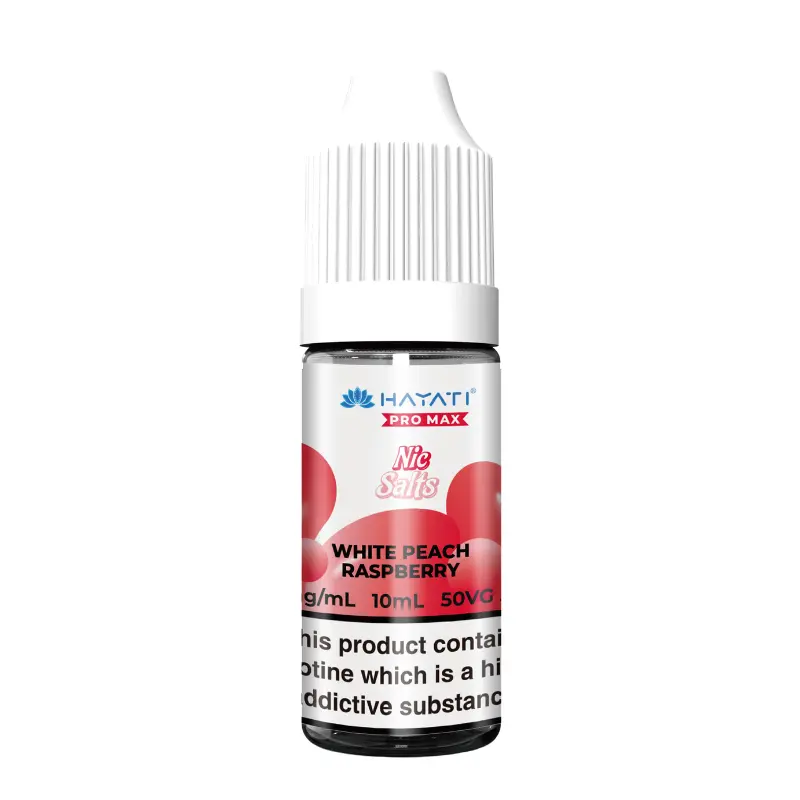
Hayati · Pro Max
White Peach Raspberry Hayati Pro Max Nic Salts
£2.49
✔ In stock — ready to ship
Genuine Hayati
Free over £20
Same-day dispatch
Secure checkout
White Peach Raspberry is a 10ml Hayati nic salt priced at £2.49, and it is one of the few bottles on the Hayati Pro Max Nic Salts shelf built around a stone fruit rather than a berry pile. The peach named on the label is the white variety, not the yellow one, and that is a genuine difference in the fruit rather than a difference in the artwork. Raspberry sits underneath it, and the pairing is not arbitrary. It is there because white peach has a specific gap in its profile, and raspberry fills exactly that gap.
Most fruit blends in this range are assembled from ingredients that are roughly equal in volume. Two berries, three berries, a berry and a citrus, all of them shouting at a similar level. This one is deliberately lopsided. One half is quiet, rounded and low in acid; the other half is bright, tart and slightly astringent. That asymmetry is the reason the bottle is interesting, and it is also the reason it is fussier than its neighbours about coil condition, power and how long you draw on it.
The short assessment is that this is a sweet, soft, juicy fruit blend with a tart edge that keeps it from collapsing into syrup, and that it is at its most convincing in the first two thirds of a fresh pod. After that, the peach starts to recede faster than the raspberry does, and what you are left with is a thinner, sharper liquid that no longer resembles the one you bought. That is not a fault in the mix. It is what happens when you put a delicate aromatic next to a robust one, and it is worth knowing before you spend £2.49 rather than after.
Below is what each half tastes like, in what order, how the balance shifts through a session, and which of the twenty-odd raspberry bottles in this range you would pick instead if the soft half is not what you are after.
Two fruits, and only one of them is fragile
Why white peach is a different fruit, not a different colour
Yellow peach and white peach are not the same thing painted differently. They are separate cultivar groups with genuinely different chemistry, and the eating experience is not close. Yellow flesh is high in acid, dense, and carries a carotenoid character that most people recognise instantly because it is the flavour of tinned peach halves in syrup. White flesh is markedly lower in acid, which changes everything downstream. With the acidity dialled back, the aromatic compounds that would otherwise be buried come forward, and white peach reads as floral in a way yellow peach never does. Honeysuckle sits in there. So does a faint jasmine edge, and a watery, almost pear-adjacent sweetness that belongs to the flesh just beneath the skin.
Translated into a liquid, those two peaches behave differently. A yellow peach concentrate is loud. It has enough acid of its own to cut through a warm coil, and it survives being mixed with heavier fruits without disappearing. A white peach concentrate is the opposite: aromatic, low-contrast, and easy to bury. Put it next to a blackcurrant and you would lose it completely. Put it on its own and it tastes lovely for about four draws before the palate stops registering it, because there is nothing in it to reset the tongue between puffs.
Which is where the raspberry comes in, and why this specific pairing exists rather than a peach and something heavier.
The inhale, and the shape of the soft half
Draw on a freshly wicked pod and the first thing that arrives is broad rather than pointed. There is no spike at the front of this liquid. The peach unfolds across the middle of the palate as a rounded, watery sweetness with a slight waxy quality behind it, the sort of note you get from the skin of a real peach rather than from the syrup in a tin. It is a wide flavour rather than a tall one. It occupies space without demanding attention.
Floral character is present but restrained. Hayati have not pushed the perfume angle hard, which is a sensible decision, because a white peach concentrate taken too far turns soapy and stops reading as fruit at all. What you get here is a hint of blossom sitting above the flesh, noticeable if you look for it and easy to miss if you are vaping while doing something else.
The texture, if that is the right word for something you inhale, is juicy. Not thick and not creamy, just wet. Some peach liquids aim for a cobbler or a gelato and load in a pastry or dairy note underneath. There is none of that here. This is fresh fruit rather than cooked fruit, and the difference shows in the first half second of the inhale.
The raspberry, and the work it is actually doing
Raspberry is not the co-star here so much as the structural support. It supplies acidity, which is the one thing white peach does not have enough of on its own, and it supplies it early enough that the sweetness never gets a chance to settle into anything cloying.
Taste it in isolation and Hayati's raspberry is a fairly typical red raspberry accord: jammy at the top, sharp in the middle, with a dry, seedy, faintly tannic finish that stops it tasting like jam. There is a green note in there too, the stalk-and-leaf side of the fruit, and that green edge is doing more than you would expect. It gives the blend a lift on the exhale that reads as freshness even though there is no coolant anywhere in the bottle.
Where it sits in the sequence matters. The raspberry does not arrive at the same time as the peach. It comes in fractionally later, roughly as the vapour is leaving, and it cuts across the soft fruit rather than blending with it. You notice the transition. The soft, wide peach narrows into something pointed, and then the tannic dryness closes the draw off. That closing dryness is what stops the sweetness accumulating draw after draw, and it is the reason the bottle stays drinkable across a full pod instead of becoming exhausting at the halfway mark.
If you have tried the range's straighter berry mixes, this raspberry will be familiar. It is recognisably the same concentrate family that turns up in Blackberry Raspberry and Blueberry Raspberry, both of which sit on the Raspberry Vapes shelf next to this one. What is different is the company it keeps. Against a blackberry it is the bright half. Against a white peach it is the loud half, and there is a real gap between being brighter than your partner and being louder than your partner.
Which one leads, and when that changes
Ask two people which fruit dominates this bottle and you will plausibly get two answers, because the balance genuinely moves depending on how you vape it.
Short, quick draws favour the raspberry. Sharp, acidic notes register on the palate faster than soft aromatic ones do, so if you take a one-second pull the tart edge lands and the peach barely has time to develop. People who vape in short bursts through the day tend to describe this as a raspberry liquid with something sweet behind it, and from where they are sitting that is accurate.
Longer, slower draws flip it. Give the vapour three seconds to build and the peach has room to fill out, the floral note surfaces, and the raspberry drops back into a supporting role at the end of the exhale. Under those conditions it reads as a peach liquid with a tart finish. Same bottle, different fruit in the lead.
Coil temperature does something similar. A cool first draw of the morning, on a pod that has been standing overnight, is the most peach-forward this liquid ever gets, because the delicate aromatics come off readily at low heat and the tannic side of the raspberry needs more energy to express itself. Six draws into a chain, with the coil properly hot, the acid pushes forward and the florals flatten out. If you find yourself thinking the bottle has changed character halfway through a session, it has, and the cause is thermal rather than anything in the liquid.
Airflow contributes as well. Tightening the airflow on an adjustable pod concentrates the vapour and favours the peach, because you are getting a denser, warmer, slower draw. Opening it up thins the liquid out and the raspberry, being the sharper of the two, is what survives the dilution. Neither setting is wrong. They give you two usefully different versions of the same £2.49 bottle, which is more than most liquids on this shelf offer.
How sweet it actually is
Sweet. There is no point pretending otherwise. On a scale running from an unsweetened fruit through to the confectionery bottles in this range, White Peach Raspberry sits comfortably in the upper third. White peach is inherently sweet before anyone adds anything, and the mix has clearly been built to lean into that rather than fight it.
What it is not is sugary in the way the sweet-shop flavours are. Put it next to Gummy Bear or Strawberry Jelly Beans and the difference is obvious within one draw: those read as sweets, this reads as fruit that happens to be sweet. The sweetness here has fruit structure under it, acid and tannin and a bit of green, where a confectionery bottle is mostly sugar with a flavour marker on top. Anyone shopping the Sweet Vapes shelf for something that will not taste like a bag of pick and mix should note that distinction.
The raspberry keeps the sweetness in check, but only up to a point, and only while the coil is fresh. As wicking slows and the peach recedes, the perceived sweetness actually goes up rather than down, because you lose the aromatic complexity before you lose the sugar. A tired pod of this tastes flatter and sweeter at the same time, which is a slightly odd combination and a reliable signal that it is time to change something.
No cooling, and the consequences of that
Nothing in the supplied description mentions ice, menthol, koolada or any other coolant, and nothing in the flavour suggests one is hiding in there. This is a room-temperature fruit blend. The lift on the exhale comes from the raspberry's acidity and its green edge, not from anything cold.
That is the right call for this particular pairing. A coolant would sit directly on top of the white peach's florals and erase them, which would leave you with a cold raspberry and no reason to have bothered with the stone fruit. Anyone who has vaped a heavily iced peach knows the effect: the peach becomes a vague sweetness behind the chill rather than a flavour in its own right.
The cost of having no coolant is that there is nothing to hide behind. Menthol is forgiving. It papers over a coil that is past its best, it masks a slightly muddled mix, and it gives a tired pod something to say. A blend like this one has no such cover. Everything that is happening at the coil comes through unfiltered, for better and for worse. If you want the same shelf with the chill included, Strawberry Raspberry Ice and Blackberry Ice are the obvious places to look, and they behave completely differently across a pod's life.
What happens when the delicate half goes first
This is the part that separates White Peach Raspberry from most of its neighbours, and it is worth understanding properly rather than discovering it by accident on day four.
Every liquid degrades as a coil ages. What differs is how. A blend of two robust fruits, say a blackcurrant and a cherry, loses definition roughly evenly. Both halves get duller at a similar rate, the whole thing flattens, and at some point you notice it has become generic red fruit. It is a gradual slide into boredom, and most people tolerate it for longer than they should.
This blend does not do that. The two halves have very different survival rates. White peach is carried by volatile aromatic compounds that come off at low temperature and are the first casualties of a gunked wick, a scorched spot or simply a coil that has done three pods more than it should have. Raspberry's acid and tannin are far more durable. They survive conditions that erase the peach entirely.
So the failure mode here is not dullness, it is imbalance. The bottle does not fade, it tips. What you had was a soft fruit with a tart edge; what you end up with is a thin, sharp raspberry with a vague sweetness underneath and none of the roundness that made the pairing worth buying. Several draws in you may notice a faint metallic or medicinal note at the back, which is what an unaccompanied raspberry accord tends to do when there is nothing soft to sit against.
Counter-intuitively, that makes this an easier bottle to diagnose than most. A flavour that gets gradually duller is hard to catch, because your palate adjusts at roughly the same rate the coil declines. A flavour that changes shape is obvious. The moment White Peach Raspberry starts tasting like raspberry on its own, the coil is finished, regardless of how much liquid is left in the pod or how recently you fitted it. Treat the disappearance of the peach as the service indicator.
The same logic applies to storage, and it is covered further down, but the principle is identical: whatever damages a delicate aromatic damages this bottle twice as visibly as it damages a Black Mamba or a Blueberry Cherry Cranberry, because those are built entirely out of the durable end of the fruit spectrum.
What this bottle is not
Worth clearing up, because the name invites several wrong guesses.
- It is not a peach iced tea. No tannin from tea, no black tea base, no lemon. The tannic dryness that is present comes from the raspberry seeds, and it is much shorter than a tea note would be.
- It is not a peach ring sweet. There is no sugar-coating effect, no gelatine chew, no sour dust. If that is what you want, the confectionery side of the range does it properly and this does not attempt it.
- It is not a sour raspberry. The acidity is present and useful but it never becomes a pucker. Blue Sour Raspberry is where the range puts actual sourness.
- It is not a yellow peach. No tinned syrup, no schnapps, no cooked character. If you were hoping for the dense, high-acid peach of a fruit cocktail, this will read as too polite.
- It is not a dessert. No cream, no pastry, no custard. Fresh fruit throughout.
- It is not subtle overall. The peach half is subtle. The bottle as a whole is a sweet, forward fruit blend and nobody would describe it as restrained.
The bottle and the mix
The format side is simple and there is no need to dress it up. Ten millilitres, child-resistant cap, nicotine salt at 10mg per millilitre, and a base split evenly between vegetable glycerine and propylene glycol.
The even split is worth one specific comment rather than a general lecture, because it interacts with everything described above. Propylene glycol is the thinner of the two liquids and the better flavour carrier, and a delicate floral note like white peach depends on that carrying capacity more than a loud fruit does. Push the glycerine proportion up and you get denser vapour, but the aromatics get dragged along rather than presented, and the first thing to go indistinct is exactly the half of this blend you cannot afford to lose. An equal split is the practical floor for keeping the peach legible. It is also why the 70/30 versions of other flavours in the Hayati E-Liquids catalogue are built around fruits that can take the treatment.
The thin mix wicks quickly, which suits the small, high-resistance coils in mouth-to-lung pods and refillable pod devices. It also means the liquid will find any imperfect seal, so a pod filled right to the brim is a pod that will weep around the mouthpiece once it warms up in a pocket.
This is a bottle for a low-powered pod setup. It is not intended for a sub-ohm tank, and at 10mg the salt strength makes that an easy decision rather than a close call.
The numbers, and what £2.49 actually buys
The specification is short. What it is worth is a slightly longer conversation.
| Product | White Peach Raspberry Hayati Pro Max Nic Salts |
| Brand | Hayati |
| Price | £2.49 |
| Bottle size | 10ml |
| Nicotine | 10mg per millilitre, nicotine salt |
| Base | 50/50 vegetable glycerine and propylene glycol |
| Profile | White peach with raspberry, sweet, no coolant |
| Suited to | Mouth-to-lung pod kits and other low-power hardware |
| Storage | Upright, cap closed, away from direct sunlight |
Take the price first, because at £2.49 for ten millilitres the arithmetic is the most persuasive thing on this page. That is just under 25p per millilitre. A 2ml pod filled from this bottle costs about 50p to fill, and the bottle gives you five such fills. Set that against a prefilled disposable pod device where the liquid and the hardware are bundled into one price, and the gap is not marginal. The trade is your time and a coil you have to look after yourself, which for a flavour this sensitive to coil condition is a real trade rather than a token one.
The 10mg figure deserves a note about draw style rather than about habits. Nicotine salts are absorbed differently from freebase nicotine at the same concentration, and the strength you see on the label interacts with how much vapour you are producing. A tight mouth-to-lung pod at low power moves a small volume of liquid per draw, so 10mg in that setting delivers a modest amount of nicotine per puff. The same bottle in something that consumes liquid faster would deliver considerably more per unit of time. Nicotine is an addictive substance, and the number on the bottle only tells you half of what determines your intake; the hardware tells you the other half.
Ten millilitres is the standard unit across the whole nic salt shelf, which makes flavour comparison easy and cheap. At this price you can buy three unrelated bottles for the cost of one mid-range shortfill and find out which direction you actually like. The New Products listing is the usual place to catch the recent additions before they settle into the main shelves.
Where it sits among the neighbours
It is the only stone fruit in a shelf of berries
Scan the Pro Max nic salt line and the pattern is hard to miss: berries, berries, blue confectionery, more berries. The Berry Vapes shelf runs to over two hundred products. The Peach Vapes shelf runs to about thirty. That imbalance is the strongest single argument for this bottle. If you are bored of the red and blue fruit rotation and want something structurally different without leaving the range, a soft stone fruit is about as far from a blue raspberry as this catalogue goes.
It is also the reason the comparison below is mostly a list of things this bottle is not. There is no direct peach rival on the same shelf to hold it against, so the useful comparisons are all about the raspberry half and about what you would be giving up.
Against the other raspberry blends
There are a lot of them, and they sort into a few clear groups.
Blackberry Raspberry is the darkest of the pairings. The blackberry brings depth and a slightly jammy weight, and the raspberry sits on top of it as the brighter voice. Both halves are robust, so it holds its shape on a tired coil in a way this bottle does not. Pick it if you want something you can neglect.
Blueberry Raspberry is the sweeter and rounder of the two-berry mixes, and it is probably the closest thing in the range to what White Peach Raspberry is trying to do, in that it pairs a soft, low-acid fruit with a sharp one. The difference is that blueberry is far more durable than white peach, and far less interesting. You lose the floral dimension entirely and gain reliability.
Blueberry Raspberry Lemon takes the same base and bolts a citrus on top. That makes it noticeably sharper than this bottle and pushes the sweetness down a step. Anyone who finds White Peach Raspberry too sweet but likes the tart finish should look here first.
Strawberry Raspberry Blueberry is the three-berry version, and it is the most generic of the group in the honest sense of the word: nothing in it surprises you, and it is perfectly pleasant. Where this bottle asks you to pay attention to a shifting balance, that one just delivers mixed red fruit consistently.
Kiwi Grape Raspberry is the odd one out, and the most interesting comparison of the lot. Kiwi brings its own acidity plus a green, seedy character, and grape brings a confected, almost artificial top note. It is busier than White Peach Raspberry and less coherent, but it is going somewhere unusual, and people who buy this bottle for its difference often end up trying that one for the same reason.
Blue Sour Raspberry is the confectionery treatment. Blue raspberry is not a fruit flavour at all, it is a sweet-shop flavour, and the sour dusting on top puts it in a different category altogether. Nothing about it is soft. Choose it when you want the tongue slapped rather than stroked.
If you want tartness without the soft half
Berry Lemonade gives you acidity from a different source, with a carbonated fizz suggestion that this bottle has no interest in. It is drier overall and less sweet, and it is the better choice in warm weather.
Blueberry Cherry Cranberry uses cranberry as its sharp element, which is a drier and more astringent acid than raspberry's. The whole thing is tarter and considerably less sweet. It also has no fragile component at all, so it is a better bet if you tend to run coils well past their useful life.
Cherry Berry leads with cherry, which brings a faint almond shadow that neither fruit in this bottle offers. It is a rounder, darker red than the bright red of a raspberry, and it makes for an easy alternate bottle since the two do not tread on each other.
If you want more sweetness rather than less
Strawberry GB and Blue Razz Gummy Bear are both further up the sugar scale, and both trade fruit definition for immediacy. Strawberry Watermelon Bubblegum goes further still and adds the bubblegum note that divides opinion more sharply than anything else on the shelf. None of these has a delicate half to lose, which makes them low-maintenance and, depending on your view, less rewarding.
If you want cold
Blue Frozen and Blackberry Ice are the straightforward iced options. Blue Razz Mojito takes a different route, using mint as a structural element rather than a blanket of chill. All three do something White Peach Raspberry deliberately avoids, and all three will mask a tired coil far better than this one will.
If you want a complete change of direction
Triple Mango is the other tropical stone-fruit-adjacent option in the range, and it is the nearest thing to a like-for-like swap if the appeal of this bottle is the soft, juicy, non-berry angle. Mango is much louder than white peach and carries a resinous quality that peach does not have, but it scratches a similar itch and it survives hardware abuse far better.
The same family in other formats
If ten millilitres at a time is not how you want to buy liquid, the range branches out. Strawberry Raspberry Ice in 70/30 and Blue Sour Raspberry in 70/30 are built for higher-power hardware and a looser draw, which is a different experience entirely. Blue Razz Cherry as a 50/50 shortfill keeps the thin mix but comes in a larger bottle at £6.99.
For anyone who would rather not refill at all, Blue Razz GB Pro Ultra Plus Pods at £7.99 and the Blue Razz Cherry and Blue Razz GB prefilled kit at £11.99 remove the coil-management question entirely. The flavour selection in prefilled form skews heavily towards the confectionery end, though, so the soft fruit angle is not really available there. The full spread across every format is on the Hayati range if you want to see the options side by side.
Who should leave this one alone
Three groups, and being honest about them is more useful than pretending the bottle suits everyone. If you run a coil until it tastes burnt, the peach will be gone for most of that coil's life and you will be paying for a flavour you are not receiving. If you dislike floral notes in food or drink, the thing that makes white peach distinctive is exactly the thing you will object to. And if you vape at the higher end of what a pod device can do, the heat will push this permanently towards the raspberry side and you would be better served by something built for that.
Looking after a bottle with a fragile half
Most of what follows applies to any liquid. What differs here is the margin for error, which is narrower than usual because there is a component that will vanish quietly while the rest of the bottle carries on tasting acceptable.
Treat the peach as your service indicator. Do not wait for a burnt note. The moment the soft fruit stops showing up and the draw reads as raspberry alone, the coil has stopped presenting the full blend. On a robust flavour you could push on for another pod's worth. On this one you are already vaping a diminished version, and no amount of persistence brings it back.
Prime it properly and then wait. Fill the pod, wet any exposed cotton directly if the design lets you, and leave it standing for a few minutes before the first draw. A thin 50/50 soaks in fast enough that people skip the wait, and the penalty for skipping it is a scorched spot on the wick. A scorched spot does not just add a burnt edge, it kills the aromatics passing over it, which on this liquid means the peach is compromised from the first pod.
Run it at the lower end of what your device offers. Heat favours acid and punishes florals. If your pod has variable power, the setting one notch below where you would normally sit will give you a noticeably more peach-forward result. If it has adjustable airflow, tighter is warmer and denser but also slower, and slower is what the soft half needs.
Keep it out of the light and out of the warm. Sunlight and heat degrade aromatic compounds first, which is precisely the wrong end of this blend to lose. A bottle that has spent a fortnight on a sunny windowsill will still taste of raspberry and will have quietly stopped tasting of peach. Store it upright with the cap done up, in a drawer or a cupboard, and keep it out of reach of children and pets.
Give it a shake before each fill. Flavour concentrate and nicotine salt settle slightly in a bottle that has been standing, and the lighter aromatic fraction is not evenly distributed after a week on a shelf. Five seconds of agitation means your fourth pod tastes like your first.
Mind what the pod held before. Raspberry ghosts. So does anything from the blue confectionery end of the range. If you fill a pod that previously ran a heavy dark berry, the residue will sit on top of the white peach and you will spend the first pod wondering where the stone fruit went. A pod dedicated to the softer flavours is worth the small outlay if you rotate between several bottles.
Leave an air gap. Do not fill to the absolute brim. Warm liquid expands, and a thin mix with nowhere to go comes out around the mouthpiece.
Refill before the level gets low. Running a pod down to the last few drops starves the wick, and a starved wick on this blend produces the imbalance described above before it produces any burnt taste. Top up at around a quarter remaining.
Do not judge it on the first fill. A brand new coil tends to read either flat or unexpectedly sharp for the first few millilitres. Give it until the second pod before deciding whether the balance is what you wanted.
Rotate it. Sweet fruit blends tire the palate faster than dry ones, and once the palate is tired the first thing it stops registering is the subtle half. Alternating with something structurally unrelated, a mint or a citrus, keeps this bottle tasting like itself for longer.
Things people ask before buying
Is white peach really different from ordinary peach flavour?
Yes, genuinely. White-fleshed peaches are lower in acid than yellow-fleshed ones, which lets the floral aromatics come through instead of being masked. In practice that means this tastes softer, more perfumed and less like tinned fruit than a standard peach liquid does.
Which fruit comes through strongest?
It depends on how you draw. Short, quick puffs bring the raspberry forward; longer, slower ones let the peach fill out and lead. A cool coil favours the peach and a hot one favours the raspberry, so the balance moves across a session.
Is there any menthol or ice in it?
No. There is no coolant listed and none is detectable. The freshness on the exhale comes from the raspberry's acidity rather than from anything cold.
How sweet is it compared with the rest of the shelf?
Upper third, but with fruit structure rather than sugar alone. It is clearly sweeter than the tart berry blends and clearly less sugary than the gummy and jelly bean flavours.
What nicotine strength is this?
10mg per millilitre, as a nicotine salt. That is the only strength stated in the information supplied for this bottle. Nicotine is addictive, and how much you take in also depends on your hardware and how often you draw on it.
Will it work in a sub-ohm tank?
It is not built for one. The 50/50 base is thin, and a salt at this strength in high-power hardware is a poor match. Low-power mouth-to-lung pods are what this bottle is designed around.
Why does it taste different after a few days in the same pod?
Because the peach degrades faster than the raspberry does. As a coil accumulates residue, the delicate aromatics stop coming through while the acid and tannin carry on, so the blend tips towards a thin, sharp raspberry. That change is the signal to fit a fresh coil.
Will it gunk a coil quickly?
It is a sweetened fruit blend, so expect a shorter coil life than a plain unsweetened mix would give you. The practical difference here is that you notice the decline earlier than usual, because the missing peach announces itself before any burnt flavour does.
How many pod fills does a bottle give?
Five, if your pods hold 2ml. At £2.49 for the 10ml bottle that works out at around 50p per fill, before whatever you spend on coils.
What is the closest thing to it in the range?
Nothing is close on the peach side, since it is the only stone fruit of its kind on this shelf. On the raspberry side, Blueberry Raspberry works on a similar soft-plus-sharp principle, and Blackberry Raspberry is the more durable alternative if you want something that tolerates an ageing coil.
How should I store it?
Upright, cap screwed down, somewhere dark and cool. Light and heat attack the aromatic half first, so a bottle kept on a windowsill will lose the peach long before it loses the raspberry.
Does the bottle taste the same from first fill to last?
The liquid does, provided it is stored properly and shaken before use. What changes is the coil underneath it, and the difference people attribute to the bottle ageing is almost always the pod ageing instead.
Where this leaves you
White Peach Raspberry is a sweet, soft, juicy fruit blend built around a pairing that makes chemical sense: a low-acid, floral stone fruit that needs sharpening, and a raspberry that does the sharpening. On a fresh coil at modest power it is one of the more distinctive things on a shelf otherwise dominated by berry combinations and blue confectionery, and at £2.49 for 10ml it is inexpensive enough to find out whether the soft fruit angle suits you.
The caveat is real and worth repeating once. The two halves do not age at the same rate. The peach is the first thing to go, and when it goes the bottle does not simply get duller, it changes shape into something sharper and thinner than what you bought. If you are the sort of vaper who changes coils on time and keeps a bottle out of the sunlight, that is a non-issue. If you are not, one of the sturdier berry blends on the Raspberry Vapes shelf will give you a more consistent experience for the same money.
Strictly for adults aged 18 and over. Nicotine is an addictive substance.
You might also like


