
Home / Hayati Pro Max Nic Salts / Blue Razz Gummy Bear Hayati Pro Max Nic Salt
Hayati · Pro Max
Blue Razz Gummy Bear Hayati Pro Max Nic Salt
£2.49
✔ In stock — ready to ship
Genuine Hayati
Free over £20
Same-day dispatch
Secure checkout
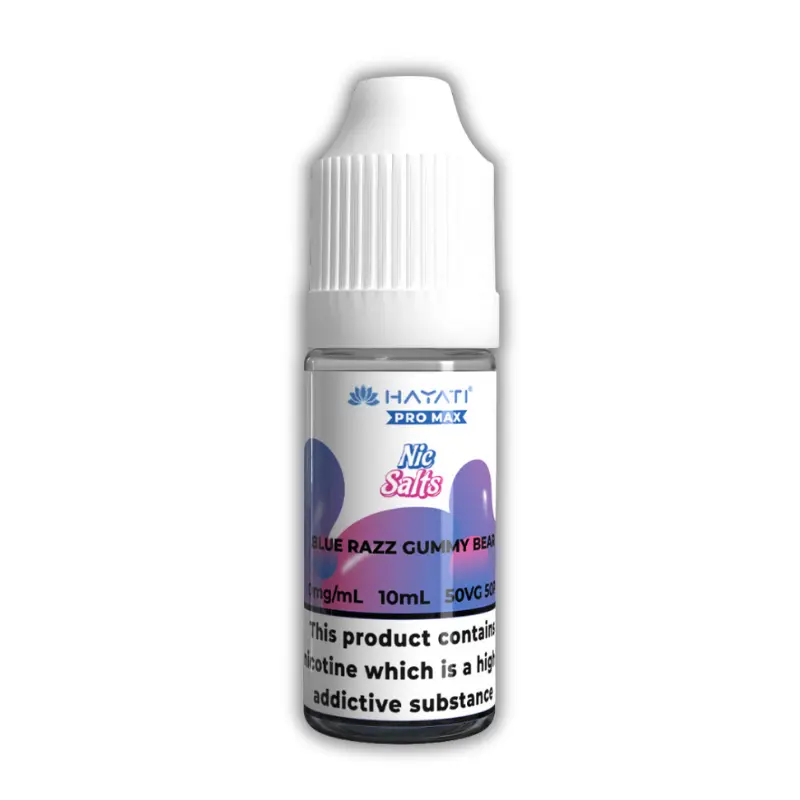
Two pounds forty-nine buys ten millilitres of Blue Razz Gummy Bear as a 10mg nicotine salt on an even glycerine and glycol base. Divide the ticket by the fill and it comes to 24.9p a millilitre, which is lower than any sealed pod Hayati sell this liquid in. That sounds like the headline and it is not, because the number has already been published and the page that published it is the one that had most to lose by doing so.
Our Blue Razz GB Hayati Rubik Pods page built its whole argument on a price floor of 33.25p a millilitre, established across the four prefilled platforms this liquid appears on, and then attached a correction to its own headline: Hayati do bottle a blue raspberry gummy liquid, under the unabbreviated name, and it runs at 24.9p in salt form. Both of those findings are that page's, both are properly argued, and neither is restated here. What that page did not do, because it was not its subject, was establish whether 24.9p and 33.25p are two prices for the same thing. It named two reasons they might not be, gave each a clause, and moved on.
Those two clauses are this page. The first is strength: this bottle is listed at 10mg and every sealed listing of the liquid is at 20mg, so a figure per millilitre is dividing two different goods by the same denominator. The second is the coil, which is a part you buy, fit and throw away on your own money here, and which arrives inside the ticket on every prefilled version. Neither reason is a quibble. Taken together they are enough to stop the comparison meaning what it looks like it means, and the second of them turns out to be something the catalogue cannot price at all, which is a more interesting result than a cheaper number.
So this is a page about a purchase rather than a taste. Twelve pages already sit on this flavour stem and between them they have finished the liquid off. There is nothing left worth saying about how blue raspberry and a gelatine sweet arrive across a draw that is not already said better somewhere else on this site, and the closing section says where.
What is already settled, and by which page
Five arguments about this liquid are closed. Listing them properly at the top is not throat-clearing, it is the reason the rest of the page is allowed to be narrow.
The price floor belongs to the Rubik pods page. It counted sixteen prefilled listings carrying the name Blue Razz GB, ranked all four platforms by cost per millilitre, found 33.25p at the bottom, and then published the bottled correction against itself. Anyone who wants the ladder should read it there. Reproducing it here would be copying, and the arithmetic does not improve by being done twice.
The strength census belongs to the Blue Razz GB Pro Ultra Plus pods page, which sorted all 492 listings by the nicotine figure in their data and found 365 of them at 20mg, a shade under three quarters of everything on the site. It also located the single line in the entire catalogue where Hayati spell out what the GB suffix abbreviates. One line, on one product, on a different fruit.
The naming question belongs to the Gummy Bear Hayati Pro Max Nic Salt, which counted the whole family and found the split runs along format rather than taste: every hardware listing clips the words to two letters, while the bottles mostly do not. That page also records that the tidy version of the explanation fails on inspection. It is a thorough piece of counting and this page takes all of it as read, in one sentence, because a second pass at the spelling would be a worse version of a finished argument.
The puff ladder and the question of what money above the floor actually purchases belong to the Blue Razz GB Pro Max Plus pods page. Its answer, briefly, is that the premium buys access to a platform rather than better liquid.
Coil wear as a handling matter belongs to the two confectionery bottles sitting beside this one at the identical ticket. Strawberry GB Hayati Pro Max Nic Salts sets out what sweetened residue does over a session, and Grape GB Hayati Pro Max Nic Salts gives the specific marker to watch for and the case for rotating rather than persisting. That advice is good, it applies here without amendment, and repeating it would waste the space this page needs. What follows treats the coil as a line in a sum, not as something to look after.
The first reason the comparison fails: one denominator, two goods
A cost per millilitre is a division. Price on the top, volume on the bottom, and a number that lets two formats be ranked against each other when nothing else about them is comparable. It is a genuinely useful operation and half the pricing arguments on this site depend on it. It is also only as honest as the assumption underneath it, which is that a millilitre of one thing is a millilitre of the same thing.
What the two millilitres contain
Here they are not. This bottle carries nicotine at 10mg in every millilitre. Every sealed listing of Blue Razz GB carries it at 20mg. That is not a rounding difference or a variant you select at checkout; it is the whole of the difference between the two figures, and it is fixed by format rather than by choice, because the bottled salt line is listed at 10mg throughout and the prefilled line sits at the legal ceiling throughout.
Run the sum the other way and see what happens to the ranking. Ten millilitres at 10mg is one hundred milligrams of nicotine in the bottle, bought for £2.49, which is 2.49p for each milligram. Twelve millilitres at 20mg is two hundred and forty milligrams, bought for £3.99, which is 1.66p. Measured that way the bottle is not cheaper at all. It is roughly half as much again per milligram, and the ordering that the per-millilitre figure produced has inverted completely.
Stated as a shopping list rather than a rate: to hold the same quantity of nicotine that arrives in one twelve-millilitre sealed pod, this bottle has to be bought twenty-four millilitres deep, which is two and a half bottles and £5.98 rather than £3.99.
Why neither number settles anything
The obvious next move is to declare the milligram figure the correct one and the millilitre figure misleading. That move is wrong, and resisting it is the point.
Nobody buys nicotine by the milligram and nothing on this page suggests they should. Strength is not a quantity to shop for, it is a property of the liquid that you either want or do not, and picking a listing because its concentration flatters a division is a poor reason to pick anything. The milligram sum is not offered as a better guide to value. It is offered as proof that the millilitre sum is not one either, because a comparison whose answer flips when you change the denominator was never measuring a like-for-like thing in the first place.
What the two figures agree on is small and worth holding onto. Both confirm that the gap between formats is real money rather than pennies, and that whichever way you slice it a person buying this liquid week after week is making a choice with a running cost attached. What they disagree on is the direction, and that disagreement is the finding.
Three bottles, three nicotine states, one name
The flavour compounds the point by existing in a third and fourth condition. Blue Razz Gummy Bear is bottled three times over. This one is the 10mg salt. The other two are both 120ml at £6.99 and both carry no nicotine as supplied: the Blue Razz Gummy Bear Hayati Pro Max 50/50 Shortfill E-Liquid on the same base ratio as this bottle, and the Blue Razz Gummy Bear Hayati Pro Max 70/30 E-Liquid on a thicker one intended for different hardware.
Divide either of those by its volume and you get 5.83p a millilitre, a figure so far below everything else that it looks like it ends the argument. It does not, and the Grape GB bottle has already explained why in the cleanest terms: a shortfill is not finished liquid, the nicotine has to be bought and added separately, and the true rate therefore depends on what the shots cost and how many go in. That reasoning is theirs and it stands. The relevant observation here is narrower and it is about what the catalogue is doing rather than what a buyer should do. One flavour name sits at three price points in bottled form, at 10mg, at 0mg and at 0mg again, and the per-millilitre figures run 24.9p, 5.83p and 5.83p. Not one of those three numbers can be compared with another without an adjustment, and the catalogue prints none of the adjustments.
The one place this flavour goes that the rest of its family does not
There is a structural oddity worth recording while the three bottles are on the table. Forty listings make up the 120ml tier, twenty flavours sold in both base ratios. Counting through them, exactly one belongs to the gummy-bear family: this one. Strawberry GB, Grape GB and Red Razz GB are absent from the tier entirely, and so is the plain Gummy Bear.
That is a real finding and it needs narrowing in one respect before it is stated, because the family is spelled two ways. Blue Razz Gummy Bear reaches the large-bottle tier under its unabbreviated name, while the sixteen prefilled listings of the same idea carry the two-letter form. So the precise version is that no GB-labelled name appears in the 120ml tier at all, and the only member of the family that gets there does so under the spelled-out words. Which spelling belongs to which format is settled on the Gummy Bear salt's page and is not reopened here.
The second reason: the coil is a cost this catalogue never prices
The strength mismatch is arithmetic and it can be resolved by anyone with a calculator. The coil cannot, and that is what makes it the more serious of the two objections.
A sealed pod arrives with its heating element already inside it and already wetted. When the element is finished the pod is finished, and both are thrown away together, which means the buyer never sees the element priced because there is no transaction in which it could be priced separately. A bottle is the opposite arrangement. The liquid is sold on its own, the element is a part the owner supplies, and it is consumed on a schedule that the liquid itself determines. Two purchases, one of which the catalogue handles and one of which it does not.
The word appears fifty-five times, and never where it is included
That asymmetry is not a theory about how pod devices work. It is visible in the listing text itself, and the pattern is absolute.
Searching all 492 listings for any mention of a coil returns fifty-five. Every single one of the fifty-five is a bottle. Thirty-six of them are 10ml salts and nineteen are 120ml bottles. Of the 387 listings that are not bottles, which is every prefilled pod and every complete kit on every platform Hayati run, the number that mention a coil is zero. Not a low number. Zero.
Narrow it to this flavour and the split is just as clean. Sixteen sealed listings carry Blue Razz GB, spread across four platforms and eight of them divided pods, and not one of the sixteen refers to a coil in any way. All three bottled listings of Blue Razz Gummy Bear do.
The reason is not mysterious. A listing mentions the part when the reader has to deal with the part, and stays quiet when the part is already inside the price. But the consequence is exactly the one that matters for a pricing comparison. On one side of the ledger the consumable is invisible because it has been paid for. On the other it is visible because it has not.
What Hayati say about it on this flavour, three times over
The three bottled listings of Blue Razz Gummy Bear each carry a warning about the coil, and they do not use the same words. This bottle's own copy says sweet liquids of this kind will build up on the element over time and advises changing it once the flavour dulls rather than continuing. The 50/50 shortfill says sweeter liquids shorten coil life and gives the same signal to act on. The 70/30 bottle is blunter, noting that sugar fouls an element faster at higher power and telling the reader to keep spares in.
Three separate pieces of copy, written for three separate listings of one flavour, independently arriving at the same instruction. On a site where the same descriptive vocabulary gets recycled across dozens of products, three out of three is about as close to a manufacturer position as the data gets: Hayati regard this liquid as hard on elements and say so every time they sell it in a form where the buyer pays for them.
Not one of the three attaches a figure. No interval, no millilitre count, no price, no indication of how much faster than what. The warning is unanimous and entirely unquantified.
Nothing in 492 listings publishes a resistance
The obvious way to put a number on it would be to start from the element the liquid is meant for. That route is closed, and it is closed across the whole catalogue rather than on this listing alone.
No listing on this site publishes a coil resistance. Searching every field of all 492 entries for a resistance value returns nothing at all. The only place the unit appears is inside the compound term for a low-resistance setup, on fifty-three listings, and it is always used to sort devices into two rough classes rather than to state a figure. Where the copy gets more specific it does so comparatively, not numerically: bottles on this base ratio are described as wanting a higher-resistance element on a restricted draw, and the thicker 70/30 bottles as wanting a lower-resistance one. Higher and lower than what is never said.
The catalogue also does not sell the part. No listing has the word in its title, and there are no elements, no spare pods for refillable hardware, no tanks and no separate device accessories anywhere in the 492. The Quokka entries are the only refillable products on the site and they arrive empty rather than with a priced consumable attached.
So the position is this. The catalogue asserts, on every bottled listing of this flavour, that the liquid will shorten the life of a part. It does not say which part, at what resistance, lasting how long, or costing how much, and it does not stock it. Every term needed to convert the warning into money is missing.
The honest conclusion, which is that the figure does not exist
It follows that the true running cost of this bottle is not computable from anything published here, and no page on this site should pretend otherwise. An effective rate could be invented easily enough by assuming a typical element price and a plausible interval, and the resulting figure would look authoritative and would be worth nothing, because both inputs would have come from the writer rather than from the data.
That is the same failure the range has already recorded elsewhere in a more damaging form, where pages reasoned from a product name to a physical specification and then stated it in the same voice they used for the price. A fabricated running cost is the pricing version of the same mistake. The number would be repeated, it would acquire authority by repetition, and it would be based on nothing.
What can be done instead is to give the reader the sum with the unknowns left as unknowns, and to say precisely how much room there is before the answer changes. That is the next section, and it is the useful part of this page.
The sum you can run, since the catalogue cannot run it for you
Two inputs are missing and both of them are things a person already knows about their own setup. What an element costs them, and how much liquid they get through before they change it. Supply those and the arithmetic is one line.
Effective cost per millilitre equals 24.9p plus the price of an element in pence divided by the number of millilitres that element sees before it is retired. Nothing else goes into it. The liquid term is fixed and published, the hardware term is personal and is not.
How much room there is before the answer changes
The interesting version of that sum is not the total, it is the threshold. The cited floor for this liquid in sealed form is 33.25p a millilitre and this bottle starts at 24.9p, so there are 8.35p of headroom in every millilitre before the bottled route stops being the cheaper one on that measure.
Turn 8.35p into the thing a person actually controls and it becomes a minimum yield per element. An element has to cover its own price out of that headroom, so the volume it must see before retirement is its price divided by 8.35p.
| What an element costs you | Millilitres it must last to stay under 33.25p | In whole bottles of this liquid |
|---|---|---|
| £1.00 | 12ml | a little over one |
| £1.50 | 18ml | under two |
| £2.00 | 24ml | two and a half |
| £2.50 | 30ml | three |
| £3.00 | 36ml | three and a half |
Read the right-hand column rather than the middle one, because bottles are the unit anybody actually counts. At two pounds an element, this bottle holds its advantage as long as one element gets you through two and a half bottles. At three pounds it needs to manage three and a half. Those are not extreme requirements and they are not trivial ones either, and which side of them a sugary liquid lands on is genuinely uncertain rather than obviously fine.
Two things this table is not. It is not a claim about what elements cost, because this site does not sell them and quoting a price from elsewhere would be inventing a fact. And it is not an argument that the bottle wins or loses, because the threshold is set against a figure that has already been shown, higher up this page, to be measuring something else. It is a way of seeing how much of the apparent saving is uncommitted, which is the honest answer: somewhere between all of it and none of it, depending on a number only the buyer has.
Why a confectionery build is exactly where this matters
Every 10ml salt in the Hayati line is £2.49 apart from one generic entry, so the liquid term in that sum is identical across sixty-four bottles. The hardware term is not identical, and the thing that moves it is sugar.
A heavily sweetened liquid leaves more behind on an element than a lean one does, and it does it at the same rate whether the flavour is blue raspberry, grape or bubblegum. That is why the bottles that carry a coil warning in their own copy skew towards the sweet end of the range, and why this particular argument is worth making on a confectionery listing rather than on a plain fruit. The gap between 24.9p and an effective rate is widest precisely where the headline figure looks most attractive, because the profiles people buy for their sweetness are the profiles that spend the headroom fastest.
The corollary is uncomfortable and worth stating. The cheapest-looking way to buy this flavour is the one whose true cost is least knowable, and the most expensive-looking way is the one whose cost is fixed at the till and cannot move. A sealed pod has no variance in it. Whatever it costs per millilitre, that is the whole of it, and nothing about your habits or your hardware changes the figure afterwards. A bottle hands you a lower number and an open question.
Getting your own figure, which takes one bottle
The missing input is measurable and the measurement costs nothing beyond paying attention once. Fit a fresh element, note the date, and use the bottle through to the end without swapping in anything else. When the flavour flattens in the way the Grape GB page describes, count how many bottles went through. That count, multiplied by ten, is your millilitres per element, and it converts the table above from a general question into your specific answer.
Do it once and the figure is good for every sweet bottle on the shelf, because the variable being measured is the interaction between a sugary liquid and your hardware rather than anything specific to blue raspberry. Do it on a plain fruit as well and the difference between the two numbers is the actual price of buying confectionery, expressed in pence per millilitre, which is a figure no page can give you and every buyer of this shelf would benefit from having.
One warning about the method. It only works if you run the bottle through one element from start to finish, which means resisting the temptation to change flavours halfway. Rotating between two liquids is good practice for the palate and it ruins the measurement, so take the reading first and rotate afterwards.
Specifications
Everything below comes from this listing. Where Hayati publish nothing, the row says so rather than borrowing a figure from a neighbouring product, which is a habit that has already put wrong numbers on pages elsewhere in this range.
| Listing | Blue Razz Gummy Bear Hayati Pro Max Nic Salt |
|---|---|
| Stock code | HPM-NS-BLUE-RAZZ-GUMMY-BEAR |
| Maker | Hayati |
| Ticket price | £2.49 |
| Cost per millilitre, liquid only | 24.9p |
| Cost per millilitre, in use | Not computable from published data |
| Volume | 10ml |
| Nicotine | 10mg in every millilitre, as a salt |
| Nicotine in the bottle | 100mg |
| Base | 50/50 glycerine to glycol |
| Profile | Blue raspberry with a gelatine-sweet confectionery character |
| Cooling | None listed |
| Element supplied | No, and none is stocked here |
| Element resistance suited | Higher resistance, restricted draw. No figure published |
| Filed under | Hayati Pro Max Nic Salts, Hayati E-Liquids, Sweet Vapes, New Products |
Three of those rows are unusual and each one is deliberate. The cost-in-use row is blank on purpose and the reasoning is set out above; a page that filled it in would be guessing. The row for the element being supplied exists because its absence is the entire pricing argument, and no spec table in this range has previously named a part that is not in the box. The resistance row states the direction without a figure because the direction is all the catalogue gives, on this listing and on the other 491.
The nicotine rows are worth reading as a pair. One hundred milligrams is the contents of the bottle and 10mg is the concentration, and the two get conflated constantly in pricing arguments. Only the second one describes what a draw is like. The first is purely an accounting quantity and appears here because the section above needed it. Nicotine is addictive.
The base ratio is the one row that does double duty. An even split of glycerine and glycol is thin, which is why the liquid suits small high-resistance elements and a narrow draw, and thin liquid also reaches a wick faster than a thick one does. On the sugar question that cuts both ways and the catalogue does not resolve it, so no claim is made here about whether this ratio is gentler on an element than the 70/30 version of the same flavour.
Choosing on a shelf where every ticket is identical
Sixty-four of the sixty-five 10ml salts Hayati list are £2.49. Price cannot separate them, and since the liquid term in the running sum is the same for all of them, the only cost that varies between one bottle and the next is the one attached to sugar. That gives a way of ordering the shelf that is not about taste, and it is the one this page can offer that the flavour pages cannot.
The bottles that spend the headroom fastest
The confectionery corner is where the coil term is largest, and this bottle sits in the middle of it. Strawberry GB and Grape GB are the direct equivalents, the same gelatine-sweet treatment on a red fruit and on a grape, and both pages are worth reading before choosing between the three because they do the tasting work properly. The plain Gummy Bear is the one with no fruit named at all, which makes it the odd entry in the family and the subject of its own investigation.
Push further into sugar and the running cost goes with you. H'Bubba Hayati Pro Max Nic Salt is a bubblegum-register bottle whose name gives away less than most, Bubblegum Ice Hayati Pro Max Nic Salt puts a coolant over the same idea, and Strawberry Watermelon Bubblegum Hayati Pro Max Nic Salt stacks two fruits on top of it. Rainbow Hayati Pro Max Nic Salt is the mixed-sweets entry rather than a single confection. None of those is a lighter load on an element than this bottle and several are heavier.
Staying blue, changing the build
If blue raspberry is the part you want and the confectionery framing is not, two bottles keep the fruit and drop some of the sugar. Mr Blue Hayati Pro Max Nic Salt is the one whose name tells you nothing and whose page has to work that out. Blue Razz Mojito Hayati Pro Max Nic Salts keeps the same berry and puts citrus and a thread of mint against it, which is a different proposition on the running-cost question because an acid or a coolant gives the palate something to reset against and tends to go with a leaner build. Berry Lemonade Hayati Pro Max Nic Salt does something comparable with a carbonated register.
The fruit bottles, where the headroom lasts longer
Moving out of the sweet shop is the single largest change you can make to the second term in the sum, and the shelf has plenty of it. Triple Mango Hayati Pro Max Nic Salt and Juicy Peach Hayati Pro Max Nic Salt are stone fruits carrying their own sweetness rather than an added confectionery layer. White Peach Raspberry Hayati Pro Max Nic Salts and Blackberry Raspberry Hayati Pro Max Nic Salts pair fruits that bring acid with them.
The three-fruit blends go further in the same direction. Blueberry Cherry Cranberry Hayati Pro Max Nic Salt and Strawberry Cherry Cranberry Hayati Pro Max Nic Salts both put cranberry in the mix, which is the least sweet fruit anywhere in this line, and Kiwi Grape Raspberry Hayati Pro Max Nic Salt leads on a fruit that is sharp before it is anything else. Black Mamba Hayati Pro Max Nic Salts is another of the listings named for an impression rather than an ingredient, so what it does to an element is as unpublished as what it tastes of.
The rotation partners, which are a cost lever as much as a palate one
Keeping a second bottle on the go is usually recommended for the sake of the palate, and on a sugary liquid it also changes the arithmetic, because millilitres drawn through the element from something lean are millilitres that are not adding residue. Fresh Mint Hayati Pro Max Nic Salt is the plainest of those, Black Mint Hayati Pro Max Nic Salt the darker reading of the same idea.
Be honest about the size of the effect though. Alternating does not make an element last twice as long, because the residue that has already built up does not come off, and the benefit is real but modest. The reason to rotate is that the flavour stops registering long before the element is finished, which is the Grape GB page's point and a better argument than this one.
Changing the format instead
Two of the exits from this whole question involve buying the flavour differently rather than buying a different flavour. The 120ml bottles, linked above, move the liquid term far enough down that the element term dominates completely, at the cost of a mixing step and a wait. The sealed pods move in the other direction and remove the element from your accounts entirely, at a per-millilitre price the Rubik pods page has already laid out platform by platform.
Neither of those is available on the same shelf as this bottle, so a note on where to look. Hayati Pro Max Nic Salts holds all sixty-five of the 10ml salts. Hayati E-Liquids is the wider shelf of one hundred and five bottles and is where the large-format versions live alongside the small ones. Sweet Vapes collects the sixty-one listings filed for sweetness across every format, which makes it the closest thing the site has to an index of the liquids this page's argument applies to. New Products and the full Hayati range both carry all 492.
Living with a bottle whose running cost you set yourself
Handling advice for a sugary salt is covered thoroughly on the two bottles beside this one and there is no reason to write it again. What is not covered anywhere is how to manage the part of the cost that is yours, so this section sticks to that and leaves the rest where it already is.
Retiring an element on the right signal
Money is lost at both ends of an element's life. Change it too early and the unused portion of its yield is thrown away, which pushes the second term of the sum up for no benefit. Run it too far and the liquid going through it stops tasting the way it should, so the millilitres are consumed without delivering what they were bought for, which pushes up the effective cost of the liquid instead. Both errors show up in the same figure.
The signal to act on is the flavour thinning while the sweetness stays, which is the marker the Grape GB page identifies and it behaves identically here because the underlying mechanism is the same. The blue raspberry is the fragile half of this pairing and the sugar is the durable half, so what you notice is not the liquid getting weaker but getting flatter, with the fruit edge going first and a broad sweetness left behind. That moment is the economically correct one to change, not the later moment when things turn harsh.
Keeping the record that makes the sum work
One line in a note on your phone is enough. Date the element went in, number of bottles through it, date it came out. After three or four cycles you have an average that is worth more to you than any figure this page could print, because it is measured on your hardware at your draw length rather than assumed.
The same record answers a question the catalogue certainly cannot, which is whether this flavour is harder on an element than the other sweet bottles you buy. Hayati assert that it is hard on one, three times over, and assert nothing about how it compares with its neighbours. Your own numbers settle that in a month.
The last two millilitres
Ten millilitres is a small bottle and the final fraction of it is where a surprising amount of money goes missing, not because of anything exotic but because a bottle that is nearly empty is easy to leave in a drawer while a full one gets opened. Liquid that is never drawn was bought at 24.9p a millilitre and delivered nothing, which is a worse outcome than any element ever inflicts. Finishing a bottle before starting another is the single cheapest habit available on this shelf and it costs nothing at all.
Storage follows from the same thought rather than from a general rule. The reason to keep this one closed, upright and out of warmth is that the fruit note is the part that fades on standing, and a bottle whose blue raspberry has gone flat before it was ever used is a bottle that will be finished without being enjoyed. The sugar keeps perfectly well. It is the half you were not paying the premium for.
What a part-used bottle is worth
A bottle you have decided against is not a total loss in the way a part-used sealed pod is, and that asymmetry is worth naming because it runs the other way from everything else on this page. Liquid left in a pod is discarded with the pod and cannot be recovered. Liquid left in a bottle can be mixed into something else on the shelf, given away, or simply kept until the mood returns, because the container it is in is not attached to a piece of hardware with its own clock running.
That is a real advantage of the format and it partly offsets the element cost. It is also the reason the flavour risk is lower here than on a twelve-millilitre sealed pod of the same liquid, where deciding you dislike it halfway through means paying for the other half regardless.
Questions this listing raises
Is this actually cheaper than the sealed pods of the same flavour?
On liquid alone, yes: 24.9p a millilitre against a floor of 33.25p for the prefilled versions, a figure established on the Blue Razz GB Rubik pods page. In use the answer depends on two things that are not published, the price of an element and how long one lasts you on a sweet liquid. There is 8.35p a millilitre of room to absorb that before the advantage disappears.
Why can you not just tell me the real cost per millilitre?
Because two of the inputs do not exist in any published form. No listing on this site states a coil resistance, no elements are sold here, and none of the three bottled listings of this flavour attaches a figure to its own warning about coil life. Any total would be built on numbers invented for the purpose, and inventing specifications is how this range has previously ended up with pages contradicting each other.
Is the 10mg here the same as the 20mg in the pods?
No, and that is the reason the two prices per millilitre are not directly comparable. This bottle holds one hundred milligrams of nicotine in total and a twelve-millilitre pod at 20mg holds two hundred and forty. Matching the pod's content from this bottle takes twenty-four millilitres and £5.98. Nicotine is addictive.
So which figure should I be using, per millilitre or per milligram?
Per millilitre, because that is the thing you consume. The milligram sum appears on this page only to demonstrate that the ranking reverses when the denominator changes, which is what proves the comparison between a bottle and a sealed pod is not like-for-like. Strength is not something to shop for by price and nothing here suggests otherwise.
Will this flavour wreck an element faster than a plain fruit?
Hayati say it is hard on one, on all three of their bottled listings of this flavour, and never say by how much. Sweetened liquids generally leave more residue than lean ones, which is why the warning sits on sweet bottles and not on the others. The honest answer on the size of the effect is that it is not published and your own record over a few elements will tell you more than any page can.
How do I work out my own millilitres per element?
Fit a fresh one, run this liquid and nothing else through it, and count the bottles until the fruit thins out while the sweetness holds. Multiply the bottle count by ten. That figure divided into the price of an element gives you the second term of the sum, and adding it to 24.9p gives you your real rate.
Is there a larger bottle of this flavour?
Two, both 120ml at £6.99, both supplied without nicotine. The 50/50 shortfill is on the same base ratio as this bottle and the 70/30 is thicker and intended for different hardware. Their headline rate of 5.83p a millilitre does not include the nicotine that has to be added, and the Grape GB bottle's page sets out why that makes the true figure a different calculation again.
Why is this called Blue Razz Gummy Bear when the pods say Blue Razz GB?
The split runs along format rather than meaning, with hardware listings using the two-letter form and bottles mostly spelling it out. The plain Gummy Bear salt's page counts the whole family and works through what does and does not explain the pattern, including an explanation that looks tidy and fails. It is settled there and not reopened here.
Are the bottle and the pods the same recipe?
Not published either way, and no page on this site should claim it. The Rubik pods page sets out the circumstantial evidence, which is that Hayati describe both in the same confectionery register, and stops short of asserting they are one liquid. A buyer who needs the answer is choosing between an unverifiable guess and a sealed pod.
Is there any cooling in it?
None is listed. This is a sweet blue raspberry with a gelatine-sweet character over it and nothing cold running underneath, which is worth knowing because several neighbours on the same shelf do carry a coolant and the bottles are otherwise hard to tell apart on a listing. If you want the coolant, the mint bottles and the iced fruits are where to look.
What hardware is a 10ml bottle on this base ratio meant for?
An even glycerine and glycol split is thin, so it wicks into small high-resistance elements on a restricted draw, which in practice means refillable pod systems and low-output mouth-to-lung tanks. Hayati do not publish a resistance figure for this or for any of the other 491 listings, only the direction. A low-resistance direct-lung setup is the wrong match for a 50/50 salt.
Does the flavour last as a daily bottle?
It is a constant sweetness with no acid or coolant holding it in check, so across a long session it flattens out the way confectionery profiles generally do. Most people who keep it keep it alongside something leaner rather than on its own. That is a palate judgement rather than a cost one, and the Strawberry GB page covers it properly.
The short version
Ten millilitres of a candy-register blue raspberry, 10mg as a nicotine salt, on an even glycerine and glycol base, for £2.49. As liquid that is 24.9p a millilitre and it sits below the 33.25p floor that our Rubik pods page established for the sealed versions of the same flavour, a figure that page published itself alongside the correction that made it necessary.
What this page adds is that the comparison does not survive inspection. The two sides carry different nicotine concentrations, so the ranking inverts if you divide by content instead of volume. And one side includes a consumable part in its ticket while the other leaves it to the buyer, a difference the catalogue makes visible without ever pricing it: the word appears on fifty-five listings, every one of them a bottle, and on none of the 387 listings where the part comes in the box. No resistance figure is published anywhere in the range and no elements are stocked, so the real running rate cannot be worked out from this site by anybody, and a page that printed one would be making it up.
What can be said is how much room there is. There are 8.35p in every millilitre between this bottle and the sealed floor, and an element has to earn its own price out of that: about twenty-four millilitres of yield at two pounds, thirty at two-fifty. On a confectionery build, which is what this is, that is a real question rather than a formality. Take the measurement once on your own hardware and the question is answered permanently.
Strictly for adults aged 18 and over. Nicotine is an addictive substance.
You might also like


