
Home / Hayati Pro Max Nic Salts / Kiwi Grape Raspberry Hayati Pro Max Nic Salt
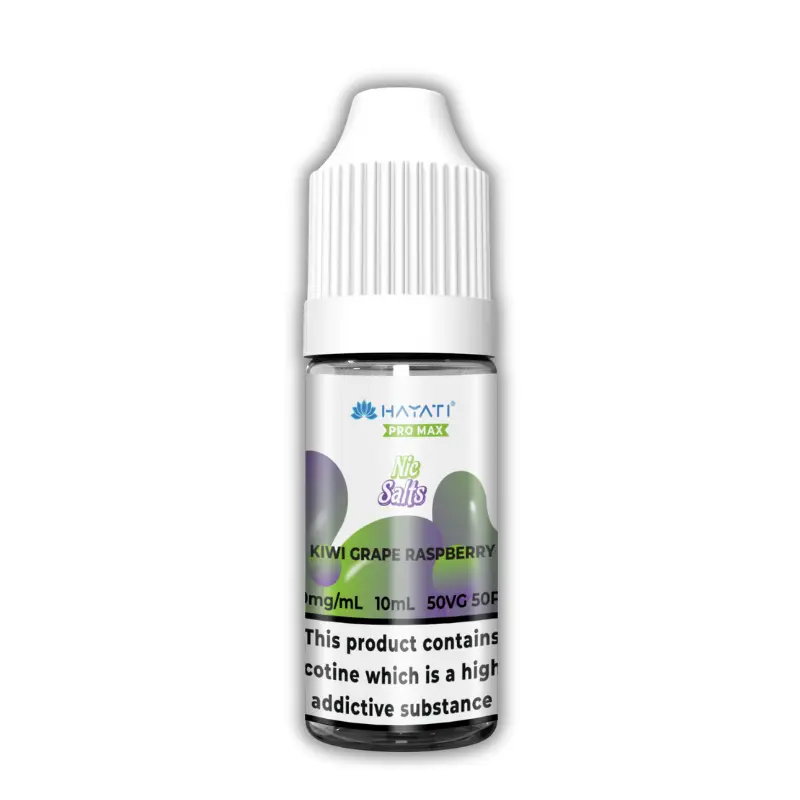
Hayati · Pro Max
Kiwi Grape Raspberry Hayati Pro Max Nic Salt
£2.49
✔ In stock — ready to ship
Genuine Hayati
Free over £20
Same-day dispatch
Secure checkout
Kiwi Grape Raspberry is a 10ml bottle of nicotine salt from Hayati's Pro Max line, listed at £2.49, mixed at 10mg in an even split of vegetable glycerine and propylene glycol, and filed under the SKU HPM-NS-KIWI-GRAPE-RASPBERRY. Three named fruits, no cooling word anywhere on it, and no hardware in the purchase. Read the specification alone and it looks like the eighth or ninth bottle you could lift off the Hayati Pro Max Nic Salts shelf without anything changing.
The reason to stop on it is not the recipe. It is that this listing is the only place in Hayati's 492 products where the recipe occurs. Not the only bottle of it, the only listing of it: no prefilled pod carries this blend, no kit carries it, no larger bottle carries it, and no second strength of it is sold. One recipe, one format, one nicotine figure, one class of device that can accept it. If you own prefilled hardware and nothing else, there is no route to this liquid at any price.
That is a smaller club than it sounds and a larger one than I was told. The range-level Hayati Pro Max Nic Salts E-Liquid page has already counted the bottled shelf properly and established the arithmetic this page leans on: 65 listings, every one of them a 10ml bottle at 10mg in a 50/50 base, 64 distinct flavour names between them, and fifteen of those names available in no other format. That work is done and none of it is repeated here. What that page did not do, because it was answering a different question, is ask how many of the fifteen are single listings rather than merely bottle-only. Two of them are not. The answer is thirteen, and the count is set out below because a claim of this shape is worth nothing unless somebody has added it up in front of you.
So the page has a job that most pages on this site do not. There is one published description of this liquid in existence, written once, and no sibling listing to read it against. Everything below separates what that single description actually commits to, what a count of the catalogue adds to it, and what remains genuinely unknown until somebody fills a pod.
Thirteen recipes with one listing each, and why this one is in the set
The angle handed to me said eleven, and named ten companions. Counting says otherwise in both directions, and the corrected version is the stronger one, so it is the version on this page.
What the count actually returns
Take the 65 bottles on the nic salt shelf. Resolve each one to its recipe rather than its title, split every dual-flavour listing into the two recipes it contains, and then ask which of those recipes appear nowhere else in the catalogue's 492 listings. Fifteen names come back, which is exactly the figure the range-level page publishes, so the two counts agree and there is no dispute to settle.
Now apply a second filter, which is the one that matters here. Bottle-only is not the same as one listing. Two of the fifteen are sold three times over: Rainbow and Blue Razz Gummy Bear each exist as this 10ml salt and again as a 120ml bottle in both the 70/30 and the 50/50 shortfill lines. A buyer who wants either of those has a second bottle size available and a second nicotine figure, because the large bottles are listed at 0mg. They are bottle-only, but they are not singular, and the distinction is the whole of this page's contribution.
Strip those two out and thirteen recipes remain, each of which appears exactly once in 492 listings: Black Mint, Bru Ice, Bubblegum Ice, Fresh Menthol Mojito, Gummy Bear, Kiwi Grape Raspberry, Lemon Peach Passionfruit, Menthol, Mr Pink, Red Berry Ice, Strawberry Jelly Beans, Strawberry Mojito and Tobacco. Thirteen out of 492 is a shade over two and a half per cent of everything Hayati sell here.
Where the brief was wrong, in both directions
Two corrections are worth recording rather than quietly absorbing, because a rarity figure that circulates unchecked is how a wrong number becomes a house fact.
The list I was handed left out Tobacco, Menthol and Gummy Bear. All three belong. It is easy to see why they look excludable: Smooth Tobacco exists on the Pro Max Plus platform, Double Menthol and Spearmint exist there too, and the gummy bear idea is all over the range in the GB suffix on Grape GB, Strawberry GB and Blue Razz GB. But a near neighbour is not the same recipe. Smooth Tobacco is a different listing with a different name and its own description. If the test is whether you can buy this exact recipe another way, all three pass it, and leaving them out would have understated the set.
The list also included Apple Mint Grape, which does not belong. Apple Mint Grape is sold prefilled, as one half of the divided pod on the Pro Ultra Plus Shisha 30000, which appears both as a pods listing and as a complete kit. The slip is instructive: the bottled version is titled Hayati Pro Max Shisha Nic Salts, with no fruit in the title at all, so a search by name finds nothing and a reader would reasonably conclude it stood alone. The recipe is in the data even though it is absent from the title. Anyone counting from titles rather than from recipe fields will get this one wrong, and I nearly did.
Eleven becomes thirteen, then, and one of the original ten names drops out. Nothing about the argument gets weaker for that. It gets sharper, because three of the additions are single-note recipes with no fruit in them at all, which makes the two three-fruit blends in the set stand out further than they did at eleven.
The consequence, which is not about scarcity
Rarity on a retail shelf is usually a marketing noise word and it is worth being clear that it buys the reader nothing here. This bottle costs the same £2.49 as almost every other listing on the shelf. Nobody is charging a premium for a recipe that exists once, there is no limited run to speak of, and the flavour is not better for being uncommon. Scarcity in this catalogue is a filing outcome, not a value.
What it does change is the shape of the decision, in two specific ways.
The first is access. The Vimbull Ice 70/30 page put the mechanism plainly when it noted that no prefilled product in this range will take liquid from a bottle and no bottle will do anything without a refillable device. That is the ordinary state of affairs and for the other 54 recipes on this shelf it is a mild inconvenience, because most of them also exist as sealed pods and you can arrive at the same liquid from either side. For these thirteen there is no other side. The format is not a preference you express, it is a gate you either pass or do not. Somebody running only sealed hardware is not choosing against this bottle. They are not being offered it.
The second is strength. The range-level page records that the whole shelf sits at one concentration, and that fact does different work depending on which recipe you are looking at. For a recipe with prefilled twins it only constrains the bottled route, because the pods on other platforms carry their own figures and a buyer who wants the same flavour at a different strength can cross formats to find it. For these thirteen the single figure is the entire published range. 10mg per millilitre in salt form is not the bottled option for Kiwi Grape Raspberry. It is the only number attached to this recipe anywhere in Hayati's catalogue. Nicotine is an addictive substance and the figure is printed so it can be read rather than as a recommendation, but it is worth knowing that on this particular liquid there is nothing else published to compare it against.
Narrowing it to what is actually particular
Being one of thirteen is a real fact and a blunt one. Three things narrow it usefully, and all three survive counting.
Of the thirteen, exactly two are three-fruit blends: this one and Lemon Peach Passionfruit. The other eleven are single notes, two-part constructions or confectionery ideas. That pairing is worth holding on to, because the two of them are the only places in the catalogue where Hayati have built a three-fruit recipe and then sold it precisely once.
Widen the frame to the shelf and the contrast gets cleaner. Eight of the 65 bottles are three-fruit blends. Six of the eight are sold between three and seven times over across prefilled platforms and larger bottles: Strawberry Raspberry Blueberry, Blueberry Raspberry Lemon, Strawberry Cherry Cranberry, Blueberry Cherry Cranberry, Mango Peach Pineapple and, at the far end, Blueberry Cherry Cranberry again at seven listings across four formats. Two are sold once. Hayati evidently commit to a three-fruit construction when they intend to roll it out, and these two were not rolled out.
And this is the only one of the thirteen built on kiwi, which follows from the fact that it is the only one built on any green fruit at all. That last point connects to a count that is not mine and is not re-derived here: the Strawberry Kiwi Rubik kit page worked through the kiwi census in detail, established that kiwi appears in twelve of the 492 listings across five recipes, and placed it joint seventh of fifteen acid-bearing fruits by recipe count. Scarcity is not what makes kiwi interesting, that page concluded, concentration is. What this bottle adds to that census is a smaller and sharper observation: it is the only listing in the whole catalogue that sits on both the Kiwi Vapes shelf and the Grape Vapes shelf, and the only one on both Grape Vapes and Exotic Vapes. Nineteen grape listings, twelve kiwi listings, and exactly one product in the intersection.
One description, and how much weight it can carry
Most pages on this site have an advantage that this one does not. When a flavour is sold five or seven times over, Hayati write fresh copy for each listing, and lining those descriptions up against each other is the closest thing to independent testimony available without opening a bottle. A property every listing asserts is close to a fact. A property one listing asserts alone is either the most interesting thing on the page or a copywriting variant, and saying which is real work.
None of that is available here. There is one description, written once, and it is the entire published record of what this liquid tastes like. No second pass, no other platform's copy, no disagreement to interpret. That is worth stating plainly rather than writing around, because it changes how confidently anything below can be said.
What the description does commit to
Three things, and they are worth separating because they are not equally solid.
It sorts the fruit by colour. The opening line describes the blend as mixing green, purple and red, which is a striking choice, because colour is a property of a kiwi you can see and not a property of a kiwi you can taste. It then assigns each fruit a role in turn: kiwi first, arriving tangy and sharp; grape second, filling the middle with a rounder sweetness; raspberry third, adding a berry tartness that pulls the other two together. And it makes one claim about the experience over time, which is that the fruits take turns rather than one of them dominating, so a full pod stays interesting rather than flattening out.
That is the whole of it. No cooling is mentioned and no cooling word appears in the title, which on this range means there is none. The Blue Frozen pods page settled the cooling vocabulary question for the whole catalogue by counting it, finding that Hayati's cooling words are not graded and that the presence of one on a title is a yes or no rather than a measurement. The corollary is the useful part here: their absence is also reliable, because Hayati do put a temperature word in a title when a liquid contains coolant. Expect this at room temperature throughout.
The colour sentence, and what it is really doing
Seventeen of the 492 descriptions in this catalogue reach for a colour word. Most of them are doing it because the product name forced them to: the Mr Blue listings, Blue Fusion, Mr Pink and Rainbow have no fruit in their titles at all, so colour is what the copy has left to work with. Strip those out and colour becomes rare.
Two other three-fruit listings on this shelf use it. Strawberry Cherry Cranberry opens by calling its three fruits red, and Blueberry Cherry Cranberry opens by calling its three deep-coloured. In both cases the colour is a grouping: one adjective covering all three, used to say these fruits belong together. Kiwi Grape Raspberry is the only listing in the catalogue that gives each named fruit its own separate colour, and that inverts the purpose entirely. Three different colours in one sentence is not saying these belong together. It is saying, without quite saying it, that they do not.
Which is a fair description of the problem the blend sets itself. Strawberry Cherry Cranberry is three red fruits and Blueberry Cherry Cranberry is three dark ones, so both have a family to sit in and the copy can say so in a word. Kiwi, grape and raspberry share nothing obvious: a green tropical, a purple confectionery-adjacent fruit and a red berry, drawn from three different parts of the range. There is no single adjective that covers them, and the writer reached for the one dimension on which the three can at least be listed in an orderly way. Read like that, the colour sentence is genuinely informative, though not about taste. It is a signal that the blend has no family, which is the actually unusual thing about it and the thing that makes it hard to place on a shelf sorted by fruit type.
Why the running order carries less weight than it looks like it does
The description walks the fruits in the order the title prints them, and it is tempting to read that as a claim about the draw. Two things argue against taking it at face value.
The first has been settled elsewhere and is not re-argued here. The Strawberry Raspberry Cherry kit page tested whether Hayati's name order predicts which fruit reaches you first, found the same three fruits printed in two different orders on two platforms, and concluded the convention is not enforced. The Cherry Peach Lemon pods page reached the same destination from the chemistry side, pointing out that what arrives first is decided by how quickly a compound leaves a coil rather than by anything on the label.
The second is mine, and it comes out of reading all eight of the shelf's three-fruit descriptions together rather than reading this one alone. Every one of the eight uses the same template. Fruit one is introduced as the opener or the anchor, fruit two fills the middle or adds depth, fruit three supplies the edge, the bite, the lift or the finishing touch. Strawberry sets the tone and cranberry keeps it honest. Blueberry softens and cranberry gives it bite. Blueberry provides, raspberry adds, lemon is the finishing touch. Lemon sparks, peach smooths, passionfruit brings the distinctive element. Eight for eight, in title order, every time.
That is a copywriting pattern, not eight independent observations about eight liquids. It means the sentence assigning kiwi the opening and raspberry the finish is the sentence that would have been written whatever the fruits did, and it should be treated as structure rather than as evidence. On a flavour with seven listings you could test the pattern by finding the listing that breaks it. Here there is nothing to test it against, which is the practical cost of being one of thirteen and the reason this page spends longer than usual on what is knowable and what is not.
The draw, taken slowly
What follows is a reading of the liquid rather than a transcription of the listing, and where it is inference it says so. No prior page describes this recipe, so there is nothing to defer to and nothing to contradict.
Answering a characterisation this blend has already been given
One sentence about this product already exists elsewhere on the site. The Strawberry Kiwi Rubik kit page, working through the five kiwi recipes, described this one in passing as burying the fruit in a three-fruit nic salt. It is a reasonable reading and it deserves an answer rather than a polite silence.
The arithmetic behind it is sound. Kiwi is one fruit of three here against one of two in Strawberry Kiwi, so on share of the recipe it has less room. Kiwi is also the quietest of the three by temperament: grape flavouring is loud and raspberry is aromatic, and a soft green fruit between them has work to do.
What cuts the other way is that Hayati's own copy puts kiwi at the front of the draw, which is not where you place something you have buried, and the name puts it first as well. Across the twelve kiwi listings, kiwi leads the title five times, and this is the only one of those five where it leads a three-fruit name rather than a solo or a pairing. So the listing's own framing treats kiwi as the lead rather than the filler.
Both readings cannot be right and the honest position is that the evidence is thin on each side. The Rubik page was reasoning from proportion, which is real. The listing is reasoning from sequence, which is a template artefact as established above. My reading, tagged as inference, is that both are partly true and that they describe different halves of the same fruit. Kiwi contributes two separable things: an acid, and a green vegetal character. The acid is loud enough to lead a draw that has grape in it. The green is not, and it is the half that gets buried.
Kiwi at the front
The Kiwi Cooler pages established the structural point about this fruit, which is that its tartness is not applied on top of a sweet base but built into the fruit itself, so sweetening a kiwi does not soften it, it removes it. That finding is theirs and the mechanism is not rebuilt here. What matters for this blend is the consequence: a kiwi sitting in a sweet three-fruit mix does not turn into a mild kiwi. It either holds its acid or it stops registering as kiwi at all.
On a short, brisk draw that is exactly the fork you land on. Pull hard for a second and what arrives is a general fruit sharpness with no address, and you would not identify the source if you were not told. Draw slowly and keep it short and there is a distinct order to it: a tightening at the sides of the tongue arrives fractionally before any sweetness does, and it has a thinner, more watery quality than a berry acid, which tends to arrive with fruit already attached to it. That thinness is the clearest signature kiwi has in this blend.
The green note is the other half and it is much harder to find. The Strawberry Kiwi kit page documented both the route and the vocabulary: it reaches you through the nose on the exhale rather than on the tongue, and every one of Hayati's twelve kiwi listings names it, which that page showed is unusual behaviour for a descriptor in this catalogue. On this recipe my reading is that it is quieter than on any of the other four kiwi blends, and the reason is specific. Sweetness masks green notes efficiently and masks acid poorly, and this liquid has grape in the middle of it, which is as concentrated a sweet signal as the range carries. Look for it on the first few draws of a fresh fill, exhaling through the nose, and it is findable as something faintly leafy behind the fruit. Come back after a week and it will be gone before anything else is.
Grape in the middle
Grape flavouring behaves unlike other fruit flavourings and the reason is worked out properly on the Grape GB nic salt page, which explains why the note reads the way it does, why a substantial number of people meet it and reject it outright, and why the confectionery reading and the medicinal reading are two responses to the same compound. None of that is repeated here. Read it if grape has ever put you off a liquid, because the answer to why is there.
The question this page can add is what changes when grape is the middle of three rather than the whole of one. Grape GB is grape with a sugared tail and nothing pulling against it. Here grape has acid on both sides: kiwi in front of it and raspberry behind it. That is a genuinely different job.
Two things follow, and the second is more useful than the first. Grape contributes body rather than identity in this construction. The characteristic purple signal is present but it is not given the uninterrupted stretch it needs to become the subject, so it reads as roundness and weight in the middle of a draw rather than as a flavour you would name. And it is the reason the blend does not thin out, because kiwi and raspberry are both bright fruits and a mixture of two bright fruits with nothing underneath them tastes hollow after twenty minutes.
The practical consequence for a buyer is that the grape-averse reaction may not fire here, and this is one of the few places in the range where that is worth testing rather than assuming. If purple grape flavouring has always been the thing you avoid, the reason is usually its uninterrupted dominance, and it does not dominate this blend. That is a conditional worth £2.49 to find out about, and the honest version of it is that the note is still in there and some people will still meet it and stop.
Raspberry at the close
The Blackberry Raspberry nic salt page established the thing about this fruit that most descriptions miss, which is that raspberry is floral before it is fruity, and that its aromatic top arrives ahead of anything a palate would call berry. That page also owns the analysis of how a 50/50 base carries throat character and how draw length steers a two-fruit balance, and neither is rebuilt here.
Placed third in a three-fruit blend, the floral top does something particular. It arrives late, on the exhale, after the grape has already filled the mouth, so it reads as a lift rather than as a fruit in its own right. The tartness is behind it and lands last of all. The listing calls raspberry the fruit that ties the other two together and, for once, that is not just template: raspberry is the only one of the three with both a bright top and an acid, so it has a foot in the kiwi camp and a foot in the sweet camp, and it is the plausible mechanism for the blend holding together at all.
What it is not is the raspberry you get when raspberry is the subject. Blueberry Raspberry gives it a soft partner and lets it be the sharp one. Blue Sour Raspberry puts declared sourness in front of it. Here it is the third voice and it behaves like one.
Where the seams are, and how to find them
Three fruits in sequence is a claim about handover, and handover is the thing most likely to fail. Whether you get three distinct moments or one homogenous sweet-sharp impression is decided less by the recipe than by how you draw and how tired the coil is.
The gap between kiwi and grape is the one to listen for, because it is the widest. Thin watery acid giving way to round sugared weight is a large transition and it is audible if the draw is long enough for both halves to reach you. The gap between grape and raspberry is much narrower, because raspberry's aromatic top overlaps the tail of the grape rather than following it cleanly, and on most setups those two will read as one event with a brightening at the end.
So the practical reading is two and a half fruits rather than three. Kiwi is separable. Grape and raspberry are partially fused. Anybody expecting three discrete courses will be disappointed and anybody expecting an undifferentiated fruit slurry will be surprised by the front of the draw.
Sweetness, placed honestly
Upper middle of the shelf. Grape puts it well above a two-berry blend like Blackberry Raspberry, which has a tannic dryness this does not, and above White Peach Raspberry, where the peach is soft rather than sugared. It sits below the confectionery end of the shelf, below Strawberry Jelly Beans and well below Grape GB, where the sugar has nothing arguing with it. Two acid sources keep it from becoming syrupy, which is more than most sweet blends here have.
What it is not
It is not cooled. Nothing in the title and nothing in the description suggests coolant, and on this range that absence is reliable. If cold is the point, Blue Frozen and Blackberry Ice are on the same shelf at the same price.
It is not sour. There is acid in two of the three fruits, and acid is structure rather than the deliberate pucker a sour product aims for. Hayati declare sourness in a title when they mean it, as on Blue Sour Raspberry, and they have not declared it here.
It is not tropical, despite kiwi's usual company. There is no perfumed or musky material in the blend, which is most of what separates it from a guava or passionfruit construction. It sits on the Exotic Vapes shelf because of the kiwi rather than because of a tropical character.
It is not a drink profile. No fizz cue, no herbal element, nothing borrowed from a cocktail, which distinguishes it from the beverage corner of the shelf where Blue Razz Mojito and Berry Lemonade live.
What a tiring coil takes first, and what it leaves you with
The Kiwi Cooler kit page recorded the order in which a fading element gives up a kiwi: the green vegetal note goes first, then the acid softens. That order is theirs and it holds here, but the outcome on this recipe is different from anywhere else in the catalogue and it is worth spelling out.
Stage one, on a fresh coil, is the blend as described: a thin acid opening, a sweet middle, a bright close. Stage two, once the green has gone, is kiwi reduced to an acid, which means the front of the draw is still sharp but it no longer has a source you could name. Stage three, once the acid softens too, is grape and raspberry with nothing in front of them.
That third stage is the interesting one, because grape and raspberry with nothing in front of them is not a degraded liquid. It is a perfectly coherent two-fruit blend, and it is roughly what a sweet purple fruit with a berry lift tastes like anywhere in this range. So this recipe does not fade into mush. It fades into something ordinary, and it does so without ever tasting broken, which makes the decline much harder to notice than on a liquid that goes muddy or scorched.
The practical instruction follows directly and it is specific to this bottle rather than general advice. The signal to act on is not harshness and not a burnt edge. It is the moment the opening of the draw stops being thin and watery and starts being simply sweet. That happens early, it happens quietly, and on a bottle it costs nothing to fix.
Ten millilitres, and the fact that there is no other way to buy it
A bottle section usually weighs a format against its alternative. That comparison is not available here, so this one is about what follows from the format being compulsory.
Divisibility is the only research tool you have
Ten millilitres is not one purchase, it is a series of fills. A two millilitre chamber takes five of them from this bottle, a smaller chamber proportionally more. On most liquids that granularity is a convenience. On this one it is the substitute for everything the catalogue cannot give you.
There is no second listing of this recipe, so there is no second description to compare, no other platform's copy to read it against and no sibling page to check a reading. The only way anybody will ever establish what this liquid does is by running it more than once, and the bottle is the one format that allows that at no extra cost. Fill one, draw slowly, and find out whether the opening is separable. Fill two, run it on a different device if you have one, or at a different airflow setting on the same one, and find out how much of what you heard the first time was the liquid and how much was your hardware. Fill three, having formed an expectation, is the one that tells you whether the expectation was real.
That is a better use of £2.49 than treating the bottle as a single verdict, and it is available to you precisely because the format was not optional.
What the even base does for a three-part sequence
An even split between the two carrier liquids is thin, and thin liquid moves through cotton quickly. The general version of that is on every bottle page in the corpus. The version that matters here is narrower.
Handover between three fruits depends on the wick keeping up with the coil for the whole length of a draw. A wick running slightly short of liquid gets hotter than a properly fed one, and heat compresses a sequence: the lightest material flashes off early, everything arrives at once, and a blend that has three stages in it presents as one. On a single-fruit liquid an underfed wick sounds like a small loss of intensity. On this one it sounds like the recipe having no structure, which is a much bigger misreading and one that would be blamed on the blend rather than on the fill level.
The thin base is on your side here, because it refills the wick fast between draws. Everything else is habit: top the chamber up while liquid remains rather than running it to the bottom, and leave a few seconds between draws rather than chaining them. Neither is fussiness on a three-part liquid, it is the difference between hearing the sequence and concluding there is not one.
The hardware, stated once
This is liquid and nothing else. No device, no pod, no coil, no cell, nothing to charge. It is intended for a refillable pod kit or another low-power device drawing mouth to lung, and it is the wrong liquid for a sub-ohm tank, where a thin base tends to flood a wide low-resistance coil rather than feed it evenly. Whatever you pour it into, the device's own manual is the authority on what coil it takes, not this listing and not any retail page including this one. The larger bottles on the wider Hayati E-Liquids shelf exist for higher-glycerine applications and are a different purchase.
The listing in numbers, with the important row left empty
| Recipe | Kiwi Grape Raspberry |
| Fruits named, in the order Hayati print them | Kiwi, grape, raspberry |
| Colours Hayati attach to them | Green, purple, red |
| Other listings of this recipe in the catalogue | None. This is the only one of 492. |
| Other strengths of this recipe | None published anywhere |
| Cooling | None in the title and none in the description |
| Nicotine | 10mg per millilitre, nicotine salt |
| Carrier base | 50 percent vegetable glycerine, 50 percent propylene glycol |
| Volume | 10ml |
| Price | £2.49 |
| Reference | HPM-NS-KIWI-GRAPE-RASPBERRY |
| Brand | Hayati |
| Intended hardware | Refillable pod kits and other low-power restricted-draw devices |
| Filed under | Hayati Pro Max Nic Salts, Hayati E-Liquids, Berry Vapes, Exotic Vapes, Grape Vapes, Kiwi Vapes, Raspberry Vapes, New Products |
| Not published by Hayati | Flavour concentrations, sweetener load, the proportion of each fruit, batch or steeping information |
Two rows deserve a note and neither of them is the price.
The row recording other listings is empty, and an empty row is doing more work here than any of the filled ones. On most pages in this catalogue that line is where you find the alternatives: the same liquid as a pod, as a kit, as a bigger bottle, at another strength. It is the row a buyer scans to work out what their options are. Here there are none, and the consequence is that every other row in the table is not a specification of this version but a specification of the recipe itself. The 10mg is not this bottle's strength. It is the strength of Kiwi Grape Raspberry, full stop.
The colour row is in the table because it is the only interpretive material Hayati supply beyond the fruit names, and leaving it out would overstate how much the listing tells you. It is a real editorial choice on their part and it is analysed above, but nobody should mistake it for a tasting note.
On price, the per-millilitre arithmetic for a £2.49 bottle at this volume is worked out on the Grape GB nic salt page and there is no reason to divide it again. The only thing worth adding is that the figure is the shelf's standard, so nothing about this listing's pricing marks it out despite everything above.
Where to go from here, depending on which part you came for
The comparison on most pages is between neighbours that offer the same thing slightly differently. Here it splits three ways, because the three fruits point at three different parts of the range and no single product covers all of them.
If the kiwi is what you came for
You have twelve listings to work with and the Kiwi Vapes shelf holds all of them, which is short enough to read end to end. The closest relative is Strawberry Kiwi Hayati Pro Max Nic Salt, the same format at the same price, where kiwi has one partner instead of two and that partner is soft rather than sweet. It is the direct test of whether you wanted kiwi or wanted a three-fruit blend that happens to contain it. The same pairing exists as Strawberry Kiwi Hayati Pro Max Plus Pods if you would rather have it sealed, which is an option this recipe cannot offer you.
For kiwi with nothing masking it, the Kiwi Cooler listings put the fruit under a declared coolant with no second fruit at all, and that is the reference to run if you want to know what you are listening for in the opening of this blend. At the other extreme, Kiwi Banana / Straw' Banana Hayati Pro Ultra Plus Pods puts kiwi against something genuinely dense on a much larger platform, using a divided pod with a collar that selects which side feeds the coil. It is a different kind of purchase entirely and it is the only place in the range where kiwi meets a heavy partner.
If the grape is what you came for
Nineteen listings carry grape and the Grape Vapes shelf collects them. Grape GB Hayati Pro Max Nic Salts is the undiluted version in this exact format, grape with a confectionery tail and no acid anywhere, and it is the listing to read if you want to know whether grape works for you before spending anything at all. On the prefilled side, Grape GB / Blue Razz GB Hayati Pro Ultra Plus 25000 Prefilled Pod Kit at £11.99 puts the same grape behind a collar alongside a blue raspberry, which is a complete device purchase rather than a bottle and carries a very different cost structure.
What no listing in the range offers is grape with acid on both sides of it, which is what this bottle is. That gap is the reason the blend is worth attention even if you already know the fruit.
If the raspberry is what you came for
This is the easy one, because 119 listings carry raspberry and the Raspberry Vapes shelf is the largest single fruit category here. On this format alone, Blackberry Raspberry is the dark reading with a tannic dryness, Strawberry Raspberry Ice is the cooled one, Blueberry Raspberry is the plain two-berry version and Blueberry Raspberry Lemon is the same pairing with citrus on top. If you want the same berry pairing sealed rather than poured, Blackberry Raspberry Hayati Pro Max Plus Pod Kit is the complete purchase.
None of those will give you the green front end, which is the only thing this bottle has that they do not.
If what interested you was the exclusivity
Twelve other recipes in this catalogue exist exactly once, and two of them are linkable from here. Lemon Peach Passionfruit is the other three-fruit single, and it is the closest structural relative this bottle has anywhere in the range: sharp fruit at the front, soft fruit in the middle, a fragrant third that closes it, one listing, one strength, no prefilled route. Strawberry Jelly Beans is the confectionery member of the set and a completely different proposition, but it sits in the same position with respect to the catalogue.
The two recipes that are bottle-only without being singular are also worth knowing about, because they show what the second tier looks like. Blue Razz Gummy Bear Hayati Pro Max 70/30 E-Liquid is the large-bottle version of a recipe that also exists as a 10ml salt, supplied at 0mg in a thicker base for different hardware, and Blue Razz Cherry Hayati Pro Max 50/50 Shortfill E-Liquid shows the other large-bottle line. Neither route exists for Kiwi Grape Raspberry, which is the whole point.
If you own only sealed hardware
Then this bottle is not available to you and no amount of reading changes that. The nearest prefilled approximations come at the blend from different angles and none of them is the same liquid. Strawberry Kiwi Hayati Pro Max Plus Pods gets you kiwi with a sweet partner. The Grape GB Pro Ultra Plus kit gets you the grape. Blackcurrant Cotton K / Blue Raspberry Hayati Pro Ultra Plus Pods gets you a sweet dark fruit against a raspberry behind a collar. The wider Berry Vapes shelf and the full Hayati range are where to look if the specific combination matters less than the general direction.
Living with a bottle whose recipe has no backup
Practical notes, all of them anchored to this liquid rather than to bottles in general.
The signal to change a coil, on this recipe
Described above and repeated here as an instruction because it is the single habit that matters most on this blend. Do not wait for harshness. The moment to act is when the opening of the draw loses its thin, watery quality and starts arriving simply sweet. That is the kiwi acid going, it happens after the green has already gone, and once both are away you are running a competent two-fruit liquid rather than the one you bought. Fitting a fresh element brings the front of the draw back with the rest of the bottle untouched.
Rotate rather than persist
A three-part liquid habituates faster than a single note, because there is more for a palate to stop noticing. An hour of continuous use flattens the handover first and the fruits second, and anybody who forms a verdict at the end of a long evening is judging a version of the blend that has lost the only thing distinguishing it. Keep something plain in the rotation. A cooled bottle works well for this because cold resets the palate in a way another fruit does not.
A pod remembers what was in it
Worth flagging specifically here, because the front of this draw is delicate. A pod that has just been running something heavily cooled or heavily sweetened will give you a handful of confused draws before this liquid settles, and during those draws the kiwi opening is the first casualty. If you are switching into it deliberately to judge it, rinse and refit before you form a view rather than after.
Storage, and why it matters more on this one
Cap on, upright, away from heat and out of direct light, and stored where children and pets cannot get at it. The reason to bother is specific: the green vegetal material is the most volatile thing in the bottle and light and warmth degrade it faster than they degrade the sugar or the acid. A bottle left somewhere bright will lose its opening while keeping its middle, which is the same failure a worn coil produces, arrived at from the other end, and unlike the coil version there is no fixing it.
There is no second listing to fall back on
One practical consequence of everything at the top of this page. If this becomes your daily liquid, the catalogue offers no alternative route to it: no pod version to pick up instead, no larger bottle, no second strength. That is not a reason to avoid it, but it is a reason to find out early whether you like it rather than discovering after a month that you have committed to something with a single source. The three-fill method above is designed for exactly that.
The empty bottle
Nothing electrical is involved in this purchase, so none of the disposal complications attached to the pod side of the range apply. What is left at the end is a small plastic bottle and a cap, handled under whatever your local rules say about plastics, with the usual sense about rinsing residue. That is one of the quieter advantages of buying liquid on its own and it is worth one sentence rather than five.
Questions this listing raises
Is this really the only place I can buy this flavour?
Within Hayati's range as catalogued here, yes. Kiwi Grape Raspberry appears once in 492 listings, with no prefilled pod, no kit, no larger bottle and no second strength. It is one of thirteen recipes in that position, and the full list is in the counting section above.
Is there any ice or menthol in it?
No. There is no cooling word in the title and none in the description, and Hayati reliably put a temperature word in a title when a liquid contains coolant. Expect it at room temperature from the first draw to the last. What some people read as freshness here is the kiwi's acidity, which is a different sensation once you have separated the two.
Can I get this at a different nicotine strength?
Not in this range. The whole bottled salt shelf is at one concentration, and because this recipe exists nowhere else, that concentration is the only figure published for it anywhere. 10mg per millilitre in salt form is a plain specification rather than a suggestion, and nicotine is an addictive substance.
Will it work in a prefilled device?
No, and that is not a limitation of this liquid in particular. Sealed pods in this range arrive filled and there is no route for adding liquid to one. A bottle needs a device you fill yourself, which for this recipe means a refillable pod kit or another low-power restricted-draw device is not one option among several but the only option there is.
Does the order of the fruits in the name tell me what I will taste first?
Treat it as weak evidence at best. Every one of the eight three-fruit descriptions on this shelf walks its fruits in title order and assigns roles by position, so the pattern is a copywriting habit rather than eight separate observations. Two other pages on this site have tested the convention against the catalogue and found it unreliable. That said, kiwi's acid is thin and fast and does plausibly arrive first on a slow draw.
I do not get on with grape flavourings. Is this one out for me?
Possibly not, and it is one of the few places worth testing. The usual objection is to grape given an uninterrupted run, and here it is boxed in by an acid at the front and a berry at the close, so it contributes weight rather than becoming the subject. The note is still present and some people will still meet it and put the bottle down, so this is a conditional rather than a reassurance.
How sweet is it compared with the rest of the shelf?
Upper middle. Sweeter than the two-berry blends and sweeter than the stone-fruit pairings, less sweet than the confectionery listings and much less sweet than a grape blend with no acid in it. Two of the three fruits contribute acid, which is what keeps it from turning syrupy across a full bottle.
How will I know when the coil needs changing?
On this blend the signal comes early and quietly. Watch the very start of the draw: when it stops being thin and watery and becomes simply sweet, the kiwi has gone and what is left is a grape and raspberry liquid. It will not taste broken at that point, which is exactly why it is easy to miss, so it is worth listening for deliberately.
What does the green, purple and red line in the description actually tell me?
Less about taste than it first appears, and more about structure. Two other three-fruit listings on this shelf use a colour word, but both use one colour to group their fruits together. This is the only listing in the catalogue giving each fruit its own colour, which is what a writer does when the three ingredients have no shared family to name.
Is it a tropical flavour?
Not in the usual sense, despite the kiwi and despite the Exotic Vapes filing. There is no perfumed or musky material in it, which is most of what separates it from a guava or passionfruit construction. It reads as a mixed fruit blend with an unusual front end rather than as a tropical one.
Why is a three-fruit blend sold only once when the others are sold five or seven times?
Hayati publish no reason and this page will not invent one. What can be said is the pattern: six of the eight three-fruit blends on this shelf were rolled out across prefilled platforms and larger bottles, and two were not. Whether that reflects a commercial decision, a timing accident or something about the recipe is not knowable from the catalogue.
How many fills will I get from the bottle?
That depends entirely on the chamber your device uses. Ten millilitres is five fills of a two millilitre chamber and proportionally more of a smaller one. How fast you work through them is a function of your coil, your power setting and how often you pick the device up, so no honest figure in days can be given.
The short version
£2.49 buys 10ml of a three-fruit nicotine salt at 10mg in an even base, uncooled, with kiwi at the front, grape filling the middle and raspberry closing it. The liquid is competent and moderately sweet, its distinguishing feature is a thin watery acid at the very start of the draw, and that feature is also the first thing a tiring coil takes away. What is left after it goes is a perfectly reasonable grape and raspberry blend, which is why the decline here is easy to miss.
The reason the page spent as long as it did on the catalogue is that this listing occupies an unusual position in it. Thirteen of Hayati's 492 products are recipes that exist exactly once, with no prefilled twin, no second bottle size and no second strength, and this is one of them. I was handed a figure of eleven and a list that included Apple Mint Grape, which turns out to be sold prefilled as one half of a divided Shisha pod, and which omitted Tobacco, Menthol and Gummy Bear, all three of which qualify. The corrected number is thirteen. Of those thirteen, two are three-fruit blends, and this is the one built on kiwi.
What follows for a buyer is simple enough. There is one published description of this liquid and no sibling copy to read it against, so the account above is more provisional than it would be on a flavour sold seven times over, and it says so where it is inferring. The format is not a choice, it is a requirement. And the strength printed on the bottle is not this version's strength, it is the only strength this recipe has anywhere. Anyone who already owns a refillable device loses nothing by finding out whether the opening of the draw is as separable as it reads. Anyone who does not own one is looking at a liquid the range has no way of selling them.
Strictly for adults aged 18 and over. Nicotine is an addictive substance.
You might also like


