
Home / Hayati Pro Max Plus Pods / Kiwi Cooler Hayati Pro Max Plus Pods
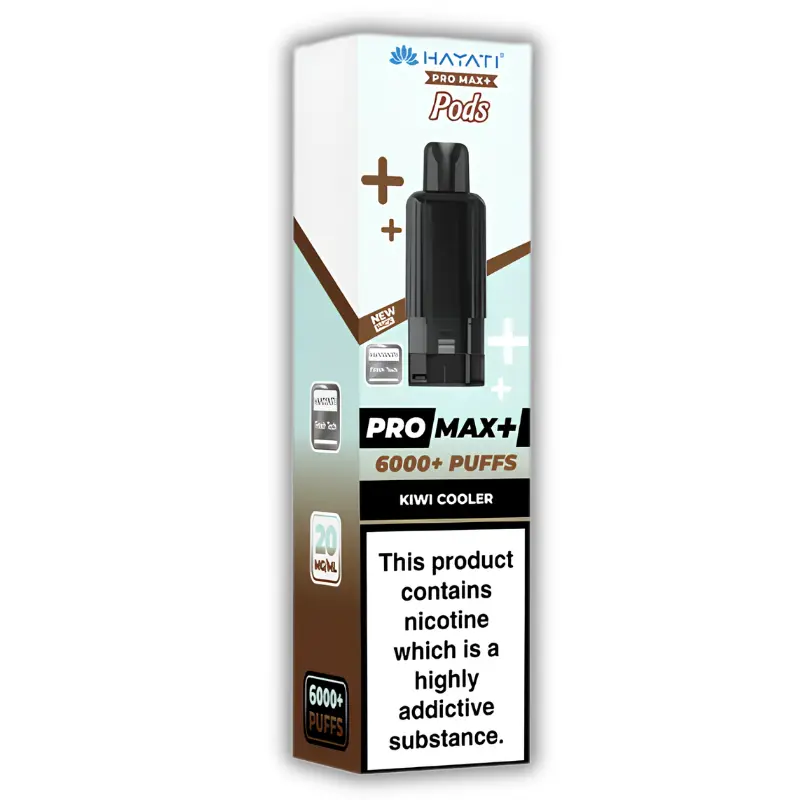
Hayati · Pro Max Plus
Kiwi Cooler Hayati Pro Max Plus Pods
£5.49
✔ In stock — ready to ship
Genuine Hayati
Free over £20
Same-day dispatch
Secure checkout
£5.49 buys one prefilled pod and nothing else. No body, no cable, no spare. The pod holds 12ml at 20mg and it fits a Hayati Pro Max Plus, which this listing takes for granted you already own, because almost nobody arrives at a bare pod entry any other way. Hayati's own rating for a filled pod is up to 6,000 puffs, produced by a machine drawing to a fixed schedule, which makes it a reasonable way to rank one listing against another and a poor way to plan a fortnight.
Two things this page will not do. It will not take the flavour apart, because the Kiwi Cooler Hayati Pro Max Plus 6000 Pod Kit page already does that at length: why kiwi carries its tartness structurally, what the green vegetal thread is doing under the acid, and why the declared cooling stacks on a sharp fruit rather than cutting across a soft one. And it will not walk you round the device, which is the same body described there and on the rest of the Hayati Pro Max Plus Pods shelf. Choosing this flavour for the first time, that page is the one you want.
What is left is the thing a reorder page is uniquely placed to raise and almost never does. You are buying the cheaper of two listings for the same liquid. £5.49 for the pod, £7.99 for the pod with a body attached. The pod is obviously the right purchase, right up until the moment it is not, because the body in your pocket is a rechargeable cell and a rechargeable cell is a consumable on a long enough timescale. The £2.50 you save every time you order the pod is only a saving while the thing you are fitting it to is still doing its job. This page is about the point where that stops being true, what the difference between the two prices actually buys, and how you would know, using only what you can observe, that you have reached it.
The question a reorder never asks you
Think about the shape of the two purchases. Buying the kit is a decision. You made it once, probably at the start, and it involved comparing a device against other devices, working out whether a prefilled platform suited you, and picking a first flavour with nothing to go on. It took attention.
Buying the pod is not a decision in the same sense. It is a repetition. You liked the liquid, you have the hardware, the listing costs less than the one next to it, and no step in the process asks you to look at the body. The page does not raise it, the basket does not raise it, and habit certainly does not, because habits exist precisely so that you need not re-examine them.
So the structure of the two listings quietly biases you towards pods, permanently, and independently of whether that is still the right answer. It is not a trick, just what happens when one purchase is deliberated and the purchase replacing it is automatic. The consequence is that the hardware question gets asked exactly once in the life of a device, at the beginning, when there is nothing to observe about it, and never again afterwards, when there is.
Most of the time this costs you nothing, and that is worth saying up front rather than building suspense. A working body is a working body and there is no prize for replacing it early. But the failure mode, when it arrives, arrives at the least convenient moment, and it arrives having been visible for some time to anyone who happened to be watching. The point of this page is to make you someone who happened to be watching, and the aim throughout is a better-timed purchase rather than a bigger one.
What the £2.50 actually buys
The marginal price of a body
The two listings for this liquid are identical in every respect except one. Both carry 12ml at 20mg. Both are the same pod. The kit at £7.99 adds a rechargeable body. Subtract one price from the other and the body costs £2.50.
That figure deserves a qualification most pages skip. £2.50 is not the price of a body. It is the price of a body when you are buying a pod anyway. Nothing in the facts available to this page sells a Pro Max Plus body on its own at any price, so the only route to a fresh one runs through a kit and the £2.50 is a marginal figure rather than a retail one. That is not pedantry, because it changes what follows: you cannot buy a body without also buying liquid you will use, the liquid half of the kit is therefore never wasted whatever you decide, and the whole question reduces to whether you want the body half.
Spread across pods, it is a rounding error
Take £2.50 and divide it by the number of pods a body sees out before you retire it. If a body carries you through four pods, the hardware cost you 62.5p a pod. Ten pods and it is 25p. Twenty and it is 12.5p, which is under a fortieth of what you pay for the liquid.
All three share a defect: the denominator is unknown. Hayati publish no service life for this body, no cycle rating, and no statement about how many pods it is expected to outlast. Treat the figures above as a shape rather than a forecast. The shape is what matters. Hardware is a small and rapidly shrinking line item for as long as it works, and the gap between 62.5p a pod and 12.5p a pod is pennies over months.
Which raises the obvious question. If £2.50 barely registers, why not buy the kit every time and never think about it again? Because it does register when it repeats. Ten kits bought where ten pods would have done is £25.00 of duplicate hardware, more than four pods of liquid, in exchange for nine bodies you will probably never unbox. The individual sum is trivial. The standing order is not.
The order you buy in does not change the total
This is the part that surprises people, and it is why the page does not end with the usual advice to play safe and buy the kit.
Buy the pod at £5.49 and let your body give out halfway through it. You now need hardware, so the next order is a kit at £7.99. Two orders, £13.48, and you hold two pods of liquid and one fresh body.
Now pre-empt it. Buy the kit at £7.99 this time and the pod at £5.49 next time. Two orders, £13.48, and you hold two pods of liquid and one fresh body.
The sums match because addition does not care about order. A part-used pod is not stranded by a body that has given out, since pods are the component that comes off and a fresh body accepts the one you were halfway through, with the kit's own pod simply joining the queue behind it. Buying the kit early is therefore not insurance bought at a premium. It is a payment you were always going to make, made sooner.
That holds only if the body really was going to need replacing. It fails the moment you buy a kit for a body that then works on for another year, because that £2.50 bought nothing. It fails in the other direction too, though not in money: being caught short costs you the stretch between the body giving out and the replacement arriving, which carries no pound sign but is the real reason people buy early.
Where the money genuinely leaks
Three leaks, in order of what they cost. The largest by a distance is the habitual kit buyer: somebody who never noticed the two listings differ, or who bookmarked the kit at the start and has reordered from that bookmark ever since. They are paying 45.5% over the odds on every order, which is what £2.50 on top of £5.49 comes to, and accumulating hardware they have no use for.
The second is the opposite error and it costs much less. Running an ageing body until it stops means being without a device for however long delivery takes, and quite possibly buying something unplanned in the meantime. In pounds it is close to neutral. In practice it is the failure people actually mind.
The third is the hedge: buying a kit while your current body is fine, then finding it still fine six months later. The spare is not wasted, because you will fit it eventually, but you have started its clock early for no return.
The same sum on the larger platform
It is worth running the identical calculation one shelf over, because the answer is different and the difference is rarely pointed out. Cola Ice Hayati Pro Ultra Plus 25K Pods is £7.99 as a bare pod. Cola Ice Hayati Pro Ultra Plus 25000 Prefilled Pod Kit is £11.99 for the same liquid with a body. The body premium on that platform is £4.00.
So renewing hardware on the Pro Max Plus costs £2.50 and renewing it on the Pro Ultra Plus costs £4.00. In absolute terms the smaller platform is the cheaper one to keep alive, by £1.50 every time you do it. As a proportion the two are closer than that sounds: £2.50 against a £5.49 pod is 45.5%, and £4.00 against a £7.99 pod is 50.1%. Both platforms charge you roughly half as much again for the order that includes hardware.
If you are weighing a move up to the bigger format, add this to the ledger: the pods hold more liquid for more money and the hardware renewal is dearer too, so a body giving out costs more there. Cherry Ice Hayati Pro Ultra Plus 25K Pods carries the same £7.99 pod price, so the sum is not specific to cola. If you are staying where you are, £2.50 is the lowest hardware renewal figure this page has facts for anywhere in the Hayati prefilled catalogue, which is a mild argument against agonising over it.
What Hayati publish about the body, and what they do not
The honest limit of this page needs stating plainly, because the temptation to fill the gap with a number is strong and every filled gap gets copied onto the next page.
Hayati publish no cycle rating for this body. No expected service life, no capacity retention figure, nothing that would let anyone convert "a rechargeable cell wears out" into "a rechargeable cell wears out after N months". This listing's own facts do not even record a capacity, since it is a pod listing and contains no device. Any page offering a timescale has invented it, and an invented timescale is worse than none, because you will plan against it.
What can be said without inventing anything is the mechanism, in terms that apply to rechargeable cells as a class. Usable capacity trends downward as charges accumulate, and it also trends downward with elapsed time independently of use, which is the part people forget and the reason a spare bought early is not free. Neither trend is linear, neither is visible from outside the device, and neither has a published figure attached to it here.
So this page does mechanism and observation only. No schedule, no "replace it every X". If you want a date, the only source of one is your own record of your own body, and the section below is about keeping a record worth having.
One further boundary, and it is not a stylistic one. Nothing here is an invitation to open a body up and look. The cell is not a serviceable component, Hayati do not describe it as one, and a rechargeable cell inside a sealed device is not something to prise at, test or attempt to swap. If a body is finished, it is finished as a unit.
How you would actually know
The measurement problem nobody warns you about
Every piece of advice on this subject reduces to "replace it when the charge does not last as long". That advice is not wrong. It is just unusable as written, because it compares the present against a past you never recorded.
Ask yourself how long your body ran between charges when you first got it. Most people cannot answer, and the ones who think they can are usually remembering a fortnight when they were vaping less. A slow decline is invisible precisely because it is slow: each week feels like the last, and the comparison you need spans months. By the time the decline is obvious enough to notice without a baseline, it has been going on for a long time.
Worse, the obvious unit of comparison is contaminated. "It needs charging more often than it used to" measures charges per day, and days are not a fixed quantity of vaping. A busy week, a stressful one, a week off work: all of them move charges per day without anything happening to the body at all. You cannot detect a trend in the numerator when the denominator is wandering.
Charges per pod, which is the reading that works
The fix is sitting in your hand. A pod is a fixed quantity: twelve millilitres is twelve millilitres, every time, from every listing on this shelf. It is the only stable unit in the system and a far better denominator than a day or a week, because it does not care how much you happen to be vaping.
So count charges per pod. Fit a pod, note the date on the box, and tally how many times you put the body on charge before that pod is finished. Do it once when the body is new and you have a baseline for its whole life. Repeat it every few pods and you have a trend.
The reading is genuinely informative. If your body took a certain number of charges to get through your first pod and now takes clearly more to get through an identical one, with the same liquid and roughly the same habits, the extra charges are coming from nowhere but the body. Usage cancels out, because a pod empties only at the rate you draw on it, so a heavy fortnight and a light month both amount to one pod's worth of consumption.
The contamination in that reading, and how to clean it up
Being straight about the flaw makes the method better rather than worse, and there is a real flaw here.
A coil that has been working for days does not render the liquid as sharply as a fresh one, and the natural response to a thinning flavour is to draw longer and more often. Longer draws cost more charge. So the tail end of any pod tends to consume more charge than the start of it, for reasons that are entirely about the coil and nothing to do with the body. Count across a whole pod and you are measuring two ageing components at once, and the reading will overstate the body's decline in a direction you cannot separate out.
The correction is simple. Count only the first stretch of each pod, the first three or four days, before the coil has aged. Compare like with like: the opening of pod one against the opening of pod eight. That removes almost all of the coil's influence, because a coil in its first days behaves about the same whichever pod it came from.
A second, smaller contaminant is temperature. A body wintering in an outside coat pocket behaves differently from one that lives indoors, so comparing a July reading against a January one adds a variable you did not intend to measure. If your readings are months apart, note the season beside the count and treat a cold-weather number as soft evidence.
The idle test, which removes the usage variable entirely
One observation does not depend on how you vape at all, and it takes no effort beyond patience. Charge the body fully, put it somewhere at room temperature, and leave it untouched for a stretch you decide in advance. Then pick it up and see what is there.
A body holding its charge over an idle period is behaving normally. A body that has run itself noticeably flat while doing nothing is telling you something a hundred charge counts could not, because there is no usage in the measurement to argue about. That makes it the cleanest reading available without instruments, and the one to run when the charges-per-pod numbers are ambiguous. Run it between pods rather than mid-pod so you are not stranded while you wait, and repeat it before acting, since a body you only thought was fully charged will produce a false alarm.
The paired comparison, and its awkward catch
Absolute readings are hard. Comparative ones are easy. The moment you own two bodies you can fit the same pod to each on the same day and feel the difference directly, with no baseline to remember and no denominator to argue about.
The catch is obvious and worth naming: you only get the second body by buying the kit, which is the purchase you were trying to decide on. The instrument that would settle the question sits on the other side of it.
Two ways round that, neither a trick. The paired comparison is not for this purchase, it is for the next one, because once you have bought a kit for any reason you own a reference for the rest of the time you use this platform. Mark the newer body when it arrives, since two bodies of different ages look identical and a comparison between units you cannot tell apart is worthless. And if anyone you live with uses the same platform, the reference already exists and costs nothing to borrow for an afternoon.
The flavour as a rough instrument, and where it misleads
This liquid is a better diagnostic than most, and the kit page explains why in more detail than belongs here: the green vegetal thread sits at the delicate end of the recipe and is the first thing to go when the body is not driving the coil properly. A weak draw flattens it. That makes Kiwi Cooler a more sensitive instrument than a sweet, heavy pod, where a slightly underpowered draw produces something that still tastes broadly correct.
The limit is that the same symptom has two causes. A tired coil also loses the green first. So the flavour on its own tells you that something has changed and nothing about which component changed, which is exactly the ambiguity that sends people to the wrong listing.
The discriminator is the charge, and it is a clean one. Put the body on charge and come back to the same pod. If the fruit returns to what you remember, the body was low and the pod is fine. If the fruit comes back only partly, or comes back and fades again within hours, the charge is not holding and the body is the variable. If the fruit does not come back at all, the pod is finished and the body was never the problem. Three outcomes, three different next purchases, and the test takes one charge.
Things that are not evidence
Four observations that get read as battery decline and are nothing of the kind. A single bad pod, because pods vary and one poor unit is not a trend: fit the next before concluding anything about hardware. A flavour going flat while the charging pattern is unchanged, which is the coil and will not respond to charging. A gurgle or a wet draw after the device has been somewhere cold, which is condensate in the airflow path and is covered on the kit page. And a new pod tasting of the last one for its first few draws, because residue survives a pod change and cooling agents are the most persistent thing to leave behind.
The most likely reading is nothing, and that is a result
If you run the count honestly and find no difference between pod one and pod eight, that is not a failed measurement. It is the answer, and it is the answer most people will get. Keep buying the pod at £5.49 and re-run the count in a few pods' time.
Further than that: the realistic conclusion of everything above is that most people reading this listing should carry on buying pods and need not think about the kit again this year. The arithmetic says the money is neutral, the mechanism says decline is gradual, and the observations say most bodies in regular use are still doing the job. This is a minority case given a page of its own because nowhere else raises it, not because it applies to you.
Why this particular pod is the one to run the test on
A short detour into flavour, from an angle the kit page does not take, because it bears on everything above.
Different liquids make different instruments. A pod built on sweetness and body tolerates an underpowered draw well, because sugar and weight survive some neglect and what reaches you still reads as the flavour intended. A pod built on brightness and detail does not. Take power away and the detail leaves while the broad impression stays, so you notice the change before you can name it.
Kiwi Cooler sits firmly in the second group. It is a sharp, thin-bodied, short-finishing liquid with a delicate green note under the acid and a declared cooling element over the top, and its elements come apart in a predictable order when something is wrong. Inconvenient if you want a forgiving pod. Useful if you want one that tells you things.
Compare the extremes on the same shelf. Smooth Strawberry Ice Hayati Pro Max Plus Pods and Ice Pop Hayati Pro Max Plus Pods are weighted low and sweet, and both carry on tasting broadly like themselves through conditions that would strip this pod back to cold sweet green. Banana Ice Hayati Pro Max Plus Pods is the most forgiving of all. At the other end, Double Menthol Hayati Pro Max Plus Pods is insensitive for the opposite reason: a pod that is nearly all coolant has little fine detail left to lose.
The recommendation is small but real. If you want the flavour reading to corroborate your charges-per-pod count, run the count on a pod like this one rather than on your sweetest listing, because you will see the change sooner and more clearly. And if you rotate between flavours, keep the count on one flavour rather than averaging across all of them, since a sweet pod and a sharp pod are not drawn on the same way.
The corollary cuts the other way and deserves saying. Sensitivity and noise arrive together, so this pod will also produce more false alarms: a perfectly healthy body on a cold morning will flatten the green here in a way it would not on a dessert profile. Treat one flat session as noise and a persistent change across a whole pod as signal.
What the listing records
The table below is built around the two prices rather than the hardware, because the hardware is not in this box and the prices are what the page has been about.
| What arrives | One prefilled pod, no device of any kind |
| Fits | Hayati Pro Max Plus bodies |
| This listing | £5.49 |
| Same liquid with a body | £7.99 |
| Difference, being the body | £2.50 |
| Liquid | 12ml, filled at the factory |
| Nicotine as supplied | 20mg, the only figure recorded |
| Puff ceiling from Hayati | Up to 6,000, a laboratory measurement |
| Cooling | Declared by the name, with no published scale |
| Body service life | Not published by Hayati anywhere |
| Coil resistance | Absent from this listing's facts |
| Maker | Hayati |
Two rows read as a pair and contain the whole argument. £5.49 and £7.99 differ by the one component this listing does not contain, and the row saying the service life is unpublished is why nobody can tell you when that difference becomes worth paying. The specification hands you a price for hardware renewal and withholds the only other number you would need to use it.
On the 20mg figure: it is the strength the pod is supplied at, no other option is recorded against this listing, and nicotine is addictive. Since the pod arrives filled there is no choice to make at purchase. What matters for a repeat buyer is that the strength is constant across every pod you will ever order from this shelf, which makes it one more thing that cannot explain a change you notice. When everything except the hardware is held constant, the hardware is where the variables live.
On the 6,000 figure: it came from test apparatus taking identical draws at identical intervals. Draw length moves it substantially in both directions, and so does how long a pod sits idle. Use it to rank pods against pods. The figure you actually want is the one you generate by dating the box, and that same record doubles as your hardware baseline.
Where this sits among the alternatives
Every other pod on this shelf carries the identical sum
The £2.50 arithmetic is not a property of kiwi. Every flavour on the Pro Max Plus pods shelf is £5.49 and every matching kit is £7.99, so the body premium is the same whichever liquid you reorder. Changing flavour therefore costs nothing at the till, and there is no financial reason to stay loyal to this one.
What changing flavour does cost you is your baseline. Switch from Kiwi Cooler to Watermelon Ice Hayati Pro Max Plus Pods or Pineapple Ice Hayati Pro Max Plus Pods and the next count is not comparable with the last, because you draw differently on a different profile. Not a reason to avoid rotating, but a reason to note which flavour each count came from.
The kiwi neighbours, if the flavour is what you are reconsidering
Kiwi appears in three roles across the catalogue and the short Kiwi Vapes shelf holds all of them. Strawberry Kiwi Hayati Pro Max Plus Pods uses kiwi as the acid line under a sweet red fruit, which makes it a gentler and considerably more forgiving pod than this one. Guava Kiwi Passion Fruit Hayati Pro Max Plus Pods buries it inside a heavy tropical trio where you would struggle to pick it out. Only this listing puts kiwi on its own.
For a repeat buyer the ordering is useful in a specific way. If you have been on Kiwi Cooler for months and it has stopped registering, the fault is usually familiarity rather than the liquid, and one pod of Strawberry Kiwi is enough to bring the register back without leaving the fruit behind.
The cooled shelf, for anyone rotating rather than replacing
Plenty of people keep two or three pods in play, and the cooled listings divide by what the cold is doing. Red Apple Ice Hayati Pro Max Plus Pods has genuine fruit acid of its own, so it behaves somewhat like this pod. Blackberry Ice Hayati Pro Max Plus Pods and Lychee Ice Hayati Pro Max Plus Pods sit softer and rounder. Blue Sour Raspberry Hayati Pro Max Plus Pods takes the confectionery route to sharpness, which is a different sensation from structural acid. The full set is on the Ice Vapes shelf.
If the cold rather than the fruit is the draw, Vim Ice Hayati Pro Max Plus Pods and Blue Frozen Hayati Pro Max Plus Pods push it further forward, and the Menthol Vapes shelf is where it stops sharing the billing. Cola Ice Hayati Pro Max Plus Pods is the outlier worth keeping around, being the only cooled listing here not built on a fruit.
A spare body is only a spare for one platform
This is the comparison that catches people out. The body in a Pro Max Plus kit fits Pro Max Plus pods and nothing else in the Hayati catalogue. Banana Ice Hayati Rubik Pods at £3.99 and Cherry Ice Hayati Mini Ultra Pods at £3.49 are cheaper pods on entirely separate hardware, and a spare Pro Max Plus body does nothing for you on either.
So if a change of format is on the cards, the body you are weighing here does not carry over and neither does the record you have kept on it, which is an argument for taking the hardware decision and the format decision in the same moment. The Hayati Prefilled Pods and Refills shelf shows what each format commits you to, the wider Hayati Pods listing covers everything that fits something, and the full Hayati catalogue is there for browsing across formats rather than within one.
Practical habits for a repeat buyer
Date the box, every time. One line in pencil on the packaging when you fit a pod, another when you retire it. It costs four seconds and it is the only thing standing between you and a decision made on a guess. Those two dates give you your real pod duration, your charges-per-pod baseline, and the evidence you will want in six months.
Mark your bodies the day a second one arrives. Two Pro Max Plus bodies are visually identical and nothing distinguishes an old one from a new one by eye. A dot of nail varnish or a strip of tape settles it permanently. Without it you will eventually retire the wrong one, or spend months comparing two units you cannot tell apart.
Do not stockpile pods against a body you are unsure about. Six pods at £5.49 is only good value if the thing you fit them to keeps working, and if the body goes you will be buying a kit with six pods already in the cupboard. Buy one or two ahead.
Retire a body on a trend, not an incident. One flat afternoon proves nothing and neither does a cold snap. What justifies a kit order is a charges-per-pod count that has moved consistently across several pods, or an idle test the body clearly failed. Everything else is noise, and acting on noise is how the drawer fills up.
When you do order a kit, treat it as the whole answer. Fit the new body and keep the old one in service until it genuinely stops rather than binning it the day the parcel lands. Two working bodies is a comfortable position and it costs nothing extra now that both are paid for.
Dispose of a finished body properly. A retired device with a cell in it does not belong in household waste. Take it to a battery or small-electrical recycling point, do not open it, and do not keep a damaged one in a drawer on the grounds it might come in useful.
Keep pod handling separate in your head. Priming a fresh pod, letting a cold device warm before judging it and not chaining on a sharp liquid are all real, all covered on the kit page, and all about the pod. Nothing in this section makes a pod last longer, and nothing in that one tells you anything about the body.
Questions a repeat buyer asks
I already own the device. Is there any reason to buy the kit instead?
One reason only: you want a fresh body. The liquid is identical and the £2.50 difference between the two listings is entirely hardware. If your current body is doing its job, the pod at £5.49 is the correct order and buying the kit adds a device you do not need.
Does buying the kit early cost me money?
Not in total, which surprises people. A pod then a kit comes to £13.48 and a kit then a pod comes to £13.48, and either way you end up with two pods of liquid and one fresh body, because a part-used pod transfers to the new body perfectly well. What buying early costs you is the possibility that the old body carries on working for a long time, in which case the £2.50 bought a spare you did not need yet.
How many pods should a body see out?
Hayati publish no figure for this, so there is no honest answer and any page giving you one has made it up. What you can do is measure your own. Count how many times you charge the body during the first few days of a new pod, note it, and repeat the count every few pods. A number that climbs across several pods with the same liquid is the signal.
Why count charges per pod rather than per week?
Because a week is not a fixed amount of vaping and a pod is. Twelve millilitres is twelve millilitres regardless of whether you got through it in five days or fifteen, so counting against the pod cancels out how much you happen to have been vaping. Counting against the calendar does not, which is why "it seems to need charging more often" is such an unreliable feeling.
The flavour has gone thin. Is that the pod or the body?
Charge it and find out, because the test separates them cleanly. If the fruit comes back to where you remember it, the body was low and the pod is fine. If it comes back briefly and fades, the body is not holding charge. If it does not come back at all, the coil is finished and the body was never involved.
Is there a way to test the battery without using it?
Charge it fully, leave it untouched at room temperature for a stretch you decide beforehand, then check what is left. A body that runs itself down while doing nothing is telling you something no usage-based observation can, because there is no vaping in the measurement to argue about. Run it more than once before acting on it.
Can I replace the battery instead of the whole device?
No. It is not described as a serviceable part, there is no published procedure for it, and a sealed device with a cell in it is not something to open. When a body is finished it is finished as a unit, and the route forward is a kit plus a trip to a recycling point.
Will this pod fit a Rubik or a Mini Ultra?
No. It is a Pro Max Plus pod and it fits Pro Max Plus bodies. The Rubik and Mini Ultra pods are separate hardware at their own prices, and a spare Pro Max Plus body is of no use on either of them.
Is the body premium the same on the bigger Hayati platform?
No, it is higher. On the Pro Ultra Plus the bare pod is £7.99 and the matching kit is £11.99, so renewing hardware there costs £4.00 against £2.50 here. As a proportion of the pod price the two are close, at roughly half again, but the absolute exposure is lower on this format.
How long does one pod go on for?
Hayati's rating is up to 6,000 puffs, obtained on test apparatus drawing at fixed intervals, which is a comparison figure rather than a prediction. Real duration moves with draw length, frequency and how long the pod sits idle. Dating the box is the only way to find your own number, and it doubles as the record you need for the hardware question.
Is 20mg the only strength?
It is the only figure recorded against this listing, and the pod arrives filled, so there is no decision to make at purchase. Nicotine is addictive, and that holds at every strength.
The short version
This listing is 12ml of a sharp, cooled green fruit at 20mg for £5.49, with no device in the box. The flavour case is made on the kit page and has not been repeated here. What this page is for is the decision underneath the reorder that never gets raised: the same liquid with a fresh body is £7.99, the £2.50 between them is hardware, and that hardware is a consumable even though nothing on either listing says so.
The arithmetic comes out mildly reassuring. Buying the kit sooner or later does not change what you spend, because the totals match in either order and a part-used pod carries over to a new body. There is no premium for perfect timing and no real penalty for getting it slightly wrong, which leaves buying the kit repeatedly when a pod would do as the only genuinely expensive habit on offer. The rule, if you want one: count charges against pods rather than weeks, run an idle test when the counts are unclear, and order the kit on a trend rather than on one poor afternoon.
For most people the honest conclusion is to keep buying the pod. Bodies in regular use tend to go on working, nobody has published a figure saying otherwise, and the money is neutral either way. The value here is not that you should buy hardware today. It is that the next time something feels off, you will know which of the two listings the problem points at.
Strictly for adults aged 18 and over. Nicotine is an addictive substance.
You might also like


