
Home / Hayati Rubik Prefilled Pod Kit / Fizzy Cherry Hayati Rubik Prefilled Pod Kit
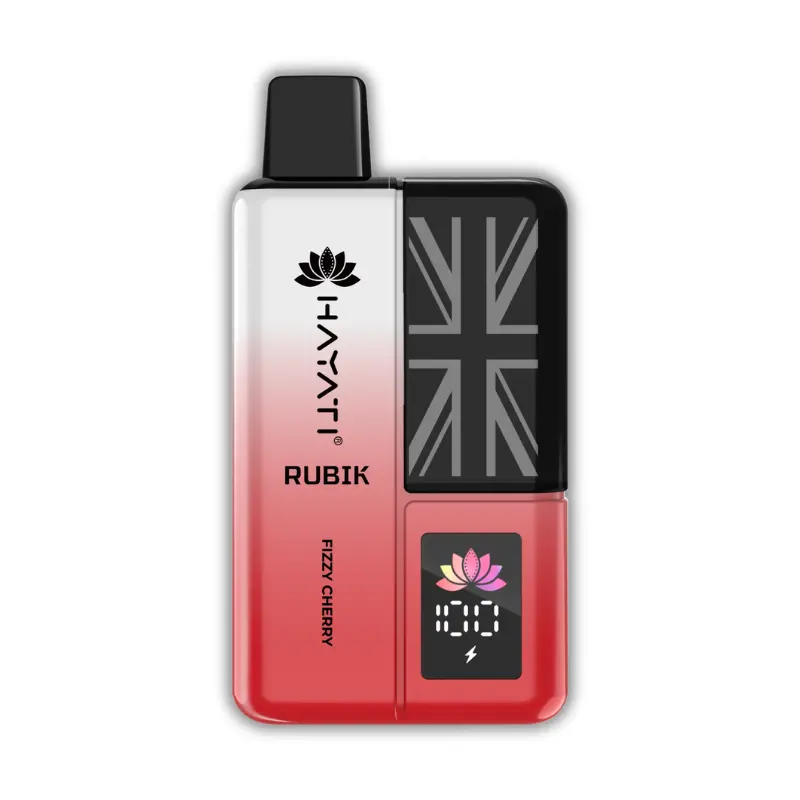
Hayati · Rubik
Fizzy Cherry Hayati Rubik Prefilled Pod Kit
£5.99
✔ In stock — ready to ship
Genuine Hayati
Free over £20
Same-day dispatch
Secure checkout
Fizzy Cherry on the Hayati Rubik is a complete kit at £5.99: the Rubik body with its 850mAh cell, and a prefilled pod holding 12ml of liquid at 20mg nicotine salt. Hayati put a figure of 7,000 puffs against a full pod, which is a bench estimate produced on test equipment to a fixed schedule rather than a statement about anybody's fortnight. Every one of the twenty kits on the Hayati Rubik Prefilled Pod Kit shelf carries the same four figures at the same price, so none of them is why you would choose this listing over the one next to it.
The name is. It contains a promise that the hardware cannot keep and that no vape hardware has ever been able to keep, and Hayati know it, because the whole of this catalogue is written by people carefully stepping around the same problem. Fizz is not a flavour. It is a physical event that needs gas dissolved in a liquid, and a pod contains no gas and produces no bubbles. That has been worked out in detail on three other pages in this shop and it is taken as settled here rather than argued again.
What has not been worked out is the interesting part, and it starts with a single word. Across all 492 Hayati product descriptions, the word carbonated appears exactly once. Not once per shelf, not once per range. Once. Forty-four listings in this catalogue are aiming at something that comes out of a bottle with bubbles in it, and not one of the forty-four will say the word. The one place it appears is on a cherry.
That is the subject of this page. Why the range spends dozens of cola and lemonade listings hedging the claim into a simile and then reaches for the actual word on a red fruit, what that tells a buyer about what is in the pod, and then the harder question underneath it: if fizz cannot be in a liquid, what is a fizzy cherry actually made of, and how close does any of it get to the thing the label says. Cherry itself gets proper treatment along the way, because cherry is the one fruit in this catalogue whose chemistry makes an acid-forward build a genuinely open question rather than a decorative one.
The word Hayati will not use, and the one listing where they use it
The count itself is not mine and there is no sense pretending otherwise. The Cola Ice and Orange Lemon Lime Mini Ultra kit page in this shop ran the census across all 492 descriptions and established two things: that carbonated appears exactly once, and that every one of the forty-four carbonated-drink listings hedges its fizz into a comparison instead. They say fizzy-inspired, fizzy-feeling, a fizzy soft-drink character, echoes the sparkle of a cold can. That page also counted the mirror-image word, squash, which likewise appears exactly once. Its conclusion was that everybody writing this copy knows the gas is not in the pod and nobody will say so. I have re-run the carbonated count against the catalogue and it returns one. The finding holds and it is cited rather than rebuilt.
What the census did not do, because it was not its subject, is ask why the exception landed where it did. And before that question can be asked properly, a correction is needed to the version of the claim I was handed, because it was off by one listing and the correction is the more interesting version.
The claim as given to me was that this listing is the one place in the catalogue where Hayati use the word. It is not. Fizzy Cherry is sold six times over in this range, and the word sits on the 10ml Pro Max nicotine salt bottle, not on this kit. What this kit reaches for instead is a different word, and that word turns out to be just as rare.
Here is the exact position. Searching all 492 descriptions for carbonated returns one hit, on Fizzy Cherry Hayati Pro Max Nic Salt, where the fizzy element is said to mimic the pop of a carbonated drink or a sour-coated sweet. Searching the same 492 for prickly returns one hit, on this listing, where the fizzy in the name is said to point to a prickly, effervescent lift. Searching for effervescent returns three hits, and all three are Fizzy Cherry: this kit, the Pro Max Plus kit and the Pro Max Plus pods. No other flavour in the catalogue uses the word at all.
So the honest version of the claim is narrower than the one I was given and it is also stronger. The Fizzy Cherry family owns the entire effervescence vocabulary of this catalogue. Two words in the semantic field of bubbles appear exactly once each in 492 descriptions, and both of them are on Fizzy Cherry listings. A third appears three times and all three are Fizzy Cherry. A range that has written forty-four descriptions of drinks that genuinely contain gas has never once used any of those words on any of them.
Why the exception is a cherry, and not a cola
The temptation is to file this as a slip by a copywriter who was not paying attention, and I do not think it is. A single careless word in 492 would be a slip. Three words clustered on one flavour, with the rest of the catalogue policed consistently, is a pattern, and patterns in copy usually come from somebody solving a problem.
The problem is a referent. Consider what happens when a cola listing says its liquid is carbonated. Every adult reading it has a cold can in their memory, they have had one recently, and the memory includes the specific physical sensation of gas leaving solution against the roof of the mouth. The claim is therefore immediately checkable, the check takes one draw, and the liquid fails it, because no liquid can pass. Worse, the failure is not a small disappointment at the edge of the profile. Carbonation is a large fraction of what a cola is. Take it out and the remainder is syrup, which is a real product with a real name and is not the drink. Naming the missing property invites the comparison the liquid cannot survive, so the copy names everything except that.
Now consider a cherry. There is no canonical fizzy cherry. Nobody has a memory of one to check the claim against, because a fizzy cherry is not a thing that exists outside flavour catalogues. Fizz here is not part of what the fruit IS, it is an effect added on top of a fruit that is complete without it. The word therefore has nothing to fall short of. It is doing descriptive work, telling you which direction the recipe has been pushed, rather than making a promise that a buyer can hold up against a physical object and reject.
That is the reasoning, and there is a control case for it sitting in the same catalogue, which is what makes me reasonably confident rather than merely persuaded by my own argument. Hayati sell Cherry Cola Hayati Pro Max Plus Pod Kit, which contains the same two nouns as this listing in the opposite order. On that listing the fizz word attaches to the cola, where the referent lives, and the copy immediately pulls its punch: the cola is credited with a fizzy character, which is a hedge, and the word carbonated is nowhere near it. Same brand, same fruit, same copy department. The only thing that changed is whether the bubbles had somewhere real to be measured against, and the vocabulary changed with it.
There is a second, less flattering reading and it deserves stating. A copywriter describing a fruit has fewer constraints than one describing a drink, simply because there is no product on a supermarket shelf to be compared to, and looser language is what you get when nothing is checking it. That reading and the first one are not in conflict. Both amount to the same thing from the buyer's side: the word is more confident here because there is less at stake in it.
One qualification, and it matters because it keeps the finding honest. Even the single use is a simile. The nic salt listing does not say the liquid is carbonated. It says the fizzy element mimics the pop of a carbonated drink. So the rule the census found has no exceptions at all: nothing in this catalogue is ever asserted to be carbonated. What varies is how far inside the hedge the copy is willing to go, and it goes furthest on the one flavour where nothing in the world can contradict it.
The verdict on the word. It is not a slip. It is the predictable consequence of the fizz having no referent on a fruit, and the Cherry Cola listing is the control that shows the same writers tightening up the moment a referent appears. For a buyer the practical upshot is short and worth carrying into the rest of this page: the confidence of the word tells you nothing about how much effervescence is in the liquid. It tells you that nobody could be caught out by it.
Six descriptions of one liquid, lined up against each other
Hayati write fresh copy for every format they sell a liquid in, which means a flavour with six listings has been described six times by people working separately. Lining those descriptions up is the closest thing to evidence a retail page can get, because a property all six assert is about as near to a fact as this catalogue offers, and a property only one asserts is either the most useful sentence in the set or a writer reaching for variety.
The six are this kit, the Hayati Pro Max Plus 6000 Prefilled Pod Kit version of the same flavour, the Pro Max Plus bare pods, the 10ml Pro Max nicotine salt at 10mg, and two 120ml zero-nicotine shortfills at 70/30 and 50/50. Three of them are prefilled pod products, three are bottles.
What all six agree on, which is not what the name says
Every one of the six describes cherry as the base, the core, the centre, the lead or the star. Every one of the six says it is sweet. Every one of the six puts a sharp element over the top and gives it a tactile word rather than a taste word: tingle, tingling, tingly, prickly, effervescent, sparkling.
And every one of the six, without exception, describes the job of that sharp element in the negative. The nic salt says it lifts the cherry so it never feels heavy. The 70/30 says the sharpness runs over the fruit so the flavour never feels heavy. The 50/50 says it lifts it so it never feels heavy, and adds that over a big bottle the sparkle keeps the flavour from settling into something flat or overly sugary. The Pro Max Plus kit says the sparkling edge keeps the fruit from feeling heavy. The Pro Max Plus pods say the sparkle stops it becoming heavy. This listing says the tingle keeps the sweetness from settling.
Six for six on a negative property. That is unusual and it is the single most useful thing in the set. The one claim every writer independently made about this liquid is not that it tastes of bubbles. It is that it does not go heavy. Heaviness and settling are not descriptions of fizz, they are descriptions of what happens to a sweet fruit over time in the mouth and over weeks in a rotation, and six writers all reached for the same defence against the same failure. Read the name as a claim about texture and the copy does not really support you. Read it as a claim that the sweetness has been held in check and every listing in the set is behind you.
Where the six disagree, and the split is clean
The disagreement is about where the acid lives, and it divides the set exactly three against three.
The three prefilled pod listings all put tartness inside the cherry itself. This kit calls it a sweet, slightly tart core. The Pro Max Plus kit calls it a deep, sweet, slightly tart base. The Pro Max Plus pods call it a deep, sweet base with a hint of tartness. In all three the fizz is then credited separately with sharpness, so acidity is described twice, once as a property of the fruit and once as a property of the treatment.
The three bottles do the opposite. The nic salt calls the cherry sweet, juicy and bright red, with no acid word attached to the fruit at all. The 70/30 calls it sweet and juicy. The 50/50 calls it a juicy, sweet red-fruit taste. In all three the entire acid load is attributed to the sparkle, and the fruit underneath is described as sweet and nothing else.
A three-three split along a format line is almost certainly about who wrote the copy rather than about two recipes. This corpus has caught the same pattern before, on a blackcurrant lemonade whose descriptions clustered by platform, and the sensible reading is that batches of listings were written together and picked up each other's habits. It is not evidence that the pod liquid is tarter than the bottled one.
But it is still worth something to a buyer, and here is what. Six writers looking at this liquid all put acid in it. Not one of them described it as sweet alone. Where they disagree is on attribution, which is a question about how to parse the name rather than a question about the taste, and the answer to the attribution question makes no difference at all to what arrives on a draw. Acid is present and it is audible. That much is corroborated six ways.
What only one listing says
Four sentences in the set appear once each and three of them are worth carrying.
The 50/50 bottle says the tang arrives just as the sweetness peaks. That is the only timing claim anywhere in the six, and timing is the axis this page argues is the real one, so it is either the most informative line in the set or a coincidence. I take it seriously below.
The nic salt is the only listing that compares the flavour to anything else Hayati sell, calling it a more energetic option than the smoother Cherry Ice. That places the flavour on the shelf rather than describing it in isolation, and it is the only line in the six that does.
The Pro Max Plus pods listing is the only one to suggest a use, saying it works as a go-between if you alternate between fruit and cola flavours. That is a genuinely practical observation and it fits everything else on this page: a fruit built with a drink's acid structure sits between the two registers and connects them.
The fourth is the phrase this kit uses and nothing else in 492 listings does, which is prickly. Given that the other five listings all chose tingle or sparkle, and given that prickle is the precise word for the mechanical half of carbonation, the choice looks deliberate. It is also the one claim in the entire set that a pod is structurally unable to deliver, which is the subject of the next section.
What a fizzy cherry is actually made of
Three pages in this shop have taken the carbonation problem apart properly and there is no value in doing it a fourth time, so what follows states their conclusions compactly, says which of them apply here, and then goes after the part they did not cover, which is what changes when the thing being made fizzy is a fruit rather than a drink.
The established part, in brief
Fizz is two events at once. Dissolved carbon dioxide forms a weak acid in the liquid, which the tongue reads as sharpness, and the gas comes out of solution as thousands of small bursts against the surfaces of the mouth, which the body reads as touch. Both halves require a liquid holding gas. Vapour is an aerosol and holds none, so the sensation cannot be reproduced at all, only substituted for. That framing belongs to the Cola Ice Pro Ultra Plus kit page and it is correct.
Acidity covers the chemical half and covers it well. Citric or malic acid in a liquid produces the same tightening at the sides of the tongue and the same salivary response as carbonic acid does, and the tongue does not much care which acid turned up. The Cola Ice Pro Max Plus pods page then established the only known substitute for the mechanical half: in a cooled liquid, the coolant is the sole material producing a physical sensation on the surfaces of the mouth rather than a smell or a taste, which makes it the only candidate for standing in for the bubbles. That page also priced the substitution honestly, pointing out that carbonation is a granular stutter of several hundred discrete events and a coolant is a smooth plateau, so it buys back a fraction and not the article.
The tool this pod does not have
Here is where Fizzy Cherry parts company with every prior page on the subject, and it is a straightforward observation that nobody has had occasion to make. There is no coolant in it.
None of the six listings mentions cooling, ice, menthol, chill or a cold finish. The name carries no cooling word, and this catalogue's cooling vocabulary has been counted elsewhere in this shop and found to be a consistent marker: Ice on ninety titles, Frozen on three, Cooler on two, and no listing ever mixing an ice-family word with a mint-family word. Hayati are reliable about flagging a coolant when one is present. On this flavour they flag nothing, across six separate descriptions written by different hands.
So the one substitute available for the mechanical half of carbonation is not in this pod. The Cola Ice pages could argue that their cold was buying back a fraction of the feel of a can. This liquid has nothing to make that purchase with. The Mini Ultra page reached the same position on its uncooled Orange Lemon Lime half and put it plainly: where there is no coolant, there is no fraction to buy.
That leaves a fruit, some sugar and some acid, and an adjective in the title that describes a physical event. What can a formulator actually do with that?
Tool one: sharp organic acid, which does most of the work
Acid is the first tool and the best one, and on a cherry it does more than it does on a cola, for a reason specific to the fruit. A cola's acid is competing for attention with cinnamon, nutmeg, coriander seed, vanilla and citrus peel oil, so a given dose of acid has to push through a crowded middle. A cherry accord is comparatively bare. There is the fruit, there is sweetness, and there is very little else in the way, so acid placed on top of it is heard at close to its full value.
What acid gives you is the tightening at the sides of the tongue, the watering response, and a finish that stops rather than trails. Those three between them are a real fraction of what a person means by fizzy, because the mouth-watering in particular is something a fizzy drink reliably causes and a still one does not. On a draw this arrives early. Acid is a tongue event, it happens while you are inhaling, and it is largely finished before the exhale begins.
What acid does not give you is any sensation of intermittency. It comes on, it holds, it goes. A carbonated drink is a stutter and an acid is a level, and no amount of acid converts one into the other. Push the dose up trying to make it feel more physical and you do not get closer to bubbles, you get closer to a sour sweet, which is a different flavour category and is what the nic salt listing is gesturing at when it mentions a sour-coated sweet.
Tool two: a prickle, which is the one that is not really available
This kit's description reaches for a prickly lift, and prickle is exactly the right word for the thing that is missing. It is worth being precise about what could and could not produce one.
A genuine prickle is a trigeminal event, meaning it is reported by the nerve that handles touch, temperature and irritation rather than by the taste buds or the nose. Several materials in a flavourist's cupboard reach that nerve. Coolants do, which is the whole substitution the cola pages identified. Capsaicin and piperine do, and nobody is putting pepper in a cherry pod. High concentrations of certain acids produce a low-grade astringency that shades into touch, which is the closest thing available here, and a carbonate salt reacting with an acid can produce a genuine effervescence in a confectionery sherbet but not in a sealed liquid that has to sit on a shelf and then be vaporised.
So the honest answer on tool two is that the mechanical half is unbought on this pod. What is present is the tail end of tool one: acid at a high enough concentration to tighten the tongue slightly, which is a plateau rather than a stutter and is in the wrong place besides, since it acts at the front of the mouth on the inhale rather than distributed across a mouthful of liquid. It is not nothing. It is also not a prickle, and a buyer who reads that word as a description of texture is going to be disappointed by roughly the amount of disappointment the word invites.
I want to be careful here, because there is a temptation to reach for the throat as the missing physical channel and it should be resisted. This is a 20mg nicotine salt, and a salt preparation is formulated specifically to reduce throat presence at a strength that would otherwise be difficult. Whatever physical sensation arrives on this pod is not coming from there, and a page that credited the fizz to throat feel would be crediting it to the one component in the liquid designed to be quiet.
Tool three: speed, which is what is actually doing the work
If neither half of the fizz can be delivered in full, the question becomes what a formulator can vary that produces the same impression by another route, and the answer is the shape of the flavour in time.
Part of why carbonation reads as lively is that it is fast and irregular. Nothing in an aroma can be irregular, but aromas can absolutely be fast. A volatile top note with a steep onset and a short decay arrives, registers and is gone within a second or two. A heavy, rounded, low-volatility material comes on slowly and hangs about. Those two produce very different impressions at identical intensity: the first reads as bright, lifted and lively, the second reads as thick, rich and heavy. Same loudness, different envelope.
That is what I think Fizzy Cherry is built on, and the evidence for it is sitting in the copy rather than in my imagination. Six listings independently defined the treatment by what it prevents, and what they all said it prevents is heaviness and settling. Heaviness is an envelope property. Settling is an envelope property. Neither is a texture and neither is a taste. If the writers had been describing bubbles they would have described bubbles, and instead all six described a liquid that does not hang around.
The 50/50 listing's unique line fits the same picture exactly. Saying the tang arrives just as the sweetness peaks is a statement about sequencing, and it describes a build in which the acid is timed to cut the sugar at its maximum rather than to sit underneath it throughout. That is a deliberate envelope decision, and it is the mechanism by which a sweet liquid stops reading as syrupy.
So the answer to what a fizzy cherry is made of, on the best reading available from the record: a cherry accord, a sweetener held somewhere short of confectionery saturation, an acid dose placed to peak with the sugar rather than before or after it, and a top end weighted towards fast-decaying material so that each draw clears instead of accumulating. The effervescence is a rate, not a texture.
How close that gets, said plainly
Not close, if what you want is bubbles. Closer than you would expect, if what you want is the thing bubbles are for.
The chemical half of fizz is covered properly here and arguably covered better than it is on the cola listings, because the accord is less crowded and the acid is heard more clearly. The mechanical half is not covered at all, and unlike a cooled soft drink this pod has nothing to cover it with. The liveliness that six descriptions all point at is real, and it is a speed effect rather than a texture effect, which means it is most audible in the first second of the exhale and in the fact that the sweetness does not build across a session.
What you should expect on the first draw, stated as inference from the record rather than as a measurement: a sweet red fruit that arrives quickly, a tightening at the sides of the tongue about halfway through the inhale, a short exhale that finishes on the fruit rather than on sugar, and a mouth that feels rinsed rather than coated afterwards. No pop. No burst. No bead of anything against the roof of the mouth. If the pod is doing its job you will notice it most at the fifth draw rather than the first, because the point of the build is that the fifth draw tastes like the first one.
Cherry, and the question of the kernel
The chemistry of cherry belongs to the Cherry Vapes shelf page, which sets it out better than a product page needs to and which this section assumes. The short form, only so that what follows makes sense on its own: a real cherry is a quiet fruit, mostly sweetness with a little malic acid and very little aroma, and what people recognise as cherry flavour comes almost entirely from benzaldehyde, which lives in the kernel rather than the flesh and which reads as almond at confectionery concentrations. Every cherry recipe is therefore a dosing decision before it is anything else. Too little and the liquid loses its cherry identity and drifts to generic red fruit. Too much and the almond stops being the floor and becomes the ceiling, which is where the medicinal reading that people complain about in cherry liquids comes from.
Two pages in this shop have already said, in passing, what they expect this particular pod to do with that dose, and they agree with each other. The shelf page says the effervescent prickle masks the kernel and makes the same fruit read as bright. The Cherry Sour Raspberry pages in this shop go further and file Fizzy Cherry as the carbonation strategy for managing the kernel, alongside cooling and a louder second fruit.
I do not think either is right about this pod, and the reason I do not is that the sour cherry page's own argument, which is the most careful piece of reasoning about cherry anywhere in this corpus, predicts the opposite.
Applying the sour cherry page's mechanism to the one listing that isolates it
That page asked what acid does to the kernel note and answered it with two mechanisms, both of which favour the kernel.
The first is perceptual. Acid suppresses perceived sweetness strongly and suppresses perceived bitterness much less. Sweetness is the mask that keeps benzaldehyde's faintly bitter almond depth underneath the fruit. Thin the mask and what was underneath has less to hide behind, so the kernel stands out more rather than less. This is the same effect the shelf page describes for cooled cherry builds, where cold suppresses sweetness and the almond surfaces.
The second is about timing. Acid is a tongue event that happens on the inhale, at the sides and tip of the tongue, and it is largely over by the time you exhale. Benzaldehyde is an aroma compound sensed retronasally on the way out. The two occupy different halves of a draw and therefore do not compete for perceptual space at all. An acid cannot mask an aroma the way a second loud aroma can, because by the time the aroma is being read the acid has finished.
Its conclusion was that acid is not the threat to the kernel. Raspberry is, because raspberry is top-heavy and aromatic and sits in exactly the retronasal window where the almond would otherwise be audible.
Now apply that to this listing. Fizzy Cherry has no second fruit. It has no coolant. It has cherry, sweetener and acid, and nothing at all occupying the exhale except the cherry itself. It is the clean case, the one listing in the range where the acid variable is isolated, which neither the sour raspberry pod nor the cooled cherry pod could manage because each had a second thing in the way.
On the sour cherry page's own mechanism, the prediction for this pod is that the kernel should be more audible here than on any other cherry Hayati sell. Acid suppresses the mask. Nothing occupies the exhale. Both mechanisms point the same way and there is no third factor pushing back except one, which is sweetener load.
The resolution, which is that both readings are partly right
Here is where I think the disagreement actually dissolves, and it took some working out.
The two prior pages say the prickle masks the kernel. What I think they are describing is real, but it is not masking. Consider what a cherry boiled sweet tastes like, or a cherry drop, or any hard confectionery cherry. Those are not benzaldehyde-poor products. They are the opposite. Confectionery cherry is where most people's reference for the almond-adjacent register comes from in the first place, and a cherry sweet with sugar and acid over it does not taste less of the kernel than a fresh cherry does. It tastes dramatically more of it.
What the acid and the sugar change is not the amount of kernel character present. It is what your brain files it as. In a soft, sweet, low-acid build the kernel reads as almond, marzipan, something nutty and slightly apart from the fruit. In a sharp, bright, fast build the same material reads as cherry, because a sharp confectionery cherry is the thing that trained you to recognise that register as cherry in the first place. The kernel does not go anywhere. It stops being identifiable as a separate note and becomes indistinguishable from the fruit identity.
So the shelf page is right that this pod reads as bright and that the almond is not something you meet as a distinct flavour. It is wrong about the mechanism, and the mechanism matters, because it predicts different behaviour at the end of a pod. Masking implies the almond is sitting there waiting to emerge when the mask weakens, which is exactly what happens on a cooled cherry as the coil tires. Recontextualisation implies something else entirely, which I come to below.
One correction is worth making explicitly while I am here, because a later writer reading the sour cherry page could repeat it. Filing Fizzy Cherry as the carbonation strategy is not available as a description of anything, because there is no carbonation in it or in any other pod. Whatever this liquid is doing, it is doing with acid, which makes it the same tool as the sour listings and not a third one. The range demonstrates two strategies for managing the kernel, not three: change what is over the top of it, or put something else in the exhale beside it.
The one variable that decides it, and how to read it yourself
Everything above is conditional on sweetener load, and sweetener load is not published for this pod or for any other in the range.
The two directions are easy to state. A restrained sweetener with a firm acid gives you the sharp confectionery cherry described above, kernel fully present and fully integrated, reading as bright. A heavy sweetener with the same acid gives you something closer to a cherry cola syrup without the spice: still not almond-forward, because the sugar is masking properly, but slower, rounder and less convincingly lively, and the anti-heaviness claim that all six listings make would be the thing that failed. The copy claims the first. The copy has every commercial reason to claim the first whether or not it is true.
You can settle it yourself on the first pod and it takes about a minute. Take a draw with a clean mouth, before coffee or anything else, and exhale slowly through the nose rather than the mouth, which is the route that carries the aroma to the receptors that read benzaldehyde. Then wait. Count four or five seconds after the vapour has gone and pay attention to what is left.
If what remains is a faint dry nuttiness at the back, the sweetener is low and you have the sharp build, which is the one the listings describe. If what remains is sweetness with the fruit already gone, the sweetener is high and the acid is decorative, and this pod will start to feel heavy by the second week regardless of what the name says. If nothing at all remains and the mouth feels rinsed, that is the best outcome on this profile and it means the envelope argument above is correct.
Marking my confidence honestly: that acid is present and audible is reasonably confident, corroborated by six independent descriptions. That the liveliness is a speed effect rather than a texture effect is probable, inferred from the six-way agreement on a negative property and from the fact that no other mechanism is available. That the kernel is integrated rather than masked is probable and follows from the sour cherry page's mechanism applied to an isolated case. Where the sweetener sits is unknown, it is the axis that decides whether the pod does what its name claims, and nothing in the record will tell you.
The Rubik, which is the short part of this page
The box contains the Rubik body with an 850mAh rechargeable cell and one prefilled 12ml pod already seated in it, filled at 20mg nicotine salt. Nothing else is included and nothing else needs to be, since the pod arrives full and the device arrives assembled. Replacement pods for this flavour are sold separately at £3.99, so the £5.99 asked here carries a £2.00 charge for the body that you pay once and never again.
The specification that matters for this particular liquid is the one Hayati do not print, which is the coil resistance. An acid-forward build is more sensitive to how hot a coil runs than a sweet one is, because acids are among the first things a tiring coil stops rendering cleanly and warmth pushes a profile towards its heavy end, which is precisely the end this liquid is engineered away from. Across all thirty-nine Rubik listings there is no resistance figure, no carrier ratio and no airflow description, so nobody outside the factory can tell you where this sits. That is the honest position and I am not going to improve on it with a guess.
The value question on this platform has already been worked out in detail and priced properly on the Vim Ice Hayati Rubik Prefilled Pod Kit page, which lines the Rubik up against the Pro Max Plus on kit price, refill price and cost per millilitre, and which also handles the puff-rating comparison and explains why a seventeen per cent gap between two laboratory figures is not evidence about hardware. Rather than rebuild any of it, the summary is that the Rubik is the cheaper of the two 12ml platforms at both tiers and does not carry a lower published rating for it, and the full arithmetic is on that page and on the Hayati Rubik shelf. Check the range name printed on your device against the range name in this title before ordering a refill.
The figures, and the fields left blank
Four numbers are published for this kit and they are the same four that every listing on the shelf carries. The table below puts them in order of how much each one should influence a decision, which on this shelf is close to the reverse of the order they are usually printed in, and then lists the fields that are blank, because on an acid-forward build the blanks are doing more work than two of the numbers.
| Nicotine strength | 20mg nicotine salt, the UK maximum for this format, and identical across all twenty kits here |
| Liquid volume | 12ml in one prefilled pod |
| Complete kit price | £5.99, of which £2.00 is the body and £3.99 is the pod |
| Manufacturer puff figure | Rated by the manufacturer at up to 7,000 puffs for a full pod, a laboratory estimate on test equipment and not a forecast |
| Cell capacity | 850mAh, rechargeable, stated for the Rubik kits |
| Cooling | None stated, on this listing or on any of the five other Fizzy Cherry listings |
| Coil resistance | Not published anywhere in the Rubik range |
| Carrier ratio | Not published for any prefilled Hayati pod |
| Sweetener load | Not published, and it is the figure that decides whether this pod does what its name claims |
| Acid type and dose | Not published; the six descriptions establish that acid is present and say nothing about how much |
Two notes on the table. The 20mg is the ceiling rather than a choice, so it carries no information about this flavour as against any other, and it is at the top only because it is the number a buyer most needs to have registered. The puff figure is fourth because of what it is: the Rubik's 7,000 and the Pro Max Plus 6,000 are both laboratory outputs, the ratio between the four prefilled formats in this shop varies by a factor of three on liquid consumed per rated puff, and a figure with that much variation behind it cannot carry much weight in a comparison.
The blanks are ordered by how much they would change the taste if you knew them, and sweetener load sits above both hardware fields for the reason set out above. A buyer who could see one number on this pod that they currently cannot should ask for that one.
Where it sits against the neighbours
There are two useful ways to place this pod and they give different answers, so both are worth walking. One is against the other cherries, which is the choice a buyer makes if they have decided on the fruit. The other is against the rest of this shelf, which is the choice they make if they have decided on the device.
Against the other cherries
Six flavour names in this catalogue are actually led by cherry, and the rest of the sixty-nine cherry-tagged listings use it as structure underneath something louder. That distinction is set out on the Cherry Vapes shelf and it is the single most useful thing to understand before buying any of them.
Cherry Ice is the direct opposite number and the comparison is clean, because the two use opposite tools on the same fruit. Cherry Ice suppresses sweetness with cold, which thins the mask and can bring the almond up as a separate note near the end of a pod. Fizzy Cherry suppresses it with acid, which thins the same mask but leaves the exhale clear and, on the reasoning above, folds the kernel into the fruit rather than lifting it out. Cold also lengthens nothing and shortens the finish, whereas acid shortens the finish for a different reason, so the two arrive at a similar brevity by different routes. If almond in a cherry liquid is something you actively dislike, the acid build is the better bet of the two, and the nic salt listing's own line about this being the more energetic option against the smoother Cherry Ice is pointing at the same difference from the other direction.
The sour cherry listing is the closest relative in intent and the furthest apart in execution. It puts a declared sour treatment over two fruits that were already acidic, and the result is one firm edge at the front of every draw rather than a layered sourness, because sourness is a single channel that reports magnitude and not identity. Fizzy Cherry uses less acid on one fruit and times it rather than piling it on. Anyone who found the sour listing one-dimensional is describing a dose problem, and this is the same tool at a lower setting.
Cherry Cola is the one to compare if the drink reading is what attracts you, and it is the honest choice for that. Cherry Cola Hayati Pro Max Plus Pod Kit has an actual cola accord in it, which means caramel, vanilla and warm spice, and the cherry sits on top as brightness. Fizzy Cherry has none of that. It is a fruit with a drink's acid structure, not a drink with a fruit in it, and a buyer expecting cola sweetness from this pod has read the wrong half of the name.
The supporting cherries are a different purchase again and should not be confused with these. Blue Razz Cherry on this same shelf puts cherry underneath blue raspberry as a floor, so it deepens the middle and stops the finish tailing off, and it is not what you taste first. The same flavour runs across three other formats if you want it elsewhere, as Blue Razz Cherry Hayati Pro Max Plus Pod Kit, as Blue Razz Cherry Hayati Pro Ultra Plus 25000 Prefilled Pod Kit on a 22ml pod, and in the smallest format as Blue Razz Cherry Hayati Mini Ultra Pod Kit, which is the cheapest way to find out whether a blend suits you before committing twelve millilitres to it. There is also a divided pod, Blue Razz Cherry / Blue Razz GB, which keeps two liquids in one 22ml pod and selects between them with a rotating mouthpiece.
Two more put cherry third or fourth in the name and mean it. Blueberry Cherry Cranberry is on this shelf and uses cherry for richness between a soft blueberry and a dry cranberry snap, and Strawberry Raspberry Cherry Hayati Pro Max Plus Pod Kit does something similar with two red berries over the top. In both cases the naming order is the tasting order, and buying either of them expecting cherry is the most common misread on that shelf.
Against the rest of this shelf
Twenty kits sit on the Hayati Rubik Prefilled Pod Kit shelf at the same price with the same four numbers, so the entire decision is flavour, and the shelf divides in ways that are worth knowing.
Seven of the twenty carry an ice word and one is a mint, which leaves twelve uncooled, and Fizzy Cherry is one of them. If you have been running cooled pods and want to know what a flavour actually tastes like without a coolant sitting over it, this is a reasonable place to find out, because the fruit is not complicated and there is nothing else in the way. The nearest cooled comparison for a red fruit is Strawberry Raspberry Ice, which pairs two soft berries with a cold finish and goes the opposite way to this pod on both counts, and Red Apple Ice is the shelf's other cooled fruit that brings its own acid. Watermelon Ice and Banana Ice are the soft, low-acid end of the same group.
For acid without cherry, the shelf has two clear options. Blue Sour Raspberry is the declared sour listing and works the same way this one does, using sharpness to stop sweetness building over a long session, but with a brighter and more aromatic fruit that occupies the exhale in a way cherry does not. Lemon Lime starts from fruits that are acid sources to begin with, so the sharpness is structural rather than added.
Pineapple Ice is a curious neighbour and worth a line, because its own description is the only one on the shelf besides this flavour's to use a tingle word, attributing it to the fruit's natural acidity rather than to a treatment. If the tactile side of this pod is what interests you, that is the other place on the shelf where somebody thought it worth mentioning.
For the drink register on this platform there is exactly one option, Lemon Cola Ice, and it makes a useful contrast to everything argued above. It is a genuine soft-drink build with a cola backbone, a citrus cut and a cooled finish, which means it has the coolant this pod lacks and therefore has the one substitute available for the mechanical half of the fizz. It is also the listing where the fizz claim has a referent to be judged against. Buy this one if you want a fruit that behaves like a drink, and that one if you want a drink.
Among the single uncooled fruits, Juicy Peach is the useful opposite: a soft, round, low-acid fruit that goes the other way on every axis this page has discussed, and a fair test of whether you actually prefer a build that holds still to one that keeps moving. Strawberry Kiwi sits between the two, pairing a soft berry with a fruit that brings its own acid.
Two on the shelf are named for a mood rather than an ingredient and cannot be predicted from the label at all, which is a different kind of purchase. Summer Dream and Mr Blue both have pages here that work through what their names can and cannot tell you, and both conclude that the flavour question stays open until you have tasted it. Fizzy Cherry has the opposite problem. Its name tells you a great deal, and one of the things it tells you is not deliverable.
For a rotation partner, Fresh Mint is the shelf's palate reset and does its best work next to a sweet fruit rather than in place of one. Off this shelf, Sakura Grape Hayati Pro Max Plus 6000 Pod Kit is the only other listing in the catalogue tagged as cherry for a reason that is not fruit, since sakura is the blossom rather than the stone fruit, and Blue Razz Fruit Twist is the page that established how sugar and acid work as two independent dials on a blue razz, which is the same pair of dials this liquid is set with. The wider shelves are Hayati Prefilled Pod Kits and, if you want to see every format this flavour exists in alongside everything else, the full Hayati range.
Living with twelve millilitres of an acid-forward cherry
The pod arrives full and seated, so there is nothing to prime and no wick to soak. What is worth doing after it has come through the post is leaving it upright for an hour before the first draw, which lets liquid that has moved about in transit settle back against the wick. That is general advice for any prefilled pod and it is not specific to this one.
Draw length is the one variable you control and on this liquid it is not neutral. The acid is a tongue event on the inhale and the fruit is read on the exhale, which means a short sharp draw weights the balance towards the acid and a longer, slower one gives the fruit more of the mouth. If the pod reads as too sharp in its first day, lengthen the draw slightly before deciding the recipe is wrong. If it reads as syrupy, shorten it. Very few flavours respond this cleanly to draw length, and the reason this one does is that its two components arrive in different halves of a draw rather than together.
Chain-vaping is worse on this profile than on most, and the reason is specific. A coil that has not had time to rewick runs hotter and drier, warmth pushes a flavour towards its heavy, low-volatility end, and the entire design of this liquid is an argument against its heavy end. A tired, hot draw on a peach pod tastes like a weaker peach. A tired, hot draw on this one tastes like a different liquid, because the fast top material that carries the liveliness is the first thing a hot coil stops rendering properly. Leaving fifteen or twenty seconds between draws is worth more here than it is on the shelf's rounder fruits.
Storage has one anchor on this pod and it is not the one cherry pages usually reach for. The slow drift of benzaldehyde in a warm cupboard is a real thing and it has been covered on the sour cherry listing, so there is no sense restating it. The risk specific to this build is at the other end of the molecular weight range. The material producing the fast attack is by definition the most volatile material in the liquid, which makes it the first to be lost through any imperfect seal and the most affected by heat cycling. A spare pod that has spent a summer in a warm room will not taste wrong, exactly. It will taste slower, and slower is the one failure this recipe is built to avoid. Somewhere dark and cool at room temperature is all that is needed, and buying one spare rather than six is the sensible pattern for a liquid whose defining property is its top end.
Knowing when the pod is finished is easier on this profile than on most, and the reason follows directly from the kernel argument above. If the almond were merely masked, the end signal would be marzipan emerging as the mask weakened, which is how a cooled cherry announces itself. On an integrated build there is nothing waiting to emerge. What happens instead is that the acid goes first, because acids are among the earliest casualties of a residue-laden coil, and what is left is the sweetness on its own with the structure gone. The pod does not taste of almond at the end. It tastes heavy, which is precisely the state all six of its descriptions promise it will not reach, and when it gets there it is done. Order the £3.99 refill before you get there rather than after, because the last stretch of an acid-forward pod is the least pleasant part of it rather than merely the weakest.
The pod is not user-refillable and there is no way to replace the coil inside it, so the pod and its coil reach the end of their working life together and the whole assembly is replaced. When it is finished it contains a coil and a residue of liquid, which puts it outside household waste. Vape hardware is covered by the UK electrical waste rules, so a retail take-back point or a local recycling facility is where it belongs. The body is the part you keep, and it is the reason the first £5.99 is more expensive than the ones after it.
Keep it out of reach of children and pets, as with anything containing nicotine.
Questions this listing raises
Is it actually fizzy?
No, and nothing in a pod can be. Carbonation needs gas dissolved in a liquid and vapour is an aerosol with neither gas nor bubbles, a point three other pages in this shop have established in detail. What this liquid does instead is use acid to produce the sharpness and the mouth-watering response that are part of what fizz feels like, and it builds the rest of the impression out of speed rather than texture. It reads as lively. It does not read as a can.
Why does this flavour get to use the word carbonated when the cola listings do not?
The word appears exactly once in all 492 descriptions and it is on the Fizzy Cherry 10ml nicotine salt, not on this kit. The likeliest reason it landed on a cherry is that a cherry gives the claim nothing to be measured against, since no canonical fizzy cherry exists, whereas everybody has a cold can in their memory to check a cola against. Even that single use is a simile rather than an assertion, so the catalogue's rule holds without exception: no Hayati liquid is ever said to be carbonated.
Is there any ice or menthol in it?
None is stated on this listing or on any of the other five Fizzy Cherry listings, and Hayati are consistent about flagging a coolant in a product name when one is present. That absence matters more here than it usually would, because a coolant is the only material known to stand in for the physical half of carbonation, and this pod does not have one.
How sweet is it?
All six descriptions call it sweet and all six also say the sharp element stops it becoming heavy, which places it below the confectionery end of the shelf without putting it anywhere near the dry end. The Pro Max Plus listings of the same liquid add that it is sweet without being cloying. The actual sweetener load is not published, and it is the one figure that would settle whether the liveliness the copy promises is real.
Will it taste of almond or marzipan?
Probably not as a separate note, though the kernel material is certainly present because it is what makes any liquid read as cherry at all. On the reasoning set out above, a sharp acid-forward build does not remove that material, it makes your brain file it as cherry rather than as almond, which is the same thing a cherry boiled sweet does. If you want to check, exhale slowly through the nose on an early draw and pay attention to what is left four or five seconds later.
How does it compare with Cherry Ice?
Both thin the sweetness that normally sits over the kernel, one with cold and one with acid, so both are brighter than a plain sweet cherry. The difference is on the exhale: cooling shortens the finish and can let the almond surface as a separate note late in a pod, whereas acid finishes before the exhale begins and leaves the fruit clear. Hayati's own copy for the Fizzy Cherry bottle describes this flavour as the more energetic of the two.
What does the 7,000 figure mean in practice?
It is rated by the manufacturer at up to 7,000 puffs for a full pod, produced on test equipment drawing to a fixed schedule, so it is a laboratory estimate rather than a description of anybody's week. It is also worth knowing that the four prefilled formats in this shop vary by a factor of three in how much liquid their ratings imply per puff, which is worked through on the Vim Ice Rubik page, so the figure is not a reliable basis for comparing hardware.
Is the Rubik pod the same as a Pro Max Plus pod?
They are different ranges with their own pods, so match the range name printed on your device to the range name in this title before buying a refill. Both hold 12ml at 20mg and both run on an 850mAh cell, which is exactly why the two are easy to mix up.
Does this flavour exist in other formats?
Six in total. This kit and a Pro Max Plus kit, bare pods for the Pro Max Plus, a 10ml nicotine salt at 10mg, and two 120ml zero-nicotine shortfills at 70/30 and 50/50. The three pod listings describe the cherry itself as slightly tart and the three bottles describe it as purely sweet with all the sharpness in the fizz, which is almost certainly a difference in who wrote the copy rather than a difference in recipe.
Would it work as a daily flavour or is it better in rotation?
The one thing all six of its descriptions agree on is that the treatment exists to stop the sweetness building up over time, which is an argument for daily use rather than against it. The counter-argument is that a single-fruit pod has no internal variety, so twelve millilitres is a long commitment to one profile with no way to change direction partway. If that is a concern, a mint or a cooled fruit alongside it does more for a rotation than a second red fruit would.
What is the practical difference between buying this and buying the pod on its own?
This listing is £5.99 and includes the Rubik body; the refill pod for the same flavour is £3.99 and does not. The £2.00 difference is a one-off charge for hardware you keep, so it only makes sense to pay it if you do not already own a Rubik. Somebody who does should buy the pod.
What should I expect on the very first draw?
Stated as inference from the record rather than as measurement: a sweet red fruit arriving quickly, a tightening at the sides of the tongue partway through the inhale, a short exhale that finishes on fruit rather than on sugar, and a mouth that feels rinsed rather than coated. There is no burst and no bead of anything against the roof of the mouth, because a pod cannot produce either. The property worth judging it on shows up around the fifth draw, when you find out whether the sweetness has started to accumulate.
The short version
Fizzy Cherry on the Rubik is £5.99 for the body, an 850mAh cell and a prefilled 12ml pod at 20mg nicotine salt, rated by the manufacturer at up to 7,000 puffs as a laboratory estimate. The hardware is identical to the other nineteen kits on the shelf, so the name is the whole decision, and the name is unusual. Carbonated appears once in 492 descriptions, on the Fizzy Cherry nicotine salt rather than on this kit; prickly appears once, here; effervescent appears three times and all three are this flavour. A range that has written forty-four descriptions of drinks with real gas in them has used none of those words on any of them, because a cola can be checked against a cold can and lose, and a fizzy cherry cannot be checked against anything.
As a liquid it is a sweet cherry carrying a soft drink's acid structure with no coolant behind it. The acid covers the sharp, mouth-watering half of fizz clearly, because a cherry accord is uncrowded. The physical half is not covered at all, and this pod has nothing to cover it with. The liveliness six writers all describe, always in the negative, is a matter of speed rather than texture. On the kernel I part company with two pages here: acid thins the sweetness that masks it and finishes before the exhale begins, so this pod should read more of the kernel, not less, with a sharp build filing it as cherry rather than as almond.
Buy it for a cherry that does not accumulate across a session, if liveliness meaning speed rather than bubbles is acceptable. Buy the cooled cherry for brevity from cold, the sour listing for more acid, and a cola build if what you wanted was a drink.
Strictly for adults aged 18 and over. Nicotine is an addictive substance.
You might also like


